Complex spectrum of the partial theta function
Pith reviewed 2026-06-28 23:58 UTC · model grok-4.3
The pith
The spectrum of the partial theta function accumulates at every point on the unit circle |q|=1.
A machine-rendered reading of the paper's core claim, the machinery that carries it, and where it could break.
Core claim
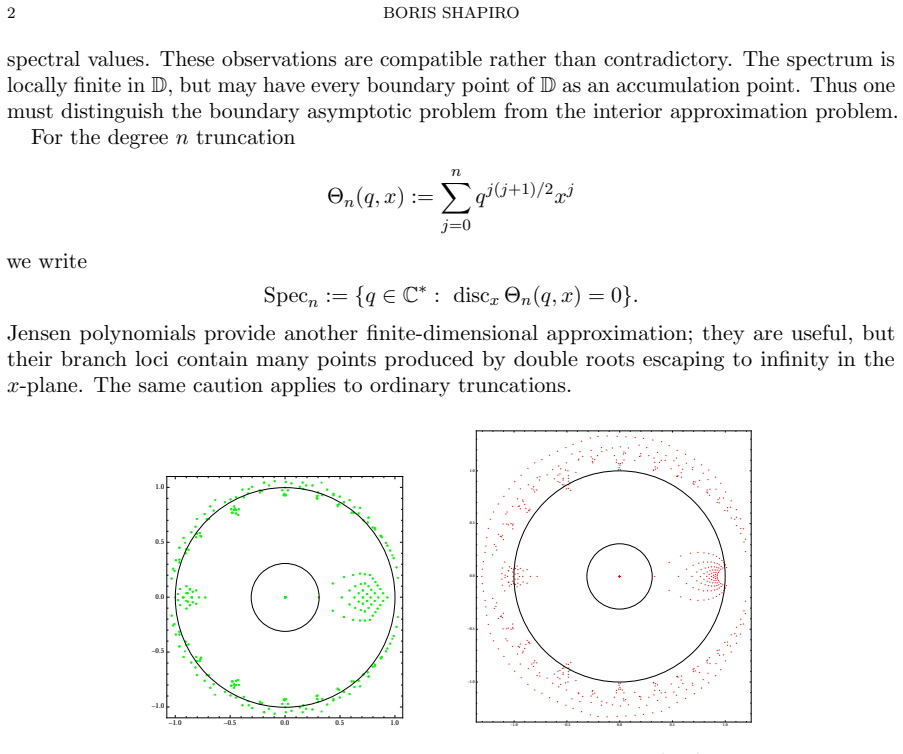
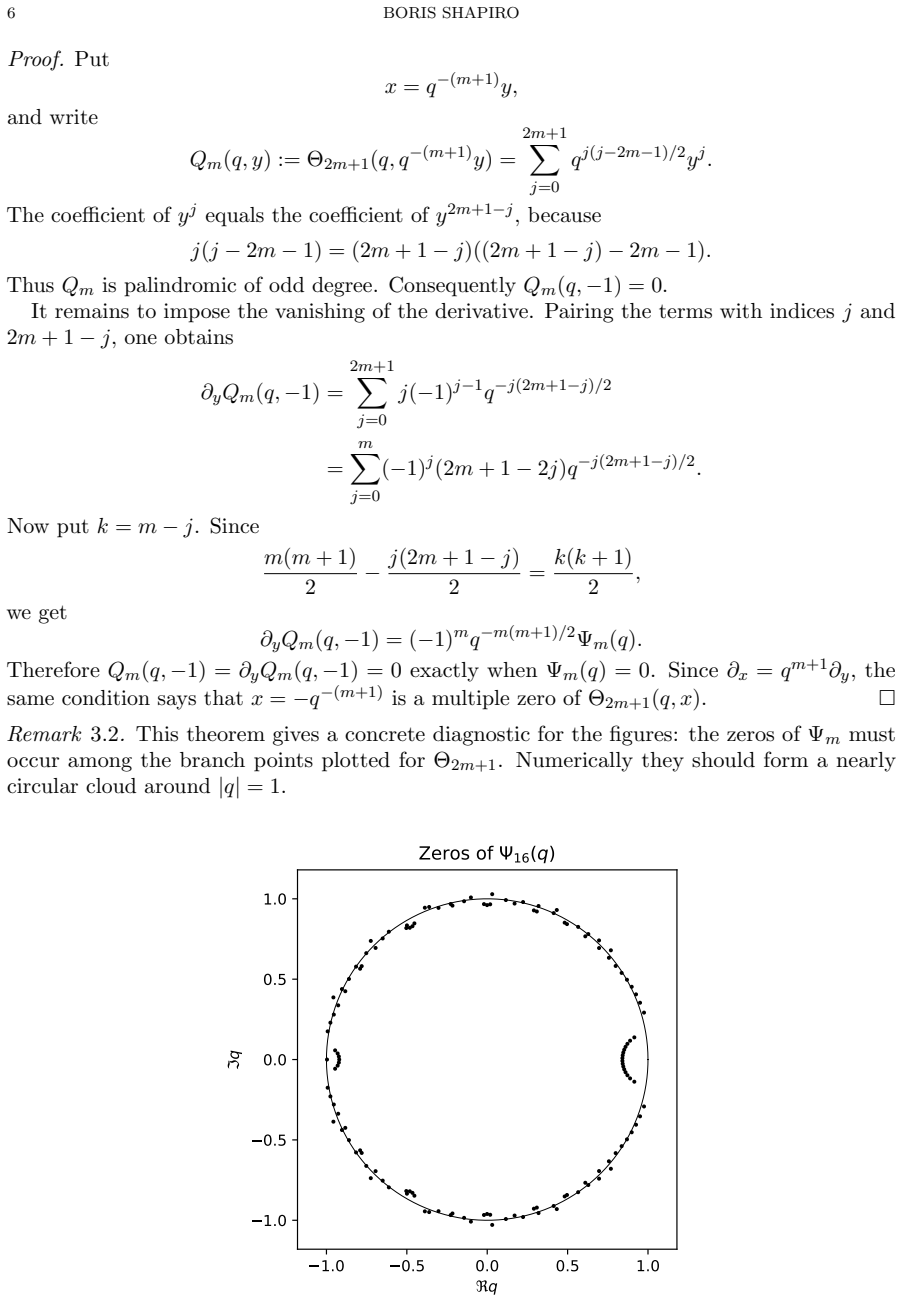
Every point of |q|=1 is an accumulation point of the spectrum. The proof uses explicit spectral factors of truncations, the Jacobi triple product, and a boundary-window lifting argument near roots of unity. Inside a fixed subdisk the true spectrum is locally finite and is separated from the larger branch loci of truncations and Jensen polynomials.
What carries the argument
The boundary-window lifting argument that transfers multiple zeros from explicit spectral factors of truncations to the partial theta function near roots of unity.
If this is right
- Every boundary point on |q|=1 is a limit point of spectral values.
- Inside any compact subset of a fixed subdisk |q|≤0.8 the spectrum consists of isolated points.
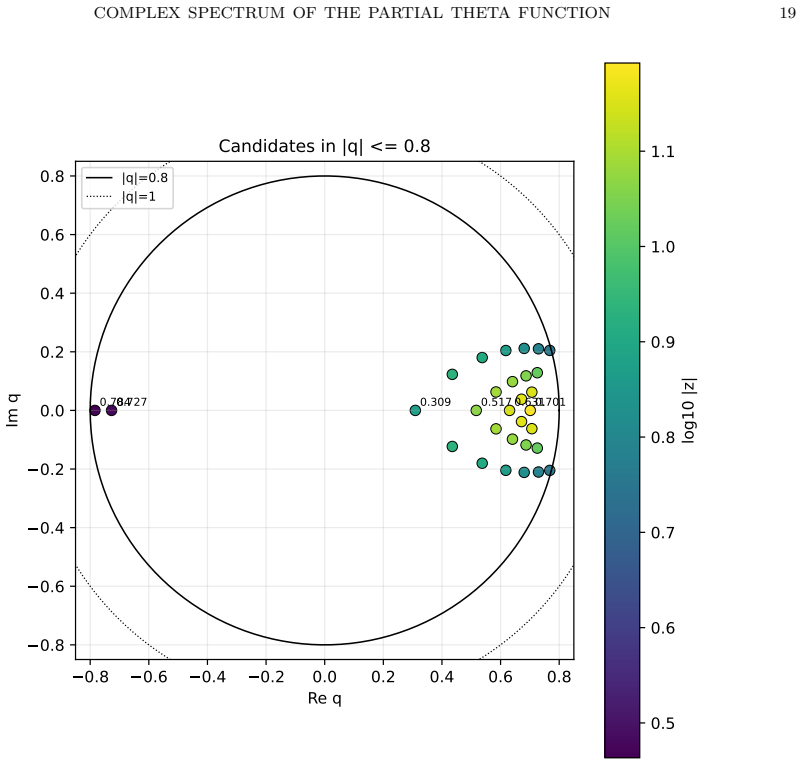
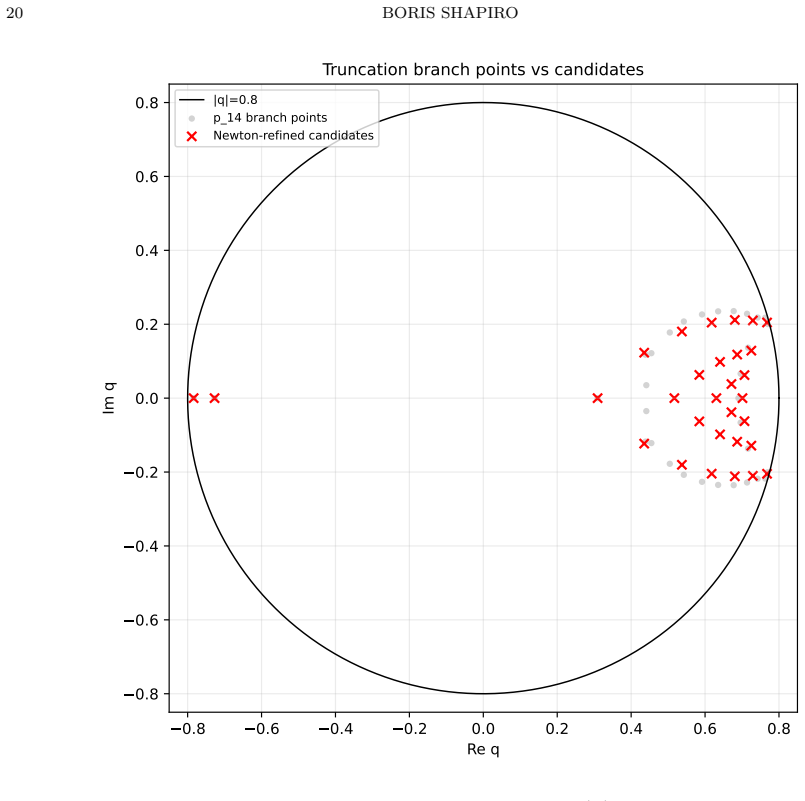
- Truncation-seeded Newton iteration produces candidate spectral values that can be refined to the true function.
- The caustic and escaping-root mechanism governs zero motion in the finite approximants.
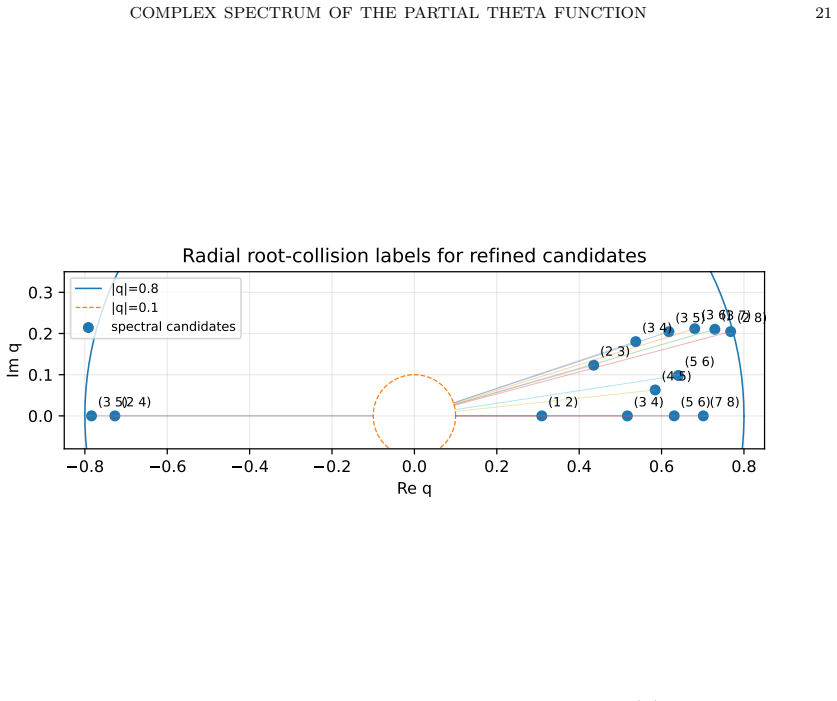
- Radial monodromy with the base-point convention yields consistent collision labels across the disk.
Where Pith is reading between the lines
- The accumulation at the boundary suggests that |q|=1 functions as a natural boundary for the distribution of multiple zeros.
- The numerical monodromy data may expose arithmetic or algebraic patterns among the spectral values that are not yet stated explicitly.
- The same truncation-plus-lifting approach could be tested on other partial sums of q-series to see whether boundary accumulation of multiple zeros is common.
Load-bearing premise
The truncations and their spectral factors remain sufficiently close to the infinite-sum function near the unit circle for the boundary-window lifting argument to transfer the multiple zeros.
What would settle it
An explicit point on |q|=1 together with a neighborhood containing no sequence of spectral values q_n inside the disk that approach it.
Figures
read the original abstract
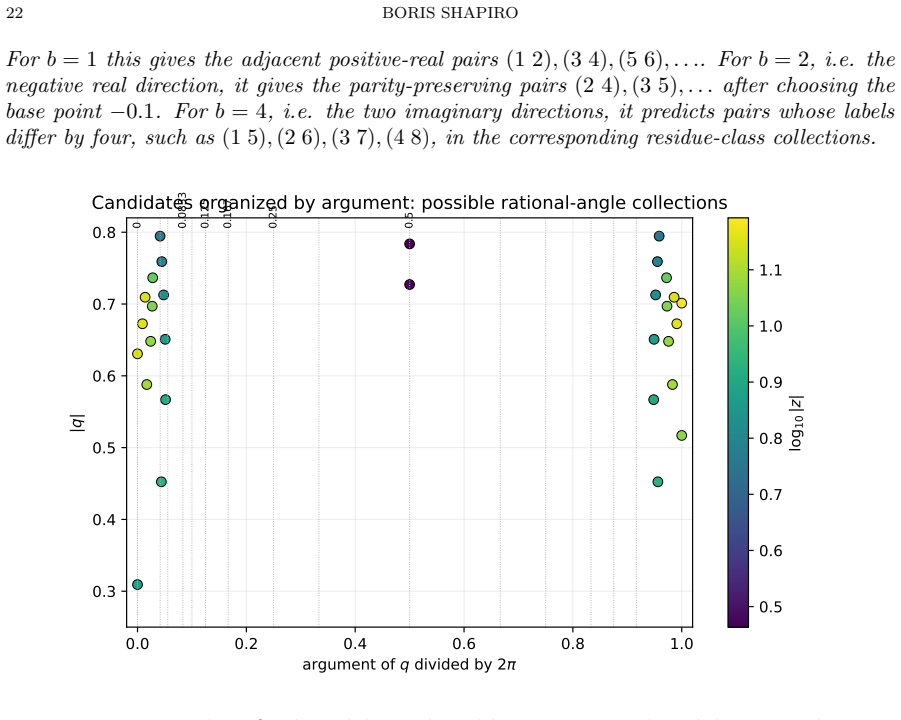
We study the complex spectrum of the partial theta function \[ \Theta(q,x)=\sum_{j=0}^{\infty}q^{j(j+1)/2}x^j, \qquad |q|<1, \] where a spectral value is a parameter for which \(\Theta(q,\cdot)\) has a multiple zero. Since the function is defined here only for \(|q|<1\), all spectral values are strictly inside the unit disk; boundary points on \(|q|=1\) occur only as accumulation points of the spectrum. The paper combines two complementary points of view. Near the unit circle we prove that every point of \(|q|=1\) is an accumulation point of the spectrum; the proof uses explicit spectral factors of truncations, the Jacobi triple product, and a boundary-window lifting argument near roots of unity. Inside a fixed subdisk, illustrated for \(|q|\leq 0.8\), the true spectrum is locally finite and must be separated carefully from the much larger branch loci of truncations and Jensen polynomials. We give a truncation-seeded Newton procedure which produces a discrete list of candidate spectral values, explain the caustic/escaping-root mechanism in finite approximants, and record numerical monodromy experiments using a radial convention: for a spectral point \(q_*\), roots are labelled at the point \(0.1q_*/|q_*|\) on the small circle and then continued along the straight radial segment to \(q_*\). This convention gives a coherent set of collision labels in the disk, treats negative real spectral values from the base point \(-0.1\), and leads to a preliminary rational-direction heuristic for radial monodromy.
Editorial analysis
A structured set of objections, weighed in public.
Referee Report
Summary. The paper studies the spectrum of the partial theta function Θ(q,x) = ∑_{j=0}^∞ q^{j(j+1)/2} x^j (|q|<1), where spectral values are those q for which Θ(q,·) has a multiple zero. The central claim is that every point of |q|=1 is an accumulation point of the spectrum inside the disk; the proof combines explicit spectral factors of finite truncations, the Jacobi triple product identity, and a boundary-window lifting argument near roots of unity. Inside the subdisk |q|≤0.8 the spectrum is asserted to be locally finite and is located numerically via a truncation-seeded Newton method together with radial monodromy tracking; the paper also describes caustic/escaping-root phenomena in the approximants.
Significance. If the accumulation-point theorem holds, the result would clarify the limiting zero distribution of this q-series on the natural boundary |q|=1 and supply a concrete mechanism (lifting from truncations) that could be useful for other lacunary series. The numerical procedure and monodromy convention provide a reproducible computational framework for locating interior spectral points. The explicit use of the Jacobi identity for the factors is a methodological strength.
major comments (2)
- [boundary-window lifting argument] Boundary-window lifting argument (near roots of unity, described after the Jacobi-triple-product construction): the transfer of multiple zeros from the explicit spectral factors of the truncations to Θ(q,x) requires that the remainder after N terms remains small enough in an N-independent window around each root of unity to preserve multiplicity. The standard remainder bound O(q^{N(N+1)/2} x^N / (1-|q|)) is not uniform as |q|→1^− inside such windows, and no modulus-of-continuity estimate for the zero loci under this perturbation is supplied. This step is load-bearing for the accumulation claim.
- [interior spectrum and numerical method] § on interior spectrum (|q|≤0.8): the separation of true spectral values from the branch loci of the truncations and Jensen polynomials is asserted to be possible, yet the numerical Newton procedure is seeded by the truncation zeros; without an a-priori radius of isolation or a rigorous error bound between truncation and limit zeros inside the subdisk, it is unclear whether all reported points are genuine multiple zeros of the infinite sum rather than artifacts of the approximants.
minor comments (2)
- [numerical monodromy experiments] The radial monodromy convention (labeling at 0.1 q_*/|q_*| and continuing along the straight segment) is clearly described but its effect on collision labels near the negative real axis should be illustrated with an explicit example.
- [truncation factors] Notation for the spectral factors of the truncations is introduced without a displayed formula; adding an equation number would aid cross-reference with the Jacobi-triple-product step.
Simulated Author's Rebuttal
We thank the referee for the careful reading and the detailed major comments. We respond point by point below.
read point-by-point responses
-
Referee: [boundary-window lifting argument] Boundary-window lifting argument (near roots of unity, described after the Jacobi-triple-product construction): the transfer of multiple zeros from the explicit spectral factors of the truncations to Θ(q,x) requires that the remainder after N terms remains small enough in an N-independent window around each root of unity to preserve multiplicity. The standard remainder bound O(q^{N(N+1)/2} x^N / (1-|q|)) is not uniform as |q|→1^− inside such windows, and no modulus-of-continuity estimate for the zero loci under this perturbation is supplied. This step is load-bearing for the accumulation claim.
Authors: We agree that the standard remainder estimate is not uniform in the windows and that an explicit modulus-of-continuity argument for the zero loci is required to complete the lifting step. In the revised manuscript we will supply such an estimate: inside a fixed angular window around each root of unity we apply Rouché’s theorem to the difference between the truncated factor (given by the Jacobi triple product) and the full partial theta function, controlling the perturbation uniformly for large N by exploiting the lacunary gap and a slightly smaller but still N-independent window radius chosen depending only on the root of unity. revision: yes
-
Referee: [interior spectrum and numerical method] § on interior spectrum (|q|≤0.8): the separation of true spectral values from the branch loci of the truncations and Jensen polynomials is asserted to be possible, yet the numerical Newton procedure is seeded by the truncation zeros; without an a-priori radius of isolation or a rigorous error bound between truncation and limit zeros inside the subdisk, it is unclear whether all reported points are genuine multiple zeros of the infinite sum rather than artifacts of the approximants.
Authors: The interior-spectrum section presents a computational procedure that produces candidate spectral values together with monodromy labels; the text already cautions that these must be distinguished from the branch loci of the approximants. We will revise the exposition to state explicitly that the listed points are numerical candidates whose genuineness is supported by observed quadratic convergence of the Newton iterates and by the radial-monodromy consistency, but that a rigorous a-priori isolation radius or error bound between truncation and limit zeros is not supplied. Such a bound lies outside the scope of the present work. revision: partial
Circularity Check
No circularity detected in derivation chain
full rationale
The paper defines the spectrum directly as parameters yielding multiple zeros of Θ(q,·). Its proof of accumulation on |q|=1 invokes the external Jacobi triple product identity plus newly constructed explicit spectral factors of finite truncations, followed by a boundary-window lifting argument. No equation reduces a claimed spectral value or accumulation result to a fitted input by construction, no self-citation supplies a load-bearing uniqueness theorem, and no ansatz is smuggled via prior work. The derivation therefore remains independent of its own outputs.
Axiom & Free-Parameter Ledger
axioms (2)
- standard math The Jacobi triple product identity holds and can be applied to the partial theta function.
- domain assumption Truncations of the series and their spectral factors approximate the infinite sum sufficiently well inside |q|<1 for the lifting argument to transfer multiple zeros.
Reference graph
Works this paper leans on
-
[1]
Craven and G
T. Craven and G. Csordas, Jensen polynomials and the Turan and Laguerre inequalities, Pacific J. Math. 136 (1989), 241–260
1989
-
[2]
Edrei, E
A. Edrei, E. B. Saff and R. S. Varga, Zeros of sections of power series, Lecture Notes in Mathematics, Vol. 1002, Springer, 1983
1983
-
[3]
Erd˝ os and P
P. Erd˝ os and P. Tur´ an, On the distribution of roots of polynomials, Ann. of Math. (2) 51 (1950), 105–119
1950
-
[4]
Forsg˚ ard, Notes on the partial theta function, unpublished notes, 2014
J. Forsg˚ ard, Notes on the partial theta function, unpublished notes, 2014
2014
-
[5]
Where not to find the spectrum of the partial theta function
Y. Gati and V. P. Kostov, Where not to find the spectrum of the partial theta function, preprint, arXiv:2605.29903
work page internal anchor Pith review Pith/arXiv arXiv
-
[6]
V. P. Kostov, Asymptotics of the spectrum of partial theta function, Rev. Mat. Complut. 27 (2014), 677–684
2014
-
[7]
V. P. Kostov, On the zeros of a partial theta function, Bull. Sci. Math. 137 (2013), 1018–1030
2013
-
[8]
V. P. Kostov, On the double zeros of the partial theta function, Publ. Math. Debrecen 90 (2017), 117–131
2017
-
[9]
V. P. Kostov and B. Shapiro, Hardy–Petrovitch–Hutchinson’s problem and partial theta function, Duke Math. J. 162 (2013), 825–861
2013
-
[10]
R. J. McIntosh, Some asymptotic formulae forq-shifted factorials, Ramanujan J. 3 (1999), 205–214
1999
-
[11]
A. D. Sokal, Roots of a formal power series, with applications to graph enumeration and q-series, lecture notes. Department of Mathematics, Stockholm University, Stockholm, S-10691, Sweden Email address:shapiro@math.su.se
discussion (0)
Sign in with ORCID, Apple, or X to comment. Anyone can read and Pith papers without signing in.