REVIEW 5 major objections 4 minor 35 references
Linearized Optimal Transport pyLOT Library: A Toolkit for Machine Learning on Point Clouds
T0 review · 5 major / 4 minor · reviewed 2026-08-09 · deepseek-v4-flash
Pith's one-line read This paper introduces pyLOT, a Python library that embeds point clouds into a Hilbert space via optimal transport maps, so that classification, clustering, dimension reduction, and generation reduce to linear operations.
desk verdict A software paper whose artifact isn't available and whose headline accuracy claim isn't tested, but with a genuinely useful iterative-barycenter demonstration buried inside. read the letter →
The pith
A machine-rendered reading of the paper's core claim, the machinery that carries it, and where it could break.
The reading
What carries the argument
The load-bearing object is the LOT embedding $\mu \mapsto T^\mu_\sigma$, where $T^\mu_\sigma$ is the optimal transport map from a fixed reference measure $\sigma$ to $\mu$, solved in practice as the barycentric projection of the discrete optimal transport plan. This map lives in $L^2(\sigma)$, so a point cloud becomes a vector; the Wasserstein manifold is replaced by its tangent space at $\sigma$, and distances become $\|T^{\mu_1}_\sigma - T^{\mu_2}_\sigma\|_{L^2(\sigma)}$. The second mechanism is the reference measure itself: starting from a Gaussian reference and iteratively replacing it with the LOT barycenter of the data moves the tangent space closer to the data, which the paper shows reduces relative barycenter error.
What would settle it
Take a point-cloud dataset whose classes differ by a transformation that violates the compatibility condition $h \circ T^\mu_\sigma = T^{h_\sharp\mu}_\sigma$ (for example, large rotations about a fixed axis), embed with a fixed Gaussian reference, and check whether linear classifiers on the LOT embeddings separate the classes. If accuracy is near chance while exact Wasserstein distances separate them, the reference-choice assumption fails.
Extended reading notes
Core claim
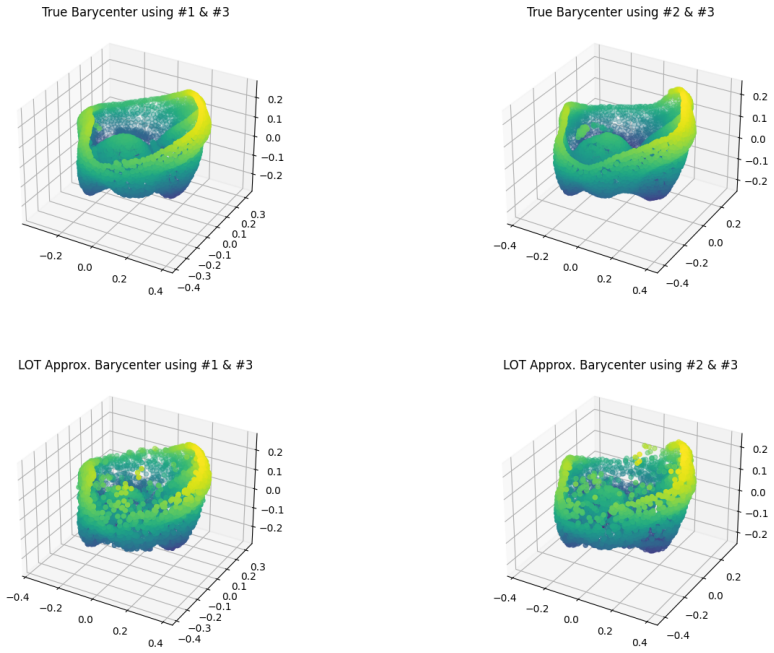
The central discovery is that replacing the Wasserstein distance with the $L^2(\sigma)$ distance between optimal transport maps — the LOT distance — preserves enough geometry for downstream linear methods to match the accuracy of full optimal transport at a fraction of the cost. Concretely, each tooth point cloud $\mu_i$ is mapped to the barycentric projection $T^{\mu_i}_\sigma$ of the optimal transport plan from a reference $\sigma$, and these maps are used as feature vectors. On the tooth dataset the LOT embeddings give high classification accuracy with KNN, linear SVM, and RBF SVM, and the LOT barycenter $\left(\sum_k w_k T^{(k)}\right)_\sharp x_r$ closely tracks the true Wasserstein barycenter, with relative error decreasing as the reference is iterated toward the data barycenter. The authors conclude that the LOT approach performs similarly to pure Wasserstein methods while being much faster.
Load-bearing premise
The fixed Gaussian reference, or the iterated barycenter reference, is close enough to the data that the LOT tangent-space embedding preserves the distances that matter for classification and barycenter approximation.
Editorial extensions
If this is right
- Any collection of point clouds of varying sample size can be registered to one reference and compared with Euclidean distances, so order-dependent matching between point sets is avoided.
- Linear classifiers, PCA, LDA, and linear barycenters become applicable to measure-valued data without training a neural network.
- The LOT barycenter approximates the true Wasserstein barycenter with relative error around 0.002–0.01 after two reference iterations on this dataset, at a small fraction of the computational cost.
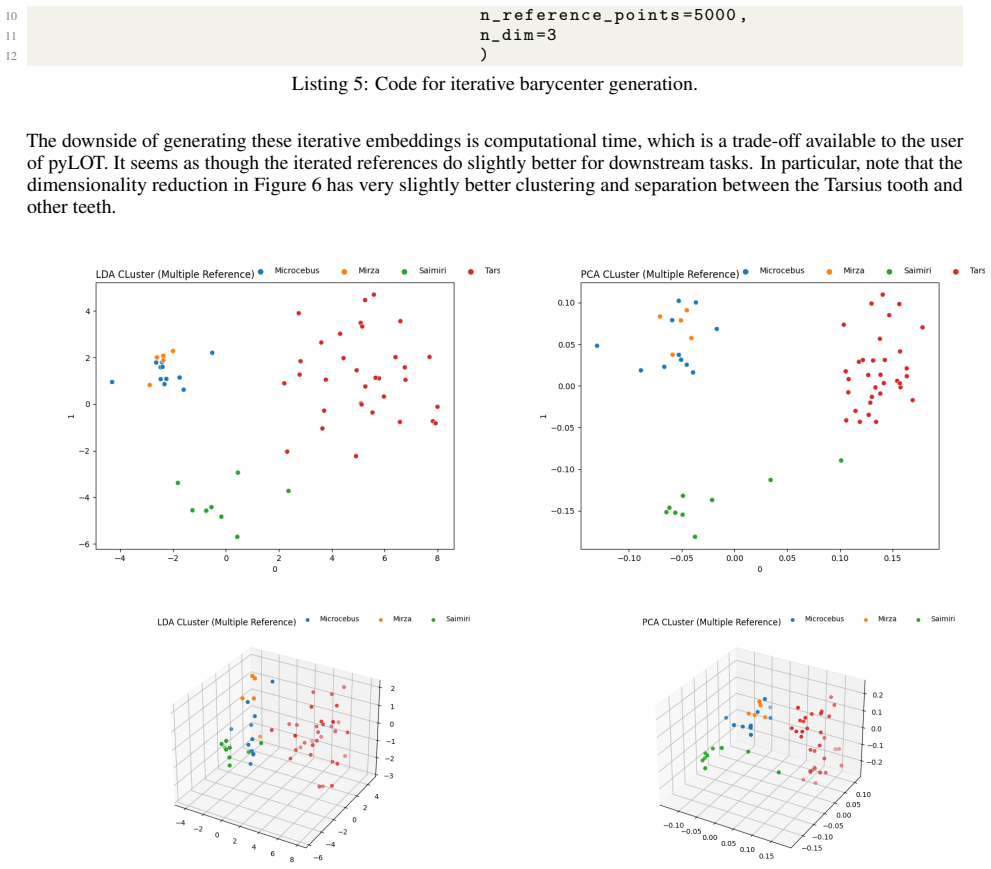
- Iterating the reference toward class barycenters improves downstream clustering and barycenter sharpness.
- Linear-program OT embeddings preserve sharp tooth features better than Sinkhorn embeddings for this data, so the choice of solver matters for feature-rich point clouds.
Reading between the lines
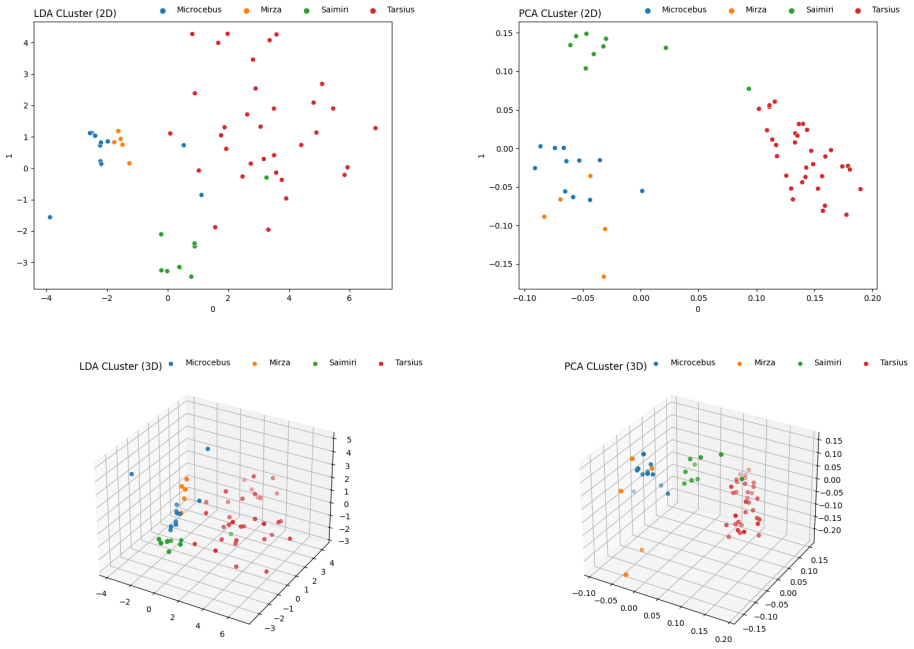
- Not in the paper: the near-perfect linear-SVM scores likely reflect the small 58-sample, oversampled setting; a larger multi-species dataset would test whether the accuracy persists or whether the reference choice degrades.
- Not in the paper: the sharp drop in relative error at iteration 2 in Table 6 suggests the iterated-barycenter reference is doing real geometric work, so one could test whether a few Sinkhorn iterations toward a reference achieve similar gains at lower cost than full LP solves.
- Not in the paper: because LOT embeds each point cloud by solving one OT problem per sample, the library should scale best when each point cloud is moderately sized; for very large point clouds the LP solver becomes the bottleneck, making the Sinkhorn path worth benchmarking against data with sharp features.
Editorial analysis
A structured set of objections, weighed in public.
Referee Report
Summary. The paper introduces pyLOT, a Python library for linearized optimal transport (LOT) embeddings, and demonstrates it on a dataset of 58 primate tooth point clouds. Sections 2 and 3 review standard OT and LOT background and then describe modules for embedding, dimensionality reduction, classification, barycenter generation, and iterative reference updates. The paper claims that LOT achieves accuracy comparable to 'pure Wasserstein' approaches at a fraction of the computational cost, and that iterative reference updates improve barycenter approximation.
Significance. If the computational and empirical claims are substantiated, the library could be a practically useful tool: LOT embeddings into L^2(σ) allow standard linear machine learning on measure-valued data, and the paper correctly situates this within the existing theory (Brenier's theorem, compatibility conditions, finite-sample concentration results). The exposition of the embedding and barycenter modules is clear, and the distinction between exact LP-based and Sinkhorn-based transport is well presented. However, the paper's central comparative claim is not directly tested, no code or data is made accessible, and the classification evaluation uses an oversampled 24-sample test set. The significance is therefore conditional on substantial empirical and reproducibility improvements.
major comments (5)
- [§1, §3.3.1, Tables 1-2] The abstract's central claim that LOT has 'similar accuracy with a fraction of the computational cost' is not tested: no classifier is run on the original point clouds using Wasserstein distances as the metric, so there is no Wasserstein classification baseline. The only runtime comparison in Table 3 concerns barycenter generation, not classification, and Tables 1-2 report accuracies of LOT-embedded features only. Please add a Wasserstein-distance baseline (e.g., kNN with pairwise W2 on the raw point clouds) and compare runtimes for the same downstream task.
- [§3.3.1, Tables 1-2] The reported classification results are based on a test set of 24 samples that was oversampled after the train/test split to equalize class sizes. This changes the evaluation distribution and can inflate accuracy, especially for a dataset with class sizes 5, 9, 11, and 33. The perfect Linear SVM score on the test set is acknowledged by the authors to be attributable to the small dataset, but the tables cannot be read as evidence for the abstract's comparative claim. Please report results on the original imbalanced test set, or use stratified cross-validation, and include per-class metrics with confidence intervals.
- [§1, §3.3.1 (Listings 1-5)] As a software paper, the manuscript does not provide a repository URL, commit hash, installation instructions, or a link to the tooth dataset. The code snippets in the listings are not sufficient to run the library or verify the reported numbers, and the dataset is described only by reference to prior work. Please include a DOI or repository URL and a documented release of the data preprocessing pipeline.
- [§3.4.2, Table 6] The 'relative error' metric δ in Section 3.4.2 is not a valid relative error: it normalizes the distance between the LOT barycenter and the true barycenter by the maximum pairwise Wasserstein distance among the LOT-embedded point clouds, a quantity that depends on the reference measure and changes across iterations. Consequently the decrease in the mean of δ from iteration 0 to iteration 2 in Table 6 may reflect a change in the denominator rather than an improvement in barycenter approximation. Please report the unnormalized W2 error to the true barycenter, or provide a normalization justified by a guaranteed upper bound.
- [§3.1.1, §3.5] The case study uses a single 5000-point Gaussian reference (Section 3.1.1) and the iterative scheme of Section 3.5, but no sensitivity analysis with respect to the reference distribution is reported. Since the paper itself emphasizes that the quality of the LOT embedding depends on the choice of σ (Section 2.2), the robustness of the reported classification accuracies and barycenter errors to the reference is load-bearing for the general usefulness of the library. Please add experiments with different references (e.g., varying variance, number of points, or an alternative reference such as one class's barycenter).
minor comments (4)
- [§2.1, Eq. (6) and surrounding notation] The notation for the transport plan constraints is inconsistent: Section 2.1 uses P1_m=α and P^T1_n=β with α∈R^k, β∈R^k, while Eq. (6) uses G1_n=a and G^T1_m=b with a∈Δ^m, b∈Δ^n. Please align the notation and dimensions.
- [Table 3] The reported 'True Barycenter' elapsed time of 408,835 seconds (about 4.7 days) seems implausibly large for a 58-sample dataset unless the algorithm is run at very high resolution; if this is a typo (e.g., milliseconds), please correct it and specify the computational environment.
- [§2.2] There are several typos, e.g., 'upmost importance' should be 'utmost importance', 'meausre-valued' should be 'measure-valued', and 'interpretted' should be 'interpreted'. Please proofread.
- [§3.5] The formula in the iterative-embedding description, '1/|Cc| ∑_{i∈Cc} T^(i) = min ...', is a definition rather than an equation to be minimized; please rewrite it so the barycenter is defined by an argmin expression.
Circularity Check
No significant circularity: pyLOT implements established LOT embeddings and barycenter updates; the unsupported accuracy comparison and test oversampling are evidence gaps, not circular steps.
full rationale
pyLOT is a software and case-study paper: the LOT embedding is defined by the standard optimal transport map construction (Eqs. 1, 8-10), and the iterative reference update is the known Wasserstein-barycenter fixed-point iteration from [14] and [33], explicitly credited in Sections 2.2 and 2.3.1. No parameter is fitted to a subset of the data and then renamed as a prediction: the reference measure is either a fixed Gaussian or updated through a stated algorithm, and post-embedding classifiers are evaluated on a held-out test set. The theoretical guarantees cited in Section 2.2 (Brenier's theorem, compatibility isometry from [13], concentration from [9], barycenter convergence from [14]) are published results with stated assumptions; although several are self-citations, under the review rules these are independent support and do not make the present claim circular. The abstract's comparative statement that LOT has 'similar accuracy with a fraction of the computational cost' is not actually tested against a Wasserstein-distance classifier, and Section 3.3.1 oversamples the test set before evaluation, which can inflate the reported accuracies. These are correctness/evidence limitations, not instances of a derivation reducing to its own inputs. No equation in the paper defines a target quantity in terms of the quantity it purports to predict, and no known result is presented as a new derivation without attribution. Therefore the circularity score is 0.
Assumptions & free parameters
free parameters (4)
- Reference measure (5000-point Gaussian) =
5000 points sampled from a Gaussian, later centered and scaled using the data
- Sinkhorn regularization lambda =
0.05
- Iteration count for iterative embeddings =
3
- Number of random weight draws M =
20
assumptions (4)
- standard math Brenier's theorem guarantees existence and uniqueness of optimal transport maps from absolutely continuous reference measures.
- domain assumption The Wasserstein space has a formal Riemannian structure and the LOT embedding behaves like a logarithm map locally near the reference measure.
- domain assumption The tooth point clouds satisfy (epsilon-)compatibility with the chosen reference measure, so the LOT embedding preserves class structure.
- standard math The iterative barycenter update converges to the true Wasserstein barycenter.
Cite this review
Pith. "Pith review of Linearized Optimal Transport pyLOT Library: A Toolkit for Machine Learning on Point Clouds." pith.science (2026). https://pith.science/paper/KBE2ENV3
@misc{pith2026250203439,
  author       = {Pith},
  title        = {Pith review of: Linearized Optimal Transport pyLOT Library: A Toolkit for Machine Learning on Point Clouds},
  year         = {2026},
  howpublished = {\url{https://pith.science/paper/KBE2ENV3}},
  note         = {Machine review of arXiv:2502.03439}
}
read the original abstract
The pyLOT library offers a Python implementation of linearized optimal transport (LOT) techniques and methods to use in downstream tasks. The pipeline embeds probability distributions into a Hilbert space via the Optimal Transport maps from a fixed reference distribution, and this linearization allows downstream tasks to be completed using off the shelf (linear) machine learning algorithms. We provide a case study of performing ML on 3D scans of lemur teeth, where the original questions of classification, clustering, dimension reduction, and data generation reduce to simple linear operations performed on the LOT embedded representations.
Figures


Figures from the paper (4 more)


Reference graph
Works this paper leans on
-
[1]
Learning representations and generative models for 3d point clouds, 2018
Panos Achlioptas, Olga Diamanti, Ioannis Mitliagkas, and Leonidas Guibas. Learning representations and generative models for 3d point clouds, 2018
work page 2018
-
[2]
Akram Aldroubi, Shiying Li, and Gustavo K. Rohde. Partitioning signal classes using transport transforms for data analysis and machine learning. Sampl. Theory Signal Process. Data Anal., 19(6), 2021
work page 2021
-
[3]
A User’s Guide to Optimal Transport, pages 1–155
Luigi Ambrosio and Nicola Gigli. A User’s Guide to Optimal Transport, pages 1–155. Springer Berlin Heidelberg, Berlin, Heidelberg, 2013
work page 2013
-
[4]
Wasserstein generative adversarial networks
Martin Arjovsky, Soumith Chintala, and Léon Bottou. Wasserstein generative adversarial networks. In Doina Precup and Yee Whye Teh, editors, Proceedings of Machine Learning Research, volume 70, pages 214–223. PMLR, 2017
work page 2017
-
[5]
Boyer, Yonatan Lipman, Elizabeth M
Doug M. Boyer, Yonatan Lipman, Elizabeth M. St Clair, Jorge Puente, Biren A. Patel, Thomas A. Funkhouser, and Jukka Jernvall. Algorithms to automatically quantify the geometric similarity of anatomical surfaces. Proceedings of the National Academy of Sciences, 108(45):18221–18226, 2011
work page 2011
-
[6]
Y . Brenier. Polar factorization and monotone rearrangement of vector-valued functions.Comm. Pure Appl. Math., 44(4):375–417, 1991
work page 1991
-
[7]
Approximating persistent homology for large datasets, 2022
Yueqi Cao and Anthea Monod. Approximating persistent homology for large datasets, 2022
work page 2022
-
[8]
Kung, Prabhjot Mundi, Joseph O
Yongxin Chen, Filemon Dela Cruz, Romeil Sandhu, Andrew L. Kung, Prabhjot Mundi, Joseph O. Deasy, and Allen Tannenbaum. Pediatric sarcoma data forms a unique cluster measured via the earth mover’s distance. Scientific Reports, 7(1):7035, 2017
work page 2017
Show all 35 references
-
[9]
Linearized wasserstein dimen- sionality reduction with approximation guarantees, 2023
Alexander Cloninger, Keaton Hamm, Varun Khurana, and Caroline Moosmüller. Linearized wasserstein dimen- sionality reduction with approximation guarantees, 2023
2023
-
[10]
Rates of estimation of optimal transport maps using plug-in estimators via barycentric projections
Nabarun Deb, Promit Ghosal, and Bodhisattva Sen. Rates of estimation of optimal transport maps using plug-in estimators via barycentric projections. Advances in Neural Information Processing Systems, 34:29736–29753, 2021
2021
-
[11]
The diffusion geometry of fibre bundles: Horizontal diffusion maps
Michael Gao. The diffusion geometry of fibre bundles: Horizontal diffusion maps. Applied and Computational Harmonic Analysis, 50:147–215, 2021. 21
2021
-
[12]
On Hölder continuity-in-time of the optimal transport map towards measures along a curve
Nicola Gigli. On Hölder continuity-in-time of the optimal transport map towards measures along a curve. Proceedings of the Edinburgh Mathematical Society, 54(2):401–409, 2011
2011
-
[13]
Supervised learning of sheared distributions using linearized optimal transport
Varun Khurana, Harish Kannan, Alexander Cloninger, and Caroline Moosmüller. Supervised learning of sheared distributions using linearized optimal transport. Sampling Theory, Signal Processing, and Data Analysis, 21(1), 2023
2023
-
[14]
Max Kuang and Esteban G. Tabak. Sample-based optimal transport and barycenter problems. Communications on Pure and Applied Mathematics, 72(8):1581–1630, 2019
2019
-
[15]
Kevrekidis, Joseph O
James Mathews, Maryam Pouryahya, Caroline Moosmüller, Ioannis G. Kevrekidis, Joseph O. Deasy, and Allen Tannenbaum. Molecular phenotyping using networks, diffusion, and topology: soft-tissue sarcoma. Scientific Reports, 9, 2019. Article number: 13982
2019
-
[16]
R. J. McCann. Polar factorization of maps on Riemannian manifolds. Geometric & Functional Analysis GAFA, 11(3):589–608, 2001
2001
-
[17]
Quantitative stability of optimal transport maps and linearization of the 2-Wasserstein space
Quentin Mérigot, Alex Delalande, and Frédéric Chazal. Quantitative stability of optimal transport maps and linearization of the 2-Wasserstein space. In Silvia Chiappa and Roberto Calandra, editors, Proceedings of the Twenty Third International Conference on Artificial Intellig...
2020
-
[18]
Linear Optimal Transport Embedding: Provable Wasserstein classification for certain rigid transformations and perturbations
Caroline Moosmüller and Alexander Cloninger. Linear Optimal Transport Embedding: Provable Wasserstein classification for certain rigid transformations and perturbations. To appear in: Information and Inference: A Journal of the IMA, 2022
2022
-
[19]
The geometry of dissipative evolution equations: The porus medium equation
Felix Otto. The geometry of dissipative evolution equations: The porus medium equation. Communications in Partial Differential Equations, 26(1-2):101–174, 2001
2001
-
[20]
Se Rim Park, Soheil Kolouri, Shinjini Kundu, and Gustavo K. Rohde. The cumulative distribution transform and linear pattern classification. Applied and Computational Harmonic Analysis, 45(3):616 – 641, 2018
2018
-
[21]
Computational optimal transport
Gabriel Peyré and Marco Cuturi. Computational optimal transport. Foundations and Trends in Machine Learning, 11(5-6):355–607, 2019
2019
-
[22]
Entropic estimation of optimal transport maps
Aram-Alexandre Pooladian and Jonathan Niles-Weed. Entropic estimation of optimal transport maps. arXiv:2109.12004, 2021
2021 arXiv
-
[23]
Qi, Hao Su, Kaichun Mo, and Leonidas J
Charles R. Qi, Hao Su, Kaichun Mo, and Leonidas J. Guibas. Pointnet: Deep learning on point sets for 3d classification and segmentation, 2017
2017
-
[24]
Qi, Li Yi, Hao Su, and Leonidas J
Charles R. Qi, Li Yi, Hao Su, and Leonidas J. Guibas. Pointnet++: Deep hierarchical feature learning on point sets in a metric space, 2017
2017
-
[25]
On a generalization of wasserstein distance and the beckmann problem to connection graphs, 2024
Sawyer Robertson, Dhruv Kohli, Gal Mishne, and Alexander Cloninger. On a generalization of wasserstein distance and the beckmann problem to connection graphs, 2024
2024
-
[26]
The earth mover’s distance as a metric for image retrieval
Yossi Rubner, Carlo Tomasi, and Leonidas J Guibas. The earth mover’s distance as a metric for image retrieval. International journal of computer vision, 40(2):99–121, 2000
2000
-
[27]
Wasserstein propagation for semi- supervised learning
Justin Solomon, Raif Rustamov, Leonidas Guibas, and Adrian Butscher. Wasserstein propagation for semi- supervised learning. In International Conference on Machine Learning, pages 306–314, 2014
2014
-
[28]
St Clair and Doug M
Elizabeth M. St Clair and Doug M. Boyer. Lower molar shape and size in prosimian and platyrrhine primates. American Journal of Physical Anthropology, 161(2):237–258, 2016
2016
-
[29]
Austin J. Stromme. Wasserstein barycenters: statistics and optimiztion. S.m. thesis, Massachusetts Institute of Technology, May 2020. Cataloged from the official PDF of thesis. Includes bibliographical references (pages 67-71)
2020
-
[30]
Optimal Transport: Old and New, volume 338
Cédric Villani. Optimal Transport: Old and New, volume 338. Springer Science & Business Media, 2008
2008
-
[31]
Ozolek, and Gustavo K
Wei Wang, Dejan Slepˇcev, Saurav Basu, John A. Ozolek, and Gustavo K. Rohde. A linear optimal transportation framework for quantifying and visualizing variations in sets of images. Int J Comput Vis, 101:254–269, 2013
2013
-
[32]
Sarma, Michael M
Yue Wang, Yongbin Sun, Ziwei Liu, Sanjay E. Sarma, Michael M. Bronstein, and Justin M. Solomon. Dynamic graph cnn for learning on point clouds, 2019
2019
-
[33]
Matthew Werenski, Brendan Mallery, Shuchin Aeron, and James M. Murphy. Linearized wasserstein barycenters: Synthesis, analysis, representational capacity, and applications, 2024
2024
-
[34]
Deep sets
Manzil Zaheer, Satwik Kottur, Siamak Ravanbakhsh, Barnabás Póczos, Ruslan Salakhutdinov, and Alexander Smola. Deep sets. In Advances in Neural Information Processing Systems (NeurIPS), volume 30, 2017. 22
2017
-
[35]
Understanding bag-of-words model: a statistical framework
Yin Zhang, Rong Jin, and Zhi-Hua Zhou. Understanding bag-of-words model: a statistical framework. Interna- tional Journal of Machine Learning and Cybernetics, 1(1-4):43–52, 2010. 23
2010
Reviewed August 9, 2026 · model on record in the stance chip above.
Discussion (0). Continue with ORCID to comment.