REVIEW 3 major objections 5 minor 13 references
Design and performance of a UV-calibration device for the SPICEcore hole
T0 review · 3 major / 5 minor · reviewed 2026-08-14 · deepseek-v4-flash
Pith's one-line read Timing backscattered 278 nm photons in a 1751 m South Pole borehole yields in-situ ice scattering and absorption lengths of 65 cm and 40 m.
desk verdict Honest instrumentation proceedings with a genuinely new 278 nm in-situ ice-optic data point, but the quoted scattering/absorption numbers are preliminary and need systematic treatment before being used. read the letter →
The pith
A machine-rendered reading of the paper's core claim, the machinery that carries it, and where it could break.
The reading
What carries the argument
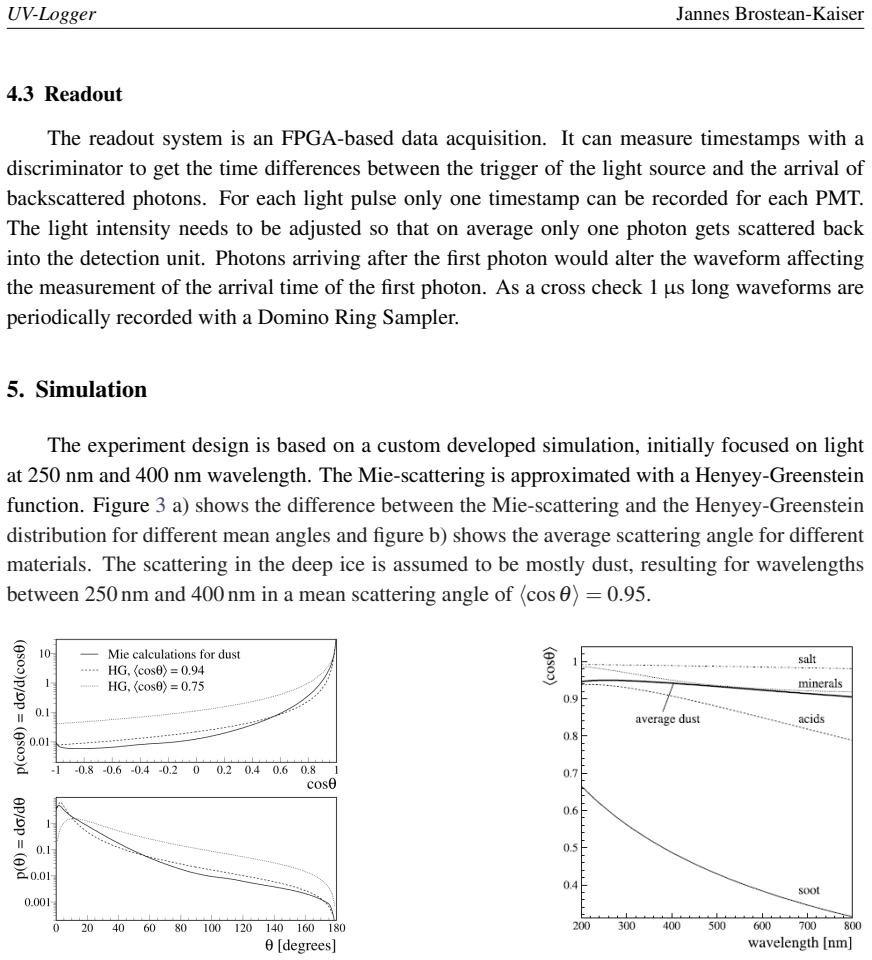
The central object is the UV logger itself: a quartz-glass probe carrying a pulsed LED behind a semi-transparent integrating sphere and a slit that forms a flat fan beam, and a detector made of wavelength-shifting rods coupled to photomultipliers. Each rod is a 50 cm, 2 cm diameter tube coated with paint that absorbs 250-400 nm light and re-emits around 420 nm; total internal reflection guides the re-emitted light to a PMT. The analysis is carried by a Monte Carlo simulation of photon propagation in ice with a Henyey-Greenstein scattering model (mean cosine 0.95), and by a binned maximum-likelihood chi-square comparison that scans scattering length, absorption length, and a 90-95 ns trigger-to-DAQ time offset. The mechanism works because the rising edge of the arrival-time distribution is dominated by scattering and the falling edge by absorption, so the pair can be fit from one timing curve.
What would settle it
Measure the 278 nm absorbance of the actual borehole fluid in a laboratory cell; if its absorption length is near or below 40 m, the quoted ice absorption length is contaminated by fluid attenuation, and if it is many hundreds of meters, the ice-only reading stands.
Extended reading notes
Core claim
The paper's central claim is that a single arrival-time distribution of backscattered 278 nm photons, recorded at 1056 m depth, is enough to fix both the scattering and absorption lengths of the surrounding ice: the smallest chi-square against Monte Carlo simulations occurs for a scattering length of 65 cm and an absorption length of 40 m, with a trigger-to-DAQ offset of 92 ns. Because this was the first campaign in which the wavelength-shifting detector segments saw light, the measurement doubles as a proof of principle for the UV-logger concept and, on the paper's terms, gives the first in-situ UV optical-property estimate in the deep borehole.
Load-bearing premise
The fit assumes ice scatters as a Henyey-Greenstein medium with mean cosine 0.95 and ignores transmission and refraction by the borehole fluid, so the quoted 65 cm and 40 m values are only as good as those two assumptions and the scanned 92 ns time offset.
Editorial extensions
If this is right
- If the fitted values are right, simulations of the new wavelength-shifting optical module can use measured UV ice parameters instead of extrapolations from visible-wavelength data.
- The detection of backscattered 278 nm photons through wavelength-shifting rods confirms the rod-based detector concept works in a real borehole.
- The absence of detected backscatter at 1475 m and 1560 m implies the source must be brighter for deeper deployments, which the planned redesign addresses by removing the integrating sphere.
- The separation of the timing curve into a scattering-dominated rise and an absorption-dominated fall means a future run with better time resolution can constrain the two lengths more independently.
- The planned multi-wavelength campaign (250, 255, 278, 310, 370 nm) would extend the measurement into a UV spectrum, allowing the wavelength-scaling formulas used in this analysis to be tested.
Reading between the lines
- The 40 m absorption length is best interpreted as an effective value for ice plus the borehole antifreeze fluid; if that fluid absorbs 278 nm light, the true ice absorption length would be longer than 40 m.
- The 92 ns time offset was chosen by scanning, and the fit's chi-square is dominated by the first 10 ns; an independent measurement of that offset would be the quickest way to sharpen the scattering-length result.
- If the assumed Henyey-Greenstein mean cosine of 0.95 is wrong, the fitted 65 cm scattering length would trade off against the true angular distribution; a second, differently oriented detector or a laboratory angular-scattering measurement could break that degeneracy.
- The failed direct-detection segments were meant to capture the rising edge without wavelength-shifter time blur; getting them working would provide a nearly independent check of the 65 cm value.
Signed reviews
Editorial analysis
A structured set of objections, weighed in public.
Referee Report
Summary. The paper reports the design, deployment, and first data analysis of a UV-calibration device ("UV logger") built for the SPICEcore hole at the South Pole. The device uses a 278 nm LED and wavelength-shifting rods coupled to PMTs to detect backscattered UV photons; the authors compare the measured arrival-time distribution to a Monte Carlo simulation and find a best-fit scattering length of 65 cm and absorption length of 40 m at 1056 m depth. Sections 1 through 5 cover the WOM context, ice properties, the SPICEcore hole, hardware details, and the simulation framework; Section 6 describes the measurements; Section 7 presents the binned maximum-likelihood fit; Section 8 outlines planned improvements.
Significance. The measurement, if robust, would be the first in-situ estimate of UV scattering and absorption lengths in the SPICEcore hole and would directly inform the design of the WOM for IceCube Upgrade. The manuscript is a candid and detailed engineering description: it gives component-level hardware information, states simulation simplifications explicitly, and presents a reproducible comparison to data. The main numerical result, however, is preliminary because it is obtained from a Monte Carlo model that omits transmission through the Estisol borehole fluid and ray tracing, with a fitted time offset that was not directly measured, and no statistical or systematic uncertainties are reported. The value of the paper is therefore primarily as a demonstration of the device concept; the quantitative ice-optic claims need additional support.
major comments (3)
- [Sections 5 and 7] The best-fit values of ls=65 cm and la=40 m are obtained from a Monte Carlo simulation that, as stated in Section 5, does not implement transmission through Estisol or ray tracing. Because the source and detector are inside an Estisol-filled borehole, any UV absorption or refraction by Estisol will distort the arrival-time PDF; without a quantitative estimate of this effect, the quoted values are not robust. The manuscript should either include Estisol transmission and ray tracing in the simulation or clearly label the result as a preliminary demonstration with a conservative systematic band.
- [Section 7, Eq. (7.1)] The time offset between the data-acquisition trigger and the light-source trigger was not measured directly but was scanned from 90 ns to 95 ns. The rising edge, which is the most scattering-sensitive part of the PDF, is only a few nanoseconds wide; the fitted scattering length is therefore degenerate with this offset. The authors should report how the fitted (ls, la) pair varies over the allowed offset range or marginalize over the offset in the fit.
- [Section 7, Figure 6] The analysis reports only the location of the minimum of the chi2/dof surface and provides no confidence intervals for the two fitted parameters. For a quantitative claim of ls=65 cm and la=40 m, the statistical uncertainty should be extracted from the chi2 surface (e.g., Delta-chi2 contours), and the main systematic uncertainties should be propagated.
minor comments (5)
- [Section 5] The word "implimented" should be spelled "implemented."
- [Section 1] The name "Cherekenkov" should be spelled "Cherenkov."
- [Eq. (7.1)] The term ai*Nd/Nd in the numerator appears to be a typo; the intended term is ai*Nd/Na, since otherwise the numerator reduces to di - ai without any normalization by the total numbers of events.
- [Figure 5 caption] The phrase "the the calculated PDF" contains a duplicated article; it should read "the calculated PDF" or "the measured PDF."
- [Section 4.2] The phrase "measure only photons down to 300 nm wavelength" is ambiguous; the intended meaning is likely "measure only photons with wavelength above 300 nm."
Circularity Check
No significant circularity: the SPICEcore UV ice-optic values are an empirical fit, not a derivation from their own inputs.
full rationale
The paper's central quantitative result, the 65 cm scattering length and 40 m absorption length at 278 nm and 1056 m depth, is obtained by comparing the measured photon arrival-time distribution to Monte Carlo simulations and finding the minimum chi2 over a scanned grid of parameters. This is an empirical fit, not a derivation that reduces to its inputs by construction. No equation in the paper defines the fitted scattering or absorption length in terms of the measured distribution without Monte Carlo comparison, and no fitted parameter is renamed as a prediction. The trigger-to-DAQ time offset is explicitly treated as a nuisance parameter, varied from 90 ns to 95 ns and fixed at 92 ns after fitting; it is not a claimed physical result. The simulation inputs taken from prior literature, such as the Henyey-Greenstein mean cosine of 0.95 and the 400 nm absorption/scattering lengths from reference [6], are used to generate comparison templates, but the final fit scans scattering lengths from 25 cm to 300 cm and absorption lengths from 25 m to 250 m, so the quoted values are not forced by those inputs. The detection of backscattered 278 nm photons through wavelength-shifting rods is a direct measurement and is independent of the Monte Carlo model. The stated omissions of Estisol transmission and ray tracing in the simulation, and the unmeasured time offset, are model limitations and systematic uncertainties rather than circular reasoning. Self-citations to IceCube/AMANDA results provide background optical parameters and are not load-bearing restrictions on the fit outcome. Therefore no significant circularity is present.
Assumptions & free parameters
free parameters (3)
- time_offset =
92 ns (scanned 90-95 ns)
- absorption_length_278nm =
40 m
- scattering_length_278nm =
65 cm
assumptions (4)
- domain assumption Henyey-Greenstein approximation with <cos theta> = 0.95 describes UV scattering in deep South Pole ice
- domain assumption Estisol 140 transmission and refraction can be ignored
- domain assumption Optical parameters and wavelength scaling formulas from [6] are valid for 250-400 nm
- domain assumption Wavelength-shifting paint delay can be approximated by a randomized offset of several ns
Cite this review
Pith. "Pith review of Design and performance of a UV-calibration device for the SPICEcore hole." pith.science (2026). https://pith.science/paper/KBEWPRHS
@misc{pith2026190810728,
  author       = {Pith},
  title        = {Pith review of: Design and performance of a UV-calibration device for the SPICEcore hole},
  year         = {2026},
  howpublished = {\url{https://pith.science/paper/KBEWPRHS}},
  note         = {Machine review of arXiv:1908.10728}
}
read the original abstract
The IceCube Neutrino Observatory will be upgraded in 2022/23. For this IceCube Upgrade and the planned enlarged detector IceCube-Gen2 new optical modules are under development. One of these optical modules, the Wavelength-shifting Optical Module (WOM), uses wavelength-shifting and light-guiding techniques to measure Cherenkov photons in the UV-range. To understand the potential improvements of this new module the absorption and scattering lengths of UV light in the South Pole ice need to be measured. The measurement is done utilizing an existing borehole (SPICEcore) of 1751 m depth. The SPICEcore hole was drilled for glaciological studies and filled with a transparent antifreeze liquid to remain accessible. To measure the UV optical properties a calibration device has been designed and lowered down into the hole. The device includes a UV light source and a UV-sensitive detector. UV photons scattered back are measured and from their time distribution the scattering and absorption length are calculated. We present the design of the probe and its performance during the 2018/19 measurement campaign.
Figures


Figures from the paper (3 more)


Reference graph
Works this paper leans on
-
[1]
IceCube Collaboration, M. G. Aartsen et al., JINST 12 (2017) 3012
work page 2017
-
[2]
IceCube Collaboration, PoS(ICRC2019)1031 (these proceedings)
-
[3]
IceCube Collaboration, M. G. Aartsen et al., arXiv:1412.5106
-
[4]
IceCube Collaboration, PoS(ICRC2017)1052 (2017)
work page 2017
-
[5]
D. Hebecker, Development of a single photon detector with wavelength shifting and light guiding technology, Master’s thesis, Universität Bonn, 2014
work page 2014
-
[6]
Ackermann et al., JGR 111 (2006)
IceCube Collaboration, M. Ackermann et al., JGR 111 (2006)
work page 2006
- [7]
-
[8]
A. P. Minton, JPC 75 (1971) 1162–1164
work page 1971
Show all 13 references
-
[9]
K. A. Casey et al., Annals of Glaciology 55 (1971) 137–146
1971
-
[10]
IceCube Collaboration, PoS(ICRC2019)983 (these proceedings)
-
[11]
IceCube Collaboration, PoS(ICRC2019)926 (these proceedings)
-
[12]
IceCube Collaboration, PoS(ICRC2019)908 (these proceedings)
-
[13]
Barlow, PCP 77 (1993) 219–228
B. Barlow, PCP 77 (1993) 219–228. 8
1993
Reviewed August 14, 2026 · model on record in the stance chip above.
Discussion (0). Continue with ORCID to comment.