Fast Adiabatic Quantum Gates via Hyperfine Intermediate States
Pith reviewed 2026-06-27 09:41 UTC · model grok-4.3
The pith
Hyperfine intermediate states accelerate adiabatic CNOT gates to 0.39 microseconds while maintaining fidelity above 0.9991 in cesium atoms.
A machine-rendered reading of the paper's core claim, the machinery that carries it, and where it could break.
Core claim
The central claim is that an electromagnetically induced transparency-based adiabatic CNOT gate can harness appropriately chosen atomic hyperfine intermediate states to enhance adiabaticity in the STAY pathway and accelerate population transfer in the TRANSFER pathway, yielding gate fidelities exceeding 0.9991 within 0.3903 microseconds in realistic Cs atomic setups; the protocol remains effective when extended to multiple hyperfine states and their decays.
What carries the argument
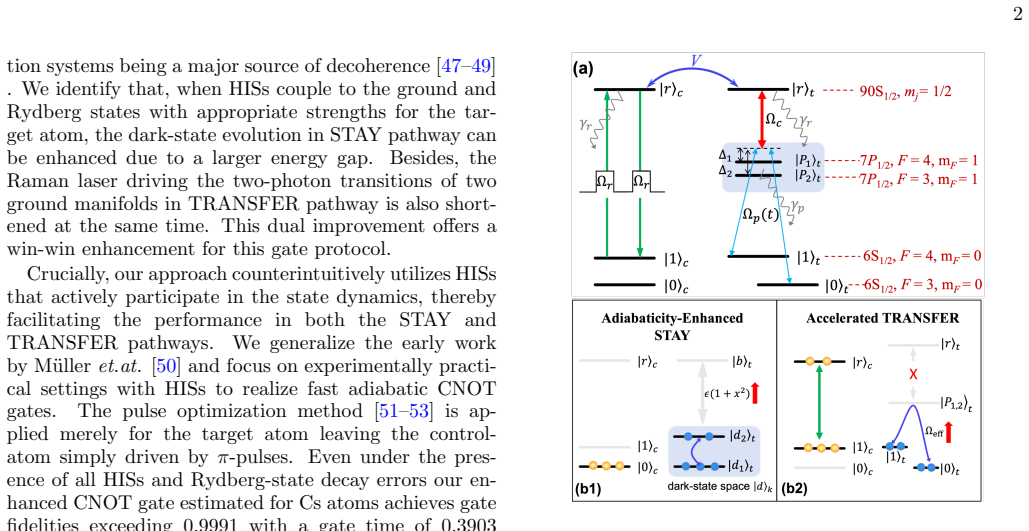
Hyperfine intermediate states (HISs) in the two-photon EIT transitions, employed to modify the STAY and TRANSFER pathways of the adiabatic protocol.
If this is right
- Adiabatic quantum operations become short enough to fit inside typical qubit coherence times.
- The protocol supplies a concrete route to fast, robust gates in Rydberg-atom platforms.
- The same HIS-assisted construction applies when the model is enlarged to an arbitrary number of intermediate states.
- Pulse-optimized adiabatic CNOT gates retain their tolerance to technical imperfections while running faster.
Where Pith is reading between the lines
- The same pathway modification might be tested on other atomic species that possess analogous hyperfine structure.
- Integration with existing Rydberg blockade techniques could produce faster multi-qubit adiabatic circuits.
- The optimization method may suggest pulse shapes for other adiabatic quantum-control tasks that currently face speed limits.
- If the fidelity holds under additional noise sources, the approach could reduce the overhead required for error-corrected adiabatic algorithms.
Load-bearing premise
Selected hyperfine intermediate states can improve adiabaticity and speed transfer without producing decay errors large enough to destroy the gate performance under realistic laboratory conditions.
What would settle it
An experiment that implements the optimized pulses on Cs atoms, includes the chosen hyperfine states, and measures whether the resulting CNOT fidelity stays above 0.999 while total operation time remains near 0.39 microseconds.
Figures
read the original abstract
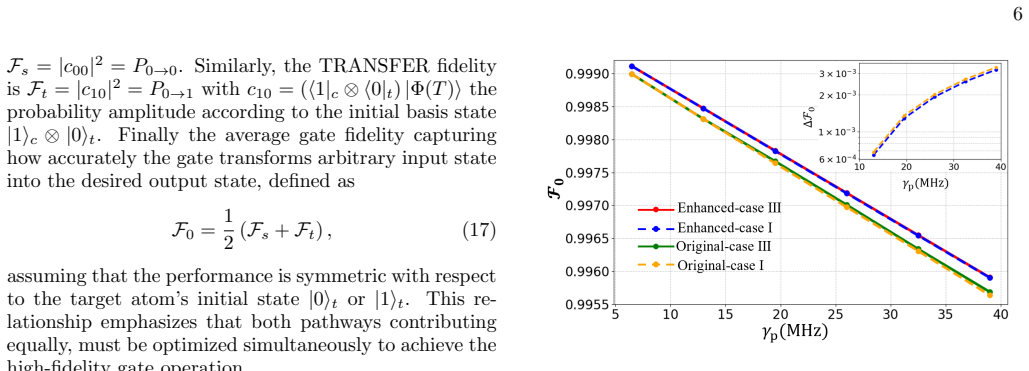
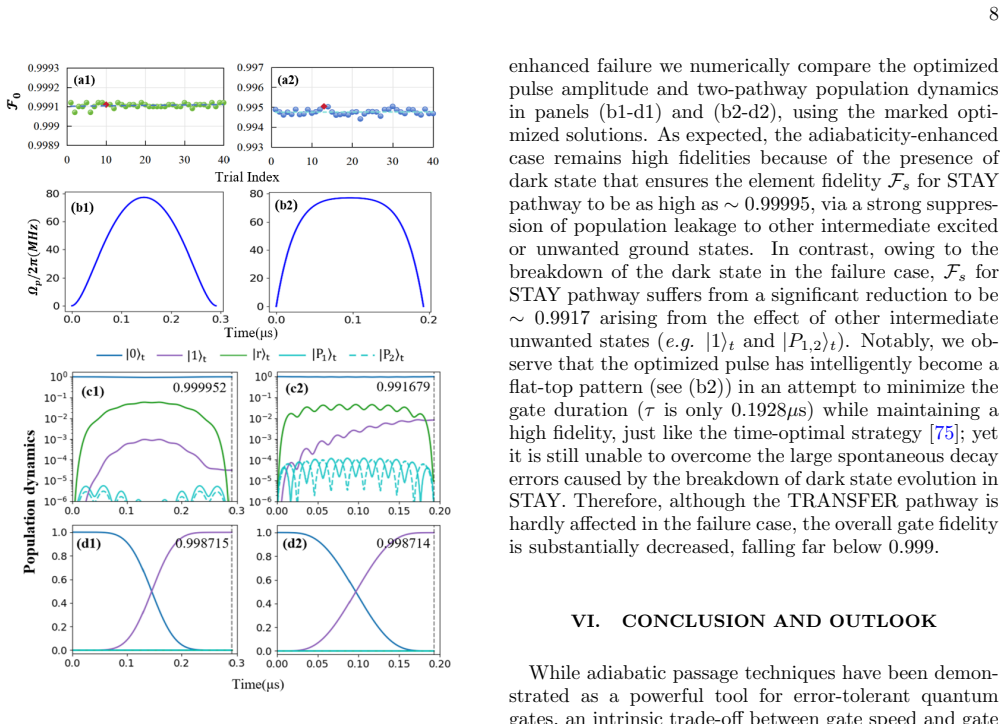
The appeal of adiabatic quantum computing lies in its intrinsic robustness against various technical imperfections, making it attractive for many quantum information applications. However, it faces a fundamental challenge: accelerating the adiabatic operations while preserving adiabaticity within the qubit coherence time. In this article, we propose an electromagnetically induced transparency-based adiabatic CNOT gate protocol which harnesses atomic hyperfine intermediate states (HISs) to speed up the adiabatic evolution. The HISs, naturally-existed in two-photon transitions, often need to be suppressed due to their significant decay errors. In contrast, this paper introduces a novel method that utilizes appropriately chosen HISs not only to enhance the adiabaticity in STAY pathway but also to accelerate the population transfer in TRANSFER pathway. Through pulse optimization, we achieve adiabatic gate fidelities exceeding 0.9991 within 0.3903 {\mu}s in realistic Cs atomic setups. To demonstrate the generality of protocol we further assess the impact of decays from multiple HIS and extend our model to arbitrary number of states, providing a practical route toward fast and robust adiabatic quantum gates in Rydberg-atom platforms.
Editorial analysis
A structured set of objections, weighed in public.
Referee Report
Summary. The manuscript proposes an electromagnetically induced transparency (EIT)-based adiabatic CNOT gate protocol for Rydberg-atom platforms that deliberately incorporates hyperfine intermediate states (HISs) in two-photon transitions. The central claim is that suitably chosen HISs can simultaneously enhance adiabaticity along the STAY pathway and accelerate population transfer along the TRANSFER pathway; pulse optimization then yields gate fidelities exceeding 0.9991 in 0.3903 μs under realistic cesium conditions. The work further examines decay contributions from multiple HISs and generalizes the model to an arbitrary number of states.
Significance. If the reported fidelities are supported by the underlying numerics, the protocol would address a long-standing tension in adiabatic quantum computing by shortening gate times while preserving robustness, thereby offering a concrete route toward practical high-fidelity adiabatic operations in existing Rydberg hardware. The explicit use of decay-prone HISs as a resource rather than a liability is a distinctive conceptual contribution.
minor comments (2)
- [Abstract] Abstract: the numerical values 0.9991 and 0.3903 μs are stated with four significant figures; the main text should explicitly link these figures to the optimization procedure (e.g., the cost function, convergence criteria, and ensemble of initial conditions) so that readers can assess reproducibility.
- The generalization to an arbitrary number of states is mentioned; a compact statement of the scaling of the effective Hamiltonian or the computational cost of the optimization with state number would strengthen the claim of generality.
Simulated Author's Rebuttal
We thank the referee for the positive assessment of our work on the EIT-based adiabatic CNOT protocol using hyperfine intermediate states and for recommending minor revision. No specific major comments were raised in the report.
Circularity Check
No significant circularity detected
full rationale
The paper's central claim rests on numerical pulse optimization results for an EIT-based adiabatic CNOT protocol in Cs atoms, with reported fidelities >0.9991 in 0.3903 μs obtained by simulating the dynamics under realistic conditions while incorporating decay from chosen hyperfine intermediate states. No derivation step reduces by construction to its own inputs: the protocol is defined via the Hamiltonian and optimization objective, the fidelities are computed outputs rather than fitted parameters renamed as predictions, and no load-bearing uniqueness theorem or ansatz is imported via self-citation. The extension to multiple HIS and arbitrary state numbers is presented as a direct numerical assessment, keeping the result self-contained against external benchmarks.
Axiom & Free-Parameter Ledger
axioms (1)
- domain assumption Hyperfine intermediate states can be chosen to simultaneously enhance adiabaticity and accelerate transfer without prohibitive decay.
Reference graph
Works this paper leans on
-
[1]
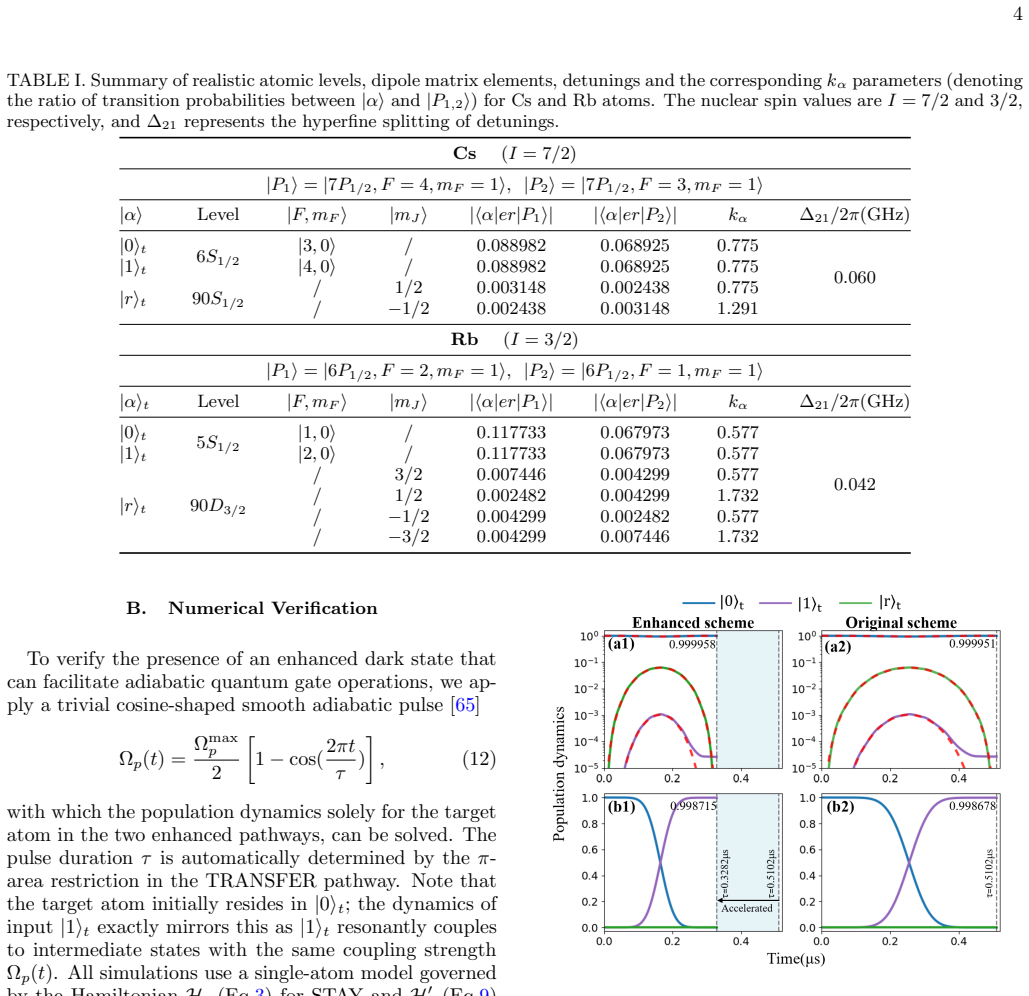
This enhancement leads to a substantial reduction in the pulse durationτ, as theπ-pulse area conditionR τ 0 dtΩeff =πmust be satisfied. A direct comparison between Fig.2(b1) and (b2) explicitly demonstrates the advantage of our scheme which achieves a much shorter pulse durationτ≈0.3282µs compared to the original duration (τ≈0.5102µs) while preserving a h...
-
[2]
the STAY-pathway fidelity reaches as high as 0.99997 mainly due to the increased adiabaticity (∝µ) for the dark state evolution. Meanwhile, the optimized gate du- ration becomes even shorter asNincreases, consistent with the effective two-photon Rabi frequency analysis for TRANSFER pathway that is alsok-dependent. This fact indicates that our protocol eff...
-
[3]
Bacon and S
D. Bacon and S. T. Flammia, Adiabatic gate teleporta- tion, Phys. Rev. Lett.103, 120504 (2009)
2009
-
[4]
I. I. Beterov, M. Saffman, E. A. Yakshina, D. B. Tretyakov, V. M. Entin, S. Bergamini, E. A. Kuznetsova, and I. I. Ryabtsev, Two-qubit gates using adiabatic pas- sage of the stark-tuned f¨ orster resonances in rydberg atoms, Phys. Rev. A94, 062307 (2016)
2016
-
[5]
Frees, S
A. Frees, S. Mehl, J. K. Gamble, M. Friesen, and S. N. Coppersmith, Adiabatic two-qubit gates in capacitively coupled quantum dot hybrid qubits, npj Quantum Infor- mation5, 73 (2019)
2019
-
[6]
Setiawan, P
F. Setiawan, P. Groszkowski, and A. A. Clerk, Fast and robust geometric two-qubit gates for superconduct- ing qubits and beyond, Phys. Rev. Applied19, 034071 (2023)
2023
-
[7]
M. Xue, S. Xu, X. Li, and X. Li, High-fidelity and ro- bust controlled-z gates implemented with rydberg atoms via echoing rapid adiabatic passage, Phys. Rev. A110, 032619 (2024)
2024
-
[8]
L.-M. Duan, J. I. Cirac, and P. Zoller, Geometric manipu- lation of trapped ions for quantum computation, Science 292, 1695 (2001)
2001
-
[9]
Barends, A
R. Barends, A. Shabani, L. Lamata, and et al., Digitized adiabatic quantum computing with a superconducting circuit, Nature534, 222 (2016)
2016
-
[10]
Liang, X
Z.-T. Liang, X. Yue, Q. Lv, Y.-X. Du, W. Huang, H. Yan, and S.-L. Zhu, Proposal for implementing univer- sal superadiabatic geometric quantum gates in nitrogen- vacancy centers, Phys. Rev. A93, 040305(R) (2016)
2016
-
[11]
X.-F. Liu, Y. Matsumoto, T. Fujita, A. Ludwig, A. D. Wieck, and A. Oiwa, Accelerated adiabatic passage of a single electron spin qubit in quantum dots, Phys. Rev. Lett.132, 027002 (2024)
2024
-
[12]
Bergmann, H
K. Bergmann, H. Theuer, and B. W. Shore, Coherent population transfer among quantum states of atoms and molecules, Rev. Mod. Phys.70, 1003 (1998)
1998
-
[13]
M. H. Goerz, E. J. Halperin, J. M. Aytac, C. P. Koch, and K. B. Whaley, Robustness of high-fidelity rydberg gates with single-site addressability, Phys. Rev. A90, 032329 (2014)
2014
-
[14]
Saffman, I
M. Saffman, I. I. Beterov, A. Dalal, E. J. P´ aez, and B. C. Sanders, Symmetric rydberg controlled-Z gates with adi- abatic pulses, Phys. Rev. A101, 062309 (2020)
2020
-
[15]
Mitra, M
A. Mitra, M. J. Martin, G. W. Biedermann, A. M. Marino, P. M. Poggi, and I. H. Deutsch, Robust molmer- sorensen gate for neutral atoms using rapid adiabatic ry- dberg dressing, Phys. Rev. A101, 030301 (2020)
2020
-
[16]
Zheng, Y
W. Zheng, Y. Zhang, Y. Dong, J. Xu, Z. Wang, X. Wang, Y. Li, D. Lan, J. Zhao, S. Li, X. Tan, and Y. Yu, Op- timal control of stimulated raman adiabatic passage in a superconducting qudit, npj Quantum Information8, 9 (2022)
2022
-
[17]
Turyansky, O
D. Turyansky, O. Ovdat, R. Dann, Z. Aqua, R. Kosloff, B. Dayan, and A. Pick, Inertial geometric quantum logic gates, Phys. Rev. Applied21, 054033 (2024)
2024
-
[18]
Møller, L
D. Møller, L. B. Madsen, and K. Mølmer, Quantum gates and multi-particle entanglement by rydberg excitation blockade and adiabatic passage, Phys. Rev. Lett.100, 170504 (2008)
2008
-
[19]
Mitra, S
A. Mitra, S. Omanakuttan, M. J. Martin, G. W. Bieder- mann, and I. H. Deutsch, Neutral-atom entanglement us- ing adiabatic rydberg dressing, Phys. Rev. A107, 062609 (2023)
2023
-
[20]
W. F. Yuan, B. B. Liu, N. Li, G. Y. Ding, W. Q. Ding, H. J. Du, J. C. Li, G. Chen, H. Jing,et al., Beating hermitian speed limits for entanglement generation via exceptional points in a trapped-ion system, Phys. Rev. Lett.136, 210201 (2026)
2026
-
[21]
D. D. Bhaktavatsala Rao and K. Mølmer, Robust rydberg-interaction gates with adiabatic passage, Phys. Rev. A89, 030301 (2014)
2014
-
[22]
Keating, R
T. Keating, R. L. Cook, A. M. Hankin, Y.-Y. Jau, G. W. Biedermann, and I. H. Deutsch, Robust quantum logic in neutral atoms via adiabatic rydberg dressing, Phys. Rev. A91, 012337 (2015)
2015
-
[23]
Petrosyan, F
D. Petrosyan, F. Motzoi, M. Saffman, and K. Mølmer, High-fidelity rydberg quantum gate via a two-atom dark state, Phys. Rev. A96, 042306 (2017)
2017
-
[24]
Wu, X.-R
H. Wu, X.-R. Huang, C.-S. Hu, Z.-B. Yang, and S.-B. Zheng, Rydberg-interaction gates via adiabatic passage and phase control of driving fields, Phys. Rev. A96, 022321 (2017)
2017
-
[25]
Khazali and K
M. Khazali and K. Mølmer, Fast multiqubit gates by adi- abatic evolution in interacting excited-state manifolds of rydberg atoms and superconducting circuits, Phys. Rev. X10, 021054 (2020). 11
2020
-
[26]
D. Yu, H. Wang, D. Ma, X. Zhao, and J. Qian, Adiabatic and high-fidelity quantum gates with hybrid rydberg- rydberg interactions, Opt. Express27, 23080 (2019)
2019
-
[27]
Li, F.-Q
M. Li, F.-Q. Guo, Z. Jin, L.-L. Yan, E.-J. Liang, and S.-L. Su, Multiple-qubit controlled unitary quantum gate for rydberg atoms using shortcut to adiabaticity and opti- mized geometric quantum operations, Phys. Rev. A103, 062607 (2021)
2021
-
[28]
M. E. Rus, A. Ferr´ on, O. Osenda, and S. S. Gomez, A uni- versal set of geometric quantum gates through dressed- states assisted shortcuts to adiabaticity, J. Phys. B: At. Mol. Opt. Phys.59, 035503 (2026)
2026
-
[29]
Turyansky, Y
D. Turyansky, Y. Zolti, Y. Cohen, and A. Pick, Pulse op- timization in adiabatic quantum computation and con- trol, Phys. Rev. Research8, 013206 (2026)
2026
-
[30]
X. Chen, I. Lizuain, A. Ruschhaupt, D. Gu´ ery-Odelin, and J. G. Muga, Shortcut to adiabatic passage in two- and three-level atoms, Phys. Rev. Lett.105, 123003 (2010)
2010
-
[31]
Gu´ ery-Odelin, A
D. Gu´ ery-Odelin, A. Ruschhaupt, A. Kiely, E. Tor- rontegui, S. Martinez-Garaot, and J. G. Muga, Short- cuts to adiabaticity: Concepts, methods, and applica- tions, Rev. Mod. Phys.91, 045001 (2019)
2019
-
[32]
M. V. Berry, Transitionless quantum driving, Journal of Physics A: Mathematical and Theoretical42, 365303 (2009)
2009
-
[33]
Ib´ a˜ nez, X
S. Ib´ a˜ nez, X. Chen, E. Torrontegui, J. G. Muga, and A. Ruschhaupt, Multiple schr¨ odinger pictures and dy- namics in shortcuts to adiabaticity, Phys. Rev. Lett.109, 100403 (2012)
2012
-
[34]
del Campo, Shortcuts to adiabaticity by counterdia- batic driving, Phys
A. del Campo, Shortcuts to adiabaticity by counterdia- batic driving, Phys. Rev. Lett.111, 100502 (2013)
2013
-
[35]
P. W. Claeys, M. Pandey, D. Sels, and A. Polkovnikov, Floquet-engineering counterdiabatic protocols in quan- tum many-body systems, Phys. Rev. Lett.123, 090602 (2019)
2019
-
[36]
Campbell, G
S. Campbell, G. D. Chiara, M. Paternostro, G. M. Palma, and R. Fazio, Shortcut to adiabaticity in the lipkin- meshkov-glick model, Phys. Rev. Lett.114, 177206 (2015)
2015
-
[37]
Sels and A
D. Sels and A. Polkovnikov, Minimizing irreversible losses in quantum systems by local counterdiabatic driving, Proceedings of the National Academy of Sciences114, E3909 (2017)
2017
-
[38]
Hartmann, V
A. Hartmann, V. Mukherjee, W. Niedenzu, and W. Lech- ner, Many-body quantum heat engines with shortcuts to adiabaticity, Phys. Rev. Research2, 023145 (2020)
2020
-
[39]
F. P. Barone, O. Kiss, M. Grossi, S. Vallecorsa, and A. Mandarino, Counterdiabatic optimized driving in quantum phase sensitive models, New Journal of Physics 26, 033031 (2024)
2024
-
[40]
I. Cong, H. Levine, A. Keesling, D. Bluvstein, S.- T. Wang, and M. D. Lukin, Hardware-efficient, fault- tolerant quantum computation with rydberg atoms, Phys. Rev. X12, 021049 (2022)
2022
-
[41]
L. V. Gerasimov, R. R. Yusupov, A. D. Moiseevsky, I. Vybornyi, K. S. Tikhonov, S. P. Kulik, S. S. Straupe, C. I. Sukenik, and D. V. Kupriyanov, Coupled dynamics of spin qubits in optical dipole microtraps: Application to the error analysis of a rydberg-blockade gate, Phys. Rev. A106, 042410 (2022)
2022
-
[42]
S. J. Evered, D. Bluvstein, M. Kalinowski, S. Ebadi, T. Manovitz, H. Zhou, S. H. Li, A. A. Geim, T. T. Wang, N. Maskara, H. Levine, G. Semeghini, M. Greiner, V. Vuletic, and M. D. Lukin, High-fidelity parallel entan- gling gates on a neutral-atom quantum computer, Nature 622, 268 (2023)
2023
-
[43]
Z. Fu, P. Xu, Y. Sun, Y.-Y. Liu, X.-D. He, X. Li, M. Liu, R.-B. Li, J. Wang, and et al., High-fidelity entanglement of neutral atoms via a rydberg-mediated single-modulated-pulse controlled-phase gate, Phys. Rev. A105, 042430 (2022)
2022
-
[44]
Ozeri, W
R. Ozeri, W. M. Itano, R. B. Blakestad, J. Britton, J. Chiaverini, J. D. Jost, C. Langer, D. Leibfried, R. Re- ichle, S. Seidelin, J. H. Wesenberg, and D. J. Wineland, Errors in trapped-ion quantum gates due to spontaneous photon scattering, Phys. Rev. A75, 042329 (2007)
2007
-
[45]
X. L. Zhang, A. T. Gill, L. Isenhower, T. G. Walker, and M. Saffman, Fidelity of a rydberg-blockade quantum gate from simulated quantum process tomography, Phys. Rev. A85, 042310 (2012)
2012
-
[46]
S. J. Evered, M. Xu, S. H. Li, A. A. Geim, J. P. B. Ataides, M. Kalinowski, D. Bluvstein, N. Maskara, C. Kokail, M. Greiner, V. Vuleti´ c, and M. D. Lukin, High-fidelity entangling gates and nonlocal circuits with neutral atoms (2026), arXiv:2604.25987 [quant-ph]
Pith/arXiv arXiv 2026
-
[47]
McDonnell, L
K. McDonnell, L. F. Keary, and J. D. Pritchard, Demon- stration of a quantum gate using electromagnetically in- duced transparency, Phys. Rev. Lett.129, 200501 (2022)
2022
-
[48]
A. M. Farouk, I. I. Beterov, P. Xu, S. Bergamini, and I. I. Ryabtsev, Parallel implementation of cnot n and c 2not2 gates via homonuclear and heteronuclear f¨ orster interac- tions of rydberg atoms, Photonics10, 1280 (2023)
2023
-
[49]
D. A. Tate and T. F. Gallagher, Microwave-optical two- photon excitation of rydberg states, Phys. Rev. A97, 033410 (2018)
2018
-
[50]
Pelegr´ ı, A
G. Pelegr´ ı, A. J. Daley, and J. D. Pritchard, High-fidelity multiqubit Rydberg gates via two-photon adiabatic rapid passage, Quantum Science and Technology7, 045020 (2022)
2022
-
[51]
Duspayev and G
A. Duspayev and G. Raithel, Hyperfine structure and collisions in three-photon rydberg electromagnetically induced transparency, Physical Review A111, 032821 (2025)
2025
-
[52]
M¨ uller, I
M. M¨ uller, I. Lesanovsky, H. Weimer, H. P. B¨ uchler, and P. Zoller, Mesoscopic rydberg gate based on elec- tromagnetically induced transparency, Phys. Rev. Lett. 102, 170502 (2009)
2009
-
[53]
L. S. Theis, F. Motzoi, F. K. Wilhelm, and M. Saffman, High-fidelity rydberg-blockade entangling gate using shaped, analytic pulses, Phys. Rev. A94, 032306 (2016)
2016
-
[54]
Pagano, S
A. Pagano, S. Weber, D. Jaschke, T. Pfau, F. Meinert, S. Montangero, and H. P. B¨ uchler, Error budgeting for a controlled-phase gate with strontium-88 rydberg atoms, Phys. Rev. Research4, 033019 (2022)
2022
-
[55]
I. Polat, R. W. J. Overwater, M. Rimbach-Russ, and F. Sebastiano, Pulse shaping for ultra-fast adi- abatic quantum gates, npj Quantum Information 10.1038/s41534-026-01245-8 (2026)
-
[56]
X. X. Li, X. Q. Shao, and W. Li, Single temporal-pulse- modulated parameterized controlled-phase gate for ryd- berg atoms, Phys. Rev. Applied18, 044042 (2022)
2022
-
[57]
I. I. Beterov, K. V. Kozenko, I. I. Ryabtsev, and P. Xu, Symmetric controlled-z gate for ultracold neutral atoms based on counterdiabatic driving at rydberg excitation, Physical Review A113, 042614 (2026)
2026
-
[58]
S. S. Rej and B. Deb, Neutral-atom quantum computa- tion using multi-qubit geometric gates via adiabatic pas- 12 sage, New Journal of Physics28, 014513 (2026)
2026
-
[59]
J. B. Naber, L. Torralbo-Campo, T. Hubert, and R. J. C. Spreeuw, Raman transitions between hyperfine clock states in a magnetic trap, Phys. Rev. A94, 013427 (2016)
2016
-
[60]
T. G. Walker and M. Saffman, Consequences of zeeman degeneracy for the van der waals blockade between ryd- berg atoms, Phys. Rev. A77, 032723 (2008)
2008
-
[61]
N. V. Vitanov, A. A. Rangelov, B. W. Shore, and K. Bergmann, Stimulated raman adiabatic passage in physics, chemistry, and beyond, Rev. Mod. Phys.89, 015006 (2017)
2017
-
[62]
M. D. Lukin, M. Fleischhauer, R. Cote, L. M. Duan, D. Jaksch, J. I. Cirac, and P. Zoller, Dipole blockade and quantum information processing in mesoscopic atomic ensembles, Phys. Rev. Lett.87, 037901 (2001)
2001
-
[63]
ˇSibali´ c, J
N. ˇSibali´ c, J. D. Pritchard, C. S. Adams, and K. J. Weatherill, Arc: An open-source library for calculating properties of alkali rydberg atoms, Computer Physics Communications220, 319 (2017)
2017
-
[64]
T. Xing, J. Zhang, and G. Long, Accelerating quantum adiabatic evolution withπpulse sequences, Sci. China- Phys. Mech. Astron.69, 230311 (2026)
2026
-
[65]
Levine, A
H. Levine, A. Keesling, G. Semeghini, A. Omran, T. T. Wang, S. Ebadi, H. Bernien, M. Greiner, V. Vuletic, and et al., Parallel implementation of high-fidelity multiqubit gates with neutral atoms, Phys. Rev. Lett.123, 170503 (2019)
2019
-
[66]
I. I. Sobelman,Atomic Spectra and Radiative Transitions (Springer Science & Business Media, 2012)
2012
-
[67]
S. S. Rej, S. Ray, and B. Deb, Rydberg atom parity gate based on dark state resonances (2026), arXiv:2601.06665 [quant-ph]
arXiv 2026
-
[68]
K. S. Rajasree, R. K. Gupta, V. Gokhroo, F. Le Kien, T. Nieddu, T. Ray, S. Nic Chormaic, and G. Tkachenko, Spin selection in single-frequency two-photon excitation of alkali-metal atoms, Phys. Rev. Research2, 033341 (2020)
2020
-
[69]
R. Li, J. Qian, and W. Zhang, Proposal for practical Ryd- berg quantum gates using a native two-photon excitation, Quantum Science and Technology8, 035032 (2023)
2023
-
[70]
Y. Sun, P. Xu, P. Chen, and L. Liu, Controlled phase gate protocol for neutral atoms via off-resonant modu- lated driving, Phys. Rev. Applied13, 024059 (2020)
2020
-
[71]
Katoch, S
S. Katoch, S. S. Chauhan, and V. Kumar, A review on genetic algorithm: past, present, and future, Multimedia Tools and Applications80, 8091 (2021)
2021
-
[72]
R. Li, S. Li, D. Yu, J. Qian, and W. Zhang, Optimal model for fewer-qubit cnot gates with rydberg atoms, Phys. Rev. Applied17, 024014 (2022)
2022
-
[73]
Mitchell,An Introduction to Genetic Algorithms (MIT Press, 1998)
M. Mitchell,An Introduction to Genetic Algorithms (MIT Press, 1998)
1998
-
[74]
Shi, Quantum logic and entanglement by neutral rydberg atoms: methods and fidelity, Quantum Sci
X.-F. Shi, Quantum logic and entanglement by neutral rydberg atoms: methods and fidelity, Quantum Sci. Tech- nol.7, 023002 (2022)
2022
-
[75]
M. H. Goerz, T. Calarco, and C. P. Koch, The quan- tum speed limit of optimal controlled phasegates for trapped neutral atoms, J. Phys. B: At. Mol. Opt. Phys. 44, 154011 (2011)
2011
-
[76]
Sun and H
Y. Sun and H. Metcalf, Nonadiabaticity in stimulated ra- man adiabatic passage, Phys. Rev. A90, 033408 (2014)
2014
-
[77]
Jandura and G
S. Jandura and G. Pupillo, Time-optimal two- and three- qubit gates for rydberg atoms, Quantum6, 712 (2022)
2022
-
[78]
P. Song, J. Wei, P. Xu, L. Yan, M. Feng, S. Su, and G. Chen, Fast realization of high-fidelity nonadiabatic holonomic quantum gates with a time-optimal-control technique in rydberg atoms, Phys. Rev. A109, 022613 (2024)
2024
-
[79]
Basilewitsch, C
D. Basilewitsch, C. Dlaska, and W. Lechner, Compar- ing planar quantum computing platforms at the quantum speed limit, Phys. Rev. Research6, 023026 (2024)
2024
-
[80]
Doultsinos and D
G. Doultsinos and D. Petrosyan, Quantum gates between distant atoms mediated by a rydberg excitation antifer- romagnet, Phys. Rev. Research7, 023246 (2025)
2025
discussion (0)
Sign in with ORCID, Apple, or X to comment. Anyone can read and Pith papers without signing in.