REVIEW 5 major objections 5 minor 74 references
Atmos-Bench: 3D Atmospheric Structures for Climate Insight
T0 review · 5 major / 5 minor · reviewed 2026-08-06 · deepseek-v4-flash
Pith's one-line read This paper introduces Atmos-Bench, the first standardized 3D benchmark for atmospheric backscatter recovery, and FourCastX, a physics-constrained generative network that restores backscatter coefficients from attenuated backscatter…
desk verdict A genuinely useful benchmark idea undercut by a missing physics constraint and unreleased data; the paper needs major revision before it can be believed. read the letter →
The pith
A machine-rendered reading of the paper's core claim, the machinery that carries it, and where it could break.
The reading
What carries the argument
The load-bearing object is the paired ATB–BC volume: for every simulated scene, the standard COSP lidar forward model produces attenuated backscatter, while a zero-optical-depth configuration (COSP-ZT) disables attenuation to yield intrinsic backscatter as ground truth. The network that maps between them is FourCastX, a U-shaped encoder–decoder built from Fast Fourier Convolution blocks (which split features into local and global Fourier branches), gated Mixture-of-Experts modules that route through convolutional, FFC, VisionLSTM, and spatial cross-attention experts, and an evidential regression head that outputs four parameters per pixel. The physics constraint enters as a differentiable physics-mixing loss: a mask generator locates degraded regions, a hybrid image mixes physical and predicted content using the mask, and the model is supervised to respect the ATB–BC energy relation while restoring the full field.
What would settle it
A direct test is to feed real spaceborne lidar ATB (CALIOP or ATLID) into a FourCastX trained only on Atmos-Bench and compare the recovered backscatter coefficients against collocated, independently retrieved cloud-aerosol products; a systematic divergence would show the WRF-COSP ground truth does not represent real attenuation physics.
Extended reading notes
Core claim
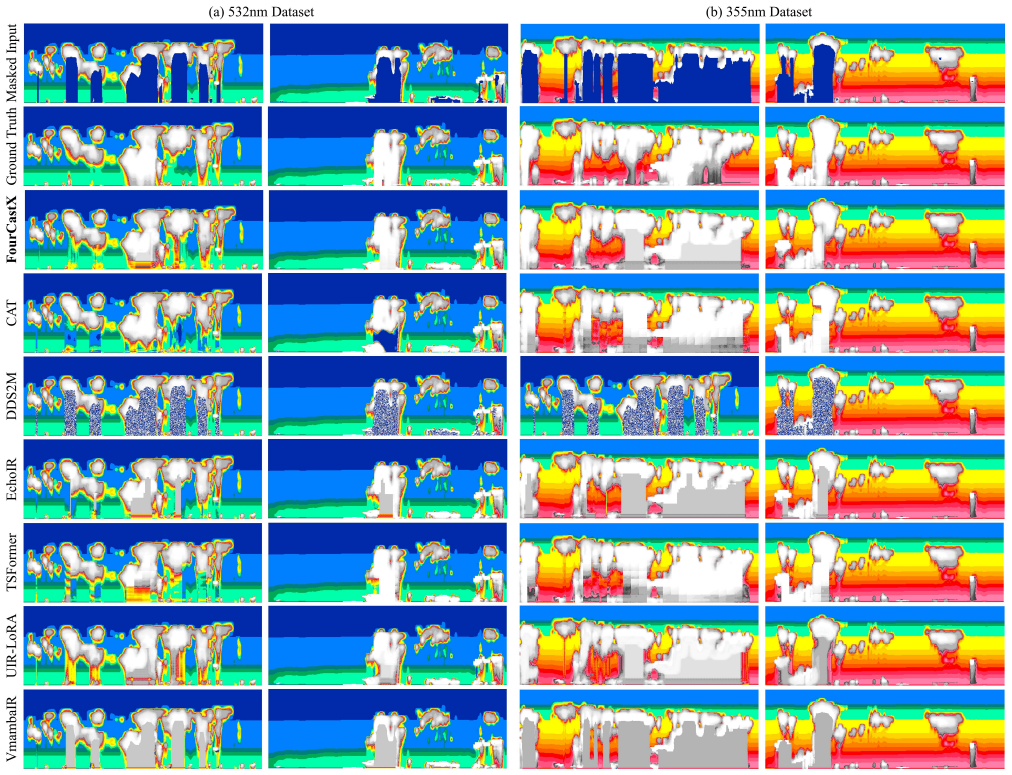
On its own terms, the central claim is that a single network can invert the lidar attenuation process: given a masked, attenuated-backscatter image, it reconstructs the intrinsic backscatter coefficient field that produced it, and it does so better than six established image-restoration models (CAT, DDS2M, EchoIR, TSFormer, UIR-LoRA, VmambaIR) at both 355 nm and 532 nm. The reported results are PSNR 23.38 dB (532 nm) and 23.94 dB (355 nm)—more than 6 dB above the strongest baseline at 532 nm—with SSIM 0.969/0.970, MAE 0.008/0.006, and FID 28.02/25.46. The paper attributes these gains to embedding the ATB–BC energy relationship directly into the architecture via a physics-mixing loss, and to the frequency and mixture-of-experts design that captures both fine cloud filaments and long-range structure. The dataset itself is presented as the first standardized 3D benchmark for this task, built from 384 WRF-COSP simulated scenes and 460,000+ voxel-aligned ATB–BC pairs on a 5 km / 200-level grid.
Load-bearing premise
The load-bearing premise is that the simulated ground-truth backscatter fields produced by WRF-COSP with the zero-attenuation configuration are faithful proxies for real atmospheric structure, and that the masked-ATB-to-BC inpainting task captures the real retrieval problem that spaceborne lidars pose.
Editorial extensions
If this is right
- A shared benchmark and evaluation protocol now exist for 3D atmospheric backscatter recovery, making future methods directly comparable on the same 921,600-image testbed.
- The physics-mixing loss gives a differentiable route to enforcing the ATB–BC energy relation, so models can be trained for physical consistency without auxiliary retrieval inputs.
- Performance stays within 5% as mask rates increase, which the paper attributes to the embedded physics constraint rather than to data-driven inpainting alone.
- Because the volumes are aligned to an EarthCARE-style observational grid, the benchmark is directly usable for mission-oriented retrieval development.
- The model's evidential head outputs uncertainty, which the paper ties to approaching the aleatoric floor of ATB measurements.
Reading between the lines
- If the simulator gap is small, the learned ATB-to-BC map is effectively an inverse of the lidar equation, so the same architecture could be adapted to other active sensors with modest fine-tuning.
- The evidential output head gives per-voxel uncertainty, which the paper does not exploit; that uncertainty could feed data assimilation or quality control in downstream climate products.
- A testable extension is semi-supervised fine-tuning on real ATLID/CALIOP data, which the paper lists as future work; success would validate the synthetic pretraining more strongly than any single metric.
- The FFC-MoE design is sensor-agnostic and could be carried to radar reflectivity or atmospheric composition retrievals, where the same attenuation-and-recovery structure appears.
Editorial analysis
A structured set of objections, weighed in public.
Referee Report
Summary. The paper introduces Atmos-Bench, a synthetic 3D atmospheric benchmark built from WRF simulations coupled with an enhanced COSP lidar simulator, providing paired attenuated backscatter (ATB) and intrinsic backscatter coefficient (BC) volumes at 355 nm and 532 nm. The authors propose FourCastX, a generative network combining Fast Fourier Convolution, Mixture-of-Experts, VisionLSTM, spatial cross-attention, and evidential regression, trained to reconstruct BC from masked ATB inputs. They report consistent improvements over six image-restoration baselines on PSNR, SSIM, MAE, LPIPS, and FID, and attribute the gains to an embedded ATB–BC physics constraint that promotes energy consistency.
Significance. If the claims were fully supported, Atmos-Bench would be a useful large-scale resource for a practically relevant remote-sensing inverse problem, and FourCastX would be a strong baseline combining several modern architectural ideas. However, the paper's central physics-informed claim is not backed by any explicit constraint, the quantitative narrative contains verifiable overstatements, and the benchmark's external validity is not tested against real spaceborne lidar data. The contribution is therefore currently a promising but unverified synthetic-data pipeline rather than a demonstrated advance for real atmospheric retrieval.
major comments (5)
- [Section 4, Eq. (10)] The physics-mixing loss Lmix is introduced in the bullet list of Section 4 and in Figure 3, and the Strengths section refers to 'the ATB–BC energy relation as a differentiable constraint,' but Lmix is never defined and it does not appear in the final generator loss in Eq. (10). As written, the training objective is a standard combination of evidential, adversarial, perceptual, feature-matching, and L1 losses, so the claimed physics-informed supervision cannot be verified or reproduced. The authors must write down the explicit form of Lmix (or the differentiable ATB–BC constraint), specify its weight in Eq. (10), and provide an ablation that isolates its contribution to the reported gains.
- [Section 5, Table 1 and accompanying text] The text states that FourCastX achieves 'over 6 dB higher' PSNR at 532 nm than the strongest baseline, but Table 1 shows FourCastX at 23.38 dB versus UIR-LoRA at 18.94 dB, a margin of 4.44 dB; the 355 nm margin is 3.13 dB. This is a factual error in the headline quantitative claim and should be corrected. The MAE reduction percentages should also be recomputed and stated consistently with the table.
- [Section 3 (COSP-ZT) and Section 6 (Limitations)] The ground-truth BC is generated by the same COSP simulator (with extinction zeroed in the COSP-ZT configuration) that produces the input ATB, so the benchmark tests the inversion of a self-consistent simulator rather than agreement with real spaceborne measurements. The paper provides no comparison to CALIOP or ATLID observations, no distributional sanity check, and no out-of-simulation evaluation. The abstract's claim that the benchmark supports 'climate insight' and that the method outperforms state-of-the-art on realistic retrieval is therefore unsupported. The authors should either add a real-data validation experiment or substantially temper the claims about atmospheric insight and real-world applicability.
- [Section 5, Strengths paragraph and References] The claim that the generator has 'one-quarter the parameters of CoModGAN and one-third those of MADF' is not verifiable: CoModGAN is not cited anywhere in the reference list, and the cited 'Zhang et al. 2021' is a paper about Gaofen-3 SAR soil-moisture retrieval, not an image-restoration model called MADF. Provide the correct references and the actual parameter counts, or remove this unsupported efficiency claim.
- [Section 3 and Section 5 (Dataset availability)] For a paper whose main contribution is a benchmark, the manuscript provides no URL or availability statement for the dataset or the code. Without a public release mechanism, the proposed 'standard' benchmark cannot be used by the community, and the reported comparisons cannot be reproduced. Add a clear data/code availability statement in the final version.
minor comments (5)
- [Abstract and Introduction] The paper repeatedly claims to outperform 'classical inversion methods' and 'traditional radiative transfer inversions,' but Table 1 contains no physics-based inversion baseline; either add such a baseline to the experiments or remove these claims.
- [Section 4, Eq. (9)] The evidential NLL term in Eq. (9) is not written out; to be reproducible, the authors should define NLL(γ, v, α, β; Y) explicitly or cite the exact equation from Amini et al. (2020).
- [Section 4, Eq. (6)] The placement of the Gaussian noise ϵ in Eq. (6) is ambiguous: it is added after global average pooling, but gating noise is normally added to the pre-softmax logits; clarify the expression.
- [Section 5, Setup] The 'R1 gradient penalty' is mentioned but never defined; state its coefficient and how it is applied.
- [Throughout] The manuscript contains numerous typos and formatting errors, including 'MiXture' in the title, 'We developAtmos-Bench' without a space, 'Spatio -Temporal' with stray spaces, and inconsistent citation formatting; a thorough language and formatting pass is needed.
Circularity Check
No significant circularity: the ATB-to-BC recovery task inverts a self-consistent simulator, but the target BC is not equal to the input ATB by construction, and no load-bearing self-citation chain forces the result.
full rationale
The paper's derivation chain does not contain a quantity that, by the paper's own equations or citations, reduces to its input. ATB and BC are generated by two configurations of the same WRF-COSP pipeline: the standard configuration simulates attenuated backscatter, while COSP-ZT 'disables attenuation by setting extinction to zero' to yield intrinsic BC. Thus BC is a distinct signal produced by zeroing a physical term, not a renamed version of ATB; this makes the benchmark evaluation self-consistent rather than circular. The paper repeatedly claims a differentiable ATB-BC 'physics constraint' and a 'physics-mixing loss Lmix,' but Lmix is never written and the only explicit losses are Eq. 9 and Eq. 10; this is an omitted derivation and a reproducibility/correctness concern, not an instance of a claim reducing to its own input. Likewise, the text's 'over 6 dB' gain versus the '4.44 dB' gap in Table 1 is an internal inconsistency, not circularity. Self-citations (e.g., Xu et al. 2023; He et al. 2024a-c; He 2024) appear as procedural references for grid alignment and image slicing; they do not carry the load of the benchmark or architecture claims. The Limitations section explicitly concedes WRF-COSP simulator-reality bias, which weakens external validity but does not make the derivation circular. Under the standard of exhibiting Eq. X = Eq. Y by construction or a fitted parameter renamed as a prediction, no circular step is identified.
Assumptions & free parameters
free parameters (3)
- Loss weighting coefficients lambda_i (i in {ev, adv, HRF, FM, 1}) =
not reported
- Physics mask generator parameters and mask rates =
not reported
- MoE routing noise sigma (Eq 6) =
not reported
assumptions (4)
- domain assumption WRF simulations faithfully represent atmospheric state for the chosen domain and periods
- domain assumption COSP-ZT zero-optical-depth configuration produces intrinsic BC that is a valid proxy for atmospheric structure
- domain assumption Masked ATB-to-BC inpainting captures the physically relevant retrieval problem
- domain assumption All deep learning components (FFC, MoE, VisionLSTM, cross-attention, evidential head) function as described in their source papers
Cite this review
Pith. "Pith review of Atmos-Bench: 3D Atmospheric Structures for Climate Insight." pith.science (2026). https://pith.science/paper/KBPZLR23
@misc{pith2026250711085,
  author       = {Pith},
  title        = {Pith review of: Atmos-Bench: 3D Atmospheric Structures for Climate Insight},
  year         = {2026},
  howpublished = {\url{https://pith.science/paper/KBPZLR23}},
  note         = {Machine review of arXiv:2507.11085}
}
read the original abstract
Atmospheric structure, represented by backscatter coefficients (BC) recovered from satellite LiDAR attenuated backscatter (ATB), provides a volumetric view of clouds, aerosols, and molecules, playing a critical role in human activities, climate understanding, and extreme weather forecasting. Existing methods often rely on auxiliary inputs and simplified physics-based approximations, and lack a standardized 3D benchmark for fair evaluation. However, such approaches may introduce additional uncertainties and insufficiently capture realistic radiative transfer and atmospheric scattering-absorption effects. To bridge these gaps, we present Atmos-Bench: the first 3D atmospheric benchmark, along with a novel FourCastX: Frequency-enhanced Spatio-Temporal Mixture-of-Experts Network that (a) generates 921,600 image slices from 3D scattering volumes simulated at 532 nm and 355 nm by coupling WRF with an enhanced COSP simulator over 384 land-ocean time steps, yielding high-quality voxel-wise references; (b) embeds ATB-BC physical constraints into the model architecture, promoting energy consistency during restoration; (c) achieves consistent improvements on the Atmos-Bench dataset across both 355 nm and 532 nm bands, outperforming state-of-the-art baseline models without relying on auxiliary inputs. Atmos-Bench establishes a new standard for satellite-based 3D atmospheric structure recovery and paves the way for deeper climate insight.
Figures



Figures from the paper (1 more)
Reference graph
Works this paper leans on
-
[1]
, " * write output.state after.block = add.period write newline
ENTRY address archivePrefix author booktitle chapter edition editor eid eprint howpublished institution isbn journal key month note number organization pages publisher school series title type volume year label extra.label sort.label short.list INTEGERS output.state before.all mid.sentence after.sentence after.block FUNCTION init.state.consts #0 'before.a...
-
[2]
write newline
" write newline "" before.all 'output.state := FUNCTION n.dashify 't := "" t empty not t #1 #1 substring "-" = t #1 #2 substring "--" = not "--" * t #2 global.max substring 't := t #1 #1 substring "-" = "-" * t #2 global.max substring 't := while if t #1 #1 substring * t #2 global.max substring 't := if while FUNCTION word.in bbl.in capitalize " " * FUNCT...
-
[3]
Adomako, A. B.; Jamshidi, E. J.; Yusup, Y.; Elsebakhi, E.; Jaafar, M. H.; Ishak, M. I. S.; Lim, H. S.; and Ahmad, M. I. 2024. Deep learning approaches for bias correction in WRF model outputs for enhanced solar and wind energy estimation: A case study in East and West Malaysia. ECOLOGICAL INFORMATICS, 84
work page 2024
-
[4]
Ahn, D.; Kim, S.; Hong, H.; and Ko, B. C. 2023. STAR-Transformer: A Spatio-temporal Cross Attention Transformer for Human Action Recognition. In 2023 IEEE/CVF WINTER CONFERENCE ON APPLICATIONS OF COMPUTER VISION (WACV), IEEE Winter Conference on Applications of Computer Vision, 3319--3328. IEEE; CVF; IEEE Comp Soc. ISBN 978-1-6654-9346-8. 23rd IEEE/CVF Wi...
work page 2023
-
[5]
Alkin, B.; Beck, M.; P \"o ppel, K.; Hochreiter, S.; and Brandstetter, J. 2024. Vision-lstm: xlstm as generic vision backbone. arXiv preprint arXiv:2406.04303
work page Pith review arXiv 2024
-
[6]
Amini, A.; Schwarting, W.; Soleimany, A.; and Rus, D. 2020. Deep Evidential Regression. In Larochelle, H.; Ranzato, M.; Hadsell, R.; Balcan, M.; and Lin, H., eds., Advances in Neural Information Processing Systems, volume 33, 14927--14937. Curran Associates, Inc
work page 2020
-
[7]
M.; Feofilov, A.; and Schutgens, N
Bonazzola, M.; Chepfer, H.; Ma, P.-L.; Quaas, J.; Winker, D. M.; Feofilov, A.; and Schutgens, N. 2023. Incorporation of aerosol into the COSPv2 satellite lidar simulator for climate model evaluation. Geoscientific Model Development, 16(4): 1359--1377
work page 2023
-
[8]
I.; Ouaknine, A.; Papoutsis, I.; and Rolnick, D
Bountos, N. I.; Ouaknine, A.; Papoutsis, I.; and Rolnick, D. 2025. FoMo: Multi-Modal, Multi-Scale and Multi-Task Remote Sensing Foundation Models for Forest Monitoring. arXiv:2312.10114
arXiv 2025
Show all 74 references
-
[9]
Chen, Z.; Deng, Y.; Wu, Y.; Gu, Q.; and Li, Y. 2022 a . Towards Understanding Mixture of Experts in Deep Learning. arXiv:2208.02813
2022 arXiv
-
[10]
Chen, Z.; Deng, Y.; Wu, Y.; Gu, Q.; and Li, Y. 2022 b . Towards Understanding the Mixture-of-Experts Layer in Deep Learning. In Koyejo, S.; Mohamed, S.; Agarwal, A.; Belgrave, D.; Cho, K.; and Oh, A., eds., ADVANCES IN NEURAL INFORMATION PROCESSING SYSTEMS 35 (NEURIPS 2022), A...
2022
-
[11]
Chen, Z.; Zhang, Y.; Gu, J.; Zhang, Y.; Kong, L.; and Yuan, X. 2022 c . Cross Aggregation Transformer for Image Restoration. In Oh, A. H.; Agarwal, A.; Belgrave, D.; and Cho, K., eds., Advances in Neural Information Processing Systems
2022
-
[12]
Chen, Z.; Zhang, Y.; Gu, J.; Zhang, Y.; Kong, L.; and Yuan, X. 2023. Cross Aggregation Transformer for Image Restoration. arXiv:2211.13654
2023 arXiv
-
[13]
Chi, L.; Jiang, B.; and Mu, Y. 2020. Fast Fourier Convolution. In Advances in Neural Information Processing Systems
2020
-
[14]
Cho, H.; Jun, S.-Y.; Ho, C.-H.; and McFarquhar, G. 2020. Simulations of Winter Arctic Clouds and Associated Radiation Fluxes Using Different Cloud Microphysics Schemes in the Polar WRF: Comparisons With CloudSat, CALIPSO, and CERES. Journal of Geophysical Research: Atmospheres...
2020
-
[15]
J.; and Kim, K.-Y
Clarke, A. J.; and Kim, K.-Y. 2005. The Response Time of the Temperature of the Equatorial Troposphere to ENSO Heating. Journal of the Atmospheric Sciences, 62(12): 4412 -- 4422
2005
-
[16]
B.; and Ermon, S
Cong, Y.; Khanna, S.; Meng, C.; Liu, P.; Rozi, E.; He, Y.; Burke, M.; Lobell, D. B.; and Ermon, S. 2023. SatMAE: Pre-training Transformers for Temporal and Multi-Spectral Satellite Imagery. arXiv:2207.08051
2023 arXiv
-
[17]
C.; He, K.; and Tang, X
Dong, C.; Loy, C. C.; He, K.; and Tang, X. 2016. Image Super-Resolution Using Deep Convolutional Networks. IEEE Transactions on Pattern Analysis and Machine Intelligence, 38(2): 295--307
2016
-
[18]
P.; van Zadelhoff, G.-J.; and Wang, P
Donovan, D. P.; van Zadelhoff, G.-J.; and Wang, P. 2024. The EarthCARE lidar cloud and aerosol profile processor (A-PRO): the A-AER, A-EBD, A-TC, and A-ICE products. Atmospheric Measurement Techniques, 17(17): 5301--5340
2024
-
[19]
Fuller, A.; Millard, K.; and Green, J. 2023. CROMA: Remote Sensing Representations with Contrastive Radar-Optical Masked Autoencoders. In Oh, A.; Naumann, T.; Globerson, A.; Saenko, K.; Hardt, M.; and Levine, S., eds., Advances in Neural Information Processing Systems, volume ...
2023
-
[20]
Guo, H.; Guo, Y.; Zha, Y.; Zhang, Y.; Li, W.; Dai, T.; Xia, S.-T.; and Li, Y. 2025. MambaIRv2: Attentive State Space Restoration. arXiv:2411.15269
2025 arXiv
-
[21]
Guo, X.; Lao, J.; Dang, B.; Zhang, Y.; Yu, L.; Ru, L.; Zhong, L.; Huang, Z.; Wu, K.; and Hu, D. 2023. SkySense: A Multi-Modal Remote Sensing Foundation Model Towards Universal Interpretation for Earth Observation Imagery. IEEE
2023
-
[22]
Guo, X.; Lao, J.; Dang, B.; Zhang, Y.; Yu, L.; Ru, L.; Zhong, L.; Huang, Z.; Wu, K.; Hu, D.; He, H.; Wang, J.; Chen, J.; Yang, M.; Zhang, Y.; and Li, Y. 2024. SkySense: A Multi-Modal Remote Sensing Foundation Model Towards Universal Interpretation for Earth Observation Imagery...
2024 arXiv
-
[23]
Han, X.; Nguyen, H.; Harris, C.; Ho, N.; and Saria, S. 2025. FuseMoE: Mixture-of-Experts Transformers for Fleximodal Fusion. arXiv:2402.03226
2025 arXiv
-
[24]
He, Y. 2024. Epl: Evidential prototype learning for semi-supervised medical image segmentation. arXiv preprint arXiv:2404.06181
2024 arXiv
-
[25]
He, Y.; Bi, Y.; Li, L.; Pun, C.-M.; Jiao, W.; and Jin, Z. 2024 a . Mutual evidential deep learning for semi-supervised medical image segmentation. In 2024 IEEE International Conference on Bioinformatics and Biomedicine (BIBM), 2010--2017. IEEE
2024
-
[26]
He, Y.; and He, Y. 2024. EchoIR: Advancing Image Restoration with Echo Upsampling and Bi-Level Optimization. arXiv:2412.07225
2024 arXiv
-
[27]
He, Y.; and Li, L. 2024. Uncertainty-aware evidential fusion-based learning for semi-supervised medical image segmentation. arXiv preprint arXiv:2404.06177
2024 arXiv
-
[28]
He, Y.; Li, L.; Zhan, T.; Jiao, W.; and Pun, C.-M. 2024 b . Generalized uncertainty-based evidential fusion with hybrid multi-head attention for weak-supervised temporal action localization. In ICASSP 2024-2024 IEEE International Conference on Acoustics, Speech and Signal Proc...
2024
-
[29]
He, Y.; Li, L.; Zhan, T.; Pun, C.-M.; Jiao, W.; and Jin, Z. 2025. Co-evidential fusion with information volume for semi-supervised medical image segmentation. Pattern Recognition, 166: 111639
2025
-
[30]
He, Y.; Song, W.; Li, L.; Zhan, T.; and Jiao, W. 2024 c . Residual Feature-Reutilization Inception Network. Pattern Recognition, 110439
2024
-
[31]
Heusel, M.; Ramsauer, H.; Unterthiner, T.; Nessler, B.; and Hochreiter, S. 2017. GANs Trained by a Two Time-Scale Update Rule Converge to a Local Nash Equilibrium. In Guyon, I.; Luxburg, U. V.; Bengio, S.; Wallach, H.; Fergus, R.; Vishwanathan, S.; and Garnett, R., eds., Advan...
2017
-
[32]
A.; and Chanussot, J
Hong, D.; Zhang, B.; Li, X.; Li, Y.; Li, C.; Yao, J.; Yokoya, N.; Li, H.; Ghamisi, P.; Jia, X.; Plaza, A.; Gamba, P.; Benediktsson, J. A.; and Chanussot, J. 2024 a . SpectralGPT: Spectral Remote Sensing Foundation Model . IEEE Transactions on Pattern Analysis & Machine Intelli...
2024
-
[33]
A.; and Chanussot, J
Hong, D.; Zhang, B.; Li, X.; Li, Y.; Li, C.; Yao, J.; Yokoya, N.; Li, H.; Ghamisi, P.; Jia, X.; Plaza, A.; Gamba, P.; Benediktsson, J. A.; and Chanussot, J. 2024 b . SpectralGPT: Spectral Remote Sensing Foundation Model. IEEE Trans. Pattern Anal. Mach. Intell., 46(8): 5227–5244
2024
-
[34]
Hu, K.; and Lu, X. 2024. Spaceborne lidar measurement of global cloud properties through machine learning. Frontiers in Remote Sensing, Volume 5 - 2024
2024
-
[35]
Irwin, K.; Beaulne, D.; Braun, A.; and Fotopoulos, G. 2017. Fusion of SAR, Optical Imagery and Airborne LiDAR for Surface Water Detection. Remote Sensing, 9(9)
2017
-
[36]
Jain, G.; Hegde, N.; Kusupati, A.; Nagrani, A.; Buch, S.; Jain, P.; Arnab, A.; and Paul, S. 2024. Mixture of Nested Experts: Adaptive Processing of Visual Tokens. arXiv:2407.19985
2024 arXiv
-
[37]
Johnson, J.; Alahi, A.; and Fei-Fei, L. 2016. Perceptual Losses for Real-Time Style Transfer and Super-Resolution. In Leibe, B.; Matas, J.; Sebe, N.; and Welling, M., eds., COMPUTER VISION - ECCV 2016, PT II, volume 9906 of Lecture Notes in Computer Science, 694--711. ISBN 978...
2016
-
[38]
Lacoste, A.; Lehmann, N.; Rodriguez, P.; Sherwin, E.; Kerner, H.; L\" u tjens, B.; Irvin, J.; Dao, D.; Alemohammad, H.; Drouin, A.; Gunturkun, M.; Huang, G.; Vazquez, D.; Newman, D.; Bengio, Y.; Ermon, S.; and Zhu, X. 2023. GEO-Bench: Toward Foundation Models for Earth Monitor...
2023
-
[39]
Li, J.; Su, Q.; Yang, Y.; Jiang, Y.; Wang, C.; and Xu, H. 2023. Adaptive Gating in Mixture-of-Experts based Language Models. In Bouamor, H.; Pino, J.; and Bali, K., eds., 2023 CONFERENCE ON EMPIRICAL METHODS IN NATURAL LANGUAGE PROCESSING, EMNLP 2023, 3577--3587. Apple; Coloss...
2023
-
[40]
Lin, J.; and Wang, Y.-G. 2024. TSFormer: Tracking Structure Transformer for Image Inpainting. ACM Trans. Multimedia Comput. Commun. Appl., 20(12)
2024
-
[41]
Liu, C.; Guo, J.; Zhang, B.; Zhang, H.; Guan, P.; and Xu, R. 2021. A Reliability Assessment of the NCEP/FNL Reanalysis Data in Depicting Key Meteorological Factors on Clean Days and Polluted Days in Beijing. Atmosphere, 12(4)
2021
-
[42]
Liu, F.; Chen, D.; Guan, Z.; Zhou, X.; Zhu, J.; Ye, Q.; Fu, L.; and Zhou, J. 2024. RemoteCLIP: A Vision Language Foundation Model for Remote Sensing. arXiv:2306.11029
2024 arXiv
-
[43]
J.; Muzio, A.; and Awadalla, H
Liu, R.; Kim, Y. J.; Muzio, A.; and Awadalla, H. H. 2022. Gating Dropout: Communication-efficient Regularization for Sparsely Activated Transformers. arXiv:2205.14336
2022 arXiv
-
[45]
Miao, Y.; Zhang, L.; Zhang, L.; and Tao, D. 2023 b . DDS2M: Self-Supervised Denoising Diffusion Spatio-Spectral Model for Hyperspectral Image Restoration. arXiv:2303.06682
2023 arXiv
-
[46]
M.; Pham, M.; Nguyen, T.; Nguyen, K.; Osher, S
Nguyen, T. M.; Pham, M.; Nguyen, T.; Nguyen, K.; Osher, S. J.; and Ho, N. 2022. FourierFormer: Transformer Meets Generalized Fourier Integral Theorem. In Koyejo, S.; Mohamed, S.; Agarwal, A.; Belgrave, D.; Cho, K.; and Oh, A., eds., ADVANCES IN NEURAL INFORMATION PROCESSING SY...
2022
-
[47]
R.; Porras-Diaz, N.; Ieremeiev, O.; Rubel, A.; Lukin, V.; Kopytek, M.; Lech, P.; Fastowicz, J.; and Okarma, K
Ramirez-Jaime, A.; Arce, G. R.; Porras-Diaz, N.; Ieremeiev, O.; Rubel, A.; Lukin, V.; Kopytek, M.; Lech, P.; Fastowicz, J.; and Okarma, K. 2025. Generative Diffusion Models for Compressed Sensing of Satellite LiDAR Data: Evaluating Image Quality Metrics in Forest Landscape Rec...
2025
-
[48]
Ronneberger, O.; Fischer, P.; and Brox, T. 2015. U-Net: Convolutional Networks for Biomedical Image Segmentation. In Navab, N.; Hornegger, J.; Wells, W. M.; and Frangi, A. F., eds., Medical Image Computing and Computer-Assisted Intervention -- MICCAI 2015, 234--241. Cham: Spri...
2015
-
[49]
E.; and Blankevoort, T
Royer, A.; Karmanov, I.; Skliar, A.; Bejnordi, B. E.; and Blankevoort, T. 2023. Revisiting Single-gated Mixtures of Experts. arXiv:2304.05497
2023 arXiv
-
[50]
E.; Nowottnick, E
Selmer, P.; Yorks, J. E.; Nowottnick, E. P.; Cresanti, A.; and Christian, K. E. 2024. A Deep Learning Lidar Denoising Approach for Improving Atmospheric Feature Detection. Remote Sensing, 16(15)
2024
-
[51]
Shazeer, N.; Mirhoseini, A.; Maziarz, K.; Davis, A.; Le, Q.; Hinton, G.; and Dean, J. 2017. Outrageously Large Neural Networks: The Sparsely-Gated Mixture-of-Experts Layer. arXiv:1701.06538
2017 arXiv
-
[52]
Shi, X.; Chen, Z.; Wang, H.; Yeung, D.-Y.; Wong, W.-k.; and Woo, W.-c. 2015. Convolutional LSTM Network: A Machine Learning Approach for Precipitation Nowcasting. In Cortes, C.; Lawrence, N.; Lee, D.; Sugiyama, M.; and Garnett, R., eds., ADVANCES IN NEURAL INFORMATION PROCESSI...
2015
-
[53]
Shi, Y.; Xia, B.; Jin, X.; Wang, X.; Zhao, T.; Xia, X.; Xiao, X.; and Yang, W. 2024. VmambaIR: Visual State Space Model for Image Restoration. arXiv:2403.11423
2024 arXiv
-
[54]
K.; Moorthi, S
Sinha, A. K.; Moorthi, S. M.; and Dhar, D. 2022. NL-FFC: Non-Local Fast Fourier Convolution for Image Super Resolution. In 2022 IEEE/CVF CONFERENCE ON COMPUTER VISION AND PATTERN RECOGNITION WORKSHOPS, CVPRW 2022, IEEE Computer Society Conference on Computer Vision and Pattern...
2022
-
[55]
Sorrentino, A.; Sannino, A.; Spinelli, N.; Piana, M.; Boselli, A.; Tontodonato, V.; Castellano, P.; and Wang, X. 2022. A Bayesian parametric approach to the retrieval of the atmospheric number size distribution from lidar data. Atmospheric Measurement Techniques, 15(1): 149--164
2022
-
[56]
Sun, S.; Ren, W.; Liu, Z.; Park, H.; Wang, R.; and Cao, X. 2024. EnsIR: An Ensemble Algorithm for Image Restoration via Gaussian Mixture Models. arXiv:2410.22959
2024 arXiv
-
[57]
T.; Abshire, J
Sun, X.; Kolbeck, P. T.; Abshire, J. B.; Kawa, S. R.; and Mao, J. 2022. Attenuated atmospheric backscatter profiles measured by the CO _ 2 Sounder lidar in the 2017 ASCENDS/ABoVE airborne campaign. Earth System Science Data, 14(8): 3821--3833
2022
-
[58]
Suvorov, R.; Logacheva, E.; Mashikhin, A.; Remizova, A.; Ashukha, A.; Silvestrov, A.; Kong, N.; Goka, H.; Park, K.; and Lempitsky, V. 2022. Resolution-robust large mask inpainting with fourier convolutions. In Proceedings of the IEEE/CVF winter conference on applications of co...
2022
-
[59]
J.; Pincus, R.; and Bodas-Salcedo, A
Swales, D. J.; Pincus, R.; and Bodas-Salcedo, A. 2018. The Cloud Feedback Model Intercomparison Project Observational Simulator Package: Version 2. Geoscientific Model Development, 11(1): 77--81
2018
-
[60]
H.; de Sousa Almeida, J
Szwarcman, D.; Roy, S.; Fraccaro, P.; Þorsteinn Elí Gíslason; Blumenstiel, B.; Ghosal, R.; de Oliveira, P. H.; de Sousa Almeida, J. L.; Sedona, R.; Kang, Y.; Chakraborty, S.; Wang, S.; Gomes, C.; Kumar, A.; Truong, M.; Godwin, D.; Lee, H.; Hsu, C.-Y.; Asanjan, A. A.; Mujeci, B...
2025
-
[61]
Tian, J.; Liu, J.; Wang, J.; Li, C.; Yu, F.; and Chu, Z. 2017. A spatio-temporal evaluation of the WRF physical parameterisations for numerical rainfall simulation in semi-humid and semi-arid catchments of Northern China. Atmospheric Research, 191: 141--155
2017
-
[62]
J.; Xiong, Z.; Zhu, X
Waldmann, L.; Shah, A.; Wang, Y.; Lehmann, N.; Stewart, A. J.; Xiong, Z.; Zhu, X. X.; Bauer, S.; and Chuang, J. 2025. Panopticon: Advancing Any-Sensor Foundation Models for Earth Observation. arXiv:2503.10845
2025 arXiv
-
[63]
Wang, C.; Bentivegna, E.; Zhou, W.; Klein, L.; and Elmegreen, B. 2020. Physics-Informed Neural Network Super Resolution for Advection-Diffusion Models. arXiv:2011.02519
2020 arXiv
-
[64]
Wang, L.; Gao, H.; Zhao, C.; Sun, X.; and Dai, D. 2024. Auxiliary-Loss-Free Load Balancing Strategy for Mixture-of-Experts. arXiv:2408.15664
2024 arXiv
-
[65]
Wu, Z.; Liu, W.; Wang, J.; Li, J.; and Huang, D. 2025. FrePrompter: Frequency self-prompt for all-in-one image restoration. Pattern Recognition, 161: 111223
2025
-
[66]
Xu, T.; Yan, K.; He, Y.; Gao, S.; Yang, K.; Wang, J.; Liu, J.; and Liu, Z. 2023. Spatio-temporal variability analysis of vegetation dynamics in china from 2000 to 2022 based on leaf area index: A multi-temporal image classification perspective. Remote Sensing, 15(12): 2975
2023
-
[67]
Yang, L.; Zhang, D.; and Karniadakis, G. E. 2020. Physics-Informed Generative Adversarial Networks for Stochastic Differential Equations. SIAM Journal on Scientific Computing, 42(1): A292--A317
2020
-
[68]
Yang, T.; Qin, H.; Ning, B.; Xu, Y.; Yao, Y.; and You, Z. 2023. Application of t-SNE and PSO-BPNN for Identification of Penetration State in Ship GMAW. In 2023 IEEE 6th International Conference on Pattern Recognition and Artificial Intelligence (PRAI), 223--228
2023
-
[69]
B.; Wang, Y.; Imhoff, R.; Uijlenhoet, R.; and Dauwels, J
Yin, J.; Meo, C.; Roy, A.; Cher, Z. B.; Wang, Y.; Imhoff, R.; Uijlenhoet, R.; and Dauwels, J. 2024. Precipitation Nowcasting Using Physics Informed Discriminator Generative Models. arXiv:2406.10108
2024 arXiv
-
[70]
Zhang, C.; Gong, D.; He, J.; Zhu, Y.; Sun, J.; and Zhang, Y. 2024. UIR-LoRA: Achieving Universal Image Restoration through Multiple Low-Rank Adaptation. arXiv:2409.20197
2024 arXiv
-
[71]
Zhang, L.; Meng, Q.; Zeng, J.; Wei, X.; and Shi, H. 2021. Evaluation of Gaofen-3 C-Band SAR for Soil Moisture Retrieval Using Different Polarimetric Decomposition Models. IEEE Journal of Selected Topics in Applied Earth Observations and Remote Sensing, 14: 5707--5719
2021
-
[72]
A.; Shechtman, E.; and Wang, O
Zhang, R.; Isola, P.; Efros, A. A.; Shechtman, E.; and Wang, O. 2018. The Unreasonable Effectiveness of Deep Features as a Perceptual Metric. IEEE
2018
-
[73]
Zhang, Y.; and Funkhouser, T. 2018. Deep Depth Completion of a Single RGB-D Image. In Proceedings of the IEEE Conference on Computer Vision and Pattern Recognition (CVPR)
2018
-
[74]
Zhang, Z.; Chen, P.; Jamet, C.; Dionisi, D.; Hu, Y.; Lu, X.; and Pan, D. 2023. Retrieving bbp and POC from CALIOP: A deep neural network approach. Remote Sensing of Environment
2023
-
[75]
Zhong, X.; Ma, Z.; Yao, Y.; Xu, L.; Wu, Y.; and Wang, Z. 2023. WRF--ML v1.0: a bridge between WRF v4.3 and machine learning parameterizations and its application to atmospheric radiative transfer. Geoscientific Model Development, 16(1): 199--209
2023
Reviewed August 6, 2026 · model on record in the stance chip above.
Discussion (0). Sign in to comment.