REVIEW 3 major objections 4 minor 43 references
Giant Flat Band Amplification via Inertial Anchors
T0 review · 3 major / 4 minor · reviewed 2026-08-01 · deepseek-v4-flash
Pith's one-line read Heavy cantilever anchors turn a classical lattice into weakly coupled resonators whose flat bands amplify elastic vibrations by up to two orders of magnitude, with spatially pervasive and temporally persistent response.
desk verdict Inertial-anchor flat bands are a credible new mechanism, but the 100x amplification rests on a near-stationary reference point; ask for absolute or force-normalized data before accepting the headline. read the letter →
The pith
A machine-rendered reading of the paper's core claim, the machinery that carries it, and where it could break.
The reading
What carries the argument
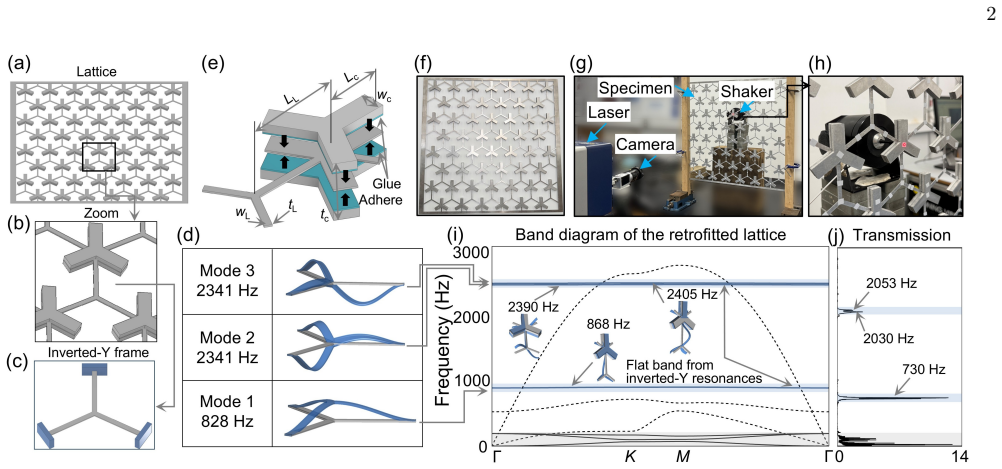
The inertial anchor: a cantilever with much larger out-of-plane thickness than the lattice beams, attached at lattice sites. Under out-of-plane excitation, its inertia pins the site, making it a near-immobile node. The region between anchors forms an inverted-Y frame that acts as a weakly coupled emergent resonator. A tight-binding dispersion ω(k) ≈ ω0 + 2κ cos(ka) links the resonator resonance to a flat band; thickness contrast between anchors and lattice controls κ, hence flatness and localization.
What would settle it
Measure, with a force gauge and an absolute displacement reference, the input force and the absolute displacement of the excitation point during flat-band excitation. If the anchored excitation point moves significantly, or if the ratio A_max/A_star no longer exceeds ~10 when referred to an absolute baseline instead of the excitation point, the central amplification claim fails. A control specimen with perfectly clamped (e.g., welded) anchors that shows far less amplification would indicate the reported gain depends on imperfect glue compliance rather than the inertial-anchor mechanism.
Extended reading notes
Core claim
In a classical hexagonal lattice, attaching heavy cantilever anchors to lattice sites creates emergent inverted-Y resonators whose resonance frequencies appear as nearly flat bands in the phonon spectrum. A tight-binding model of weakly coupled resonators (ω(k) ≈ ω0 + 2κ cos(ka)) explains the bandwidth; when anchors strongly suppress inter-cell coupling, |κ| ≪ ω0, the band becomes flat. Laser-vibrometry experiments verify that exciting these flat bands yields displacement amplification up to 100×, response spread over multiple cells, and transient response that persists after the drive ends. Numerical simulations show the same anchoring mechanism creates flat bands and amplification in squar
Load-bearing premise
The amplification metric is normalized by the displacement at the excitation point, which sits on an anchored cantilever that is expected to stay nearly still; if that point merely happens to be a node rather than a true anchor, the two-order-of-magnitude amplification could be a denominator artifact.
Editorial extensions
If this is right
- Elastic flat bands can be achieved in classical lattices without interference engineering, using only inertial retrofitting, which simplifies fabrication and broadens material choice.
- The flat-band response is source-agnostic: moving the excitation point across four different locations still gives amplification between 47× and 112× and activates multiple cells.
- Transient response persists: amplitude after 20 excitation cycles remains 77%–157% of the peak during excitation, unlike band-gap excitation which decays rapidly.
- Thickness contrast between anchors and lattice tunes the flatness: increasing it reduces bandwidth and increases peak amplification from 140× to 223× in simulations.
- The strategy transfers numerically to square and triangular lattices, suggesting it can be applied to a general class of lattice architectures.
Reading between the lines
- If the mechanism generalizes as claimed, inertial anchoring could turn ordinary cut-and-glued metallic lattices into flat-band systems for vibration control and energy harvesting without additive manufacturing.
- The tight-binding analogy suggests the anchor thickness contrast plays the role of a hopping parameter; tuning it across a lattice could permit direct mechanical emulation of electronic flat-band models.
- The reported amplification is normalized by the displacement at the excitation point, which sits on an anchored cantilever; a direct measurement of input force and absolute displacement would quantify the true energy gain.
- One testable extension is to attach piezoelectric patches to the inverted-Y beams and compare harvested power under flat-band versus pass-band excitation.
Signed reviews
Editorial analysis
A structured set of objections, weighed in public.
Referee Report
Summary. The paper proposes a strategy to produce elastic flat bands by retrofitting classical lattice architectures with heavy cantilever 'inertial anchors' that suppress motion at lattice sites, effectively partitioning the lattice into weakly coupled emergent resonators. The authors present FEA band diagrams showing nearly flat bands, a tight-binding analogy in the SI, and laser-vibrometry experiments on a water-jet-cut aluminum hexagonal lattice with glued cantilever platelets. They report three experimental signatures: amplification up to two orders of magnitude (e.g., 100x, 47-112x), multi-cell activation that is source-agnostic, and persistent transient response after excitation stops. A parametric study on thickness contrast and numerical examples for square and triangular lattices are also included.
Significance. If the quantitative claim of giant amplification is robust, this work offers a conceptually new, interference-free route to elastic flat bands with potential for energy-harvesting applications. The FEA band diagrams, mode-shape matching, and the thickness-ratio parametric study independently support the existence of nearly flat bands originating from weakly coupled inverted-Y resonators. The experimental work is ambitious, combining careful fabrication and full-field laser vibrometry. The paper is well written and the physical mechanism is plausible. However, the headline 'giant amplification' claim depends critically on a normalization that the authors themselves show to be problematic, which currently undermines the practical significance and must be addressed before the central claim can be accepted.
major comments (3)
- [Fig. 2(a-d), Fig. 3(a-d), Fig. 4(c-d)] The amplification metric A_max/A_star is normalized by the displacement at the excitation point, which is located on an inertially anchored cantilever that the authors state 'does not displace appreciably' (Fig. 2a-b). If the excitation point is near a nodal point, a 100x or higher ratio can arise even when the absolute maximum response is modest. The manuscript reports no absolute displacements, input force, or force-normalized mobility. The central claim of 'giant amplification' and the energy-harvesting implication are therefore not supported unless absolute or force-normalized measurements are provided, or the claim is reframed to describe spatial contrast rather than absolute amplification.
- [Fig. 3(h)] The transient persistence ratio A_t20/A_t1,max is reported as 77% to 157%. A value exceeding 100% means the response 20 excitation periods after the excitation has stopped exceeds the maximum during excitation. For a passive damped structure this is physically implausible and likely a consequence of the same near-node normalization (the reference point at the excitation point may decay differently). The authors should report calibrated absolute envelopes, not just ratios, to substantiate the persistence claim.
- [Fig. 1(j), SI Section II] The weak-coupling premise |κ| ≪ ω0 is central to the flat-band interpretation. In the experimental specimen, the anchors are glued to the lattice, and the authors attribute a downward frequency shift to 'imperfect bonding' and 'non-ideal clamping conditions.' This means the actual coupling strength in the tested specimen is uncontrolled and not directly measured. The transmission peaks are consistent with flat bands, but a direct measurement of dispersion (e.g., wave-number-resolved response) or a quantitative estimate of κ from the measured bandwidth would considerably strengthen the claim that the experiment realizes the proposed weakly coupled regime.
minor comments (4)
- [FEA parameters in main text] The density of aluminum is given as ρ=3000 kg/m3, but the standard value is about 2700 kg/m3. Please correct or justify this value, as it may affect the computed frequencies and the comparison with experiments.
- [Abstract] The abstract states 'amplification up to two orders of magnitude compared to pass band and band gap conditions.' As written, the comparison is against the normalized excitation-point displacement, not against absolute pass-band amplitudes. This wording is misleading and should be revised to reflect the actual metric.
- [Fig. 3(e)] The term 'source agnostic' is somewhat strong given that the activated cell fraction ranges from 13% to 35% across excitation locations. Suggest softening to 'largely independent of source location' or similar.
- [SI Section I] The tight-binding analogy is useful but purely illustrative; the coupling constant κ is not derived from the geometry or from FEA. Please state explicitly that this model is qualitative and that the quantitative flat-band evidence comes from the Bloch FEA.
Circularity Check
No significant circularity: the flat-band mechanism is supported by independent FEA and experiments; self-citations are background only.
full rationale
The paper's central claim is that inertial anchors create weakly coupled emergent resonators whose resonances appear as flat bands. The derivation chain is: (1) design anchored cells so that the bounded regions act as inverted-Y resonant frames; (2) compute the isolated frame modes with FEA; (3) compute the full lattice band diagram with FEA Bloch analysis; (4) measure transmission and full-field response on a fabricated specimen. The flat-band frequencies and mode shapes are shown to match the emergent-resonator modes, but this is a consistency check between two independent computations/measurements, not a definitional equivalence: the lattice band diagram is not constructed from the isolated-frame frequencies, and no parameter is fitted to force the match. The tight-binding model in the SI is explicitly an analogy used to rationalize the flat bands; it is not used to set any constant in the FEA or experiments. The self-citations [35,36] are invoked only to repurpose a prior cell-decoration technique for locally resonant band gaps and do not carry the load of the flat-band claim. The amplification metric A_max/A_star is normalized by the excitation point on a nearly stationary anchor, which may inflate the reported ratios, but this is a measurement-interpretation concern, not a case where a predicted quantity is equivalent to a fitted input by construction. Overall, the derivation is self-contained and externally evidenced.
Assumptions & free parameters
assumptions (4)
- domain assumption Weak nearest-neighbor tight-binding model (ω² q_n = ω0² q_n + κ² q_{n+1}+κ² q_{n-1}, SI Eq. S1) captures the flat-band formation from weakly coupled resonators.
- domain assumption Inertially anchored sites remain nearly stationary and act as fixed clamps, making the inverted-Y frame an isolated emergent resonator.
- standard math Standard FEA Bloch analysis gives the true band structure of the fabricated lattice.
- domain assumption The measured transmission peaks correspond to the computed flat bands despite a downward frequency shift attributed to imperfect bonding.
Cite this review
Pith. "Pith review of Giant Flat Band Amplification via Inertial Anchors." pith.science (2026). https://pith.science/paper/KCJWL7RR
@misc{pith2026260717011,
  author       = {Pith},
  title        = {Pith review of: Giant Flat Band Amplification via Inertial Anchors},
  year         = {2026},
  howpublished = {\url{https://pith.science/paper/KCJWL7RR}},
  note         = {Machine review of arXiv:2607.17011}
}
read the original abstract
In electronic materials, flat bands are associated with compact electron localization, with implications for superconductivity, ferromagnetism and strongly correlated systems. The physical significance of their counterparts in elastic media is far less charted. Here we report a strategy to achieve elastic flat bands through an inertial retrofitting of classical lattice architectures. The idea is to alter the cell geometry to realize a network of inertial anchors, effectively partitioning the lattice into an array of weakly coupled emergent resonators, whose resonances appear as flat bands in the phonon spectrum. We demonstrate flat-band conditions that combine localized and extended state attributes and induce a giant response that is spatially and temporally persistent. Laser vibrometry experiments reveal three signatures of this mechanism: amplification up to two orders of magnitude compared to pass band and band gap conditions, multi-cell activation that is agnostic to the source location, and a persistent transient response even after several excitation cycles.
Figures


Figures from the paper (1 more)

Reference graph
Works this paper leans on
-
[1]
Y. Deng, W. A. Benalcazar, Z.-G. Chen, M. Oudich, G. Ma, and Y. Jing, Physical Review Letters128, 174301 (2022)
2022
-
[2]
S.-H. Jo, H. Yoon, Y. C. Shin, and B. D. Youn, In- ternational Journal of Mechanical Sciences215, 106950 (2022)
2022
-
[3]
Shen, Y.-G
Y.-X. Shen, Y.-G. Peng, P.-C. Cao, J. Li, and X.-F. Zhu, Physical Review B105, 104102 (2022)
2022
-
[4]
E. Riva, F. Bellinzoni, and F. Braghin, Communications Physics8, 255 (2025)
2025
-
[5]
Paulose, B
J. Paulose, B. G.-g. Chen, and V. Vitelli, Nature Physics 11, 153 (2015)
2015
-
[6]
M. P. Makwana and R. V. Craster, Physical Review B 98, 235125 (2018)
2018
-
[7]
H. Fan, B. Xia, L. Tong, S. Zheng, and D. Yu, Physical Review Letters122, 204301 (2019)
2019
-
[8]
Serra-Garcia, V
M. Serra-Garcia, V. Peri, R. Susstrunk, O. R. Bilal, T. Larsen, L. G. Villanueva, and S. D. Huber, Nature 555, 342 (2018)
2018
Show all 43 references
-
[9]
Azizi, S
P. Azizi, S. Sarkar, K. Sun, and S. Gonella, Physical Re- view Letters130, 156101 (2023)
2023
-
[10]
Azizi, S
P. Azizi, S. Sarkar, K. Sun, and S. Gonella, Physical Re- view B110, L060102 (2024)
2024
-
[11]
Karki and J
P. Karki and J. Paulose, Physical Review Research5, 023036 (2023)
2023
-
[12]
M. M. Samak and O. R. Bilal, Physical Review Letters 133, 266101 (2024)
2024
-
[13]
Sutherland, Physical Review B34, 5208 (1986)
B. Sutherland, Physical Review B34, 5208 (1986)
1986
-
[14]
Tasaki, Physical Review Letters73, 1158 (1994)
H. Tasaki, Physical Review Letters73, 1158 (1994)
1994
-
[15]
Maksymenko, A
M. Maksymenko, A. Honecker, R. Moessner, J. Richter, and O. Derzhko, Physical Review Letters109, 096404 (2012)
2012
-
[16]
Misumi and H
T. Misumi and H. Aoki, Physical Review B96, 155137 (2017)
2017
-
[17]
Chase-Mayoral, L
C. Chase-Mayoral, L. English, N. Lape, Y. Kim, S. Lee, A. Andreanov, S. Flach, and P. Kevrekidis, Physical Re- view B109, 075430 (2024)
2024
-
[18]
M. Kang, S. Fang, L. Ye, H. C. Po, J. Denlinger, 6 C. Jozwiak, A. Bostwick, E. Rotenberg, E. Kaxiras, J. G. Checkelsky,et al., Nature Communications11, 4004 (2020)
2020
-
[19]
K. Sun, Z. Gu, H. Katsura, and S. Das Sarma, Physical Review Letters106, 236803 (2011)
2011
-
[20]
X. Wan, S. Sarkar, S.-Z. Lin, and K. Sun, Physical Re- view Letters130, 216401 (2023)
2023
-
[21]
Sarkar, X
S. Sarkar, X. Wan, S.-Z. Lin, and K. Sun, Physical Re- view Letters135, 016501 (2025)
2025
-
[22]
Leykam, S
D. Leykam, S. Flach, O. Bahat-Treidel, and A. S. Desy- atnikov, Physical Review B88, 224203 (2013)
2013
-
[23]
Mukherjee, A
S. Mukherjee, A. Spracklen, D. Choudhury, N. Goldman, P. ¨Ohberg, E. Andersson, and R. R. Thomson, Physical Review Letters114, 245504 (2015)
2015
-
[24]
Travkin, F
E. Travkin, F. Diebel, and C. Denz, Applied Physics Let- ters111(2017)
2017
-
[25]
L. Song, S. Gao, J. Ma, L. Tang, D. Song, Y. Li, and Z. Chen, Optics Letters48, 5947 (2023)
2023
-
[26]
Zheng, Y
L.-Y. Zheng, Y. Wu, X. Ni, Z.-G. Chen, M.-H. Lu, and Y.-F. Chen, Applied Physics Letters104(2014)
2014
-
[27]
Dubois, J
M. Dubois, J. Perchoux, A. Vanel, C. Tronche, Y. Achaoui, G. Dupont, K. Bertling, A. Raki´ c, T. Anton- akakis, S. Enoch,et al., Physical Review B99, 100301 (2019)
2019
-
[28]
Y. Tang, B. Liang, X. Zhu, and S. Lin, Physical Review Applied21, 034020 (2024)
2024
-
[29]
M.-H. Ling, P. Wu, Y.-G. Peng, and X.-F. Zhu, Advanced Materials38, e19287 (2026)
2026
-
[30]
C. Han, S. Fan, H.-T. Zhou, K. He, Y. Jia, C. Li, H. Li, X.-D. Yang, L.-Q. Chen, T. Yang,et al., Nature Com- munications16, 634 (2025)
2025
-
[31]
Zhang, T
X. Zhang, T. Liu, Q. Zhang, X. Fan, F. Wu, and C. Qiu, Physical Review B111, 125143 (2025)
2025
-
[32]
Ramos-Alonso, B
A. Ramos-Alonso, B. Remez, D. Bennett, R. M. Fernan- des, and H. Ochoa, Physical Review Letters134, 026501 (2025)
2025
-
[33]
E. Riva, J. Marconi, and F. Braghin, Journal of Sound and Vibration619, 119369 (2025)
2025
-
[34]
K. H. Matlack, M. Serra-Garcia, A. Palermo, S. D. Hu- ber, and C. Daraio, Nature Materials17, 323 (2018)
2018
-
[35]
Gonella, A
S. Gonella, A. C. To, and W. K. Liu, Journal of the Mechanics and Physics of Solids57, 621 (2009)
2009
-
[36]
Celli, S
P. Celli, S. Gonella, V. Tajeddini, A. Muliana, S. Ahmed, and Z. Ounaies, Smart Materials and Structures26, 035001 (2017)
2017
-
[37]
A. S. Phani, J. Woodhouse, and N. A. Fleck, The Journal of the Acoustical Society of America119, 1995 (2006)
1995
-
[39]
Yariv, Y
A. Yariv, Y. Xu, R. K. Lee, and A. Scherer, Optics Let- ters24, 711 (1999)
1999
-
[41]
Giant Flat Band Amplification via Inertial Anchors
N. O. Nfor and S. B. Yamgou´ e, Journal of Nonlinear Mathematical Physics30, 71 (2023). Supplemental Material for “Giant Flat Band Amplification via Inertial Anchors” I: THEORETICAL ANAL YSIS OF THE FLA T BANDS To rationalize the formation of the flat bands, we draw an analogy...
2023
-
[42]
Brillouin,Wave Propagation in Periodic Structures: Electric Filters and Crystal Lattices, 2nd ed
L. Brillouin,Wave Propagation in Periodic Structures: Electric Filters and Crystal Lattices, 2nd ed. (Dover Pub- lications, New York, 1953)
1953
-
[43]
Yariv, Y
A. Yariv, Y. Xu, R. K. Lee, and A. Scherer, Optics Letters 24, 711 (1999)
1999
-
[44]
Longhi, Physical Review A91, 063809 (2015)
S. Longhi, Physical Review A91, 063809 (2015)
2015
-
[45]
N. O. Nfor and S. B. Yamgou´ e, Journal of Nonlinear Math- ematical Physics30, 71 (2023)
2023
Reviewed August 1, 2026 · model on record in the stance chip above.
Discussion (0). Continue with ORCID to comment.