REVIEW 5 minor 45 references
Electrical networks, Grassmannians, and cluster algebras
T0 review · 0 major / 5 minor · reviewed 2026-07-14 · grok-4.5
Pith's one-line read For odd n, circular-total-positivity tests on electrical-network response matrices are identical to Grassmannian positivity tests after freezing n central variables.
desk verdict Clean, fully combinatorial isomorphism linking circular minors of response matrices to a seed in the Grassmannian cluster algebra; the odd-n case and the LM_n identification are solid and new. read the letter →
The pith
A machine-rendered reading of the paper's core claim, the machinery that carries it, and where it could break.
The reading
What carries the argument
The seed obtained by applying Scott’s face-labelling rule to the reduced plabic graph produced by generalised Temperley’s trick from the critical electrical network G_n; its face labels are proved to be exactly the central circular pairs, so that after freezing the n central (empty-pair) vertices the seed coincides with the initial seed of CM_n.
What would settle it
For a concrete odd n (e.g. n=5 or n=7) compute all face labels of the Temperley plabic graph of G_n by Scott’s rule, apply the bijection of Lemma 3.5, and check whether every resulting circular pair is central and whether the quiver obtained after freezing the n central vertices is identical to the published quiver of CM_n.
Extended reading notes
Core claim
For odd n the cluster algebra A_{n-1,2n} of the Grassmannian Gr(n-1,2n), after natural freezing and trivialisation of n central variables, is isomorphic to the Alman–Lian–Tran cluster algebra CM_n of circular minors; the isomorphism identifies the initial seeds and therefore identifies the corresponding positivity tests. Separately, the Laurent-phenomenon algebra LM_n realises the coordinate ring of the non-compactified electrical-network space.
Load-bearing premise
The explicit recursive formulae that label the faces of the Temperley plabic graph of G_n must produce only central circular pairs and must reproduce the quiver of CM_n after the n central vertices are frozen; any missed non-central pair or extra edge would break the seed isomorphism.
Editorial analysis
A structured set of objections, weighed in public.
Referee Report
Summary. The paper constructs an explicit seed in Scott’s cluster algebra A_{n-1,2n} on Gr(n-1,2n) whose cluster variables are Plücker coordinates corresponding (via Lam’s embedding and the bijection of Lemma 3.5) to central circular minors of response matrices of electrical networks. For odd n, after freezing and trivializing the n central variables, this seed is shown to coincide with the initial seed of Alman–Lian–Tran’s cluster algebra CM_n (Theorem 5.1); the resulting isomorphism identifies the circular-total-positivity test given by central circular minors with a positivity test for the image point in the Grassmannian (Corollary 5.8). For even n a related seed consisting entirely of central circular Plücker coordinates is obtained by a finite sequence of mutations (Theorem 5.3). Independently, the Laurent-phenomenon algebra LM_n is identified with the coordinate ring of the non-compactified space of electrical networks, i.e., a localization of the grove algebra (Theorem 5.19). The proofs proceed by direct combinatorial comparison of face-labelling rules on the plabic graph arising from generalized Temperley’s trick applied to the critical networks G_n, inductive verification of centrality, and matching of exchange relations with Grassmann–Plücker identities.
Significance. The work supplies a precise dictionary between two previously separate positivity theories—circular total positivity of response matrices and total positivity in the Grassmannian—via an explicit isomorphism of cluster structures. The dictionary yields a new, cluster-algebraic proof of the Laurent phenomenon for contiguous circular minors and realises the coordinate ring of the non-compactified electrical-network space as an LP algebra. The constructions are fully combinatorial (explicit labelling formulae, inductive centrality arguments, short-Plücker matching) and rest on independently established foundations (Scott’s Grassmannian cluster algebra, Lam’s embedding, Alman–Lian–Tran’s CM_n/LM_n). The results therefore constitute a solid and reusable bridge between electrical networks, positroid geometry and cluster algebras.
minor comments (5)
- In §5.1.2 the recursive formulae (12)–(15) for face labels are stated for the right and left parts of each angle; a short remark that the same formulae (with the obvious parity change) cover the dual angles would make the global coverage of all central pairs completely transparent.
- The even-n case (§5.2) relies on an auxiliary plabic graph S_n that is not obtained from a critical electrical network. A one-sentence explanation of why no such network exists for even n (or a pointer to the literature) would help the reader.
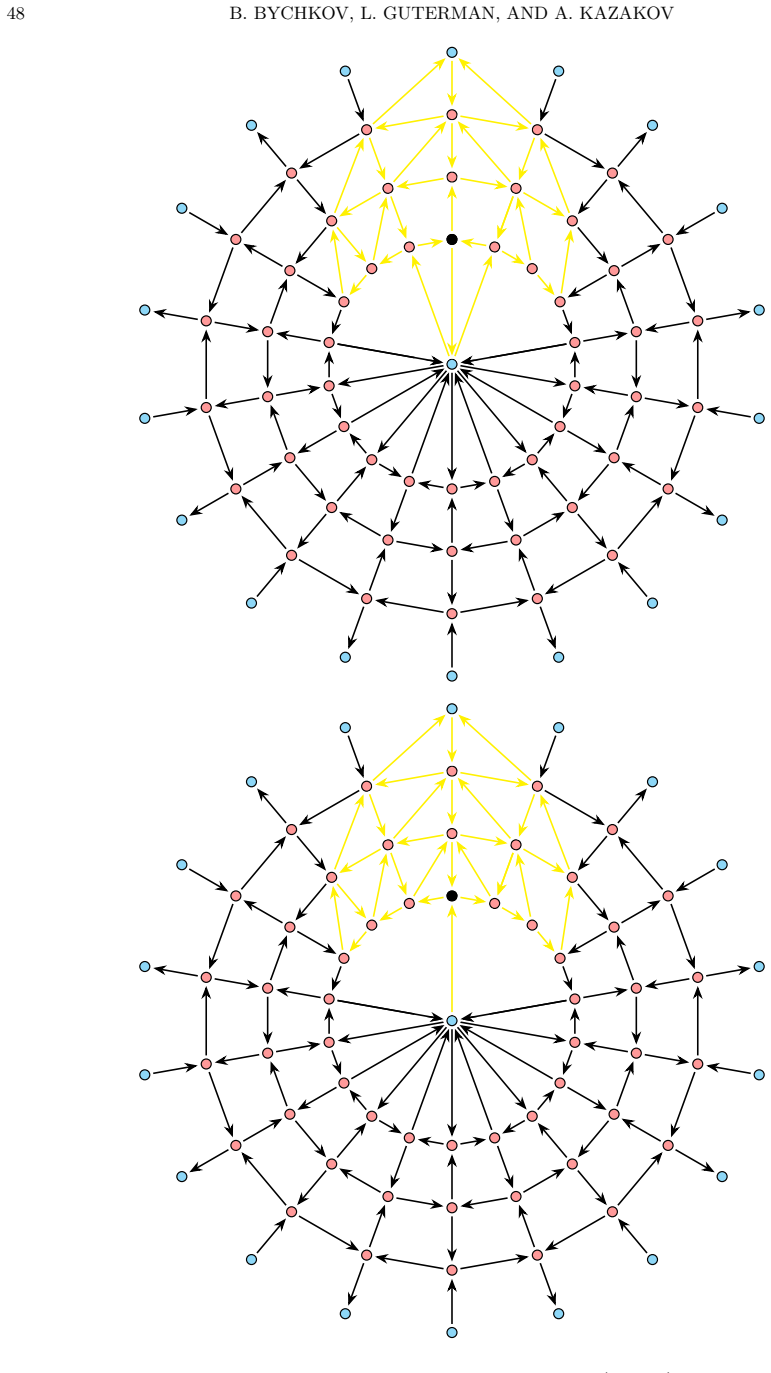
- Figure 18 juxtaposes the frozen/trivialized quivers for n=5; adding the corresponding figure for a larger odd n (e.g. n=7) would make the general pattern easier to verify by eye.
- Appendix B proves reachability of contiguous minors by an inductive “highest D-statistic” mutation sequence. A brief comparison with the Aztec-diamond condensations of Kenyon–Wilson would clarify the combinatorial origin of the construction.
- A few typographical inconsistencies appear: “plabic graph” versus “Postnikov arrangement”, occasional missing spaces around “mod”, and the dual use of CM_n for both the set of central pairs and the cluster algebra. Standardising the notation would improve readability.
Circularity Check
No significant circularity: independent seeds of Scott and Alman–Lian–Tran are compared by explicit combinatorial labelling; self-citations are black-box prior theorems.
full rationale
The central claims (Theorems 5.1, 5.3, 5.19 and Corollary 5.8) are obtained by constructing an explicit seed in Scott’s Grassmannian cluster algebra A_{n-1,2n} via generalised Temperley’s trick applied to the critical networks G_n, verifying by induction that the face labels are precisely the central circular pairs (formulae (12)–(15) and even-n analogues), and showing that after freezing/trivialising the n central vertices the resulting quiver coincides with the initial quiver of Alman–Lian–Tran’s CM_n. The isomorphism of seeds is therefore a concrete combinatorial identification, not a definitional tautology. Subsequent applications (positivity tests, Laurent phenomenon for contiguous minors, isomorphism of LM_n with the localisation of the grove algebra) follow from this identification together with already-published results of Scott, Lam, Kenyon–Wilson and Alman–Lian–Tran, which are used as black boxes. No parameter is fitted to data and later re-presented as a prediction; no uniqueness theorem is imported solely from the authors’ own prior work to force the present construction. The single minor self-citation load is the authors’ earlier geometric description of Lam’s image (used only for background), which is not required for the seed comparison itself. Hence the derivation is self-contained against external benchmarks and scores 1.
Assumptions & free parameters
assumptions (4)
- standard math Scott’s construction realises the coordinate ring of Gr(k,n) as a cluster algebra whose seeds are labelled by faces of reduced plabic graphs with Grassmann permutation (Theorem 4.14).
- domain assumption Lam’s embedding realises electrical networks as points of Gr_{≥0}(n-1,2n)∩PH whose Plücker coordinates are grove measurements (Theorems 2.12, 2.17).
- domain assumption The initial seed of CM_n / LM_n consists of central circular minors and the exchange relations are the Grassmann–Plücker identities of type (9) (Alman–Lian–Tran).
- domain assumption Response matrices of well-connected networks are precisely the circularly totally positive symmetric matrices with zero row sums (Curtis–Ingerman–Morrow).
Cite this review
Pith. "Pith review of Electrical networks, Grassmannians, and cluster algebras." pith.science (2026). https://pith.science/paper/KCM346KK
@misc{pith2026260709975,
  author       = {Pith},
  title        = {Pith review of: Electrical networks, Grassmannians, and cluster algebras},
  year         = {2026},
  howpublished = {\url{https://pith.science/paper/KCM346KK}},
  note         = {Machine review of arXiv:2607.09975}
}
abstract
The paper studies the problem of circular total positivity of the symmetric matrices with zero row sums. These matrices are exactly response matrices of the electrical networks. Alman, Lian and Tran described tests for circular total positivity in two related frameworks: the cluster algebra $\mathcal{CM}_n$ and the Laurent Phenomenon algebra $\mathcal{LM}_n$. Our first result is the construction of a seed in Scott's cluster algebra structure on the coordinate ring of the Grassmannian $\mathrm{Gr}(n-1,2n)$ that consists entirely of circular minors. We compare the cluster structure induced by this seed with $\mathcal{CM}_n$. In particular, for odd $n$ the cluster algebra structure $\mathcal{CM}_n$ is isomorphic to the cluster algebra structure on $\mathrm{Gr}(n-1,2n)$ subject to natural freezing and trivialization of certain cluster variables in their initial seeds. We use this isomorphism to relate circular total positivity to positivity in the Grassmannian. Our second result is that the Laurent Phenomenon algebra $\mathcal{LM}_n$ is isomorphic to the coordinate ring of the noncompactified space of electrical network, or equivalently, to a certain localization of the grove algebra.
Figures


Figures from the paper (23 more)







Reference graph
Works this paper leans on
-
[1]
Alman, C
J. Alman, C. Lian, and B. Tran,Circular planar electrical networks: posets and positivity, J. Combin. Theory Ser. A132(2015), 58–101
2015
- [2]
-
[3]
Berenstein, S
A. Berenstein, S. Fomin, and A. Zelevinsky,Cluster algebras. III. Upper bounds and double Bruhat cells, Duke Math. J.126(2005), no. 1, 1–52
2005
-
[4]
Berenstein, S
A. Berenstein, S. Fomin, and A. Zelevinsky,Parametrizations of canonical bases and totally positive matrices, Adv. Math.122(1996), no. 1, 49–149
1996
-
[5]
Borcea, V
L. Borcea, V. Druskin, and F. G. Vasquez,Electrical impedance tomography with resistor networks, Inverse Problems24(2008), no. 3, 035013
2008
-
[6]
Bychkov, V
B. Bychkov, V. Gorbounov, L. Guterman, and A. Kazakov,Symplectic geometry of electrical networks, J. Geom. Phys.207(2025), 105323
2025
-
[7]
Bychkov, V
B. Bychkov, V. Gorbounov, A. Kazakov, and D. Talalaev,Electrical networks, Lagrangian Grassmannians, and symplectic groups, Mosc. Math. J.23(2023), no. 2, 133–167
2023
-
[8]
Chaiken,A combinatorial proof of the all minors matrix tree theorem, SIAM J
S. Chaiken,A combinatorial proof of the all minors matrix tree theorem, SIAM J. Algebraic Discrete Methods3(1982), no. 3, 319–329
1982
Show all 45 references
-
[9]
Chepuri, T
S. Chepuri, T. George, and D. E. Speyer,Electrical networks and Lagrangian Grassmannians, Proc. Lond. Math. Soc. (3)125(2022), no. 5, 1103–1151
2022
-
[10]
E. B. Curtis and J. A. Morrow,Inverse Problems for Electrical Networks, Series on Applied Mathematics, vol. 13, World Scientific, 2000
2000
-
[11]
E. B. Curtis, D. Ingerman, and J. A. Morrow,Circular planar graphs and resistor networks, Linear Algebra Appl.283(1998), no. 1-3, 115–150
1998
-
[12]
Colin de Verdi` ere, I
Y. Colin de Verdi` ere, I. Gitler, and D. Vertigan: R´ eseaux ´ electriques planaires. II, Comment. Math. Helv., 71(1) (1996), 144–167
1996
-
[13]
Fomin, L
S. Fomin, L. Williams, and A. Zelevinsky,Introduction to Cluster Algebras, Chapters 1–3, arXiv:1608.05735
-
[14]
Fomin, L
S. Fomin, L. Williams, and A. Zelevinsky,Introduction to Cluster Algebras, Chapters 4–5, arXiv:1707.07190
-
[15]
Fomin, L
S. Fomin, L. Williams, and A. Zelevinsky,Introduction to Cluster Algebras, Chapter 6, arXiv:2008.09189
2008 arXiv
-
[16]
Fomin and A
S. Fomin and A. Zelevinsky,Double Bruhat cells and total positivity, J. Amer. Math. Soc.12 (1999), 335–380
1999
-
[17]
Fomin and A
S. Fomin and A. Zelevinsky,Cluster algebras I: Foundations, J. Amer. Math. Soc.15(2002), 497–529
2002
-
[18]
Fomin and A
S. Fomin and A. Zelevinsky,Cluster algebras II: Finite type classification, Invent. Math.154 (2003), 63–121
2003
-
[19]
Fomin and A
S. Fomin and A. Zelevinsky,Total positivity: tests and parametrizations, Math. Intelligencer 22(2000), 23–33
2000
-
[20]
Galashin,Amplituhedra and origami, arXiv:2410.09574 (2024)
P. Galashin,Amplituhedra and origami, arXiv:2410.09574 (2024)
2024 arXiv
-
[21]
Galashin and T
P. Galashin and T. Lam,Positroid varieties and cluster algebras, Ann. Sci. ´Ec. Norm. Sup´ er. (4)56(2023), no. 3, 859–884
2023
-
[22]
F. R. Gantmakher,The theory of matrices. American Mathematical Soc.131, 2000
2000
-
[23]
Y. Gao, T. Lam, and Z. Xu,Electrical networks and the Grove algebra, Canad. J. Math. (2024), 1–34
2024
-
[24]
George,The twist for electrical networks and the inverse problem, Int
T. George,The twist for electrical networks and the inverse problem, Int. Math. Res. Not., 2024(2024), no. 8, pp. 7001–7031
2024
-
[25]
Gorbounov and A
V. Gorbounov and A. Kazakov,Electrical networks and data analysis in phylogenetics, Data Analytics and Topology1(2025), no. 1, 33–45
2025
-
[26]
Jain,Novel relationships between circular planar graphs and electrical networks, PRIMES Report, 2015
V. Jain,Novel relationships between circular planar graphs and electrical networks, PRIMES Report, 2015. Available at https://math.mit.edu/research/highschool/ primes/materials/2015/Jain.pdf
2015
-
[27]
A. A. Kazakov,Inverse problems related to electrical networks and the geometry of non-negative Grassmannians, Physica D483(2025), 134948
2025
-
[28]
Kenyon and D
R. Kenyon and D. Wilson,Combinatorics of tripartite boundary connections for trees and dimers, Electron. J. Combin.16(2009), no. 1, Research Paper 112. 50 B. BYCHKOV, L. GUTERMAN, AND A. KAZAKOV
2009
-
[29]
Kenyon and D
R. Kenyon and D. Wilson,The space of circular planar electrical networks, SIAM J. Discrete Math.31(2017), no. 1, 1–28
2017
-
[30]
Kenyon,The Laplacian on planar graphs and graphs on surfaces, Current Developments in Mathematics2011(2012), 1–55
R. Kenyon,The Laplacian on planar graphs and graphs on surfaces, Current Developments in Mathematics2011(2012), 1–55
2012
-
[31]
E. H. Kuo,Applications of graphical condensation for enumerating matchings and tilings, Theoret. Comput. Sci.319(2004), no. 1-3, 29–57
2004
-
[32]
Lai,Proof of a conjecture of Kenyon and Wilson on semicontiguous minors, J
T. Lai,Proof of a conjecture of Kenyon and Wilson on semicontiguous minors, J. Combin. Theory Ser. A161(2019), 134–163
2019
-
[33]
Lam,Totally non-negative Grassmannian and Grassmann polytopes, Current Developments in Mathematics2014(2015)
T. Lam,Totally non-negative Grassmannian and Grassmann polytopes, Current Developments in Mathematics2014(2015)
2015
-
[34]
Lam,Electroid varieties and a compactification of the space of electrical networks, Adv
T. Lam,Electroid varieties and a compactification of the space of electrical networks, Adv. Math.338(2018), 549–600
2018
-
[35]
Lam and P
T. Lam and P. Pylyavskyy,Electrical networks and Lie theory, Algebra Number Theory9 (2015), no. 6, 1401–1418
2015
-
[36]
Lam and P
T. Lam and P. Pylyavskyy,Laurent phenomenon algebras, Camb. J. Math.4(2016), no. 1, 121–162
2016
-
[37]
C. A. Lombard´ ıa,The inverse problem on finite networks, Ph.D. thesis, Universidad de Zaragoza, 2014
2014
-
[38]
J. W. Moon,Some determinant expansions and the matrix-tree theorem, Discrete Math.124 (1994), no. 1-3, 163–171
1994
-
[39]
Muller and D
G. Muller and D. E. Speyer,The twist for positroid varieties, Proc. Lond. Math. Soc. (3)115 (2017), no. 5, 1014–1071
2017
-
[40]
S. Oh, A. Postnikov, and D. E. Speyer,Weak separation and plabic graphs, Proc. Lond. Math. Soc. (3)110(2015), no. 3, 721–754
2015
-
[41]
M. F. Paulos and B. U. W. Schwab,Cluster algebras and the positive Grassmannian, J. High Energy Phys.2014(2014), no. 10, 31
2014
-
[42]
Postnikov,Total positivity, Grassmannians, and networks, arXiv:math/0609764 (2006)
A. Postnikov,Total positivity, Grassmannians, and networks, arXiv:math/0609764 (2006)
2006 arXiv
-
[43]
J. S. Scott,Grassmannians and cluster algebras, Proc. Lond. Math. Soc. (3)92(2006), no. 2, 345–380
2006
-
[44]
D. G. Wagner,Combinatorics of electrical networks, Lecture Notes, Dept. of C&O, University of Waterloo, 2009
2009
-
[45]
Zelevinsky,Connected components of real double Bruhat cells, Int
A. Zelevinsky,Connected components of real double Bruhat cells, Int. Math. Res. Not.2000 (2000), no. 21, 1131–1153. B. B.: Department of Mathematics, University of Haifa, Mount Carmel, 3498838, Haifa, Israel Email address:bbychkov@hse.ru L. G.: Einstein Institute of Mathematic...
2000
Reviewed July 14, 2026 · model on record in the stance chip above.
Discussion (0). Continue with ORCID to comment.