REVIEW 4 major objections 7 minor 53 references
Learning Compact Target-Oriented Feature Representations for Visual Tracking
T0 review · 4 major / 7 minor · reviewed 2026-08-14 · deepseek-v4-flash
Pith's one-line read The paper claims that jointly learning a Laplacian feature code and the correlation filter produces a compact, target-oriented representation that tracks better than using raw deep features.
desk verdict The joint coding-plus-DCF idea is new and cleanly formulated, but the tracker as written never uses the learned code at test time, so the paper's central claim is untested by its own equations. read the letter →
The pith
A machine-rendered reading of the paper's core claim, the machinery that carries it, and where it could break.
The reading
What carries the argument
The load-bearing object is the joint objective in Eq. (6): minimize over the coding matrix $Z$ and the dual filter variable $u$ the dual correlation-filter loss plus a Laplacian regularization $\gamma\,\mathrm{tr}(ZLZ^\top)$, under the reconstruction constraint $X = BZ$, with the encoded feature $Zc$ feeding the circulant matrix $S(Zc)$. The Laplacian term encodes locality and similarity among local features, and ADMM splits the problem into three convex subproblems solved by NAG and FFT. The codebook $B$ is built once by dictionary learning on the first frame.
What would settle it
Take a sequence with strong gradual appearance change, such as a target rotating and changing lighting, track with the published fixed-codebook setting, and compare against the same model but rebuilding or updating the codebook every few frames. If the fixed-codebook version loses the target significantly earlier while the updated version stays on it, the assumption fails. A cheaper check is to measure the nearest-neighbor consistency of codes for the same target patch across appearance changes and see whether similar patches produce dissimilar codes.
Extended reading notes
Core claim
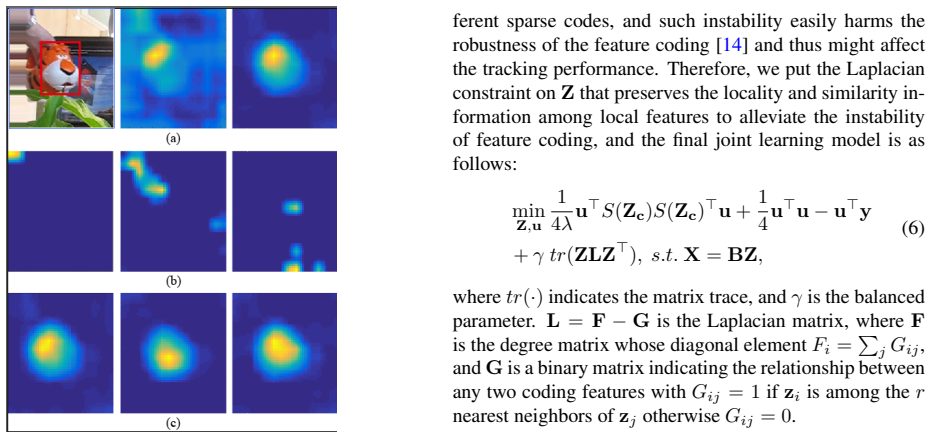
The central claim is that filter learning and feature coding should be one optimization, not two. The paper encodes each target patch as a combination of codebook atoms, feeds the code as the correlation filter's input channels, and in the same objective (Eq. (6)) fits the filter, the code, and a Laplacian prior that keeps nearby local features encoded similarly. The result, per the paper, is a feature map whose channels concentrate on different parts of the target and suppress background, so the filter becomes less sensitive to redundancy and noise in the original deep features.
Load-bearing premise
The load-bearing premise is that a codebook built from the first frame and never updated stays good enough for the whole sequence: the paper asserts, without verifying, that appearance changes still encode similarly on this fixed dictionary, so tracking quality is not harmed.
Editorial extensions
If this is right
- Replacing raw deep features with Laplacian codes of dimension $k=10$ removes most of the 512-channel noise while still improving filter discrimination, so lower-dimensional inputs need not hurt tracking.
- Joint optimization contributes more than the coding alone: the ablation shows a clear drop when coding and filter are learned separately.
- The unified framework keeps runtime close to the baseline, because ADMM converges in about two iterations and the added optimization is a small fraction of the frame time.
- The coding step applies to multi-layer features and, the paper argues, even to low-dimensional features such as HOG or gray values, which PCA-based compression cannot improve.
Reading between the lines
- The same joint-coding trick could be dropped into any circulant-shift learner, such as scale filters or re-detection filters, not just the translation filter, since the solver is generic to the dual correlation-filter form.
- Because the codebook is fixed after the first frame, an online dictionary-update rule based on confident frames is a natural cheap test and may extend tracking to longer appearance drifts.
- The small number of learned channels behaves like a set of part detectors; inspecting which patch regions activate each channel could give a quantitative link between tracking robustness and feature interpretability.
Signed reviews
Editorial analysis
A structured set of objections, weighed in public.
Referee Report
Summary. The paper proposes FOF, a correlation-filter tracker that learns a compact, target-oriented code Z of deep CNN features via Laplacian coding, jointly with the dual correlation filter. The central model (Eq. (6)) minimizes a DCF objective expressed on the encoded features p=Zc, plus a Laplacian regularizer on Z, subject to the reconstruction constraint X=BZ and the relation p=Zc. The optimization is carried out by ADMM; the Z-subproblem is solved by NAG, while the p- and u-subproblems have closed-form Fourier solutions. The complete tracker adds model updating, EdgeBox-based re-detection, and scale estimation to the HCF baseline, and is evaluated on OTB50, OTB100, and VOT2016. The paper reports consistent gains over HCF and state-of-the-art or comparable results, with ablation and sensitivity studies. The main technical concern, discussed below, is that the inference equations in Section 5.1 appear to operate on raw features rather than the learned code.
Significance. If the joint coding/filter model is genuinely the mechanism behind the reported results, this is a worthwhile contribution: it is, to the authors' knowledge, the first attempt to bring bag-of-features coding into DCF tracking, and the ADMM derivation is standard and the per-iteration cost is plausibly modest. The paper presents a fairly complete evaluation: three benchmarks, comparisons to strong baselines, an ablation study, parameter sensitivity, and a complexity analysis. The main issue is that the test-time pipeline in Section 5.1, as written, uses raw features, so the experiments do not yet establish that the reported gains come from the learned representation. Until this discrepancy is resolved, the quantitative claims cannot be interpreted as support for the proposed model.
major comments (4)
- [Section 5.1, Eqs. (16)-(17), Algorithm 1] The model update and detection are written on raw features. Eq. (16) updates the appearance model with F(x), and Eq. (17) computes the response as F^{-1}(F(\bar u) \odot \sum_d F(x^d \odot \bar x^d)), where x is the raw image-patch feature defined in Sections 3-4.1. No step in Algorithm 1 encodes the test patch with the codebook B, and the sum in Eq. (17) runs over the D raw channels, while the dual filter \bar u was trained on the k-channel encoded representation p=Zc in Eq. (14). As written, the learned code Z is not used at test time, so the reported PR/SR gains over HCF cannot be attributed to the joint feature-coding model; they could stem entirely from the added re-detection and scale modules. Please specify how the test features are encoded and use them in Eqs. (16)-(17), or, if the experiments actually apply the filter to raw features, state this and revise the attribution of the gains.
- [Section 4.1, Eq. (6); Algorithm 1, line 5] The Laplacian matrix in the model is defined on the coding features Z (G_{ij}=1 if z_i is among the r nearest neighbors of z_j), but Algorithm 1 computes L_t using the raw features X_t and then solves Eq. (6) with this fixed L. The implemented objective is therefore \gamma tr(Z L_X Z^T) rather than the stated \gamma tr(Z L_Z Z^T). This changes the regularizer and undermines the claim of 'Laplacian coding' on the learned codes. The authors should either define the graph on the raw features and justify that choice, or compute the graph from Z during the optimization; the current description is not reproducible.
- [Section 4.3] The codebook B is built from the first frame and never updated. The paper justifies this by asserting that 'the pattern across different frames would encode similar features on the fixed dictionary,' but no experiment or analysis supports this assumption. On sequences with substantial appearance change, a fixed codebook may not represent the target well, so the robustness of the learned coding is unverified. Please provide evidence (e.g., an attribute-based breakdown or tracking success as a function of appearance-change severity) or discuss conditions under which the fixed codebook fails.
- [Section 6.5, ablation study] The key ablation 'noJL' is described as first performing feature coding and then training the correlation filter, but the text does not state whether this variant (and the full FOF) uses the encoded features at detection. If both variants use the raw-feature response of Eq. (17), the comparison mostly reflects differences in filter training, not joint coding at inference. In addition, the text says 'FOF over FOF-noJR' (presumably FOF-noJL), and Figure 4 is referenced without reporting its numeric values in the text. Please report the full ablation numbers and specify the inference pipeline for each variant.
minor comments (7)
- [Section 4.1] The text says 'cookbook' where it should say 'codebook'.
- [Section 6.1 and Table 3] The default \gamma is reported as 0.8, but Table 3's sensitivity analysis varies \gamma over 5, 10, and 15; please reconcile these values.
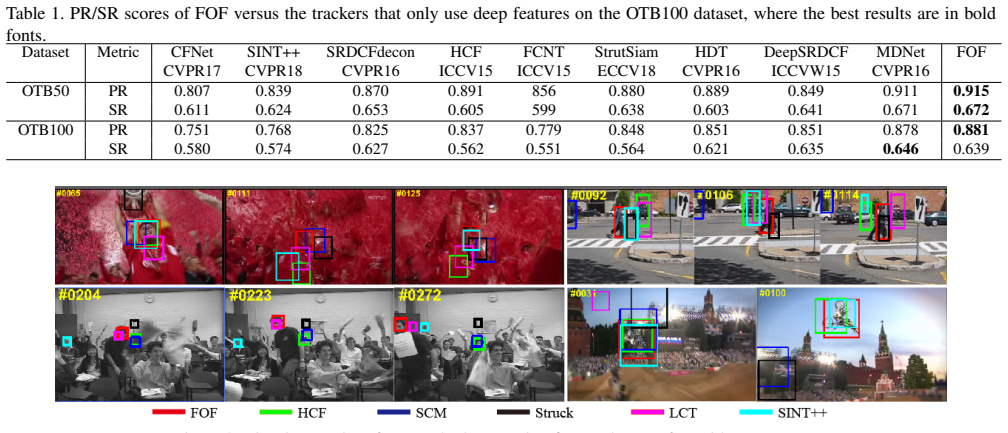
- [Table 1, OTB50 row] The FCNT entries '856' and '599' are missing the leading '0.' (presumably 0.856 and 0.599).
- [Section 4.2, Eq. (13)] The closed-form update for \hat{p} appears to omit the 1/(MN) normalization that Parseval's theorem introduces in the \ell_2 term; please clarify whether this factor is absorbed into \mu or \lambda.
- [Section 4.2, complexity analysis] The stated O(k^3 N_J D M N) for the Z-subproblem is difficult to reconcile with the precomputation of B^T B and the NAG iterations; please provide the per-iteration cost with the actual matrix sizes.
- [Section 6.5, Figure 4] Figure 4 is not visible in the manuscript text, so the reader cannot verify the claimed 2.9%/2.2% improvement without the figure or a table.
- [Section 1 and Section 6.5] The paper states that source codes and experimental results 'would be available online,' but this version provides no URL or release details, which limits reproducibility.
Circularity Check
No circular reduction; the joint feature-coding/CF model is evaluated against external benchmarks, not derived from its own outputs.
full rationale
The paper's central claim is that jointly optimizing the feature code Z and dual correlation filter u in Eq. (6) yields a more compact, discriminative, target-oriented representation. The derivation is a genuine optimization over X=BZ with a Laplacian regularizer and DCF objective; the output Z is a function of the input features, the first-frame codebook B, and labels y, not a renamed version of the benchmark scores. Codebook construction (Section 4.3) uses first-frame dictionary learning [19] and is fixed, but that is a design choice, not a loaded parameter. Hyperparameters (λ, γ, k) are set on OTB100 and checked for sensitivity (Tables 3 and 4), and the method is then compared on OTB50, OTB100 and VOT2016; no fitted value is relabeled as a prediction. The self-citations ([17], [22]–[25]) are background/related-work references; [17] supports general feature-coding advantages and is not used to justify the joint model. No uniqueness theorem or ansatz is imported from the authors' prior work. The strongest concern—that test-time equations (16)–(17) update the appearance model with raw feature x and compute responses without explicitly re-encoding through B—is a potential internal-consistency or attribution problem, not a circular equivalence; the claimed result is not true by construction from its inputs. Hence circularity score 0.
Assumptions & free parameters
free parameters (6)
- λ (regularization) =
0.5
- γ (Laplacian balance) =
0.8
- k (codebook size) =
10
- r (nearest neighbors for Laplacian graph) =
not reported
- NI (ADMM iterations) =
2
- NJ (NAG iterations) =
3
assumptions (5)
- standard math Circulant matrix S(x) is diagonalized by the Fourier transform.
- domain assumption A good codebook B can be learned from the first frame using the dictionary learning algorithm of Jenatton et al.
- ad hoc to paper The fixed codebook remains valid for later frames.
- ad hoc to paper The Laplacian graph built from raw features X is a valid substitute for the graph built from coding features Z.
- domain assumption A few iterations of ADMM and NAG suffice for near-optimal solutions.
Cite this review
Pith. "Pith review of Learning Compact Target-Oriented Feature Representations for Visual Tracking." pith.science (2026). https://pith.science/paper/KDADH7WY
@misc{pith2026190801442,
  author       = {Pith},
  title        = {Pith review of: Learning Compact Target-Oriented Feature Representations for Visual Tracking},
  year         = {2026},
  howpublished = {\url{https://pith.science/paper/KDADH7WY}},
  note         = {Machine review of arXiv:1908.01442}
}
read the original abstract
Many state-of-the-art trackers usually resort to the pretrained convolutional neural network (CNN) model for correlation filtering, in which deep features could usually be redundant, noisy and less discriminative for some certain instances, and the tracking performance might thus be affected. To handle this problem, we propose a novel approach, which takes both advantages of good generalization of generative models and excellent discrimination of discriminative models, for visual tracking. In particular, we learn compact, discriminative and target-oriented feature representations using the Laplacian coding algorithm that exploits the dependence among the input local features in a discriminative correlation filter framework. The feature representations and the correlation filter are jointly learnt to enhance to each other via a fast solver which only has very slight computational burden on the tracking speed. Extensive experiments on three benchmark datasets demonstrate that this proposed framework clearly outperforms baseline trackers with a modest impact on the frame rate, and performs comparably against the state-of-the-art methods.
Figures

Figures from the paper (1 more)

Reference graph
Works this paper leans on
-
[1]
L. Bertinetto, J. Valmadre, S. Golodetz, O. Miksik, and P. H. Torr. Staple: complementary learners for real-time tracking. In CVPR, 2016. 2
work page 2016
-
[2]
L. Bertinetto, J. Valmadre, J. Henriques, and P. Torr. Fully convolutional siamese networks for object tracking. In ECCV Workshops, 2016. 8
work page 2016
-
[3]
D. S. Bolme, J. R. Beveridge, B. A. Draper, and Y . M. Lui. Visual object tracking using adaptive correlation filters. In CVPR, 2010. 2
work page 2010
-
[4]
S. Boyd, N. Parikh, E. Chu, B. Peleato, and J. Eckstein. Dis- tributed optimization and statistical learning via the alternat- ing direction method of multipliers. Foundations and Trends in Machine Learning, 3(1):1–122, 2011. 4, 5
work page 2011
-
[5]
M. Danelljan, G. Bhat, F. Khan, and M. Felsberg. Eco: Effi- cient convolution operators for tracking. In CVPR, 2017. 1, 2, 6
work page 2017
-
[6]
M. Danelljan, G. Hager, F. Khan, and M. Felsberg. Convolu- tional features for correlation filter based visual tracking. In ICCV Workshops, 2015. 7
work page 2015
-
[7]
M. Danelljan, G. Hager, F. S. Khan, and M. Felsberg. Learn- ing spatially regularized correlation filters for visual track- ing. In ICCV, 2015. 2, 8
work page 2015
-
[8]
M. Danelljan, G. Hager, F. S. Khan, and M. Felsberg. Adap- tive decontamination of the training set: A unified formula- tion for discriminative visual tracking. In CVPR, 2016. 7
work page 2016
Show all 53 references
-
[9]
Danelljan, G
M. Danelljan, G. Hager, F. S. Khan, and M. Felsberg. Dis- criminative scale space tracking. IEEE TPAMI, 39(8):1561– 1575, 2017. 2
2017
-
[10]
Danelljan, F
M. Danelljan, F. S. Khan, M. Felsberg, and J. van de Weijer. Adaptive color attributes for real-time visual tracking. In CVPR, 2014. 6
2014
-
[11]
Danelljan, A
M. Danelljan, A. Robinson, F. S. Khan, and M. Felsberg. Beyond correlation filters: Learning continuous convolution operators for visual tracking. In ECCV, 2016. 1, 2
2016
-
[12]
M. Ding, L. Wei, Y . Cao, J. Wang, and L. Cao. Visual track- ing using locality-constrained linear coding under a particle filtering framework. IET Computer Vision, 12(2):196–207,
-
[13]
H. K. Galoogahi, A. Fagg, and S. Lucey. Learning background-aware correlation filters for visual tracking. In ICCV, 2017. 2
2017
-
[14]
S. Gao, I. W.-H. Tsang, and L.-T. Chia. Laplacian sparse coding, hypergraph laplacian sparse coding,and applications. IEEE TPAMI, 35(1):92–104, 2013. 2, 3, 4
2013
-
[15]
S. Hare, A. Saffari, and P. H. S. Torr. Struck: Structured output tracking with kernels. In ICCV, 2011. 7
2011
-
[16]
J. F. Henriques, R. Caseiro, P. Martins, and J. Batista. High- speed tracking with kernelized correlation filters. IEEE TPAMI, 37(3):583–596, 2015. 1, 2, 3, 5
2015
-
[17]
Huang, Z
Y . Huang, Z. Wu, L. Wang, and T. Tan. Feature coding in image classification: A comprehensive study. IEEE TPAMI, 36(3):493–506, 2014. 2, 3
2014
-
[18]
Jegou, F
H. Jegou, F. Perronnin, M. Douze, J. Sanchez, P. Perez, and C. Schmid. Aggregating local image descriptors into com- pact codes. IEEE TPAMI, 34(9):1704–1716, 2012. 3
2012
-
[19]
Jenatton, J
R. Jenatton, J. Mairal, G. Obozinski, and F. Bach. Proxi- mal methods for sparse hierarchical dictionary learning. In ICML, 2010. 5
2010
-
[20]
Kristan, A
M. Kristan, A. Leonoardis, and et al. The visual object track- ing vot2016 challenge results. In ECCV Workshops, 2016. 6, 7, 8
2016
-
[21]
J. A. Lasserre, C. M. Bishop, and T. P. Minka. Principled hybrids of generative and discriminative models. In CVPR,
-
[22]
C. Li, H. Cheng, S. Hu, X. Liu, J. Tang, and L. Lin. Learn- ing collaborative sparse representation for grayscale-thermal tracking. IEEE TIP, 25(12):5743–5756, 2016. 2
2016
-
[23]
C. Li, X. Liang, Y . Lu, N. Zhao, and J. Tang. Rgb-t object tracking: Benchmark and baseline. PR, 2019. 2
2019
-
[24]
C. Li, L. Lin, W. Zuo, J. Tang, and M.-H. Yang. Visual tracking via dynamic graph learning. IEEE TPAMI, 2019. 2
2019
-
[25]
C. Li, C. Zhu, Y . Huang, J. Tang, and L. Wang. Cross-modal ranking with soft-consistency and noisy labels for robust rgb- t tracking. In ECCV, 2018. 2
2018
-
[26]
F. Li, Y . Yao, P. Li, W. Z. D. Zhang, and M. H. Yang. In- tegrating boundary and center correlation filters for visual tracking with aspect ratio variation. In ICCV Workshops,
-
[27]
B. Liu, J. Huang, L. Yang, and C. Kulikowsk. Robust track- ing using local sparse appearance model and k-selection. In CVPR, 2011. 2, 3, 6
2011
-
[28]
S. Liu, T. Zhang, X. Cao, and C. Xu. Structural correlation filter for robust visual tracking. In CVPR, 2016. 2
2016
-
[29]
T. Liu, G. Wang, and Q. Yang. Real-time part-based visual tracking via adaptive correlation filters. In CVPR, 2015. 2
2015
-
[30]
Lukezic, T
A. Lukezic, T. V ojir, L. C. Zajc, J. Matas, and M. Kristan. Discriminative correlation filter with channel and spatial re- liability. In CVPR, 2016. 2
2016
-
[31]
Ma, J.-B
C. Ma, J.-B. Huang, X. Yang, and M.-H. Yang. Hierarchical convolutional features for visual tracking. In ICCV, 2015. 1, 2, 7, 8
2015
-
[32]
Ma, J.-B
C. Ma, J.-B. Huang, X. Yang, and M.-H. Yang. Robust vi- sual tracking via hierarchical convolutional features. IEEE TPAMI, 2018. 6
2018
-
[33]
C. Ma, X. Yang, C. Zhang, and M.-H. Yang. Long-term correlation tracking. In CVPR, 2015. 6, 7
2015
-
[34]
Mueller, N
M. Mueller, N. Smith, and B. Ghanem. Context-aware cor- relation filter tracking. In CVPR, 2017. 2
2017
-
[35]
Nam and B
H. Nam and B. Han. Learning multi-domain convolutional neural networks for visual tracking. In CVPR, 2016. 1, 2, 7, 8
2016
-
[36]
A. Y . Ng and M. I. Jordan. n discriminative vs. generative classifiers: A comparison of logistic regression and naive bayes. In NIPS, 2001. 1
2001
-
[37]
Y . Qi, S. Zhang, L. Qin, H. Yao, Q. Huang, J. Lim, and M.-H. Yang. Hedged deep tracking. CVPR, 2016. 7
2016
-
[38]
S. Ruder. An overview of gradient descent optimization al- gorithms. arXiv:1609.04747, 2016. 5
2016 arXiv
-
[39]
Simonyan and A
K. Simonyan and A. Zisserman. Very deep convolutional networks for large-scale image recognition. In ICLR, 2015. 2, 4
2015
-
[40]
Sui and Y
Y . Sui and Y . T. L. Zhang. Discriminative low-rank tracking. In ICCV, 2015. 1
2015
-
[41]
Valmadre, L
J. Valmadre, L. Bertinetto, J. Henriques, A. Vedaldi, and P. H. S. Torr. End-to-end representation learning for cor- relation filter based tracking. In CVPR, 2017. 7
2017
-
[42]
G. Wang, X. Qin, F. Zhong, Y . Liu, H. Li, Q. Peng, and M.- H. Yang. Visual tracking via sparse and local linear coding. IEEE TIP, 24(11):3796–3809, 2015. 2, 3, 6
2015
-
[43]
L. Wang, W. Ouyang, X. Wang, and H. Lu. Visual tracking with fully convolutional networks. In ICCV, 2015. 7
2015
-
[44]
X. Wang, C. Li, B. Luo, and J. Tang. Sint++: Robust vi- sual tracking via adversarial positive instance generation. In CVPR, 2018. 7
2018
-
[45]
Y . Wu, J. Lim, and M.-H. Yang. Online object tracking: A benchmark. In CVPR, 2013. 6
2013
-
[46]
Y . Wu, J. Lim, and M.-H. Yang. Object tracking benchmark. IEEE TPAMI, 2015. 4, 6
2015
-
[47]
Xu and W
Y . Xu and W. Yin. A block coordinate descent method for regularized multiconvex optimization with applications to nonnegative tensor factorization and completion. SIAM Journal on imaging sciences, 6(3):1758–1789, 2013. 5
2013
-
[48]
Zhang, X
S. Zhang, X. Lan, H. Yao, H. Zhou, D. Tao, and X. Li. A bi- ologically inspired appearance model for robust visual track- ing. IEEE TNNLS, 28(10):2357–2370, 2017. 2, 3, 6
2017
-
[49]
Zhang, H
S. Zhang, H. Yao, X. Sun, and X. Lu. Sparse coding based visual tracking: Review and experimental comparison. PR, 46(7):1772–1788, 2013. 3, 6
2013
-
[50]
Zhang, L
Y . Zhang, L. Wang, J. Qi, D. Wang, and M. Feng. Structured siamese network for real-time visual tracking. In ECCV,
-
[51]
Zhong, H
W. Zhong, H. Lu, and M.-H. Yang. Robust object tracking via sparsity-based collaborative model. In CVPR, 2012. 1, 2, 3, 6, 7
2012
-
[52]
Zhuang, H
B. Zhuang, H. Lu, Z. Xiao, and D. Wang. Visual tracking via discriminative sparse similarity map.IEEE TIP, 23(4):1872– 1881, 2014. 2
2014
-
[53]
C. L. Zitnick and P. Dollar. Edge boxes: Locating object proposals from edges. In ECCV, 2014. 6
2014
Reviewed August 14, 2026 · model on record in the stance chip above.
Discussion (0). Continue with ORCID to comment.