REVIEW 4 major objections 6 minor 43 references
Error Bounded Foreground and Background Modeling for Moving Object Detection in Satellite Videos
T0 review · 4 major / 6 minor · reviewed 2026-08-14 · deepseek-v4-flash
Pith's one-line read Adding a bounded residual matrix to low-rank background/foreground decomposition lifts moving-object detection precision on satellite video.
desk verdict A modest, honest extension of LSD with an explicit residual term; the main flaw is that the ADMM schedule leaves the proven convergence region, so the reported numbers may describe the solver more than the model. read the letter →
The pith
A machine-rendered reading of the paper's core claim, the machinery that carries it, and where it could break.
The reading
What carries the argument
The central object is the three-matrix decomposition $D = B + S + E$, solved by the Alternating Direction Method of Multipliers. The nuclear norm $\|B\|_*$ relaxes the rank constraint, the structured sparsity-inducing norm $\|S\|_{\ell_1/\ell_\infty}$ penalizes foreground patterns whose nonzero pixels are scattered rather than clustered, and the squared Frobenius term $\|E\|_F^2$ bounds the residuals. The solver alternates singular value thresholding for $B$, a dual reformulation of the structured-sparsity update as a quadratic min-cost network-flow problem for $S$, and a closed-form update for $E$; the convergence claim rests on three-block ADMM analysis for a strongly convex block.
What would settle it
Run E-LSD on a synthetic video whose true background is a known low-rank matrix and whose foreground is a known set of small moving blobs, and compare the recovered $B$, $S$, $E$ against ground truth as the ADMM penalty is raised from inside to far outside the proven range; if the iterates stop at visibly wrong decompositions while smaller penalties succeed, the empirical penalty enlargement at the heart of the method is unsafe.
Extended reading notes
Core claim
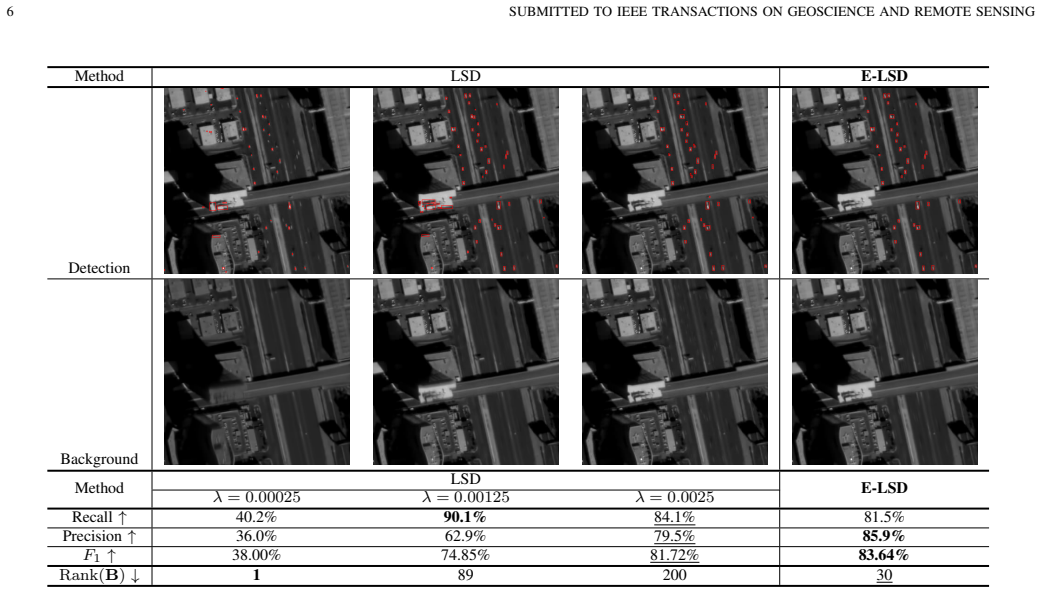
The paper's central claim is that the failure of low-rank-plus-sparse decomposition on satellite video is not a weakness of the low-rank or the sparsity assumptions themselves but a missing model component: data that obey neither assumption. E-LSD therefore decomposes the observed frames as $D = B + S + E$ and minimizes the nuclear norm of $B$, a structured sparsity-inducing norm on $S$, and the squared Frobenius norm of $E$, subject to exact equality. The residual matrix $E$ absorbs transient artifacts such as noise, parallax, and illumination shifts, allowing $B$ to stay genuinely low-rank and $S$ to stay spatially coherent. Empirically the paper demonstrates on two satellite videos that E-LSD raises detection precision, lowers the rank of the estimated background from hundreds to tens, and reaches the same stopping criterion in fewer ADMM iterations than the original LSD. In the limit of an infinitely heavy penalty on $E$ the formulation reduces to LSD, so E-LSD is a strict generalization rather than a different model.
Load-bearing premise
The solver's proven convergence covers only a narrow range of penalty values, and the paper relies on the empirical premise that raising the penalty far beyond that range still lands on the true solution rather than a misleading decomposition.
Editorial extensions
If this is right
- Low-contrast, few-pixel moving objects in satellite footage become detectable with fewer false alarms, because residuals no longer leak into the foreground mask.
- The estimated background rank drops sharply (from hundreds to tens on both test videos), indicating a cleaner subspace for subsequent change detection and tracking.
- E-LSD reaches the same relative reconstruction error in about 20 fewer iterations than LSD, cutting wall-clock time by roughly a factor of three in the reported experiments.
- Since the model reduces to LSD when the residual penalty is large, any scene where LSD already works inherits the same behavior, making E-LSD a safe drop-in extension.
Reading between the lines
- Editorial inference: a temporal smoothness prior on $E$ could separate slow illumination drift from moving targets, since $E$ is currently estimated frame-by-frame without temporal constraints.
- Editorial inference: the same residual-absorption mechanism should help other small-target wide-area motion imagery, including high-altitude aerial video, whenever target contrast is near the noise floor.
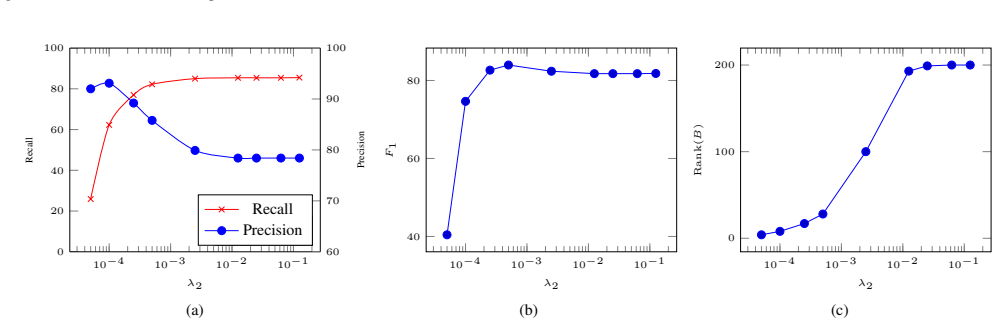
- Editorial inference: the reported sensitivity of background rank to the residual weight suggests a no-ground-truth tuning rule—scan the weight from large to small and stop where rank stops decreasing—which the paper does not state.
- Editorial inference: the convergence advantage over LSD is likely to grow with residual magnitude, a prediction testable on synthetic data by injecting controlled noise levels and comparing iteration counts.
Signed reviews
Editorial analysis
A structured set of objections, weighed in public.
Referee Report
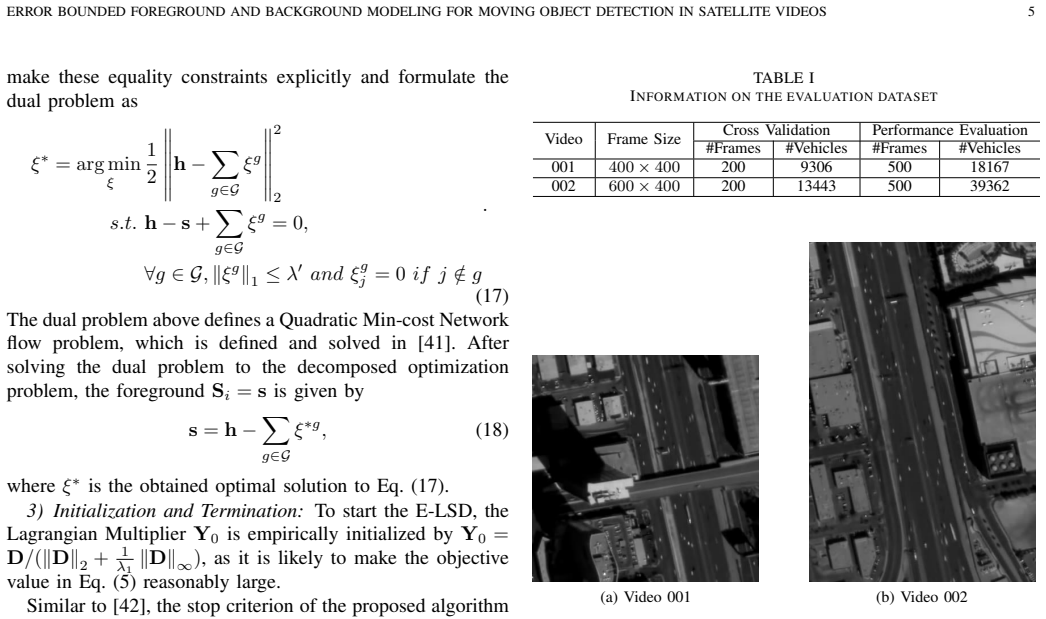
Summary. The paper addresses moving object detection in low-resolution satellite videos by extending the Low-rank and Structured Sparse Decomposition (LSD) model with an explicit residual term. The proposed E-LSD formulation decomposes the video matrix D into a low-rank background B, a structured-sparse foreground S, and a residual matrix E, with a squared-Frobenius penalty on E, and solves the resulting convex problem by a direct extension of ADMM. The authors claim that handling residuals explicitly yields cleaner background estimates, higher detection precision, and faster convergence than LSD, and they report experiments on two satellite videos (Video 001 and Video 002) comparing E-LSD with RPCA-PCP, GoDec, DECOLOR, and LSD.
Significance. If the central claims hold, the paper makes a useful practical contribution: it identifies a real limitation of low-rank-plus-structured-sparse decomposition on low-contrast satellite data and proposes a simple, convex remedy that is solvable with standard tools. The formulation is clearly motivated, the subproblems are standard (singular value thresholding and network-flow-based structured-sparsity projection), and the paper explicitly discusses parameter sensitivity. However, the validation is thin: only two videos from one satellite, no error bars or statistical tests, and the convergence of the proposed ADMM schedule is not supported by the cited theory. The significance is therefore conditional on closing the convergence gap and broadening the empirical evidence.
major comments (4)
- [Section II-C, Algorithm 1 and Eq. (20)] The convergence guarantee cited from [36] holds only for μ in (0, 7λ2/8), but Algorithm 1 initializes μ > 1 and increases it to μ × 1e5; with the experimental setting λ2 = λ1/5 and λ1 = 1/√p, the algorithm operates far outside the proven range. The stop criterion Eq. (20) checks only the primal residual ‖D−B−S−E‖_F/‖D‖_F, not stationarity. Consequently, the reported B, S, and E may not be minimizers of Eq. (4), and the rank and precision numbers in Table II could be properties of the penalty schedule rather than of the E-LSD model. Please provide a convergence proof for the actual μ schedule, or report dual residual/KKT-violation curves for the specific runs and verify that the reported solutions are stationary points.
- [Section II-B, Eqs. (3) and (4)] The bounded-error constraint in Eq. (3) is replaced by the penalized formulation in Eq. (4), but the paper does not establish an equivalence or a quantitative relationship between the parameter λ2 and the bound ζ; ζ never appears again in the algorithm or experiments. As written, E-LSD solves a penalized problem, not the constrained problem announced in the title and motivation. Please either state the exact relationship for which the two formulations coincide, or present E-LSD directly as a penalized model and adjust the claims accordingly.
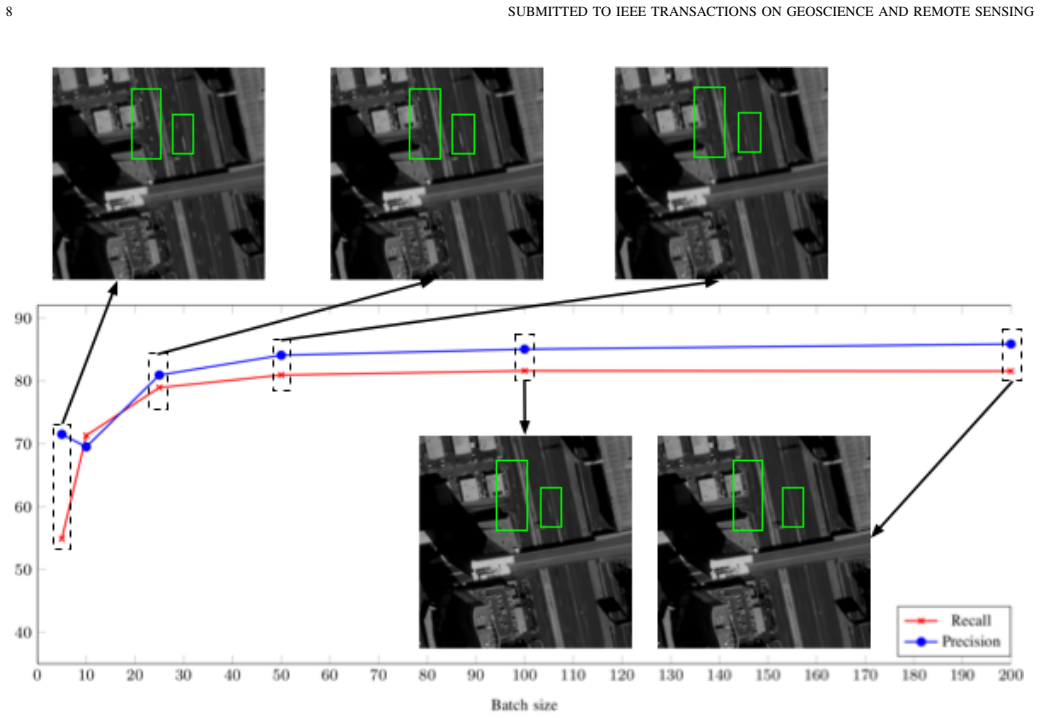
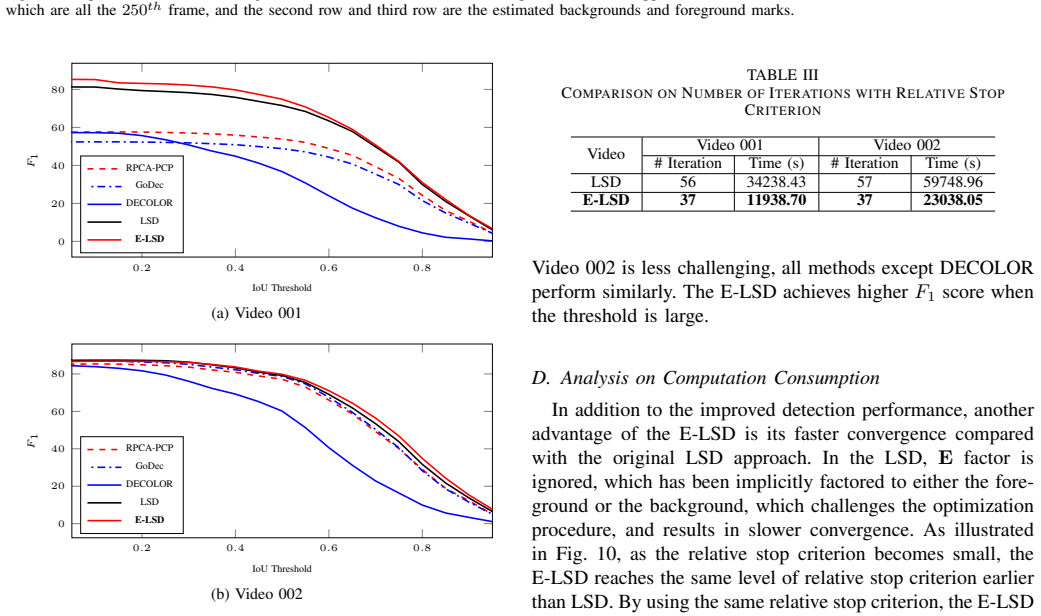
- [Section III-C, Table II] The experimental validation is limited to two videos from the same satellite, with a single run per method and no error bars or statistical tests. The precision improvement on Video 001 is notable, but on Video 002 E-LSD has lower recall than LSD (79.6% vs. 82.2%) and essentially unchanged F1 (86.13% vs. 86.31%). The paper should temper the 'improved detection' claim, discuss the precision/recall trade-off explicitly, and ideally report variability across runs or additional satellite video sequences.
- [Section III-A and III-C, rank(B) as a background-quality metric] Low rank of the estimated background is used as a proxy for background modeling quality, but Table II shows that RPCA-PCP and GoDec achieve rank 2 with much worse detection performance, while E-LSD reports rank 65 and 76. Rank alone is therefore not a reliable indicator of background quality. The background-modeling improvement should be supported by a more direct measure, such as reconstruction error on known static regions, quantitative residual statistics, or a systematic visual evaluation, rather than rank and a single example.
minor comments (6)
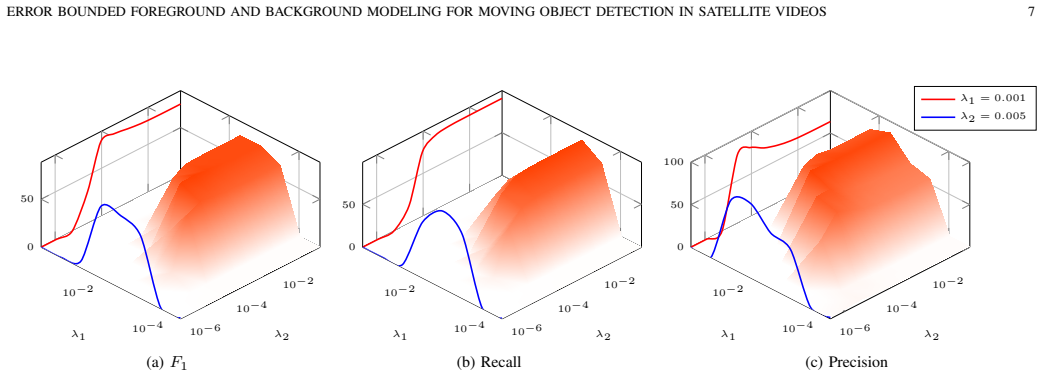
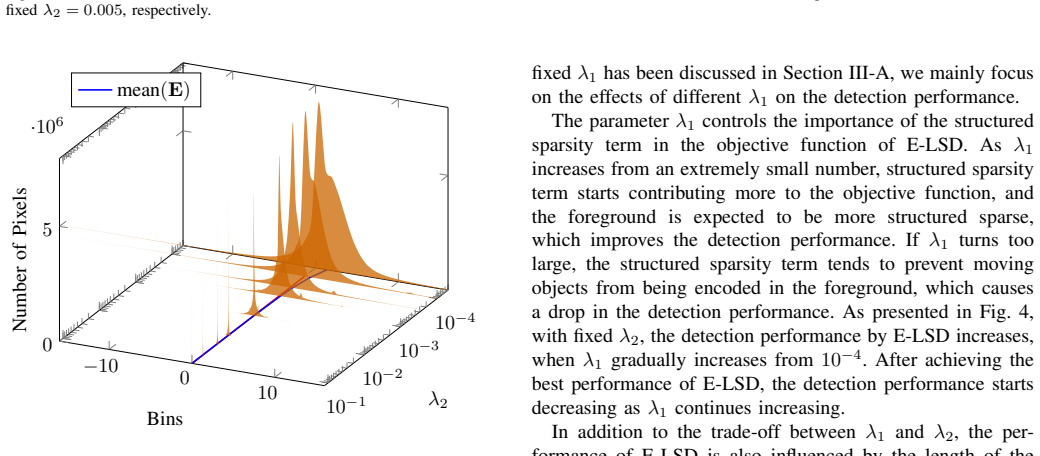
- [Section III-B, text near Fig. 5] The text says 'As presented in Fig. 4, with fixed λ2, the detection performance by E-LSD increases', but Fig. 4 varies λ2 with fixed λ1; the λ1 effect is shown in Fig. 5. Please correct the cross-reference.
- [Section II-C.2, Eqs. (15)–(17)] The derivation of the dual problem assumes that 'all variables in h and ξ are assumed non-negative', but h = D − B − E + Y/μ is not non-negative in general. Please clarify the sign-handling transformation or provide the exact reduction to the network-flow formulation of [41] for arbitrary real-valued data.
- [Section II-C, Eq. (20)] Equation (20) uses B*, S*, and E* in the stopping condition although these are the quantities being estimated; the notation is confusing and should refer to the current iterates.
- [Section III-B] There is a typo: 'improved recall and prevision' should read 'improved recall and precision'.
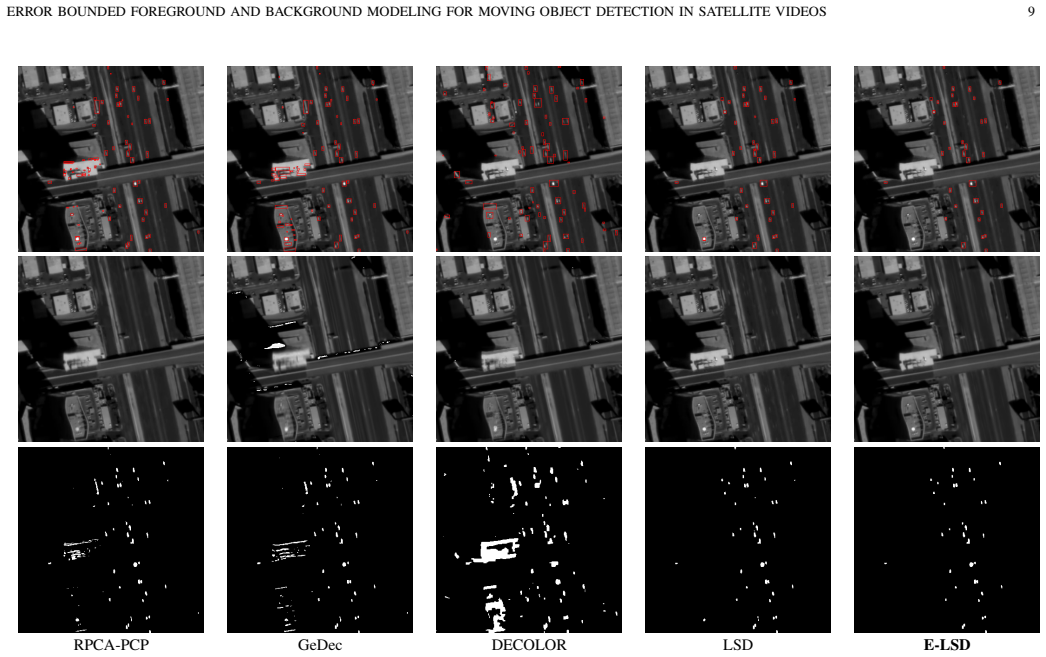
- [Fig. 8] The column label 'GeDec' appears in the figure; the method name is spelled 'GoDec' elsewhere.
- [Section III-C] The comparison set is limited to methods from 2011–2015; since the paper claims state-of-the-art performance, it should at least discuss or compare with more recent satellite-video moving object detection approaches, including those cited in the introduction.
Circularity Check
No circularity: the E-LSD objective is independently defined and evaluated against external baselines.
full rationale
The paper's central claim is that solving the proposed objective (Eq. 4) yields improved detection precision and lower background rank compared with LSD and other baselines. The objective is defined from first principles as a three-term decomposition (nuclear norm, structured sparsity norm, and squared Frobenius residual) with a hard constraint D = B + S + E. This is not built from the evaluation metric (IoU-based precision/recall/F1) nor from the ground-truth bounding boxes. The performance improvement is measured against independent methods (RPCA-PCP, GoDec, DECOLOR, LSD) using a held-out test portion of the videos, with parameters selected on a separate 200-frame validation split. No fitted parameter is renamed as a prediction, and no cited result is invoked to forbid alternatives. The only notable weakness is an acknowledged gap between the theoretical ADMM convergence condition (mu in (0, 7*lambda2/8), per reference [36]) and the algorithm's empirical penalty schedule (mu grows to mu*1e5). The paper explicitly concedes that the theoretical analysis is conservative and that empirical enlargement leads to good solutions. This is a correctness/convergence risk, not circularity: the model and the solver are not defined in terms of the evaluation outcomes, so the reported comparisons are meaningful even if the solver's convergence is heuristic. The components inherited from prior work (LSD objective, ADMM, structured sparsity solvers) are standard scientific inheritance with independent support. Hence no circular step is present and the score is 0.
Assumptions & free parameters
free parameters (4)
- lambda1 =
1/sqrt(p)
- lambda2 =
lambda1/5
- batch length =
length of the video (500 frames for evaluation)
- binarization threshold =
not specified
assumptions (4)
- domain assumption The background lies in a low-dimensional subspace (low rank/nuclear norm).
- domain assumption Moving objects form spatially contiguous blobs that can be encoded by the l1/l-infinity norm over 3x3 pixel groups.
- domain assumption The residuals that do not fit the background or foreground are well captured by a matrix E with small squared Frobenius norm.
- standard math The direct extension of ADMM converges for the three-block problem under the practical mu schedule.
Cite this review
Pith. "Pith review of Error Bounded Foreground and Background Modeling for Moving Object Detection in Satellite Videos." pith.science (2026). https://pith.science/paper/KDSFD5MA
@misc{pith2026190809539,
  author       = {Pith},
  title        = {Pith review of: Error Bounded Foreground and Background Modeling for Moving Object Detection in Satellite Videos},
  year         = {2026},
  howpublished = {\url{https://pith.science/paper/KDSFD5MA}},
  note         = {Machine review of arXiv:1908.09539}
}
read the original abstract
Detecting moving objects from ground-based videos is commonly achieved by using background subtraction techniques. Low-rank matrix decomposition inspires a set of state-of-the-art approaches for this task. It is integrated with structured sparsity regularization to achieve background subtraction in the developed method of Low-rank and Structured Sparse Decomposition (LSD). However, when this method is applied to satellite videos where spatial resolution is poor and targets' contrast to the background is low, its performance is limited as the data no longer fits adequately either the foreground structure or the background model. In this paper, we handle these unexplained data explicitly and address the moving target detection from space as one of the pioneer studies. We propose a technique by extending the decomposition formulation with bounded errors, named Extended Low-rank and Structured Sparse Decomposition (E-LSD). This formulation integrates low-rank background, structured sparse foreground and their residuals in a matrix decomposition problem. We provide an effective solution by introducing an alternative treatment and adopting the direct extension of Alternating Direction Method of Multipliers (ADMM). The proposed E-LSD was validated on two satellite videos, and experimental results demonstrate the improvement in background modeling with boosted moving object detection precision over state-of-the-art methods.
Figures

Figures from the paper (8 more)


Reference graph
Works this paper leans on
-
[36]
X. Cai, D. Han, and X. Yuan, “On the convergence of the direct extension of admm for three-block separable convex minimization models with one strongly convex function,” Computational Optimization and Applications , vol. 66, no. 1, pp. 39–73, 2017
work page 2017
-
[1]
Video satellite imagery super resolution via convolutional neural networks,
Y . Luo, L. Zhou, S. Wang, and Z. Wang, “Video satellite imagery super resolution via convolutional neural networks,” IEEE Geoscience and Remote Sensing Letters , vol. 14, no. 12, pp. 2398–2402, 2017
work page 2017
-
[2]
Planet application program interface: In space for life on earth. san francisco, ca,
P. Team, “Planet application program interface: In space for life on earth. san francisco, ca,” 2016
work page 2016
-
[3]
Small moving vehicle detection in a satellite video of an urban area,
T. Yang, X. Wang, B. Yao, J. Li, Y . Zhang, Z. He, and W. Duan, “Small moving vehicle detection in a satellite video of an urban area,” Sensors, vol. 16, no. 9, p. 1528, 2016
work page 2016
-
[4]
Low-rank decomposition and total variation regularization of hyperspectral video sequences,
Y . Xu, Z. Wu, J. Chanussot, M. Dalla Mura, A. L. Bertozzi, and Z. Wei, “Low-rank decomposition and total variation regularization of hyperspectral video sequences,” IEEE Transactions on Geoscience and Remote Sensing , vol. 56, no. 3, pp. 1680–1694, 2017
work page 2017
-
[5]
Spatiotemporal scene interpretation of space videos via deep neural network and tracklet analysis,
L. Mou and X. X. Zhu, “Spatiotemporal scene interpretation of space videos via deep neural network and tracklet analysis,” in Geoscience and Remote Sensing Symposium (IGARSS), 2016 IEEE International . IEEE, 2016, pp. 1823–1826
work page 2016
-
[6]
B. Du, Y . Sun, S. Cai, C. Wu, and Q. Du, “Object tracking in satellite videos by fusing the kernel correlation filter and the three-frame- difference algorithm,” IEEE Geoscience and Remote Sensing Letters , vol. 15, no. 2, pp. 168–172, 2018
work page 2018
-
[7]
J. Zhang, X. Jia, J. Hu, and K. Tan, “Satellite multi-vehicle tracking under inconsistent detection conditions by bilevel k-shortest paths opti- mization,” in 2018 Digital Image Computing: Techniques and Applica- tions (DICTA). IEEE, 2018, pp. 1–8
work page 2018
Show all 43 references
-
[8]
Tracking in aerial hyperspectral videos using deep kernelized correlation filters,
B. Uzkent, A. Rangnekar, and M. J. Hoffman, “Tracking in aerial hyperspectral videos using deep kernelized correlation filters,” IEEE Transactions on Geoscience and Remote Sensing, no. 99, pp. 1–13, 2018
2018
-
[9]
Vehicle detection and traffic density monitoring from very high resolution satellite video data,
G. Kopsiaftis and K. Karantzalos, “Vehicle detection and traffic density monitoring from very high resolution satellite video data,” in Geoscience and Remote Sensing Symposium (IGARSS), 2015 IEEE International . IEEE, 2015, pp. 1881–1884
2015
-
[10]
Background subtraction techniques: a review,
M. Piccardi, “Background subtraction techniques: a review,” in 2004 IEEE International Conference on Systems, Man and Cybernetics (IEEE Cat. No. 04CH37583) , vol. 4. IEEE, 2004, pp. 3099–3104
2004
-
[11]
Background subtraction for automated multisensor surveillance: a comprehensive review,
M. Cristani, M. Farenzena, D. Bloisi, and V . Murino, “Background subtraction for automated multisensor surveillance: a comprehensive review,”EURASIP Journal on Advances in Signal Processing , vol. 2010, no. 1, p. 343057, 2010
2010
-
[12]
A comprehensive review of background subtraction algorithms evaluated with synthetic and real videos,
A. Sobral and A. Vacavant, “A comprehensive review of background subtraction algorithms evaluated with synthetic and real videos,” Com- puter Vision and Image Understanding , vol. 122, pp. 4–21, 2014
2014
-
[13]
Robust pca via principal component pursuit: A review for a comparative evaluation in video surveillance,
T. Bouwmans and E. H. Zahzah, “Robust pca via principal component pursuit: A review for a comparative evaluation in video surveillance,” Computer Vision and Image Understanding , vol. 122, pp. 22–34, 2014
2014
-
[14]
Decomposition into low-rank plus additive matrices for back- ground/foreground separation: A review for a comparative evaluation with a large-scale dataset,
T. Bouwmans, A. Sobral, S. Javed, S. K. Jung, and E.-H. Za- hzah, “Decomposition into low-rank plus additive matrices for back- ground/foreground separation: A review for a comparative evaluation with a large-scale dataset,” Computer Science Review , vol. 23, pp. 1– 71, 2017
2017
-
[15]
On the applications of robust pca in image and video processing,
T. Bouwmans, S. Javed, H. Zhang, Z. Lin, and R. Otazo, “On the applications of robust pca in image and video processing,” Proceedings of the IEEE , vol. 106, no. 8, pp. 1427–1457, 2018
2018
-
[16]
Principal component analysis,
I. Jolliffe, “Principal component analysis,” in International Encyclopedia of Statistical Science . Springer, 2011, pp. 1094–1096
2011
-
[17]
Robust principal component analysis: Exact recovery of corrupted low-rank matrices via convex optimization,
J. Wright, A. Ganesh, S. Rao, Y . Peng, and Y . Ma, “Robust principal component analysis: Exact recovery of corrupted low-rank matrices via convex optimization,” in Advances in Neural Information Processing Systems, 2009, pp. 2080–2088
2009
-
[18]
Linearized alternating direction method with adaptive penalty for low-rank representation,
Z. Lin, R. Liu, and Z. Su, “Linearized alternating direction method with adaptive penalty for low-rank representation,” in Advances in Neural Information Processing Systems , 2011, pp. 612–620
2011
-
[19]
Robust principal component analysis?
E. J. Cand `es, X. Li, Y . Ma, and J. Wright, “Robust principal component analysis?” Journal of the ACM (JACM) , vol. 58, no. 3, p. 11, 2011
2011
-
[20]
Godec: Randomized low-rank & sparse matrix decomposition in noisy case,
T. Zhou and D. Tao, “Godec: Randomized low-rank & sparse matrix decomposition in noisy case,” in International Conference on Machine Learning. Omnipress, 2011
2011
-
[21]
Rank-sparsity incoherence for matrix decomposition,
V . Chandrasekaran, S. Sanghavi, P. A. Parrilo, and A. S. Willsky, “Rank-sparsity incoherence for matrix decomposition,” SIAM Journal on Optimization , vol. 21, no. 2, pp. 572–596, 2011
2011
-
[22]
Foreground detection based on low-rank and block-sparse matrix decomposition,
C. Guyon, T. Bouwmans, and E.-H. Zahzah, “Foreground detection based on low-rank and block-sparse matrix decomposition,” in2012 19th IEEE International Conference on Image Processing . IEEE, 2012, pp. 1225–1228. ERROR BOUNDED FOREGROUND AND BACKGROUND MODELING FOR MOVING OBJEC...
2012
-
[23]
Or- pca with mrf for robust foreground detection in highly dynamic back- grounds,
S. Javed, S. H. Oh, A. Sobral, T. Bouwmans, and S. K. Jung, “Or- pca with mrf for robust foreground detection in highly dynamic back- grounds,” in Asian Conference on Computer Vision . Springer, 2014, pp. 284–299
2014
-
[24]
Moving object detection by detecting contiguous outliers in the low-rank representation,
X. Zhou, C. Yang, and W. Yu, “Moving object detection by detecting contiguous outliers in the low-rank representation,” IEEE Transactions on Pattern Analysis and Machine Intelligence , vol. 35, no. 3, pp. 597– 610, 2013
2013
-
[25]
Corola: a sequential solution to moving object detection using low-rank approximation,
M. Shakeri and H. Zhang, “Corola: a sequential solution to moving object detection using low-rank approximation,” Computer Vision and Image Understanding, vol. 146, pp. 27–39, 2016
2016
-
[26]
Structured variable selection with sparsity-inducing norms,
R. Jenatton, J.-Y . Audibert, and F. Bach, “Structured variable selection with sparsity-inducing norms,” Journal of Machine Learning Research , vol. 12, no. Oct, pp. 2777–2824, 2011
2011
-
[27]
Proximal methods for sparse hierarchical dictionary learning
R. Jenatton, J. Mairal, G. Obozinski, and F. R. Bach, “Proximal methods for sparse hierarchical dictionary learning.” in ICML, vol. 1. Citeseer, 2010, p. 2
2010
-
[28]
Robust and practical face recognition via structured sparsity,
K. Jia, T.-H. Chan, and Y . Ma, “Robust and practical face recognition via structured sparsity,” in European Conference on Computer Vision . Springer, 2012, pp. 331–344
2012
-
[29]
Background subtraction based on low-rank and structured sparse decomposition,
X. Liu, G. Zhao, J. Yao, and C. Qi, “Background subtraction based on low-rank and structured sparse decomposition,” IEEE Transactions on Image Processing, vol. 24, no. 8, pp. 2502–2514, 2015
2015
-
[30]
Model selection and estimation in regression with grouped variables,
M. Yuan and Y . Lin, “Model selection and estimation in regression with grouped variables,” Journal of the Royal Statistical Society: Series B (Statistical Methodology) , vol. 68, no. 1, pp. 49–67, 2006
2006
-
[31]
Proximal methods for hierarchical sparse coding,
R. Jenatton, J. Mairal, G. Obozinski, and F. Bach, “Proximal methods for hierarchical sparse coding,” Journal of Machine Learning Research , vol. 12, no. Jul, pp. 2297–2334, 2011
2011
-
[32]
Background subtraction via generalized fused lasso foreground modeling,
B. Xin, Y . Tian, Y . Wang, and W. Gao, “Background subtraction via generalized fused lasso foreground modeling,” in Proceedings of the IEEE Conference on Computer Vision and Pattern Recognition , 2015, pp. 4676–4684
2015
-
[33]
Stable principal com- ponent pursuit,
Z. Zhou, X. Li, J. Wright, E. Candes, and Y . Ma, “Stable principal com- ponent pursuit,” in 2010 IEEE International Symposium on Information Theory. IEEE, 2010, pp. 1518–1522
2010
-
[34]
Simultaneous video stabilization and moving object detection in turbulence,
O. Oreifej, X. Li, and M. Shah, “Simultaneous video stabilization and moving object detection in turbulence,” IEEE Transactions on Pattern Analysis and Machine Intelligence , vol. 35, no. 2, pp. 450–462, 2013
2013
-
[35]
The direct extension of admm for multi-block convex minimization problems is not necessarily conver- gent,
C. Chen, B. He, Y . Ye, and X. Yuan, “The direct extension of admm for multi-block convex minimization problems is not necessarily conver- gent,” Mathematical Programming, vol. 155, no. 1-2, pp. 57–79, 2016
2016
-
[37]
Distributed optimization and statistical learning via the alternating direction method of multipliers,
S. Boyd, N. Parikh, E. Chu, B. Peleato, J. Eckstein et al. , “Distributed optimization and statistical learning via the alternating direction method of multipliers,” F oundations and Trends R© in Machine Learning , vol. 3, no. 1, pp. 1–122, 2011
2011
-
[38]
A singular value thresholding al- gorithm for matrix completion,
J.-F. Cai, E. J. Cand `es, and Z. Shen, “A singular value thresholding al- gorithm for matrix completion,” SIAM Journal on Optimization , vol. 20, no. 4, pp. 1956–1982, 2010
1956
-
[39]
Boyd and L
S. Boyd and L. Vandenberghe, Convex optimization . Cambridge university press, 2004
2004
-
[40]
Lagrange multipliers revisited,
M. Slater, “Lagrange multipliers revisited,” Cowles Foundation for Research in Economics, Yale University, Tech. Rep., 1959
1959
-
[41]
Network flow algorithms for structured sparsity,
J. Mairal, R. Jenatton, F. R. Bach, and G. R. Obozinski, “Network flow algorithms for structured sparsity,” in Advances in Neural Information Processing Systems, 2010, pp. 1558–1566
2010
-
[42]
The augmented lagrange multiplier method for exact recovery of corrupted low-rank matrices,
Z. Lin, M. Chen, and Y . Ma, “The augmented lagrange multiplier method for exact recovery of corrupted low-rank matrices,” arXiv preprint arXiv:1009.5055, 2010
2010 arXiv
-
[43]
Block-sparse rpca for consistent foreground detection,
Z. Gao, L.-F. Cheong, and M. Shan, “Block-sparse rpca for consistent foreground detection,” in European Conference on Computer Vision . Springer, 2012, pp. 690–703. Junpeng Zhang received the B.Sci. degree from the China University of Mining and Technology, Xuzhou, China, in 2...
1999
Reviewed August 14, 2026 · model on record in the stance chip above.
Discussion (0). Continue with ORCID to comment.