REVIEW 4 major objections 6 minor 7 references
LensCraft: Your Professional Virtual Cinematographer
T0 review · 4 major / 6 minor · reviewed 2026-08-07 · deepseek-v4-flash
Pith's one-line read Text-to-camera model beats prior baselines and runs 26x faster
desk verdict A genuinely useful volume-aware camera trajectory system with a strong synthetic dataset, but the headline SOTA claim is not supported because all numbers come from the authors' own simulator and the paper contains a mathematically invalid loss term and a self-contradicting table. read the letter →
The pith
A machine-rendered reading of the paper's core claim, the machinery that carries it, and where it could break.
The reading
What carries the argument
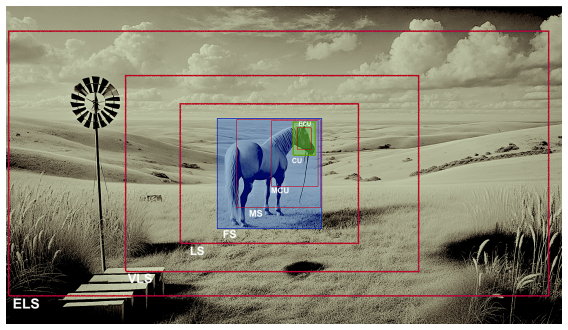
The load-bearing mechanism is the volume bounding box (VBox) plus the standardized cinematographic description (SCD), a four-parameter encoding of shot type, camera angle, framing, and movement/easing. A hand-crafted simulator converts SCDs into trajectories through two interpolations, Plinear (straight-line) and Paware (a curved path that arcs around the subject), and enforces constraints such as static location, static distance, visibility, and maximum acceleration. The neural model is a denoising masked autoencoder transformer whose encoder is trained to align with CLIP embeddings via multi-task high/low-level losses, whose decoder consumes only high-level embeddings, and whose weighted loss combines initial, relative, speed, CLIP, and cycle-consistency terms; the angular part of the pose discrepancy is mapped through a tangent so rotational errors are measured in the same Euclidean domain as translation errors.
What would settle it
Run LensCraft, CCD, and E.T. on real footage where a cinematographer's actual camera path and subject volumes are known (e.g., tracked feature-film shots), and compare trajectories against the human-shot paths and expert preference ratings; if LensCraft does not beat the baselines on that held-out real data, the simulator-only results would not support the real-world claim.
Extended reading notes
Core claim
On the paper's own terms, the central discovery is that a compact masked-autoencoder transformer, conditioned on a subject-volume bounding box and on high-level CLIP embeddings, can generate camera trajectories that are more semantically faithful and more accurate than the current state-of-the-art diffusion-based text-to-camera models, across both static and dynamic scenes. The model learns to reconstruct camera trajectories from noisy inputs while a progressive masking schedule teaches it to accept partial conditions such as a few keyframes; the discrete losses for initial pose, relative geometry, speed, CLIP alignment, and cycle consistency jointly enforce framing accuracy and smoothness. On the generated benchmark, LensCraft reports FID 40.4 (static) and 24.35 (dynamic) against 161.37 and 151.5 for the best E.T. variant, while its CLIP-Score rises from roughly 90.7 to 92.75/92.93, with corresponding gains across precision, recall, density, and coverage.
Load-bearing premise
The simulator's hand-crafted interpolation rules and the four-parameter standardized description are assumed to be a complete and faithful model of professional cinematography; if real cinematographers would move the camera differently, the benchmark numbers on the self-generated simulator data do not carry over to real scenes.
Editorial extensions
If this is right
- Text-only users can get professional-looking camera motion without specifying angles or coordinates, since the translator converts natural language into the standardized description.
- Keyframes and reference trajectories become usable conditions on the same model, so shot interpolation and style transfer need no separate architecture.
- The 1.66 s / 1.64 GFLOPs footprint makes real-time or near-real-time camera planning feasible in interactive tools, virtual production, and game or drone cinematography.
- If the simulator faithfully encodes professional practice, the open dataset and simulator let other tasks reuse volume-aware, prompt-paired trajectory data.
- The static/dynamic split of the benchmark lets future work test whether a method is robust to subject motion or only tuned to stationary scenes.
Reading between the lines
- Editorial inferences: the VBox representation could let LensCraft transfer to real footage if a detector supplies an approximate subject bounding box per frame, but the paper does not demonstrate that transfer.
- The translator's reliance on synthetic prompts means performance on genuinely novel phrasing, slang, or non-English instructions is untested; a user study with real directors would be a natural next check.
- The tangent-based angular discrepancy suggests a general recipe for camera pose losses: measuring rotational error by how far the camera would need to move to restore framing, which could benefit other pose-generation tasks.
- The fixed interest-box limitation means fine-grained framing like 'close-up on the hand' is out of reach; extending ABox to part-level boxes is an obvious next step the paper notes only as a limitation.
Editorial analysis
A structured set of objections, weighed in public.
Referee Report
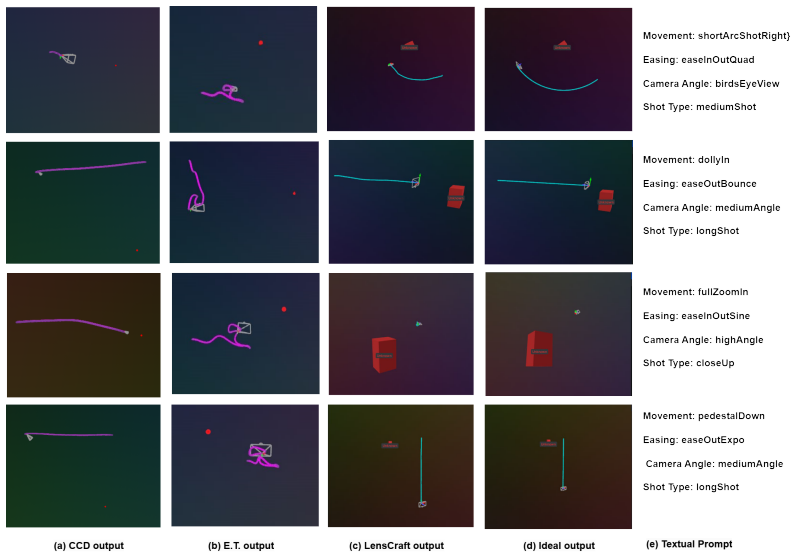
Summary. LensCraft proposes a camera-trajectory generation system for virtual cinematography. The paper introduces a Standardized Cinematographic Language (SCL/SCD), a simulator that generates 100,000 paired text-trajectory samples from hand-crafted interpolation and framing rules, and a lightweight transformer-based model that conditions on text prompts, keyframes, source trajectories, and a subject volume box (VBox). The model is trained with a multi-term loss including a CLIP alignment term and evaluated against CCD and E.T. on static and dynamic subsets of the authors' own dataset, reporting superior FID, precision/recall/density/coverage, and CLIP-Score, along with a large speed advantage. The paper also provides qualitative results on the E.T. dataset and ablated analyses of loss terms and input modalities.
Significance. If the central claims were supported, LensCraft would be a meaningful contribution: it offers a lightweight, real-time architecture with flexible multi-modal conditioning, a volume-aware subject representation, and an open-source dataset/simulator that could facilitate reproducible research in automated cinematography. The authors state that code, data, model weights, and simulation environment will be publicly released, which is a concrete strength. However, the significance is conditional on whether the evaluation actually measures professional cinematographic quality rather than fit to the authors' own simulator; the current evidence does not establish that transfer, so the claimed 'unprecedented accuracy' must be interpreted with substantial caution.
major comments (4)
- [§4.1, Table 1; Appendix A.2-A.3] The central SOTA claim is evaluated only on a dataset generated by the authors' own simulator, whose trajectory-generation rules (Plinear, Paware, and the SCD parameters in Appendix A.3, including Table 5's shot-type scaling) are hand-crafted from undocumented 'consultations.' The translator is trained on prompts generated from SCD permutations, and the model is conditioned on the same SCD-derived representations. Thus Table 1 measures how well each method reproduces the distribution defined by the authors' interpolation formulas, not how well LensCraft mimics professional cinematography or transfers to real scenes. No quantitative external evaluation is provided; Appendix C is qualitative and restricted to the static subset of E.T. This gap is load-bearing because the paper's stated purpose is to outperform prior methods on real cinematographic tasks.
- [§3.2, Eq. (1)] The angular discrepancy term tan(π/4 + ε + 1 − ⟨n(θ̂_j), n(θ_j)⟩) can become negative. If n(θ) is a unit-vector representation of an angle, then ⟨n(θ̂), n(θ)⟩ = cos(θ̂−θ) ∈ [−1,1], so the tangent argument ranges from π/4+ε to π/4+ε+2; whenever the angular difference is larger than about π/4, the argument exceeds π/2 and tan is negative. This means the 'distance' can decrease with increasing error, violating the definition of a metric and allowing the composite loss (Eq. 7) to reward large angular errors. Since L_init, L_rel, and L_speed all use this discrepancy, the training objective is not 'stable and perceptually consistent' as claimed.
- [§4.2, Table 2] The sentence 'the combined input configurations achieve superior results compared to any single modality' is contradicted by the data in Table 2. In the Dynamic block, Source trajectory alone has FID 11.70 while Prompt+Source has FID 13.70; in the Static block, Source alone has FID 12.79 while Prompt+Source has FID 15.38. Similarly, Dynamic Prompt+KeyFrame has CLIP-Score 92.43, below KeyFrame-only 92.62. The claim needs to be qualified to specific metrics/configurations, or the protocol needs explanation.
- [§3.3, Eq. (5); §B.2, Eq. (13)] The CLIP-Score evaluation metric is not independent of the training objective. The model is trained with L_clip to align encoder embeddings with CLIP embeddings, and the CS metric measures cosine similarity between 'CLIP embeddings of the generated camera trajectory' and the text prompt. If these trajectory embeddings come from the same encoder used during training (as §4.4 suggests when re-encoding trajectories), then high CS partly reflects optimization of the training loss rather than an external measure of semantic quality. The paper should specify exactly what is embedded for CS and include at least one semantic metric not directly aligned with the training loss.
minor comments (6)
- [Appendix A.1] The translator evaluation is described twice in near-identical paragraphs; the first version references 'Table ??' and the second refers to Table 4. This duplication and broken reference should be fixed.
- [Appendix C] The opening paragraph of Appendix C is repeated verbatim; one copy should be removed.
- [§3.2, Eq. (1)] The notation n(·) is ambiguous: it is called a 'normalized rotation matrix representation' but the formula behaves like a unit-vector cosine of an angle difference. The authors should state the exact definition and the range of the inner product so that the domain of the tangent function is clear.
- [§B.2, Eqs. (8)-(12)] The FID, precision, recall, density, and coverage metrics require a feature representation of trajectories, but no feature extractor is described. This is essential for reproducibility of all quantitative results in Tables 1-3.
- [§B.3] The sentence about the dataset split is incomplete: 'evenly split between static and dynamic subject trajectories (50' — presumably 50,000 each, but the sentence is cut off.
- [Table 2] For the Key Frame condition, the paper says 'randomly chose 1 to 10 key frames' but does not report the distribution or average number; this should be specified for a reproducible protocol.
Circularity Check
The reported CLIP-Score is the same cosine-similarity objective used as the training loss, so the semantic-alignment advantage is forced by construction; the rest of the benchmark raises validity concerns but does not reduce by construction.
-
fitted input called prediction
[Sec. 3.3 (Eq. 5), Sec. 4.4, Appendix B.2 (Eq. 13), Table 3]
"Lclip = Σ_{k∈{high,low}} (1 − ⟨Ek, CLIPk⟩/(∥Ek∥2∥CLIPk∥2)) ... we compute CLIP-Score (CS) ... measures the cosine similarity between the embeddings of trajectories and their corresponding ground truth textual prompts in the CLIP feature space as: CLIP-S(c,v)=Σ c_i·v_i/(∥c_i∥2∥v_i∥2) ... we re-encode these trajectories using our encoder to obtain their latent embeddings ... against the original CLIP embeddings of the prompts."
The reported CS metric (Eq. 13) is mathematically the same cosine-similarity objective that L_clip (Eq. 5) minimizes during training. The encoder is explicitly trained to align its trajectory embeddings E_k with CLIP prompt embeddings, and at evaluation the trajectory-side 'CLIP embeddings' are produced by re-encoding generated trajectories with that same LensCraft encoder (Sec. 4.4). A high CS therefore does not measure independent semantic quality; it reports the training loss itself as a benchmark score. Table 3 confirms the reduction: removing L_clip makes CS collapse to 0.00 while other metrics remain non-trivial. Thus the semantic-alignment 'prediction' is fitted by construction and renamed as an evaluation result.
full rationale
The only by-construction reduction I can exhibit with equations is the CLIP-Score metric: Eq. 5 defines the training loss as cosine similarity between encoder embeddings and CLIP prompt embeddings, Eq. 13 defines the evaluation metric as the same cosine similarity, and Sec. 4.4 shows that trajectory embeddings are obtained with the same encoder. Table 3 makes the dependence explicit. This makes the CS column of Tables 1-3 a fitted input called a prediction, warranting a partial-circularity score of 6. The broader concern that the benchmark is generated by the authors' own simulator with hand-crafted Plinear/Paware and SCD rules is a construct-validity and external-generalization issue, not a circular derivation: training and testing on a self-generated distribution is methodologically weak for real-world SOTA claims, but the model is not predicting its own inputs by construction. The self-citations to Dehghanian et al. (2025) are used for background claims about prior datasets and are not load-bearing to any derivation. No uniqueness theorem or ansatz-smuggling pattern is present.
Assumptions & free parameters
free parameters (10)
- Loss weights α, β, γ, λ =
α=8.0, β=20, γ=50, λ=5
- ε in discrepancy function =
not reported
- Teacher forcing ratio schedule =
0.7 to 1.0
- Masking ratio schedule =
0.1 to 0.8
- Noise ratio schedule =
1.0 to 0.0
- Shot type interpolation factor and scale =
Table 5 values, e.g., ECU 0.0/0.5, ELS 1.0/3.0
- Subject-aware curve magnitude α =
not reported
- Translator default rules =
hand-coded defaults
- Assumed human height for VBox on external datasets =
170 cm
- Temporal window length =
30 frames
assumptions (7)
- domain assumption The four-parameter SCD (shot type, angle, framing, movement/easing) is a complete and minimal representation of user cinematographic intent.
- domain assumption Plinear and Paware interpolation rules generate valid cinematographic camera paths.
- domain assumption CLIP text embeddings provide a valid semantic supervision signal for camera trajectories.
- domain assumption The axis-aligned VBox captures the subject's task-relevant volume.
- domain assumption Rule-of-thirds grid is an adequate framing model for composition.
- ad hoc to paper Eq.1 tangent-based angular discrepancy is a valid distance metric.
- domain assumption Synthetic trajectories produced by the simulator are a balanced, comprehensive representation of real camera work.
invented entities (2)
-
Standard Cinematographic Language (SCL) / Standardized Cinematographic Description (SCD)
-
Volume-bounding box (VBox) and attention-bounding box (ABox)
Cite this review
Pith. "Pith review of LensCraft: Your Professional Virtual Cinematographer." pith.science (2026). https://pith.science/paper/KDYLBMQK
@misc{pith2026250600988,
  author       = {Pith},
  title        = {Pith review of: LensCraft: Your Professional Virtual Cinematographer},
  year         = {2026},
  howpublished = {\url{https://pith.science/paper/KDYLBMQK}},
  note         = {Machine review of arXiv:2506.00988}
}
read the original abstract
Digital creators, from indie filmmakers to animation studios, face a persistent bottleneck: translating their creative vision into precise camera movements. Despite significant progress in computer vision and artificial intelligence, current automated filming systems struggle with a fundamental trade-off between mechanical execution and creative intent. Crucially, almost all previous works simplify the subject to a single point-ignoring its orientation and true volume-severely limiting spatial awareness during filming. LensCraft solves this problem by mimicking the expertise of a professional cinematographer, using a data-driven approach that combines cinematographic principles with the flexibility to adapt to dynamic scenes in real time. Our solution combines a specialized simulation framework for generating high-fidelity training data with an advanced neural model that is faithful to the script while being aware of the volume and dynamic behavior of the subject. Additionally, our approach allows for flexible control via various input modalities, including text prompts, subject trajectory and volume, key points, or a full camera trajectory, offering creators a versatile tool to guide camera movements in line with their vision. Leveraging a lightweight real time architecture, LensCraft achieves markedly lower computational complexity and faster inference while maintaining high output quality. Extensive evaluation across static and dynamic scenarios reveals unprecedented accuracy and coherence, setting a new benchmark for intelligent camera systems compared to state-of-the-art models. Extended results, the complete dataset, simulation environment, trained model weights, and source code are publicly accessible on LensCraft Webpage.
Figures


Figures from the paper (5 more)



Reference graph
Works this paper leans on
-
[1]
This is particularly useful for movements like panning where the camera pivots from a fixed position
Static Location: This constraint locks the camera’s position in space, allowing adjustments only through orientation and focal length changes. This is particularly useful for movements like panning where the camera pivots from a fixed position
-
[2]
Static Distance: This ensures the camera maintains a constant distance from the subject throughout the shot, making it ideal for orbiting movements where the camera circles the subject
-
[3]
Visibility at all: This constraint ensures continuous visual contact with the subject throughout the movement, preventing any temporary loss of sight during complex camera paths
-
[4]
Maximum Acceleration (amax): This defines the upper limit of camera acceleration along the path, ensuring that generated movements remain physically feasible and can be executed smoothly in real-world scenarios. In the micro-alignment stage, we refine the camera setup through precise adjustments to focal length and orientation to achieve the desired frami...
work page 2012
-
[2014]
Art & Perception 2, 1-2 (2014), 163–182
Evaluating the rule of thirds in photographs and paintings. Art & Perception 2, 1-2 (2014), 163–182. Yoshua Bengio. 2000. Gradient-based optimization of hyperparameters. Neural computation 12, 8 (2000), 1889–1900. Rogerio Bonatti, Arthur Bucker, Sebastian Scherer, Mustafa Mukadam, and Jessica Hodgins. 2021. Batteries, camera, action! learning a semantic c...
arXiv 2014
-
[2021]
make the camera swoop dramatically around the car while keeping it centered
An Overview of Applications of Gaussian Numerical Methods. In 2021 2nd International Conference on Smart Electronics and Communication (ICOSEC) . IEEE, 645–657. Bill Tomlinson, Bruce Blumberg, and Delphine Nain. 2000. Expressive autonomous cinematography for interactive virtual environments. In Proceedings of the fourth international conference on Autonom...
arXiv 2008
-
[2023]
In Proceedings of the IEEE/CVF International Conference on Computer Vision
Humans in 4D: Reconstructing and tracking humans with transformers. In Proceedings of the IEEE/CVF International Conference on Computer Vision . 14783–14794. Chuan Guo, Shiwei Zou, Xuan Zuo, Sen Wang, Wei Ji, Xinning Li, and Li Cheng. 2022. Generating Diverse and Natural 3D Human Motions from Text. In Proceedings of the IEEE/CVF Conference on Computer Vis...
arXiv 2024
Reviewed August 7, 2026 · model on record in the stance chip above.
Discussion (0). Sign in to comment.