REVIEW 3 major objections 6 minor 20 references
How do imperfections cause asymmetry in elastic snap-through?
T0 review · 3 major / 6 minor · reviewed 2026-08-12 · deepseek-v4-flash
Pith's one-line read A snapping arch's transient asymmetry is governed by one ratio—wobble amplitude divided by clamp imperfection—and the crossover between regimes is gradual, not sharp.
desk verdict A clean follow-up to the Wang et al. PRL showing how boundary imperfections and precursor oscillations add in determining snap-through asymmetry; worth refereeing, with the main caveat that the near-linear law is proven rigorously only at the critical rate. read the letter →
The pith
A machine-rendered reading of the paper's core claim, the machinery that carries it, and where it could break.
The reading
What carries the argument
The load-bearing object is the double-mass von Mises truss, a two-degree-of-freedom toy model in which two masses are joined by springs and held by torsion springs at clamps whose angles differ by a small imperfection $\delta\alpha$; with parameters $\beta = 0.110$ and $L_{0C} = 0.655$ it reproduces the arch's bifurcation structure (instability to asymmetric modes at $\mu_c = 1/4$, loss of the inverted equilibrium at $\mu^* \approx 0.247$). Writing the degrees of freedom in symmetric and antisymmetric combinations and expanding for small $\alpha$ yields two coupled ODEs, of which the antisymmetric one carries the effect of interest: $\ddot{\psi}_A \propto a_0 \delta\hat{\alpha} - 2 f(\psi_S;\mu)\,\psi_A$. Near the critical unloading rate, where the coefficient $f$ vanishes quadratically in time, this reduces to the linear equation $d^2\tilde{\psi}_A/d\tau^2 = c - \tau^2 \tilde{\psi}_A$, whose solution decomposes exactly as $\tilde{\psi}_A = \phi_{\delta\hat{\alpha}} + \gamma\,\phi_{\rm osc}$, with $\gamma = \psi_0^A/\delta\hat{\alpha}$ the ratio of initial oscillation to imperfection: the imperfection-driven part is forced by the constant $c$, while the oscillation-driven part obeys the homogeneous parabolic-cylinder equation $d^2\phi_{\rm osc}/d\tau^2 = -\tau^2 \phi_{\rm osc}$ and has an exact solution in terms of parabolic cylinder functions $D_\nu(x)$. Because the two components peak at nearby times ($\tau \approx 1.41$ for $\phi_{\delta\hat{\alpha}}$, $\tau \approx 1.17$ for $\phi_{\rm osc}$), the maximum of their sum is close to linear in $\gamma$, which is the mechanism behind the law $\theta_{\max} = \delta\alpha\, G(\gamma; |\dot{\mu}|)$.
What would settle it
Measure the static asymmetry of each experimental arch directly before snap-through—for example by imaging the clamped inverted arch and converting its midpoint deflection into $\delta\hat{\alpha}$—then re-plot the experimental points with each run's own measured value. If the collapse onto $G(\gamma;|\dot{\mu}|)$ is not preserved (or worsens relative to the assumed constant $0.2$), the constant-imperfection explanation of the scatter is wrong. As a second check, at fixed unloading rate and fixed $\theta_{\rm osc}$, a deliberately machined clamp asymmetry should increase $\theta_{\max}$ proportionally to $\delta\alpha$ for small $\gamma$; a step-like or vanishing dependence would contradict the near-linear law.
Extended reading notes
Core claim
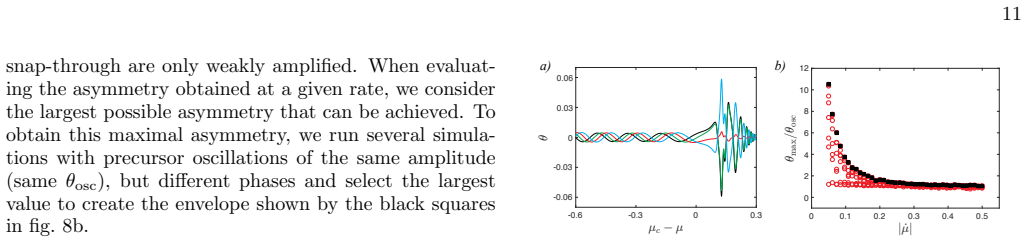
On the paper's own terms, the discovery is that the transient asymmetry of a snap-through arch is a single-parameter phenomenon once the imperfection size is known: $\theta_{\max} = \delta\alpha\, G(\gamma; |\dot{\mu}|)$ with $\gamma = \theta_{\rm osc}/\delta\alpha$, where $G$ is a near-linear increasing function of $\gamma$ at fixed unloading rate. In the limit of no precursor oscillations ($\gamma \to 0$), the maximum asymmetry is proportional to the intrinsic imperfection $\delta\alpha$, and the growth factor $G$ is largest at slow unloading rates. In the opposite limit (large $\gamma$), the amplification $A = \theta_{\max}/\theta_{\rm osc}$ collapses onto the perfect-symmetry results of Wang et al. [10], so the imperfection becomes irrelevant. The paper further claims there is no sharp transition between these regimes: even at the critical unloading rate $|\dot{\mu}|_c$, the maximum asymmetry responds smoothly, close to linearly, to $\gamma$. The same law accounts for the previously 'anomalous' experimental points in [10]: once each run's measured precursor oscillation is converted into $\gamma$ and a fixed relative clamp imperfection $\delta\hat{\alpha} = 0.2$ is assumed, the scattered data collapse onto the surface $G(\gamma; |\dot{\mu}|)$.
Load-bearing premise
The load-bearing premise is that every experimental run in Section IV shares the same intrinsic clamp imperfection, $\delta\hat{\alpha} = 0.2$, inferred from the stated clamp-angle precision rather than measured independently for each arch; if the true imperfection varied run to run, the collapse of the previously 'anomalous' data could be coincidental.
Editorial extensions
If this is right
- For small precursor oscillations ($\gamma \ll 1$), the transient asymmetry is proportional to the clamp imperfection $\delta\alpha$, so the sign and size of the imperfection alone select which way the arch leans during snap-through.
- For large precursor oscillations ($\gamma \gg 1$), the system behaves as if perfectly symmetric: the amplification $A = \theta_{\max}/\theta_{\rm osc}$ depends only on the unloading rate, and the imperfection drops out.
- Slow unloading is the imperfection-dominated regime and fast unloading the oscillation-dominated regime, so the loading protocol can be used to choose which mechanism sets the asymmetry.
- The previously scattered experimental data of [10] collapse onto the single surface $\theta_{\max} = \delta\alpha\, G(\gamma; |\dot{\mu}|)$ once each run's precursor oscillation is accounted for with $\delta\hat{\alpha} = 0.2$.
- Making the imperfection deliberately large compared with unavoidable precursor oscillations gives a repeatable way to control the asymmetric mode—and hence the jump direction—of snapping-beam robots.
Reading between the lines
- The near-linearity of $G$ in $\gamma$ suggests a practical control rule beyond the jumping-robot use case the paper names: since precursor oscillations are hard to suppress while clamp asymmetry is easy to machine, imprinting a controlled imperfection is the more reliable route to directional snap-through in any bistable elastic actuator.
- The same decomposition—an inhomogeneous forcing term plus a homogeneous oscillator term that peak at nearby times—should appear in other delayed-bifurcation instabilities, so $\gamma$ may organize asymmetry data for dynamic buckling of ribbons, shells, and articulated mechanisms beyond arches.
- A testable extension is to measure $\delta\hat{\alpha}$ for each arch individually from its static clamped shape rather than assuming $0.2$; the experimental collapse onto $G(\gamma;|\dot{\mu}|)$ should sharpen if the theory is right and degrade if the constant-imperfection assumption was doing the work.
Editorial analysis
A structured set of objections, weighed in public.
Referee Report
Summary. The paper studies how intrinsic boundary imperfections (a difference δα in the two clamp angles) and initial asymmetric precursor oscillations θosc combine to determine the transient asymmetry θmax of a snapping elastic arch. Using discrete-elastic-rods simulations and a two-degree-of-freedom von Mises truss toy model, the authors derive a linearized equation for the asymmetric mode ψA (Eq. 32), reduce it at the critical unloading rate to Eq. (36), and decompose the solution as ψA = δα φδα + γ φosc with γ = ψ0A/δα. They propose the central scaling θmax = δα G(γ; |μ̇|), with G a near-linear increasing function of γ, and argue that there is no sharp transition between imperfection-dominated and precursor-dominated regimes. They then reanalyze the experiments of Wang et al. [10] and claim that previously anomalous data points collapse onto the predicted surface once an assumed relative imperfection δα̂ = 0.2 and the measured θosc are used.
Significance. If the proposed scaling is correct, the paper provides a useful unification of the prior perfect-symmetry amplification result [10] with imperfection sensitivity, and it gives a practical design rule for controlling the asymmetry of snapping actuators. The strengths are explicit: the toy model derivation is transparent, the calibration of β and L0C to the static bifurcation points of the continuous arch is stated, the linear decomposition in Eq. (37) follows directly from linearity of Eq. (32), and the full discrete-elastic-rods simulations provide a nontrivial cross-check of the toy-model predictions. The analytical solution for φosc in Appendix A is a concrete addition. The principal weaknesses are the unverified extension of the near-linear G(γ) behavior to off-critical unloading rates and the experimental validation that depends on an assumed, unmeasured value of δα̂.
major comments (3)
- [Section IV, Fig. 7] The central claim θmax = δα G(γ; |μ̇|) with G near-linear in γ is derived only at the critical unloading rate |μ̇|c, where f(t*) = f′(t*) = 0. The text states that 'a similar decomposition ... suggests' the relation extends to other rates and asserts that this 'emerges for the full dynamic simulations of the simple model' and 'in the full arch simulations,' but no off-critical plot of θmax/δα versus γ is shown: Fig. 6b corresponds to the critical-rate reduction, and Fig. 7b presents a surface without isolating γ-dependence at fixed off-critical rates. Because the maxima of φδα and φosc occur at different times (τ = 1.41 and 1.17, respectively), |φδα + γ φosc|max is not linear in γ in general, and the near-linearity could degrade as the two maxima separate. Please provide explicit toy-model and full-simulation gamma-scans at fixed off-critical unloading rates, or a quantitative bound on the deviation from linearity, before the universal form is claimed.
- [Section III, Eq. (37)] The experimental validation assumes δα̂ = 0.2 for every run, inferred from the stated clamp-angle precision (±2° on α = π/12) rather than measured independently. Since γ = θosc/δα̂ enters the horizontal coordinate of every experimental point in Fig. 7b, a run-to-run variation in the true imperfection would change all γ values and could make the apparent collapse coincidental. This is load-bearing because the explanation of the previously 'anomalous' points rests entirely on this single assumed parameter. Please provide an independent estimate of δα̂ per run, or a sensitivity analysis showing that the qualitative collapse and the no-sharp-transition conclusion are robust to plausible variations in δα̂.
- [Section IV, Fig. 7] The argument that the maximum of ψA is 'close to linear' in γ because the maxima of φδα and φosc are close in τ is heuristic, not a derivation. For larger γ, or for off-critical rates where the phase relationship can differ, the maximum of a sum of two functions with different temporal locations is a nonlinear function of γ. The paper should either state the γ-range over which the near-linearity is claimed, provide a quantitative bound based on the separation of the maxima and the curvature of φosc, or present numerical evidence over the full rate range used in the conclusions.
minor comments (6)
- [Section III, final paragraph] There is a typo in 'with a beam undergoing a fast change of configuration and hitting the has been used' — a word such as 'ground' appears to be missing.
- [Fig. 6 caption] The sentence 'as we shall show in the conclusion' is not accurate: the conclusion presents Fig. 7 but does not contain a full-simulation plot of θmax/δα versus γ at off-critical rates. Please cite the specific figure or add the missing data.
- [Appendix B] The caption for panel (b) says the solution of the 'full problem, eqns (31) and (32)' is compared with Eq. (36), but it does not state the unloading rate used for the full problem; please specify whether the comparison is at |μ̇| = |μ̇|c or at other rates.
- [Notation] The paper should state explicitly that Fig. 7b uses the phase-maximized envelope from Appendix B; otherwise the reader may wonder why experimental points with uncontrolled phase are compared with a surface that represents the largest possible asymmetry.
- [References] The manuscript uses both δα̂ and δα/α for the relative imperfection; Fig. 3 spells out 'δα = δα/α' while the text defines δα̂. Please unify the notation.
- [References] Reference [9] is cited as an arXiv preprint; if a peer-reviewed version is now available, please cite it instead.
Circularity Check
The central scaling law is derived from a linearized toy-model ODE and verified against full arch simulations; the experimental comparison assumes an unmeasured imperfection but does not reduce the prediction to its inputs.
full rationale
The paper's central claim, theta_max = delta_alpha * G(gamma; |mu_dot|), is not circular. The toy-model equation of motion for the asymmetric mode, Eq. (32), is linear in psi_A when the imperfection is small, and the critical-rate reduction, Eq. (36), is also linear. The decomposition psi_A = phi_delta_alpha + gamma*phi_osc, Eq. (37), is an exact consequence of linearity, not an ansatz fitted to the output; the two components are driven by the imperfection and the initial perturbation respectively. The near-linear dependence of the maximum on gamma is argued from the nearby locations of the component maxima and is then checked against the full toy-model dynamics (Fig. 6b) and against full arch simulations (Fig. 7b). Thus the theoretical derivation is self-contained and does not define the predicted quantity in terms of itself. The experimental validation does assume a single value delta_alpha_hat = 0.2, inferred from the clamp-angle precision rather than measured independently; this is an unverified parameter choice and a fragility in the comparison, but it is not a fitted input that is then renamed as a prediction, because the theoretical surface G is computed independently of the experimental theta_max values. The paper also builds on the previous work of overlapping authorship (Ref. [10]) for the toy-model parameters and the critical unloading rate, but that prior work is used as a modelling tool and is benchmarked against the same full arch simulations; it does not import an unverified uniqueness theorem or smuggle in the target result. No step in the derivation chain reduces by construction to its own inputs, so no circularity is present.
Assumptions & free parameters
free parameters (6)
- beta (bending parameter in toy model) =
0.110
- L0C (dimensionless central-spring rest length) =
0.655
- tosc (time rescaling prefactor) =
9.477
- kappa (f''(t*) at critical rate) =
0.819
- delta_alpha_hat in experimental comparison =
0.2
- Initial phase of precursor oscillation =
maximized over phase (envelope)
assumptions (5)
- domain assumption The double-mass von Mises truss, with two degrees of freedom, captures the transient dynamics of the continuous elastic arch relevant to snap-through asymmetry.
- domain assumption The clamp angles are small, alpha << 1, so the energy and kinetic energy can be expanded to leading order in alpha and the beam is close to flat.
- domain assumption The asymmetric mode psi_A remains small enough for linearization in Eq. (32) and for the superposition (37) to be valid.
- standard math Standard Lagrangian mechanics and asymptotic expansion are valid.
- ad hoc to paper The body-force protocol for exciting precursor oscillations in the full simulations is equivalent to an initial offset psi_0^A in the toy model.
Cite this review
Pith. "Pith review of How do imperfections cause asymmetry in elastic snap-through?." pith.science (2026). https://pith.science/paper/KEEAQ6Z6
@misc{pith2026241113971,
  author       = {Pith},
  title        = {Pith review of: How do imperfections cause asymmetry in elastic snap-through?},
  year         = {2026},
  howpublished = {\url{https://pith.science/paper/KEEAQ6Z6}},
  note         = {Machine review of arXiv:2411.13971}
}
read the original abstract
A symmetrically-buckled arch whose boundaries are clamped at an angle has two stable equilibria: an inverted and a natural state. When the distance between the clamps is increased (i.e. the confinement is decreased) the system snaps from the inverted to the natural state. Depending on the rate at which the confinement is decreased ('unloading'), the symmetry of the system during snap-through may change: slow unloading results in snap-through occurring asymmetrically, while fast unloading results in a symmetric snap-through. It has recently been shown [Wang et al., Phys. Rev. Lett. 132, 267201 (2024)] that the transient asymmetry at slow unloading rates is the result of the amplification of small asymmetric precursor oscillations (shape perturbations) introduced dynamically to the system, even when the system itself is perfectly symmetric. In reality, however, imperfections, such as small asymmetries in the boundary conditions, are present too. Using numerical simulations and a simple toy model, we discuss the relative importance of intrinsic imperfections and initial asymmetric shape perturbations in determining the transient asymmetry observed. We show that, for small initial perturbations, the magnitude of the asymmetry grows in proportion to the size of the intrinsic imperfection but that, when initial shape perturbations are large, intrinsic imperfections are unimportant - the asymmetry of the system is dominated by the transient amplification of the initial asymmetric shape perturbations. We also show that the dominant origin of asymmetry changes the way that asymmetry grows dynamically. Our results may guide engineering and design of snapping beams used to control insect-sized jumping robots.
Figures


Figures from the paper (4 more)


Reference graph
Works this paper leans on
-
[10]
if the unloading is sufficiently fast, f may remain positive throughout the motion (because trajectories of the system lag behind the equilibrium behaviour some- what [11]); in this case, therefore, ψA oscillates, but does not grow significantly during the motion. However, when the system is loaded slowly, ψS remains close to its equi- librium value (no l...
- [1]
-
[2]
This equation has an analytical solution (given in the appendix A), and describes the component of the evolution that is introduced by precursor oscillations. The maximum absolute value of the two trajectories described by (38) and (39) are close to each other (at τ = 1.41 for ϕδ ˆα and at τ = 1.17 for ϕosc), meaning the maximum of ˜ψA is somewhere betwee...
-
[3]
Y. Forterre, J. M. Skotheim, J. Dumais, and L. Ma- hadevan, How the Venus flytrap snaps, Nature 433, 421 (2005)
work page 2005
-
[4]
T. G. Sano and H. Wada, Twist-induced snapping in a bent elastic rod and ribbon, Phys. Rev. Lett.122, 114301 (2019)
work page 2019
-
[5]
Isenberg, The jumping disc, Phys
C. Isenberg, The jumping disc, Phys. Educ. 22, 158 (1987)
work page 1987
-
[6]
Bolmin, J
O. Bolmin, J. J. Socha, M. Alleyne, A. C. Dunn, K. Fez- zaa, and A. A. Wissa, Nonlinear elasticity and damp- ing govern ultrafast dynamics in click beetles, Proc. Natl Acad. Sci. USA 118, e2014569118 (2021)
2021
- [7]
Show all 20 references
-
[8]
Ucke and H
C. Ucke and H. Schlichting, Revival of the jumping disc, Phys. Educ. 44, 612 (2009)
2009
-
[9]
D. Tong, Z. Hao, M. Liu, and W. Huang, Inverse design of snap-actuated jumping robots powered by mechanics- aided machine learning, arXiv preprint arXiv:2408.10470 (2024)
2024 arXiv
-
[11]
Y. Wang, Q. Wang, M. Liu, Y. Qin, L. Cheng, O. Bolmin, M. Alleyne, A. Wissa, R. H. Baughman, D. Vella, and S. H. Tawfick, Insect-scale jumping robots enabled by a dynamic buckling cascade, Proc. Natl Acad. Sci. USA 120, e2210651120 (2023)
2023
-
[12]
Q. Wang, A. Giudici, W. Huang, Y. Wang, M. Liu, S. H. Tawfick, and D. Vella, Transient amplification of broken symmetry in elastic snap-through, Phys. Rev. Lett. 132, 267201 (2024)
2024
-
[13]
M. Liu, M. Gomez, and D. Vella, Delayed bifurcation in elastic snap-through instabilities, J. Mech. Phys. Solids 151, 104386 (2021)
2021
-
[14]
Bergou, M
M. Bergou, M. Wardetzky, S. Robinson, B. Audoly, and E. Grinspun, Discrete elastic rods, in ACM Transactions on Graphics (TOG), Vol. 27 (ACM, 2008) p. 63
2008
-
[15]
Bergou, B
M. Bergou, B. Audoly, E. Vouga, M. Wardetzky, and E. Grinspun, Discrete viscous threads, in ACM Transac- tions on Graphics (TOG), Vol. 29 (ACM, 2010) p. 116
2010
-
[16]
Huang and M
W. Huang and M. K. Jawed, Newmark-beta method in discrete elastic rods algorithm to avoid energy dissipa- tion, Journal of Applied Mechanics 86, 084501 (2019)
2019
-
[17]
Zhang and C
J. Zhang and C. R. McInnes, Reconfiguration of a four- bar mechanism using phase space connections, Mechani- cal Systems and Signal Processing 81, 43 (2016)
2016
-
[18]
Huang, T
W. Huang, T. Yu, D. Vella, K. J. Hsia, and M. Liu, Ex- ploiting dynamic bifurcation in elastic ribbons for mode skipping and selection, J. Mech. Phys. Solids190, 105721 (2024)
2024
-
[19]
Abramowitz and I
M. Abramowitz and I. A. Stegun, Handbook of mathemat- ical functions: with formulas, graphs, and mathematical tables (Courier Corporation, 1964)
1964
-
[20]
F. W. Olver, NIST handbook of mathematical functions (Cambridge University Press, 2010)
2010
Reviewed August 12, 2026 · model on record in the stance chip above.
Discussion (0). Continue with ORCID to comment.