Coherent Microwave Control of Optically Addressable Donor Qubits in ZnO
Pith reviewed 2026-06-26 21:05 UTC · model grok-4.3
The pith
Microwave pulses coherently rotate the electron spins of implanted indium donors in zinc oxide with 14-nanosecond pi times.
A machine-rendered reading of the paper's core claim, the machinery that carries it, and where it could break.
Core claim
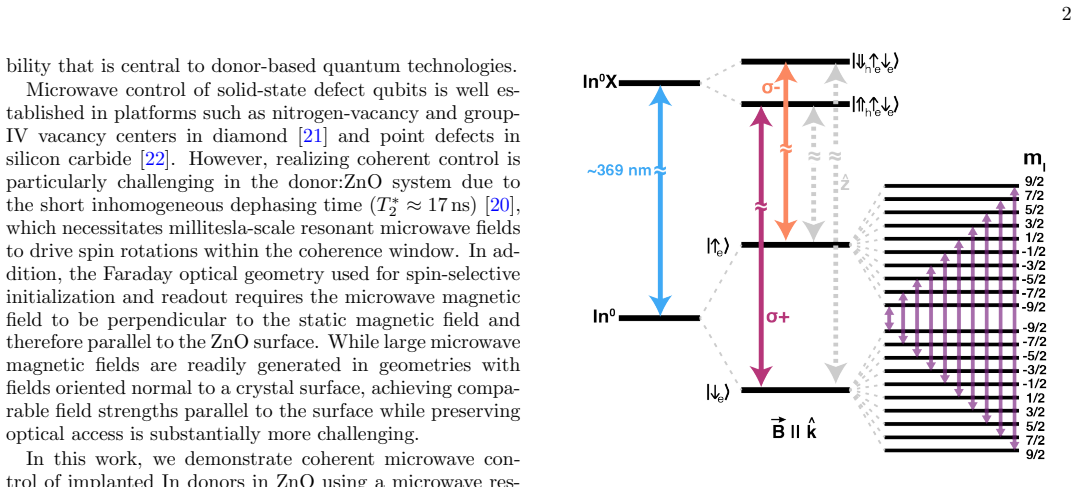
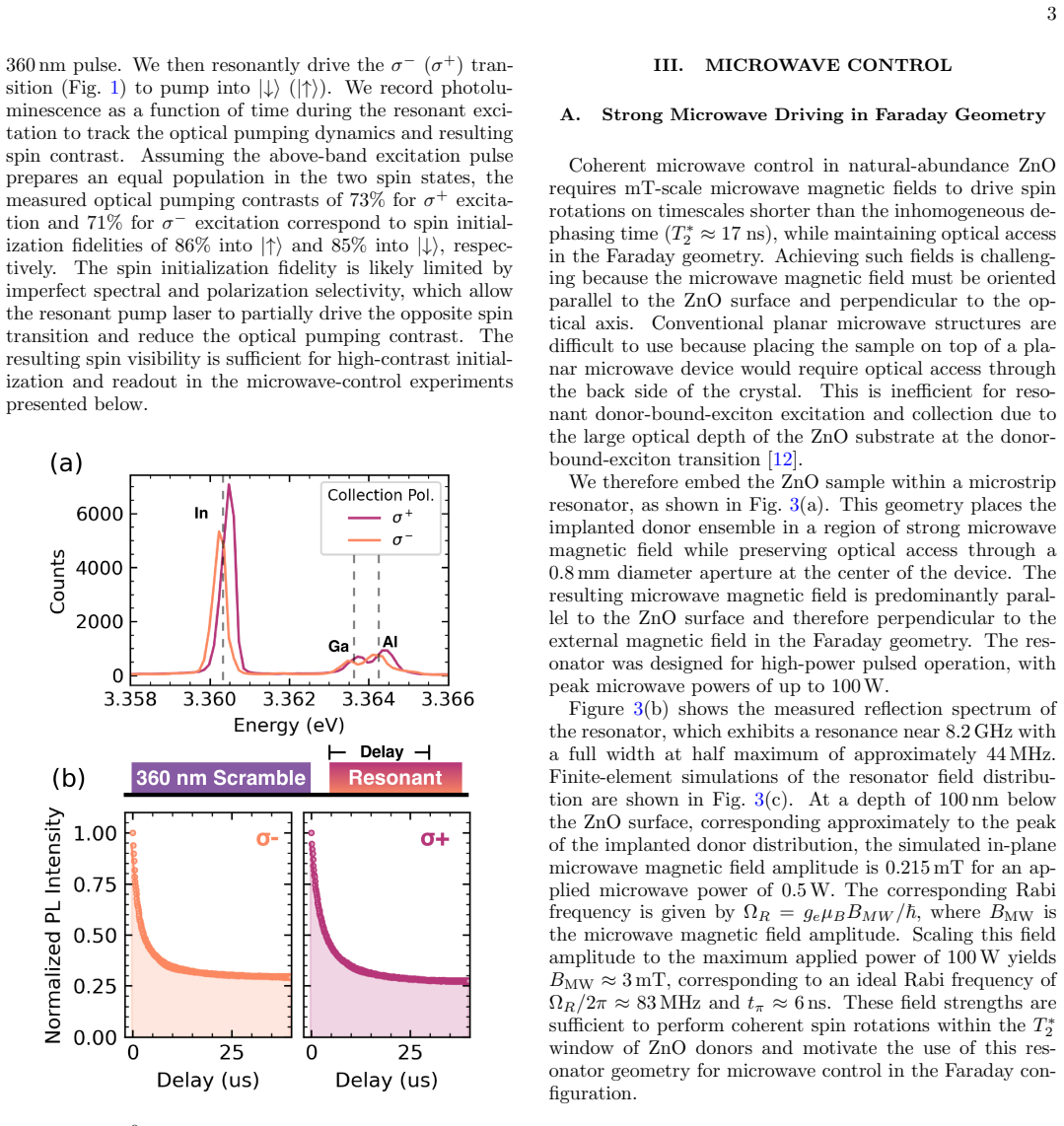
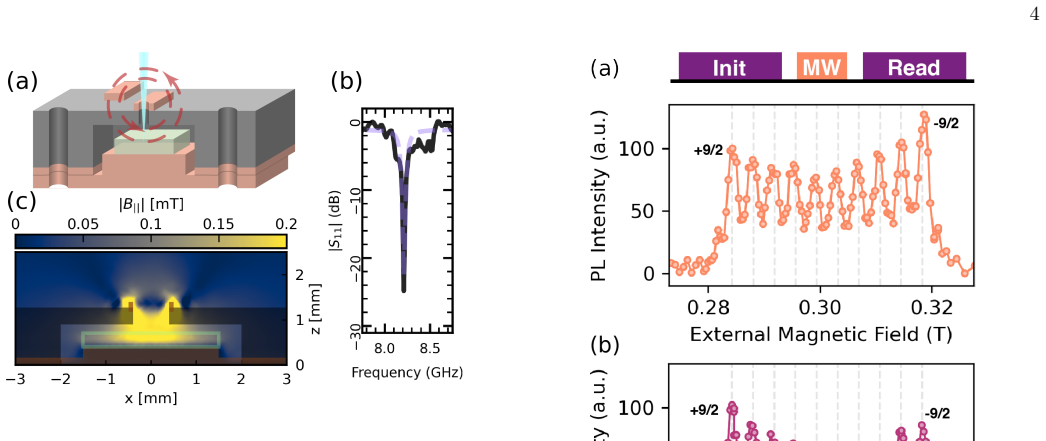
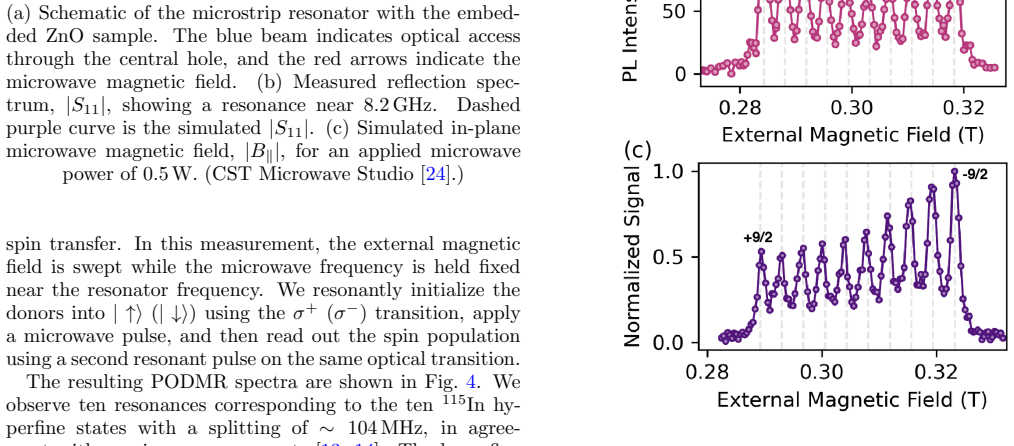
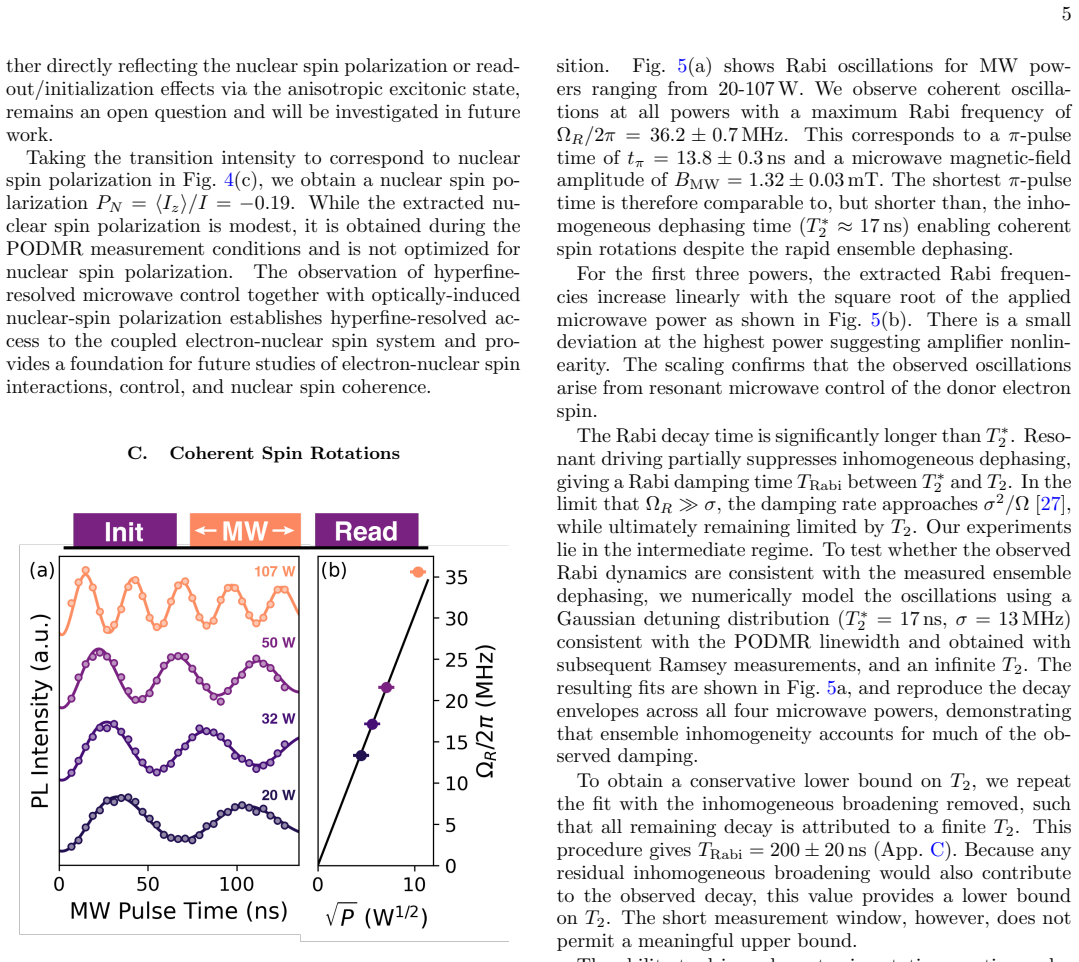
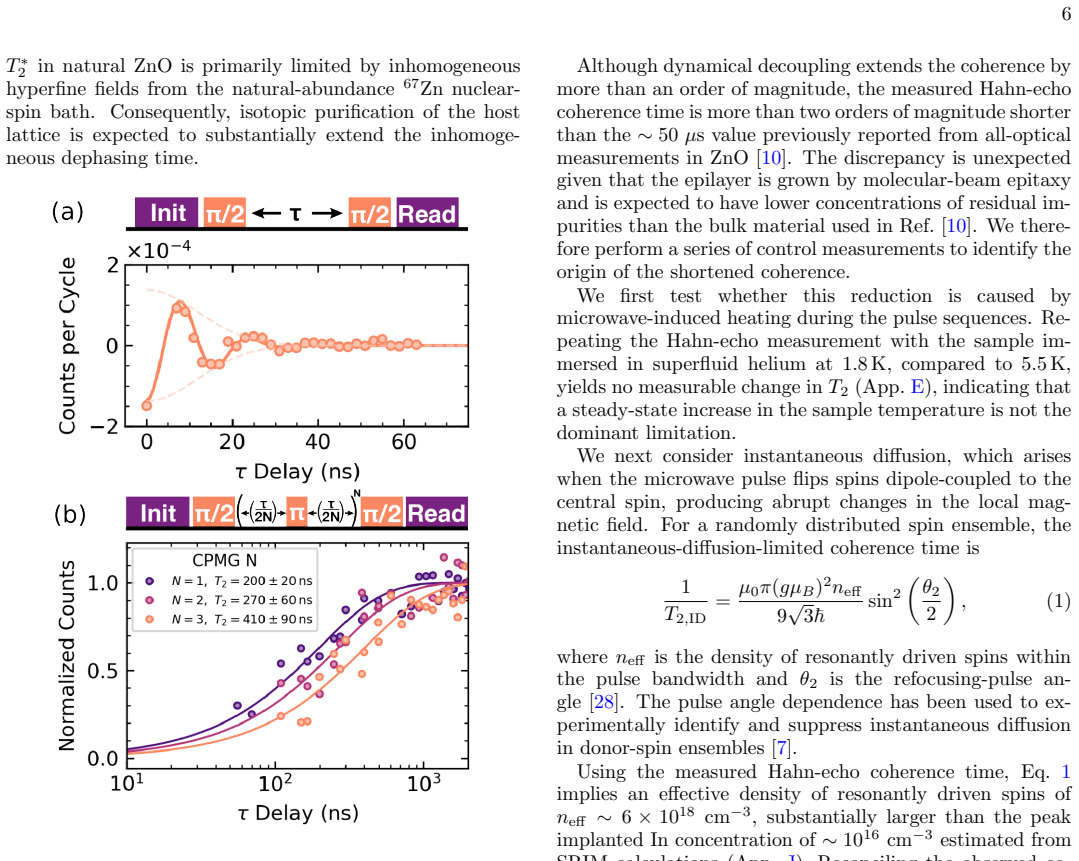
Resonant optical pumping initializes and reads out the donor electron spin while pulsed optically-detected magnetic resonance resolves the ten hyperfine lines of the I=9/2 115In nucleus and reveals optical-pumping-induced nuclear polarization. Microwave driving produces coherent Rabi oscillations with a maximum frequency of 36.2 MHz (pi-pulse time 13.8 ns). Spin coherence is characterized by Ramsey, Hahn-echo, and dynamical-decoupling measurements; the observed times are substantially shorter than those reported in prior high-field optical studies. Several simple decoherence sources are ruled out by control experiments, leaving an open question on the origin of low-field decoherence.
What carries the argument
Pulsed optically-detected magnetic resonance that combines resonant optical pumping for spin initialization and readout with microwave driving of the donor electron spin coupled to its nuclear spin.
If this is right
- Microwave control becomes available for specific donor species in ZnO despite nanosecond-scale inhomogeneous dephasing.
- Field-, temperature-, and materials-dependent studies of coherence-limiting mechanisms can now be performed.
- Optically interfaced electron-nuclear spin registers can be developed using the demonstrated initialization, readout, and coherent driving.
- Coherent microwave control is shown to function in optically addressable systems whose dephasing time is only a few nanoseconds.
Where Pith is reading between the lines
- The shorter low-field coherence may indicate a field-dependent decoherence channel that could be mapped by repeating the measurements across a range of magnetic fields.
- The same optical-pumping-plus-microwave protocol could be tested in other wide-bandgap hosts to identify which material properties set the ultimate coherence floor.
- Integration with photonic cavities or waveguides would be a direct next step to convert the demonstrated spin control into a spin-photon interface.
- Nuclear-spin polarization observed under optical pumping suggests that the system may support dynamic nuclear polarization protocols for longer-lived quantum memory.
Load-bearing premise
The observed Rabi oscillations and coherence signals arise specifically from the implanted 115In donors rather than from unidentified defects or experimental artifacts.
What would settle it
Absence of the characteristic ten-line hyperfine spectrum or of Rabi oscillations at the reported frequency in a control sample without indium implantation would falsify the assignment of the signals to the In donors.
Figures
read the original abstract
Optically addressable shallow donors in ZnO combine efficient spin-selective optical transitions with the potential for long spin coherence in an isotopically purifiable host lattice, making them an attractive platform for spin-photon quantum technologies. A key missing capability, however, has been coherent control beyond the small-angle rotations accessible with ultrafast optical pulses. Here we demonstrate coherent microwave control of implanted $^{115}\mathrm{In}$ donors in ZnO. Resonant optical pumping initializes and reads out the donor electron spin. Pulsed optically-detected magnetic resonance resolves the ten hyperfine transitions associated with the coupled $^{115}\mathrm{In}$ nuclear spin (I = 9/2) and reveals optical-pumping-induced nuclear spin polarization. We observe coherent Rabi oscillations with a maximum Rabi frequency of $\Omega/2\pi = 36.2 \pm 0.7$\;MHz, corresponding to a $\pi$-pulse time of 13.8$\pm$0.3\;ns, and characterize the spin coherence using Ramsey, Hahn echo and dynamical-decoupling measurements. Unexpectedly, the measured coherence is substantially shorter than reported in previous optical studies of donor spins in ZnO at high magnetic field. Control experiments rule out several simple explanations including microwave heating and instantaneous diffusion from the driven donor ensemble, leaving an open question regarding the origin of decoherence at low magnetic field in microwave-controlled ZnO donors. These results establish microwave control of ZnO donor qubits with resonant optical access to specific donor species. More broadly, they demonstrate that coherent microwave control can be achieved in optically addressable spin systems with nanosecond-scale inhomogeneous dephasing, enabling field-, temperature-, and materials-dependent studies of coherence-limiting mechanisms and the development of optically interfaced electron-nuclear spin registers.
Editorial analysis
A structured set of objections, weighed in public.
Referee Report
Summary. The manuscript demonstrates coherent microwave control of implanted 115In donor electron spins in ZnO. Resonant optical pumping initializes and reads out the spin; pulsed ODMR resolves the ten hyperfine lines of the I=9/2 nuclear spin and shows optical-pumping-induced nuclear polarization. Coherent Rabi oscillations are observed with maximum frequency Ω/2π = 36.2 ± 0.7 MHz (π-pulse time 13.8 ± 0.3 ns). Spin coherence is characterized via Ramsey, Hahn-echo, and dynamical-decoupling sequences. Control experiments exclude microwave heating and instantaneous diffusion as sources of the observed decoherence, which is shorter than in prior high-field optical studies; the origin remains an open question. The work establishes microwave control for this optically addressable donor system.
Significance. If the reported measurements hold, the result is significant for spin-photon quantum technologies: it supplies the missing coherent microwave control capability for an isotopically purifiable, optically addressable donor platform in ZnO. Quantitative Rabi frequencies and coherence times with error bars, together with explicit control experiments, enable direct comparison with other systems and field-dependent studies of decoherence. The manuscript credits the open question on low-field coherence rather than overclaiming.
minor comments (2)
- Abstract: the LaTeX spacing command \; before MHz should be replaced by a standard thin space or SI-unit formatting for consistency with journal style.
- The manuscript would benefit from an explicit statement in the methods or results section of the microwave pulse calibration procedure used to extract the quoted Rabi frequency and its uncertainty.
Simulated Author's Rebuttal
We thank the referee for their positive assessment of the manuscript, accurate summary of the results, and recommendation to accept. The referee correctly notes that the work supplies the missing coherent microwave control for this platform and that the open question on low-field coherence is already acknowledged without overclaiming.
Circularity Check
No significant circularity
full rationale
This is a pure experimental report with no derivation chain, equations, or predictions. All central results (Rabi frequency of 36.2 MHz, hyperfine lines, coherence times from Ramsey/Hahn echo/DD) are direct measurements from ODMR and pulsed control experiments. Control experiments are reported as independent checks rather than fitted inputs. No self-citations are load-bearing for any claimed result, and no ansatz or uniqueness theorem is invoked. The paper is self-contained against external benchmarks.
Axiom & Free-Parameter Ledger
axioms (1)
- standard math Standard quantum mechanics governs the electron and nuclear spin dynamics of shallow donors in ZnO.
Reference graph
Works this paper leans on
-
[1]
Benjamin, B
S. Benjamin, B. Lovett, and J. Smith, Prospects for measurement-based quantum computing with solid state spins, Laser & Photonics Reviews3, 556 (2009)
2009
-
[2]
J. R. Weber, W. F. Koehl, J. B. Varley, A. Janotti, B. B. Buckley, C. G. V. de Walle, and D. D. Awschalom, Quan- tum computing with defects, Proceedings of the National Academy of Sciences107, 8513 (2010)
2010
-
[3]
T. D. Ladd, F. Jelezko, R. Laflamme, Y. Nakamura, C. Mon- roe, and J. L. O’Brien, Quantum computers, Nature464, 45 (2010)
2010
-
[4]
Wehner, D
S. Wehner, D. Elkouss, and R. Hanson, Quantum internet: A vision for the road ahead, Science362, eaam9288 (2018)
2018
-
[5]
Orieux and E
A. Orieux and E. Diamanti, Recent advances on integrated quantum communications, Journal of Optics18, 083002 (2016)
2016
-
[6]
Niaouris, M
V. Niaouris, M. V. Durnev, X. Linpeng, M. L. K. Vi- itaniemi, C. Zimmermann, A. Vishnuradhan, Y. Kozuka, M. Kawasaki, and K.-M. C. Fu, Ensemble spin relaxation of shallow donor qubits in ZnO, Phys. Rev. B105, 195202 (2022)
2022
-
[7]
A. M. Tyryshkin, S. Tojo, J. J. L. Morton, H. Riemann, N. V. Abrosimov, P. Becker, H.-J. Pohl, T. Schenkel, M. L. W. Thewalt, K. M. Itoh, and S. A. Lyon, Electron spin coherence exceeding seconds in high-purity silicon, Na- ture Materials11, 143 (2012)
2012
-
[8]
Balasubramanian, P
G. Balasubramanian, P. Neumann, D. Twitchen, M. Markham, R. Kolesov, N. Mizuochi, J. Isoya, J. Achard, J. Beck, J. Tissler, V. Jacques, P. R. Hemmer, F. Jelezko, and J. Wrachtrup, Ultralong spin coherence time in iso- topically engineered diamond, Nature Materials8, 383 (2009)
2009
-
[9]
M. R. Wagner, G. Callsen, J. S. Reparaz, J.-H. Schulze, R. Kirste, M. Cobet, I. A. Ostapenko, S. Rodt, C. Nen- stiel, M. Kaiser, A. Hoffmann, A. V. Rodina, M. R. Phillips, S. Lautenschl¨ ager, S. Eisermann, and B. K. Meyer, Bound excitons in ZnO: Structural defect complexes versus shallow impurity centers, Phys. Rev. B84, 035313 (2011)
2011
-
[10]
Linpeng, M
X. Linpeng, M. L. Viitaniemi, A. Vishnuradhan, Y. Kozuka, C. Johnson, M. Kawasaki, and K.-M. C. Fu, Coherence prop- erties of shallow donor qubits in ZnO, Phys. Rev. Applied 10, 064061 (2018)
2018
-
[11]
X. Wang, C. Zimmermann, M. Titze, V. Niaouris, E. R. Hansen, S. H. D’Ambrosia, L. Vines, E. S. Bielejec, and K.-M. C. Fu, Properties of Donor Qubits in ZnO Formed 15 FIG. A10: Detailed geometry and fabrication process for the gap-coupled microstrip resonator. (a) Dimensioned top-view and cross-sectional schematics of the resonator, sample pocket, and copp...
2023
-
[12]
Niaouris, S
V. Niaouris, S. H. D’Ambrosia, C. Zimmermann, X. Wang, E. R. Hansen, M. Titze, E. S. Bielejec, and K.-M. C. Fu, Contributions to the optical linewidth of shallow donor- bound excitonic transition in zno, Optica Quantum2, 7 (2024)
2024
-
[13]
Block, A
D. Block, A. Herv´ e, and R. T. Cox, Optically detected mag- netic resonance and optically detected ENDOR of shallow indium donors in ZnO, Phys. Rev. B25, 6049 (1982)
1982
-
[14]
Gonzalez, D
C. Gonzalez, D. Block, R. Cox, and A. Herve´, Magnetic resonance studies of shallow donors in zinc oxide, Journal of Crystal Growth59, 357 (1982)
1982
-
[15]
J. H. Buß, J. Rudolph, T. A. Wassner, M. Eickhoff, and D. H¨ agele, Optical manipulation of a multilevel nuclear spin in ZnO: Master equation and experiment, Phys. Rev. B93, 155204 (2016)
2016
-
[16]
Neumann, N
P. Neumann, N. Mizuochi, F. Rempp, P. Hemmer, H. Watanabe, S. Yamasaki, V. Jacques, T. Gaebel, F. Jelezko, and J. Wrachtrup, Multipartite entanglement among single spins in diamond, Science320, 1326 (2008)
2008
-
[17]
J. J. L. Morton, A. M. Tyryshkin, R. M. Brown, S. Shankar, B. W. Lovett, A. Ardavan, T. Schenkel, E. E. Haller, J. W. Ager, and S. A. Lyon, Solid-state quantum memory using the 31p nuclear spin, Nature455, 1085 (2008)
2008
-
[18]
S. T. Merkel, P. S. Jessen, and I. H. Deutsch, Quantum control of the hyperfine-coupled electron and nuclear spins in alkali-metal atoms, Physical Review A78, 023404 (2008)
2008
-
[19]
E. R. Hansen, V. Niaouris, B. E. Matthews, C. Zimmer- mann, X. Wang, R. Kolodka, L. Vines, S. R. Spurgeon, and K.-M. C. Fu, Isolation of single donors in zno, Phys. Rev. Lett.133, 146902 (2024)
2024
-
[20]
Linpeng,Donor Qubits in Direct Band GaP Materials, Ph.D
X. Linpeng,Donor Qubits in Direct Band GaP Materials, Ph.D. thesis, University of Washington (2020)
2020
-
[21]
Karapatzakis, J
I. Karapatzakis, J. Resch, M. Schrodin, P. Fuchs, M. Ki- eschnick, J. Heupel, L. Kussi, C. S¨ urgers, C. Popov, J. Mei- jer, C. Becher, W. Wernsdorfer, and D. Hunger, Microwave control of the tin-vacancy spin qubit in diamond with a su- perconducting waveguide, Phys. Rev. X14, 031036 (2024)
2024
-
[22]
W. F. Koehl, B. B. Buckley, F. J. Heremans, G. Calusine, and D. D. Awschalom, Room temperature coherent con- trol of defect spin qubits in silicon carbide, Nature479, 84 (2011)
2011
-
[23]
J. F. Ziegler, M. Ziegler, and J. Biersack, SRIM – The stop- ping and range of ions in matter (2010), Nuclear Instruments and Methods in Physics Research Section B: Beam Inter- actions with Materials and Atoms268, 1818 (2010), 19th International Conference on Ion Beam Analysis
2010
-
[24]
Dassault Syst` emes, CST Studio Suite: Microwave Studio, Version 2024, Dassault Syst` emes Simulia, Darmstadt, Ger- many (2024)
2024
-
[25]
D. M. Hofmann, A. Hofstaetter, F. Leiter, H. Zhou, F. He- necker, B. K. Meyer, S. B. Orlinskii, J. Schmidt, and P. G. Baranov, Hydrogen: A relevant shallow donor in zinc oxide, Phys. Rev. Lett.88, 045504 (2002)
2002
-
[26]
C. D. Jeffries, Dynamic orientation of nuclei by forbidden 16 transitions in paramagnetic resonance, Phys. Rev.117, 1056 (1960)
1960
-
[27]
Abragam,The Principles of Nuclear Magnetism, Inter- national Series of Monographs on Physics, Vol
A. Abragam,The Principles of Nuclear Magnetism, Inter- national Series of Monographs on Physics, Vol. 32 (Oxford University Press, Oxford, 1961)
1961
-
[28]
K. M. Salikhov, S. A. Dzuba, and A. M. Raitsimring, The theory of electron spin-echo signal decay resulting from dipole-dipole interactions between paramagnetic centers in solids, Journal of Magnetic Resonance42, 255 (1981)
1981
-
[29]
Zhang, G
J. Zhang, G. D. Grant, I. Masiulionis, M. T. Solomon, J. K. Bindra, J. Niklas, A. M. Dibos, O. G. Poluektov, F. J. Here- mans, S. Guha, and D. D. Awschalom, Optical and spin co- herence of er 3+ in epitaxial ceo 2 on silicon, npj Quantum Information10, 118 (2024)
2024
-
[30]
Welinski, P
S. Welinski, P. J. T. Woodburn, N. Lauk, R. L. Cone, C. Si- mon, P. Goldner, and C. W. Thiel, Electron spin coherences in rare-earth optically excited states for microwave to optical quantum transducers, Physical Review Letters122, 247401 (2019)
2019
-
[31]
Kanai, F
S. Kanai, F. J. Heremans, H. Seo, G. Wolfowicz, C. P. Anderson, S. E. Sullivan, M. Onizhuk, G. Galli, D. D. Awschalom, and H. Ohno, Generalized scaling of spin qubit coherence in over 12,000 host materials, Proceedings of the National Academy of Sciences119, e2121808119 (2022)
2022
discussion (0)
Sign in with ORCID, Apple, or X to comment. Anyone can read and Pith papers without signing in.