REVIEW 3 major objections 4 minor 69 references
The Low Frequency Trap: Video Language Models Fail at Simple Event Bookkeeping
T0 review · 3 major / 4 minor · reviewed 2026-08-07 · deepseek-v4-flash
Pith's one-line read Video-language models fail at event counting once load rises, trace audit shows.
desk verdict Careful trace-grounded benchmark with a real diagnostic payoff, but the headline representation claim overreaches because the blink pulse duration is unreported and may be an input-sampling artifact. read the letter →
The pith
A machine-rendered reading of the paper's core claim, the machinery that carries it, and where it could break.
The reading
What carries the argument
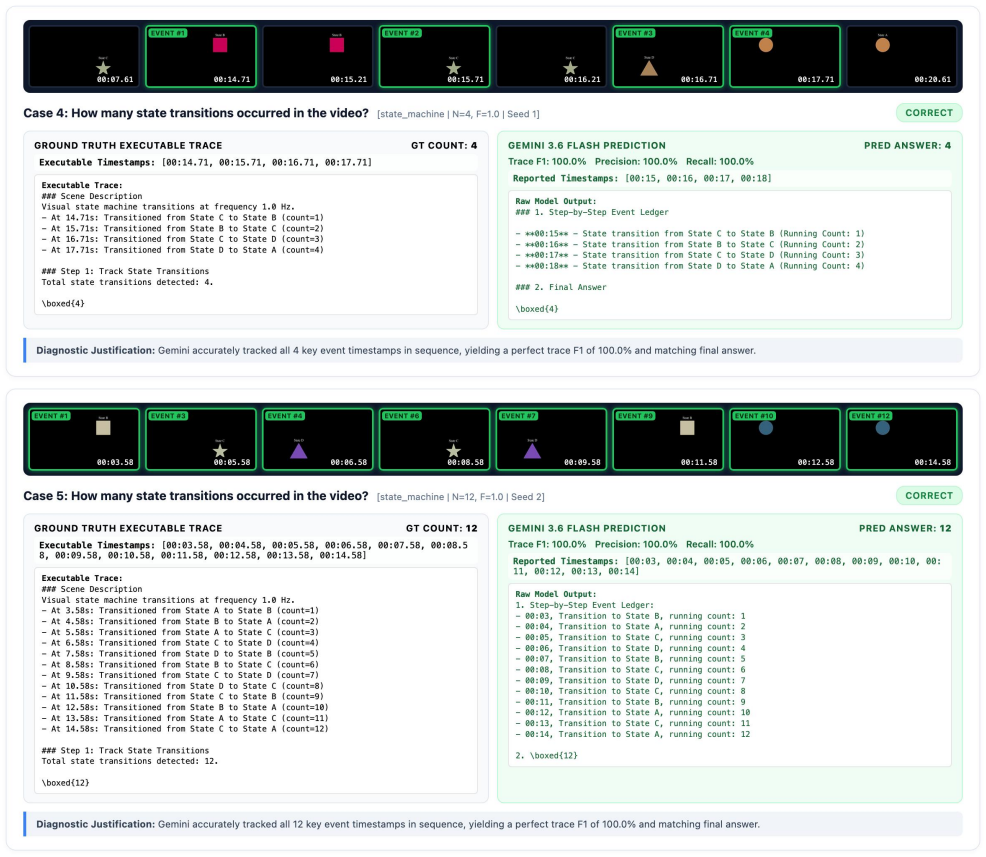
The central object is the executable event trace, a renderer-generated schedule $T^* = \{(t_i, e_i, s_i^-, s_i^+, c_i)\}_{i=1}^N$ produced by the same event schedule used to generate the video. It carries the argument by letting the authors align model-reported timestamps to ground truth within a rate-relative window $\delta(F) = 1/(2F)$, the half inter-event period, and then score precision, recall, trace F1, visual observation ratio, accidental correctness, and reasoning failure. This trace alignment is what converts a final-count benchmark into a diagnosis of where temporal reasoning fails.
What would settle it
Render the Blinking task with a pulse duration at least as long as one frame interval, such as one second at 1 FPS, or report the exact on-pulse duration used; if the no-reliable-positive-count region persists with full-frame pulses, the transient-representation claim is supported, and if a reliable region appears, the observed failure is an input-sampling artifact.
Extended reading notes
Core claim
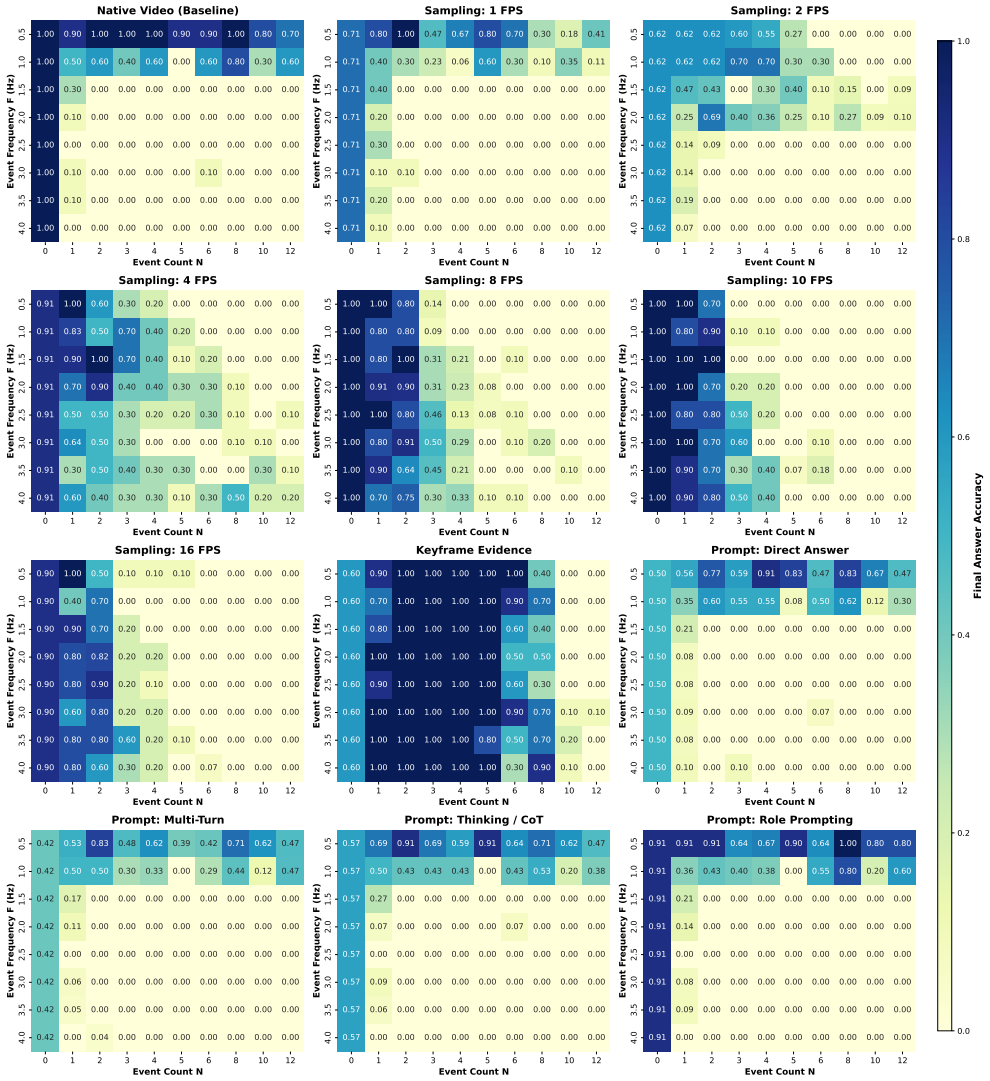
On the paper's own terms, the discovery is a staged, representation-dependent temporal failure: whether an event persists on screen determines whether the model can access the evidence at all, and once count and frequency rise, models under-report events and stop aggregating them correctly. The executable traces show that reported timestamps align with ground truth only partially, with macro trace F1 at 36.4%, that correct final counts can arise from low-fidelity traces, and that more input frames raise final accuracy from 19.6% to 29.3% while reported-sequence agreement stays at 3.7%. Better final scores therefore need not reflect faithful event recovery.
Load-bearing premise
The Blinking task's pulse duration is never reported, so if each blink is short relative to the supplied one-frame-per-second sampling rate, many pulses will fall entirely between frames and the model's failure to count them could reflect input undersampling rather than a limit of event bookkeeping.
Editorial extensions
If this is right
- If the claim is correct, final-answer exact match should not be the primary measure of temporal video understanding; benchmark suites should pair videos with executable traces and score reported timestamps.
- Persistent state transitions being countable through twelve events at 0.5–1.0 Hz shows that low-frequency bookkeeping is not inherently impossible, so progress should be measured against the count-by-frequency boundary rather than aggregate accuracy.
- Dense sampling alone will not restore faithful event recovery: 4 FPS raised exact match from 19.6% to 29.3% but trace F1 stayed at 3.7%, so extra frames can inflate final scores while missing events remain hidden.
- Prompting strategies—direct, structured trace, multi-turn verification, chain of thought, and role prompting—all stay near 19–20% on Bounce Ball, indicating the bottleneck is not instruction format.
- On natural repeated-event videos the same concentration of accuracy at low counts appears across prompting formats, suggesting the controlled failure pattern transfers outside synthetic clips.
Reading between the lines
- An untested implication is that the bottleneck is largely retention or aggregation rather than perception: oracle keyframes at every event reach 68.6% accuracy but collapse past five events, which separates event localization from sequence retention.
- A testable extension is to vary blink pulse duration in the Blinking task, for example from 0.1 to 2 seconds, to separate the transient-representation effect from the frame-sampling effect; the paper itself leaves event duration outside its controlled scope.
- If the 0.2% high-load figure generalizes, applications that require counting many fast events cannot trust current video-language models without timestamp-level auditing.
Editorial analysis
A structured set of objections, weighed in public.
Referee Report
Summary. The paper introduces trace-grounded parametric profiling for video event counting. It generates 2,190 controlled Manim videos across three tasks (bouncing-ball wall contacts, visual blinks, categorical state transitions), sweeping event count N and frequency F while holding rendering fixed. Each video is paired with an executable ground-truth trace, and the authors align model-reported timestamps with these traces to compute final-answer exact match, precision, recall, trace F1, and two new diagnostics (ACR and RFR). The primary results show that Gemini 3.6 Flash has a broad reliable region for persistent State Machine transitions up to N=12 at low frequencies, no reliable positive-count region for Blinking, very low trace fidelity in the high-count/high-frequency regime, and only limited gains from denser sampling, oracle keyframes, or prompting. A supplementary Qwen3-VL check and a real-world TransRAC transfer evaluation are also reported. The paper argues that aggregate final-answer scores overstate temporal fidelity and that trace-level evaluation reveals a staged failure of event access, retention, and aggregation.
Significance. If the central claims hold, this is a valuable methodological contribution: it replaces a single aggregate accuracy score with capability surfaces over event count and frequency, ships an executable trace format with timestamp-level evaluation, introduces ACR/RFR to separate unsupported correct answers from faithful traces, and provides unusually transparent cost and sensitivity analyses. The cross-model comparisons and the natural-video transfer check are useful robustness evidence. The paper's independent trace-fidelity findings—especially the 4 FPS result where final accuracy rises but trace F1 collapses to 3.7%—are strong and are not undermined by the sampling concern raised below. However, the headline representation-dependence claim (persistent vs. transient events) is currently under-specified, because the Blinking task does not report pulse duration and the persistent-versus-transient comparison is not isolated from other domain differences.
major comments (3)
- [Appendix A.1, §3.1] The Blinking event primitive is defined only as "visual pulse opacities" (Appendix A.1), and the on-pulse duration or duty cycle is never reported. Since Gemini receives approximately 1 FPS (Section 3, Appendix A.2), a pulse substantially shorter than one frame interval can fall entirely between supplied frames, so even a perfect event counter would miss many blinks. The observed absence of a reliable positive-count region for Blinking is therefore compatible with a pure input-sampling ceiling rather than with the paper's claim that "event representation dictates whether a model initially accesses evidence." This is load-bearing because the persistent-State-Machine versus transient-Blinking comparison is the only direct evidence for the representation claim. Please report the blink on-pulse duration in the task specification, state the expected frame-capture probability per (N,F) cell, and ideally add a control that varies event persistence while holding the event schedule and visual salience fixed.
- [§3.3, Eq. (5)] The capability boundary is defined using tau=0.80 on 10 trials per cell. A cell with 8 correct answers has a two-sided 95% Wilson interval of roughly [0.49,0.95], so the distinction between a "reliable" and an "unreliable" cell at the reported boundary is not statistically robust. The aggregate Wilson intervals in Appendix B.4 do not cover cell-level boundaries, and the boundary at N=12 at 1.0 Hz for State Machine rests on a single cell at exactly 8/10. Please report per-cell intervals or an explicit robustness analysis over tau (e.g., 0.70, 0.90) and over seed resampling, or soften the wording from "reliably counts" to "achieves at least 80% exact match on the tested renderings." The boundary definitions themselves are reasonable, but the operational language overstates their stability.
- [§4, §5, Abstract] The paper explicitly concedes that "the domains also vary visual form and semantics" (Section 4) and "while not isolating persistence from other domain differences" (Section 5), yet the abstract and introduction state the representation claim as causal: "event representation dictates whether a model initially accesses the evidence." The design does not manipulate persistence independently of event duration, visual salience, or semantics. The Appendix keyframe results on Blinking (e.g., Figure 14) are consistent with a large sampling-related component in the Blinking deficit, which makes the missing pulse-duration control more salient. Please either add a matched control (same object and event times, varying only whether the event leaves a persistent state change) or restrict the main claim to a descriptive statement that performance differs across the three controlled domains, with causality attributed to the combination of representation, duration, and sampling.
minor comments (4)
- [§7] The text says "We use 151 clips from TransRAC" but also reports "152 TransRAC clips" in the Figure 5 caption; please reconcile the count.
- [Figure 2] The Blinking caption says "An object pulsing ON and OFF at 1.0 Hz." If a blink is defined as an ON transition rather than a full ON-OFF cycle, the wording is ambiguous and should be clarified, ideally with the pulse duration stated in the figure or its caption.
- [§4, Figure 3 caption] The caption says "Qwen shows the same concentration of accuracy at low counts and frequencies," but the Qwen panel in Figure 3b has no contiguous reliable positive-count region; consider making the caption more precise by noting that Qwen's reliability is limited to isolated low-count cells.
- [§5, Table 1] The Part B region definitions (N≤3, N≥5, F≤2.0, F≥2.5) leave the N=4 and F=2.0/2.5 cells unassigned; please state explicitly how those cells are treated or note that they are excluded from the regional aggregation.
Circularity Check
No significant circularity: the paper is a measurement study whose headline numbers are computed from model outputs against renderer-produced ground truth, and its self-citations are contextual rather than load-bearing.
full rationale
The paper does not contain a derivation chain in which a prediction is equivalent, by construction, to an input. The central results—accuracy surfaces over N×F, trace precision/recall/F1, ACR/RFR, and intervention deltas—are all measured quantities computed from model responses on newly generated videos paired with executable ground-truth traces. Equations (1)–(6) define evaluation metrics and descriptive reliability boundaries; no parameter is fitted to data and then renamed as a prediction. The trace alignment uses an a priori rate-relative window δ(F)=1/(2F), which is a scoring rule, not a fitted input that determines the outcomes. The only self-references (MORSE-500 and Mementos) appear as related work and do not supply any measured value in the paper. The paper itself states limitations that could affect interpretation—e.g., 'the profiles evaluate complete end-to-end systems' with 'sampling and interface remain confounds', and the State Machine comparison is 'while not isolating persistence from other domain differences'—but these are experimental confounds and reporting gaps, not circular reductions. The unreported blinking pulse duration is a legitimate concern about input undersampling, but it does not make any claim circular. No load-bearing step reduces to its own inputs or to an unverified self-citation, so the appropriate finding is no significant circularity.
Assumptions & free parameters
free parameters (5)
- reliability target tau =
0.80
- ACR/RFR trace fidelity cutoff =
0.80
- timestamp matching tolerance delta(F) =
1/(2F), from 1.0 s at 0.5 Hz to 0.125 s at 4.0 Hz
- capability region bins =
N<=3, N>=5, F<=2.0, F>=2.5 Hz
- blink on-pulse duration =
not reported
assumptions (5)
- domain assumption Manim rendering is frame-accurate with no compression artifacts or timing jitter, so executable traces exactly describe visual events.
- domain assumption Parsed final counts and explicit timestamps are valid behavioral readouts of a model's event bookkeeping.
- domain assumption The three domains differ primarily in event persistence, not in other factors relevant to counting.
- domain assumption The supplied sampling rates, 1 FPS for Gemini and 2 FPS for Qwen, are fixed external input settings.
- domain assumption The N=0 no-event control is rendered at nominal F=1.0 Hz and is excluded from trace ratios.
Cite this review
Pith. "Pith review of The Low Frequency Trap: Video Language Models Fail at Simple Event Bookkeeping." pith.science (2026). https://pith.science/paper/KEQIS47K
@misc{pith2026260806361,
  author       = {Pith},
  title        = {Pith review of: The Low Frequency Trap: Video Language Models Fail at Simple Event Bookkeeping},
  year         = {2026},
  howpublished = {\url{https://pith.science/paper/KEQIS47K}},
  note         = {Machine review of arXiv:2608.06361}
}
read the original abstract
Real-world video benchmarks provide broad coverage, but their fixed clips entangle event count, rate, duration, and visual complexity, making failure modes hard to isolate. While existing programmatic benchmarks offer better control, they score only the final answer rather than auditing reported events against executable ground truth. To bridge this gap, we introduce trace-grounded parametric profiling for event counting in three controlled video tasks: bouncing-ball wall contacts, visual blinks, and categorical state transitions. Across 2,190 videos, we vary event count N and frequency F while holding rendering fixed. Each video includes an executable event trace for capability-surface estimation and timestamp-level evaluation. Our results reveal a staged temporal failure. At an 80% reliability threshold, Gemini 3.6 Flash reliably counts persistent state transitions up to 12 events at 0.5 and 1.0 Hz, yet demonstrates no reliable positive-count region for transient blinking events. Thus, event representation dictates whether a model initially accesses evidence -- a limitation that compounds as count and frequency increase. In the high-count, high-frequency regime, only 0.2% of final counts are correct and the model recovers just 18.1% of true events. To test if visual access is the primary bottleneck, we increase sampling rate. Although this boosts Bounce Ball accuracy from 19.6% to 29.3%, the reported sequence agrees with ground truth only 3.7% of the time. Extra frames can therefore inflate final scores without producing faithful event recovery. Different prompting strategies yield similarly limited gains, and real-world video evaluations show the same concentration of success at low event counts. Ultimately, trace-grounded profiling shifts video evaluation from aggregate accuracy metrics to a detailed diagnostic of where temporal reasoning fails.
Figures


Figures from the paper (25 more)






Reference graph
Works this paper leans on
-
[1]
L.; Panda, S.; Meghwani, H.; Singh, J.; Dua, K.; Li, P.; Sheng, T.; Ravi, S.; and Roth, D
Agarwal, A.; Patel, H. L.; Panda, S.; Meghwani, H.; Singh, J.; Dua, K.; Li, P.; Sheng, T.; Ravi, S.; and Roth, D. 2025. RCI: A Score for Evaluating Global and Local Reasoning in Multimodal Benchmarks. arXiv:2509.23673
-
[2]
Bai, S.; Cai, Y.; Chen, R.; Chen, K.; Chen, X.; Cheng, Z.; Deng, L.; Ding, W.; Gao, C.; Ge, C.; Ge, W.; Guo, Z.; Huang, Q.; Huang, J.; Huang, F.; Hui, B.; Jiang, S.; Li, Z.; Li, M.; Li, M.; Li, K.; Lin, Z.; Lin, J.; Liu, X.; Liu, J.; Liu, C.; Liu, Y.; Liu, D.; Liu, S.; Lu, D.; Luo, R.; Lv, C.; Men, R.; Meng, L.; Ren, X.; Ren, X.; Song, S.; Sun, Y.; Tang, ...
arXiv 2025
-
[3]
Cai, Z.; Wang, A.; Satheesh, A.; Nakhawa, A.; Jae, H.; Powell, K.; Liu, M.; Jay, N.; Oh, S.; Wang, X.; Liang, Y.; Goldstein, T.; and Huang, F. 2025. MORSE-500: A Programmatically Controllable Video Benchmark to Stress-Test Multimodal Reasoning. arXiv:2506.05523
arXiv 2025
-
[4]
M.; Kota, T.; He, J.; Eyzaguirre, C.; Durante, Z.; Li, M.; Wu, J.; and Fei-Fei, L
Chandrasegaran, K.; Gupta, A.; Hadzic, L. M.; Kota, T.; He, J.; Eyzaguirre, C.; Durante, Z.; Li, M.; Wu, J.; and Fei-Fei, L. 2024. HourVideo: 1-Hour Video-Language Understanding. In Advances in Neural Information Processing Systems, volume 37, 53168--53197
work page 2024
-
[5]
Chen, L.; Li, J.; Dong, X.; Zhang, P.; Zang, Y.; Chen, Z.; Duan, H.; Wang, J.; Qiao, Y.; Lin, D.; and Zhao, F. 2024. Are We on the Right Way for Evaluating Large Vision-Language Models? arXiv:2403.20330
arXiv 2024
-
[6]
Cheng, Z.; Hu, J.; Liu, Z.; Si, C. P.; Li, W.; and Gong, S. 2026. V-STaR: Benchmarking Video-LLMs on Video Spatio-Temporal Reasoning. In Proceedings of the IEEE/CVF Conference on Computer Vision and Pattern Recognition (CVPR) Findings
work page 2026
-
[7]
Chow, W.; Mao, J.; Li, B.; Seita, D.; Guizilini, V.; and Wang, Y. 2025. PhysBench: Benchmarking and Enhancing Vision-Language Models for Physical World Understanding. In International Conference on Learning Representations
work page 2025
-
[8]
S.; Salehi, M.; Tripathi, R.; Lee, S.; Ren, Z.; Kim, C
Clark, C.; Zhang, J.; Ma, Z.; Park, J. S.; Salehi, M.; Tripathi, R.; Lee, S.; Ren, Z.; Kim, C. D.; Yang, Y.; Shao, V.; Yang, Y.; Huang, W.; Gao, Z.; Anderson, T.; Zhang, J.; Jain, J.; Stoica, G.; Han, W.; Farhadi, A.; and Krishna, R. 2026. Molmo2: Open Weights and Data for Vision-Language Models with Video Understanding and Grounding. arXiv:2601.10611
arXiv 2026
Show all 69 references
-
[9]
Cores, D.; Dorkenwald, M.; Mucientes, M.; Snoek, C. G. M.; and Asano, Y. M. 2025. Lost in Time: A New Temporal Benchmark for VideoLLMs. In 36th British Machine Vision Conference 2025, BMVC 2025 . BMVA
2025
-
[11]
Fu, C.; Dai, Y.; Luo, Y.; Li, L.; Ren, S.; Zhang, R.; Wang, Z.; Zhou, C.; Shen, Y.; Zhang, M.; Chen, P.; Li, Y.; Lin, S.; Zhao, S.; Li, K.; Xu, T.; Zheng, X.; Chen, E.; Shan, C.; He, R.; and Sun, X. 2025. Video-MME: The First-Ever Comprehensive Evaluation Benchmark of Multi-mo...
2025
-
[12]
A.; Ma, W.-C.; and Krishna, R
Fu, X.; Hu, Y.; Li, B.; Feng, Y.; Wang, H.; Lin, X.; Roth, D.; Smith, N. A.; Ma, W.-C.; and Krishna, R. 2024. BLINK: Multimodal Large Language Models Can See but Not Perceive. arXiv:2404.12390
2024 arXiv
-
[13]
W.; Li, L.; Yang, Z.; Wang, L.; and Cheng, Y
Hao, Y.; Gu, J.; Wang, H. W.; Li, L.; Yang, Z.; Wang, L.; and Cheng, Y. 2025. Can MLLMs Reason in Multimodality? EMMA: An Enhanced MultiModal ReAsoning Benchmark. In Proceedings of the 42nd International Conference on Machine Learning (ICML 2025)
2025
-
[16]
L.; and Girshick, R
Johnson, J.; Hariharan, B.; van der Maaten, L.; Fei-Fei, L.; Zitnick, C. L.; and Girshick, R. 2017. CLEVR: A Diagnostic Dataset for Compositional Language and Elementary Visual Reasoning. In Proceedings of the IEEE Conference on Computer Vision and Pattern Recognition (CVPR), ...
2017
-
[17]
Li, C.; Chen, Q.; Li, Z.; Tao, F.; and Zhang, Y. 2024 a . VideoCogQA: A Controllable Benchmark for Evaluating Cognitive Abilities in Video-Language Models. arXiv:2411.09105
2024 arXiv
-
[18]
Li, K.; Wang, Y.; He, Y.; Li, Y.; Wang, Y.; Liu, Y.; Wang, Z.; Xu, J.; Chen, G.; Luo, P.; Wang, L.; and Qiao, Y. 2024 b . MVBench: A Comprehensive Multi-modal Video Understanding Benchmark. arXiv:2311.17005
2024 arXiv
-
[20]
Liu, Y.; Li, S.; Liu, Y.; Wang, Y.; Ren, S.; Li, L.; Chen, S.; Sun, X.; and Hou, L. 2024. T emp C ompass: Do Video LLM s Really Understand Videos? In Findings of the Association for Computational Linguistics: ACL 2024. Association for Computational Linguistics
2024
-
[22]
Lu, H.; Huo, Y.; Du, Y.; Zhao, Z.; Guo, L.; Wang, B.; Chen, W.; and Liu, J. 2025. Needle In A Video Haystack: A Scalable Synthetic Evaluator for Video MLLMs. In Yue, Y.; Garg, A.; Peng, N.; Sha, F.; and Yu, R., eds., International Conference on Learning Representations, volume...
2025
-
[23]
Lu, P.; Bansal, H.; Xia, T.; Liu, J.; Li, C.; Hajishirzi, H.; Cheng, H.; Chang, K.-W.; Galley, M.; and Gao, J. 2024. MathVista: Evaluating Mathematical Reasoning of Foundation Models in Visual Contexts. arXiv:2310.02255
2024 arXiv
-
[24]
Mangalam, K.; Akshulakov, R.; and Malik, J. 2023. EgoSchema: A Diagnostic Benchmark for Very Long-form Video Language Understanding. In Oh, A.; Naumann, T.; Globerson, A.; Saenko, K.; Hardt, M.; and Levine, S., eds., Advances in Neural Information Processing Systems, volume 36...
2023
-
[27]
Shojaee, P.; Mirzadeh, I.; Alizadeh, K.; Horton, M.; Bengio, S.; and Farajtabar, M. 2025. The Illusion of Thinking: Understanding the Strengths and Limitations of Reasoning Models via the Lens of Problem Complexity. arXiv:2506.06941
2025 arXiv
-
[28]
Song, E.; Chai, W.; Xu, W.; Xie, J.; Liu, Y.; and Wang, G. 2025. Video-MMLU: A Massive Multi-Discipline Lecture Understanding Benchmark. arXiv:2504.14693
2025 arXiv
-
[29]
Sun, Y.; Hu, S.; Zhou, G.; Zheng, K.; Hajishirzi, H.; Dziri, N.; and Song, D. 2025. OMEGA: Can LLMs Reason Outside the Box in Math? Evaluating Exploratory, Compositional, and Transformative Generalization. arXiv:2506.18880
2025 arXiv
-
[30]
Tong, J.; Tang, J.; Li, H.; Mou, Y.; Zhang, M.; Zhao, J.; Wen, Y.; Song, F.; Zhan, J.; Lu, Y.; Tao, C.; Guo, Z.; Yu, J.; Cheng, T.; Xi, Z.; Jiang, C.; Yin, Z.; Zheng, Y.; Ge, W.; Chen, G.; Gui, T.; Qiu, X.; Zhang, Q.; and Huang, X. 2025. Game-RL: Synthesizing Multimodal Verifi...
2025
-
[31]
Tong, S.; Liu, Z.; Zhai, Y.; Ma, Y.; LeCun, Y.; and Xie, S. 2024. Eyes Wide Shut? Exploring the Visual Shortcomings of Multimodal LLMs. arXiv:2401.06209
2024 arXiv
-
[32]
Wang, W.; Gao, Z.; Gu, L.; Pu, H.; Cui, L.; Wei, X.; Liu, Z.; Jing, L.; Ye, S.; Shao, J.; Wang, Z.; Chen, Z.; Zhang, H.; Yang, G.; Wang, H.; Wei, Q.; Yin, J.; Li, W.; Cui, E.; Chen, G.; Ding, Z.; Tian, C.; Wu, Z.; Xie, J.; Li, Z.; Yang, B.; Duan, Y.; Wang, X.; Hou, Z.; Hao, H....
2025 arXiv
-
[34]
Wang, X.; Zhou, Y.; Liu, X.; Lu, H.; Xu, Y.; He, F.; Yoon, J.; Lu, T.; Liu, F.; Bertasius, G.; Bansal, M.; Yao, H.; and Huang, F. 2024. Mementos: A Comprehensive Benchmark for Multimodal Large Language Model Reasoning over Image Sequences. In Ku, L.-W.; Martins, A.; and Srikum...
2024
-
[35]
Wu, H.; Li, D.; Chen, B.; and Li, J. 2024. LongVideoBench: A Benchmark for Long-context Interleaved Video-Language Understanding. arXiv:2407.15754
2024 arXiv
-
[36]
J.; Huang, Y.; Liu, Z.; Qu, P.; He, J.; Chen, J.; Yuan, Y.-J.; Han, J.; Xu, H.; Li, H.; Sachan, M.; and Liang, X
Xiang, K.; Li, H.; Zhang, T. J.; Huang, Y.; Liu, Z.; Qu, P.; He, J.; Chen, J.; Yuan, Y.-J.; Han, J.; Xu, H.; Li, H.; Sachan, M.; and Liang, X. 2025. SeePhys: Does Seeing Help Thinking? -- Benchmarking Vision-Based Physics Reasoning. arXiv:2505.19099
2025
-
[38]
Yue, X.; Ni, Y.; Zhang, K.; Zheng, T.; Liu, R.; Zhang, G.; Stevens, S.; Jiang, D.; Ren, W.; Sun, Y.; Wei, C.; Yu, B.; Yuan, R.; Sun, R.; Yin, M.; Zheng, B.; Yang, Z.; Liu, Y.; Huang, W.; Sun, H.; Su, Y.; and Chen, W. 2024. MMMU: A Massive Multi-discipline Multimodal Understand...
2024 arXiv
-
[39]
Zelikman, E.; Wu, Y.; Mu, J.; and Goodman, N. 2022. Star: Bootstrapping reasoning with reasoning. Advances in Neural Information Processing Systems, 35: 15476--15488
2022
-
[40]
Proceedings of the IEEE/CVF Conference on Computer Vision and Pattern Recognition (CVPR) , month =
Fu, Chaoyou and Dai, Yuhan and Luo, Yongdong and Li, Lei and Ren, Shuhuai and Zhang, Renrui and Wang, Zihan and Zhou, Chenyu and Shen, Yunhang and Zhang, Mengdan and Chen, Peixian and Li, Yanwei and Lin, Shaohui and Zhao, Sirui and Li, Ke and Xu, Tong and Zheng, Xiawu and Chen...
2025
-
[41]
T emp C ompass: Do Video LLM s Really Understand Videos?
Liu, Yuanxin and Li, Shicheng and Liu, Yi and Wang, Yuxiang and Ren, Shuhuai and Li, Lei and Chen, Sishuo and Sun, Xu and Hou, Lu. T emp C ompass: Do Video LLM s Really Understand Videos?. Findings of the Association for Computational Linguistics: ACL 2024. 2024
2024
-
[42]
Proceedings of the IEEE Conference on Computer Vision and Pattern Recognition (CVPR) , pages =
CLEVR: A Diagnostic Dataset for Compositional Language and Elementary Visual Reasoning , author =. Proceedings of the IEEE Conference on Computer Vision and Pattern Recognition (CVPR) , pages =
-
[43]
and Kota, Taran and He, Jimming and Eyzaguirre, Cristobal and Durante, Zane and Li, Manling and Wu, Jiajun and Fei-Fei, Li , booktitle =
Chandrasegaran, Keshigeyan and Gupta, Agrim and Hadzic, Lea M. and Kota, Taran and He, Jimming and Eyzaguirre, Cristobal and Durante, Zane and Li, Manling and Wu, Jiajun and Fei-Fei, Li , booktitle =. HourVideo: 1-Hour Video-Language Understanding , volume =
-
[44]
EgoSchema: A Diagnostic Benchmark for Very Long-form Video Language Understanding , volume =
Mangalam, Karttikeya and Akshulakov, Raiymbek and Malik, Jitendra , booktitle =. EgoSchema: A Diagnostic Benchmark for Very Long-form Video Language Understanding , volume =. doi:10.52202/075280-2004 , editor =
2004 doi
-
[45]
2024 , eprint=
MVBench: A Comprehensive Multi-modal Video Understanding Benchmark , author=. 2024 , eprint=
2024
-
[46]
International Conference on Learning Representations , year =
PhysBench: Benchmarking and Enhancing Vision-Language Models for Physical World Understanding , author =. International Conference on Learning Representations , year =
-
[47]
2025 , eprint=
SeePhys: Does Seeing Help Thinking? -- Benchmarking Vision-Based Physics Reasoning , author=. 2025 , eprint=
2025
-
[48]
arXiv preprint arXiv:2504.16074 , year =
Phybench: Holistic evaluation of physical perception and reasoning in large language models , author =. arXiv preprint arXiv:2504.16074 , year =
-
[49]
arXiv preprint arXiv:2512.05091 , year=
Visual Reasoning Tracer: Object-Level Grounded Reasoning Benchmark , author=. arXiv preprint arXiv:2512.05091 , year=
-
[50]
arXiv preprint arXiv:2505.23359 , year=
VideoReasonBench: Can MLLMs Perform Vision-Centric Complex Video Reasoning? , author=. arXiv preprint arXiv:2505.23359 , year=
-
[51]
2025 , eprint=
MORSE-500: A Programmatically Controllable Video Benchmark to Stress-Test Multimodal Reasoning , author=. 2025 , eprint=
2025
-
[52]
Needle In A Video Haystack: A Scalable Synthetic Evaluator for Video MLLMs , volume =
Lu, Haoyu and Huo, Yuqi and Du, Yifan and Zhao, Zijia and Guo, Longteng and Wang, Bingning and Chen, Weipeng and Liu, Jing , booktitle =. Needle In A Video Haystack: A Scalable Synthetic Evaluator for Video MLLMs , volume =
-
[53]
2024 , eprint=
VideoCogQA: A Controllable Benchmark for Evaluating Cognitive Abilities in Video-Language Models , author=. 2024 , eprint=
2024
-
[54]
arXiv preprint arXiv:2204.01018 , year=
TransRAC: Encoding Multi-scale Temporal Correlation with Transformers for Repetitive Action Counting , author=. arXiv preprint arXiv:2204.01018 , year=
-
[55]
2025 , eprint=
Qwen3-VL Technical Report , author=. 2025 , eprint=
2025
-
[56]
2025 , eprint=
InternVL3.5: Advancing Open-Source Multimodal Models in Versatility, Reasoning, and Efficiency , author=. 2025 , eprint=
2025
-
[57]
2026 , eprint=
Molmo2: Open Weights and Data for Vision-Language Models with Video Understanding and Grounding , author=. 2026 , eprint=
2026
-
[58]
2024 , eprint=
LongVideoBench: A Benchmark for Long-context Interleaved Video-Language Understanding , author=. 2024 , eprint=
2024
-
[59]
Mementos: A Comprehensive Benchmark for Multimodal Large Language Model Reasoning over Image Sequences
Wang, Xiyao and Zhou, Yuhang and Liu, Xiaoyu and Lu, Hongjin and Xu, Yuancheng and He, Feihong and Yoon, Jaehong and Lu, Taixi and Liu, Fuxiao and Bertasius, Gedas and Bansal, Mohit and Yao, Huaxiu and Huang, Furong. Mementos: A Comprehensive Benchmark for Multimodal Large Lan...
2024
-
[60]
2025 , eprint=
Video-MMLU: A Massive Multi-Discipline Lecture Understanding Benchmark , author=. 2025 , eprint=
2025
-
[61]
2024 , eprint=
BLINK: Multimodal Large Language Models Can See but Not Perceive , author=. 2024 , eprint=
2024
-
[62]
2024 , eprint=
Eyes Wide Shut? Exploring the Visual Shortcomings of Multimodal LLMs , author=. 2024 , eprint=
2024
-
[63]
2024 , eprint=
MMMU: A Massive Multi-discipline Multimodal Understanding and Reasoning Benchmark for Expert AGI , author=. 2024 , eprint=
2024
-
[64]
2024 , eprint=
MathVista: Evaluating Mathematical Reasoning of Foundation Models in Visual Contexts , author=. 2024 , eprint=
2024
-
[65]
2024 , eprint=
Are We on the Right Way for Evaluating Large Vision-Language Models? , author=. 2024 , eprint=
2024
-
[66]
Proceedings of the 42nd International Conference on Machine Learning (ICML 2025) , year =
Can MLLMs Reason in Multimodality? EMMA: An Enhanced MultiModal ReAsoning Benchmark , author =. Proceedings of the 42nd International Conference on Machine Learning (ICML 2025) , year =
2025
-
[67]
2025 , eprint=
RCI: A Score for Evaluating Global and Local Reasoning in Multimodal Benchmarks , author=. 2025 , eprint=
2025
-
[68]
arXiv preprint arXiv:2203.11171 , year=
Self-consistency improves chain of thought reasoning in language models , author=. arXiv preprint arXiv:2203.11171 , year=
-
[69]
Advances in Neural Information Processing Systems , volume=
Star: Bootstrapping reasoning with reasoning , author=. Advances in Neural Information Processing Systems , volume=
-
[70]
2025 , eprint=
The Illusion of Thinking: Understanding the Strengths and Limitations of Reasoning Models via the Lens of Problem Complexity , author=. 2025 , eprint=
2025
-
[71]
2025 , eprint=
OMEGA: Can LLMs Reason Outside the Box in Math? Evaluating Exploratory, Compositional, and Transformative Generalization , author=. 2025 , eprint=
2025
-
[72]
2025 , eprint=
Game-RL: Synthesizing Multimodal Verifiable Game Data to Boost VLMs' General Reasoning , author=. 2025 , eprint=
2025
-
[73]
arXiv preprint arXiv:2406.11303 , year =
Videovista: A versatile benchmark for video understanding and reasoning , author =. arXiv preprint arXiv:2406.11303 , year =
-
[74]
arXiv preprint arXiv:2405.08813 , year =
Cinepile: A long video question answering dataset and benchmark , author =. arXiv preprint arXiv:2405.08813 , year =
-
[75]
arXiv preprint arXiv:2501.13826 , year =
Video-MMMU: Evaluating Knowledge Acquisition from Multi-Discipline Professional Videos , author =. arXiv preprint arXiv:2501.13826 , year =
-
[76]
Daniel Cores and Michael Dorkenwald and Manuel Mucientes and Cees G. M. Snoek and Yuki M. Asano , title =. 36th British Machine Vision Conference 2025,
2025
-
[77]
arXiv preprint arXiv:2505.14321 , year=
Breaking Down Video LLM Benchmarks: Knowledge, Spatial Perception, or True Temporal Understanding? , author=. arXiv preprint arXiv:2505.14321 , year=
-
[78]
Proceedings of the IEEE/CVF Conference on Computer Vision and Pattern Recognition (CVPR) Findings , year=
V-STaR: Benchmarking Video-LLMs on Video Spatio-Temporal Reasoning , author=. Proceedings of the IEEE/CVF Conference on Computer Vision and Pattern Recognition (CVPR) Findings , year=
Reviewed August 7, 2026 · model on record in the stance chip above.
Discussion (0). Sign in to comment.