REVIEW 3 major objections 5 minor 8 references
ACT: Automated Constraint Targeting for Multi-Objective Recommender Systems
T0 review · 3 major / 5 minor · reviewed 2026-08-05 · deepseek-v4-flash
Pith's one-line read ACT automatically finds the minimal hyperparameter changes needed to satisfy secondary-metric guardrails in recommender systems, using offline pairwise evaluation and continuous retraining.
desk verdict ACT is a plausible production framework for guardrail maintenance, but the minimality claim and the estimator calibration are thinner than the abstract suggests. read the letter →
The pith
A machine-rendered reading of the paper's core claim, the machinery that carries it, and where it could break.
The reading
What carries the argument
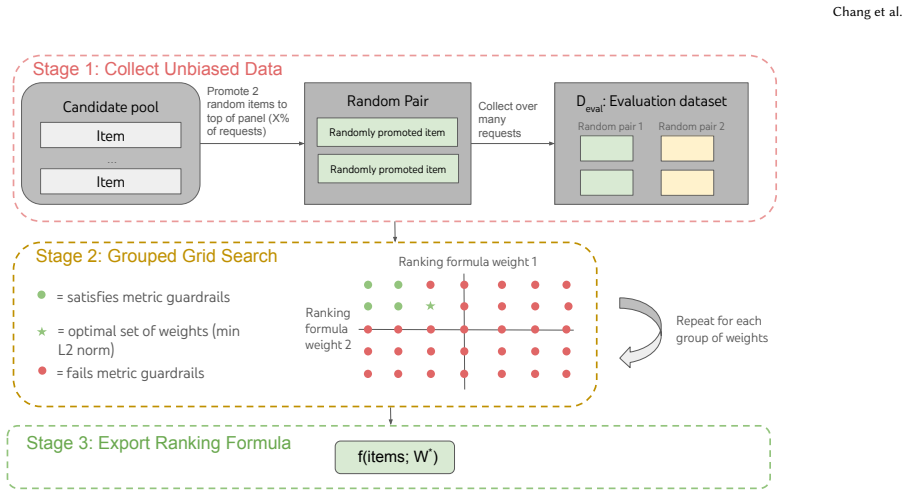
The central object is the pairwise offline estimator $\hat{S}_i(W) = \mathbb{E}_{(A,B) \sim D_{\text{random}}}[ s_{i,A} \cdot I(r_A > r_B) + s_{i,B} \cdot I(r_B \ge r_A) ]$, computed on data where two random candidates are promoted to prominent panel positions for a small fraction of requests. This estimator simulates the metric impact of any candidate weight vector without serving that configuration, and it is what the grouped grid search optimizes against; minimizing $\|W\|_2^2$ selects the smallest adjustment closest to the original scores.
What would settle it
The decisive test: take the 100 past A/B tests used to report the 0.82 correlation, hold out a subset of model-change types, and check whether ACT-selected weights predicted to satisfy guardrails actually do in live traffic. A single model variant where the offline estimator passes but the live metric falls below the guardrail would falsify the central claim.
Extended reading notes
Core claim
ACT treats guardrail enforcement as finding the smallest weight vector W such that every secondary metric S_i(W) clears its guardrail epsilon_i, minimizing $\|W\|_2^2$. The key discovery is that this constrained optimization can be solved offline with a pairwise estimator $\hat{S}_i(W)$ computed as the mean item-level attribute over winners in randomized pairs, and that this estimator tracks online metric movement (Pearson correlation 0.82 across 100 past A/B tests). In production, ACT moved a secondary metric from -13.40% to -2.25%, while a fixed weight left the -13.40% drop unaddressed.
Load-bearing premise
Everything rests on the offline random-pair measurement being a trustworthy stand-in for how the real metric will move online.
Editorial extensions
If this is right
- Every experimental treatment can be exported with its own guardrailed ranking formula, so all variants satisfy the same secondary-metric constraints during live serving.
- If a guardrail is already met at W=0, ACT sets the corresponding weight to zero, avoiding unnecessary distortion of the ranking score.
- Re-running the pipeline on a recurring basis (e.g., daily) lets the weights adapt to system changes, corpus changes, and organic user behavior changes without manual retuning.
- The grouped grid search handles interactions between correlated objectives within a group; in production, a path-independence test justified the simpler sequential search for orthogonal metrics.
- ACT's pairwise evaluation offers a practical middle ground between full-slate permutation evaluation, which can degrade user experience, and biased logged-data evaluation.
Reading between the lines
- Because ACT only needs a per-item analogue of the target metric, the same machinery should transfer to any recommendation objective with a measurable item-level proxy, though the paper only demonstrates it for video ranking metrics.
- The reported 0.82 correlation comes from one metric across past A/B tests; the framework's reliability would be more fully established by evaluating the offline estimator for multiple secondary metrics and on held-out model changes.
- If the forced random-pair promotion changes user context in a way that biases the estimator, a weight vector that passes offline guardrails could still fail live; adding an offline safety margin is a testable extension the paper does not explore.
- The sequential simplification is justified by one path-independence result for two orthogonal metrics; for correlated objectives, the block-coordinate-descent search is not guaranteed to reach the global minimum-L2 solution, though the paper presents joint grouping as the general case.
Editorial analysis
A structured set of objections, weighed in public.
Referee Report
Summary. The paper proposes ACT (Automated Constraint Targeting), a framework for automatically selecting scalarization hyperparameters for secondary objectives in a recommender ranking system, with the goal of ensuring that online secondary metrics satisfy pre-specified guardrails. ACT formulates the problem as minimizing the L2 norm of a weight vector subject to constraints S_i(W) >= epsilon_i. The method collects randomized pairwise data, defines an offline pairwise estimator for each metric, performs a grouped grid search over weight vectors, and exports the chosen ranking formula, with daily retraining. The production deployment on YouTube reports that ACT reduced a -13.4% drop in a secondary metric S1 to -2.25%, kept S2 near neutral, and an offline/online Pearson correlation of 0.82 across 100 A/B tests for S1.
Significance. The problem is practically important, and the use of randomized pairwise data for off-policy evaluation is a credible and useful idea, especially in a large-scale production setting. The paper's strengths include the randomized-data collection protocol, the explicit constrained-optimization formulation, and the live deployment evidence. However, the central claim of finding 'minimal' hyperparameter adjustments is not established: Algorithm 1 is a heuristic grid search with no optimality proof, and the offline estimator is validated only by correlation, not by absolute calibration at the guardrail boundary. The paper is therefore a promising industrial case study, but as a scientific claim it requires substantially more evidence or a more modest statement of what ACT guarantees.
major comments (3)
- [§3.3, Algorithm 1 line 11, §4.3] The offline estimator \hat{S}_i(W) is defined as an expectation of an item-level attribute over winners of random pairs, but it is never shown to have the same absolute scale as the online metric S_i(W). Algorithm 1 compares \hat{S}_i(W_temp) directly against the guardrail threshold epsilon_i. The reported Pearson correlation of 0.82 for S1 does not establish calibration: a highly correlated but biased estimator (e.g., an affine transform with nonzero intercept, or a nonlinear relationship) can yield \hat{S}_i >= epsilon_i while S_i < epsilon_i online. No correlation or calibration evidence is given for S2, which is also used in Table 1. The authors should report the regression slope and intercept, boundary coverage, or a conservative bias correction; otherwise the constraint-satisfaction claim is unsupported.
- [§3.4, Algorithm 1 line 5, §2] The abstract and Section 2 claim that ACT finds the 'minimal' hyperparameter adjustment, but Algorithm 1 selects only a point on an unspecified grid. The line 'Define a grid of candidate values for W_j as an epsilon-net on R^n' is not implementable as stated, since an epsilon-net of R^n is uncountable. If a finite grid is intended, the selected point is minimal only within that finite grid, not over the continuous domain. Furthermore, the grouped block-coordinate procedure is order-dependent in general; the path-independence test in §4.2 covers only one reversal and reports only the S1 result, which is insufficient to justify the sequential simplification. The authors should either prove optimality under stated assumptions or revise the claims to 'smallest weight on a predefined finite grid' and analyze sensitivity to grid resolution.
- [§4.1, Table 1, §4.2] The empirical demonstration of online guardrail enforcement rests on a single experiment per metric. The S2 result (+0.39% fixed vs. +0.03% ACT) is within the 0.8% routine-retraining variation mentioned in §4.1, so it does not convincingly demonstrate ACT's effect for S2. No comparison is made against a manually tuned weight that explicitly satisfies the guardrail, so the claim that ACT finds a minimal adjustment is not tested. The paper would be much stronger if it reported, for a range of candidate weights, the offline estimates and the corresponding online outcomes, showing that the selected W* indeed satisfies the guardrails and that smaller weights in its grid neighborhood fail them. The 100 A/B tests in §4.3 are a positive feature, but they only support S1, not S2, and only on a correlation scale.
minor comments (5)
- [References] Reference [3] is incomplete: it is listed as 'Course Instructor or Department of Computer Science & Engineering. [n.d.].' with no title or venue. This needs to be replaced with a proper citation for the unbiased off-policy evaluation material.
- [Algorithm 1] There is no fallback behavior specified if no grid point satisfies all guardrails in a group. The algorithm should state what W* is returned in that case (e.g., the current W, or the least-violating point).
- [§3.4] The phrase 'epsilon-net on R^n' is mathematically imprecise as used; the grid range and spacing should be specified. Also, if the grid always includes W_j=0, then the property in §1.1 that already-satisfied guardrails yield zero weights follows, but this should be stated explicitly.
- [Figure 1] The legend is not self-contained: it does not explain how 'satisfies metric guardrails' and 'fails metric guardrails' points are determined, nor how the optimal set is selected from the valid region. A short caption or an inline diagram annotation would improve readability.
- [§3.3] The estimator is written as an expectation over random pairs, but it would help to explicitly state that the randomness is over the pair sampling and any stochasticity in the ranking score ties, and to specify that s_i is measured on the shown (promoted) item. This clarifies the off-policy interpretation.
Circularity Check
No significant circularity: ACT's weight selection is validated against independent online metrics, and its self-citations are not load-bearing reductions.
full rationale
The derivation chain is self-contained. ACT defines an offline estimator in §3.3 (\hat{S}_i(W) = E over random pairs of the item-level attribute s_i of the higher-scoring item), then Algorithm 1 selects the minimum-L2-norm weight grid point satisfying \hat{S}_i(W) >= epsilon_i. The online metrics S_i(W) are measured in live experiments in §4.1 and are not used to fit or calibrate the estimator. The §4.3 Pearson correlation of 0.82 is a post-hoc validation across 100 A/B tests, not a fitted parameter, so no 'fitted input called prediction' occurs. The self-citations ([1] for random-pair data collection, [7] for background on metric drops) are to published, externally checkable work; they do not smuggle in the paper's conclusion or a uniqueness theorem, and the central guardrail optimization does not reduce to them. The possible bias of the pairwise estimator (slope/intercept miscalibration or distribution shift from random-pair promotion) is a correctness/validity risk, not a circularity, because the paper explicitly distinguishes \hat{S}_i from S_i and reports independent online measurements. One citation-quality issue: reference [3], used to support the unbiasedness of randomized data, is an incomplete placeholder ('Course Instructor or Department of Computer Science & Engineering. [n.d.].'); this is a missing-reference defect, not circularity, and does not change the score.
Assumptions & free parameters
free parameters (3)
- Grid granularity and range for W
- Objective grouping partition
- Random-pair traffic fraction
assumptions (4)
- domain assumption Each secondary metric S_i has an item-level analogue s_i, and the winner-based mean over random pairs equals the offline estimate.
- domain assumption Random-pair promotion at prominent positions does not substantially change user behavior or feedback.
- domain assumption The offline estimator remains predictive across system and user behavior changes.
- domain assumption Grid search with grouped block coordinate descent finds the L2-minimal feasible point.
Cite this review
Pith. "Pith review of ACT: Automated Constraint Targeting for Multi-Objective Recommender Systems." pith.science (2026). https://pith.science/paper/KESBU5QG
@misc{pith2026250903661,
  author       = {Pith},
  title        = {Pith review of: ACT: Automated Constraint Targeting for Multi-Objective Recommender Systems},
  year         = {2026},
  howpublished = {\url{https://pith.science/paper/KESBU5QG}},
  note         = {Machine review of arXiv:2509.03661}
}
read the original abstract
Recommender systems often must maximize a primary objective while ensuring secondary ones satisfy minimum thresholds, or "guardrails." This is critical for maintaining a consistent user experience and platform ecosystem, but enforcing these guardrails despite orthogonal system changes is challenging and often requires manual hyperparameter tuning. We introduce the Automated Constraint Targeting (ACT) framework, which automatically finds the minimal set of hyperparameter changes needed to satisfy these guardrails. ACT uses an offline pairwise evaluation on unbiased data to find solutions and continuously retrains to adapt to system and user behavior changes. We empirically demonstrate its efficacy and describe its deployment in a large-scale production environment.
Figures

Reference graph
Works this paper leans on
-
[3]
Course Instructor or Department of Computer Science & Engineering. [n.d.]
-
[1]
Fairness in Recommendation Ranking through Pairwise Comparisons
Alex Beutel, Jilin Chen, Tulsee Doshi, Hai Qian, Li Wei, Yi Wu, Lukasz Heldt, Zhe Zhao, Lichan Hong, Ed H. Chi, and Cristos Goodrow. 2019. Fairness in Recommendation Ranking through Pairwise Comparisons. In KDD. https://arxiv. org/pdf/1903.00780.pdf
work page Pith review arXiv 2019
-
[2]
Qingpeng Cai, Zhenghai Xue, Chi Zhang, Wanqi Xue, Shuchang Liu, Ruohan Zhan, Xueliang Wang, Tianyou Zuo, Wentao Xie, Dong Zheng, Peng Jiang, and Kun Gai. 2024. Two-Stage Constrained Actor-Critic for Short Video Recommendation. arXiv:cs.LG/2302.01680 https://arxiv.org/abs/2302.01680
arXiv 2024
-
[4]
Olivier Jeunen, Jatin Mandav, Ivan Potapov, Nakul Agarwal, Sourabh Vaid, Wenzhe Shi, and Aleksei Ustimenko. 2024. Multi-Objective Recommendation via Multi- variate Policy Learning. arXiv:cs.IR/2405.02141 https://arxiv.org/abs/2405.02141
work page Pith review arXiv 2024
-
[5]
Lihong Li, Wei Chu, John Langford, and Robert E Schapire. 2011. Unbiased offline evaluation of contextual-bandit-based news article recommendation algorithms. In Proceedings of the 4th ACM International Conference on Web Search and Data Mining. ACM, 297–306
work page 2011
-
[6]
Rishabh Mehrotra, Niannan Xue, and Mounia Lalmas. 2020. Bandit based Opti- mization of Multiple Objectives on a Music Streaming Platform. In Proceedings of the 26th ACM SIGKDD International Conference on Knowledge Discovery & Data Mining (KDD ’20) . Association for Computing Machinery, New York, NY, USA, 3224–3233. https://doi.org/10.1145/3394486.3403374
arXiv 2020
-
[7]
Yi Wu, Daryl Chang, Jennifer She, Zhe Zhao, Li Wei, and Lukasz Heldt. 2024. Learned Ranking Function: From Short-term Behavior Predictions to Long-term User Satisfaction. arXiv:cs.LG/2408.06512 https://arxiv.org/abs/2408.06512
work page Pith review arXiv 2024
-
[8]
Yong Zheng and David (Xuejun) Wang. 2022. A survey of recommender systems with multi-objective optimization. Neurocomputing 474 (2022), 141–153. https: //doi.org/10.1016/j.neucom.2021.11.041
Reviewed August 5, 2026 · model on record in the stance chip above.
Discussion (0). Sign in to comment.