REVIEW 3 major objections 6 minor 125 references
A magnetar-driven bubble can take over ejecta–CSM shocks and power superluminous supernova light curves without extreme nickel or explosion energy.
Reviewed by Pith at T0; open to challenge. T0 means a machine referee read the full paper against a public rubric. the ladder, T0–T4 →
T0 review · grok-4.5
2026-07-10 11:10 UTC pith:KEXNDJ4J
load-bearing objection Solid semi-analytic hybrid that couples magnetar PWB dynamics to CSI and maps the Em/Esn–tsd/tc plane; the clean FS1 takeover after RS collision is the main untested assumption, but the paper is still worth engaging. the 3 major comments →
A Magnetar Engine and Circumstellar Medium Interaction: Synergistic Effects in Producing Superluminous Supernovae
The pith
A machine-rendered reading of the paper's core claim, the machinery that carries it, and where it could break.
Core claim
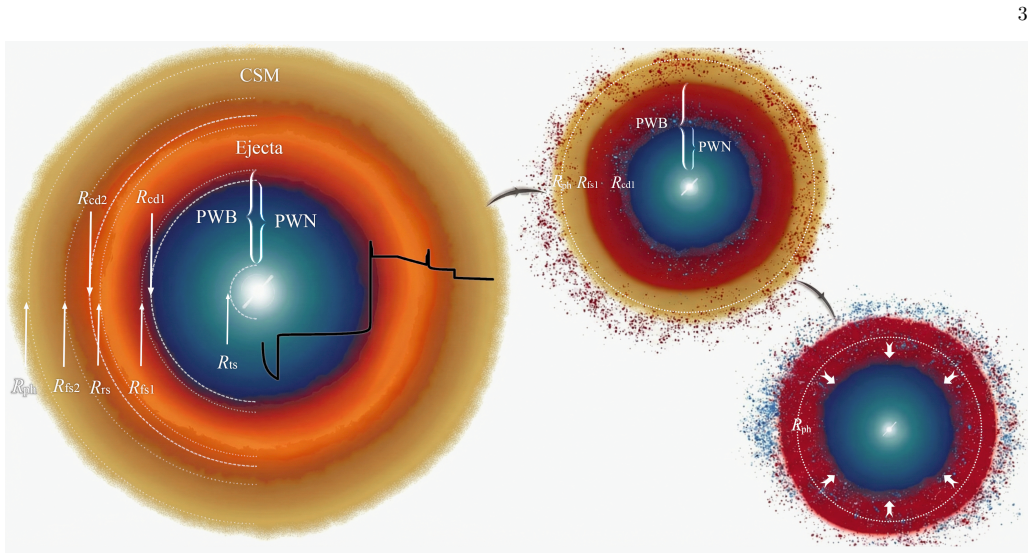
When a magnetar-driven pulsar-wind bubble expands through supernova ejecta that are already interacting with dense CSM, its forward shock can overtake the reverse shock, break out of the CSI region, and thereafter dominate interaction with unshocked CSM; the coupled dynamics and diffusion produce diverse SLSN light-curve morphologies while converting magnetar rotational energy into both kinetic energy and radiated luminosity, thereby relaxing extreme nickel-mass or initial-explosion-energy requirements of pure radioactive or pure CSI models.
What carries the argument
The semi-analytical hybrid dynamical model of the isobaric pulsar-wind bubble (PWB) and the Chevalier self-similar CSI region, closed by coupled energy equations and diffusion timescales that let FS1 catch FS2 and take over the unshocked CSM.
Load-bearing premise
The one-dimensional self-similar shock structure and thin-shell pressure balance still hold after the magnetar-driven shock collides with the outer interaction region, so the bubble can cleanly break out rather than being strongly decelerated or disrupted.
What would settle it
A well-sampled SLSN with an asymmetric light curve and high kinetic energy whose multi-band photometry and late-time broad-line velocities cannot be fit by any hybrid track that uses canonical explosion energy ~10^51 erg plus magnetar spin-down, or whose spectra show no reprocessed continuum or high-velocity interaction signatures when the model predicts FS1 has entered the outer CSM.
Editorial analysis
A structured set of objections, weighed in public.
Referee Report
Summary. The paper develops a semi-analytical hybrid model for superluminous supernovae in which a magnetar-driven pulsar-wind bubble (PWB) expands through the ejecta while the outer ejecta interact with dense CSM. The model couples magnetar spin-down injection, shock heating at FS1/RS/FS2, and radiative diffusion, and follows four dynamical stages culminating in FS1 catching the CSI region and taking over interaction with unshocked CSM. Analytic asymptotic scalings are derived for breakout time, radius, pressure ratio, and heating rate (Eqs. 36–46; Figs. 8–9). The authors argue that this framework can produce luminous interaction-like peaks, asymmetric post-peak declines, late magnetar-powered emission, and post-peak bumps, while allowing a canonical initial explosion energy (~10^51 erg) rather than extreme nickel masses or explosion energies. Illustrative multi-band comparisons are shown for SN 2015bn, SN 2018gft, and SN 2020auv (Fig. 6; Table 2).
Significance. If the coupled dynamics are approximately correct, the work offers a useful unification of two standard SLSN power sources that are usually treated as independent add-ons. The multi-stage dynamical map and the Em/Esn–tsd/tc parameter-space diagnostics (Figs. 8–9) are concrete, falsifiable contributions that go beyond pure light-curve fitting. The explicit reduction of the initial kinetic-energy requirement for CSI-powered peaks is scientifically valuable for SLSN progenitor and engine studies. Strengths include a carefully written energy-budget treatment, transparent asymptotic scalings, and an honest discussion of binary/CSM geometry caveats in Section 4. The main limitation is that quantitative takeover predictions rest on 1-D self-similar and thin-shell assumptions after FS1–RS collision, which the paper itself notes are incomplete relative to existing hydrodynamics.
major comments (3)
- Sections 2.2–2.4, 3.1, and 3.5 (Eqs. 26–28, 36–42; Fig. 9): The central takeover claim—that FS1 cleanly breaks out of FS2 and thereafter dominates unshocked-CSM interaction—rests on continued use of Chevalier (1982) self-similar CSI profiles and an isobaric thin-shell PWB after the FS1–RS collision, justified mainly by Ppwb/Pcsi ≳ 1. The manuscript itself cites hydro results showing flatter CSI structure, possible compression/reverberation, and FS1–CD1 separation/blowout (footnote 3; Blondin et al. 2001; Suzuki & Maeda 2017). Please either (i) restrict the quantitative scalings for tb, Rb, and Hb to order-of-magnitude estimates with explicit failure criteria, or (ii) add a focused comparison/discussion against published hydro runs showing when clean takeover remains valid. Without this, the luminous hybrid peaks and post-peak-bump formulae are not yet on firm dynamical footing.
- Section 3.3, Figure 6, and Table 2: The text states that the hybrid model can “broadly reproduce” SN 2015bn, SN 2018gft, and SN 2020auv, but the comparisons use hand-chosen parameters with fixed Esn = 10^51 erg, no formal fits, no uncertainties, and no degeneracy exploration (e.g., magnetar-only vs hybrid vs pure CSI). Please reframe these as illustrative morphology demonstrations, quantify which features require the hybrid coupling (vs independent magnetar+CSI sum), and state which observables would falsify the takeover picture. As written, the observational support for the synergistic claim is overstated relative to the evidence shown.
- Section 3.2 and Eqs. (13)–(17), (29)–(30): After FS1 enters the CSM, emission is treated as quasi-blackbody until τus < 2/3, with diffusion times averaged under simplified density profiles. Footnote 4 already notes tension with radiation-mediated-shock criteria and possible non-thermal/transmitted spectra. Because the peak luminosity and post-peak decline shape are attributed to FS1 shock heating plus cooling, please clarify how sensitive the claimed asymmetric declines and FS1-dominated peaks are to this thermalization cutoff, and whether the late Lpwn,th component remains robust if FS1 becomes optically thin earlier.
minor comments (6)
- Figure 1 caption: “Nano Banana Pro” is an unusual attribution for a scientific schematic; either remove the tool credit or replace with a conventional author-drawn figure statement.
- Table 1 is helpful; consider adding tb and tpb cross-references next to the equations where they are first used so readers can navigate the multi-stage analysis more easily.
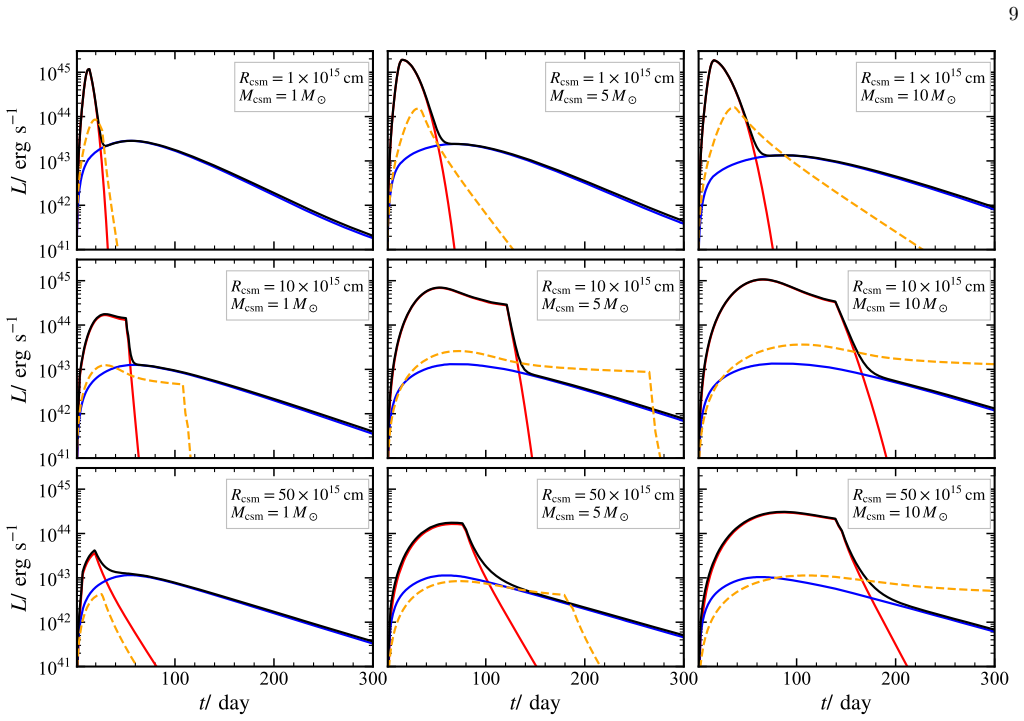
- Equation (35) and surrounding text: the non-monotonic peak-time behavior with Rcsm is interesting but dense; a short sentence stating the Mcsm ≪ Mthin vs Mcsm ≳ Mthin regimes would help non-specialists.
- Section 3.4 / footnote 5: the post-peak-bump discussion correctly flags 1-D limitations; consider moving a one-sentence version of that caveat into the main text near Figure 7.
- References: several 2025–2026 entries are fine for a draft, but ensure all arXiv-only items are consistently formatted before final submission.
- Notation: κγ is introduced with a broad range (0.01–0.1 cm2 g−1); a brief note on which Table 2 choices affect only late-time tails (not peak morphology) would reduce reader confusion.
Circularity Check
No load-bearing circularity: dynamics and scalings are derived from conservation laws plus standard self-similar solutions; only the three illustrative light-curve matches are parameter-tuned.
specific steps
-
fitted input called prediction
[Section 3.3, Figure 6, Table 2]
"For illustrative purposes, we apply our model to the nearby event SN 2015bn ... and two events (SN 2018gft and SN 2020auv ...). Figure 6 compares the resulting model multi-band light curves with the observations, and the corresponding parameters are listed in Table 2. In this comparison, we do not attempt to place stringent constraints on individual parameter values. Instead, we adopt a typical CCSN kinetic energy of 10^51 erg ..."
Parameters (M_ej, M_csm, R_csm, L_sd,i, t_sd, κ_γ) are chosen so that the hybrid light curves match the three observed events. Those particular morphologies are therefore partly forced by the fit rather than predicted from independent first principles. The general multi-stage dynamics and analytic scalings remain independent of these three fits, so the circularity is minor and non-load-bearing for the paper’s central claim.
full rationale
The hybrid model is constructed from magnetar spin-down (Eq. 1), broken-power-law ejecta and wind-like CSM densities (Eqs. 2–3), energy/momentum balance for the PWB and CSI regions (Eqs. 4–8, 20–25), radiation-pressure isobaric thin-shell approximations, and Chevalier (1982) self-similar profiles (Eqs. 26–28). Analytic breakout times, radii, pressure ratios and heating rates (Eqs. 36–44, Figs. 8–9) follow directly from those inputs and asymptotic power-law solutions; they are not fitted to the SLSN light curves they later illustrate. Multi-band comparisons for SN 2015bn, SN 2018gft and SN 2020auv (Fig. 6, Table 2) do choose parameters to reproduce observed morphologies, so those particular curves are partly fitted rather than a priori predictions. That is ordinary model illustration, not a circular derivation of the central claim that magnetar-driven FS1 can overtake CSI and power diverse light-curve shapes while reducing extreme E_sn or nickel requirements. Self-citations (Yu et al. 2015, 2017; Liu et al.) supply context or prior magnetar-only results and are not used as uniqueness theorems that force the hybrid construction. The paper’s own caveats about 1-D self-similarity after FS1–RS collision (footnote 3, Sec. 3.5) are correctness/hydrodynamic limitations, not circularity. Score 2 reflects only the minor, non-load-bearing fitting of three example light curves.
Axiom & Free-Parameter Ledger
free parameters (6)
- Lsd,i (initial magnetar spin-down luminosity)
- tsd (magnetar spin-down timescale)
- Mej, Esn (ejecta mass and initial kinetic energy)
- Mcsm, Rcsm (CSM mass and outer radius)
- κ, κγ (optical and gamma-ray opacities)
- δ, n, s (density power-law indices)
axioms (5)
- domain assumption Magnetar spin-down luminosity follows the standard magnetic-dipole form Lsd ∝ (1 + t/tsd)^-2 with Em = 2×10^52 P_i,-3^-2 erg.
- domain assumption Ejecta density is a broken power law (flat core + steep envelope) and CSM is a steady wind ρ ∝ r^-s with s=2.
- ad hoc to paper PWB is isobaric and radiation-dominated; FS1 shell is thin; CSI region obeys Chevalier (1982) self-similar profiles even after FS1 collision.
- domain assumption Photon diffusion timescales are given by the optical-depth integrals (Eqs. 14–17, 30) with constant opacity, and emission is quasi-blackbody until τus < 2/3.
- domain assumption PWN high-energy radiation is thermalized with an effective κγ and light-crossing time inside the bubble.
read the original abstract
Superluminous supernovae (SLSNe) are often modeled as being powered either by a central engine or by strong interaction with dense circumstellar material (CSM). These two mechanisms may be dynamically coupled if the ejecta interact with dense CSM while being energized by a newborn magnetar. We develop a semi-analytical hybrid model that follows the coupled dynamics, energy conversion, and radiative output of such systems. A rapidly rotating magnetar injects energy through a relativistic wind, inflating a hot bubble inside the expanding ejecta. Part of the injected energy is stored as radiation, while the rest is converted into bulk kinetic energy of the swept-up ejecta. At the same time, the outer ejecta collide with the surrounding CSM and form a circumstellar interaction (CSI) region. As the shock driven by the magnetar accelerates through the ejecta, it can catch up with the CSI region and take over the subsequent interaction with the unshocked CSM. The emergent light curves are therefore governed by the coupled effects of magnetar energy injection, shock heating, and radiative diffusion. We show that this hybrid model can produce diverse SLSN light-curve morphologies, including luminous interaction-powered peaks, asymmetric post-peak declines, and late-time emission sustained by delayed leakage of magnetar-powered radiation. The model provides a plausible way to reduce the extreme nickel-mass or initial explosion-energy requirements often encountered in purely radioactive or purely interaction-powered interpretations.
Figures




Reference graph
Works this paper leans on
-
[1]
2025, MNRAS, 541, 2674, doi: 10.1093/mnras/staf1113
Aamer, A., Nicholl, M., Gomez, S., et al. 2025, MNRAS, 541, 2674, doi: 10.1093/mnras/staf1113
-
[2]
Arnett, W. D. 1982, ApJ, 253, 785, doi: 10.1086/159681
-
[3]
Torres, D. F. 2020, MNRAS, 499, 2051, doi: 10.1093/mnras/staa2956 —. 2023a, MNRAS, 520, 2451, doi: 10.1093/mnras/stad134
-
[4]
Bandiera, R., Bucciantini, N., Olmi, B., & Torres, D. F. 2023b, MNRAS, 525, 2839, doi: 10.1093/mnras/stad2387
-
[5]
1967, PhRvL, 18, 379, doi: 10.1103/PhysRevLett.18.379
Barkat, Z., Rakavy, G., & Sack, N. 1967, PhRvL, 18, 379, doi: 10.1103/PhysRevLett.18.379
-
[6]
Blondin, J. M., & Chevalier, R. A. 2017, ApJ, 845, 139, doi: 10.3847/1538-4357/aa8267
-
[7]
Blondin, J. M., Chevalier, R. A., & Frierson, D. M. 2001, ApJ, 563, 806, doi: 10.1086/324042
-
[8]
M., Lundqvist, P., & Chevalier, R
Blondin, J. M., Lundqvist, P., & Chevalier, R. A. 1996, ApJ, 472, 257, doi: 10.1086/178060
-
[9]
Bucciantini, N., Blondin, J. M., Del Zanna, L., & Amato, E. 2003, A&A, 405, 617, doi: 10.1051/0004-6361:20030624
-
[10]
Chatzopoulos, E., Wheeler, J. C., & Vinko, J. 2012, ApJ, 746, 121, doi: 10.1088/0004-637X/746/2/121
-
[11]
Chatzopoulos, E., Wheeler, J. C., Vinko, J., Horvath, Z. L., & Nagy, A. 2013, ApJ, 773, 76, doi: 10.1088/0004-637X/773/1/76
-
[12]
Chatzopoulos, E., Wheeler, J. C., Vinko, J., et al. 2016, ApJ, 828, 94, doi: 10.3847/0004-637X/828/2/94
-
[13]
Chen, K.-J., Woosley, S. E., & Sukhbold, T. 2016, ApJ, 832, 73, doi: 10.3847/0004-637X/832/1/73
-
[14]
Chen, K.-J., Woosley, S. E., & Whalen, D. J. 2020, ApJ, 893, 99, doi: 10.3847/1538-4357/ab7db0
-
[15]
2026, ApJ, 1001, 59, doi: 10.3847/1538-4357/ae4c58
Chen, M., Kashiyama, K., & Sato, M. 2026, ApJ, 1001, 59, doi: 10.3847/1538-4357/ae4c58
-
[16]
Chen, T.-W., Smartt, S. J., Yates, R. M., et al. 2017a, MNRAS, 470, 3566, doi: 10.1093/mnras/stx1428
-
[17]
Chen, T. W., Nicholl, M., Smartt, S. J., et al. 2017b, A&A, 602, A9, doi: 10.1051/0004-6361/201630163
-
[18]
H., Yan, L., Kangas, T., et al
Chen, Z. H., Yan, L., Kangas, T., et al. 2023a, ApJ, 943, 41, doi: 10.3847/1538-4357/aca161 —. 2023b, ApJ, 943, 42, doi: 10.3847/1538-4357/aca162
-
[19]
Chevalier, R. A. 1977, ARA&A, 15, 175, doi: 10.1146/annurev.aa.15.090177.001135 —. 1982, ApJ, 258, 790, doi: 10.1086/160126 —. 1984, ApJ, 280, 797, doi: 10.1086/162053 —. 2005, ApJ, 619, 839, doi: 10.1086/426584 —. 2012, ApJL, 752, L2, doi: 10.1088/2041-8205/752/1/L2
-
[20]
Chevalier, R. A., Blondin, J. M., & Emmering, R. T. 1992, ApJ, 392, 118, doi: 10.1086/171411
-
[21]
Chevalier, R. A., & Fransson, C. 2003, in Supernovae and Gamma-Ray Bursters, ed. K. Weiler, Vol. 598 (Springer,
work page 2003
-
[22]
Berlin, Heidelberg), 171–194, doi: 10.1007/3-540-45863-8 10
-
[23]
Chevalier, R. A., & Irwin, C. M. 2011, ApJL, 729, L6, doi: 10.1088/2041-8205/729/1/L6 —. 2012, ApJL, 747, L17, doi: 10.1088/2041-8205/747/1/L17
-
[24]
Chevalier, R. A., & Soker, N. 1989, ApJ, 341, 867, doi: 10.1086/167545
-
[25]
Cleland, C., McGee, S. L., & Nicholl, M. 2023, MNRAS, 524, 3559, doi: 10.1093/mnras/stad2118
-
[26]
Clocchiatti, A., & Wheeler, J. C. 1997, ApJ, 491, 375, doi: 10.1086/304961
-
[27]
2019, A&A, 621, A141, doi: 10.1051/0004-6361/201834535
Dessart, L. 2019, A&A, 621, A141, doi: 10.1051/0004-6361/201834535
-
[28]
Dessart, L., Audit, E., & Hillier, D. J. 2015, MNRAS, 449, 4304, doi: 10.1093/mnras/stv609
-
[29]
2023, ApJ, 951, 61, doi: 10.3847/1538-4357/acd848
Dong, X.-F., Liu, L.-D., Gao, H., & Yang, S. 2023, ApJ, 951, 61, doi: 10.3847/1538-4357/acd848
-
[30]
Duncan, R. C., & Thompson, C. 1992, ApJL, 392, L9, doi: 10.1086/186413
-
[31]
2025, A&A, 696, A103, doi: 10.1051/0004-6361/202453426
Ercolino, A., Jin, H., Langer, N., & Dessart, L. 2025, A&A, 696, A103, doi: 10.1051/0004-6361/202453426
-
[32]
Farah, J. R., Prust, L. J., Howell, D. A., et al. 2026, Nature, 651, 321, doi: 10.1038/s41586-026-10151-0
-
[33]
2012, Science, 337, 927, doi: 10.1126/science.1203601 16 —
Gal-Yam, A. 2012, Science, 337, 927, doi: 10.1126/science.1203601 16 —. 2017, in Handbook of Supernovae, ed. A. W. Alsabti & P. Murdin (Springer, Cham), 195, doi: 10.1007/978-3-319-21846-5 35 —. 2019, ARA&A, 57, 305, doi: 10.1146/annurev-astro-081817-051819
-
[34]
Gal-Yam, A., Mazzali, P., Ofek, E. O., et al. 2009, Nature, 462, 624, doi: 10.1038/nature08579
-
[35]
Gelfand, J. D., Slane, P. O., & Zhang, W. 2009, ApJ, 703, 2051, doi: 10.1088/0004-637X/703/2/2051
-
[36]
2012, ApJ, 757, 178, doi: 10.1088/0004-637X/757/2/178
Ginzburg, S., & Balberg, S. 2012, ApJ, 757, 178, doi: 10.1088/0004-637X/757/2/178
-
[37]
2024, MNRAS, 535, 471, doi: 10.1093/mnras/stae2270
Gomez, S., Nicholl, M., Berger, E., et al. 2024, MNRAS, 535, 471, doi: 10.1093/mnras/stae2270
-
[38]
2021, ApJ, 907, 113, doi: 10.3847/1538-4357/abd180
Govreen-Segal, T., Nakar, E., & Levinson, A. 2021, ApJ, 907, 113, doi: 10.3847/1538-4357/abd180
-
[39]
2026, MNRAS, 547, stag464, doi: 10.1093/mnras/stag464
Govreen-Segal, T., Nakar, E., & Quataert, E. 2026, MNRAS, 547, stag464, doi: 10.1093/mnras/stag464
-
[40]
Heger, A., & Woosley, S. E. 2002, ApJ, 567, 532, doi: 10.1086/338487
-
[41]
Hosseinzadeh, G., Berger, E., Metzger, B. D., et al. 2022, ApJ, 933, 14, doi: 10.3847/1538-4357/ac67dd
-
[42]
Howell, D. A. 2017, in Handbook of Supernovae, ed. A. W. Alsabti & P. Murdin (Springer, Cham), 431, doi: 10.1007/978-3-319-21846-5 41
-
[43]
2021, ApJ, 921, 180, doi: 10.3847/1538-4357/ac1aca
Hsu, B., Hosseinzadeh, G., & Berger, E. 2021, ApJ, 921, 180, doi: 10.3847/1538-4357/ac1aca
-
[44]
Hu, R.-C., Zhu, J.-P., Qin, Y., et al. 2023, arXiv e-prints, arXiv:2301.06402, doi: 10.48550/arXiv.2301.06402
work page internal anchor Pith review Pith/arXiv arXiv doi:10.48550/arxiv.2301.06402 2023
-
[45]
Hwang, U., & Laming, J. M. 2012, ApJ, 746, 130, doi: 10.1088/0004-637X/746/2/130
-
[46]
2019, Nature Astronomy, 3, 697, doi: 10.1038/s41550-019-0854-4
Inserra, C. 2019, Nature Astronomy, 3, 697, doi: 10.1038/s41550-019-0854-4
-
[47]
Inserra, C., Smartt, S. J., Jerkstrand, A., et al. 2013, ApJ, 770, 128, doi: 10.1088/0004-637X/770/2/128
-
[48]
Inserra, C., Nicholl, M., Chen, T. W., et al. 2017, MNRAS, 468, 4642, doi: 10.1093/mnras/stx834
-
[49]
Inserra, C., Smartt, S. J., Gall, E. E. E., et al. 2018, MNRAS, 475, 1046, doi: 10.1093/mnras/stx3179
-
[50]
2013, A&A Rv, 21, 59, doi: 10.1007/s00159-013-0059-2
Ivanova, N., Justham, S., Chen, X., et al. 2013, A&A Rv, 21, 59, doi: 10.1007/s00159-013-0059-2
-
[51]
Jerkstrand, A., Smartt, S. J., Inserra, C., et al. 2017, ApJ, 835, 13, doi: 10.3847/1538-4357/835/1/13
-
[52]
1998, ApJ, 499, 282, doi: 10.1086/305627
Jun, B.-I. 1998, ApJ, 499, 282, doi: 10.1086/305627
-
[53]
2010, ApJ, 717, 245, doi: 10.1088/0004-637X/717/1/245
Kasen, D., & Bildsten, L. 2010, ApJ, 717, 245, doi: 10.1088/0004-637X/717/1/245
-
[54]
Kasen, D., Metzger, B. D., & Bildsten, L. 2016, ApJ, 821, 36, doi: 10.3847/0004-637X/821/1/36
-
[55]
Kasen, D., Woosley, S. E., & Heger, A. 2011, ApJ, 734, 102, doi: 10.1088/0004-637X/734/2/102
-
[56]
Khatami, D. K., & Kasen, D. N. 2024, ApJ, 972, 140, doi: 10.3847/1538-4357/ad60c0 K¨ onyves-T´ oth, R. 2025, ApJ, 980, 219, doi: 10.3847/1538-4357/adae04 K¨ onyves-T´ oth, R., & Vink´ o, J. 2021, ApJ, 909, 24, doi: 10.3847/1538-4357/abd6c8
-
[57]
Kotera, K., Phinney, E. S., & Olinto, A. V. 2013, MNRAS, 432, 3228, doi: 10.1093/mnras/stt680
-
[58]
Laming, J. M., & Hwang, U. 2003, ApJ, 597, 347, doi: 10.1086/378268
-
[59]
2012, ARA&A, 50, 107, doi: 10.1146/annurev-astro-081811-125534
Langer, N. 2012, ARA&A, 50, 107, doi: 10.1146/annurev-astro-081811-125534
-
[60]
2015, MNRAS, 449, 917, doi: 10.1093/mnras/stv320
Leloudas, G., Schulze, S., Kr¨ uhler, T., et al. 2015, MNRAS, 449, 917, doi: 10.1093/mnras/stv320
-
[61]
2020, ApJ, 891, 98, doi: 10.3847/1538-4357/ab718d
Li, L., Wang, S.-Q., Liu, L.-D., et al. 2020, ApJ, 891, 98, doi: 10.3847/1538-4357/ab718d
-
[62]
2024, arXiv e-prints, arXiv:2407.05968, doi: 10.48550/arXiv.2407.05968
Li, S., Liang, Y.-F., Liao, N.-H., Lei, L., & Fan, Y.-Z. 2024, arXiv e-prints, arXiv:2407.05968, doi: 10.48550/arXiv.2407.05968
work page internal anchor Pith review doi:10.48550/arxiv.2407.05968 2024
-
[63]
2022, ApJL, 935, L34, doi: 10.3847/2041-8213/ac86d2
Liu, J.-F., Zhu, J.-P., Liu, L.-D., Yu, Y.-W., & Zhang, B. 2022, ApJL, 935, L34, doi: 10.3847/2041-8213/ac86d2
-
[64]
2021, ApJ, 911, 142, doi: 10.3847/1538-4357/abf042
Liu, L.-D., Gao, H., Wang, X.-F., & Yang, S. 2021, ApJ, 911, 142, doi: 10.3847/1538-4357/abf042
-
[65]
2017a, ApJ, 842, 26, doi: 10.3847/1538-4357/aa73d9
Liu, L.-D., Wang, S.-Q., Wang, L.-J., et al. 2017a, ApJ, 842, 26, doi: 10.3847/1538-4357/aa73d9
-
[66]
Liu, Y.-Q., Modjaz, M., & Bianco, F. B. 2017b, ApJ, 845, 85, doi: 10.3847/1538-4357/aa7f74
-
[67]
2016, ApJ, 831, 144, doi: 10.3847/0004-637X/831/2/144
Lunnan, R., Chornock, R., Berger, E., et al. 2016, ApJ, 831, 144, doi: 10.3847/0004-637X/831/2/144
-
[68]
Matzner, C. D., & McKee, C. F. 1999, ApJ, 510, 379, doi: 10.1086/306571
-
[69]
D., Margalit, B., Kasen, D., & Quataert, E
Metzger, B. D., Margalit, B., Kasen, D., & Quataert, E. 2015, MNRAS, 454, 3311, doi: 10.1093/mnras/stv2224
-
[70]
Metzger, B. D., Vurm, I., Hasco¨ et, R., & Beloborodov, A. M. 2014, MNRAS, 437, 703, doi: 10.1093/mnras/stt1922
-
[71]
Moriya, T. J., Blinnikov, S. I., Tominaga, N., et al. 2013a, MNRAS, 428, 1020, doi: 10.1093/mnras/sts075
-
[72]
J., Maeda, K., Taddia, F., et al
Moriya, T. J., Maeda, K., Taddia, F., et al. 2013b, MNRAS, 435, 1520, doi: 10.1093/mnras/stt1392
-
[73]
J., Murase, K., Kashiyama, K., & Blinnikov, S
Moriya, T. J., Murase, K., Kashiyama, K., & Blinnikov, S. I. 2022, MNRAS, 513, 6210, doi: 10.1093/mnras/stac1352
-
[74]
2015, ApJ, 805, 82, doi: 10.1088/0004-637X/805/1/82
Murase, K., Kashiyama, K., Kiuchi, K., & Bartos, I. 2015, ApJ, 805, 82, doi: 10.1088/0004-637X/805/1/82
-
[75]
Murase, K., Omand, C. M. B., Coppejans, D. L., et al. 2021, MNRAS, 508, 44, doi: 10.1093/mnras/stab2506
-
[76]
2017, ApJ, 850, 55, doi: 10.3847/1538-4357/aa9334 17
Nicholl, M., Guillochon, J., & Berger, E. 2017, ApJ, 850, 55, doi: 10.3847/1538-4357/aa9334 17
-
[77]
Nicholl, M., Berger, E., Smartt, S. J., et al. 2016a, ApJ, 826, 39, doi: 10.3847/0004-637X/826/1/39
-
[78]
2016b, ApJL, 828, L18, doi: 10.3847/2041-8205/828/2/L18
Nicholl, M., Berger, E., Margutti, R., et al. 2016b, ApJL, 828, L18, doi: 10.3847/2041-8205/828/2/L18
work page internal anchor Pith review doi:10.3847/2041-8205/828/2/l18 2041
-
[79]
Omand, C. M. B. 2026, MNRAS, 546, stag112, doi: 10.1093/mnras/stag112
-
[80]
Omand, C. M. B., & Jerkstrand, A. 2023, A&A, 673, A107, doi: 10.1051/0004-6361/202245406
discussion (0)
Sign in with ORCID, Apple, or X to comment. Anyone can read and Pith papers without signing in.