REVIEW 3 major objections 5 minor 3 cited by
GigaWorld-1: A Roadmap to Build World Models for Robot Policy Evaluation
T0 review · 3 major / 5 minor · reviewed 2026-07-12 · grok-4.5
Pith's one-line read Robot policy evaluators succeed by staying action-faithful over long horizons, not by looking more photorealistic.
desk verdict Solid large-scale empirical roadmap for world models as robot policy evaluators; the 14.9% headline is on a chosen diagnostic average, not quantified closed-loop ranking ρ. read the letter →
The pith
A machine-rendered reading of the paper's core claim, the machinery that carries it, and where it could break.
The reading
What carries the argument
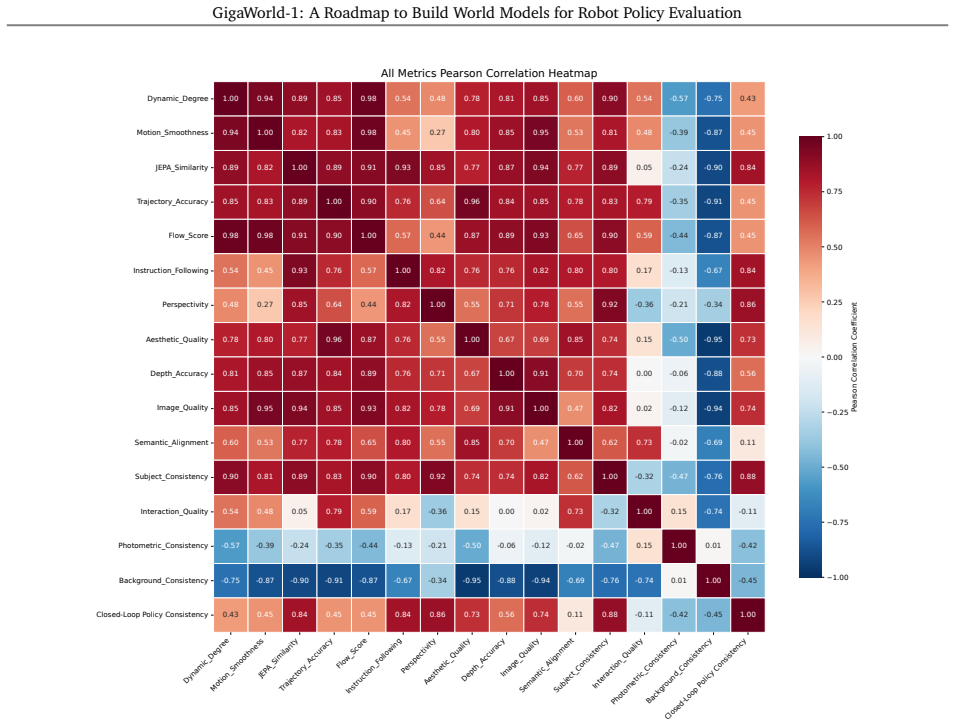
WMBench: a paired real/world-model rollout benchmark whose primary target is ranking correlation between real-world and world-model success rates (and the related ordinal WMES score), used to isolate which metrics, data mixes, and architectures actually predict real policy outcomes.
What would settle it
Take a set of policies whose real-robot success ranking is known on tasks outside WMBench’s eight families or on a different embodiment; if the world model’s closed-loop ranking correlation collapses while short-horizon visual metrics remain high, the central claim that long-horizon action faithfulness on this benchmark is sufficient fails.
Extended reading notes
Core claim
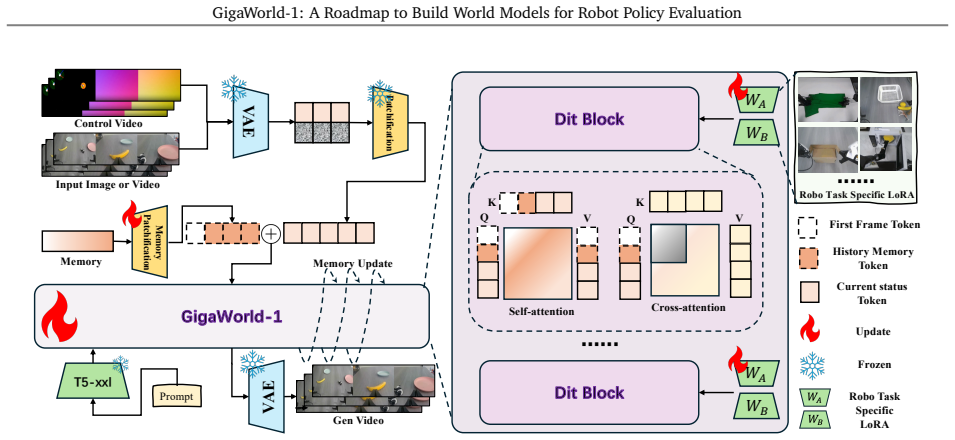
A world model is a reliable robot-policy evaluator only when its closed-loop rollouts stay action-faithful over long horizons and therefore reproduce the same success/failure ranking that real robots produce; short-term photorealism is secondary, and the decisive levers are balanced physical-plus-robot data, spatially aligned action control, persistent multi-scale memory, and post-training aimed at evaluator agreement rather than generic video quality.
Load-bearing premise
Agreement on WMBench’s eight held-out manipulation families, still drawn from the same platforms, cameras, and task distribution, is enough to claim that a world model will rank novel policies reliably under broader initial states, embodiments, and contact-rich failures.
Editorial extensions
If this is right
- Policy developers can replace a large fraction of hardware rollouts with closed-loop world-model evaluation once the model is scored by ranking agreement rather than frame beauty.
- Metric suites that reward static or action-ignorant videos will systematically promote weak evaluators and should be dropped from evaluator leaderboards.
- Training recipes must mix broad physical video with robot data; robot-only fine-tuning improves embodiment look but can erase the priors needed for reliable evaluation.
- Spatially aligned control maps plus hierarchical memory become standard requirements for any video world model intended as a policy surrogate.
- Open release of the benchmark, models, and annotation toolkit lets the community iterate on evaluator design the way language-model groups iterate on digital suites.
Reading between the lines
- The same long-horizon action-faithfulness test could become a filter for world models used as data engines or planners, not only as offline evaluators.
- If VLM outcome labeling stays within a few percent of human WMES at method level, most future evaluator leaderboards can run without exhaustive human annotation.
- Contact-rich failure modes still show optimistic bias; hybrid world models that add explicit contact or force state may be the next necessary step beyond pure video.
- Once ranking correlation is the accepted target, sim-to-real gaps in classical simulators can be measured against the same yardstick rather than against visual fidelity alone.
Signed reviews
Editorial analysis
A structured set of objections, weighed in public.
Referee Report
Summary. The paper studies world models as surrogate evaluators of robot policies, arguing that real-robot evaluation is the bottleneck for embodied foundation models. It introduces WMBench (paired teleoperation and policy-rollout data over eight manipulation task families), analyzes seven video world models, four action encodings, and 324k+ annotated rollouts (including CVPR 2026 challenge submissions), and reports three design insights: long-horizon action-faithful consistency dominates short-term visual realism; pretraining gains require balancing general physical priors with robot controllability; and action interface, memory, and evaluator-oriented post-training strongly affect real-world alignment. These are instantiated in GigaWorld-1 (Wan-based, ~13k hours multi-source data, pixel-aligned EE/ray control, hierarchical memory, progressive training), which improves a six-metric average by 14.9% over Wan 2.2 5B under matched post-training (Table 9). Code, models, and data are released.
Significance. If the design claims hold, the work is a substantial contribution to scalable robot policy evaluation: it reframes world models as external policy evaluators rather than only data engines or planners, provides a large paired real/sim benchmark and metric analysis (Figs. 4–5, WMES), and ships a concrete open roadmap (data mixture, spatially aligned control, memory, distillation) with reproducible artifacts. The controlled ablations (Tables 2–4, 9) and community-scale annotation are genuine strengths relative to prior proof-of-concept evaluator papers. The practical value depends on whether closed-loop ranking fidelity—not only diagnostic video metrics—is demonstrated at the same scale as the headline gains.
major comments (3)
- [Sec. 3 Eq. (4); Sec. 6.5.1 Table 9; Sec. 6.5.5 Figs. 16–17] Sec. 3, Eq. (4) defines the primary evaluator target as ranking/success agreement ρ = Corr(S_real(π), S_wm(π)) across policies. The abstract, intro, and Sec. 6.5.1 instead headline a 14.9% gain of GigaWorld-1-Plus over Wan 2.2 5B on a paper-chosen six-metric average (Aesthetic, Image, JEPA, Semantic, Subject, Trajectory; Table 9: 0.6834 vs 0.5948). Those diagnostics are justified by correlation with human WMES on challenge rollouts (Findings 1–2, Figs. 4–5), but they are not ρ. Closed-loop evidence in Sec. 6.5.5 is limited to task-level success-rate scatter and Gen−Real bias bars on four tasks/subtasks (Figs. 16–17), without a quantified ρ (or Kendall/Spearman ranking) over a multi-checkpoint policy set for GigaWorld-1 vs baselines. Please report ρ (with CIs) under the same closed-loop protocol for the main models, or reframe the 14.9% claim so it is not presented as the primary evaluato
- [Sec. 6.5.5; Fig. 17; Finding 3 / Table 4] Sec. 6.5.5 and Fig. 17 acknowledge residual optimistic bias on contact-sensitive failures (e.g., pour/press subtasks). Because the paper’s own Finding 3 and Table 4 argue that long-horizon action-faithful consistency—not short-horizon visual quality—dominates evaluator reliability, the closed-loop calibration gap is load-bearing. Either quantify how often GigaWorld-1 flips real success/failure relative to baselines (confusion matrices or per-subtask agreement rates on the full WMBench closed-loop set), or temper claims that the model is “specially optimized for policy evaluation” until failure-mode calibration is measured at the same scale as the diagnostic average.
- [Sec. 4.3; Findings 4–5; Table 1; Table 9] WMES and several diagnostic metrics (Perspectivity, Instruction Following, Interaction Quality, Semantic Alignment) rely on VLM judges (Sec. 4.3; Finding 4–5; Table 1). The LoRA VLM is trained to predict human WMES with score-token weight 8.0, then used for scalable outcome assessment. Metric selection for Table 9 is guided by correlation with that same WMES family. This is not fatal circularity—human WMES and real success labels remain external—but it creates mild self-reinforcement risk if models are tuned toward VLM-preferred appearance/geometry. Please report (i) human-only vs VLM-only ranking of the main models on a held-out subset, and (ii) sensitivity of the six-metric average and any ρ to excluding VLM-judged diagnostics.
minor comments (5)
- [Fig. 1; Abstract; Sec. 4.1; Table 6] Fig. 1 and abstract claim “324,000+ analyzed rollouts” and “12K+ hours training data”; Table 6 totals ~12,980 hours. Align the rounded figures and clarify whether 324k counts segments or full closed-loop episodes (Sec. 4.1 says segments chained into episodes of 20–30 segments).
- [Table 3; Finding 9] Table 3 ranks control interfaces on Trajectory Accuracy and motion metrics for Wan 2.1 1.3B only. A short note on whether channel-concat remains best for the 5B backbone (GigaWorld-1-Plus) would strengthen Finding 9.
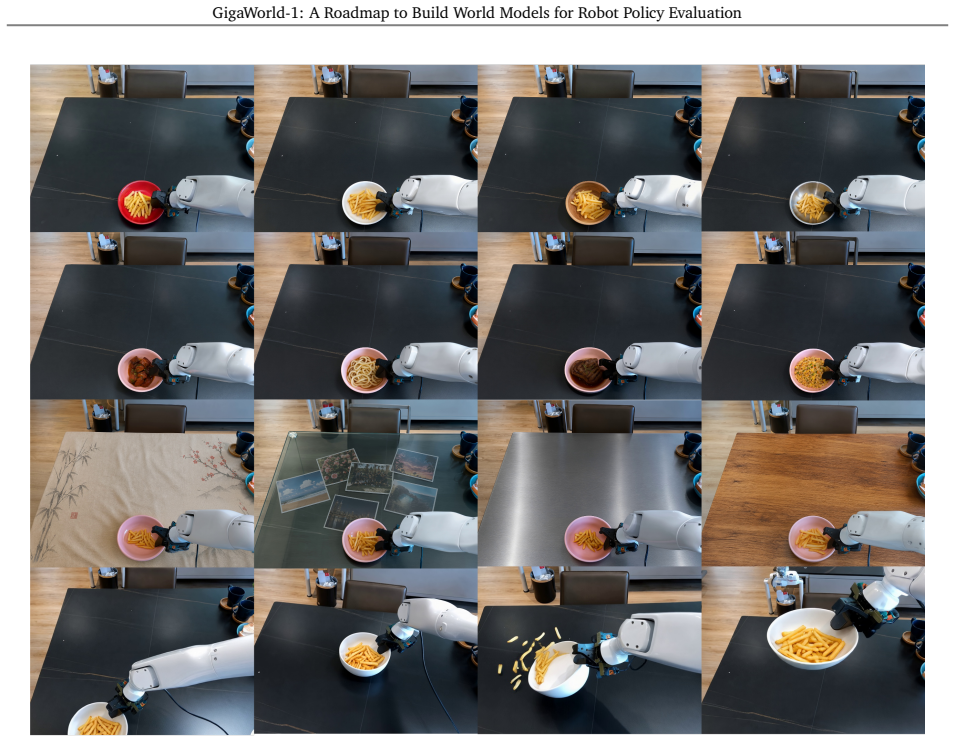
- [Sec. 4.1; Sec. 6.5.4; Sec. 7] Sec. 4.1 train/test split is episode-disjoint within the same eight task families and platforms. Sec. 7 correctly flags limited coverage of mobile/dexterous/safety-critical settings; a brief explicit statement in Sec. 6.5 that OOD claims (Fig. 15) are appearance/content shifts, not embodiment or policy-family shifts, would prevent over-reading.
- [Fig. 2; Fig. 3] Typo in Fig. 3 caption/step labels: “Train Wodel Model” should be “Train World Model.” Several figure panels (e.g., Fig. 2 Chinese annotation fragment in the source) should be cleaned for the camera-ready version.
- [Finding 6 footnote; Sec. 7] Cosmos-3 is mentioned as planned but unavailable (footnote in Finding 6). Either update the comparison if multiview access is obtained, or move the note to a single limitations paragraph to avoid dangling promises.
Circularity Check
No load-bearing circular derivation: claims rest on external real-robot pairings and held-out metrics; only mild metric-suite selection via human WMES.
-
other
[Sec. 5.1 Findings 1–2; Sec. 6.5.1 / Table 9; Eq. 4 vs. reported AVG]
"evaluator quality is dominated by long-horizon, action-faithful rollout consistency rather than short-term visual realism... GigaWorld-1-Plus improves the average score by ... 14.9% over Wan 2.2 5B... we retain six core evaluator-relevant metric(Aesthetic Quality, Image Quality, JEPA Similarity, Semantic Alignment, Subject Consistency, and Trajectory Accuracy)... Visual Fidelity has the highest correlation (ρ=0.78)... Subject Consistency (ρ=0.88) and Perspectivity (ρ=0.86) are the strongest predictors"
The paper’s stated primary target is ρ=Corr(S_real,S_wm) (Eq. 4), but the headline 14.9% is the mean of six automatic metrics pre-selected because they correlate with human WMES on the same challenge ecosystem. That makes the reported “evaluator-alignment” gain partly an improvement on a human-rubric-derived metric suite rather than a direct closed-loop ranking result. Mild self-reinforcement of the evaluation criterion, not a by-construction identity between fit and prediction.
full rationale
This is an empirical systems paper, not a first-principles derivation. The primary evaluator target (Eq. 4) is ranking/success agreement between world-model and real-robot outcomes—an external quantity. WMBench uses episode-disjoint held-out trajectories with real teleoperation and policy rollouts; the 324k annotated segments and human WMES are independent labels, not fitted parameters renamed as predictions. Ablations (control interfaces, memory, data mixtures) and the Table 9 comparison (matched post-training of multiple backbones) measure independently computed diagnostics (JEPA, NDTW trajectory accuracy, etc.). Self-citations (GigaBrain, GigaWorld-0, etc.) supply data sources and related work, not uniqueness theorems that force the result. The only mild circularity risk is operational: Findings 1–2 select the six-metric AVG reported as “evaluator-alignment” because those metrics correlate with human WMES on challenge rollouts, and a LoRA VLM is trained to predict that same WMES for scalable closed-loop scoring—so the reported 14.9% is alignment with a paper-chosen human-rubric proxy, not a direct measurement of ρ. That is metric-selection self-reinforcement, not definitional circularity or a fitted input called a prediction; the model scores are not forced by construction. Score 1 reflects that minor operational loop without elevating it to a load-bearing circular chain.
Assumptions & free parameters
free parameters (6)
- Six-metric evaluator average weights (equal mean of Aesthetic, Image, JEPA, Semantic, Subject, Trajectory)
- VLM score-token loss weight 8.0 (format 1.0, rationale min 0.05)
- Data mixture composition (PhysData / AgiBot / GigaData hours and filters)
- Video quality / motion filter thresholds (τ_img, τ_aes, τ_jump, τ_static, τ_motion, τ_jerk)
- LoRA ranks/alphas and stage learning rates (e.g., Stage1 LR 5e-5, Stage2 1e-4, ranks 128/256)
- Hierarchical memory partition (short/mid/long + first-frame anchor) and generation window length
assumptions (5)
- domain assumption Agreement between world-model and real-world policy success/ranking is the primary definition of evaluator quality.
- domain assumption Video diffusion backbones with action conditioning can capture decision-relevant physical dynamics for closed-loop manipulation evaluation.
- domain assumption Human WMES ordinal labels (0–3) and LoRA-tuned VLM scores are valid ground truth for ranking world models as evaluators.
- ad hoc to paper Episode-disjoint train/test splits within the same eight task families suffice to measure generalization for evaluator claims.
- standard math Standard flow-matching / diffusion training and autoregressive windowing preserve enough dynamics for long-horizon evaluation when memory and control are added.
invented entities (3)
-
WMBench
independent evidence
-
WMES (World Model as Evaluator Score)
-
GigaWorld-1 (Nano/Plus)
independent evidence
Cite this review
Pith. "Pith review of GigaWorld-1: A Roadmap to Build World Models for Robot Policy Evaluation." pith.science (2026). https://pith.science/paper/KFY7ODQ4
@misc{pith2026260702642,
  author       = {Pith},
  title        = {Pith review of: GigaWorld-1: A Roadmap to Build World Models for Robot Policy Evaluation},
  year         = {2026},
  howpublished = {\url{https://pith.science/paper/KFY7ODQ4}},
  note         = {Machine review of arXiv:2607.02642}
}
read the original abstract
Evaluating embodied robot foundation models remains a critical bottleneck; unlike large language models efficiently assessed via digital benchmarks, robotic policies require slow, costly real-world rollouts limited by hardware and human supervision, which has driven interest in world models as surrogate policy evaluators, yet the key properties that make a world model reliable for policy assessment remain poorly understood. This work presents a systematic study of world models for robotic policy evaluation and introduces WMBench, a benchmark constructed from real-robot teleoperation data and matched policy rollouts covering diverse manipulation tasks to enable controlled comparisons across model families, action encodings, rollout horizons, and evaluation metrics. Using WMBench, we analyze 7 video world models, 4 action representation schemes, and over 324,000 simulated policy rollouts paired with real robot executions, further enriching our analysis with large-scale community submissions from the CVPR 2026 GigaBrain Challenge, curated synthetic trajectories, and a training videos spanning more than 12,000 hours. Our experiments deliver three core insights: evaluator quality is dominated by long-horizon, action-faithful rollout consistency rather than short-term visual realism; pretraining gains stem not only from data scale but from balancing general world knowledge with robot-specific controllability; and architectural choices including action encoding, memory design, and evaluator-focused post-training strongly determine alignment with real-world robot behavior. Drawing on these results, we derive a practical design roadmap and realize it in \textit{GigaWorld-1}, a world model specially optimized for policy evaluation, and we fully release our code, models, datasets, and toolkits to advance scalable evaluation research for embodied foundation models.
Figures


Figures from the paper (14 more)







Forward citations
Cited by 3 Pith papers
-
WorldSimProbe: Diagnosing Simulator Faithfulness in Action-Conditioned World Models for Embodied Manipulation
WorldSimProbe is a five-suite benchmark showing that six action-conditioned world models systematically degrade in action-to-motion fidelity and interaction grounding across RoboTwin, ManiSkill, and LIBERO.
-
Is Forward Prediction Enough? Physical State Grounding for JEPA World Models
PSG-JEPA grounds JEPA world-model latents in robot proprioception and joint-angle changes, improving physical state identifiability, planning, and policy learning.
-
GigaWorld-Policy-0.5: A Faster and Stronger WAM Empowered by AutoResearch
GigaWorld-Policy-0.5 uses a Mixture-of-Transformers action-expert split and mixed world-model pretraining to reach 85 ms action-only inference with claimed success-rate gains.
Reference graph
Works this paper leans on
-
[1]
Cosmos 3: Omnimodal world models for physical ai.arXiv preprint arXiv:2606.02800, 2026
Niket Agarwal, Arslan Ali, Jon Allen, Martin Antolini, Adeline Aubame, Alisson Azzolini, Junjie Bai, Maciej Bala, Yogesh Balaji, Josh Bapst, et al. Cosmos 3: Omnimodal world models for physical ai.arXiv preprint arXiv:2606.02800, 2026. 2, 3, 4, 11, 30
arXiv 2026
-
[2]
Hassan Abu Alhaija, Jose Alvarez, Maciej Bala, Tiffany Cai, Tianshi Cao, Liz Cha, Joshua Chen, Mike Chen, Francesco Ferroni, Sanja Fidler, et al. Cosmos-transfer1: Conditional world generation with adaptive multimodal control.arXiv preprint arXiv:2503.14492, 2025. 3
arXiv 2025
-
[3]
World simulation with video foundation models for physical ai.arXiv preprint arXiv:2511.00062, 2025
Arslan Ali, Junjie Bai, Maciej Bala, Yogesh Balaji, Aaron Blakeman, Tiffany Cai, Jiaxin Cao, Tianshi Cao, Elizabeth Cha, Yu-Wei Chao, et al. World simulation with video foundation models for physical ai.arXiv preprint arXiv:2511.00062, 2025. 11
arXiv 2025
-
[4]
Pranav Atreya, Karl Pertsch, Tony Lee, Moo Jin Kim, Arhan Jain, Artur Kuramshin, Clemens Eppner, Cyrus Neary, Edward Hu, Fabio Ramos, et al. Roboarena: Distributed real-world evaluation of generalist robot policies.arXiv preprint arXiv:2506.18123, 2025. 3
arXiv 2025
-
[5]
Hyperreel: High-fidelity 6-dof video with ray-conditioned sampling
Benjamin Attal, Jia-Bin Huang, Christian Richardt, Michael Zollhoefer, Johannes Kopf, Matthew O’Toole, and Changil Kim. Hyperreel: High-fidelity 6-dof video with ray-conditioned sampling. InCVPR, pages 16610–16620, 2023. 19
2023
-
[7]
Qwen3-vl technical report.arXiv preprint arXiv:2511.21631, 2025
Shuai Bai, Yuxuan Cai, Ruizhe Chen, Keqin Chen, Xionghui Chen, Zesen Cheng, Lianghao Deng, Wei Ding, Chang Gao, Chunjiang Ge, Wenbin Ge, Zhifang Guo, Qidong Huang, Jie Huang, Fei Huang, Binyuan Hui, Shutong Jiang, Zhaohai Li, Mingsheng Li, Mei Li, Kaixin Li, Zicheng Lin, Junyang Lin, Xuejing Liu, Jiawei Liu, Chenglong Liu, Yang Liu, Dayiheng Liu, Shixuan ...
arXiv 2025
-
[9]
Qwen2.5-vl technical report.arXiv preprint arXiv:2502.13923,
Shuai Bai, Keqin Chen, Xuejing Liu, Jialin Wang, Wenbin Ge, Sibo Song, Kai Dang, Peng Wang, Shijie Wang, Jun Tang, Humen Zhong, Yuanzhi Zhu, Mingkun Yang, Zhaohai Li, Jianqiang Wan, Pengfei Wang, Wei Ding, Zheren Fu, Yiheng Xu, Jiabo Ye, Xi Zhang, Tianbao Xie, Zesen Cheng, Hang Zhang, Zhibo Yang, Haiyang Xu, and Junyang Lin. Qwen2.5-vl technical report.ar...
-
[10]
7 32 GigaWorld-1: A Roadmap to Build World Models for Robot Policy Evaluation
Show all 162 references
-
[11]
Navigation world models
Amir Bar, Gaoyue Zhou, Danny Tran, Trevor Darrell, and Yann LeCun. Navigation world models. In CVPR, pages 15791–15801, 2025. 2
2025
-
[12]
V-JEPA: Latent video prediction for visual representation learning, 2024
Adrien Bardes, Quentin Garrido, Jean Ponce, Xinlei Chen, Michael Rabbat, Yann LeCun, Mido Assran, and Nicolas Ballas. V-JEPA: Latent video prediction for visual representation learning, 2024. URL https://openreview.net/forum?id=WFYbBOEOtv. 7
2024
-
[13]
Motus: A unified latent action world model.arXiv preprint arXiv:2512.13030, 2025
Hongzhe Bi, Hengkai Tan, Shenghao Xie, Zeyuan Wang, Shuhe Huang, Haitian Liu, Ruowen Zhao, Yao Feng, Chendong Xiang, Yinze Rong, et al. Motus: A unified latent action world model.arXiv preprint arXiv:2512.13030, 2025. 2, 3
2025 arXiv
-
[14]
Gr00t n1: An open foundation model for generalist humanoid robots.arXiv preprint arXiv:2503.14734, 2025
Johan Bjorck, Fernando Castañeda, Nikita Cherniadev, Xingye Da, Runyu Ding, Linxi Fan, Yu Fang, Dieter Fox, Fengyuan Hu, Spencer Huang, et al. Gr00t n1: An open foundation model for generalist humanoid robots.arXiv preprint arXiv:2503.14734, 2025
2025 arXiv
-
[15]
pi0: A vision-language-action flow model for general robot control.arXiv preprint arXiv:2410.24164, 2024
Kevin Black, Noah Brown, Danny Driess, Adnan Esmail, Michael Equi, Chelsea Finn, Niccolo Fusai, Lachy Groom, Karol Hausman, Brian Ichter, et al. pi0: A vision-language-action flow model for general robot control.arXiv preprint arXiv:2410.24164, 2024. 2
2024 arXiv
-
[16]
Stable video diffusion: Scaling latent video diffusion models to large datasets.arXiv preprint arXiv:2311.15127, 2023
Andreas Blattmann, Tim Dockhorn, Sumith Kulal, Daniel Mendelevitch, Maciej Kilian, Dominik Lorenz, Yam Levi, Zion English, Vikram Voleti, Adam Letts, et al. Stable video diffusion: Scaling latent video diffusion models to large datasets.arXiv preprint arXiv:2311.15127, 2023. 2, 11
2023 arXiv
-
[17]
Tiny autoencoder for stable diffusion.https://github.com/madebyollin/taesd,
Ollin Boer Bohan. Tiny autoencoder for stable diffusion.https://github.com/madebyollin/taesd,
-
[18]
GitHub repository. 24
-
[19]
Agibot world colosseo: A large-scale manipulation platform for scalable and intelligent embodied systems
Qingwen Bu, Jisong Cai, Li Chen, Xiuqi Cui, Yan Ding, Siyuan Feng, Xindong He, Xu Huang, et al. Agibot world colosseo: A large-scale manipulation platform for scalable and intelligent embodied systems. In IROS, 2025. 15
2025
-
[20]
Sam 3: Segment anything with concepts, 2025
Nicolas Carion, Laura Gustafson, Yuan-Ting Hu, Shoubhik Debnath, Ronghang Hu, Didac Suris, Chai- tanya Ryali, Kalyan Vasudev Alwala, Haitham Khedr, Andrew Huang, Jie Lei, Tengyu Ma, Baishan Guo, Arpit Kalla, Markus Marks, Joseph Greer, Meng Wang, Peize Sun, Roman Rädle, Triant...
2025 arXiv
-
[21]
Emerging properties in self-supervised vision transformers, 2021
Mathilde Caron, Hugo Touvron, Ishan Misra, Hervé Jégou, Julien Mairal, Piotr Bojanowski, and Armand Joulin. Emerging properties in self-supervised vision transformers, 2021. URLhttps://arxiv.org/ abs/2104.14294. 7
2021 arXiv
-
[22]
Worldvla: Towards autoregressive action world model.arXiv preprint arXiv:2506.21539, 2025
Jun Cen, Chaohui Yu, Hangjie Yuan, Yuming Jiang, Siteng Huang, Jiayan Guo, Xin Li, Yibing Song, Hao Luo, Fan Wang, et al. Worldvla: Towards autoregressive action world model.arXiv preprint arXiv:2506.21539, 2025. 2
2025 arXiv
-
[23]
Reflect-r1: Evidence-driven reflection for self-correction in long video understanding, 2026
Shuimu Chen, Yuteng Chen, Yuanshen Guan, Zebang Cheng, Zeyu Zhang, Shengqian Qin, Bin Xia, Jiaran Li, Wenming Yang, and Fei Ma. Reflect-r1: Evidence-driven reflection for self-correction in long video understanding, 2026. URLhttps://arxiv.org/abs/2606.27922. 17
2026 arXiv
-
[24]
Robotwin 2.0: A scalable data generator and benchmark with strong domain randomization for robust bimanual robotic manipulation.arXiv preprint arXiv:2506.18088,
Tianxing Chen, Zanxin Chen, Baijun Chen, Zijian Cai, Yibin Liu, Qiwei Liang, Zixuan Li, Xianliang Lin, Yiheng Ge, Zhenyu Gu, et al. Robotwin 2.0: A scalable data generator and benchmark with strong domain randomization for robust bimanual robotic manipulation.arXiv preprint ar...
-
[25]
2, 4 33 GigaWorld-1: A Roadmap to Build World Models for Robot Policy Evaluation
-
[26]
Abot-physworld: Interactive world foundation model for robotic manipulation with physics alignment.arXiv preprint arXiv:2603.23376, 2026
Yuzhi Chen, Ronghan Chen, Dongjie Huo, Yandan Yang, Dekang Qi, Haoyun Liu, Tong Lin, Shuang Zeng, Junjin Xiao, Xinyuan Chang, et al. Abot-physworld: Interactive world foundation model for robotic manipulation with physics alignment.arXiv preprint arXiv:2603.23376, 2026. 2
2026
-
[27]
Training verifiers to solve math word problems.arXiv preprint arXiv:2110.14168, 2021
Karl Cobbe, Vineet Kosaraju, Mohammad Bavarian, Mark Chen, Heewoo Jun, Lukasz Kaiser, Matthias Plappert, Jerry Tworek, Jacob Hilton, Reiichiro Nakano, et al. Training verifiers to solve math word problems.arXiv preprint arXiv:2110.14168, 2021. 2
2021 arXiv
-
[28]
Introducing veo 3, our video generation model with expanded creative controls – including native audio and extended videos
Google DeepMind. Introducing veo 3, our video generation model with expanded creative controls – including native audio and extended videos. [Online], 2025. URLhttps://deepmind.google/models/ veo/. 3
2025
-
[29]
Emma: Generalizingreal-worldrobotmanipulationviagenerative visual transfer.arXiv preprint arXiv:2509.22407, 2025
Zhehao Dong, Xiaofeng Wang, Zheng Zhu, Yirui Wang, Yang Wang, Yukun Zhou, Boyuan Wang, Chaojun Ni, RunqiOuyang, WenkangQin, etal. Emma: Generalizingreal-worldrobotmanipulationviagenerative visual transfer.arXiv preprint arXiv:2509.22407, 2025. 3
2025
-
[30]
Aim: Intent-aware unified world action modeling with spatial value maps.arXiv preprint arXiv:2604.11135, 2026
Liaoyuan Fan, Zetian Xu, Chen Cao, Wenyao Zhang, Mingqi Yuan, and Jiayu Chen. Aim: Intent-aware unified world action modeling with spatial value maps.arXiv preprint arXiv:2604.11135, 2026. 3
2026 arXiv
-
[31]
Video-mme: The first-ever comprehensive evaluation benchmark of multi-modal llms in video analysis
Chaoyou Fu, Yuhan Dai, Yongdong Luo, Lei Li, Shuhuai Ren, Renrui Zhang, Zihan Wang, Chenyu Zhou, Yunhang Shen, Mengdan Zhang, et al. Video-mme: The first-ever comprehensive evaluation benchmark of multi-modal llms in video analysis. InCVPR, pages 24108–24118, 2025. 2
2025
-
[32]
Learning video generation for robotic manipulation with collaborative trajectory control.arXiv preprint arXiv:2506.01943, 2025
Xiao Fu, Xintao Wang, Xian Liu, Jianhong Bai, Runsen Xu, Pengfei Wan, Di Zhang, and Dahua Lin. Learning video generation for robotic manipulation with collaborative trajectory control.arXiv preprint arXiv:2506.01943, 2025. 19
2025
-
[33]
Seedance 1.0: Exploring the boundaries of video generation models.arXiv preprint arXiv:2506.09113, 2025
Yu Gao, Haoyuan Guo, Tuyen Hoang, Weilin Huang, Lu Jiang, Fangyuan Kong, Huixia Li, Jiashi Li, Liang Li, Xiaojie Li, et al. Seedance 1.0: Exploring the boundaries of video generation models.arXiv preprint arXiv:2506.09113, 2025. 3
2025 arXiv
-
[34]
Genesis: Multimodal driving scene generation with spatio-temporal and cross-modal consistency.NeurIPS, 38:60431–60455, 2026
Xiangyu Guo, Zhanqian Wu, Kaixin Xiong, Ziyang Xu, Lijun Zhou, Gangwei Xu, Shaoqing Xu, Haiyang Sun, Bing Wang, Guang Chen, et al. Genesis: Multimodal driving scene generation with spatio-temporal and cross-modal consistency.NeurIPS, 38:60431–60455, 2026. 3
2026
-
[35]
Ctrl-world: A controllable generative world model for robot manipulation.arXiv preprint arXiv:2510.10125, 2025
Yanjiang Guo, Lucy Xiaoyang Shi, Jianyu Chen, and Chelsea Finn. Ctrl-world: A controllable generative world model for robot manipulation.arXiv preprint arXiv:2510.10125, 2025. 2, 3, 4
2025 arXiv
-
[36]
Ltx-video: Realtime video latent diffusion.arXiv preprint arXiv:2501.00103, 2024
Yoav HaCohen, Nisan Chiprut, Benny Brazowski, Daniel Shalem, Dudu Moshe, Eitan Richardson, Eran Levin, Guy Shiran, Nir Zabari, Ori Gordon, et al. Ltx-video: Realtime video latent diffusion.arXiv preprint arXiv:2501.00103, 2024. 2, 11
2024 arXiv
-
[37]
Pre-trained video generative models as world simulators
Haoran He, Yang Zhang, Liang Lin, Zhongwen Xu, and Ling Pan. Pre-trained video generative models as world simulators. InAAAI, volume 40, pages 4645–4653, 2026. 2
2026
-
[38]
Matrix-game 2.0: An open-source real-time and streaming interactive world model.arXiv preprint arXiv:2508.13009, 2025
Xianglong He, Chunli Peng, Zexiang Liu, Boyang Wang, Yifan Zhang, Qi Cui, Fei Kang, Biao Jiang, Mengyin An, Yangyang Ren, et al. Matrix-game 2.0: An open-source real-time and streaming interactive world model.arXiv preprint arXiv:2508.13009, 2025. 3
2025 arXiv
-
[39]
Skip: Sparse keyframe interpolation paradigm for efficient embodied world models.arXiv preprint arXiv:2606.00664, 2026
Ziheng He, Yixiang Chen, Ning Yang, Zhanqian Wu, Qisen Ma, Yuan Xu, Jiabing Yang, Peiyan Li, Xiangnan Wu, Xiaofeng Wang, et al. Skip: Sparse keyframe interpolation paradigm for efficient embodied world models.arXiv preprint arXiv:2606.00664, 2026. 3
2026 arXiv
-
[40]
Measuring massive multitask language understanding
Dan Hendrycks, Collin Burns, Steven Basart, Andy Zou, Mantas Mazeika, Dawn Song, and Jacob Steinhardt. Measuring massive multitask language understanding. InICLR, 2020. 2 34 GigaWorld-1: A Roadmap to Build World Models for Robot Policy Evaluation
2020
-
[41]
Gans trained by a two time-scale update rule converge to a local nash equilibrium.NeurIPS, 2017
Martin Heusel, Hubert Ramsauer, Thomas Unterthiner, Bernhard Nessler, and Sepp Hochreiter. Gans trained by a two time-scale update rule converge to a local nash equilibrium.NeurIPS, 2017. 8
2017
-
[42]
Cogvideo: Large-scale pretraining for text-to-video generation via transformers
Wenyi Hong, Ming Ding, Wendi Zheng, Xinghan Liu, and Jie Tang. Cogvideo: Large-scale pretraining for text-to-video generation via transformers. InICLR, 2023. 3
2023
-
[43]
Ruler: What’s the real context size of your long-context language models?arXiv preprint arXiv:2404.06654, 2024
Cheng-Ping Hsieh, Simeng Sun, Samuel Kriman, Shantanu Acharya, Dima Rekesh, Fei Jia, Yang Zhang, and Boris Ginsburg. Ruler: What’s the real context size of your long-context language models?arXiv preprint arXiv:2404.06654, 2024. 2
2024 arXiv
-
[44]
Lora: Low-rank adaptation of large language models
Edward J Hu, Phillip Wallis, Zeyuan Allen-Zhu, Yuanzhi Li, Shean Wang, Lu Wang, Weizhu Chen, et al. Lora: Low-rank adaptation of large language models. InICLR, 2021. 18
2021
-
[45]
Self forcing: Bridging the train-test gap in autoregressive video diffusion.NeurIPS, 38:167283–167308, 2026
Xun Huang, Zhengqi Li, Guande He, Mingyuan Zhou, and Eli Shechtman. Self forcing: Bridging the train-test gap in autoregressive video diffusion.NeurIPS, 38:167283–167308, 2026. 3
2026
-
[46]
Physical Intelligence, Kevin Black, Noah Brown, James Darpinian, Karan Dhabalia, Danny Driess, Adnan Esmail, Michael Equi, Chelsea Finn, Niccolo Fusai, et al.𝜋0.5: a vision-language-action model with open-world generalization.arXiv preprint arXiv:2504.16054, 2025. 2
2025 arXiv
-
[47]
Rlbench: The robot learning benchmark & learning environment.IEEE Robotics and Automation Letters, 5(2):3019–3026, 2020
Stephen James, Zicong Ma, David Rovick Arrojo, and Andrew J Davison. Rlbench: The robot learning benchmark & learning environment.IEEE Robotics and Automation Letters, 5(2):3019–3026, 2020. 2
2020
-
[48]
Galaxea open-world dataset and g0 dual-system vla model.arXiv preprint arXiv:2509.00576, 2025
Tao Jiang, Tianyuan Yuan, Yicheng Liu, Chenhao Lu, Jianning Cui, Xiao Liu, Shuiqi Cheng, Jiyang Gao, Huazhe Xu, and Hang Zhao. Galaxea open-world dataset and g0 dual-system vla model.arXiv preprint arXiv:2509.00576, 2025. 2, 15
2025 arXiv
-
[49]
Enerverse-ac: Envisioning embodied environments with action condition.arXiv preprint arXiv:2505.09723, 2025
Yuxin Jiang, Shengcong Chen, Siyuan Huang, Liliang Chen, Pengfei Zhou, Yue Liao, Xindong He, Chiming Liu, Hongsheng Li, Maoqing Yao, et al. Enerverse-ac: Envisioning embodied environments with action condition.arXiv preprint arXiv:2505.09723, 2025. 2
2025 arXiv
-
[50]
Swe-bench: Can language models resolve real-world github issues? InICLR, volume 2024, pages 54107–54157, 2024
Carlos E Jimenez, John Yang, Alexander Wettig, Shunyu Yao, Kexin Pei, Ofir Press, and Karthik Narasimhan. Swe-bench: Can language models resolve real-world github issues? InICLR, volume 2024, pages 54107–54157, 2024. 2
2024
-
[51]
How far is video generation from world model: A physical law perspective.arXiv preprint arXiv:2411.02385,
Bingyi Kang, Yang Yue, Rui Lu, Zhijie Lin, Yang Zhao, Kaixin Wang, Gao Huang, and Jiashi Feng. How far is video generation from world model: A physical law perspective.arXiv preprint arXiv:2411.02385,
-
[52]
Musiq: Multi-scale image quality transformer
Junjie Ke, Qifei Wang, Yilin Wang, Peyman Milanfar, and Feng Yang. Musiq: Multi-scale image quality transformer. InICCV, pages 5148–5157, October 2021. 7
2021
-
[53]
Openvla: Anopen-sourcevision-language-action model.arXiv preprint arXiv:2406.09246, 2024
Moo Jin Kim, Karl Pertsch, Siddharth Karamcheti, Ted Xiao, Ashwin Balakrishna, Suraj Nair, Rafael Rafailov,EthanFoster,GraceLam,PannagSanketi,etal. Openvla: Anopen-sourcevision-language-action model.arXiv preprint arXiv:2406.09246, 2024. 2
2024 arXiv
-
[54]
Cosmos policy: Fine-tuning video models for visuomotor control and planning.arXiv preprint arXiv:2601.16163, 2026
Moo Jin Kim, Yihuai Gao, Tsung-Yi Lin, Yen-Chen Lin, Yunhao Ge, Grace Lam, Percy Liang, Shuran Song, Ming-Yu Liu, Chelsea Finn, et al. Cosmos policy: Fine-tuning video models for visuomotor control and planning.arXiv preprint arXiv:2601.16163, 2026. 2, 3
2026 arXiv
-
[55]
Aesthetic predictor, 2022
LAION-AI. Aesthetic predictor, 2022. URLhttps://github.com/LAION-AI/aesthetic-predictor. Accessed: 2024. 7
2022
-
[56]
Vag: Dual-stream video-action generation for embodied data synthesis.arXiv preprint arXiv:2604.09330, 2026
Xiaolei Lang, Yang Wang, Yukun Zhou, Chaojun Ni, Kerui Li, Jiagang Zhu, Tianze Liu, Jiajun Lv, Xingxing Zuo, Yun Ye, et al. Vag: Dual-stream video-action generation for embodied data synthesis.arXiv preprint arXiv:2604.09330, 2026. 2 35 GigaWorld-1: A Roadmap to Build World Mo...
2026 arXiv
-
[57]
Robomemarena: A comprehensive and challenging robotic memory benchmark.arXiv preprint arXiv:2605.10921, 2026
HuashuoLei,WenxuanSong,HuaruiZhang,JieyuanPei,JiayiChen,HaodongYan,HanZhao,Pengxiang Ding, Zhipeng Zhang, Lida Huang, et al. Robomemarena: A comprehensive and challenging robotic memory benchmark.arXiv preprint arXiv:2605.10921, 2026. 4
2026 arXiv
-
[58]
Mimicdreamer: Aligning human and robot demonstrations for scalable vla training.arXiv preprint arXiv:2509.22199, 2025
HaoyunLi, IvanZhang, RunqiOuyang, XiaofengWang, ZhengZhu, ZhiqinYang, ZhentaoZhang, Boyuan Wang, Chaojun Ni, Wenkang Qin, et al. Mimicdreamer: Aligning human and robot demonstrations for scalable vla training.arXiv preprint arXiv:2509.22199, 2025. 3
2025
-
[59]
Stableidm: Stabilizing inverse dynamics model against manipulator truncation via spatio-temporal refinement.arXiv preprint arXiv:2604.17887, 2026
Kerui Li, Zhe Jing, Xiaofeng Wang, Zheng Zhu, Yukun Zhou, Guan Huang, Dongze Li, Qingkai Yang, and Huaibo Huang. Stableidm: Stabilizing inverse dynamics model against manipulator truncation via spatio-temporal refinement.arXiv preprint arXiv:2604.17887, 2026. 3
2026 arXiv
-
[60]
Evaluatingreal-worldrobotmanipulationpoliciesinsimulation
Xuanlin Li, Kyle Hsu, Jiayuan Gu, Karl Pertsch, Oier Mees, Homer Rich Walke, Chuyuan Fu, Ishikaa Lunawat,IsabelSieh,SeanKirmani,etal. Evaluatingreal-worldrobotmanipulationpoliciesinsimulation. arXiv preprint arXiv:2405.05941, 2024. 2
2024 arXiv
-
[61]
Worldeval: World model as real-world robot policies evaluator.arXiv preprint arXiv:2505.19017, 2025
Yaxuan Li, Yichen Zhu, Junjie Wen, Chaomin Shen, and Yi Xu. Worldeval: World model as real-world robot policies evaluator.arXiv preprint arXiv:2505.19017, 2025. 2
2025 arXiv
-
[62]
Genie envisioner: A unified world foundation platform for robotic manipulation.arXiv preprint arXiv:2508.05635, 2025
Yue Liao, Pengfei Zhou, Siyuan Huang, Donglin Yang, Shengcong Chen, Yuxin Jiang, Yue Hu, Jingbin Cai, Si Liu, Jianlan Luo, et al. Genie envisioner: A unified world foundation platform for robotic manipulation.arXiv preprint arXiv:2508.05635, 2025. 19
2025 arXiv
-
[63]
Depth anything 3: Recovering the visual space from any views.arXiv preprint arXiv:2511.10647,
Haotong Lin, Sili Chen, Junhao Liew, Donny Y Chen, Zhenyu Li, Guang Shi, Jiashi Feng, and Bingyi Kang. Depth anything 3: Recovering the visual space from any views.arXiv preprint arXiv:2511.10647,
-
[64]
Truthfulqa: Measuring how models mimic human falsehoods
Stephanie Lin, Jacob Hilton, and Owain Evans. Truthfulqa: Measuring how models mimic human falsehoods. InProceedings of the 60th annual meeting of the association for computational linguistics (volume 1: long papers), pages 3214–3252, 2022. 2
2022
-
[65]
Libero: Bench- marking knowledge transfer for lifelong robot learning.NeurIPS, 36:44776–44791, 2023
Bo Liu, Yifeng Zhu, Chongkai Gao, Yihao Feng, Qiang Liu, Yuke Zhu, and Peter Stone. Libero: Bench- marking knowledge transfer for lifelong robot learning.NeurIPS, 36:44776–44791, 2023. 2, 4
2023
-
[66]
Mamba4d: Efficient 4d point cloud video understanding with disentangled spatial-temporal state space models
Jiuming Liu, Jinru Han, Lihao Liu, Angelica I Aviles-Rivero, Chaokang Jiang, Zhe Liu, and Hesheng Wang. Mamba4d: Efficient 4d point cloud video understanding with disentangled spatial-temporal state space models. InCVPR, pages 17626–17636, 2025. 3
2025
-
[67]
Difflow3d: Hierarchical diffusion models for uncertainty-aware 3d scene flow estimation.TPAMI, 2025
Jiuming Liu, Weicai Ye, Guangming Wang, Chaokang Jiang, Lei Pan, Jinru Han, Zhe Liu, Guofeng Zhang, and Hesheng Wang. Difflow3d: Hierarchical diffusion models for uncertainty-aware 3d scene flow estimation.TPAMI, 2025. 3
2025
-
[68]
Arflow: Auto-regressive optical flow estimation for arbitrary-length videos via progressive next-frame forecasting
Jiuming Liu, Mengmeng Liu, Siting Zhu, Yunpeng Zhang, Jiangtao Li, Michael Ying Yang, Francesco Nex, Hao Cheng, and Hesheng Wang. Arflow: Auto-regressive optical flow estimation for arbitrary-length videos via progressive next-frame forecasting. InICLR, 2026. 3
2026
-
[69]
Towards interactive video world modeling: Frontiers, challenges, benchmarks, and future trends.arXiv preprint arXiv:2606.01164, 2026
Jiuming Liu, Chaojun Ni, Mengmeng Liu, Chensheng Peng, Fangjinhua Wang, Sitian Shen, Marc Pollefeys, Masayoshi Tomizuka, Ayush Tewari, and Per Ola Kristensson. Towards interactive video world modeling: Frontiers, challenges, benchmarks, and future trends.arXiv preprint arXiv:2...
2026 arXiv
-
[70]
Robotransfer: Controllable geometry-consistent video diffusion for manipulation policy transfer
Liu Liu, Xiaofeng Wang, Guosheng Zhao, Keyu Li, Wenkang Qin, Jiagang Zhu, Jiaxiong Qiu, Guan Huang, and Zhizhong Su. Robotransfer: Controllable geometry-consistent video diffusion for manipulation policy transfer. InCVPR, pages 1410–1420, 2026. 3 36 GigaWorld-1: A Roadmap to B...
2026
-
[71]
Physgen: Rigid-body physics- grounded image-to-video generation
Shaowei Liu, Zhongzheng Ren, Saurabh Gupta, and Shenlong Wang. Physgen: Rigid-body physics- grounded image-to-video generation. InECCV, pages 360–378. Springer, 2024. 2
2024
-
[72]
Beyond fvd: Enhanced evaluation metrics for video generation quality, 2024
Ge Ya Luo, Gian Mario Favero, Zhi Hao Luo, Alexia Jolicoeur-Martineau, and Christopher Pal. Beyond fvd: Enhanced evaluation metrics for video generation quality, 2024. URLhttps://arxiv.org/abs/ 2410.05203. 7
2024 arXiv
-
[73]
Viva: A video-generative value model for robot reinforcement learning.arXiv preprint arXiv:2604.08168, 2026
Jindi Lv, Hao Li, Jie Li, Yifei Nie, Fankun Kong, Yang Wang, Xiaofeng Wang, Zheng Zhu, Chaojun Ni, Qiuping Deng, Hengtao Li, Jiancheng Lv, and Guan Huang. Viva: A video-generative value model for robot reinforcement learning.arXiv preprint arXiv:2604.08168, 2026. 3
2026 arXiv
-
[74]
Follow your pose: Pose-guided text-to-video generation using pose-free videos
Yue Ma, Yingqing He, Xiaodong Cun, Xintao Wang, Siran Chen, Xiu Li, and Qifeng Chen. Follow your pose: Pose-guided text-to-video generation using pose-free videos. InAAAI, volume 38, pages 4117–4125, 2024a. 3
-
[75]
Follow-your-emoji: Fine-controllable and expressive freestyle portrait animation
Yue Ma, Hongyu Liu, Hongfa Wang, Heng Pan, Yingqing He, Junkun Yuan, Ailing Zeng, Chengfei Cai, Heung-Yeung Shum, Wei Liu, et al. Follow-your-emoji: Fine-controllable and expressive freestyle portrait animation. InSIGGRAPH Asia, pages 1–12, 2024b
-
[76]
Controllable video generation: A survey.arXiv preprint arXiv:2507.16869, 2025a
Yue Ma, Kunyu Feng, Zhongyuan Hu, Xinyu Wang, Yucheng Wang, Mingzhe Zheng, Xuanhua He, Chenyang Zhu, Hongyu Liu, Yingqing He, et al. Controllable video generation: A survey.arXiv preprint arXiv:2507.16869, 2025a
-
[77]
Follow-your-motion: Video motion transfer via efficient spatial-temporal decoupled finetuning.arXiv preprint arXiv:2506.05207, 2025b
Yue Ma, Yulong Liu, Qiyuan Zhu, Ayden Yang, Kunyu Feng, Xinhua Zhang, Zhifeng Li, Sirui Han, Chenyang Qi, and Qifeng Chen. Follow-your-motion: Video motion transfer via efficient spatial-temporal decoupled finetuning.arXiv preprint arXiv:2506.05207, 2025b
-
[78]
Follow-your-emoji-faster: Towards efficient, fine-controllable, and expressive freestyle portrait animation.arXiv preprint arXiv:2509.16630, 2025c
Yue Ma, Zexuan Yan, Hongyu Liu, Hongfa Wang, Heng Pan, Yingqing He, Junkun Yuan, Ailing Zeng, Chengfei Cai, Heung-Yeung Shum, et al. Follow-your-emoji-faster: Towards efficient, fine-controllable, and expressive freestyle portrait animation.arXiv preprint arXiv:2509.16630, 2025c
-
[79]
Follow-your-click: Open-domain regional image animation via motion prompts
Yue Ma, Yingqing He, Hongfa Wang, Andong Wang, Leqi Shen, Chenyang Qi, Jixuan Ying, Chengfei Cai, Zhifeng Li, Heung-Yeung Shum, et al. Follow-your-click: Open-domain regional image animation via motion prompts. InAAAI, volume 39, pages 6018–6026, 2025d
-
[80]
Follow-your-creation: Empowering 4d creation through video inpainting.arXiv preprint arXiv:2506.04590, 2025e
Yue Ma, Kunyu Feng, Xinhua Zhang, Hongyu Liu, David Junhao Zhang, Jinbo Xing, Yinhan Zhang, Ayden Yang, Zeyu Wang, and Qifeng Chen. Follow-your-creation: Empowering 4d creation through video inpainting.arXiv preprint arXiv:2506.04590, 2025e
-
[81]
Group editing: Edit multiple images in one go.arXiv preprint arXiv:2603.22883, 2026a
Yue Ma, Xinyu Wang, Qianli Ma, Qinghe Wang, Mingzhe Zheng, Xiangpeng Yang, Hao Li, Chongbo Zhao, Jixuan Ying, Harry Yang, et al. Group editing: Edit multiple images in one go.arXiv preprint arXiv:2603.22883, 2026a
-
[82]
Fastvmt: Eliminating redundancy in video motion transfer.arXiv preprint arXiv:2602.05551, 2026b
Yue Ma, Zhikai Wang, Tianhao Ren, Mingzhe Zheng, Hongyu Liu, Jiayi Guo, Mark Fong, Yuxuan Xue, Zixiang Zhao, Konrad Schindler, et al. Fastvmt: Eliminating redundancy in video motion transfer.arXiv preprint arXiv:2602.05551, 2026b. 3
-
[83]
Zentner, Ryan Julian, J K Terry, Isaac Woungang, Nariman Farsad, and Pablo Samuel Castro
Reginald McLean, Evangelos Chatzaroulas, Luc McCutcheon, Frank Röder, Tianhe Yu, Zhanpeng He, K.R. Zentner, Ryan Julian, J K Terry, Isaac Woungang, Nariman Farsad, and Pablo Samuel Castro. Meta-world+: An improved, standardized, RL benchmark. InThe Thirty-ninth Annual Conferen...
2025
-
[84]
Springer, 2007
Meinard Müller.Information retrieval for music and motion. Springer, 2007. 8
2007
-
[85]
Robocasa: Large-scale simulation of everyday tasks for generalist robots
Soroush Nasiriany, Abhiram Maddukuri, Lance Zhang, Adeet Parikh, Aaron Lo, Abhishek Joshi, Ajay 37 GigaWorld-1: A Roadmap to Build World Models for Robot Policy Evaluation Mandlekar, and Yuke Zhu. Robocasa: Large-scale simulation of everyday tasks for generalist robots. arXiv ...
2024 arXiv
-
[86]
Robocasa365: A large-scale simulation framework for training and benchmarking generalist robots.arXiv preprint arXiv:2603.04356,
Soroush Nasiriany, Sepehr Nasiriany, Abhiram Maddukuri, and Yuke Zhu. Robocasa365: A large-scale simulation framework for training and benchmarking generalist robots.arXiv preprint arXiv:2603.04356,
-
[87]
Swiftvla: Unlocking spatiotemporal dynamics for lightweight vla models at minimal overhead.arXiv preprint arXiv:2512.00903, 2025
Chaojun Ni, Cheng Chen, Xiaofeng Wang, Zheng Zhu, Wenzhao Zheng, Boyuan Wang, Tianrun Chen, Guosheng Zhao, Haoyun Li, Zhehao Dong, et al. Swiftvla: Unlocking spatiotemporal dynamics for lightweight vla models at minimal overhead.arXiv preprint arXiv:2512.00903, 2025. 2
2025
-
[88]
Wonderfree: Enhancing novel view quality and cross-view consistency for 3d scene exploration.arXiv preprint arXiv:2506.20590, 2025
Chaojun Ni, Jie Li, Haoyun Li, Hengyu Liu, Xiaofeng Wang, Zheng Zhu, Guosheng Zhao, Boyuan Wang, Chenxin Li, Guan Huang, et al. Wonderfree: Enhancing novel view quality and cross-view consistency for 3d scene exploration.arXiv preprint arXiv:2506.20590, 2025. 2
2025 arXiv
-
[89]
Wonderturbo: Generating interactive 3d world in 0.72 seconds.arXiv preprint arXiv:2504.02261, 2025
Chaojun Ni, Xiaofeng Wang, Zheng Zhu, Weijie Wang, Haoyun Li, Guosheng Zhao, Jie Li, Wenkang Qin, Guan Huang, and Wenjun Mei. Wonderturbo: Generating interactive 3d world in 0.72 seconds.arXiv preprint arXiv:2504.02261, 2025. 2
2025 arXiv
-
[90]
Recondreamer-rl: Enhancing reinforcement learning via diffusion-based scene reconstruction.arXiv preprint arXiv:2508.08170, 2025
Chaojun Ni, Guosheng Zhao, Xiaofeng Wang, Zheng Zhu, Wenkang Qin, Xinze Chen, Guanghong Jia, Guan Huang, and Wenjun Mei. Recondreamer-rl: Enhancing reinforcement learning via diffusion-based scene reconstruction.arXiv preprint arXiv:2508.08170, 2025. 3
2025 arXiv
-
[91]
Recondreamer: Crafting world models for driving scene reconstruction via online restoration
Chaojun Ni, Guosheng Zhao, Xiaofeng Wang, Zheng Zhu, Wenkang Qin, Guan Huang, Chen Liu, Yuyin Chen, Yida Wang, Xueyang Zhang, et al. Recondreamer: Crafting world models for driving scene reconstruction via online restoration. InCVPR, pages 1559–1569, 2025. 3
2025
-
[92]
Worldsimbench: Towards video generation models as world simulators.arXiv preprint arXiv:2410.18072, 2024
Yiran Qin, Zhelun Shi, Jiwen Yu, Xijun Wang, Enshen Zhou, Lijun Li, Zhenfei Yin, Xihui Liu, Lu Sheng, Jing Shao, et al. Worldsimbench: Towards video generation models as world simulators.arXiv preprint arXiv:2410.18072, 2024. 2
2024 arXiv
-
[93]
Ge-sim 2.0: A roadmap towards comprehensive closed-loop video world simulators for robotic manipulation.arXiv preprint arXiv:2605.27491, 2026
Boxiang Qiu, Liliang Chen, Yue Liao, Nan Wang, Lintao Wang, Jiayi Luo, Wenzhi Zhao, Shengcong Chen, Di Chen, Ye Li, et al. Ge-sim 2.0: A roadmap towards comprehensive closed-loop video world simulators for robotic manipulation.arXiv preprint arXiv:2605.27491, 2026. 19
2026 arXiv
-
[94]
Worldgym: World model as an environment for policy evaluation.arXiv preprint arXiv:2506.00613,
Julian Quevedo, Ansh Kumar Sharma, Yixiang Sun, Varad Suryavanshi, Percy Liang, and Sherry Yang. Worldgym: World model as an environment for policy evaluation.arXiv preprint arXiv:2506.00613,
-
[95]
Learning transferable visual models from natural language supervision, 2021
Alec Radford, Jong Wook Kim, Chris Hallacy, Aditya Ramesh, Gabriel Goh, Sandhini Agarwal, Girish Sastry, Amanda Askell, Pamela Mishkin, Jack Clark, Gretchen Krueger, and Ilya Sutskever. Learning transferable visual models from natural language supervision, 2021. URLhttps://arx...
2021 arXiv
-
[96]
Sam 2: Segment anything in images and videos
Nikhila Ravi, Valentin Gabeur, Yuan-Ting Hu, Ronghang Hu, Chaitanya Ryali, Tengyu Ma, Haitham Khedr, Roman Rädle, Chloe Rolland, Laura Gustafson, et al. Sam 2: Segment anything in images and videos. InICLR, volume 2025, pages 28085–28128, 2025. 17
2025
-
[97]
Gpqa: A graduate-level google-proof q&a benchmark.arXiv preprint arXiv:2311.12022, 2023
David Rein, Betty Li Hou, Asa Cooper Stickland, Jackson Petty, Richard Yuanzhe Pang, Julien Dirani, Julian Michael, and Samuel R Bowman. Gpqa: A graduate-level google-proof q&a benchmark.arXiv preprint arXiv:2311.12022, 2023. 2
2023 arXiv
-
[98]
Seedance 1.5 pro: A native audio-visual joint generation foundation model.arXiv preprint arXiv:2512.13507, 2025
Team Seedance, Heyi Chen, Siyan Chen, Xin Chen, Yanfei Chen, Ying Chen, Zhuo Chen, Feng Cheng, Tianheng Cheng, Xinqi Cheng, et al. Seedance 1.5 pro: A native audio-visual joint generation foundation model.arXiv preprint arXiv:2512.13507, 2025. 3 38 GigaWorld-1: A Roadmap to Bu...
2025 arXiv
-
[99]
Worldarena: A unified benchmark for evaluating perception and functional utility of embodied world models.arXiv preprint arXiv:2602.08971, 2026
Yu Shang, Zhuohang Li, Yiding Ma, Weikang Su, Xin Jin, Ziyou Wang, Lei Jin, Xin Zhang, Yinzhou Tang, Haisheng Su, et al. Worldarena: A unified benchmark for evaluating perception and functional utility of embodied world models.arXiv preprint arXiv:2602.08971, 2026. 6
2026
-
[100]
Roboscape: Physics- informed embodied world model.NeurIPS, 38:63674–63698, 2026
Yu Shang, Xin Zhang, Yinzhou Tang, Lei Jin, Chen Gao, Wei Wu, and Yong Li. Roboscape: Physics- informed embodied world model.NeurIPS, 38:63674–63698, 2026. 2
2026
-
[101]
Videovla: Video generators can be generalizable robot manipulators.arXiv preprint arXiv:2512.06963, 2025
Yichao Shen, Fangyun Wei, Zhiying Du, Yaobo Liang, Yan Lu, Jiaolong Yang, Nanning Zheng, and Baining Guo. Videovla: Video generators can be generalizable robot manipulators.arXiv preprint arXiv:2512.06963, 2025. 2
2025
-
[102]
Zeroscope
Spencer Sterling. Zeroscope. [Online], 2023. 3
2023
-
[103]
Worldplay: Towards long-term geometric consistency for real-time interactive world modeling.arXiv preprint arXiv:2512.14614, 2025
Wenqiang Sun, Haiyu Zhang, Haoyuan Wang, Junta Wu, Zehan Wang, Zhenwei Wang, Yunhong Wang, Jun Zhang, Tengfei Wang, and Chunchao Guo. Worldplay: Towards long-term geometric consistency for real-time interactive world modeling.arXiv preprint arXiv:2512.14614, 2025. 3
2025 arXiv
-
[104]
Gigabrain-0: A world model-powered vision-language-action model.arXiv preprint arXiv:2510.19430, 2025
GigaBrain Team, Angen Ye, Boyuan Wang, Chaojun Ni, Guan Huang, Guosheng Zhao, Haoyun Li, Jie Li, Jiagang Zhu, Lv Feng, et al. Gigabrain-0: A world model-powered vision-language-action model.arXiv preprint arXiv:2510.19430, 2025. 5
2025
-
[105]
Gigabrain-0.5 m*: a vla that learns from world model-based reinforcement learning.arXiv preprint arXiv:2602.12099, 2026
GigaBrain Team, Boyuan Wang, Chaojun Ni, Guan Huang, Guosheng Zhao, Hao Li, Jie Li, Jindi Lv, Jingyu Liu, Lv Feng, et al. Gigabrain-0.5 m*: a vla that learns from world model-based reinforcement learning.arXiv preprint arXiv:2602.12099, 2026. 2, 3
2026
-
[106]
Gigaworld-0: World models as data engine to empower embodied ai.arXiv preprint arXiv:2511.19861, 2025
GigaWorld Team, Angen Ye, Boyuan Wang, Chaojun Ni, Guan Huang, Guosheng Zhao, Haoyun Li, Jiagang Zhu, Kerui Li, Mengyuan Xu, et al. Gigaworld-0: World models as data engine to empower embodied ai.arXiv preprint arXiv:2511.19861, 2025. 2, 3
2025
-
[107]
Kling-omni technical report.arXiv preprint arXiv:2512.16776, 2025
Kling Team, Jialu Chen, Yuanzheng Ci, Xiangyu Du, Zipeng Feng, Kun Gai, Sainan Guo, Feng Han, Jingbin He, Kang He, et al. Kling-omni technical report.arXiv preprint arXiv:2512.16776, 2025. 3
2025 arXiv
-
[108]
Motubrain: An advanced world action model for robot control.arXiv preprint arXiv:2604.27792, 2026
MotuBrain Team, Chendong Xiang, Fan Bao, Haitian Liu, Hengkai Tan, Hongzhe Bi, James Li, Jiabao Liu, Jingrui Pang, Kiro Jing, et al. Motubrain: An advanced world action model for robot control.arXiv preprint arXiv:2604.27792, 2026. 3
2026 arXiv
-
[109]
Raft: Recurrent all-pairs field transforms for optical flow
Zachary Teed and Jia Deng. Raft: Recurrent all-pairs field transforms for optical flow. InECCV, pages 402–419. Springer, 2020. 8
2020
-
[110]
Scalable policy evaluation with video world models.arXiv preprint arXiv:2511.11520, 2025
Wei-Cheng Tseng, Jinwei Gu, Qinsheng Zhang, Hanzi Mao, Ming-Yu Liu, Florian Shkurti, and Lin Yen-Chen. Scalable policy evaluation with video world models.arXiv preprint arXiv:2511.11520, 2025. 2
2025
-
[111]
Towards accurate generative models of video: A new metric & challenges.arXiv preprint arXiv:1812.01717, 2018
Thomas Unterthiner, Sjoerd Van Steenkiste, Karol Kurach, et al. Towards accurate generative models of video: A new metric & challenges.arXiv preprint arXiv:1812.01717, 2018. 8
2018 arXiv
-
[113]
Wan: Open and advanced large-scale video generative models.arXiv preprint arXiv:2503.20314, 2025
Team Wan, Ang Wang, Baole Ai, Bin Wen, Chaojie Mao, Chen-Wei Xie, Di Chen, Feiwu Yu, Haiming Zhao, Jianxiao Yang, et al. Wan: Open and advanced large-scale video generative models.arXiv preprint arXiv:2503.20314, 2025. 3
2025 arXiv
-
[114]
Embodiedreamer: Advancing real2sim2real transfer for policy training via embodied world modeling.arXiv preprint arXiv:2507.05198, 2025
Boyuan Wang, Xinpan Meng, Xiaofeng Wang, Zheng Zhu, Angen Ye, Yang Wang, Zhiqin Yang, Chaojun Ni, Guan Huang, and Xingang Wang. Embodiedreamer: Advancing real2sim2real transfer for policy training via embodied world modeling.arXiv preprint arXiv:2507.05198, 2025. 2, 3
2025 arXiv
-
[115]
Humandreamer-x: Photorealistic single-image human avatars recon- struction via gaussian restoration.arXiv preprint arXiv:2504.03536, 2025
Boyuan Wang, Runqi Ouyang, Xiaofeng Wang, Zheng Zhu, Guosheng Zhao, Chaojun Ni, Guan Huang, Lihong Liu, and Xingang Wang. Humandreamer-x: Photorealistic single-image human avatars recon- struction via gaussian restoration.arXiv preprint arXiv:2504.03536, 2025. 3
2025
-
[116]
Humandreamer: Generating controllable human-motion videos via decoupled generation.arXiv preprint arXiv:2503.24026, 2025
Boyuan Wang, Xiaofeng Wang, Chaojun Ni, Guosheng Zhao, Zhiqin Yang, Zheng Zhu, Muyang Zhang, Yukun Zhou, Xinze Chen, Guan Huang, Lihong Liu, and Xingang Wang. Humandreamer: Generating controllable human-motion videos via decoupled generation.arXiv preprint arXiv:2503.24026, 2025. 3
2025 arXiv
-
[117]
Physctrl: Generativephysicsforcontrollableandphysics-groundedvideogeneration.NeurIPS,38:167907–167932,
Chen Wang, Chuhao Chen, Yiming Huang, Zhiyang Dou, Yuan Liu, Jiatao Gu, and Lingjie Liu. Physctrl: Generativephysicsforcontrollableandphysics-groundedvideogeneration.NeurIPS,38:167907–167932,
-
[118]
Qwen2-vl: Enhancing vision-language model’s perception of the world at any resolution.arXiv preprint arXiv:2409.12191, 2024
Peng Wang, Shuai Bai, Sinan Tan, Shijie Wang, Zhihao Fan, Jinze Bai, Keqin Chen, Xuejing Liu, Jialin Wang, Wenbin Ge, Yang Fan, Kai Dang, Mengfei Du, Xuancheng Ren, Rui Men, Dayiheng Liu, Chang Zhou, Jingren Zhou, and Junyang Lin. Qwen2-vl: Enhancing vision-language model’s pe...
2024 arXiv
-
[119]
Drivegen3d: Boosting feed-forward driving scene generation with efficient video diffusion.arXiv preprint arXiv:2510.15264, 2025
Weijie Wang, Jiagang Zhu, Zeyu Zhang, Xiaofeng Wang, Zheng Zhu, Guosheng Zhao, Chaojun Ni, Haoxiao Wang, Guan Huang, Xinze Chen, et al. Drivegen3d: Boosting feed-forward driving scene generation with efficient video diffusion.arXiv preprint arXiv:2510.15264, 2025. 2
2025 arXiv
-
[120]
Drivedreamer: Towards real-world-drive world models for autonomous driving
Xiaofeng Wang, Zheng Zhu, Guan Huang, Xinze Chen, Jiagang Zhu, and Jiwen Lu. Drivedreamer: Towards real-world-drive world models for autonomous driving. InECCV, 2024. 2, 3
2024
-
[121]
Worlddreamer: Towards general world models for video generation via predicting masked tokens.arXiv preprint arXiv:2401.09985, 2024
Xiaofeng Wang, Zheng Zhu, Guan Huang, Boyuan Wang, Xinze Chen, and Jiwen Lu. Worlddreamer: Towards general world models for video generation via predicting masked tokens.arXiv preprint arXiv:2401.09985, 2024. 3
2024 arXiv
-
[122]
Egovid-5m: A large-scale video-action dataset for egocentric videos generation.NeurIPS, 38,
Xiaofeng Wang, Kang Zhao, Feng Liu, Jiayu Wang, Guosheng Zhao, Xiaoyi Bao, Zheng Zhu, and Yingya Zhang. Egovid-5m: A large-scale video-action dataset for egocentric videos generation.NeurIPS, 38,
-
[123]
Precise action-to-video generation through visual action prompts
Yuang Wang, Chao Wen, Haoyu Guo, Sida Peng, Minghan Qin, Hujun Bao, Xiaowei Zhou, and Ruizhen Hu. Precise action-to-video generation through visual action prompts. InICCV, pages 12713–12724,
-
[124]
Mmlu-pro: A more robust and challenging multi-task language understanding benchmark.NeurIPS, 37:95266–95290, 2024
Yubo Wang, Xueguang Ma, Ge Zhang, Yuansheng Ni, Abhranil Chandra, Shiguang Guo, Weiming Ren, Aaran Arulraj, Xuan He, Ziyan Jiang, et al. Mmlu-pro: A more robust and challenging multi-task language understanding benchmark.NeurIPS, 37:95266–95290, 2024. 2
2024
-
[125]
Robomind: Benchmark on multi-embodiment intelligence normative data for robot manipulation.arXiv preprint arXiv:2412.13877, 2024
Kun Wu, Chengkai Hou, Jiaming Liu, Zhengping Che, Xiaozhu Ju, Zhuqin Yang, Meng Li, Yinuo Zhao, Zhiyuan Xu, Guang Yang, et al. Robomind: Benchmark on multi-embodiment intelligence normative data for robot manipulation.arXiv preprint arXiv:2412.13877, 2024. 15
2024 arXiv
-
[126]
imac: Translating actions into motion and contact images for embodied world models.arXiv preprint arXiv:2606.09813, 2026
Zhenyu Wu, Xiuwei Xu, Yukun Zhou, Yifan Li, Qiuping Deng, Xiaofeng Wang, Zheng Zhu, Bingyao Yu, Ziwei Wang, Jiwen Lu, et al. imac: Translating actions into motion and contact images for embodied world models.arXiv preprint arXiv:2606.09813, 2026. 3 40 GigaWorld-1: A Roadmap to...
2026 arXiv
-
[127]
Pan: A world model for general, interactable, and long-horizon world simulation
Jiannan Xiang, Yi Gu, Zihan Liu, Zeyu Feng, Qiyue Gao, Yiyan Hu, Benhao Huang, Guangyi Liu, Yichi Yang, Kun Zhou, et al. Pan: A world model for general, interactable, and long-horizon world simulation. arXiv preprint arXiv:2511.09057, 2025. 3
2025
-
[128]
Clgc: Continuous layout guidance for consistent text-to- video editing
Xuancheng Xu, Ming Tao, and Bing-Kun Bao. Clgc: Continuous layout guidance for consistent text-to- video editing. InICME, pages 1–6. IEEE, 2025. 3
2025
-
[129]
Disco-lora: Disentangled composition of content, style, and motion for multi-concept video customization.arXiv preprint arXiv:2606.26668, 2026
Xuancheng Xu, Gengyun Jia, and Bing-Kun Bao. Disco-lora: Disentangled composition of content, style, and motion for multi-concept video customization.arXiv preprint arXiv:2606.26668, 2026
2026 arXiv
-
[130]
Smrabooth: Subject and motion representation alignment for customized video generation
Xuancheng Xu, Yaning Li, Sisi You, and Bing-Kun Bao. Smrabooth: Subject and motion representation alignment for customized video generation. InCVPR, pages 16130–16141, 2026. 3
2026
-
[131]
Egodemogen: Novel egocentric demonstration generation enables viewpoint-robust manipulation.arXiv preprint arXiv:2509.22578, 2025
Yuan Xu, Jiabing Yang, Xiaofeng Wang, Yixiang Chen, Zheng Zhu, Bowen Fang, Guan Huang, Xinze Chen, Yun Ye, Qiang Zhang, et al. Egodemogen: Novel egocentric demonstration generation enables viewpoint-robust manipulation.arXiv preprint arXiv:2509.22578, 2025. 3
2025
-
[132]
Robochallenge: Large-scale real-robot evaluation of embodied policies.arXiv preprint arXiv:2510.17950, 2025
Adina Yakefu, Bin Xie, Chongyang Xu, Enwen Zhang, Erjin Zhou, Fan Jia, Haitao Yang, Haoqiang Fan, Haowei Zhang, Hongyang Peng, et al. Robochallenge: Large-scale real-robot evaluation of embodied policies.arXiv preprint arXiv:2510.17950, 2025. 3
2025
-
[133]
Depth anything v2.arXiv:2406.09414, 2024
Lihe Yang, Bingyi Kang, Zilong Huang, Zhen Zhao, Xiaogang Xu, Jiashi Feng, and Hengshuang Zhao. Depth anything v2.arXiv:2406.09414, 2024. 7
2024 arXiv
-
[134]
Wam-nav: Asymmetric latent world-action modeling for unified visual navigation
Ning Yang, Yan Huang, Kaiwen Peng, Ziheng He, Kai Wang, Cui Miao, Kailin Lyu, Guo Li, Xiaofeng Wang, Zheng Zhu, et al. Wam-nav: Asymmetric latent world-action modeling for unified visual navigation. arXiv preprint arXiv:2606.04907, 2026. 3
2026 arXiv
-
[136]
Cogvideox: Text-to-video diffusion models with an expert transformer.arXiv preprint arXiv:2408.06072, 2024
Zhuoyi Yang, Jiayan Teng, Wendi Zheng, Ming Ding, Shiyu Huang, Jiazheng Xu, Yuanming Yang, Wenyi Hong, Xiaohan Zhang, Guanyu Feng, et al. Cogvideox: Text-to-video diffusion models with an expert transformer.arXiv preprint arXiv:2408.06072, 2024. 3
2024 arXiv
-
[137]
Gigaworld-policy: An efficient action-centered world–action model.arXiv preprint arXiv:2603.17240, 2026
Angen Ye, Boyuan Wang, Chaojun Ni, Guan Huang, Guosheng Zhao, Hao Li, Hengtao Li, Jie Li, Jindi Lv, Jingyu Liu, et al. Gigaworld-policy: An efficient action-centered world–action model.arXiv preprint arXiv:2603.17240, 2026. 2, 3
2026
-
[138]
Yan: Foundational interactive video generation.arXiv preprint arXiv:2508.08601, 2025
Deheng Ye, Fangyun Zhou, Jiacheng Lv, Jianqi Ma, Jun Zhang, Junyan Lv, Junyou Li, Minwen Deng, Mingyu Yang, Qiang Fu, et al. Yan: Foundational interactive video generation.arXiv preprint arXiv:2508.08601, 2025. 3
2025 arXiv
-
[139]
World action models are zero-shot policies.arXiv preprint arXiv:2602.15922, 2026
Seonghyeon Ye, Yunhao Ge, Kaiyuan Zheng, Shenyuan Gao, Sihyun Yu, George Kurian, Suneel Indupuru, You Liang Tan, Chuning Zhu, Jiannan Xiang, et al. World action models are zero-shot policies.arXiv preprint arXiv:2602.15922, 2026. 3
2026 arXiv
-
[140]
From slow bidirectional to fast autoregressive video diffusion models
Tianwei Yin, Qiang Zhang, Richard Zhang, William T Freeman, Fredo Durand, Eli Shechtman, and Xun Huang. From slow bidirectional to fast autoregressive video diffusion models. InCVPR, pages 22963–22974, 2025. 3
2025
-
[141]
Helios: Real real-time long video generation model.arXiv preprint arXiv:2603.04379, 2026
Shenghai Yuan, Yuanyang Yin, Zongjian Li, Xinwei Huang, Xiao Yang, and Li Yuan. Helios: Real real-time long video generation model.arXiv preprint arXiv:2603.04379, 2026. 3, 18 41 GigaWorld-1: A Roadmap to Build World Models for Robot Policy Evaluation
2026
-
[142]
Fast-wam: Do world action models need test-time future imagination?arXiv preprint arXiv:2603.16666, 2026
Tianyuan Yuan, Zibin Dong, Yicheng Liu, and Hang Zhao. Fast-wam: Do world action models need test-time future imagination?arXiv preprint arXiv:2603.16666, 2026. 3
2026 arXiv
-
[143]
Mmmu: A massive multi-discipline multimodal understanding and reasoning benchmark for expert agi
Xiang Yue, Yuansheng Ni, Kai Zhang, Tianyu Zheng, Ruoqi Liu, Ge Zhang, Samuel Stevens, Dongfu Jiang, Weiming Ren, Yuxuan Sun, et al. Mmmu: A massive multi-discipline multimodal understanding and reasoning benchmark for expert agi. InCVPR, pages 9556–9567, 2024. 2
2024
-
[144]
Mmmu-pro: A more robust multi-discipline multimodal understanding benchmark
Xiang Yue, Tianyu Zheng, Yuansheng Ni, Yubo Wang, Kai Zhang, Shengbang Tong, Yuxuan Sun, Botao Yu, Ge Zhang, Huan Sun, et al. Mmmu-pro: A more robust multi-discipline multimodal understanding benchmark. InProceedings of the 63rd Annual Meeting of the Association for Computatio...
2025
-
[145]
Rethinking driving world model as synthetic data generator for perception tasks.arXiv preprint arXiv:2510.19195, 2025
Kai Zeng, Zhanqian Wu, Kaixin Xiong, Xiaobao Wei, Xiangyu Guo, Zhenxin Zhu, Kalok Ho, Lijun Zhou, Bohan Zeng, Ming Lu, et al. Rethinking driving world model as synthetic data generator for perception tasks.arXiv preprint arXiv:2510.19195, 2025. 3
2025
-
[146]
Igniting vlms toward the embodied space.arXiv preprint arXiv:2509.11766, 2025
Andy Zhai, Brae Liu, Bruno Fang, Chalse Cai, Ellie Ma, Ethan Yin, Hao Wang, Hugo Zhou, James Wang, Lights Shi, et al. Igniting vlms toward the embodied space.arXiv preprint arXiv:2509.11766, 2025. 2
2025
-
[147]
Vfimamba: Video frame interpolation with state space models.NeurIPS, 37:107225–107248, 2024
Guozhen Zhang, Chunxu Liu, Yutao Cui, Xiaotong Zhao, Kai Ma, and Limin Wang. Vfimamba: Video frame interpolation with state space models.NeurIPS, 37:107225–107248, 2024. 8
2024
-
[148]
Vlabench: A large-scale benchmark for language-conditioned robotics manipulation with long-horizon reasoning tasks
Shiduo Zhang, Zhe Xu, Peiju Liu, Xiaopeng Yu, Yuan Li, Qinghui Gao, Zhaoye Fei, Zhangyue Yin, Zuxuan Wu, Yu-Gang Jiang, et al. Vlabench: A large-scale benchmark for language-conditioned robotics manipulation with long-horizon reasoning tasks. InICCV, pages 11142–11152, 2025. 2
2025
-
[149]
Flexiact: Towards flexible action control in heterogeneous scenarios
Shiyi Zhang, Junhao Zhuang, Zhaoyang Zhang, Ying Shan, and Yansong Tang. Flexiact: Towards flexible action control in heterogeneous scenarios. InProceedings of the Special Interest Group on Computer Graphics and Interactive Techniques Conference Conference Papers, pages 1–11, 2025. 3
2025
-
[150]
Physdreamer: Physics-based interaction with 3d objects via video generation
Tianyuan Zhang, Hong-Xing Yu, Rundi Wu, Brandon Y Feng, Changxi Zheng, Noah Snavely, Jiajun Wu, and William T Freeman. Physdreamer: Physics-based interaction with 3d objects via video generation. InECCV, pages 388–406. Springer, 2024. 2
2024
-
[151]
Drivedreamer4d: World models are effective data machines for 4d driving scene representation
Guosheng Zhao, Chaojun Ni, Xiaofeng Wang, Zheng Zhu, Xueyang Zhang, Yida Wang, Guan Huang, Xinze Chen, Boyuan Wang, Youyi Zhang, et al. Drivedreamer4d: World models are effective data machines for 4d driving scene representation. InCVPR, pages 12015–12026, 2025. 3
2025
-
[152]
Recondreamer++: Harmonizing generative and reconstructive models for driving scene representation
GuoshengZhao, XiaofengWang, ChaojunNi, ZhengZhu, WenkangQin, GuanHuang, andXingangWang. Recondreamer++: Harmonizing generative and reconstructive models for driving scene representation. arXiv preprint arXiv:2503.18438, 2025. 3
2025 arXiv
-
[153]
Drivedreamer-2: Llm-enhanced world models for diverse driving video generation
Guosheng Zhao, Xiaofeng Wang, Zheng Zhu, Xinze Chen, Guan Huang, Xiaoyi Bao, and Xingang Wang. Drivedreamer-2: Llm-enhanced world models for diverse driving video generation. InAAAI, volume 39, pages 10412–10420, 2025. 2, 3
2025
-
[154]
Unidrivedreamer: A single-stage multimodal world model for autonomous driving.arXiv preprint arXiv:2602.02002, 2026
Guosheng Zhao, Yaozeng Wang, Xiaofeng Wang, Zheng Zhu, Tingdong Yu, Guan Huang, Yongchen Zai, Ji Jiao, Changliang Xue, Xiaole Wang, et al. Unidrivedreamer: A single-stage multimodal world model for autonomous driving.arXiv preprint arXiv:2602.02002, 2026. 3
2026
-
[155]
Causal forcing++: Scalable few-step autoregressive diffusion distillation for real-time interactive video generation.arXiv preprint arXiv:2605.15141, 2026
Min Zhao, Hongzhou Zhu, Kaiwen Zheng, Zihan Zhou, Bokai Yan, Xinyuan Li, Xiao Yang, Chongxuan Li, and Jun Zhu. Causal forcing++: Scalable few-step autoregressive diffusion distillation for real-time interactive video generation.arXiv preprint arXiv:2605.15141, 2026. 3
2026 arXiv
-
[156]
Cami2v: Camera-controlled image-to-video diffusion model.arXiv preprint arXiv:2410.15957, 2024
Guangcong Zheng, Teng Li, Rui Jiang, Yehao Lu, Tao Wu, and Xi Li. Cami2v: Camera-controlled image-to-video diffusion model.arXiv preprint arXiv:2410.15957, 2024. 19 42 GigaWorld-1: A Roadmap to Build World Models for Robot Policy Evaluation
2024 arXiv
-
[157]
Agieval: A human-centric benchmark for evaluating foundation models
Wanjun Zhong, Ruixiang Cui, Yiduo Guo, Yaobo Liang, Shuai Lu, Yanlin Wang, Amin Saied, Weizhu Chen, and Nan Duan. Agieval: A human-centric benchmark for evaluating foundation models. In Findings of the association for computational linguistics: NAACL 2024, pages 2299–2314, 2024. 2
2024
-
[158]
Toward physically consistent driving video world models under challenging trajectories.arXiv preprint arXiv:2603.24506, 2026
Jiawei Zhou, Zhenxin Zhu, Lingyi Du, Linye Lyu, Lijun Zhou, Zhanqian Wu, Hongcheng Luo, Zhuotao Tian, Bing Wang, Guang Chen, et al. Toward physically consistent driving video world models under challenging trajectories.arXiv preprint arXiv:2603.24506, 2026. 3
2026
-
[159]
Xiaomi ev world model: A joint world model integrating reconstruction and generation for autonomous driving.arXiv preprint arXiv:2605.18137, 2026
Lijun Zhou, Hongcheng Luo, Zhenxin Zhu, Cheng Chi, Mingfei Tu, Kaixin Xiong, Lei Gong, Zhanqian Wu, Zehan Zhang, Fangzhen Li, et al. Xiaomi ev world model: A joint world model integrating reconstruction and generation for autonomous driving.arXiv preprint arXiv:2605.18137, 2026. 3
2026 arXiv
-
[160]
Pengfei Zhou, Shengcong Chen, Di Chen, Jiaxu Wang, Rongjun Jin, Bingwen Zhu, Yike Pan, Songen Gu, Kuanning Wang, Shufeng Nan, Xingyu Qiu, Chenhao Qiu, Pu Yang, Yunuo Cai, Jianxiong Gao, Yifan Li, Yanwei Fu, Xiangyu Yue, Zhi Chen, and Jianlan Luo.𝜏0-WM: A unified video-action w...
2026 arXiv
-
[161]
Drivedreamer-policy: A geometry-grounded world-action model for unified generation and planning.arXiv preprint arXiv:2604.01765, 2026
Yang Zhou, Xiaofeng Wang, Hao Shao, Letian Wang, Guosheng Zhao, Jiangnan Shao, Jiagang Zhu, Tingdong Yu, Zheng Zhu, Guan Huang, et al. Drivedreamer-policy: A geometry-grounded world-action model for unified generation and planning.arXiv preprint arXiv:2604.01765, 2026. 3
2026
-
[162]
Irasim: A fine-grained world model for robot manipulation
Fangqi Zhu, Hongtao Wu, Song Guo, Yuxiao Liu, Chilam Cheang, and Tao Kong. Irasim: A fine-grained world model for robot manipulation. InICCV, pages 9834–9844, 2025. 2
2025
-
[163]
Causal forcing: Autore- gressive diffusion distillation done right for high-quality real-time interactive video generation.arXiv preprint arXiv:2602.02214, 2026
Hongzhou Zhu, Min Zhao, Guande He, Hang Su, Chongxuan Li, and Jun Zhu. Causal forcing: Autore- gressive diffusion distillation done right for high-quality real-time interactive video generation.arXiv preprint arXiv:2602.02214, 2026. 3
2026 arXiv
-
[164]
robosuite: A modular simulation framework and benchmark for robot learning.arXiv preprint arXiv:2009.12293, 2020
Yuke Zhu, Josiah Wong, Ajay Mandlekar, Roberto Martín-Martín, Abhishek Joshi, Kevin Lin, Abhiram Maddukuri, Soroush Nasiriany, and Yifeng Zhu. robosuite: A modular simulation framework and benchmark for robot learning.arXiv preprint arXiv:2009.12293, 2020. 2
2009 arXiv
-
[165]
Is sora a world simulator? a comprehensive survey on general world models and beyond.arXiv preprint arXiv:2405.03520, 2024
Zheng Zhu, Xiaofeng Wang, Wangbo Zhao, Chen Min, Bohan Li, Nianchen Deng, Min Dou, Yuqi Wang, Botian Shi, Kai Wang, et al. Is sora a world simulator? a comprehensive survey on general world models and beyond.arXiv preprint arXiv:2405.03520, 2024. 3
2024
-
[166]
Worldsplat: Gaussian-centricfeed-forward4dscenegenerationforautonomous driving.arXiv preprint arXiv:2509.23402, 2025
Ziyue Zhu, Zhanqian Wu, Zhenxin Zhu, Lijun Zhou, Haiyang Sun, Bing Wan, Kun Ma, Guang Chen, HangjunYe,JinXie,etal. Worldsplat: Gaussian-centricfeed-forward4dscenegenerationforautonomous driving.arXiv preprint arXiv:2509.23402, 2025. 3 43
2025
Reviewed July 12, 2026 · model on record in the stance chip above.
Discussion (0). Continue with ORCID to comment.