REVIEW 2 major objections 5 minor 35 references
BriefMe: A Legal NLP Benchmark for Assisting with Legal Briefs
T0 review · 2 major / 5 minor · reviewed 2026-08-07 · deepseek-v4-flash
Pith's one-line read Today's large language models can already write persuasive brief headings, sometimes better than human lawyers, but they struggle to place missing arguments and retrieve relevant case law.
desk verdict BriefMe is a genuinely useful legal NLP benchmark, but the headline 'LLMs beat human headings' rides on an LLM judge that was also used to filter the data, so that claim needs a stronger human anchor. read the letter →
The pith
A machine-rendered reading of the paper's core claim, the machinery that carries it, and where it could break.
The reading
What carries the argument
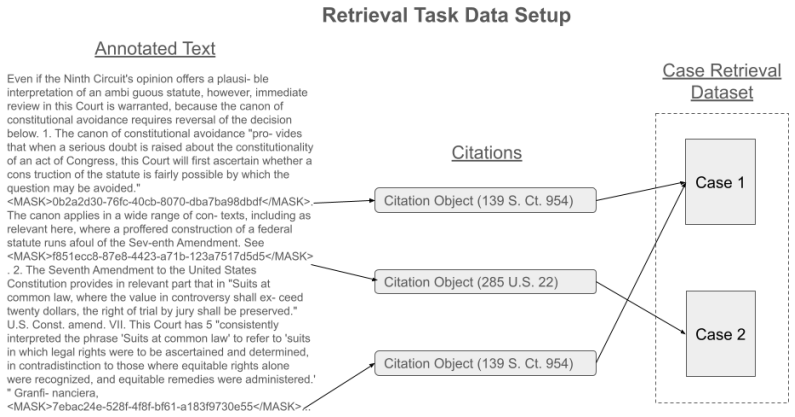
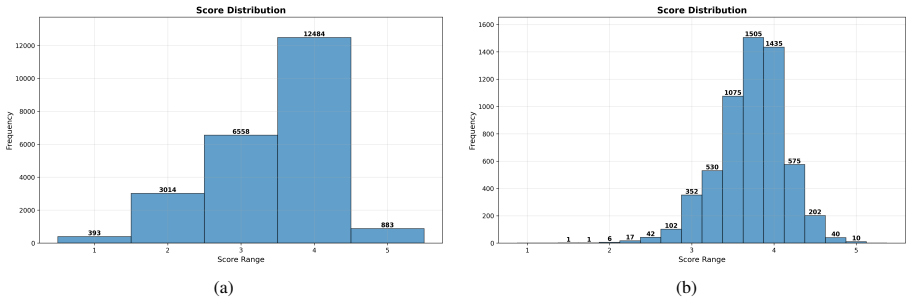
The load-bearing object is the dataset itself, built by scraping and parsing 3,753 Supreme Court merit briefs from 2017 to 2024 and aligning each section's heading to its body text. That structure supplies all three tasks at once: each heading is a gold extreme summary of its section; each table of contents is a tree of nested arguments from which one node can be masked for completion; each citation, masked with a unique identifier, defines a retrieval query against a corpus of 24,525 cited opinions. Evaluation is carried by an LLM-as-judge: o3-mini, prompted with expert guidelines on persuasive legal headings, assigns ratings from 1 to 5 that the paper argues are more reliable than the human annotators it recruited.
What would settle it
Take a random sample of, say, 100 summarization outputs from few-shot GPT-4o and the human-authored headings from the same briefs, have a panel of practicing appellate lawyers rate them blind with the same rubric, and check whether the human headings actually average below the model's; if expert agreement does not reproduce the judge's ordering, the 'beats human headings' claim fails.
Extended reading notes
Core claim
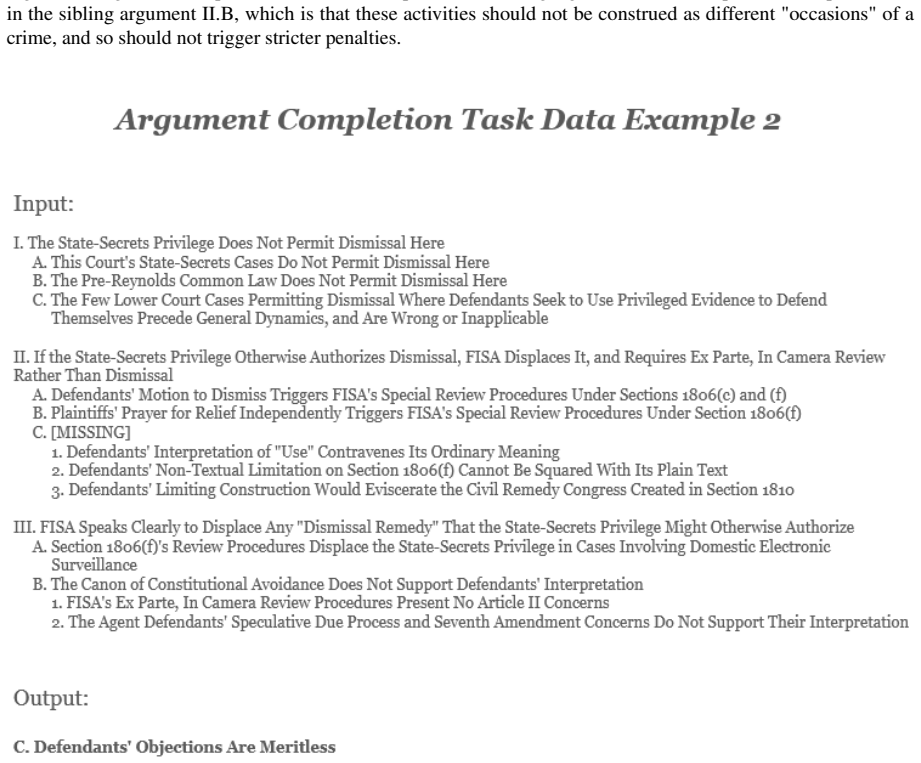
The central discovery is BRIEF ME, a benchmark that repurposes the internal structure of Supreme Court merit briefs—section headings, nested tables of contents, and masked citations—into three training and evaluation tasks. The paper's empirical claim is that LLMs are already useful for the drafting side of legal work: few-shot GPT-4o headings average 4.3/5 from the o3-mini judge, above the 4.0 of quality-filtered human headings and well above the 3.4/3.5 of unfiltered human headings, and the advantage persists on a contamination-controlled set of briefs published after February 2025. The same models are not yet reliable for the structural and evidentiary side: locating a missing heading in a realistic table-of-contents completion succeeds only 18% of the time, and no retrieval method brings the correct precedent into the top five more than 31.5% of the time, even after fine-tuning and reranking. The intended upshot is a division of labor: LLMs can draft headings, while placement and precedent retrieval remain open problems.
Load-bearing premise
The claim that GPT-4o beats human headings stands or falls with the assumption that the o3-mini judge's ratings really capture expert legal heading quality, a check done on just ten samples per task with meta-ratings by one author.
Editorial extensions
If this is right
- Few-shot GPT-4o produces section headings rated 4.3/5 on average, above human headings, and its advantage survives on briefs published after the model's training cutoff, so heading generation is a realistic near-term assistive tool.
- Fine-tuning and in-context examples often hurt open models on the judge's scale, so prompting a strong proprietary model currently beats training smaller ones.
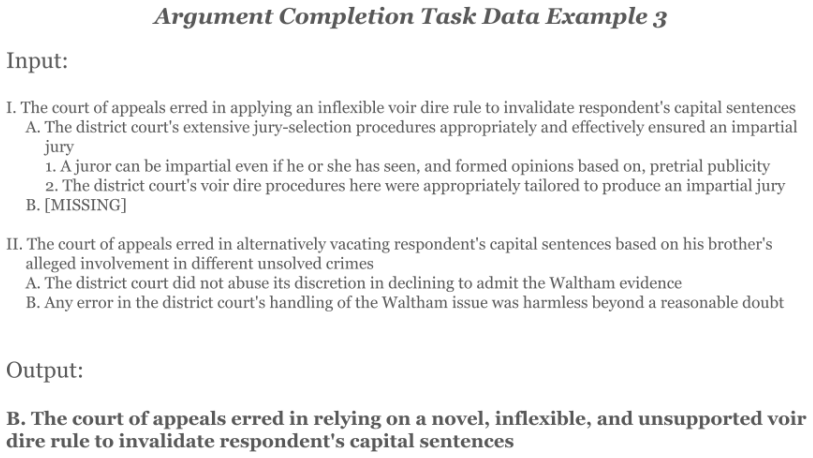
- A model can detect that a table of contents is incomplete and name the missing heading's level, but placing it correctly succeeds only 18% of the time; this is the bottleneck for realistic argument completion.
- Case retrieval is the weakest task, with the best top-five recall around 31.5%, and models often retrieve a topically similar but not the cited case, so retrieval needs new methods before it can support brief drafting.
- Because the same source documents yield all three tasks, BRIEF ME lets researchers study drafting and research skills on one corpus rather than stitching together datasets.
Reading between the lines
- If the judge's ratings are trusted, the practical design lesson is to spend engineering effort on placement and retrieval rather than phrasing: a drafting assistant that suggests headings is near-ready, while one that decides where they go and what to cite is not.
- The 'right topic, wrong case' failure pattern suggests the exact-match evaluation may understate real utility, because lawyers often need any supportive precedent; a natural extension is to score retrieval by whether the top results could be cited for the proposition.
- The judge's reliability rests on ten samples per task and one author's meta-ratings, so the 'beats human headings' claim should be rechecked with a larger expert panel before it is used to justify deployment.
- The three-task structure invites a testable composite: use the retrieval task to supply evidence for candidate completed headings, and use summarization quality as a signal that a placed heading fits; that could close the 18% placement gap.
Editorial analysis
A structured set of objections, weighed in public.
Referee Report
Summary. The paper introduces BRIEFME, a legal NLP benchmark built from Supreme Court of the United States merit briefs, with three tasks: argument summarization (generating section headings), argument completion (filling a missing heading in a table of contents, in both guided and realistic settings), and case retrieval (retrieving the case cited in a brief passage). The authors describe a detailed extraction and cleaning pipeline, present dataset statistics, and benchmark a range of LLMs and retrieval models. Using an o3-mini LLM-as-a-judge, they report that current LLMs, especially GPT-4o, achieve judge ratings above human-authored headings on summarization and guided completion, while performing poorly on realistic argument completion and on retrieving the exact cited case. They also include a contamination check using briefs published after model training cutoffs.
Significance. If the evaluation is valid, BRIEFME fills a clear gap in Legal NLP by focusing on persuasive legal argumentation in briefs rather than judicial opinions. The dataset construction is careful and detailed, the contamination check with temporally separated briefs is a notable strength, and the authors have released code and data. The retrieval corpus of over 24K cases and the three-task structure should be useful to the community. However, the headline claim that LLMs 'beat human-generated headings' is not yet established because it rests on an LLM judge that was also used to filter the dataset, was validated on only ten samples per task, and was meta-evaluated by one of the authors. The retrieval evaluation also assumes a single gold case. These issues do not undermine the dataset itself but do require substantial revision before the central comparative claims can be accepted.
major comments (2)
- [§4.1, §4.2, Table 3, Appendix E/F] The central claim that GPT-4o few-shot 'beats human-generated headings' (4.3 vs. 4.0 on the filtered set and vs. 3.4 on the unfiltered set, Table 3) is carried entirely by the o3-mini LLM-as-judge. The same judge is used in §3.4 to filter low-quality human headings and then used to compare model outputs against human headings, so the judge both constructs the gold set and measures the outcome. More importantly, the generation prompt (Appendix F.1) and the judge rubric (Appendix F.2) are both derived from the same legal-writing guidelines; model outputs are therefore generated to satisfy the exact criteria the judge applies, while human headings were not. The external validation of the judge consists of three annotators on ten samples per task, with meta-ratings provided by one of the paper's authors (Appendix E, Figs. 15–16, Table 20). Furthermore, the authors' own error analysis (Appendix H.1/H.2) shows the judge assigning different scores (4 vs. 5) to identical or near-identical headings, so the 4.3-vs-4.0 margin falls within the judge's apparent inconsistency. To support the headline claim, the authors should either provide a substantially larger independent expert evaluation that calibrates the 4-vs-5 boundary and directly compares model vs. human headings, or soften the claim to state that models reach a level comparable to human headings according to an LLM judge.
- [§4.4, Table 5, Appendix H.3] The case retrieval evaluation treats the single case cited in the brief as the only relevant document. As the authors acknowledge in Appendix H.3, in 2 of 40 examined failures both models retrieved cases that could plausibly have been cited for the proposition, and in many other cases the models retrieved topically correct cases. Under a single-gold assumption, Recall@k and MRR@10 (Table 5) may substantially underestimate retrieval quality. The claim that models 'perform poorly' on case retrieval should be re-framed as 'models rarely retrieve the exact cited case,' or the authors should provide a supplementary multi-relevance evaluation, even on a small sample, to separate topical relevance from exact-match retrieval. Without this, the negative result for case retrieval is not crisply interpretable.
minor comments (5)
- [§4.2] The sentence 'the LLM judge scores show that sincorporating training examples' contains a typo; it should read 'since incorporating.'
- [Appendix I] The model name 'Qwe-n2.5-14B-Instruct' is misspelled; it should be 'Qwen-2.5-14B-Instruct.'
- [Appendix B, Table 7] Table 7 reports 'Mean Compression 59.90' while the text states that the dataset has a 'higher median Compression rate (∼1.3x) than Newsroom'; please clarify whether this is a ratio, a percentage, and whether the mean or median is intended, since the two figures are inconsistent in magnitude.
- [Table 3 caption] The notation 'o3-miniS' is used in Table 3 and later tables, but it is not defined in the caption or in the main text; please define it explicitly when it is first introduced.
- [§4.1] The footnote 'We refined the judge instructions using Claude' is vague; a brief description of the refinement process and whether the final instructions were re-validated on the human-judge comparison would improve reproducibility.
Circularity Check
No significant circularity: the same LLM judge used for filtering and evaluation is a validity limitation, not a reduction; benchmark results are not forced by construction.
full rationale
The paper's central outputs are empirical benchmark scores, not a derivation from fitted inputs. The o3-mini judge is used both to filter low-quality human headings (Section 3.4) and to evaluate model outputs (Sections 4.1-4.2), which raises a legitimate evaluation-validity concern: if the judge is biased, the human-versus-model comparison is weakened. However, this is not circularity in the sense of this analysis, because the judge is a fixed, externally prompted evaluation function rather than a parameter fitted to the data being predicted; model outputs are generated without optimizing the judge, and the unfiltered comparison (4.3 vs. 3.4) does not depend on the filtering step. The human validation in Appendix E is small and partly self-assessed, but it is external grounding rather than a reduction. There is no self-citation chain, no imported uniqueness theorem, no ansatz smuggled via citation, and no renaming of a known result. The case-retrieval results are fully independent of the judge. The paper itself flags the evaluation difficulty in Section 6, and the claims are stated with appropriate hedging. Therefore no significant circularity is present.
Assumptions & free parameters
free parameters (6)
- Minimum section word count =
25
- Minimum heading word count =
3
- Summarization quality filter threshold =
score <= 3 excluded
- Completion quality filter threshold =
average ToC score below 3.5 excluded
- LoRA fine-tuning hyperparameters =
rank=8, alpha=16, dropout=0.05, lr=2e-5, batch=4, 1 epoch
- Token limits for inputs and generations =
5K input, 50 output
assumptions (5)
- domain assumption Section headings in legal briefs are gold-standard extreme summaries of the sections they introduce.
- domain assumption The table of contents of a brief encodes the logical structure of legal arguments, so removing and regenerating a heading is a meaningful test of argument reasoning.
- ad hoc to paper The o3-mini LLM judge, prompted with legal writing guidelines, produces valid assessments of legal heading quality.
- domain assumption The specific case citation masked in each retrieval query is the unique relevant precedent for that section.
- domain assumption The PDF extraction and fuzzy header-to-section matching pipeline yields accurate section boundaries.
Cite this review
Pith. "Pith review of BriefMe: A Legal NLP Benchmark for Assisting with Legal Briefs." pith.science (2026). https://pith.science/paper/KG3UMZI6
@misc{pith2026250606619,
  author       = {Pith},
  title        = {Pith review of: BriefMe: A Legal NLP Benchmark for Assisting with Legal Briefs},
  year         = {2026},
  howpublished = {\url{https://pith.science/paper/KG3UMZI6}},
  note         = {Machine review of arXiv:2506.06619}
}
read the original abstract
A core part of legal work that has been under-explored in Legal NLP is the writing and editing of legal briefs. This requires not only a thorough understanding of the law of a jurisdiction, from judgments to statutes, but also the ability to make new arguments to try to expand the law in a new direction and make novel and creative arguments that are persuasive to judges. To capture and evaluate these legal skills in language models, we introduce BRIEFME, a new dataset focused on legal briefs. It contains three tasks for language models to assist legal professionals in writing briefs: argument summarization, argument completion, and case retrieval. In this work, we describe the creation of these tasks, analyze them, and show how current models perform. We see that today's large language models (LLMs) are already quite good at the summarization and guided completion tasks, even beating human-generated headings. Yet, they perform poorly on other tasks in our benchmark: realistic argument completion and retrieving relevant legal cases. We hope this dataset encourages more development in Legal NLP in ways that will specifically aid people in performing legal work.
Figures


Figures from the paper (27 more)









Reference graph
Works this paper leans on
-
[1]
- Directly correspond to the questions presented to the court
**Major Headings** - Present independent grounds for relief. - Directly correspond to the questions presented to the court. - Must progress logically without redundancy
-
[2]
- Include specific legal reasoning, claim elements, or analytical factors
**Minor Headings** - Develop and support the arguments of their respec- tive major headings. - Include specific legal reasoning, claim elements, or analytical factors. - Should comprehensively build the case for the parent major heading
-
[3]
- Offer additional support and context for the argu- ments made at the minor level
**Subheadings** - Provide further detail under minor headings. - Offer additional support and context for the argu- ments made at the minor level. ## Assessment Framework You might decide to add one or more headings at these levels: major, minor, or subheading. Here’s how you can approach determining if adding headings is needed or not, and in case it is ...
work page 2022
-
[4]
The Reasoning section and the Fact section are the basis of the court’s decision
Decision: The Decision section is the specific re- sponse given by the court to the legal dispute based on the key facts of the case. The Reasoning section and the Fact section are the basis of the court’s decision
-
[5]
Tail: The Tails section introduces the basic infor- mation about the court, the judge, etc. The legal document is broken down into smaller units (sentences). Your task is to carefully identify the units that mark the beginning of each segment. Keep in mind that the segments must follow this specific sequence: Procedure, Fact, Reasoning, Decision, and Tail...
-
[7]
In Proceedings of the Natural Le- gal Language Processing Workshop 2021, pages 63– 75
Multi-granular legal topic classification on greek legislation. In Proceedings of the Natural Le- gal Language Processing Workshop 2021, pages 63– 75. Kishore Papineni, Salim Roukos, Todd Ward, and Wei- Jing Zhu. 2002. BLEU: a method for automatic eval- uation of machine translation. In Proceedings of the 40th annual meeting of the Association for Computa...
work page 2021
-
[8]
Yes, BM25 is a strong baseline for legal case retrieval. CoRR, abs/2105.05686. Fabio Salvi, Manuel H. Ribeiro, Riccardo Gallotti, and Robert West. 2025. On the conversational persua- siveness of large language models: A randomized controlled trial. Nature Human Behaviour. Advance online publication. Dan Schweitzer. 2017. U.S. supreme court brief writing s...
arXiv 2025
-
[13]
- If no → The ToC is complete as is
Would adding headings (at any level) improve the ToC’s effectiveness? - If yes → Some headings are missing, and you need to report the level of the heading as well. - If no → The ToC is complete as is
Show all 35 references
-
[14]
(In case the answer to the previous question is yes) Where could I add headings (at any level) that improve the ToC’s effectiveness? To confirm your choice for each heading you decide to add, check the following: - Does it highlight a missing but important argument? - Does it ...
-
[15]
binary_verdict
Now that the locations are identified, the next step is generating a recommendation for the missing head- ings. Consider the following points when generating each of the new headings: - What purpose does this new heading serve? - How does this heading contribute to the overall...
-
[16]
E.g., ’Plaintiff’, ’Defendant’, ’On appeal’, ’procedural pos- ture’
Procedure: The Procedure section introduces the parties’ information and procedural posture. E.g., ’Plaintiff’, ’Defendant’, ’On appeal’, ’procedural pos- ture’
-
[17]
Fact: The Fact section is a description of the parties’ arguments, evidence, and basic events
-
[18]
In Reasoning, the judge explains the reasons for the application of the rules
Reasoning: The Reasoning component is the pro- cess where the court selects the rules and applies them to the facts. In Reasoning, the judge explains the reasons for the application of the rules. In other words, the events that are relevant to the application of the rules, i.e...
-
[21]
inal activity after his first offense is therefore an entirely irrelevant inquiry
They observed the following trends. There were 17 of 30 analyzed generations rated a 1 by the judge. 11/17 were incomplete sentences (e.g. “inal activity after his first offense is therefore an entirely irrelevant inquiry.”). 2/17 were snippets of punctuation (e.g. “aa.”). 4/1...
2009
-
[22]
Subjects
“Subjects” of International Law Typically Possess Powers As Well as Obligations
-
[23]
Subjects
Recognizing Corporations As “Subjects” Of International Law Is Perceived To Compromise State Sovereignty
-
[24]
The Lack Of International Law Consensus Regarding Corporate Liability Forecloses Such Liability Under The ATS C
[MISSING] B. The Lack Of International Law Consensus Regarding Corporate Liability Forecloses Such Liability Under The ATS C. To The Extent That Corporate Liability Poses A Domestic Law Question, It Is One That Congress Must Answer III. DOMESTIC CORPORATE OVERSIGHT OF OVERSEAS...
-
[25]
Text of section 1182(a)(2)
-
[26]
Surrounding provisions in section 1182(a)
-
[27]
Renders The Alien Inadmissible
Structure of the INA. B. The two-part structure of the stop-time rule demonstrates that Petitioner is correct. C. The purpose and history of the stop-time rule reinforce that Petitioner’s position is correct. II. Alternatively, If An Alien Is Capable Of Being Charged With Inad...
-
[28]
The Proposed Twitter/Facebook Standard
-
[29]
THE COURT SHOULD NOT ADOPT ANY OF THE NEW LEGAL RULES AND REQUIREMENTS PROPOSED BY DEFENDANTS OR THE UNITED STATES
The Proposed Government Standard II. THE COURT SHOULD NOT ADOPT ANY OF THE NEW LEGAL RULES AND REQUIREMENTS PROPOSED BY DEFENDANTS OR THE UNITED STATES
-
[30]
Knowledge of Accounts or Postings Connected To The Reina Attack
-
[31]
Knowledge of Accounts or Postings Used for Particular Attacks
-
[32]
Knowledge of Substantial Assistance
-
[33]
Special Standard for Remoteness
-
[34]
Special Standard for Widely Available, Ordinary Services
-
[35]
THE COMPLAINT PLAUSIBLY ALLEGED THE DEFENDANTS KNOWINGLY ASSISTED ISIS’S TERRORIST ACTIVITIES A
Requirement of Direct Knowledge III. THE COMPLAINT PLAUSIBLY ALLEGED THE DEFENDANTS KNOWINGLY ASSISTED ISIS’S TERRORIST ACTIVITIES A. The Allegations of The Complaint B. Defendants’ Asserted Lack of More Specific Knowledge Missing Heading: Special Standard for Routine Services...
-
[1264]
Antoine Louis and Gerasimos Spanakis
Association for Computing Machinery. Antoine Louis and Gerasimos Spanakis. 2022. A statu- tory article retrieval dataset in french. In Proceedings of the 60th Annual Meeting of the Association for Computational Linguistics (Volume 1: Long Papers), pages 6789–6803, Dublin, Irel...
2022 arXiv
-
[2012]
In Proceedings of the Workshop on Innovative Hybrid Approaches to the Processing of Textual Data, pages 115–123, Avignon, France
Combining different summarization tech- niques for legal text. In Proceedings of the Workshop on Innovative Hybrid Approaches to the Processing of Textual Data, pages 115–123, Avignon, France. Association for Computational Linguistics. Mingqi Gao, Xinyu Hu, Jie Ruan, Xiao Pu, ...
2024 arXiv
-
[2018]
In Proceedings of the 2018 Conference on Empirical Methods in Natural Lan- guage Processing, pages 1797–1807, Brussels, Bel- gium
Don‘t give me the details, just the summary! topic-aware convolutional neural networks for ex- treme summarization. In Proceedings of the 2018 Conference on Empirical Methods in Natural Lan- guage Processing, pages 1797–1807, Brussels, Bel- gium. Association for Computational ...
2018
-
[2019]
How well does the summary capture the key points of the article?
CAIL2019-SCM: A dataset of similar case matching in legal domain. CoRR, abs/1911.08962. An Yang, Baosong Yang, Beichen Zhang, Binyuan Hui, Bo Zheng, Bowen Yu, Chengyuan Li, Dayi- heng Liu, Fei Huang, Haoran Wei, Huan Lin, Jian Yang, Jianhong Tu, Jianwei Zhang, Jianxin Yang, Ji...
2018 arXiv
-
[2020]
volume abs/2010.02559
LEGAL-BERT: the muppets straight out of law school. volume abs/2010.02559. Ilias Chalkidis, Manos Fergadiotis, Prodromos Malaka- siotis, and Ion Androutsopoulos. 2019. Large-scale multi-label text classification on EU legislation. In Proceedings of the 57th Conference of the A...
2010 arXiv
-
[2021]
In Proceedings of the Natural Legal Language Processing Workshop 2021, pages 19–35
Swiss-judgment-prediction: A multilingual le- gal judgment prediction benchmark. In Proceedings of the Natural Legal Language Processing Workshop 2021, pages 19–35. Rodrigo Nogueira and Kyunghyun Cho. 2019. Passage re-ranking with BERT. CoRR, abs/1901.04085. Christos Papalouka...
2021 arXiv
-
[2023]
In Proceedings of the 46th International ACM SIGIR Conference on Re- search and Development in Information Retrieval, SIGIR 2023, Taipei, Taiwan, July 23-27, 2023, pages 1035–1044
SAILER: structure-aware pre-trained language model for legal case retrieval. In Proceedings of the 46th International ACM SIGIR Conference on Re- search and Development in Information Retrieval, SIGIR 2023, Taipei, Taiwan, July 23-27, 2023, pages 1035–1044. Association for Com...
2023
Reviewed August 7, 2026 · model on record in the stance chip above.
Discussion (0). Sign in to comment.