REVIEW 4 major objections 6 minor 35 references
SpeLLM: Character-Level Multi-Head Decoding
T0 review · 4 major / 6 minor · reviewed 2026-08-06 · deepseek-v4-flash
Pith's one-line read SpeLLM replaces an LLM's token-level output head with k parallel character-level heads, cutting decoding runtime by 5.1% while maintaining competitive downstream performance.
desk verdict A genuinely new character-level multi-head decoding method with a modest measured speedup; the main gap is that the fast and accurate configurations are never measured as one system. read the letter →
The pith
A machine-rendered reading of the paper's core claim, the machinery that carries it, and where it could break.
The reading
What carries the argument
The central object is a bank of k linear heads over the final hidden state, each with a small character vocabulary of size s, whose argmax outputs concatenate to spell the next token, with a padding symbol for short tokens. Because s is far smaller than the BPE vocabulary S, the output projection becomes drastically cheaper while the set of representable strings is combinatorially large. The argument is carried by three interacting pieces: the parallel character heads; a self-distillation loss that trains each head against the best-matching of the teacher's top-3 token spellings plus an auxiliary token-level loss that preserves the teacher's token representations; and an auto-correct layer that, for strings that are not valid tokens, filters the BPE vocabulary by position-wise top-3 character constraints and re-scores the survivors with the original token head.
What would settle it
Re-score SpeLLM's output against the original corpus token instead of the teacher's top-5 predictions; if exact-match accuracy falls materially below the reported 92% (or 95% with AutoCorrect), the teacher's top-5 supervision is inflating the apparent spelling quality.
Extended reading notes
Core claim
The central claim is that an LLM can generate its next token as a fixed-length character string predicted in parallel by k independent linear heads instead of as an index into a huge embedding table. With k=10 heads over a 105-symbol character vocabulary, the output projection uses fewer than 0.85% of the original output-layer parameters, yet covers roughly 91% of Latin-script tokens in the tested vocabularies. Distilled only on the teacher's top-5 predictions, the student spells the teacher's intended token exactly about 92% of the time, rising to about 95% with an auto-correct filter that re-scores candidate tokens; including valid prefixes the match rate reaches 94.89% and 97.57%, respectively. On downstream tasks the SpeLLM variants match or beat the teacher on BoolQ and ARC-Easy, lose some ground on GSM8K and CNN/Daily Mail, and regain part of that ground through an entropy-based fallback to the original token head.
Load-bearing premise
The pipeline assumes the teacher model's top-5 token predictions, with the original gold token ignored, are a sufficiently correct and unbiased set of labels, since both the distillation loss and the intrinsic evaluation score against that same top-5 list.
Editorial extensions
If this is right
- Decoding speedup: across Llama3.2-3B, Llama3-8B, Gemma2-2B, and Gemma2-9B, SpeLLM reduces end-to-end generation runtime by 5.1% on average, with the isolated output-head time dropping to a small fraction of the token-level head's time while transformer layers dominate remaining latency.
- Quality retention: SpeLLM is comparable or better than the teacher on BoolQ and ARC-Easy, and within a few points on GSM8K and CNN/Daily Mail, with an entropy-fallback mechanism closing much of the GSM8K gap.
- Output-layer economy: ten heads of 105 characters total 1,050 vectors, under 0.85% of the 128K-256K token output matrices, so input vocabulary can be enlarged without proportionally enlarging the output projection.
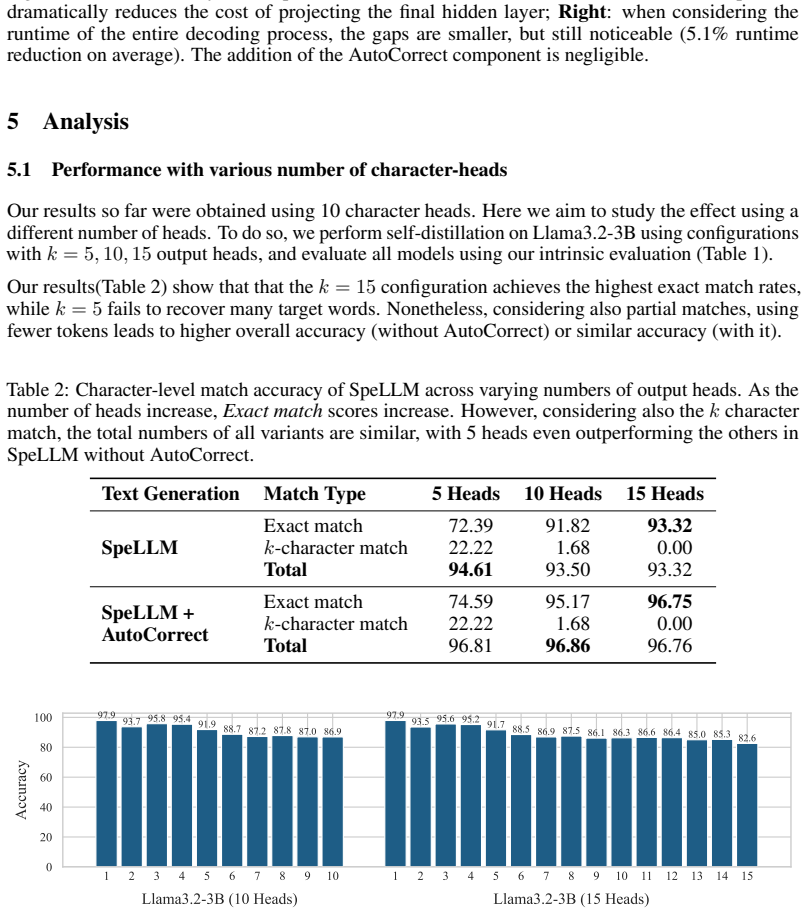
- Head-count flexibility: increasing k from 5 to 15 raises exact-match spelling from 72% to 93%, while total match rates including partial prefixes stay roughly constant, so the architecture is not tied to one head count.
- Confidence signal: SpeLLM's mean character entropy is a reliable error signal, with about 99% accuracy in the lowest-entropy bin falling to about 65% in the second bin, which validates the entropy-fallback design.
Reading between the lines
- The same self-distillation recipe should transfer to non-Latin scripts: because the heads use a small character set with an unknown-character symbol, a SpeLLM trained on multilingual data could spell words its BPE tokenizer represents poorly, turning the paper's stated low-resource-language motivation into a testable accuracy comparison.
- The reported 5.1% end-to-end speedup is a floor for what the output-head decoupling alone buys; since the authors note transformer layers dominate latency, pairing SpeLLM with larger input vocabularies or multi-token prediction could push the total speedup substantially higher.
- Because both training and intrinsic evaluation use the teacher's top-5 as ground truth, an independent check against original text would separate spelling quality from teacher confidence; the paper's entropy analysis suggests failures would concentrate where the teacher itself is uncertain.
- A straightforward variant—predicting one character for each of several future tokens across k heads, rather than k characters of a single token—would compound the savings and is hinted at in the paper's conclusion; it would require a teacher that provides multiple future tokens, which existing multi-token-prediction setups already supply.
Editorial analysis
A structured set of objections, weighed in public.
Referee Report
Summary. The paper proposes SpeLLM, a modification of standard transformer LLMs in which the token-level output head is replaced by k parallel character-level linear heads that predict a fixed-length character string in a single decoding step. A pretrained BPE-based LLM serves as teacher, and the SpeLLM student is trained by self-distillation: the teacher's top-5 token predictions (with the gold token ignored) are used as labels, with a character loss and an auxiliary token-level loss. The paper reports intrinsic accuracy against the teacher's top-5 predictions, downstream performance on BoolQ, ARC-Easy, GSM8K, and CNN/Daily Mail, and a 5.1% average runtime speedup over the teacher, across Llama3.2-3B, Llama3-8B, Gemma2-2B, and Gemma2-9B. Additional analyses examine the number of character heads, accuracy vs. token length, entropy-based fallback, and an AutoCorrect mechanism.
Significance. If the main claims held, SpeLLM would be a simple, practical way to shrink the output projection and modestly accelerate decoding of existing LLMs while maintaining output quality, and the paper's release of code would aid reproducibility. The idea of decoupling input and output vocabularies through character-level multi-head prediction is reasonable and the self-distillation setup is straightforward. However, the present evaluation does not fully support the headline claims: the intrinsic metric is circular, the speedup and the competitive downstream results are measured on different configurations, and the downstream and runtime results lack uncertainty quantification. These issues are addressable, so the paper warrants a major revision rather than rejection.
major comments (4)
- [Section 3.3 and Section 2.2] The intrinsic evaluation in Table 1 measures agreement with the teacher's top-5 token predictions, which is exactly the training target defined in Section 2.2 (the teacher's top-5 predictions, with the gold token ignored, are used as distillation labels). Thus the reported 91.75% 'full exact match' and 94.89% total are distillation-fidelity scores, not independent measures of generation quality. The text's phrasing ('SpeLLM generates a full match in almost 92% of the cases') overstates what the metric establishes. Please relabel these results as distillation fidelity or, better, add an external metric such as exact match against gold text, character-level perplexity, or downstream task performance on held-out data.
- [Section 4 (Fig. 3) and Section 5.3] The 5.1% speedup is measured only for SpeLLM and SpeLLM+AutoCorrect (Fig. 3), while the downstream results that 'closely approach' the teacher on GSM8K and CNN/Daily Mail are obtained with the entropy-fallback variant (Fig. 2 and Section 5.3). No end-to-end runtime is reported for the entropy-fallback configuration, and the fallback trigger rate is not given. Since entropy fallback routes a fraction of tokens through the full token-level head whenever the mean character-head entropy exceeds 0.22, its latency is not captured by the 5.1% figure. Consequently, the abstract's conjunction—competitive performance and 5.1% faster—is not established for any single deployed variant. Please measure and report end-to-end latency for the entropy-fallback variant, including the trigger rate and the resulting average added cost.
- [Section 3.3 and Fig. 2/Fig. 3] The downstream evaluation uses only 500 samples for BoolQ, ARC-Easy, and GSM8K and 100 samples for CNN/Daily Mail, and no confidence intervals or significance tests are reported. Figure 2 shows many differences of only a few points between SpeLLM variants and the teacher, so the claims of 'comparable' performance and improvements 'of up to 6.2%' are not statistically supported. Similarly, the runtime measurements in Fig. 3 have no error bars, leaving unclear whether the 5.1% average difference is significant. Please report confidence intervals or significance tests (or increase sample sizes) for both downstream accuracy and runtime.
- [Section 2.2 (training labels)] The student is trained to reproduce the teacher's top-5 predictions while the original gold token is ignored. If the correct token is not among the teacher's top-5 at a given position, the student is trained to spell an incorrect but plausible word, and the intrinsic evaluation—also based on the teacher's top-5—cannot detect this failure. The paper should report the frequency with which the gold token appears in the teacher's top-5 on the training and evaluation data, and ideally evaluate against gold tokens directly, to establish the quality of the distillation signal. This is a load-bearing assumption because the conversion process depends entirely on the teacher's correctness.
minor comments (6)
- [Section 4] The word 'neglibgble' in the runtime paragraph is a typo and should be 'negligible'.
- [Section 3.3] 'Other benchmarks are used in zero-short settings' should read 'zero-shot settings'.
- [Section 2.2] 'We than compute the loss' should read 'We then compute the loss'.
- [Section 7 (Limitations)] 'our approach is not as accurate on as the teacher model' is ungrammatical; it should read 'not as accurate as the teacher model'.
- [Abstract and Section 3.1] The abstract's claim that the approach 'increase[s] support for underrepresented languages' is not supported by the implementation: the character vocabulary in Section 3.1 contains only Latin characters, digits, punctuation, a padding symbol, and a single unknown symbol, with diacritics stripped, so non-Latin scripts are collapsed to the unknown symbol. The paper should either extend the character vocabulary to cover non-Latin scripts or temper the claim to a potential avenue for future work.
- [Section 5.3] The entropy-fallback threshold of 0.22 is stated without justification or sensitivity analysis; a brief study of how results vary with the threshold would strengthen the proposal.
Circularity Check
Intrinsic 'accuracy' is defined against the same teacher top-5 set used as distillation labels, so Table 1 measures fit to the training target; downstream and runtime results remain externally grounded.
-
fitted input called prediction
[Sections 2.2-2.3 and 3.3; Table 1]
"Our goal is for SpeLLM( M) to match M’s BPE predictions. To do so, we run inference over a dataset and record M’s top-5 predictions, while ignoring the original gold word. ... Correctness is assessed by comparing SpeLLM’s output against the top-5 predictions of the model’s token-level head."
The training objective is to match the teacher's top-5 token predictions (Sec. 2.2), and Sec. 3.3 scores 'correctness' against exactly that same set. Further, Sec. 2.3 selects as label the precomputed top-3 token with the most position-wise character matches with the student's current char_argmax, so the target is partly chosen to be close to the student's own output. Thus Table 1's 91.75%/94.93% 'full exact match' measures agreement with the distillation target, not with the original gold token; the 10-character and prefix criteria are likewise defined against the teacher's top-5 set. The intrinsic evaluation is, by construction, a fit-to-training-signal metric, not an independent spelling-correctness test. Downstream tasks use external labels, so the circularity is partial.
full rationale
The main quantitative result has two independent parts: downstream quality (Fig. 2) and speedup (Fig. 3). Both are measured against external benchmarks or direct timing and are therefore not circular. The circularity is confined to the intrinsic evaluation (Table 1 and related analyses), where 'correctness' is defined as matching the teacher's top-5 set, which is also the source of the distillation labels. The training procedure even selects among those top-5/top-3 candidates using the student's own current character argmax, so the high full-match percentages largely reflect self-consistency with the training target rather than spelling accuracy against the original gold text. This is a partial circularity: it undermines the internal accuracy claim but does not force the downstream or runtime conclusions. The paper does not report end-to-end latency for the entropy-fallback configuration that yields the best downstream numbers; that is a reporting gap rather than a circularity.
Assumptions & free parameters
free parameters (4)
- Number of character heads k =
10 (default; 5 and 15 analyzed)
- Entropy fallback threshold =
0.22
- Character vocabulary size =
105 symbols
- Top-k teacher predictions used =
top-5 for labels, top-3 for character matching
assumptions (4)
- domain assumption Teacher's top-5 predictions, ignoring gold labels, provide a sufficient training signal.
- ad hoc to paper The BPE token can be segmented into a fixed-length character stream of k=10, with longer tokens continued in the next step.
- domain assumption Fine-tuning only the last five feed-forward layers preserves the information needed for character decoding.
- domain assumption A Latin-focused character set with diacritic stripping is adequate for downstream tasks.
invented entities (2)
-
Padding symbol
-
Unknown character symbol
Cite this review
Pith. "Pith review of SpeLLM: Character-Level Multi-Head Decoding." pith.science (2026). https://pith.science/paper/KGABQLFY
@misc{pith2026250716323,
  author       = {Pith},
  title        = {Pith review of: SpeLLM: Character-Level Multi-Head Decoding},
  year         = {2026},
  howpublished = {\url{https://pith.science/paper/KGABQLFY}},
  note         = {Machine review of arXiv:2507.16323}
}
abstract
Scaling LLM vocabulary is often used to reduce input sequence length and alleviate attention's quadratic cost. Yet, current LLM architectures impose a critical bottleneck to this procedure: the output projection layer scales linearly with vocabulary size, rendering substantial expansion impractical. We propose SpeLLM, a method that decouples input and output vocabularies by predicting character-level strings through multiple output heads. In SpeLLM, each of the $k$ linear heads predicts a single character simultaneously, enabling the model to represent a much larger output space using smaller, independent linear heads. We present a self-distillation approach for converting a standard LLM to a SpeLLM. Our experiments with four pre-trained LLMs show their SpeLLM variants achieve competitive performance on downstream tasks while reducing runtime by 5.1% on average across models. Our approach provides a potential avenue for reducing LLM costs, while increasing support for underrepresented languages and domains.
Figures


Figures from the paper (6 more)


Reference graph
Works this paper leans on
-
[1]
A new algorithm for data compression
Philip Gage. A new algorithm for data compression. C Users J., 12(2):23–38, February 1994. ISSN 0898-9788. doi: 10.5555/177910.177914
-
[2]
Neural Machine Translation of Rare Words with Subword Units
Rico Sennrich, Barry Haddow, and Alexandra Birch. Neural Machine Translation of Rare Words with Subword Units. arXiv, August 2015. doi: 10.48550/arXiv.1508.07909
-
[3]
Aaron Grattafiori, Abhimanyu Dubey, Abhinav Jauhri, Abhinav Pandey, et al. The Llama 3 Herd of Models. arXiv, July 2024. doi: 10.48550/arXiv.2407.21783
-
[4]
Gemma 2: Improv- ing Open Language Models at a Practical Size
Gemma Team, Morgane Riviere, Shreya Pathak, Pier Giuseppe Sessa, et al. Gemma 2: Improv- ing Open Language Models at a Practical Size. arXiv, July 2024. doi: 10.48550/arXiv.2408. 00118
-
[5]
Do all languages cost the same? tokenization in the era of commercial language models
Orevaoghene Ahia, Sachin Kumar, Hila Gonen, Jungo Kasai, David Mortensen, Noah Smith, and Yulia Tsvetkov. Do all languages cost the same? tokenization in the era of commercial language models. In Houda Bouamor, Juan Pino, and Kalika Bali, editors, Proceedings of the 2023 Conference on Empirical Methods in Natural Language Processing, pages 9904–9923, Sing...
doi:10.18653/v1/2023 2023
-
[6]
Neha Sengupta, Sunil Kumar Sahu, Bokang Jia, Satheesh Katipomu, Haonan Li, Fajri Koto, William Marshall, Gurpreet Gosal, Cynthia Liu, Zhiming Chen, Osama Mohammed Afzal, Samta Kamboj, Onkar Pandit, Rahul Pal, Lalit Pradhan, Zain Muhammad Mujahid, Massa Baali, Xudong Han, Sondos Mahmoud Bsharat, Alham Fikri Aji, Zhiqiang Shen, Zhengzhong Liu, Natalia Vassi...
arXiv 2023
-
[7]
Language model tokenizers introduce unfairness between languages
Aleksandar Petrov, Emanuele La Malfa, Philip Torr, and Adel Bibi. Language model tokenizers introduce unfairness between languages. In Proc. of NeurIPS, 2023
work page 2023
-
[8]
MEGABYTE: Predicting Million-byte Sequences with Multiscale Transformers
Lili Yu, Dániel Simig, Colin Flaherty, Armen Aghajanyan, et al. MEGABYTE: Predicting Million-byte Sequences with Multiscale Transformers. arXiv, May 2023. doi: 10.48550/arXiv. 2305.07185
Show all 35 references
-
[9]
Byte Latent Transformer: Patches Scale Better Than Tokens
Artidoro Pagnoni, Ram Pasunuru, Pedro Rodriguez, John Nguyen, Benjamin Muller, Margaret Li, Chunting Zhou, Lili Yu, Jason Weston, Luke Zettlemoyer, Gargi Ghosh, Mike Lewis, Ari Holtzman, and Srinivasan Iyer. Byte Latent Transformer: Patches Scale Better Than Tokens. arXiv, Dec...
- [10]
-
[11]
What do tokens know about their characters and how do they know it? ArXiv, abs/2206.02608, 2022
Ayush Kaushal and Kyle Mahowald. What do tokens know about their characters and how do they know it? ArXiv, abs/2206.02608, 2022. URL https://api.semanticscholar.org/ CorpusID:249394509
2022 arXiv
-
[12]
Training Verifiers to Solve Math Word Problems
Karl Cobbe, Vineet Kosaraju, Mohammad Bavarian, Mark Chen, Heewoo Jun, Lukasz Kaiser, Matthias Plappert, Jerry Tworek, Jacob Hilton, Reiichiro Nakano, Christopher Hesse, and John Schulman. Training Verifiers to Solve Math Word Problems. arXiv, October 2021. doi: 10.48550/arXiv...
- [13]
-
[14]
Headless Language Models: Learning without Predicting with Contrastive Weight Tying.arXiv, September 2023
Nathan Godey, Éric de la Clergerie, and Benoît Sagot. Headless Language Models: Learning without Predicting with Contrastive Weight Tying.arXiv, September 2023. doi: 10.48550/arXiv. 2309.08351. 10
-
[15]
The FineWeb Datasets: Decanting the Web for the Finest Text Data at Scale
Guilherme Penedo, Hynek Kydlíˇcek, Loubna Ben Allal, Anton Lozhkov, Margaret Mitchell, Colin Raffel, Leandro V on Werra, and Thomas Wolf. The FineWeb Datasets: Decanting the Web for the Finest Text Data at Scale. arXiv, June 2024. doi: 10.48550/arXiv.2406.17557
-
[16]
BoolQ: Exploring the Surprising Difficulty of Natural Yes/No Questions
Christopher Clark, Kenton Lee, Ming-Wei Chang, Tom Kwiatkowski, Michael Collins, and Kristina Toutanova. BoolQ: Exploring the Surprising Difficulty of Natural Yes/No Questions. arXiv, May 2019. doi: 10.48550/arXiv.1905.10044
-
[17]
Think you have Solved Question Answering? Try ARC, the AI2 Reasoning Challenge
Peter Clark, Isaac Cowhey, Oren Etzioni, Tushar Khot, Ashish Sabharwal, Carissa Schoenick, and Oyvind Tafjord. Think you have Solved Question Answering? Try ARC, the AI2 Reasoning Challenge. arXiv, March 2018. doi: 10.48550/arXiv.1803.05457
-
[18]
Efficient vocabulary reduction for small language models
Yuta Nozaki, Dai Nakashima, Ryo Sato, Naoki Asaba, and Shintaro Kawamura. Efficient vocabulary reduction for small language models. In Owen Rambow, Leo Wanner, Marianna Apidianaki, Hend Al-Khalifa, Barbara Di Eugenio, Steven Schockaert, Kareem Darwish, and Apoorv Agarwal, edit...
2025
-
[19]
T-FREE: Subword Tokenizer-Free Generative LLMs via Sparse Representations for Memory- Efficient Embeddings
Björn Deiseroth, Manuel Brack, Patrick Schramowski, Kristian Kersting, and Samuel Weinbach. T-FREE: Subword Tokenizer-Free Generative LLMs via Sparse Representations for Memory- Efficient Embeddings. arXiv, June 2024. doi: 10.48550/arXiv.2406.19223
-
[20]
FR-Spec: Accelerating Large-V ocabulary Language Models via Frequency-Ranked Speculative Sampling
Weilin Zhao, Tengyu Pan, Xu Han, Yudi Zhang, Ao Sun, Yuxiang Huang, Kaihuo Zhang, Weilun Zhao, Yuxuan Li, Jianyong Wang, Zhiyuan Liu, and Maosong Sun. FR-Spec: Accelerating Large-V ocabulary Language Models via Frequency-Ranked Speculative Sampling. arXiv, February 2025. doi: ...
- [21]
-
[22]
Fast V ocabulary Transfer for Language Model Compression
Leonidas Gee, Andrea Zugarini, Leonardo Rigutini, and Paolo Torroni. Fast V ocabulary Transfer for Language Model Compression. arXiv, February 2024. doi: 10.18653/v1/2022. emnlp-industry.41
2024 doi
- [23]
- [24]
-
[25]
Stevens, Rangharajan Venkatesan, Steve Dai, Brucek Khailany, and Anand Raghu- nathan
Jacob R. Stevens, Rangharajan Venkatesan, Steve Dai, Brucek Khailany, and Anand Raghu- nathan. Softermax: Hardware/Software Co-Design of an Efficient Softmax for Transformers. arXiv, March 2021. doi: 10.48550/arXiv.2103.09301
-
[26]
Baharav, Ryan Kang, Colin Sullivan, Mo Tiwari, Eric Luxenberg, David Tse, and Mert Pilanci
Tavor Z. Baharav, Ryan Kang, Colin Sullivan, Mo Tiwari, Eric Luxenberg, David Tse, and Mert Pilanci. Adaptive Sampling for Efficient Softmax Approximation. Advances in Neural Information Processing Systems , 37:117580–117613, December
- [27]
- [28]
- [29]
-
[30]
ByT5: Towards a token-free future with pre-trained byte-to-byte models
Linting Xue, Aditya Barua, Noah Constant, Rami Al-Rfou, Sharan Narang, Mihir Kale, Adam Roberts, and Colin Raffel. ByT5: Towards a token-free future with pre-trained byte-to-byte models. arXiv, May 2021. doi: 10.48550/arXiv.2105.13626
-
[31]
Clark, Dan Garrette, Iulia Turc, and John Wieting
Jonathan H. Clark, Dan Garrette, Iulia Turc, and John Wieting. CANINE: Pre-training an Efficient Tokenization-Free Encoder for Language Representation. arXiv, March 2021. doi: 10.1162/tacl_a_00448
2021 doi
-
[32]
Decoupled Weight Decay Regularization
Ilya Loshchilov and Frank Hutter. Decoupled Weight Decay Regularization. arXiv, November
-
[35]
All models are trained on a single GPU: smaller models on Nvidia L40S, and larger models on Nvidia A100
with a learning rate of 5e-5 and a weight decay of 0.01. All models are trained on a single GPU: smaller models on Nvidia L40S, and larger models on Nvidia A100. Token Coverage Llama uses a vocabulary of 128K tokens, while Gemma models use 256K. Our approach employs 10 linear ...
-
[2017]
A Appendix Accuracy over various token lengths In Section 5.2, we analyze the accuracy of models with varying number of character-level heads across different token lengths
doi: 10.48550/arXiv.1711.05101. A Appendix Accuracy over various token lengths In Section 5.2, we analyze the accuracy of models with varying number of character-level heads across different token lengths. Here we create a plot similar to Fig. 4 with additional models (all wit...
-
[2024]
URL https://proceedings.neurips.cc/paper_files/paper/2024/hash/ d52dbd66219dc4e432e0bd4f9c25c4c3-Abstract-Conference.html
2024
Reviewed August 6, 2026 · model on record in the stance chip above.
Discussion (0). Sign in to comment.