REVIEW 2 major objections 6 minor 57 references
Energy conversion and scaling analysis of relativistic magnetic reconnection
T0 review · 2 major / 6 minor · reviewed 2026-08-06 · deepseek-v4-flash
Pith's one-line read Relativistic resistive reconnection has a much weaker inflow scaling than earlier theory predicted, because magnetic energy is mostly converted into heat rather than bulk kinetic energy.
desk verdict A decent resistive-MHD reconnection paper with a genuinely new compressibility scaling, but the inflow measurement probe is too close to the sheet to fully trust the headline exponent. read the letter →
The pith
A machine-rendered reading of the paper's core claim, the machinery that carries it, and where it could break.
The reading
What carries the argument
The load-bearing object is the compressibility factor $\alpha$, defined as the ratio of the mass entering through the sheet-length edge to the mass leaving through the sheet-thickness edge, inserted into the mass-conservation law $\beta_{\rm in}=\alpha\rho_{\rm out}\beta_{\rm out}\delta/L$. In the uncompressed non-relativistic theory this factor is effectively one; here it carries the entire argument because the simulations show $\alpha\sim\sigma^{-0.47}$, which converts the strong $\rho_{\rm out}\sim\sigma^{0.52}$ growth into the weak observed $\beta_{\rm in}\sim\sigma^{0.1}$ inflow. A secondary mechanism is the decomposition of $\mathbf{J}\cdot\mathbf{E}$ through the relativistic Ohm's law into resistive $(\eta/\Gamma)J^2$ and convective $-\mathbf{J}\cdot(\mathbf{v}\times\mathbf{B})$ terms, which locates the energy transfer in the current sheet and separatrix and shows the resistive term dominating early and the convective term later.
What would settle it
Run the same $\sigma$ scan with several probe lines at distances $x=0.025$, $0.05$, and $0.1$ from the sheet centre and see whether the exponent in $\beta_{\rm in}$ versus $\sigma/S$ moves toward $0.5$ as the probe approaches the sheet. If it does, the reported $0.11$ exponent is a near-field island effect; if it stays near $0.1$ to $0.13$, the weak scaling is robust. Independently check whether $\alpha\sim\sigma^{-0.47}$ reproduces $\beta_{\rm in}=\alpha\rho_{\rm out}\beta_{\rm out}\delta/L$ at each $\sigma$ to within the simulation's roughly 10% mass-conservation error.
Extended reading notes
Core claim
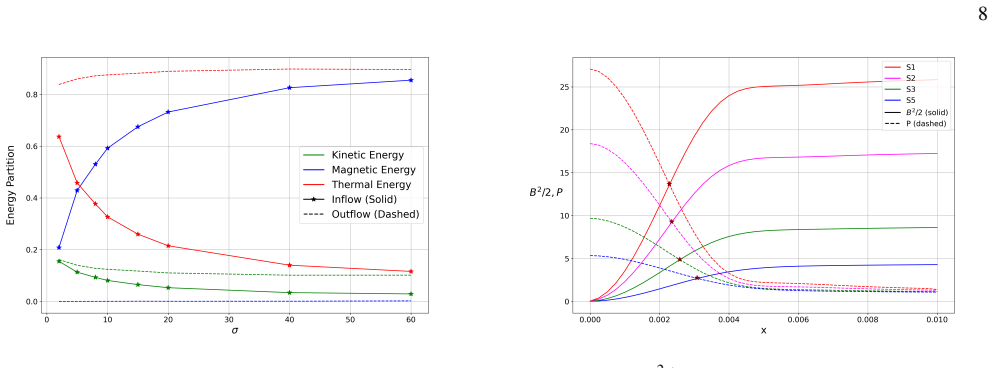
The paper's central claim is that the inflow in relativistic resistive reconnection does not follow the previously proposed $\beta_{\rm in}\propto(\sigma/S)^{0.5}$ law. Instead, the measured inflow scales as $\beta_{\rm in}\propto(\sigma/S)^{0.11\pm0.02}$, with the inflow speed itself depending only weakly on $\sigma$. The explanation offered is that magnetic energy is converted predominantly into thermal energy, making the outflow hot and dense and forcing a compressible mass balance; the outflow density grows as $\rho_{\rm out}\sim\sigma^{0.52}$, and the compressibility factor scales as $\alpha\sim\sigma^{-0.47}$. With this correction, mass conservation $\beta_{\rm in}=\alpha\rho_{\rm out}\beta_{\rm out}\delta/L$ closes consistently, and the outflow four-speed follows $u_{y,\max}\sim\sigma^{0.15}$ rather than $\sqrt{\sigma}$. The paper also reports where energy conversion happens (current sheet and separatrix), a shift from resistive to convective electric-field dominance as reconnection develops, and an outflow energy budget that is roughly 90% thermal.
Load-bearing premise
The scaling exponents are read off the inflow speed measured at a fixed probe line $x=\pm0.05$, two and a half sheet half-thicknesses from the centre, averaged over $y\in[-0.2,0.2]$; if that line chiefly samples plasma circulating around magnetic islands rather than the asymptotic inflow, the reported $\sigma$ dependence of $\beta_{\rm in}$ and the derived $\alpha$ scaling would not be the true inflow law.
Editorial extensions
If this is right
- Reconnection in high-magnetization collisional plasmas releases magnetic energy more slowly than the previous $\sqrt{\sigma/S}$ estimate would suggest, so flare durations and light-curve rise times in magnetar and black-hole-flare models would be lengthened at fixed Lundquist number.
- Because roughly 90% of the outflow energy is thermal, radiative models of relativistic reconnection should treat bulk plasma heating as the primary energy sink rather than nonthermal or bulk-kinetic channels.
- The compressibility scaling $\alpha\sim\sigma^{-0.47}$ gives large-scale simulations a quantitative subgrid correction for inflow speed without requiring them to resolve the dissipation region.
- Guide fields suppress the reconnection rate but leave the outflow energy partition almost unchanged, so magnetized environments with strong guide fields should still be efficient heaters even when their reconnection is slower.
Reading between the lines
- A testable consequence the authors do not state: the measured exponent may be sensitive to the probe line's distance from the sheet; repeating the scan at $x=0.025$ and $x=0.1$ and extrapolating to the sheet edge would separate the asymptotic inflow law from circulation around magnetic islands.
- If the weak inflow scaling is robust, it would also affect reconnection rates used in global accretion and jet models, where the local Lundquist number is large and magnetization is moderate; that is an extrapolation beyond the $\sigma=1$ to $60$ range simulated here.
- The resistive-MHD compressibility correction could be compared against kinetic (particle-in-cell) simulations of the same $\sigma$ range: if kinetic runs also show $\alpha\sim\sigma^{-0.5}$ and $\beta_{\rm in}\propto(\sigma/S)^{0.1}$, the heating-dominated inflow law would be a general relativistic-plasma result, not just a fluid closure artifact.
- Since the guide-field scan shows hints of scaling only for strong guide fields ($B_G/B_0\ge0.75$), an extension would be a dedicated high-guide-field sigma scan; the paper leaves this regime unresolved.
Editorial analysis
A structured set of objections, weighed in public.
Referee Report
Summary. This paper presents 2.5D special-relativistic resistive MHD simulations of magnetic reconnection starting from a Harris sheet with λ=0.02, using the BHAC code. It validates the Sweet-Parker reconnection-rate scaling R~S^-0.45 from a convergence study at resolutions up to 4096^2. It analyzes energy conversion by decomposing J·E into resistive and convective contributions, finding the resistive part dominates early and the convective part later, with peak conversion near the separatrix. For σ=2-60 at fixed Reynolds number, it reports β_in ∝ (σ/S)^0.11 and ρ_out∝σ^0.52, and proposes a compressibility factor α satisfying β_in∝αρ_out, with a measured scaling α∝σ^-0.47. The paper also examines guide-field effects and energy partition, concluding that thermal energy dominates the outflow. The central new claims are the weak σ dependence of the inflow and the compressibility-driven interpretation.
Significance. The paper offers a systematic parameter scan in a regime (mildly relativistic, resistive MHD) that is underexplored compared to kinetic PIC studies. If the central scaling β_in∝(σ/S)^0.11 and α∝σ^-0.47 hold, they would revise the Lyutikov-Uzdensky prediction β_in∝√(σ/S) for compressible, thermal-pressure-dominated relativistic reconnection. The authors have shipped convergence-checked runs, an energy-conservation check (Appendix A), and explicit tabulated parameters; these are strengths. However, the main scaling claims depend on a single inflow-probe location and on the operational definition of α, so their status is currently conditional rather than established.
major comments (2)
- [Sec. III C, Figs. 6 and 7] The inflow velocity β_in is measured only at the fixed line x=±0.05, averaged over y∈[-0.2,0.2]. With λ=0.02, this line is 2.5λ from the sheet center, and the y-average spans nearly the entire elongated sheet length (L20≈0.2). At the measurement time (t/τ)_20, magnetic islands have formed (Fig. 1b-c), and the blue domain does not exclude island-driven circulation along this fixed line. Because Sweet-Parker scaling is an asymptotic upstream statement, the measured quantity may include return flows or reconnection-layer near-field dynamics rather than the true inflow. Please demonstrate that the β_in scaling is insensitive to probe distance by repeating the σ-scan measurement at x=0.025 and x=0.1 (analogous to Table III) or by providing an upstream mass-flux check. Until this is shown, the central scaling β_in∝(σ/S)^0.11 and the derived α exponent are not fully protected against this systematic.
- [Sec. III C, Eq. (9) and Fig. 7(f)] The "prediction" α∼σ^(-0.42±0.07) is obtained by subtracting the fitted exponents of β_in and ρ_out, and the "validation" α∼σ^(-0.47±0.02) is obtained by fitting α from the same simulation runs. If α is computed from the boundary mass fluxes, this is a consistency check on mass bookkeeping rather than an independent prediction. Please state explicitly how α is measured (e.g., volume-integrated mass or boundary flux ratio), and, if α is derived from β_in and ρ_out, revise the wording to avoid implying an independent verification. The current text says α=Mass_in/Mass_out but does not specify whether the masses are measured directly or constructed from the same fitted quantities used in the prediction.
minor comments (6)
- [Table IV, Sec. III E] The reconnection rate for G4 (B_G/B_0=0.5) is 0.24, which is lower than both its neighbors G3 (1.39) and G5 (0.93), contradicting the text's claim that the reconnection rate monotonically decreases with increasing guide field. Please verify the G4 run or discuss the non-monotonicity; this also affects the reliability of the qualitative conclusion in that section.
- [Abstract and Sec. III A] The phrase "Alfvén four Mach number" is used for M_A = u_y,max/u_A; please define the four-velocity ratio explicitly, since "Mach number" usually refers to a velocity ratio in the fluid frame.
- [Sec. III C] Equation (9), β_in = ρ_out β_out δ/L, assumes ρ_in≈1; this is stated in the text but should be made explicit in the equation or its immediate caption to avoid confusion.
- [Sec. III C] The sentence "We found that the ratio of inflow mass to outflow mass reduced to less than 40%" is ambiguous: please specify which masses, at which boundaries, and at what time this ratio is evaluated, and define the normalization used for the 40% figure.
- [Sec. III E] The sentence "We do not see a clear σ scaling across (B0/BG)" is confusing because the scan is in B_G/B_0, not σ; please rephrase to say there is no clear scaling with guide-field strength.
- [Sec. III C, Fig. 7(c)] The statement that β_out∼v_A^0.99 implies β_out is "independent of σ at high σ-values" is misleading, because v_A varies by a factor of roughly 1.8 across the σ range in Table II; please qualify the statement to note that v_A is only asymptotically constant as σ→∞.
Circularity Check
The α compressibility 'prediction' is computed from the same fitted β_in and ρ_out exponents and then 'verified' on the same simulation runs, so it is a consistency check, not an independent prediction.
-
fitted input called prediction
[Section III C, Sigma Scaling (paragraph following Eq. (9) and the discussion of Fig. 7)]
"We modified the mass conservation form to ρinβinL=αρ outβoutδ, where α=Mass in/Massout is the compressibility factor defined as the ratio between the inflow mass along the edge L and outflow mass along the edge δ, so we get βin ∝ αρout. That is, our inflow velocity is only dependent on the mass compression and the outflow density. Using the observed scaling relations in Fig. 7, we predict α∼σ (0.1±0.02)−(0.52±0.05)=−0.42±0.07. This is very well validated by Fig. 7(f) which shows a strong scaling of α∼σ −0.47±0.02"
The exponent of α is not predicted from an independent theory: it is computed by subtracting the fitted exponent of ρ_out (obtained from the same Fig. 7 runs) from the fitted exponent of β_in (also from the same runs). Because the paper's own modified mass conservation gives β_in = α ρ_out β_out δ/L, and β_out and δ/L are reported as nearly σ-independent, β_in ∝ α ρ_out, so the α exponent is algebraically forced to equal the β_in exponent minus the ρ_out exponent. The subsequent direct fit of α to the same simulation data can only confirm this mass-bookkeeping identity; agreement is not independent verification. Thus the 'predicted and verified' α scaling is a fitted input renamed as a prediction, although the directly measured β_in ∝ (σ/S)^0.11 remains an independent measurement.
full rationale
The paper's headline inflow scaling, β_in ∝ (σ/S)^0.11, is a direct fit of simulation data and does not reduce to the model inputs; the Sweet-Parker validation, energy-conversion decomposition, and guide-field scans are likewise independent empirical analyses. The circularity is localized to the compressibility-factor claim. The paper defines α through a modified mass-conservation equation, then derives the predicted α exponent by subtracting the fitted β_in and ρ_out exponents from the same simulations, and finally fits α from the same runs and reports agreement. Since α ∝ β_in/ρ_out holds by construction under the stated nearly constant β_out and δ/L, the agreement is a bookkeeping identity rather than a confirmation of a theoretical prediction. This warrants a partial circularity score of 6: the β_in measurement has independent content, but one of the paper's advertised scaling 'predictions' reduces, by the paper's own equations, to a recombination of the same fitted quantities it claims to verify.
Assumptions & free parameters
free parameters (4)
- Resistivity eta =
2.5e-5 for R_M=800 with lambda=0.02
- Perturbation amplitude deltaB0 =
0.03 B0
- Inflow measurement location x=+/-0.05 =
0.05 (2.5 lambda)
- Quasi-steady time criterion J_0.2/J_0=0.5
assumptions (4)
- domain assumption Relativistic Ohm's law with scalar resistivity (Eq 4)
- domain assumption Electric field has no component parallel to velocity, so E dot v equals 0
- ad hoc to paper The system is in a Sweet-Parker quasi-steady state at (t/tau)_20
- domain assumption Continuous (open) boundary conditions allow magnetic islands to exit the domain
Cite this review
Pith. "Pith review of Energy conversion and scaling analysis of relativistic magnetic reconnection." pith.science (2026). https://pith.science/paper/KGJ5ZRWK
@misc{pith2026250616227,
  author       = {Pith},
  title        = {Pith review of: Energy conversion and scaling analysis of relativistic magnetic reconnection},
  year         = {2026},
  howpublished = {\url{https://pith.science/paper/KGJ5ZRWK}},
  note         = {Machine review of arXiv:2506.16227}
}
read the original abstract
Relativistic magnetic reconnection is a key process for accelerating charged particles and producing high-energy radiation. We study this process using relativistic resistive magnetohydrodynamics simulations. Starting with Harris sheet configuration, we study time evolution of reconnection rate and the Alfven four Mach number for outflow. These measurements validate the Sweet-Parker scaling, consistent with previous studies. To study energy conversion processes, we calculate Ohmic dissipation, crucial for understanding how energy is converted between plasma and electromagnetic fields. Decomposing electric field components relative to velocity field, we find that energy conversion is initially dominated by the resistive electric field, but convective electric fields take over as reconnection progresses. Plasma primarily gains energy within the current sheet and near the separatrix. We perform a scan of magnetization for mildly relativistic plasma to examine scaling laws previously derived for non-relativistic inflow. We find the inflow is slower than predicted, due to conversion of magnetic energy mostly into thermal energy, causing strong compressibility. We calculate and verify the scaling of the compressibility factor, providing a more accurate representation of inflow dynamics. We analyze the impact of a guide field on reconnection and energy partition, finding that a stronger guide field reduces the reconnection rate but has minimal effect on the relative distribution of kinetic, magnetic, and thermal energy. Addition of rotating guide field and variations in initial pressure and density have little effect on the energy composition of the outflow, with thermal energy consistently dominating at nearly 90%.
Figures


Figures from the paper (6 more)




Reference graph
Works this paper leans on
-
[1]
merlin.mbs aapmrev4-1.bst 2010-07-25 4.21a (PWD, AO, DPC) hacked
FUNCTION id.bst "merlin.mbs aapmrev4-1.bst 2010-07-25 4.21a (PWD, AO, DPC) hacked" ENTRY address archive archivePrefix author bookaddress booktitle chapter collaboration doi edition editor eid eprint howpublished institution isbn issn journal key language month note number organization pages primaryClass publisher school SLACcitation series title translat...
2010
-
[2]
merlin.mbs aipauth4-1.bst 2010-07-25 4.21a (PWD, AO, DPC) hacked
FUNCTION id.bst "merlin.mbs aipauth4-1.bst 2010-07-25 4.21a (PWD, AO, DPC) hacked" ENTRY address archive archivePrefix author bookaddress booktitle chapter collaboration doi edition editor eid eprint howpublished institution isbn issn journal key language month note number organization pages primaryClass publisher school SLACcitation series title translat...
2010
-
[3]
merlin.mbs aipnum4-1.bst 2010-07-25 4.21a (PWD, AO, DPC) hacked
FUNCTION id.bst "merlin.mbs aipnum4-1.bst 2010-07-25 4.21a (PWD, AO, DPC) hacked" ENTRY address archive archivePrefix author bookaddress booktitle chapter collaboration doi edition editor eid eprint howpublished institution isbn issn journal key language month note number organization pages primaryClass publisher school SLACcitation series title translati...
2010
-
[4]
author author D. Biskamp ,\ title title Magnetic reconnection via current sheets , \ 10.1063/1.865670 journal journal Physics of Fluids \ volume 29 ,\ pages 1520--1531 ( year 1986 ) NoStop
-
[5]
author author E. Priest ,\ title title MHD reconnection , \ 10.4249/scholarpedia.2371 journal journal Scholarpedia \ volume 6 ,\ pages 2371 ( year 2011 ) NoStop
-
[6]
author author E. G. \ Blackman \ and\ author G. B. \ Field ,\ title title Kinematics of relativistic magnetic reconnection , \ 10.1103/PhysRevLett.72.494 journal journal Physical Review Letters \ volume 72 ,\ pages 494--497 ( year 1994 ) NoStop
-
[7]
author author J. M. \ Tenbarge , author R. D. \ Hazeltine , \ and\ author S. M. \ Mahajan ,\ title title Relativistic Petschek reconnection with pressure anisotropy in a pair-plasma , \ 10.1111/j.1365-2966.2009.16116.x journal journal Monthly Notices of the Royal Astronomical Society \ volume 403 ,\ pages 335--341 ( year 2010 ) NoStop
arXiv 2009
-
[8]
author author Y. V. \ Tolstykh , author V. S. \ Semenov , author H. K. \ Biernat , author M. F. \ Heyn , \ and\ author T. Penz ,\ title title Relativistic unsteady Petschek-type model of magnetic reconnection , \ 10.1016/j.asr.2007.01.013 journal journal Advances in Space Research \ volume 40 ,\ pages 1538--1542 ( year 2007 ) NoStop
Show all 57 references
-
[9]
author author M. Lyutikov ,\ title title Magnetar giant flares and afterglows as relativistic magnetized explosions , \ 10.1111/j.1365-2966.2006.10069.x journal journal Monthly Notices of the Royal Astronomical Society \ volume 367 ,\ pages 1594--1602 ( year 2006 ) ,\ http://a...
2006
-
[10]
Gill \ and\ author J
author author R. Gill \ and\ author J. S. \ Heyl ,\ title title On the trigger mechanisms for soft gamma-ray repeater giant flares , \ 10.1111/j.1365-2966.2010.17038.x journal journal Monthly Notices of the Royal Astronomical Society \ volume 407 ,\ pages 1926--1932 ( year 201...
2010
-
[11]
Masada , author S
author author Y. Masada , author S. Nagataki , author K. Shibata , \ and\ author T. Terasawa ,\ title title Solar-type magnetic reconnection model for magnetar giant flares , \ 10.1093/pasj/62.4.1093 journal journal Publications of the Astronomical Society of Japan \ volume 62...
-
[12]
author author J. Arons ,\ title title Pulsar wind nebulae as cosmic pevatrons: A current sheet’s tale , \ 10.1007/s11214-012-9885-1 journal journal Space Science Reviews \ volume 173 ,\ pages 341--367 ( year 2012 ) NoStop
2012 doi
-
[13]
author author D. A. \ Uzdensky \ and\ author A. Spitkovsky ,\ title title Physical conditions in the reconnection layer in pulsar magnetospheres , \ 10.1088/0004-637X/780/1/3 journal journal The Astrophysical Journal \ volume 780 ,\ pages 3 ( year 2013 ) NoStop
-
[14]
Philippov \ and\ author M
author author A. Philippov \ and\ author M. Kramer ,\ title title Pulsar magnetospheres and their radiation , \ https://doi.org/10.1146/annurev-astro-052920-112338 journal journal Annual Review of Astronomy and Astrophysics \ volume 60 ,\ pages 495--558 ( year 2022 ) NoStop
-
[15]
Lyubarsky \ and\ author J
author author Y. Lyubarsky \ and\ author J. G. \ Kirk ,\ title title Reconnection in a Striped Pulsar Wind , \ 10.1086/318354 journal journal The Astrophysical Journal Supplement Series \ volume 547 ,\ pages 437--448 ( year 2001 ) ,\ http://arxiv.org/abs/astro-ph/0009270 arXiv...
-
[16]
author author T. di Matteo ,\ title title Magnetic reconnection: flares and coronal heating in active galactic nuclei , \ 10.1046/j.1365-8711.1998.01950.x journal journal Monthly Notices of the Royal Astronomical Society \ volume 299 ,\ pages L15--L20 ( year 1998 ) ,\ http://a...
1998
-
[17]
author author D. Giannios ,\ title title Uhecrs from magnetic reconnection in relativistic jets , \ 10.1111/j.1745-3933.2010.00925.x journal journal Monthly Notices of the Royal Astronomical Society: Letters \ volume 408 ,\ pages L46--L50 ( year 2010 ) ,\ http://arxiv.org/abs/...
2010
-
[18]
Sironi , author M
author author L. Sironi , author M. E. \ Rowan , \ and\ author R. Narayan ,\ title title Reconnection-driven particle acceleration in relativistic shear flows , \ 10.3847/2041-8213/abd9bc journal journal The Astrophysical Journal Letters \ volume 907 ,\ pages L44 ( year 2021 ) NoStop
-
[19]
Ripperda , author M
author author B. Ripperda , author M. Liska , author K. Chatterjee , author G. Musoke , author A. A. \ Philippov , author S. B. \ Markoff , author A. Tchekhovskoy , \ and\ author Z. Younsi ,\ title title Black hole flares: Ejection of accreted magnetic flux through 3d plasmoid...
-
[20]
author author Drenkhahn, G. ,\ title title Acceleration of grb outflows by poynting flux dissipation , \ 10.1051/0004-6361:20020390 journal journal Astronomy and Astrophysics \ volume 387 ,\ pages 714--724 ( year 2002 ) NoStop
2002 doi
-
[21]
author author J. C. \ McKinney \ and\ author D. A. \ Uzdensky ,\ title title A reconnection switch to trigger gamma-ray burst jet dissipation , \ 10.1111/j.1365-2966.2011.19721.x journal journal Monthly Notices of the Royal Astronomical Society \ volume 419 ,\ pages 573--607 (...
2011
-
[22]
Zhang \ and\ author H
author author B. Zhang \ and\ author H. Yan ,\ title title The internal-collision-induced magnetic reconnection and turbulence (icmart) model of gamma-ray bursts , \ 10.1088/0004-637X/726/2/90 journal journal The Astrophysical Journal \ volume 726 ,\ pages 90 ( year 2010 ) NoStop
-
[23]
author author P. A. \ Sweet ,\ title title The Neutral Point Theory of Solar Flares , \ in\ @noop booktitle Electromagnetic Phenomena in Cosmical Physics ,\ series IAU Symposium , Vol. volume 6 ,\ editor edited by\ editor B. Lehnert \ ( year 1958 )\ p.\ pages 123 NoStop
1958
-
[24]
author author E. N. \ Parker ,\ title title Sweet's Mechanism for Merging Magnetic Fields in Conducting Fluids , \ 10.1029/JZ062i004p00509 journal journal Journal of Geophysical Research \ volume 62 ,\ pages 509--520 ( year 1957 ) NoStop
-
[25]
author author E. N. \ Parker ,\ title title The Solar-Flare Phenomenon and the Theory of Reconnection and Annihiliation of Magnetic Fields. \ 10.1086/190087 journal journal The Astrophysical Journal Supplement Series \ volume 8 ,\ pages 177 ( year 1963 ) NoStop
-
[26]
Birn , author J
author author J. Birn , author J. E. \ Borovsky , \ and\ author M. Hesse ,\ title title The role of compressibility in energy release by magnetic reconnection , \ 10.1063/1.4742314 journal journal Physics of Plasmas \ volume 19 ,\ eid 082109 ( year 2012 ) NoStop
-
[27]
author author J. F. \ Drake , author M. Swisdak , author H. Che , \ and\ author M. A. \ Shay ,\ title title Electron acceleration from contracting magnetic islands during reconnection , \ 10.1038/nature05116 journal journal Nature \ volume 443 ,\ pages 553--556 ( year 2006 ) NoStop
-
[28]
Li , author F
author author X. Li , author F. Guo , author H. Li , author A. Stanier , \ and\ author P. Kilian ,\ title title Formation of Power-law Electron Energy Spectra in Three-dimensional Low- Magnetic Reconnection , \ 10.3847/1538-4357/ab4268 journal journal The Astrophysical Journal...
-
[29]
Ripperda , author F
author author B. Ripperda , author F. Bacchini , \ and\ author A. A. \ Philippov ,\ title title Magnetic Reconnection and Hot Spot Formation in Black Hole Accretion Disks , \ 10.3847/1538-4357/ababab journal journal The Astrophysical Journal Supplement Series \ volume 900 ,\ e...
-
[30]
Yang , author Y
author author Y. Yang , author Y. Shi , author M. Wan , author W. H. \ Matthaeus , \ and\ author S. Chen ,\ title title Energy cascade and its locality in compressible magnetohydrodynamic turbulence , \ 10.1103/PhysRevE.93.061102 journal journal Physical Review E \ volume 93 ,...
-
[31]
author author W. H. \ Matthaeus , author Y. Yang , author M. Wan , author T. N. \ Parashar , author R. Bandyopadhyay , author A. Chasapis , author O. Pezzi , \ and\ author F. Valentini ,\ title title Pathways to Dissipation in Weakly Collisional Plasmas , \ 10.3847/1538-4357/a...
-
[32]
Du , author H
author author S. Du , author H. Li , author X. Fu , author Z. Gan , \ and\ author S. Li ,\ title title Magnetic energy conversion in magnetohydrodynamics: Curvature relaxation and perpendicular expansion of magnetic fields , \ 10.3847/1538-4357/ac3de1 journal journal The Astro...
-
[33]
Pongkitiwanichakul , author D
author author P. Pongkitiwanichakul , author D. Ruffolo , author F. Guo , author S. Du , author P. Suetrong , author C. Yannawa , author K. Makwana , \ and\ author K. Malakit ,\ title title Role of parallel solenoidal electric field on energy conversion in 2.5d decaying turbul...
-
[34]
author author A. A. \ Schekochihin , author S. C. \ Cowley , author W. Dorland , author G. W. \ Hammett , author G. G. \ Howes , author E. Quataert , \ and\ author T. Tatsuno ,\ title title Astrophysical gyrokinetics: Kinetic and fluid turbulent cascades in magnetized weakly c...
-
[35]
Guo , author Y.-H
author author F. Guo , author Y.-H. \ Liu , author X. Li , author H. Li , author W. Daughton , \ and\ author P. Kilian ,\ title title Recent progress on particle acceleration and reconnection physics during magnetic reconnection in the magnetically-dominated relativistic regim...
-
[36]
author author K. D. \ Makwana , author R. Keppens , \ and\ author G. Lapenta ,\ title title Study of magnetic reconnection in large-scale magnetic island coalescence via spatially coupled mhd and pic simulations , \ 10.1063/1.5037774 journal journal Physics of Plasmas \ volume...
-
[37]
Makwana , author R
author author K. Makwana , author R. Keppens , \ and\ author G. Lapenta ,\ title title Two-way coupled mhd-pic simulations of magnetic reconnection in magnetic island coalescence , \ 10.1088/1742-6596/1031/1/012019 journal journal Journal of Physics: Conference Series \ volume...
-
[38]
Guo , author Y.-H
author author F. Guo , author Y.-H. \ Liu , author S. Zenitani , \ and\ author M. Hoshino ,\ https://arxiv.org/abs/2309.13382 title Magnetic reconnection and associated particle acceleration in high-energy astrophysics , \ ( year 2024 ),\ http://arxiv.org/abs/2309.13382 arXiv:...
2024 arXiv
-
[39]
Porth , author H
author author O. Porth , author H. Olivares Sánchez , author Y. Mizuno , author Z. Younsi , author L. Rezzolla , author M. Moscibrodzka , author H. Falcke , \ and\ author M. Kramer ,\ title title The black hole accretion code , \ 10.1186/s40668-017-0020-2 journal journal Compu...
-
[40]
, author Fromm, Christian M
author author Olivares, Hector , author Porth, Oliver , author Davelaar, Jordy , author Most, Elias R. , author Fromm, Christian M. , author Mizuno, Yosuke , author Younsi, Ziri , \ and\ author Rezzolla, Luciano ,\ title title Constrained transport and adaptive mesh refinement...
-
[41]
Ripperda , author F
author author B. Ripperda , author F. Bacchini , author O. Porth , author E. R. \ Most , author H. Olivares , author A. Nathanail , author L. Rezzolla , author J. Teunissen , \ and\ author R. Keppens ,\ title title General-relativistic resistive magnetohydrodynamics with robus...
-
[42]
author author H. R. \ Takahashi , author T. Kudoh , author Y. Masada , \ and\ author J. Matsumoto ,\ title title Scaling law of relativistic sweet--parker-type magnetic reconnection , \ @noop journal journal The Astrophysical Journal Letters \ volume 739 ,\ pages L53 ( year 20...
2011
-
[43]
author author E. G. \ Harris ,\ title title On a plasma sheath separating regions of oppositely directed magnetic field , \ 10.1007/bf02733547 journal journal Il Nuovo Cimento \ volume 23 ,\ pages 115--121 ( year 1962 ) NoStop
1962 doi
-
[44]
Keppens \ and\ author Z
author author R. Keppens \ and\ author Z. Meliani ,\ title title Linear wave propagation in relativistic magnetohydrodynamics , \ 10.1063/1.2991408 journal journal Physics of Plasma \ volume 15 ( year 2008 ),\ 10.1063/1.2991408 NoStop
2008 doi
-
[45]
author author Y. E. \ Lyubarsky ,\ title title On the relativistic magnetic reconnection , \ 10.1111/j.1365-2966.2005.08767.x journal journal Monthly Notices of the Royal Astronomical Society \ volume 358 ,\ pages 113--119 ( year 2005 ) NoStop
2005
-
[46]
author author S. S. \ Komissarov ,\ title title Multidimensional numerical scheme for resistive relativistic magnetohydrodynamics , \ 10.1111/j.1365-2966.2007.12448.x journal journal Monthly Notices of the Royal Astronomical Society \ volume 382 ,\ pages 995--1004 ( year 2007 ...
2007
-
[47]
author author E. G. \ Blackman \ and\ author G. B. \ Field ,\ title title Ohm's law for a relativistic pair plasma , \ 10.1103/PhysRevLett.71.3481 journal journal Phys. Rev. Lett. \ volume 71 ,\ pages 3481--3484 ( year 1993 ) NoStop
1993 doi
-
[48]
Lyutikov \ and\ author D
author author M. Lyutikov \ and\ author D. Uzdensky ,\ title title Dynamics of relativistic reconnection , \ 10.1086/374808 journal journal The Astrophysical Journal \ volume 589 ,\ pages 893 ( year 2003 ) NoStop
2003 doi
-
[49]
Zenitani , author M
author author S. Zenitani , author M. Hesse , \ and\ author A. Klimas ,\ title title Resistive magnetohydrodynamic simulations of relativistic magnetic reconnection , \ 10.1088/2041-8205/716/2/L214 journal journal The Astrophysical Journal Letters \ volume 716 ,\ pages L214 ( ...
-
[50]
Mbarek , author C
author author R. Mbarek , author C. Haggerty , author L. Sironi , author M. Shay , \ and\ author D. Caprioli ,\ title title Relativistic asymmetric magnetic reconnection , \ 10.1103/PhysRevLett.128.145101 journal journal Phys. Rev. Lett. \ volume 128 ,\ pages 145101 ( year 202...
-
[51]
rong Fu , author J
author author X. rong Fu , author J. Guo , \ and\ author S. Wang ,\ title title Collisionless magnetic reconnection in the presence of initial guide field , \ https://doi.org/10.1016/j.chinastron.2007.03.002 journal journal Chinese Astronomy and Astrophysics \ volume 31 ,\ pag...
2007 doi
-
[52]
author author J. D. \ Huba ,\ title title Hall magnetic reconnection: Guide field dependence , \ 10.1063/1.1834592 journal journal Physics of Plasmas \ volume 12 ,\ eid 012322 ( year 2005 ) NoStop
2005 doi
-
[53]
Zenitani , author M
author author S. Zenitani , author M. Hesse , \ and\ author A. Klimas ,\ title title Relativistic two-fluid simulations of guide field magnetic reconnection , \ 10.1088/0004-637X/705/1/907 journal journal The Astrophysical Journal \ volume 705 ,\ pages 907 ( year 2009 ) NoStop
-
[54]
author author M. P. \ Grehan , author T. Ghosal , author J. R. \ Beattie , author B. Ripperda , author O. Porth , \ and\ author F. Bacchini ,\ title title Comparison of magnetic diffusion and reconnection in ideal and resistive relativistic magnetohydrodynamics, ideal magnetod...
2025
-
[55]
French , author F
author author O. French , author F. Guo , author Q. Zhang , \ and\ author D. A. \ Uzdensky ,\ title title Particle injection and nonthermal particle acceleration in relativistic magnetic reconnection* , \ 10.3847/1538-4357/acb7dd journal journal The Astrophysical Journal \ vol...
-
[56]
merlin.mbs apsrev4-1.bst 2010-07-25 4.21a (PWD, AO, DPC) hacked
FUNCTION id.bst "merlin.mbs apsrev4-1.bst 2010-07-25 4.21a (PWD, AO, DPC) hacked" ENTRY address archive archivePrefix author bookaddress booktitle chapter collaboration doi edition editor eid eprint howpublished institution isbn issn journal key language month note number orga...
2010
-
[57]
merlin.mbs apsrmp4-1.bst 2010-07-25 4.21a (PWD, AO, DPC) hacked
FUNCTION id.bst "merlin.mbs apsrmp4-1.bst 2010-07-25 4.21a (PWD, AO, DPC) hacked" ENTRY address archive archivePrefix author bookaddress booktitle chapter collaboration doi edition editor eid eprint howpublished institution isbn issn journal key language month note number orga...
2010
Reviewed August 6, 2026 · model on record in the stance chip above.
Discussion (0). Sign in to comment.