REVIEW 2 major objections 4 minor 1 cited by
Critical behavior of the driven Curie-Weiss model
T0 review · 2 major / 4 minor · reviewed 2026-07-11 · grok-4.5
Pith's one-line read In a driven Curie-Weiss magnet the nonequilibrium specific heat diverges at a driving-lowered Curie point, and ferro and para phases can stably coexist.
desk verdict Solid completion of the driven Curie-Weiss phase diagram: diverging nonequilibrium specific heat, Floquet coexistence, and consistent critical points, with only minor numerical soft spots. read the letter →
The pith
A machine-rendered reading of the paper's core claim, the machinery that carries it, and where it could break.
The reading
What carries the argument
Floquet multiplier of the linearized magnetization ODE: μ = exp(∫ a(t) dt) with a(t) = -1 + β sech^{2}(β[m*(t) + A cos(ωt)]); criticality occurs when μ o 1, which forces both the specific-heat integrals and the susceptibility to diverge.
What would settle it
Numerically or experimentally measure the nonequilibrium specific heat and DC susceptibility of a driven mean-field Ising magnet across the predicted β_c(A, ω); if the two quantities do not diverge at the same point, or if the measured exponents deviate from 1 and ≈ 0.86, the central claim fails.
Extended reading notes
Core claim
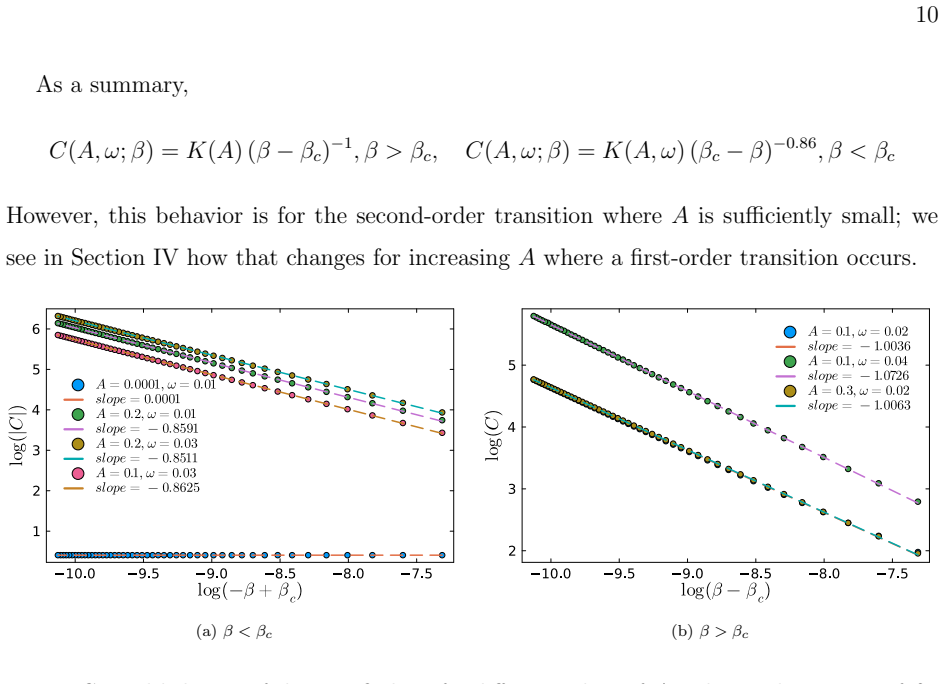
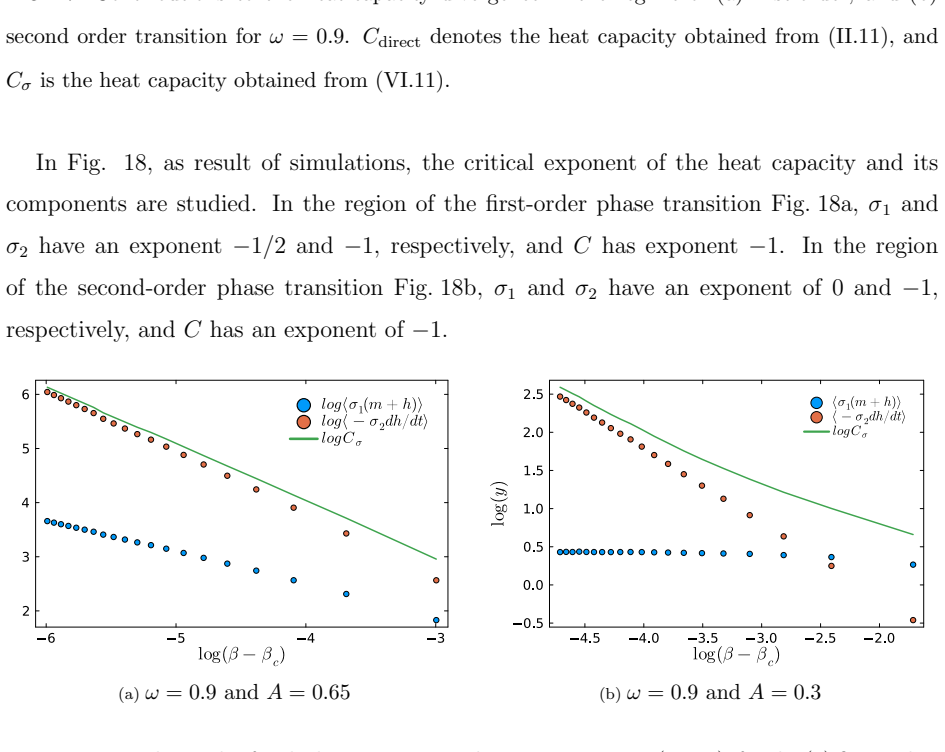
The nonequilibrium specific heat of the driven Curie-Weiss model diverges at the same critical inverse temperature β_c that marks the divergence of the DC susceptibility; the new Curie point decreases with driving amplitude, the critical exponents are α = 1 for β ↓ β_c and α ≈ 0.86 for β ↑ β_c, and a regime of stable ferromagnetic-paramagnetic coexistence appears for large enough drive amplitude and frequency at low temperature.
Load-bearing premise
All results rest on the assumption that the macroscopic magnetization obeys the closed ordinary differential equation dm/dt = tanh[β(m + h(t))] - m with a constant attempt rate, and that this mean-field rate choice remains valid under periodic driving.
Editorial extensions
If this is right
- The Curie temperature of a driven mean-field magnet is a decreasing function of drive amplitude and can be read off from either heat capacity or susceptibility.
- A first-order dynamical transition with a finite coexistence window of ferro and para phases appears for large A and ω at low T.
- The divergence of specific heat is carried by the dissipative response term that vanishes in the static (equilibrium) limit, so the singularity is genuinely nonequilibrium.
- Floquet marginal stability supplies a practical diagnostic for locating dynamical critical points in other periodically driven mean-field models.
Reading between the lines
- The same Floquet criterion may locate analogous heat-capacity divergences in other Model-A systems under periodic drive, including lattice gases with local detailed balance.
- Because the specific-heat singularity is absent in equilibrium, AC-calorimetry becomes a sharper experimental probe of dynamical phase transitions than susceptibility alone.
- The essential critical point at (A = 1, T = 0) suggests that low-temperature switching dynamics under strong drive may be chaotic rather than periodic, inviting further dynamical-systems analysis.
Editorial analysis
A structured set of objections, weighed in public.
Referee Report
Summary. The paper completes the phase diagram of the mean-field Curie–Weiss magnet driven by a time-periodic field h(t)=A cos(ωt). Using the closed ODE dm/dt=tanh[β(m+h(t))]-m, it shows that the nonequilibrium specific heat C (defined via AC calorimetry) and the DC susceptibility χ diverge at the same dynamical critical inverse temperature β_c(A,ω)<1. For small driving the transition is second-order with fitted exponents α=1 (β↓β_c) and α≃ 0.86 (β↑β_c); for larger A a first-order regime appears together with a region of stable ferro–para coexistence. Floquet multipliers of the linearized periodic orbit control both the stability boundaries and the poles of C and χ, establishing that the criticality is dynamical.
Significance. If the results hold, the work supplies a clean, analytically tractable mean-field example in which nonequilibrium calorimetry reveals a divergent specific heat that is absent in equilibrium, together with a genuine coexistence of stable ferromagnetic and paramagnetic periodic orbits. The Floquet analysis (Secs. V–VII) and the high-T/low-T expansions of χ (Appendix A) give a transparent link between critical slowing-down and the observed divergences. These features are of clear interest for the statistical mechanics of driven systems and for the broader program of nonequilibrium thermodynamics.
major comments (2)
- The claim α≃ 0.86 for β↑β_c (abstract and Sec. III, Fig. 3a) rests on a purely numerical linear fit of log|C| versus log(β_c-β) without reported uncertainties, fit ranges, or finite-time checks. Because the same Floquet factor μ o1 that produces the exact α=1 pole on the ferromagnetic side also governs the approach from below, an analytic or at least systematically controlled numerical determination of the subcritical exponent is needed before the asymmetric value can be regarded as established.
- Equation (III.2) is introduced as an “unexpectedly accurate guess” that is then used to extract the shift β_c=1+A^{2}/(2ω^{2}). While the high-T formula (III.1) is derived in Appendix A, the intermediate expression (III.2) is not. Either a controlled derivation or a clear statement that the formula is only phenomenological should be supplied, since the subsequent analytic estimate of β_c relies on it.
minor comments (4)
- The constant attempt frequency ν=1 is fixed without discussion of possible m-dependence (mentioned only in passing in Sec. II.A). A short remark on the robustness of the phase diagram under other Glauber-type rates would strengthen the presentation.
- Several figures (e.g., Figs. 1, 2, 10–13) lack error bars or statements of numerical resolution; adding them would help the reader assess the quality of the reported divergences and coexistence boundaries.
- Typographical slips: “ferromagentic” (p. 3), “sustainability” for susceptibility (Fig. 7 caption), and inconsistent spacing around β_c throughout.
- The relation of the present Floquet analysis to earlier mean-field treatments of the dynamic phase transition (Refs. [6,7]) could be stated more explicitly in the introduction.
Circularity Check
Only minor residual circularity in a heuristic high-T scaling guess for eta_c; main claims (shared divergence of C and \chi, Floquet coexistence) follow independently from the ODE and multiplier o1.
-
fitted input called prediction
[§III, Eqs. (III.1)–(III.5) and surrounding text; also App. A]
"By scaling that high-temperature formula to fit the critical point, we suggest that near-criticality χ^{-1}≈b/2 + A^{2}/4/(ω^{2}+(b/2)^{2}). We do not have a precise derivation of (III.2), but our guess is unexpectedly accurate… Consequently, we obtain b=-A^{2}/(2ω^{2}), which yields eta_c=1+A^{2}/(2ω^{2})."
The high-T expansion (A.11) is exact for eta≪1. The authors then arbitrarily rescale its coefficients so that the same functional form vanishes at the already-known numerical critical point, producing (III.2). The resulting algebraic condition for vanishing denominator is therefore forced by the fit and is re-labeled a prediction of eta_c. The step is acknowledged as a guess and is not used for the Floquet or specific-heat analysis, so it remains minor.
full rationale
The load-bearing chain is the closed mean-field ODE (II.3), its linearization a(t) or J(t), and the Floquet multiplier ho=exp(∫ a dt). Stability boundaries, poles of σ_{1}/σ_{2} that control C (VI.7–VI.11), and the pole of χ (VII.2) all reduce to the same condition ho o1; this is a genuine derivation, not a redefinition. Numerical extraction of C via the AC-calorimetry integral (II.11) and of χ via period averages simply solves the same ODE; the protocol is taken from prior Maes-group papers but does not enter the dynamical equations or force the observed coincidence of divergences. The sole soft spot is the undervived near-critical guess (III.2) obtained by rescaling the rigorously derived high-T formula (III.1/A.11) “to fit the critical point,” then used to “predict” eta_c=1+A^{2}/(2ω^{2}). That step is a fitted-input-called-prediction of limited scope (small A,ω only) and is explicitly labeled a guess; it is not required for the phase diagram, the α exponents, or the coexistence region. No uniqueness theorems, ansatz smuggling, or self-citation chains prop up the central results. Score 2 reflects only that isolated heuristic.
Assumptions & free parameters
assumptions (3)
- domain assumption In the N→∞ limit the magnetization obeys the closed ODE dm/dt + m = tanh[β(m + A cos(ωt))] (Eq. II.3 with ν=1).
- domain assumption Nonequilibrium specific heat is the out-of-phase component of excess power under a slow temperature modulation (Eq. II.11).
- standard math Linear stability of a τ-periodic orbit is decided by the Floquet multiplier μ=exp(∫a(t)dt) (Eq. V.2).
Cite this review
Pith. "Pith review of Critical behavior of the driven Curie-Weiss model." pith.science (2026). https://pith.science/paper/KH4VNUBO
@misc{pith2026260705130,
  author       = {Pith},
  title        = {Pith review of: Critical behavior of the driven Curie-Weiss model},
  year         = {2026},
  howpublished = {\url{https://pith.science/paper/KH4VNUBO}},
  note         = {Machine review of arXiv:2607.05130}
}
abstract
We complete the phase diagram of the macroscopic Curie-Weiss magnet in a time-periodic external field, as a function of temperature and driving parameters. There is a regime (large enough driving amplitude and frequency, at low temperatures) where stable paramagnetic and ferromagnetic phases coexist. In particular, we present a new detailed analysis of the (nonequilibrium) specific heat, diverging at the same critical inverse temperature $\beta_c$ as the magnetic susceptibility. The new Curie temperature decreases with the driving, and we find critical exponent $\alpha=1$ for $\beta\downarrow \beta_c$, and $\alpha\simeq 0.86$ for $\beta\uparrow \beta_c$, even for small driving. A Floquet analysis shows the nature of the criticality, which is dynamical, with implications that remain unseen and are mostly impossible when the system is in thermal equilibrium.
Figures


Figures from the paper (15 more)


Forward citations
Cited by 1 Pith paper
-
Dynamic scaling behavior in the presence of a periodic magnetic driving across Ising continuous transitions
A 2D Ising system driven by a periodic magnetic field at its critical point obeys universal dynamic scaling with variables tau = t/P and sigma = A P^kappa.
Reference graph
Works this paper leans on
-
[1]
essential
(although theirω= 0.897). (a) (b) FIG. 10:Phase diagram of the driven Curie–Weiss model forω= 0.9. (a) The diagram is obtained using ferromagnetic initial conditionsm 0 = 1. For smallAthe transition appears continuous (second order), while for largeAit is discontinuous (first order). (b) The coexistence region is revealed by comparing the long-time averag...
-
[2]
J. Krug. Boundary-induced phase transitions in driven diffusive systems.Phys. Rev. Lett., 67(14):1882–1885, 1991
1991
-
[3]
T. M. Liggett.Interacting Particle Systems. Springer-Verlag, New York, 1985
1985
-
[4]
G. M. Sch¨ utz. Exactly solvable models for many-body systems far from equilibrium. In Cyril Domb and Joel L. Lebowitz, editors,Phase Transitions and Critical Phenomena, volume 19, pages 1–251. Academic Press, San Diego, 2001
2001
-
[5]
Schmittmann and R
B. Schmittmann and R. K. P. Zia.Statistical Mechanics of Driven Diffusive Systems, vol- ume 17 ofPhase Transitions and Critical Phenomena. Academic Press, London, 1995
1995
-
[6]
B. K. Chakrabarti and M. Acharyya. Dynamic transitions and hysteresis.Rev. Mod. Phys., 71:847–859, 1999
1999
-
[7]
R. A. Gallardo, Olatz Idigoras, P. Landeros, and A. Berger. Analytical derivation of critical exponents of the dynamic phase transition in the mean-field approximation.Phys. Rev. E., 86(5):051101, 2012
2012
-
[8]
Tom´ e and Mario J
T. Tom´ e and Mario J. de Oliveira. Dynamic phase transition in the kinetic Ising model under a time-dependent oscillating field.Phys. Rev. A, 41(8):4251–4254, 1990
1990
Show all 20 references
-
[9]
E. R. Fiori, C. Maes, and R. Vidts. Specific heat of the driven Curie-Weiss model.J. Stat. Phys., 192:63, 2025
2025
-
[10]
Suzuki and R
M. Suzuki and R. Kubo. Dynamics of the Ising model near the critical point.J. Phys. Soc. Jpn., 24(1):51–59, 1968
1968
-
[11]
P. A. Rikvold, H. Tomita, S. Miyashita, and S. W. Sides. Metastable lifetimes in a kinetic Ising model: Dependence on field and system size.Phys. Rev. E., 49:5080–5090, 1994
1994
-
[12]
D. T. Robb, P. A. Rikvold, A. Berger, and M. A. Novotny. Conjugate field and fluctuation- dissipation relation for the dynamic phase transition in the two-dimensional kinetic Ising model.Phys. Rev. E., 76:021124, 2007
2007
-
[13]
D. T. Robb, Y. H. Xu, O. Hellwig, J. McCord, A. Berger, M. A. Novotny, and P. A. Rikvold. Evidence for a dynamic phase transition in [co/pt] 3 magnetic multilayers.Phys. Rev. B., 78:134422, 2008. 29
2008
-
[14]
Beyen, C
A. Beyen, C. Maes, and I. Maes. Phase Diagram and Specific Heat of a Nonequilibrium Curie–Weiss Model.J. Stat. Phys., 191(5), 2024
2024
-
[15]
Ptaszy´ nski and M
K. Ptaszy´ nski and M. Esposito. Critical heat current fluctuations in curie-weiss model in and out of equilibrium.Phys. Rev. E., 111(3), March 2025
2025
-
[16]
R. J. Glauber. Time-dependent statistics of the Ising model.J. Math. Phys., 4(2):294–307, 1963
1963
-
[17]
Maes and K
C. Maes and K. Netoˇ cn´ y. Nonequilibrium calorimetry.J. Stat. Mech.: Theory and Experiment, 2019(11):114004, 2019
2019
-
[18]
Khodabandehlou, C
F. Khodabandehlou, C. Maes, I. Maes, and K. Netoˇ cn´ y. The vanishing of excess heat for nonequilibrium processes reaching zero ambient temperature.Ann. H. Poincar´ e, 2023
2023
-
[19]
Khodabandehlou, C
F. Khodabandehlou, C. Maes, and K. Netoˇ cn´ y. A Nernst heat theorem for nonequilibrium jump processes.J. Chem. Phys., 158(20), 2023
2023
-
[20]
Chicone.Ordinary Differential Equations with Applications, volume 34 ofTexts in Applied Mathematics
C. Chicone.Ordinary Differential Equations with Applications, volume 34 ofTexts in Applied Mathematics. Springer, New York, 2 edition, 2006. 30 Appendix A: Proof of susceptibility criticality at small driving We start with the asymptotic form of the DC-susceptibility in the hi...
2006
Reviewed July 11, 2026 · model on record in the stance chip above.
Discussion (0). Continue with ORCID to comment.