REVIEW 3 major objections 6 minor 3 cited by
Direct evidence for r-process nucleosynthesis in delayed MeV emission from the SGR 1806-20 magnetar giant flare
T0 review · 3 major / 6 minor · reviewed 2026-08-10 · deepseek-v4-flash
Pith's one-line read The delayed MeV glow after the SGR 1806-20 giant flare is the radioactive signature of freshly made r-process nuclei, making magnetar giant flares a confirmed r-process site.
desk verdict A genuinely new and plausible identification of the 2004 SGR 1806-20 delayed MeV component as r-process decay emission, but the "direct evidence" claim outstrips what the light-curve fit and an unattenuated spectral comparison can support. read the letter →
The pith
A machine-rendered reading of the paper's core claim, the machinery that carries it, and where it could break.
The reading
What carries the argument
The mechanism is the radioactive decay chain of freshly synthesized r-process nuclei. Each $\beta$-decaying species emits a set of nuclear gamma-ray lines, and the high ejecta velocities $v \gtrsim 0.1c$ Doppler-broaden the lines into a quasi-continuous spectrum peaking near 1 MeV, so the discrete atomic carriers are hidden but their collective decay power is not. The gamma-ray luminosity follows $\dot{Q}_\gamma = M_r \epsilon_\gamma \dot{q}_r(t)$ with $\dot{q}_r(t) \approx 5\times10^{12}\,(t/10^3\,\mathrm{s})^{-1.2}\,\mathrm{erg\,s^{-1}\,g^{-1}}$, and the ejecta become transparent on a timescale $t_{\rm peak}\sim10^3\,\mathrm{s}$ set by the opacity, mass, and velocity. The r-process itself operates through the $\alpha$-rich freeze-out mechanism, which allows neutron capture to build heavy nuclei even at the moderate electron fraction $Y_e\approx0.4$ expected in ejected neutron-star crust.
What would settle it
Observe the next Galactic giant flare with a MeV spectrometer such as COSI: the model predicts Doppler-broadened line bumps from identified isotopes (for example $^{89}$Rb lines near 658, 1032, and 1248 keV and $^{92}$Sr near 1384 keV) appearing around $10^3$–$10^4$ seconds and decaying as $t^{-1.2}$. If those features are absent while the continuum matches, the r-process interpretation is ruled out. A targeted reanalysis of archival SGR 1900+14 1998 flare data, looking for a delayed MeV component without pulsations, would provide a second, independent test.
Extended reading notes
Core claim
The central claim is that the delayed MeV emission component detected by INTEGRAL, Konus-WIND, and RHESSI in the aftermath of the SGR 1806-20 giant flare—rising to a broad peak near 600–800 seconds and then decaying roughly as $t^{-1.2}$—is gamma-ray line emission from freshly synthesized radioactive r-process nuclei expelled during the flare. Using an ejecta model with mass $\sim 1.2\times10^{-6}\,M_\odot$, r-process mass $\sim 7\times10^{-7}\,M_\odot$, minimum velocity $0.15c$, covering fraction $3/4$, and electron fraction $Y_e = 0.40$, the paper reproduces the light curve, the total fluence of about $9\times10^{-4}\,\mathrm{erg\,cm^{-2}}$, and the hard spectrum peaking near 1 MeV. It concludes that this is direct observational evidence for the synthesis of $\sim 10^{-6}\,M_\odot$ of r-process elements and that magnetar giant flares are confirmed r-process sites.
Load-bearing premise
The identification rests on the assumption that the giant flare really ejected about a millionth of a solar mass of neutron-star crust at speeds near a tenth of the speed of light with an electron fraction near 0.4; the ejection mechanism is complex, not directly observed, and still under active investigation.
Editorial extensions
If this is right
- Magnetar giant flares join neutron star mergers as directly confirmed r-process sites, contributing at least about 1–10% of the Galactic r-process inventory.
- Because magnetars form promptly with star formation, their flares can enrich very metal-poor stars and help explain the early iron/r-process correlation in the Galactic halo.
- The same ejecta, when shocked by the surrounding medium, can accelerate r-process nuclei to cosmic-ray energies, making magnetars potentially major sources of heavy cosmic rays.
- The predicted Doppler-broadened decay lines give a concrete spectral target for COSI and next-generation MeV telescopes during the next Galactic giant flare.
- The model predicts a kilonova-like optical/UV transient, a 'nova brevis' peaking at about magnitude 4 roughly 15 minutes after the flare, from the same ejecta.
Reading between the lines
- If the interpretation is right, the 1998 giant flare from SGR 1900+14 should have produced a similar delayed MeV component; a modern reanalysis of archival Konus-WIND data might recover it despite the high solar background at that time.
- Resolving individual lines in a future flare would test the predicted abundance pattern (first-peak nuclei around $A\sim90$ dominating the MeV output); absence of the predicted bumps would falsify the r-process identification even if the continuum matched.
- The 1–10% Galactic contribution is a lower bound: if less energetic flares eject comparable r-process mass, magnetars could be a substantially larger share of the Galactic r-process budget than the fiducial estimate.
Signed reviews
Editorial analysis
A structured set of objections, weighed in public.
Referee Report
Summary. This paper proposes that the previously unexplained delayed MeV emission observed after the 2004 giant flare of SGR 1806-20 (Mereghetti et al. 2005; Frederiks et al. 2007; Boggs et al. 2007) is the gamma-ray signature of ~10^-6 solar masses of freshly synthesized r-process nuclei ejected from the neutron star crust during the flare. The authors construct a power-law velocity-distribution ejecta model (Eq. 1), derive analytic scalings for the gamma-ray photosphere time (Eq. 4), the radioactive heating rate (Eq. 5), the decay luminosity (Eq. 6), and the fluence (Eq. 8), and augment these with a multizone SkyNet nucleosynthesis calculation and approximate gamma-ray transport following Hotokezaka et al. (2016). They report a new analysis of INTEGRAL SPI-ACS data (Appendix A) yielding a post-peak decay index delta = 1.2 +/- 0.1 that matches the r-process heating index, and they compare their fiducial model (Mej ~ 1.2e-6 solar masses, vbar = 0.15c, Ye = 0.40) with the observed light curve, total fluence ~ 9e-4 erg/cm^2, and the RHESSI spectrum parameterized as kBT ~ 1.9 MeV bremsstrahlung. On this basis they conclude that magnetar giant flares are a second confirmed r-process site and discuss implications for Galactic chemical evolution, r-process cosmic rays, and future MeV observatories such as COSI, together with a falsifiable 'nova brevis' optical counterpart prediction.
Significance. If the identification is correct, this is a landmark result: magnetar giant flares would become the second directly confirmed r-process site, with short delay relative to star formation, an estimated 1-10% contribution to the Galactic r-process inventory, and a novel source of r-process cosmic rays. The paper ships concrete assets: transparent analytic scalings (Eqs. 4-8) that expose the parameter dependencies; a genuinely new, model-independent archival measurement (the SPI-ACS decay index, Appendix A); detailed line-level spectra built from the JINA REACLIB and ENSDF nuclear data via SkyNet; and several falsifiable predictions (nova brevis with m_AB ~ 4 at 15 minutes; COSI detectability of line bumps from the next Galactic giant flare; late hard-X-ray emission for NuSTAR-like instruments). The authors are commendably explicit about the principal assumption (Sec. 2.1: the C24 ejection mechanism 'remains under active investigation') and about the difficulty of excluding non-thermal alternatives (Sec. 3.4).
major comments (3)
- [Sec. 2.2, Fig. 3] The spectral comparison in Fig. 3 is not, as presented, a valid test of the r-process identification. The synthetic spectra are computed 'accounting for Doppler broadening due to the ejecta expansion but excluding extinction effects' (Fig. 3 caption; Sec. 2.2), whereas the RHESSI measurement used for comparison (Boggs et al. 2007) was accumulated over t = 400-900 s (Appendix A), i.e., during the rising phase at or before the model's gamma-ray photosphere time t_peak ~ 10^3 s (Eq. 4). At that epoch the bulk of the ejecta (which for beta = 6 is concentrated in low-velocity layers) still has tau_gamma > 1, so the escaping radiation is not the intrinsic total line forest shown in the figure: attenuation preferentially suppresses the narrow components from the inner layers, the visible fast outer layers have a different nucleosynthesis history than the bulk, and inelastic Compton scattering down-scatters MeV photons, the last effect being conceded in Sec. 2.2 but not applied to the plotted spectra. Because the r-process specificity of the claim (as opposed to generic radioactive decay of neutron-rich ejecta) rests on the predicted spectral character (Table 1), the authors should compare the RHESSI data with emergent spectra computed using the same per-layer attenuation employed for the light curve (Hotokezaka et al. 2016), or show quantitatively that attenuation leaves the qualitative match intact. As it stands, the abstract's claim that the spectrum 'matches' is not supported by the evidence shown.
- [Sec. 2.1, Eqs. (4)-(8); Sec. 3.1; Appendix A] The inferred r-process mass and the Galactic-yield estimates built upon it are calibration outcomes, not independent predictions, and the paper should say so. Since the fluence scales as F_gamma proportional to Mr (Eq. 8), the statement that the data reveal 'the synthesis of ~10^-6 M_sun of r-process elements' (Abstract) is essentially the measured fluence re-expressed once the r-process interpretation, the heating-rate normalization (Eqs. 5-6), the distance (8.7 +/- 1.5 kpc), and the integration window out to 10 t_peak are assumed; the peak time constrains only the combination (Mej/f_Omega)/vbar^2 (Eq. 4). Independent support for the fiducial Mej ~ 1.2e-6 M_sun is weak: the radio-afterglow modeling quoted in Sec. 1 spans 10^24.5-10^27 g, and Appendix C shows that Mej = 10^-8 M_sun would fail by orders of magnitude while remaining consistent with the radio constraints. The strongest non-circular evidence is the post-peak decay index delta = 1.2 +/- 0.1 measured from archival SPI-ACS data (Appendix A), which is independent of the model normalization and agrees with the r-process heating index alpha ~ 1.2; I recommend that the Abstract and Sec. 4 present this as the primary evidence and label Mej, vbar, f_Omega, Ye, and Mr as fitted parameters. In addition, the fluence normalization itself is derived by scaling the RHESSI fluence by SPI-ACS count ratios with acknowledged comparable statistical and systematic errors (Appendix A); these uncertainties, together with the distance error, should be propagated into the 1-10% Galactic-r-process contribution quoted in Sec. 3.1.
- [Sec. 4 (Summary) and Sec. 2.1] The robustness claim in the Summary, that the r-process interpretation 'is likely to remain robust' to improved understanding of the ejection mechanism because a mass greater than about 10^-7 to 10^-6 M_sun must be excavated from neutron-rich depths, is not established by the material in the paper. The mass requirement is itself derived from the observed fluence under the r-process interpretation (Eqs. 6-8), so it cannot independently vouch for that interpretation. Moreover, the nucleosynthesis outcome is not guaranteed by crustal composition alone: the r-process in these ejecta operates via alpha-rich freeze-out at Ye = 0.40, which requires specific entropy and expansion conditions (Sec. 1; Patel et al. 2025), and Appendix C shows that the synthesized mass fraction and the late-time decay slope both vary with Ye. Since Sec. 2.1 states that the ejection process 'remains under active investigation', the abstract's 'confirmed r-process sites' is premature. The correct claim at present is that the delayed MeV emission is consistent with r-process decay for a plausible but non-unique set of ejecta parameters, with the temporal decay index providing the strongest quantitative support; confirmation would come from the paper's own falsifiable predictions (COSI line bumps; nova brevis at m_AB ~ 4).
minor comments (6)
- [Abstract vs. Sec. 1] The arXiv abstract block cites 'Patel et al. (in prep.)' while the manuscript text and references cite Patel et al. (2025) (arXiv:2501.17253); make the citation consistent and verify that the companion paper is publicly available.
- [Appendix A and Appendix B] There are typos in the stated integration ranges: 't0 + 120000 s' should read 't0 + 12000 s' in two places, and 'tot0 + 14000 s' is missing a space.
- [References] The reference list contains two separate entries for Boggs et al. (2007) that are the same paper; merge them into one.
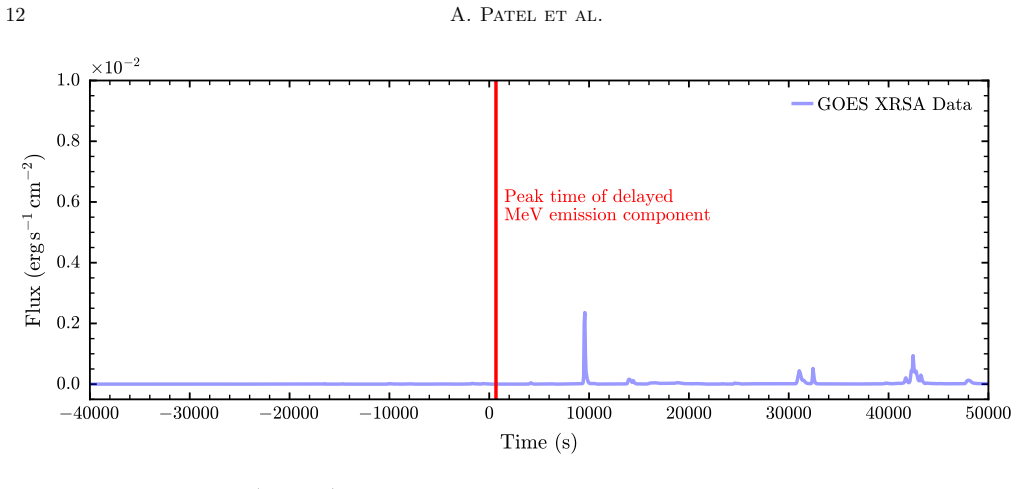
- [Sec. 1 and Fig. 2] The text states that the delayed component decays below the background level at t greater than about 3000-8000 s, whereas Fig. 2 and Appendix A use data out to 12000 s; harmonize the quoted decay-end times.
- [Eqs. (5)-(6)] Please report the numerical heating-rate normalization actually used in the analytic estimates; the text states that qdot_r is 'normalized based on our nucleosynthesis calculations' (Sec. 2.1) but does not give the resulting constant, so Eqs. (6)-(8) are not fully reproducible.
- [Appendix A, Fig. 4] The new decay index delta = 1.2 +/- 0.1 differs from the value delta = 0.85 quoted in Mereghetti et al. (2005), with the difference attributed to the fit window; showing the residuals of the power-law fit and the sensitivity of delta to the chosen start time (675 s) and background model would strengthen the comparison with alpha ~ 1.2.
Circularity Check
The inferred r-process mass and fluence are fitted to the observed MeV signal via Eq. (8), so the headline yield is a normalization rather than an independent prediction.
-
fitted input called prediction
[Sec. 2.1 after Eq. (8); see also Sec. 2.2 parameter choice]
"For Mej ≈ Mr ≈ 10−6M⊙, ¯v ≈ 0.1–0.2c and κγ ≈ 0.1 cm2g−1, we thus predict a light-curve peak time ∼ tpeak around 1000 s (Eq. (4)) with a total gamma-ray fluence Fγ ≈ 8 × 10⁻⁴ erg cm−2. Both are in broad agreement with those measured for the delayed MeV emission from SGR 1806-20 ... These dependencies illustrate the main degeneracies that exist in fitting the observed signal and instill confidence in our finding that ∼ 10−6M⊙ of r-process production occurred from the SGR 1806-20 giant flare."
Eq. (8) gives Fγ ≈ 8×10⁻⁴ erg cm−2 × (Mr/10−6 M⊙) × (t_peak/10^3 s)^−0.2, so the predicted fluence is directly proportional to the assumed r-process mass Mr. The observed delayed fluence is ~9×10⁻⁴ erg cm−2, and the model parameters (Mej ≈ 1.2×10⁻⁶ M⊙, Mr ≈ 7×10⁻⁷ M⊙, ¯v = 0.15c, fΩ = 0.75) are chosen so that Eq. (4) places t_peak near 10^3 s and Eq. (8) reproduces the measured fluence. The paper itself says these parameters 'provide an adequate fit to the gamma-ray light-curve (Fig. 2)' and refers to 'degeneracies that exist in fitting the observed signal.' Thus the headline claim of direct evidence for ~10−6 M⊙ of r-process material is a fit to the fluence by construction, not a prediction, though the spectral shape and decay index retain independent content.
full rationale
The central identification is tested against an external dataset (the previously unexplained delayed MeV component), so it is not circular by construction. However, the paper's strongest quantitative claim—the inferred r-process mass of ~10−6 M⊙—is obtained by matching the observed fluence through Eq. (8), in which Fγ ∝ Mr, and by choosing Mej/fΩ and ¯v to put t_peak near the observed rise time via Eq. (4). The paper explicitly acknowledges fitting the observed signal, so the fluence and mass yield are normalizations rather than independent predictions. The decay index and the ~1 MeV spectral peak are genuine model outputs, although the spectral comparison in Fig. 3 is made without attenuation at an epoch where the model's own transport treatment says extinction matters, which weakens but does not circularize that check. Self-citations to Cehula et al. (2024) and Patel et al. (2025) are load-bearing, but those prior calculations are independent of the SGR 1806-20 MeV data and rest on separate hydrodynamical and nucleosynthesis simulations, so they are not counted as circularity under the stated rules. Overall, one central prediction reduces to a fit, giving partial circularity.
Assumptions & free parameters
free parameters (6)
- Mej (ejecta mass) =
1.2e-6 solar masses (fiducial)
- vbar (characteristic ejecta velocity) =
0.15c (fiducial)
- beta (velocity distribution power-law index) =
6 (fiducial)
- f_Omega (covering fraction) =
0.75 (fiducial)
- Ye (initial electron fraction) =
0.40 (fiducial)
- Mr (r-process mass) =
7e-7 solar masses (fiducial)
assumptions (5)
- domain assumption Ejecta expands homologously following a power-law density profile (Eq. 1).
- domain assumption Gamma-ray opacity is constant at kappa_gamma = 0.1 cm2/g for photons near 0.1-1 MeV.
- standard math Radioactive heating rate follows qdot_r ~ 5e12 (t/1e3 s)^-1.2 erg/s/g (Eq. 5).
- domain assumption The delayed MeV emission is associated with SGR 1806-20 and is not solar or instrumental in origin.
- ad hoc to paper The baryon ejection mechanism of C24 operates as modeled.
Cite this review
Pith. "Pith review of Direct evidence for r-process nucleosynthesis in delayed MeV emission from the SGR 1806-20 magnetar giant flare." pith.science (2026). https://pith.science/paper/KH7WR3T3
@misc{pith2026250109181,
  author       = {Pith},
  title        = {Pith review of: Direct evidence for r-process nucleosynthesis in delayed MeV emission from the SGR 1806-20 magnetar giant flare},
  year         = {2026},
  howpublished = {\url{https://pith.science/paper/KH7WR3T3}},
  note         = {Machine review of arXiv:2501.09181}
}
abstract
The origin of heavy elements synthesized through the rapid neutron capture process ($r$-process) has been an enduring mystery for over half a century. Cehula et al. (2024) recently showed that magnetar giant flares, among the brightest transients ever observed, can shock-heat and eject neutron star crustal material at high velocity, achieving the requisite conditions for an $r$-process. Patel et al. (in prep.) confirmed an $r$-process in these ejecta using detailed nucleosynthesis calculations. Radioactive decay of the freshly synthesized nuclei releases a forest of gamma-ray lines, Doppler broadened by the high ejecta velocities $v \gtrsim 0.1c$ into a quasi-continuous spectrum peaking around 1 MeV. Here, we show that the predicted emission properties (light-curve, fluence, and spectrum) match a previously unexplained hard gamma-ray signal seen in the aftermath of the famous December 2004 giant flare from the magnetar SGR 1806-20. This MeV emission component, rising to peak around 10 minutes after the initial spike before decaying away over the next few hours, is direct observational evidence for the synthesis of $\sim 10^{-6}M_{\odot}$ of $r$-process elements. The discovery of magnetar giant flares as confirmed $r$-process sites, contributing at least $\sim 1$-$10\%$ of the total Galactic abundances, has implications for the Galactic chemical evolution, especially at the earliest epochs probed by low-metallicity stars. It also implicates magnetars as potentially dominant sources of heavy cosmic rays. Characterization of the $r$-process emission from giant flares by resolving decay line features offers a compelling science case for NASA's forthcoming COSI nuclear spectrometer, as well as next-generation MeV telescope missions.
Figures


Figures from the paper (4 more)



Forward citations
Cited by 3 Pith papers
-
Heavy element nucleosynthesis in rotating proto-magnetar winds
Magnetar winds with magnetic fields as low as 5e14 G are shown in post-processed MHD simulations to produce r-process elements up to and beyond the third peak.
-
Mixing neutron star material into the jets in the common envelope jets supernova r-process scenario
In the CEJSN scenario, the accretion disk can entrain up to ~0.01-0.03 M_sun of neutron star crust material via Kelvin-Helmholtz mixing, enhancing the r-process yield.
-
Reconstructing Critical Current Density in Josephson Junctions with Phase Non-linearity
The standard Dynes-Fulton reconstruction of critical current density breaks down for junctions with nonlinear phase distributions, and the authors propose an iterative algorithm that incorporates prior knowledge to fix it.
Reference graph
Works this paper leans on
-
[1]
Aramaki, T., Adrian, P. O. H., Karagiorgi, G., & Odaka, H. 2020, Astroparticle Physics, 114, 107, doi: 10.1016/j.astropartphys.2019.07.002
-
[2]
2011, ApJ, 731, 5, doi: 10.1088/0004-637X/731/1/5
Arcones, A., & Montes, F. 2011, ApJ, 731, 5, doi: 10.1088/0004-637X/731/1/5
-
[3]
1993, ApJ, 413, 281, doi: 10.1086/172995
Band, D., Matteson, J., Ford, L., et al. 1993, ApJ, 413, 281, doi: 10.1086/172995
doi:10.1086/172995 1993
-
[4]
2016, ApJ, 829, 110, doi: 10.3847/0004-637X/829/2/110
Barnes, J., Kasen, D., Wu, M.-R., & Mart ´ ınez-Pinedo, G. 2016, ApJ, 829, 110, doi: 10.3847/0004-637X/829/2/110
-
[5]
Barnes, J., Zhu, Y. L., Lund, K. A., et al. 2021, ApJ, 918, 44, doi: 10.3847/1538-4357/ac0aec
-
[6]
Beloborodov, A. M. 2013, ApJ, 762, 13, doi: 10.1088/0004-637X/762/1/13
-
[7]
2019, MNRAS, 487, 1426, doi: 10.1093/mnras/stz1391
Kouveliotou, C. 2019, MNRAS, 487, 1426, doi: 10.1093/mnras/stz1391
-
[8]
2024, ApJ, 966, 17, doi: 10.3847/1538-4357/ad32cd
Beniamini, P., & Piran, T. 2024, ApJ, 966, 17, doi: 10.3847/1538-4357/ad32cd
Show all 92 references
-
[9]
Beniamini, P., Wadiasingh, Z., & Metzger, B. D. 2020, MNRAS, 496, 3390, doi: 10.1093/mnras/staa1783
2020 doi
- [10]
-
[11]
2013, ApJL, 774, L23, doi: 10.1088/2041-8205/774/2/L23
Berger, E., Fong, W., & Chornock, R. 2013, ApJL, 774, L23, doi: 10.1088/2041-8205/774/2/L23
2013 doi
-
[12]
L., Crowther, P
Bibby, J. L., Crowther, P. A., Furness, J. P., & Clark, J. S. 2008, MNRAS, 386, L23, doi: 10.1111/j.1745-3933.2008.00453.x
2008
-
[13]
E., Zoglauer, A., Bellm, E., et al
Boggs, S. E., Zoglauer, A., Bellm, E., et al. 2007, The Astrophysical Journal, 661, 458
2007
-
[14]
E., Zoglauer, A., Bellm, E., et al
Boggs, S. E., Zoglauer, A., Bellm, E., et al. 2007, ApJ, 661, 458, doi: 10.1086/516732
2007 doi
-
[15]
M., Burbidge, G
Burbidge, E. M., Burbidge, G. R., Fowler, W. A., & Hoyle, F. 1957, Reviews of Modern Physics, 29, 547, doi: 10.1103/RevModPhys.29.547
1957 doi
-
[16]
2021, ApJL, 907, L28, doi: 10.3847/2041-8213/abd8c8
Burns, E., Svinkin, D., Hurley, K., et al. 2021, ApJL, 907, L28, doi: 10.3847/2041-8213/abd8c8
2021 doi
-
[17]
2023, arXiv preprint arXiv:2308.04485
Burns, E., Coughlin, M., Ackley, K., et al. 2023, arXiv preprint arXiv:2308.04485
2023 arXiv
-
[18]
Cameron, A. G. W. 1957, AJ, 62, 9, doi: 10.1086/107435
1957 doi
-
[19]
B., Chandra, P., Ray, A., et al
Cameron, P. B., Chandra, P., Ray, A., et al. 2005, Nature, 434, 1112, doi: 10.1038/nature03605
2005 doi
-
[20]
A., & Metzger, B
Cehula, J., Thompson, T. A., & Metzger, B. D. 2024, MNRAS, 528, 5323, doi: 10.1093/mnras/stae358
2024 doi
-
[21]
2024, ApJ, 971, 143, doi: 10.3847/1538-4357/ad65ec evidence for r -process nucleosynthesis in the SGR 1806-20 magnetar giant flare 15
Chen, M.-H., Li, L.-X., & Liang, E.-W. 2024, ApJ, 971, 143, doi: 10.3847/1538-4357/ad65ec evidence for r -process nucleosynthesis in the SGR 1806-20 magnetar giant flare 15
2024 doi
-
[22]
2021, ApJ, 919, 59, doi: 10.3847/1538-4357/ac1267 Cˆ ot´ e, B., Eichler, M., Arcones, A., et al
Chen, M.-H., Li, L.-X., Lin, D.-B., & Liang, E.-W. 2021, ApJ, 919, 59, doi: 10.3847/1538-4357/ac1267 Cˆ ot´ e, B., Eichler, M., Arcones, A., et al. 2019, ApJ, 875, 106, doi: 10.3847/1538-4357/ab10db
2021 doi
-
[23]
A., Foley, R
Coulter, D. A., Foley, R. J., Kilpatrick, C. D., et al. 2017, Science, 358, 1556, doi: 10.1126/science.aap9811
2017 doi
-
[24]
H., Amthor, A
Cyburt, R. H., Amthor, A. M., Ferguson, R., et al. 2010, ApJS, 189, 240, doi: 10.1088/0067-0049/189/1/240
2010 doi
-
[25]
2023, MNRAS, 518, 810, doi: 10.1093/mnras/stac3120
Demidov, I., & Lyubarsky, Y. 2023, MNRAS, 518, 810, doi: 10.1093/mnras/stac3120
2023 doi
- [26]
-
[27]
Eichler, D., Livio, M., Piran, T., & Schramm, D. N. 1989, Nature, 340, 126, doi: 10.1038/340126a0
1989 doi
-
[28]
D., Klebesadel, R
Evans, W. D., Klebesadel, R. W., Laros, J. G., et al. 1980, ApJL, 237, L7, doi: 10.1086/183222
1980 doi
-
[29]
A., Kulkarni, S
Frail, D. A., Kulkarni, S. R., & Bloom, J. S. 1999, Nature, 398, 127, doi: 10.1038/18163
1999 doi
-
[30]
D., Golenetskii, S
Frederiks, D. D., Golenetskii, S. V., Palshin, V. D., et al. 2007, Astronomy Letters, 33, 1, doi: 10.1134/S106377370701001X
2007 doi
-
[31]
Gaensler, B. M. 2004, Advances in Space Research, 33, 645, doi: 10.1016/j.asr.2003.04.023
2004 doi
-
[32]
M., Kouveliotou, C., Gelfand, J
Gaensler, B. M., Kouveliotou, C., Gelfand, J. D., et al. 2005, Nature, 434, 1104, doi: 10.1038/nature03498
2005 doi
-
[33]
D., Lyubarsky, Y
Gelfand, J. D., Lyubarsky, Y. E., Eichler, D., et al. 2005, ApJL, 634, L89, doi: 10.1086/498643
2005 doi
-
[34]
B., et al
Granot, J., Ramirez-Ruiz, E., Taylor, G. B., et al. 2006, ApJ, 638, 391, doi: 10.1086/497680
2006 doi
-
[35]
A., Craig, W
Harrison, F. A., Craig, W. W., Christensen, F. E., et al. 2013, ApJ, 770, 103, doi: 10.1088/0004-637X/770/2/103
2013 doi
-
[36]
2005, Solar Physics, 226, 255
Hill, S., Pizzo, V., Balch, C., et al. 2005, Solar Physics, 226, 255
2005
-
[37]
D., Woosley, S
Hoffman, R. D., Woosley, S. E., & Qian, Y.-Z. 1997, ApJ, 482, 951, doi: 10.1086/304181
1997 doi
-
[38]
2018, International Journal of Modern Physics D, 27, 1842005, doi: 10.1142/S0218271818420051
Hotokezaka, K., Beniamini, P., & Piran, T. 2018, International Journal of Modern Physics D, 27, 1842005, doi: 10.1142/S0218271818420051
2018 doi
-
[39]
2022, MNRAS, 515, L89, doi: 10.1093/mnrasl/slac071
Hotokezaka, K., Tanaka, M., Kato, D., & Gaigalas, G. 2022, MNRAS, 515, L89, doi: 10.1093/mnrasl/slac071
2022 doi
-
[40]
2016, MNRAS, 459, 35, doi: 10.1093/mnras/stw404
Hotokezaka, K., Wanajo, S., Tanaka, M., et al. 2016, MNRAS, 459, 35, doi: 10.1093/mnras/stw404
2016 doi
-
[41]
1999, Nature, 397, 41, doi: 10.1038/16199
Hurley, K., Cline, T., Mazets, E., et al. 1999, Nature, 397, 41, doi: 10.1038/16199
1999 doi
-
[42]
E., Smith, D
Hurley, K., Boggs, S. E., Smith, D. M., et al. 2005, Nature, 434, 1098, doi: 10.1038/nature03519
2005 doi
-
[43]
R., et al
Kalogera, V., Kim, C., Lorimer, D. R., et al. 2004, ApJL, 601, L179, doi: 10.1086/382155
2004 doi
-
[44]
2017, Nature, 551, 80, doi: 10.1038/nature24453
Ramirez-Ruiz, E. 2017, Nature, 551, 80, doi: 10.1038/nature24453
2017 doi
-
[45]
M., & Beloborodov, A
Kaspi, V. M., & Beloborodov, A. M. 2017, ARA&A, 55, 261, doi: 10.1146/annurev-astro-081915-023329
2017 doi
-
[46]
2020, The Astrophysical Journal, 903, 63
Knuth, T., & Glesener, L. 2020, The Astrophysical Journal, 903, 63
2020
-
[47]
2017, ApJ, 846, 143, doi: 10.3847/1538-4357/aa86b3
Komiya, Y., & Shigeyama, T. 2017, ApJ, 846, 143, doi: 10.3847/1538-4357/aa86b3
2017 doi
-
[48]
M., Fryer, C
Korobkin, O., Hungerford, A. M., Fryer, C. L., et al. 2020, ApJ, 889, 168, doi: 10.3847/1538-4357/ab64d8
2020 doi
-
[49]
1998, Nature, 393, 235, doi: 10.1038/30410
Kouveliotou, C., Dieters, S., Strohmayer, T., et al. 1998, Nature, 393, 235, doi: 10.1038/30410
1998 doi
-
[50]
M., Mackie, F., Ravenhall, D
Lattimer, J. M., Mackie, F., Ravenhall, D. G., & Schramm, D. N. 1977, ApJ, 213, 225, doi: 10.1086/155148
1977 doi
-
[51]
M., & Schramm, D
Lattimer, J. M., & Schramm, D. N. 1974, ApJL, 192, L145, doi: 10.1086/181612
1974 doi
-
[52]
J., Gompertz, B
Levan, A. J., Gompertz, B. P., Salafia, O. S., et al. 2024, Nature, 626, 737, doi: 10.1038/s41586-023-06759-1
2024 doi
-
[53]
2019, ApJ, 872, 19, doi: 10.3847/1538-4357/aaf961
Li, L.-X. 2019, ApJ, 872, 19, doi: 10.3847/1538-4357/aaf961
2019 doi
-
[54]
1998, Astrophys
Li, L.-X., & Paczy´ nski, B. 1998, Astrophys. J. Lett., 507, L59, doi: 10.1086/311680
1998 doi
-
[55]
D., et al
Lien, A., Sakamoto, T., Barthelmy, S. D., et al. 2016, ApJ, 829, 7, doi: 10.3847/0004-637X/829/1/7
2016 doi
-
[56]
Lippuner, J., & Roberts, L. F. 2017, ApJS, 233, 18, doi: 10.3847/1538-4365/aa94cb
2017 doi
-
[57]
2014, ARA&A, 52, 415, doi: 10.1146/annurev-astro-081811-125615
Madau, P., & Dickinson, M. 2014, ARA&A, 52, 415, doi: 10.1146/annurev-astro-081811-125615
2014 doi
-
[58]
P., Golentskii, S
Mazets, E. P., Golentskii, S. V., Ilinskii, V. N., Aptekar, R. L., & Guryan, I. A. 1979, Nature, 282, 587, doi: 10.1038/282587a0
1979 doi
-
[59]
2005, ApJL, 624, L105, doi: 10.1086/430669
Mereghetti, S., G¨ otz, D., von Kienlin, A., et al. 2005, ApJL, 624, L105, doi: 10.1086/430669
2005 doi
-
[60]
A., & Melatos, A
Mereghetti, S., Pons, J. A., & Melatos, A. 2015, SSRv, 191, 315, doi: 10.1007/s11214-015-0146-y
2015 doi
-
[61]
D., Arcones, A., Quataert, E., & Mart ´ ınez-Pinedo, G
Metzger, B. D., Arcones, A., Quataert, E., & Mart ´ ınez-Pinedo, G. 2010, MNRAS, 402, 2771, doi: 10.1111/j.1365-2966.2009.16107.x
2010
-
[62]
S., Mathews, G
Meyer, B. S., Mathews, G. J., Howard, W. M., Woosley, S. E., & Hoffman, R. D. 1992, ApJ, 399, 656, doi: 10.1086/171957
1992 doi
-
[63]
P., Frebel, A., Naidu, R
Ou, X., Ji, A. P., Frebel, A., Naidu, R. P., & Limberg, G. 2024, ApJ, 974, 232, doi: 10.3847/1538-4357/ad6f9b
2024 doi
-
[64]
M., Barthelmy, S., Gehrels, N., et al
Palmer, D. M., Barthelmy, S., Gehrels, N., et al. 2005, Nature, 434, 1107, doi: 10.1038/nature03525
2005 doi
-
[65]
D., Goldberg, J
Patel, A., Metzger, B. D., Goldberg, J. A., et al. 2025, arXiv e-prints, arXiv:2501.17253. https://arxiv.org/abs/2501.17253
2025 arXiv
-
[66]
2021, ApJ, 913, 60, doi: 10.3847/1538-4357/abf24d 16 A
Poolakkil, S., Preece, R., Fletcher, C., et al. 2021, ApJ, 913, 60, doi: 10.3847/1538-4357/abf24d 16 A. Patel et al
2021 doi
-
[67]
Prasanna, T., Coleman, M. S. B., & Thompson, T. A. 2024, ApJ, 973, 91, doi: 10.3847/1538-4357/ad4d90
2024 doi
-
[68]
Qian, Y., & Woosley, S. E. 1996, ApJ, 471, 331, doi: 10.1086/177973
1996 doi
-
[69]
Qian, Y.-Z., Vogel, P., & Wasserburg, G. J. 1998, ApJ, 506, 868, doi: 10.1086/306285
1998 doi
-
[70]
Qian, Y.-Z., & Wasserburg, G. J. 2007, PhR, 442, 237, doi: 10.1016/j.physrep.2007.02.006
2007 doi
-
[71]
L., Metzger, B
Ripley, J. L., Metzger, B. D., Arcones, A., & Mart ´ ınez-Pinedo, G. 2014, MNRAS, 438, 3243, doi: 10.1093/mnras/stt2434
2014 doi
-
[72]
F., Kasen, D., Lee, W
Roberts, L. F., Kasen, D., Lee, W. H., & Ramirez-Ruiz, E. 2011, ApJL, 736, L21, doi: 10.1088/2041-8205/736/1/L21
2011 doi
- [73]
-
[74]
M., Barnes, J., & Metzger, B
Siegel, D. M., Barnes, J., & Metzger, B. D. 2019, Nature, 569, 241, doi: 10.1038/s41586-019-1136-0
2019 doi
-
[75]
D., Brown, T
Simon, J. D., Brown, T. M., Mutlu-Pakdil, B., et al. 2023, ApJ, 944, 43, doi: 10.3847/1538-4357/aca9d1
2023 doi
-
[76]
J., & Gallino, R
Sneden, C., Cowan, J. J., & Gallino, R. 2008, ARA&A, 46, 241, doi: 10.1146/annurev.astro.46.060407.145207
2008
-
[77]
Symbalisty, E., & Schramm, D. N. 1982, Astrophys. J. Lett., 22, 143
1982
-
[78]
R., Levan, A
Tanvir, N. R., Levan, A. J., Fruchter, A. S., et al. 2013, Nature, 500, 547, doi: 10.1038/nature12505
2013 doi
- [79]
-
[80]
B., Gelfand, J
Taylor, G. B., Gelfand, J. D., Gaensler, B. M., et al. 2005, ApJL, 634, L93, doi: 10.1086/491648
2005 doi
-
[81]
2022, ApJ, 933, 111, doi: 10.3847/1538-4357/ac721f
Terada, Y., Miwa, Y., Ohsumi, H., et al. 2022, ApJ, 933, 111, doi: 10.3847/1538-4357/ac721f
2022 doi
-
[82]
2020, in Journal of Physics Conference Series, Vol
Thielemann, F.-K., Wehmeyer, B., & Wu, M.-R. 2020, in Journal of Physics Conference Series, Vol. 1668, Journal of Physics Conference Series (IOP), 012044, doi: 10.1088/1742-6596/1668/1/012044
2020 doi
-
[83]
A., Burrows, A., & Meyer, B
Thompson, T. A., Burrows, A., & Meyer, B. S. 2001, ApJ, 562, 887, doi: 10.1086/323861
2001 doi
- [84]
- [85]
-
[86]
2021, ApJL, 920, L32, doi: 10.3847/2041-8213/ac2c75
Tsujimoto, T. 2021, ApJL, 920, L32, doi: 10.3847/2041-8213/ac2c75
2021 doi
-
[87]
Turolla, R., Zane, S., & Watts, A. L. 2015, Reports on Progress in Physics, 78, 116901, doi: 10.1088/0034-4885/78/11/116901
2015 doi
-
[88]
2023, The Astrophysical Journal Supplement Series, 267, 9 van de Voort, F., Pakmor, R., Grand, R
Ursi, A., Parmiggiani, N., Messerotti, M., et al. 2023, The Astrophysical Journal Supplement Series, 267, 9 van de Voort, F., Pakmor, R., Grand, R. J. J., et al. 2020, MNRAS, 494, 4867, doi: 10.1093/mnras/staa754
2023 doi
-
[89]
J., Selsing, J., et al
Watson, D., Hansen, C. J., Selsing, J., et al. 2019, Nature, 574, 497, doi: 10.1038/s41586-019-1676-3
2019 doi
-
[90]
T., & Takahashi, K
Witti, J., Janka, H. T., & Takahashi, K. 1994, A&A, 286, 841
1994
-
[91]
D., et al
Wu, M.-R., Banerjee, P., Metzger, B. D., et al. 2019, ApJ, 880, 23, doi: 10.3847/1538-4357/ab2593
2019 doi
-
[92]
M., et al
Zevin, M., Kremer, K., Siegel, D. M., et al. 2019, ApJ, 886, 4, doi: 10.3847/1538-4357/ab498b
2019 doi
Reviewed August 10, 2026 · model on record in the stance chip above.
Discussion (0). Continue with ORCID to comment.