REVIEW 4 major objections 5 minor 2 cited by
Divide-Fuse-Conquer: Eliciting "Aha Moments" in Multi-Scenario Games
T0 review · 4 major / 5 minor · reviewed 2026-08-07 · deepseek-v4-flash
Pith's one-line read A staged divide-fuse-conquer RL recipe lifts a 32B model to Claude3.5-level play across 18 text games.
desk verdict A promising RL recipe whose headline its own Table 2 contradicts: the two-player record against Claude3.5 is 99W-29D-151L, not 'comparable'. read the letter →
The pith
A machine-rendered reading of the paper's core claim, the machinery that carries it, and where it could break.
The reading
What carries the argument
The load-bearing operation is the fusion identity $\theta(\pi^{(k)}) = \tfrac{1}{2}\left(\theta(\pi^{(k-1)}) + \theta(\pi_k)\right)$, which averages the parameters of the previously fused policy with the newly trained group specialist. That simple average is what allows knowledge from separate game groups to coexist in one model before the conquer phase retrains it; the conquer phase uses GRPO (Group Relative Policy Optimization) on self-play rollouts, stabilized by format reward shaping, half-negative sampling, mixed priority sampling, epsilon-greedy disturbance, randomized seeds, and a step penalty for hasty actions. The divide step supplies the grouping heuristic: games are split by random versus fixed initial states and by whether the base model has any non-zero win rate, yielding four groups of comparable difficulty and dynamics.
What would settle it
Train the same 18 TextArena games with the identical conquer recipe but replace the fuse step by random parameter interpolation, or by simply concatenating all games without grouping; if the final win/draw/loss record against Claude3.5 stays at 7/4/7 under the same compute budget, then the divide-fuse mechanism is not what drives the result.
Extended reading notes
Core claim
The central claim is that "aha moments" — the sudden jumps in reasoning quality that outcome-only RL can produce in math and coding — can be elicited in multi-scenario games if the scenarios are first separated, conquered, and then recombined. The paper's result is a training trajectory: four groups of games, one specialist per group, parameter averaging as the fusion operation, and a "conquer" phase with GRPO, format rewards, half-negative sampling, mixed priority sampling, epsilon-greedy exploration, randomized seeds, and a hasty-action penalty. On 18 TextArena environments, this recipe turns Qwen2.5-32B-Align into a policy that records 7 wins, 4 draws, and 7 losses against Claude3.5, outperforming both single-scenario RL and direct multi-scenario RL on the same benchmark.
Load-bearing premise
The framework depends on parameter averaging keeping each group's specialized skill intact: if averaging two policies just mixes away the hard-won behaviors, the conquer phase begins from a degraded model and the whole framework loses its mechanism.
Editorial extensions
If this is right
- A 32B open-weight model can reach parity with a frontier model on a multi-game benchmark without supervised reasoning data, purely through staged RL on outcome rewards.
- Training collapse seen when many heterogeneous games are combined is attributable to scenario diversity, and can be avoided by grouping games before joint optimization.
- Fused parameter-averaged policies provide an initialization from which continued GRPO training converges faster and to a higher final win rate than training any single group alone.
- Each stabilization technique in the conquer recipe contributes measurably: format rewards prevent instruction-following collapse, half-negative sampling prevents early collapse, and mixed priority sampling accelerates slow-converging games.
- The framework should transfer to other RL domains where a single policy must cover many scenarios with distinct mechanics.
Reading between the lines
- The reported 7W/4D/7L record is against one fixed opponent; a natural next test is whether the trained policy stays competitive against a panel of opponents with different styles and against the same model in repeated plays with varied seeds.
- If the parameter-averaging step is the real mechanism, the recipe could generalize to other multi-task RL settings, such as robotics skill libraries, multi-domain dialogue, or agent tool use, by grouping tasks with shared state-transition structure.
- A direct ablation of the divide step itself — random grouping versus rule-based grouping with the same fuse-and-conquer budget — would separate the contribution of grouping quality from the contribution of progressive training.
Signed reviews
Editorial analysis
A structured set of objections, weighed in public.
Referee Report
Summary. The paper proposes Divide-Fuse-Conquer (DFC-MSRL), a multi-scenario reinforcement learning framework for LLMs playing text games. The method divides 18 TextArena games into four heuristic groups, trains a specialized policy per group with GRPO and several stabilizers (format reward shaping, half-negative sampling, mixed prioritized sampling, epsilon-greedy disturbance, randomized seeds, hasty-action penalty), fuses the specialized policies by parameter averaging, and then continues RL training on the merged groups. The authors claim that Qwen2.5-32B-Align trained with this recipe reaches performance comparable to Claude3.5, citing a record of 7 wins and 4 draws across the 18 games, and they report ablations and training curves for the individual techniques.
Significance. If the headline result were sound, the paper would present a useful empirical recipe for scaling RL across heterogeneous game scenarios, with practical engineering techniques and extensive TextArena evaluation. Credit is due for the detailed ablations (Figure 3), hyperparameter sensitivity experiments (Appendix F), and the unusually complete description of the training recipe. However, the central claim is not supported by the paper's own data: the 14 genuine two-player games show an aggregate 99 wins, 29 draws, and 151 losses against Claude3.5, and the advertised 7-4-7 count follows only from treating single-player success rates as head-to-head results. The framework may still yield improvements over the base model, but the claimed comparability to a frontier model is an artifact of the comparison protocol.
major comments (4)
- [Abstract; Section 4.3; Table 2] The abstract and Section 4.3 claim that Qwen2.5 (DFC-MSRL) is comparable to Claude3.5, achieving 7 wins and 4 draws. This count does not follow from Table 2 for the 14 two-player games, which give 5 wins, 2 draws, and 7 losses under the paper's own majority rule. The 7-4-7 count is obtained only by treating single-player games (GuessTheNumber-v0, GuessTheNumber-v0-hardcore, TowerOfHanoi-v0, TowerOfHanoi-v0-medium) as wins/draws against Claude3.5, but these are not adversarial head-to-head games. Summing the two-player rows of Table 2 gives 99 wins, 29 draws, and 151 losses out of 280 matches, a 35.4% win rate and a decisive aggregate loss. The central claim of comparability to Claude3.5 is therefore unsupported by the paper's own data.
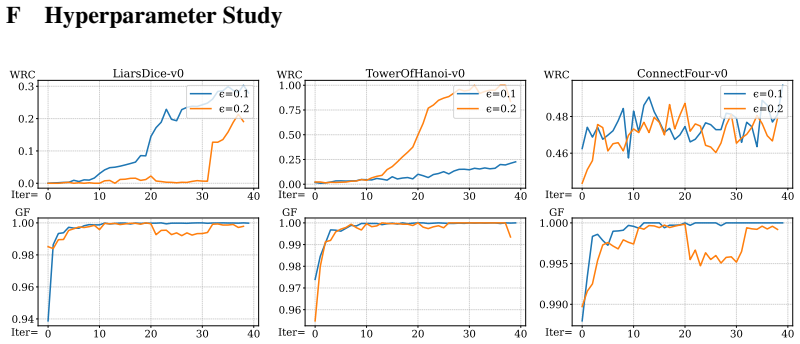
- [Section 4.1; Section 4.2; Appendix F] The evaluation suite was selected after preliminary testing with the base model (Section 4.1 states that only games where the base model 'did not consistently fail' were retained and then expanded), and hyperparameters were tuned on the same games (Section 4.2 and Appendix F). This introduces selection bias and a risk of overfitting to the evaluation set. Moreover, all results are single batches of 20 seeds per environment with no reported variance, confidence intervals, or significance tests; many entries are 20/0/0 or 0/0/20, so the paper's headline difference between 7-4-7 and the two-player 5-2-7 may well be within noise. The evaluation should be repeated with multiple independent runs and error bars.
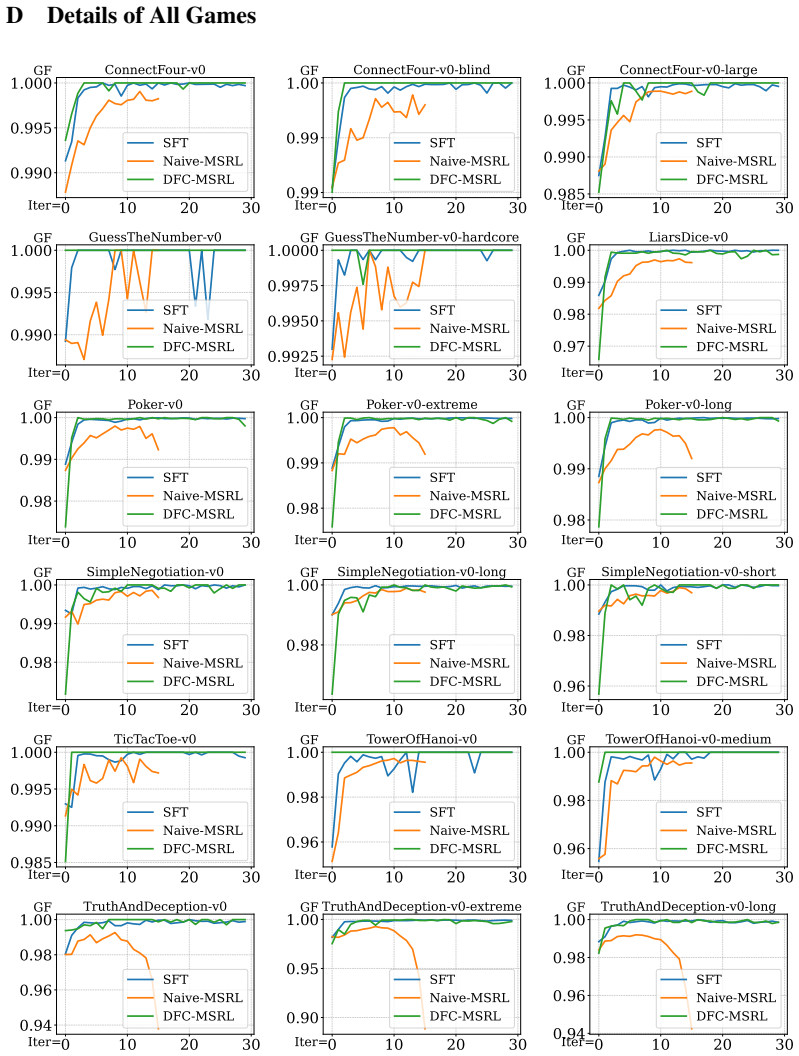
- [Section 3.2.2; Table 3] The fuse step assumes that parameter averaging, theta(pi(k)) = 1/2(theta(pi(k-1)) + theta(pi(k))), preserves the competence of each group-specialized policy well enough that continued GRPO training on the merged group improves rather than destroys performance. Table 3 provides only indirect evidence: after fusion, win rates sometimes drop sharply before the conquer phase (for example, SimpleNegotiation-v0-long goes from 8/8/4 at Conquer(g1,g2) to 2/4/14 at Fuse(g1,g2,g3)). No direct test is provided that the fused policy retains the skills of its parents. An ablation comparing DFC-MSRL with a version that skips fusion, or fuses at different stages, is needed to validate this load-bearing mechanism.
- [Section 4.3 (Aha Moment)] The 'Aha Moment' analysis is partly circular: it defines aha moments as improvements in win rate, response length, and step count, which are exactly the metrics optimized by the reward shaping and training objectives. The reported curves therefore show that the policy follows the training signal, not that a distinct reasoning breakthrough occurs. If the paper wishes to claim an aha-moment phenomenon, it should provide a more direct behavioral measure, such as qualitative changes in intermediate reasoning steps, independent of the optimized reward.
minor comments (5)
- [Section 3.2.3] In the MPS rollout allocation formula, the denominator uses M(t)_{g_j} but should use W(t)_{g_j} to match the definition of the mixed sampling weight; as written, the expression is undefined.
- [Algorithm 1] The word 'Algorighm' is a typo in the algorithm caption; it should be 'Algorithm'.
- [Table 3] Table 3 is very difficult to read: game names are concatenated with group labels in the first column, and the column headers such as 'Fuse(g1,g2,g3)' combined with the final 'g1+g2+g3+g4' row are ambiguous. The table should be reformatted with clear separate rows for each game and explicit phase labels.
- [Section 3.1] The base model Qwen2.5-32B-Align is described as an in-house model and is not publicly available; this limits reproducibility. The authors should state how to obtain the model or otherwise make the exact base checkpoint identifiable.
- [Figure 1] Figure 1 displays only 8 of the 18 games, yet the text refers to 'the win rates of Qwen2.5 and Qwen2.5 (DFC-MSRL)' without explaining the selection; the caption should clarify which games are shown and why.
Circularity Check
No derivation-level circularity: DFC results are freshly measured, but the 'aha moment' evidence is self-definitional (prompt-scripted insight narrations plus the RL reward metric itself), and game 'difficulty' is defined by base-model win rates on the same games later reported as success.
-
self definitional
[Section 4.3 'Aha Moment' and Appendix A (Table 4 prompt); Appendix C examples]
"These moments reflect human-like intuition and are evident in various performance metrics—such as win rate, response length, and the number of steps per game episode (Figure 4). ... you will repeatedly go through cycles of exploration, attempts, mistakes, idea adjustment, sudden insight, implementation, and verification, eventually arriving at the key solution."
The 'aha moment' is evidenced by (i) win-rate, response-length, and step-count gains in which win rate is by definition the RL reward being optimized (Table 1: Renv = +1 win, 0 draw, -1 loss), so a rising win-rate curve is the training objective itself rather than evidence of a distinct emergent event; and (ii) reasoning narrations in Appendix C that are generated under the paper's own prompt, which instructs the model to narrate 'sudden insight' and 'emotional fluctuations.' The phenomenon is therefore defined by metrics the optimizer is constructed to maximize, and its textual evidence is solicited by construction. The reduction is local: the DFC-vs-Claude comparison uses fresh playouts and is unaffected.
-
other
[Section 3.2.1 (Divide) and Section 4.1 (Evaluation)]
"Within each category, games are further divided based on whether the base model achieves a non-zero win rate—that is, whether it can win at all. This distinction serves as a proxy for game difficulty, yielding a total of four groups."
Game 'difficulty' — the basis of the grouping the framework is designed to manage — is defined by the base model's win rate on the exact TextArena games later used as the evaluation suite (Sec. 4.1 filters to games where the base model 'did not consistently fail' in 100 trials). The reported evidence of success (Table 2) is a win-rate tally on those same games, so the difficulty label and the outcome metric are the same quantity measured at different times. This is not a statistical forcing: post-training win rates and the Claude3.5 matches are independently measured, so the central comparison retains external content. It is a mild selection/mirroring circularity in evaluation design, not a construction-level identity.
full rationale
This paper is an empirical RL-methods report, so there is no derivation chain that could reduce to its inputs. The fuse step (theta(pi(k)) = 1/2(theta(pi(k-1)) + theta(pi(k))), Sec. 3.2.2) is a parameter-averaging assumption whose validity is tested by later measured win rates; it is not an output forced by an equation. The conquer recipe, MPS sampling, and ablations are all evaluated by fresh playouts against the initial model and against Claude3.5, so the central comparison has independent content. No load-bearing self-citation exists: reference [24] (Kimi K1.5) is from the same company (Moonshot AI) as two authors, but it is cited only for the standard rollout-update iteration loop, and no uniqueness theorem or ansatz is imported. Two mild self-referential framings warrant note. First, the 'Aha Moment' section (Sec. 4.3) defines the phenomenon by win rate, response length, and step count, with win rate being literally the reward GRPO maximizes (Table 1), and the Appendix C narrations cited as examples are produced under a prompt (Appendix A, Table 4) that instructs the model to recount 'sudden insight' and 'emotional fluctuations'; the qualitative evidence is thus constructed by the prompt and the quantitative evidence is the optimization target itself. This circularity is confined to the motivational narrative and does not carry the framework's empirical claims. Second, the Divide step (Sec. 3.2.1) labels game difficulty by the base model's non-zero win rate on the same TextArena games that form the final evaluation suite (Sec. 4.1), so the 'difficulty' of each evaluated game is defined by the quantity the experiment later reports as improved; this is a selection/mirroring effect, not a statistical forcing, and the Claude3.5 comparison and ablations are measured independently. For completeness and per the review rules, the headline '7 wins and 4 draws' treats four single-player environment scores as head-to-head wins/draws over Claude3.5 (restricting to the 14 two-player games gives roughly 99W-29D-151L); this is a comparison-protocol correctness risk, not circularity, and is flagged here rather than scored as one. The paper honestly discloses turn-asymmetry variance (Appendix E) and hyperparameter sensitivity (Appendix F), further indicating that negative results are not hidden behind construction.
Assumptions & free parameters
free parameters (9)
- MPS priority weight a =
0.2
- MPS priority weight b =
0.8
- MPS minimum sampling ratio epsilon_1 =
0.1
- epsilon-greedy probability =
0.1 or 0.3 (ablation)
- GRPO clip ratio epsilon =
0.1
- KL penalty alpha =
0.1
- Reward values (format, win, draw, loss) =
-2, 1, 0, -1
- Hasty-action penalty divisor =
n_tau (number of steps)
- Grouping threshold: non-zero base win rate =
binary split
assumptions (6)
- standard math GRPO policy gradient updates improve the expected reward under the rule-based reward.
- ad hoc to paper Parameter averaging of two RL policies preserves enough of each policy's competence for further training.
- ad hoc to paper The four-group split based on fixed/random initial states and non-zero base win rate creates groups with similar learning pace.
- ad hoc to paper Randomly discarding half of negative trajectories stabilizes training without removing necessary learning signal.
- domain assumption Self-play rollouts with the best historical policy provide a valid training distribution for all two-player games.
- domain assumption Win rate over 20 seeds per game is a reliable estimate of true performance.
Cite this review
Pith. "Pith review of Divide-Fuse-Conquer: Eliciting "Aha Moments" in Multi-Scenario Games." pith.science (2026). https://pith.science/paper/KHAR6WRZ
@misc{pith2026250516401,
  author       = {Pith},
  title        = {Pith review of: Divide-Fuse-Conquer: Eliciting "Aha Moments" in Multi-Scenario Games},
  year         = {2026},
  howpublished = {\url{https://pith.science/paper/KHAR6WRZ}},
  note         = {Machine review of arXiv:2505.16401}
}
read the original abstract
Large language models (LLMs) have been observed to suddenly exhibit advanced reasoning abilities during reinforcement learning (RL), resembling an ``aha moment'' triggered by simple outcome-based rewards. While RL has proven effective in eliciting such breakthroughs in tasks involving mathematics, coding, and vision, it faces significant challenges in multi-scenario games. The diversity of game rules, interaction modes, and environmental complexities often leads to policies that perform well in one scenario but fail to generalize to others. Simply combining multiple scenarios during training introduces additional challenges, such as training instability and poor performance. To overcome these challenges, we propose Divide-Fuse-Conquer, a framework designed to enhance generalization in multi-scenario RL. This approach starts by heuristically grouping games based on characteristics such as rules and difficulties. Specialized models are then trained for each group to excel at games in the group is what we refer to as the divide step. Next, we fuse model parameters from different groups as a new model, and continue training it for multiple groups, until the scenarios in all groups are conquered. Experiments across 18 TextArena games show that Qwen2.5-32B-Align trained with the Divide-Fuse-Conquer strategy reaches a performance level comparable to Claude3.5, achieving 7 wins and 4 draws. We hope our approach can inspire future research on using reinforcement learning to improve the generalization of LLMs.
Figures


Figures from the paper (10 more)




Forward citations
Cited by 2 Pith papers
-
Entropy Pacing Policy Optimization for Multi-Task Agentic Reinforcement Learning
Replacing GRPO's fixed clipping range with a task-wise entropy-aware adaptive bound stabilizes multi-task agentic LLM training by synchronizing exploration-exploitation paces.
-
Reinforcement Learning Meets Large Language Models: A Survey of Advancements and Applications Across the LLM Lifecycle
A survey that maps reinforcement learning methods, datasets, benchmarks, and open-source tools across the full training lifecycle of large language models, focusing on verifiable-reward reasoning.
Reference graph
Works this paper leans on
-
[1]
Reinforcement learning: Applications in gaming, robotics, and real-world decision-making
Moses Alabi. Reinforcement learning: Applications in gaming, robotics, and real-world decision-making. 2025
work page 2025
-
[2]
High-level reinforcement learning in strategy games
Christopher Amato and Guy Shani. High-level reinforcement learning in strategy games. In AAMAS, volume 10, pages 75–82, 2010
work page 2010
-
[3]
Constrained Multi-Relational Hyper-Graphons with Maximum Entropy
Amin Amini, Eric Zelikman, Rafael Rafailov, and Tengyu Zhang. Offset dpo: Generalizing direct preference optimization for better alignment.arXiv preprint arXiv:2403.09662, 2024
work page Pith review arXiv 2024
-
[4]
In-Chang Baek, Sung-Hyun Kim, Sam Earle, Zehua Jiang, Noh Jin-Ha, Julian Togelius, and Kyung-Joong Kim. Pcgrllm: Large language model-driven reward design for procedural content generation reinforcement learning.arXiv preprint arXiv:2502.10906, 2025
work page Pith review arXiv 2025
-
[5]
Finite-time regret bounds for the multiarmed bandit problem
Nicolo Cesa-Bianchi and Paul Fischer. Finite-time regret bounds for the multiarmed bandit problem. InICML, volume 98, pages 100–108. Citeseer, 1998
work page 1998
-
[6]
Limit Laws for Critical Dispersion on Complete Graphs
Ritwik Dutta, Yi Tay, Yao Liu, Hanbum Ryu, Jason Phang, Noa Shinn, Zihan Ma, Shikhar Narayan, Xuezhi Ma, Quoc Le, et al. Rl4code: Aligning code generation models with rl from ai feedback.arXiv preprint arXiv:2403.05372, 2024
work page Pith review arXiv 2024
- [7]
-
[8]
Daya Guo, Qihao Zhu, Dejian Yang, Zhenda Xie, Kai Dong, Wentao Zhang, Guanting Chen, Xiao Bi, Yu Wu, YK Li, et al. Deepseek-coder: When the large language model meets programming–the rise of code intelligence.arXiv preprint arXiv:2401.14196, 2024
arXiv 2024
Show all 31 references
-
[9]
Deepseek-r1: Incentivizing reasoning capability in llms via reinforcement learning.arXiv preprint arXiv:2501.12948, 2025
Daya Guo, Dejian Yang, Haowei Zhang, Junxiao Song, Ruoyu Zhang, Runxin Xu, Qihao Zhu, Shirong Ma, Peiyi Wang, Xiao Bi, et al. Deepseek-r1: Incentivizing reasoning capability in llms via reinforcement learning.arXiv preprint arXiv:2501.12948, 2025
2025 arXiv
-
[10]
Vision-r1: Incentivizing reasoning capability in multimodal large language models
Wenxuan Huang, Bohan Jia, Zijie Zhai, Shaosheng Cao, Zheyu Ye, Fei Zhao, Yao Hu, and Shaohui Lin. Vision-r1: Incentivizing reasoning capability in multimodal large language models. arXiv preprint arXiv:2503.06749, 2025
2025 arXiv
-
[11]
Rogue-gym: A new challenge for generalization in reinforcement learning
Yuji Kanagawa and Tomoyuki Kaneko. Rogue-gym: A new challenge for generalization in reinforcement learning. In2019 IEEE Conference on Games (CoG), pages 1–8. IEEE, 2019
2019
-
[12]
Reward design with language models.arXiv preprint arXiv:2303.00001, 2023
Minae Kwon, Sang Michael Xie, Kalesha Bullard, and Dorsa Sadigh. Reward design with language models.arXiv preprint arXiv:2303.00001, 2023
2023 arXiv
-
[13]
Self-play reinforcement learning with comprehensive critic in computer games.Neurocomputing, 449:207–213, 2021
Shanqi Liu, Junjie Cao, Yujie Wang, Wenzhou Chen, and Yong Liu. Self-play reinforcement learning with comprehensive critic in computer games.Neurocomputing, 449:207–213, 2021
2021
-
[14]
Hao Ma, Tianyi Hu, Zhiqiang Pu, Liu Boyin, Xiaolin Ai, Yanyan Liang, and Min Chen. Coevolv- ing with the other you: Fine-tuning llm with sequential cooperative multi-agent reinforcement learning.Advances in Neural Information Processing Systems, 37:15497–15525, 2024
2024
-
[15]
Civrealm: A learning and reasoning odyssey in civilization for decision-making agents.arXiv preprint arXiv:2401.10568, 2024
Siyuan Qi, Shuo Chen, Yexin Li, Xiangyu Kong, Junqi Wang, Bangcheng Yang, Pring Wong, Yifan Zhong, Xiaoyuan Zhang, Zhaowei Zhang, et al. Civrealm: A learning and reasoning odyssey in civilization for decision-making agents.arXiv preprint arXiv:2401.10568, 2024
2024 arXiv
-
[16]
Manning, and Chelsea Finn
Rafael Rafailov, Archit Sharma, Eric Mitchell, Stefano Ermon, Christopher D. Manning, and Chelsea Finn. Direct preference optimization: Your language model is secretly a reward model. arXiv preprint arXiv:2305.18290, 2023. 10
2023 arXiv
-
[17]
Reinforcement learning in strategy-based and atari games: A review of google deepminds innovations.arXiv preprint arXiv:2502.10303, 2025
Abdelrhman Shaheen, Anas Badr, Ali Abohendy, Hatem Alsaadawy, and Nadine Alsayad. Reinforcement learning in strategy-based and atari games: A review of google deepminds innovations.arXiv preprint arXiv:2502.10303, 2025
2025
-
[18]
Deepseekmath: Pushing the limits of mathematical reasoning in open language models.arXiv preprint arXiv:2402.03300, 2024
Zhihong Shao, Peiyi Wang, Qihao Zhu, Runxin Xu, Junxiao Song, Xiao Bi, Haowei Zhang, Mingchuan Zhang, YK Li, Y Wu, et al. Deepseekmath: Pushing the limits of mathematical reasoning in open language models.arXiv preprint arXiv:2402.03300, 2024
2024 arXiv
-
[19]
Satori: Reinforcement learning with chain-of-action-thought enhances llm reasoning via autoregressive search.arXiv preprint arXiv:2502.02508, 2025
Maohao Shen, Guangtao Zeng, Zhenting Qi, Zhang-Wei Hong, Zhenfang Chen, Wei Lu, Gregory Wornell, Subhro Das, David Cox, and Chuang Gan. Satori: Reinforcement learning with chain-of-action-thought enhances llm reasoning via autoregressive search.arXiv preprint arXiv:2502.02508, 2025
2025 arXiv
-
[20]
Sample-efficient robust multi- agent reinforcement learning in the face of environmental uncertainty.arXiv preprint arXiv:2404.18909, 2024
Laixi Shi, Eric Mazumdar, Yuejie Chi, and Adam Wierman. Sample-efficient robust multi- agent reinforcement learning in the face of environmental uncertainty.arXiv preprint arXiv:2404.18909, 2024
2024 arXiv
-
[21]
Agentic reasoning and tool integration for llms via reinforcement learning.arXiv preprint arXiv:2505.01441, 2025
Joykirat Singh, Raghav Magazine, Yash Pandya, and Akshay Nambi. Agentic reasoning and tool integration for llms via reinforcement learning.arXiv preprint arXiv:2505.01441, 2025
2025 arXiv
-
[22]
Large language models and video games: A preliminary scoping review
Penny Sweetser. Large language models and video games: A preliminary scoping review. In Proceedings of the 6th ACM Conference on Conversational User Interfaces, pages 1–8, 2024
2024
-
[23]
Grammar and gameplay-aligned rl for game descrip- tion generation with llms.arXiv preprint arXiv:2503.15783, 2025
Tsunehiko Tanaka and Edgar Simo-Serra. Grammar and gameplay-aligned rl for game descrip- tion generation with llms.arXiv preprint arXiv:2503.15783, 2025
2025 arXiv
-
[24]
Kimi Team, Angang Du, Bofei Gao, Bowei Xing, Changjiu Jiang, Cheng Chen, Cheng Li, Chenjun Xiao, Chenzhuang Du, Chonghua Liao, et al. Kimi k1. 5: Scaling reinforcement learning with llms.arXiv preprint arXiv:2501.12599, 2025
2025 arXiv
-
[25]
Level generation through large language models
Graham Todd, Sam Earle, Muhammad Umair Nasir, Michael Cerny Green, and Julian Togelius. Level generation through large language models. InProceedings of the 18th International Conference on the F oundations of Digital Games, pages 1–8, 2023
2023
-
[26]
Logic-rl: Unleashing llm reasoning with rule-based reinforcement learning.arXiv preprint arXiv:2502.14768, 2025
Tian Xie, Zitian Gao, Qingnan Ren, Haoming Luo, Yuqian Hong, Bryan Dai, Joey Zhou, Kai Qiu, Zhirong Wu, and Chong Luo. Logic-rl: Unleashing llm reasoning with rule-based reinforcement learning.arXiv preprint arXiv:2502.14768, 2025
2025 arXiv
-
[27]
Generalization in text-based games via hierarchical reinforcement learning.arXiv preprint arXiv:2109.09968, 2021
Yunqiu Xu, Meng Fang, Ling Chen, Yali Du, and Chengqi Zhang. Generalization in text-based games via hierarchical reinforcement learning.arXiv preprint arXiv:2109.09968, 2021
2021 arXiv
-
[28]
Language agents with reinforcement learning for strategic play in the werewolf game.arXiv preprint arXiv:2310.18940, 2023
Zelai Xu, Chao Yu, Fei Fang, Yu Wang, and Yi Wu. Language agents with reinforcement learning for strategic play in the werewolf game.arXiv preprint arXiv:2310.18940, 2023
2023 arXiv
-
[29]
Fine-tuning large vision-language models as decision-making agents via reinforcement learning.Advances in neural information processing systems, 37: 110935–110971, 2024
Simon Zhai, Hao Bai, Zipeng Lin, Jiayi Pan, Peter Tong, Yifei Zhou, Alane Suhr, Saining Xie, Yann LeCun, Yi Ma, et al. Fine-tuning large vision-language models as decision-making agents via reinforcement learning.Advances in neural information processing systems, 37: 110935–11...
2024
-
[30]
R1-reward: Training multimodal reward model through stable reinforcement learning.arXiv preprint arXiv:2505.02835, 2025
Yi-Fan Zhang, Xingyu Lu, Xiao Hu, Chaoyou Fu, Bin Wen, Tianke Zhang, Changyi Liu, Kaiyu Jiang, Kaibing Chen, Kaiyu Tang, et al. R1-reward: Training multimodal reward model through stable reinforcement learning.arXiv preprint arXiv:2505.02835, 2025
2025 arXiv
-
[31]
aha moment
Hengguang Zhou, Xirui Li, Ruochen Wang, Minhao Cheng, Tianyi Zhou, and Cho-Jui Hsieh. R1-zero’s" aha moment" in visual reasoning on a 2b non-sft model.arXiv preprint arXiv:2503.05132, 2025. 11 A Prompts Table 4: Prompt for LLMs. You are a game player and must play according to...
2025 arXiv
Reviewed August 7, 2026 · model on record in the stance chip above.
Discussion (0). Continue with ORCID to comment.