REVIEW 3 major objections 5 minor 106 references
A study of the transition to a turbulent shock using a coarse-graining approach to ion phase space transport
T0 review · 3 major / 5 minor · reviewed 2026-08-11 · deepseek-v4-flash
Pith's one-line read Pre-existing turbulence activates ion phase-space transport at an oblique shock, linking the thermal inflow to the reflected field-aligned beam.
desk verdict Promising Eulerian diagnostic for ion phase-space transport at shocks, but the 2D-2V reduction drops v_z-moment terms that need bounding before the headline flux measurement is trusted. read the letter →
The pith
A machine-rendered reading of the paper's core claim, the machinery that carries it, and where it could break.
The reading
What carries the argument
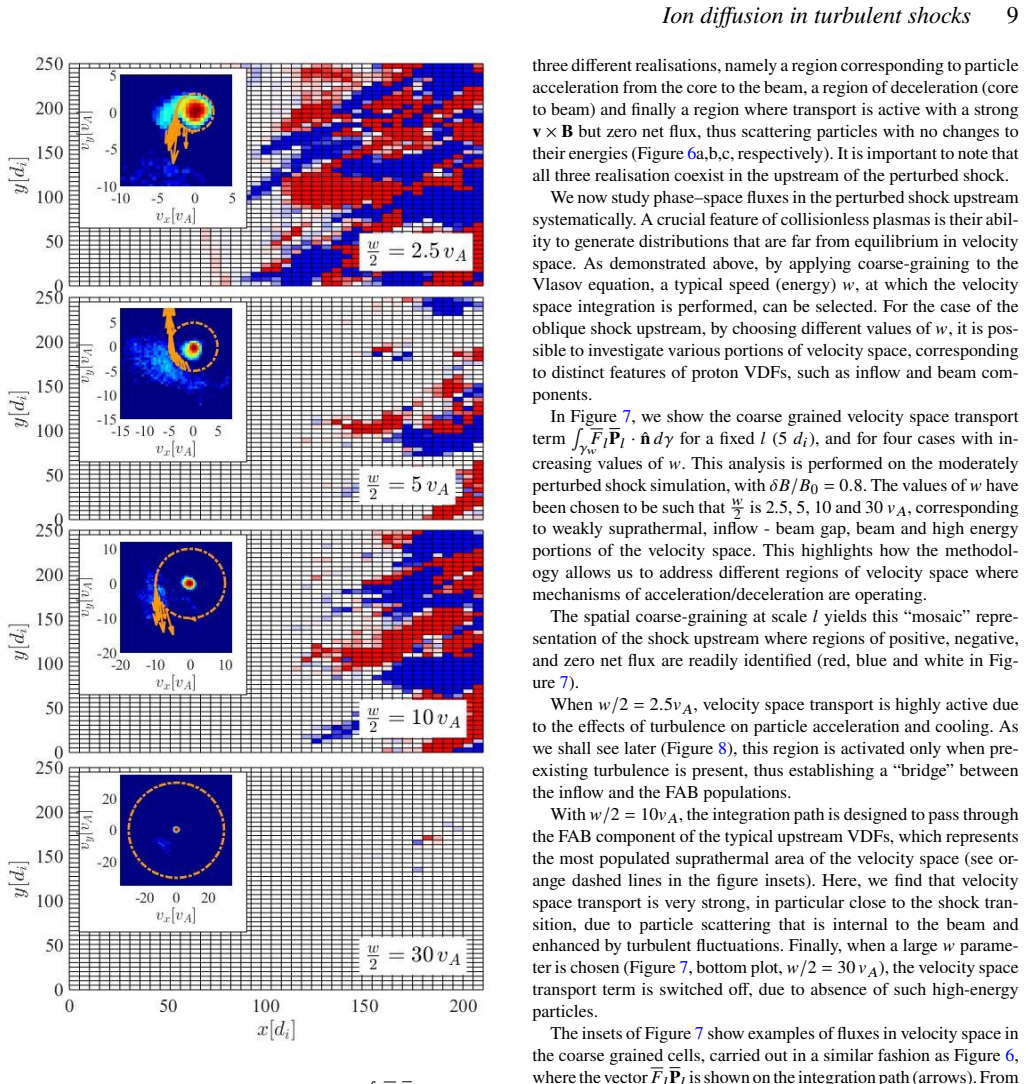
The central object is the filtered distribution $F_l$ and the coarse-grained Vlasov equation (7), obtained by applying a box-filter kernel at spatial scale $l$ to the Vlasov equation and then integrating in velocity space up to a speed $w$. The integration boundary $\gamma_w$ is a circle of radius $w$, and the flux integral of $F_l \mathbf{P}_l \cdot \hat{\mathbf{n}}$ across $\gamma_w$—where $\mathbf{P}_l$ is the coarse-grained phase-space force $\mathbf{E} + \mathbf{v}\times\mathbf{B}$—separates into an electric part that changes particle energy and a magnetic part tangent to the circle that spreads pitch angles. This 'mosaic' of positive, negative, and zero flux regions is the diagnostic the paper uses to identify where injection of particles into the beam occurs and how it is controlled by turbulence.
What would settle it
One concrete check would be to run the same shock simulation in full 3D-3V phase space, or to evaluate the discarded $v_z$-moment terms and the subgrid residual $Q_l$ in the existing 2D simulation, and compare the coarse-grained flux with the reduced 2D-2V result; if the difference is comparable to the measured flux, the reduced diagnostic is not clean.
Extended reading notes
Core claim
The central discovery is that the coarse-grained velocity-space flux $\int_{\gamma_w} F_l \mathbf{P}_l \cdot \hat{\mathbf{n}} \, d\gamma$ from Equation (7) is a quantitative, Eulerian measure of ion phase-space transport between the upstream inflow and the reflected field-aligned beam. In the laminar (unperturbed) case this flux is negligible, meaning the two populations are effectively non-interacting; when pre-existing turbulence is present, the flux is strongly activated, with regions of positive and negative net transport that are anti-correlated with the parallel electric field, indicating energization and deceleration. The flux and the corresponding spatial transport term are self-similar across the inertial-range coarse-graining scales $l$ studied, which the authors take as evidence of robustness and as justification for applying the diagnostic up to observable scales.
Load-bearing premise
The paper's quantitative claim rests on the assumption that the reduced four-dimensional Vlasov equation, obtained by integrating out the $z$ and $v_z$ dimensions, is exact at the scales of interest and that the subgrid residual contributes negligibly to the flux balance.
Editorial extensions
If this is right
- If the central claim holds, upstream turbulence is a controlling factor for populating the suprathermal field-aligned beam upstream of oblique shocks.
- The coarse-graining diagnostic can be applied to single-spacecraft measurements, potentially relaxing time-resolution constraints on in-situ studies of shock foreshocks.
- Higher levels of pre-existing turbulence imply more distorted shock fronts, faster shock propagation, and broader downstream energy spectra with higher maximum proton energies.
- The self-similarity across inertial-range scales suggests that a single-scale measurement may capture the phase-space transport properties at all inertial scales.
Reading between the lines
- As an editorial extension, the same coarse-grained flux could be computed directly from spacecraft velocity-distribution snapshots to test whether the anti-correlation with the parallel electric field survives at observational resolution.
- If the self-similar scaling of the transport term is characterized quantitatively, the diagnostic could serve as a proxy for turbulent transport coefficients from data at a single spatial scale.
- The paper leaves the subgrid residual $Q_l$ and the reduced-dimensionality couplings unquantified; testing whether either is comparable to the measured flux would either strengthen or dissolve the clean-interpretation claim.
- A natural next step, beyond the present scope, is to extend the method to a full 3D-3V phase space, where the neglected $v_z$ couplings would be explicitly retained to confirm the reduced-model results.
Signed reviews
Editorial analysis
A structured set of objections, weighed in public.
Referee Report
Summary. This paper studies the transition of an oblique shock from laminar to turbulent using self-consistent hybrid-kinetic simulations with four levels of pre-existing upstream turbulence (δB/B0 = 0.0, 0.4, 0.8, 2.1). The authors introduce a coarse-graining of the Vlasov equation in 2D-2V phase space, define a velocity-space transport flux across a circle γ_w in velocity space, and apply this diagnostic upstream of the simulated shocks. They report that the flux is activated only when pre-existing turbulence is present, that it forms a 'bridge' between the inflow and the field-aligned beam (FAB) populations, and that the results are self-similar across spatial coarse-graining scales l in the inertial range. The paper also discusses shock-front distortion, energy spectra, and parallel electric-field correlations.
Significance. If the central diagnostic is valid, this is a valuable contribution: it offers an Eulerian, observation-oriented way to quantify phase-space transport in shock-turbulence systems, complements Lagrangian particle-tracing approaches, and provides a concrete physical picture in which upstream turbulence controls the coupling between the incoming solar-wind-like population and the reflected FAB. The manuscript has clear strengths: it uses self-consistent hybrid simulations with a controlled turbulence-level scan, presents the data openly via a DOI, and does not fit any parameter to produce the reported flux maps (the coarse-graining scales l and w are diagnostic choices, not fitted parameters). The main risk is that the reduced 2D-2V Vlasov equation underlying the diagnostic is not derived exactly, and the omitted terms are not quantified; this needs to be resolved before the central claim can be regarded as established.
major comments (3)
- [Section 4, Eq. (3)] Equation (3) is presented as the exact result of integrating the 3D Vlasov equation (2) over z and v_z, but that integration does not produce the stated reduced equation. After integrating over v_z, the x and y components of the Lorentz term contain extra contributions involving the first v_z-moment M_z = ∫ v_z f dv_z. Specifically, the terms -B_y ∂_{v_x} M_z + B_x ∂_{v_y} M_z appear, and these are not present in Eq. (3). Neither M_z = 0 nor B_x = B_y = 0 holds in the simulation setup: the mean field lies in the x-y plane at θ_Bn = 45°, so B_x and B_y are of order B0, and the MHD-initialized turbulent velocity field includes δV_z, making M_z locally nonzero. Since Eq. (3) is the foundation for the filtered equation (5) and the central flux diagnostic (7), the measured ∫_{γ_w} F_l P_l · n dγ may not isolate the energization flux. In fact, after filtering, the missing terms contribute to the same boundary integral as -∮_{γ_w} M_{z,l}(B_{y,l} n_x - B_{x,l} n_y) dγ. The paper's general limitation statement in Section 6 about 'reduced dimensionality' does not quantify or bound this omission. The authors should either derive the reduced model explicitly as a 2D-2V closure with stated assumptions, or show from the simulation data that the omitted terms are negligible compared with the retained flux at the scales and locations analyzed.
- [Section 5, Eq. (7) and following text] The interpretation of the left-hand side of Eq. (7) as the dominant phase-space transport hinges on the claim that the subgrid residual ∫_{γ_w} Q_l · n dγ is 'comparatively negligible' with respect to the other terms. The manuscript states that this is 'not shown here' and notes that the residual is difficult to estimate due to resolution and particle noise. This is a load-bearing point: if the residual is not actually negligible, then the flux maps in Figures 7–9 do not measure the coarse-grained transport term in isolation. The authors should provide a quantitative estimate of the residual, for example by computing the time-averaged or spatial rms of ∫_{γ_w} Q_l · n dγ relative to the retained terms for the same values of l and w used in the figures. Without such an estimate, the claim that the diagnostic isolates the inflow–FAB coupling is not fully supported.
- [Section 5, Figures 8 and 9] The paper's central robustness claim is that the coarse-grained transport terms are 'self-similar' across spatial scales l = 1, 5, 10 d_i in the inertial range. The support for this claim is currently visual: the stacked mosaic plots look similar across l, but no quantitative measure is provided. Since the abstract and conclusions explicitly state that the method 'gives consistent results for inertial range scales,' the authors should substantiate this with a quantitative scale-invariance test, such as a correlation coefficient between fields at different l, a scaling-exponent analysis of the flux magnitude, or a comparison of the spatial structure functions. A qualitative visual similarity is not sufficient to support the cross-scale claim, especially given the noisiness of the maps.
minor comments (5)
- [Section 4, Eq. (6) and Figure 7 caption] The notation for the velocity-space cutoff is inconsistent: Eq. (6) defines G_w(v) as nonzero for |v| < w, so w is the radius of γ_w, but the text and Figure 7 describe the chosen values as 'w/2 = 2.5, 5, 10, 30 v_A' and Figure 6 states that 'l and w/2 were fixed at 5 d_i and 5 v_A.' Please clarify whether w denotes the radius or the diameter of the integration circle, and use a consistent symbol throughout.
- [Section 5, paragraph on parallel electric field] The statement that the velocity-space transport term is 'anti-correlated' with the upstream parallel electric field E·b0 is not quantified. The authors report a 'good correlation' and originally reported the correlation in Trotta et al. (2021), but in this paper no correlation coefficient or statistical measure is given. A quantitative value (or at least a scatter plot) would strengthen the claim and make the comparison reproducible.
- [Section 6, Conclusions] There is a typo in the sentence 'self-similar results for spatial scales in the turbulence intertial range' — 'intertial' should be 'inertial.'
- [Figure 2 caption and Figure 3 caption] The word 'coloumns' is misspelled in both captions; it should be 'columns.'
- [Introduction, paragraph 2] The phrase 'rcently considered' contains a typo and should read 'recently considered.'
Circularity Check
No circularity: the coarse-grained Vlasov flux is a diagnostic computed from the simulated fields and VDFs, and the paper's self-citations are provenance rather than load-bearing input.
full rationale
The central result is the velocity-space flux integral in Eq. (7), derived by filtering the Vlasov equation and integrating over a circle of radius w; all quantities F_l, P_l, and Q_l are evaluated from the hybrid-PIC distribution functions and electromagnetic fields, with no free parameter fitted to produce the reported turbulence-induced activation or self-similarity. The simulations are reused from Trotta et al. (2021), but the paper recomputes the coarse-grained transport terms (Figs. 7-9) rather than importing the prior conclusion, and the datasets are externally archived (10.5281/zenodo.13730180). The correlation with parallel electric field is also re-derived in Figure 8, so the self-citation 'originally reported in Trotta et al. (2021)' is not load-bearing. The derivation chain from Eq. (2) to Eq. (3) is not exact: integrating over v_z introduces first v_z-moment terms coupled to B_x and B_y, and the paper neither derives nor bounds them; likewise, the claim that the subgrid residual integral on the right of Eq. (7) is negligible is asserted without showing the balance. These are unquantified modeling approximations and therefore correctness risks, not circular reductions, because the omitted terms are not equivalent to the paper's input assumptions or fitted values. No uniqueness theorem, ansatz-by-citation, or renaming of a known result as a prediction was found. Accordingly the circularity score is 0.
Assumptions & free parameters
free parameters (2)
- w (velocity-space cutoff radius) =
10 v_A (main analysis); 5, 20, 60 v_A in Figure 7
- l (spatial coarse-graining scale) =
1, 5, 10 d_i
assumptions (5)
- ad hoc to paper 2D-2V reduction of the Vlasov equation with P = E + v×B is valid for the velocity-integrated distribution F(x,y,v_x,v_y).
- domain assumption The subgrid residual term Q_l on the right side of Eq. (7) is negligible compared with the resolved transport terms.
- domain assumption Box-filter coarse-graining at inertial-range scales l gives a physically meaningful decomposition for the kinetic shock upstream.
- domain assumption The hybrid simulation (massless adiabatic electrons, proton macroparticles) captures the essential kinetics for the studied shock transition.
- domain assumption The injected MHD turbulence, windowed with the mask function of Eq. (1) and Helmholtz-decomposed velocity field, is a faithful proxy for pre-existing astrophysical turbulence.
Cite this review
Pith. "Pith review of A study of the transition to a turbulent shock using a coarse-graining approach to ion phase space transport." pith.science (2026). https://pith.science/paper/KHVHJ3ZR
@misc{pith2026241208404,
  author       = {Pith},
  title        = {Pith review of: A study of the transition to a turbulent shock using a coarse-graining approach to ion phase space transport},
  year         = {2026},
  howpublished = {\url{https://pith.science/paper/KHVHJ3ZR}},
  note         = {Machine review of arXiv:2412.08404}
}
read the original abstract
Shocks and turbulence are ubiquitous phenomena, responsible for particle acceleration to very high energies in a large collection of astrophysical systems. Using self-consistent, hybrid-kinetic simulations with and without pre-existing turbulence, we study the transition of a shock from ``laminar'' to turbulent. We show that the changes in upstream proton transport behaviour are crucial to understand this transition, which we address quantitatively with a novel Eulerian approach. This method, based on the coarse-graining of the Vlasov equation originally introduced in one of our previous studies, gives consistent results for inertial range scales. The potential applications of the coarse-graining approach beyond the shock-turbulence system are outlined.
Figures


Figures from the paper (6 more)




Reference graph
Works this paper leans on
-
[1]
Alfonsi G., Ferraro D., Lauria A., Gaudio R., 2019, @doi [Physics of Fluids] 10.1063/1.5116522 , 31, 085105
-
[2]
Aluie H., 2017, @doi [New Journal of Physics] 10.1088/1367-2630/aa5d2f , 19, 025008
-
[3]
Amato E., Blasi P., 2018, @doi [Advances in Space Research] https://doi.org/10.1016/j.asr.2017.04.019 , 62, 2731
-
[4]
Ambrosiano J., Matthaeus W. H., Goldstein M. L., Plante D., 1988, @doi [ ] 10.1029/JA093iA12p14383 , http://adsabs.harvard.edu/abs/1988JGR....9314383A 93, 14383
-
[5]
Arzner K., Vlahos L., 2004, @doi [ ] 10.1086/392506 , http://adsabs.harvard.edu/abs/2004ApJ...605L..69A 605, L69
-
[6]
Behar E., Fatemi S., Henri P., Holmstr\"om M., 2022, @doi [Annales Geophysicae] 10.5194/angeo-40-281-2022 , 40, 281
-
[7]
Blandford R., Eichler D., 1987, @doi [ ] 10.1016/0370-1573(87)90134-7 , https://ui.adsabs.harvard.edu/abs/1987PhR...154....1B 154, 1
-
[8]
Bonifazi C., Egidi A., Moreno G., Orsini S., 1980, @doi [ ] 10.1029/JA085iA07p03461 , https://ui.adsabs.harvard.edu/abs/1980JGR....85.3461B 85, 3461
Show all 106 references
-
[9]
S., Niemiec, J
Boula S. S., Niemiec, J. Amano, T. Kobzar, O. 2024, @doi [A&A] 10.1051/0004-6361/202349091 , 684, A129
2024 doi
-
[10]
Cambridge University Press, @doi 10.1017/CBO9781139044097 , http://ebooks.cambridge.org/ref/id/CBO9781139044097
Burgess D., Scholer M., 2015, Collisionless Shocks in Space Plasmas. Cambridge University Press, @doi 10.1017/CBO9781139044097 , http://ebooks.cambridge.org/ref/id/CBO9781139044097
2015 doi
-
[11]
M., 2016, @doi [Journal of Plasma Physics] 10.1017/S0022377816000660 , 82, 905820401
Burgess D., Hellinger P., Gingell I., Trávníček P. M., 2016, @doi [Journal of Plasma Physics] 10.1017/S0022377816000660 , 82, 905820401
2016 doi
-
[12]
M., Vazza F., Kropotina J
Bykov A. M., Vazza F., Kropotina J. A., Levenfish K. P., Paerels F. B. S., 2019, @doi [ ] 10.1007/s11214-019-0585-y , https://ui.adsabs.harvard.edu/abs/2019SSRv..215...14B 215, 14
2019 doi
-
[13]
Camporeale E., Burgess D., 2011, @doi [The Astrophysical Journal] 10.1088/0004-637X/730/2/114 , 730, 114
2011 doi
-
[14]
Camporeale E., Sorriso-Valvo L., Califano F., Retin \`o A., 2018, @doi [ ] 10.1103/PhysRevLett.120.125101 , https://ui.adsabs.harvard.edu/abs/2018PhRvL.120l5101C 120, 125101
2018 doi
-
[16]
Caprioli D., Spitkovsky A., 2014b, @doi [The Astrophysical Journal] 10.1088/0004-637X/783/2/91 , 783, 91
-
[17]
Caprioli D., Spitkovsky A., 2014c, @doi [ ] 10.1088/0004-637X/794/1/47 , https://ui.adsabs.harvard.edu/abs/2014ApJ...794...47C 794, 47
-
[18]
S., Camporeale E., 2020, arXiv e-prints, https://ui.adsabs.harvard.edu/abs/2020arXiv200503130C p
Cerri S. S., Camporeale E., 2020, arXiv e-prints, https://ui.adsabs.harvard.edu/abs/2020arXiv200503130C p. arXiv:2005.03130
2020 arXiv
-
[19]
Chandran B. D. G., Verscharen D., Quataert E., Kasper J. C., Isenberg P. A., Bourouaine S., 2013, @doi [ ] 10.1088/0004-637X/776/1/45 , https://ui.adsabs.harvard.edu/abs/2013ApJ...776...45C 776, 45
2013 doi
-
[20]
Chen C. H. K., Klein K. G., Howes G. G., 2019, @doi [Nature Communications] 10.1038/s41467-019-08435-3 , https://ui.adsabs.harvard.edu/abs/2019NatCo..10..740C 10, 740
2019 doi
-
[21]
Comisso L., Sironi L., 2018, @doi [ ] 10.1103/PhysRevLett.121.255101 , https://ui.adsabs.harvard.edu/abs/2018PhRvL.121y5101C 121, 255101
2018 doi
-
[22]
Comisso L., Sironi L., 2019, @doi [ ] 10.3847/1538-4357/ab4c33 , https://ui.adsabs.harvard.edu/abs/2019ApJ...886..122C 886, 122
2019 doi
-
[23]
H., Seenu N., 2004, @doi [ ] 10.1086/425301 , https://ui.adsabs.harvard.edu/abs/2004ApJ...617..667D 617, 667
Dmitruk P., Matthaeus W. H., Seenu N., 2004, @doi [ ] 10.1086/425301 , https://ui.adsabs.harvard.edu/abs/2004ApJ...617..667D 617, 667
2004 doi
-
[24]
P., Lucek E
Eastwood J. P., Lucek E. A., Mazelle C., Meziane K., Narita Y., Pickett J., Treumann R. A., 2005, @doi [ ] 10.1007/s11214-005-3824-3 , https://ui.adsabs.harvard.edu/abs/2005SSRv..118...41E 118, 41
2005 doi
-
[25]
L., 2018, @doi [Physical Review X] 10.1103/PhysRevX.8.041020 , https://ui.adsabs.harvard.edu/abs/2018PhRvX...8d1020E 8, 041020
Eyink G. L., 2018, @doi [Physical Review X] 10.1103/PhysRevX.8.041020 , https://ui.adsabs.harvard.edu/abs/2018PhRvX...8d1020E 8, 041020
2018 doi
-
[26]
L., Aluie H., 2009, @doi [Physics of Fluids] 10.1063/1.3266883 , 21, 115107
Eyink G. L., Aluie H., 2009, @doi [Physics of Fluids] 10.1063/1.3266883 , 21, 115107
2009 doi
-
[27]
A., Kozlovsky B., Ramaty R., 1974, @doi [ ] 10.1086/181498 , http://adsabs.harvard.edu/abs/1974ApJ...190L..35F 190, L35
Fisk L. A., Kozlovsky B., Ramaty R., 1974, @doi [ ] 10.1086/181498 , http://adsabs.harvard.edu/abs/1974ApJ...190L..35F 190, L35
1974 doi
-
[28]
Franci L., Landi S., Matteini L., Verdini A., Hellinger P., 2015, @doi [The Astrophysical Journal] 10.1088/0004-637X/812/1/21 , 812, 21
2015 doi
-
[29]
Franci L., et al., 2017, @doi [ ] 10.3847/2041-8213/aa93fb , https://ui.adsabs.harvard.edu/abs/2017ApJ...850L..16F 850, L16
2017 doi
-
[30]
Frisch U., 1995, Turbulence: The Legacy of A. N. Kolmogorov. Cambridge University Press, @doi 10.1017/CBO9781139170666
1995 doi
-
[31]
Gedalin M., 2023, @doi [The Astrophysical Journal] 10.3847/1538-4357/ad0461 , 958, 2
2023 doi
-
[32]
Germano M., 1992, @doi [Journal of Fluid Mechanics] 10.1017/S0022112092001733 , 238, 325–336
1992 doi
-
[33]
H., 1991, @doi [Physics of Fluids A] 10.1063/1.857955 , https://ui.adsabs.harvard.edu/abs/1991PhFlA...3.1760G 3, 1760
Germano M., Piomelli U., Moin P., Cabot W. H., 1991, @doi [Physics of Fluids A] 10.1063/1.857955 , https://ui.adsabs.harvard.edu/abs/1991PhFlA...3.1760G 3, 1760
1991 doi
-
[34]
Giacalone J., 2005, @doi [ ] 10.1086/429265 , https://ui.adsabs.harvard.edu/abs/2005ApJ...624..765G 624, 765
2005 doi
-
[35]
J., Ellison D
Giacalone J., Burgess D., Schwartz S. J., Ellison D. C., Bennett L., 1997, @doi [ ] 10.1029/97JA01529 , https://ui.adsabs.harvard.edu/abs/1997JGR...10219789G 102, 19789
1997 doi
-
[36]
J., Kucharek H., Farrugia C
Gingell I., Schwartz S. J., Kucharek H., Farrugia C. J., Fryer L. J., Plank J., Trattner K. J., 2023, @doi [Physics of Plasmas] 10.1063/5.0129084 , 30, 012902
2023 doi
-
[37]
W., Ala-Lahti M., Palmerio E., Kilpua E
Good S. W., Ala-Lahti M., Palmerio E., Kilpua E. K. J., Osmane A., 2020, @doi [The Astrophysical Journal] 10.3847/1538-4357/ab7fa2 , 893, 110
2020 doi
-
[38]
T., Asbridge J
Gosling J. T., Asbridge J. R., Bame S. J., Paschmann G., Sckopke N., 1978, @doi [ ] 10.1029/GL005i011p00957 , https://ui.adsabs.harvard.edu/abs/1978GeoRL...5..957G 5, 957
1978 doi
-
[39]
Guo F., Giacalone J., 2012, @doi [ ] 10.1088/0004-637X/753/1/28 , https://ui.adsabs.harvard.edu/abs/2012ApJ...753...28G 753, 28
2012 doi
-
[40]
Guo F., Giacalone J., 2015, @doi [ ] 10.1088/0004-637X/802/2/97 , https://ui.adsabs.harvard.edu/abs/2015ApJ...802...97G 802, 97
2015 doi
-
[41]
Guo F., Giacalone J., Zhao L., 2021, @doi [Frontiers in Astronomy and Space Sciences] 10.3389/fspas.2021.644354 , 8
2021
-
[42]
G., Klein K
Howes G. G., Klein K. G., Li T. C., 2017, @doi [Journal of Plasma Physics] 10.1017/S0022377816001197 , https://ui.adsabs.harvard.edu/abs/2017JPlPh..83a7002H 83, 705830102
2017 doi
-
[43]
R., 1966, @doi [ ] 10.1086/148912 , https://ui.adsabs.harvard.edu/abs/1966ApJ...146..480J 146, 480
Jokipii J. R., 1966, @doi [ ] 10.1086/148912 , https://ui.adsabs.harvard.edu/abs/1966ApJ...146..480J 146, 480
1966 doi
-
[44]
R., 1987, @doi [ ] 10.1086/165022 , https://ui.adsabs.harvard.edu/abs/1987ApJ...313..842J 313, 842
Jokipii J. R., 1987, @doi [ ] 10.1086/165022 , https://ui.adsabs.harvard.edu/abs/1987ApJ...313..842J 313, 842
1987 doi
-
[45]
R., Lee M
Jokipii J. R., Lee M. A., 2010, @doi [ ] 10.1088/0004-637X/713/1/475 , https://ui.adsabs.harvard.edu/abs/2010ApJ...713..475J 713, 475
2010 doi
-
[46]
T., Jian L
Kajdič P., Blanco-Cano X., Aguilar-Rodriguez E., Russell C. T., Jian L. K., Luhmann J. G., 2012, @doi [Journal of Geophysical Research: Space Physics] https://doi.org/10.1029/2011JA017381 , 117
2012 doi
-
[47]
Kang H., Ryu D., Ha J.-H., 2019, @doi [The Astrophysical Journal] 10.3847/1538-4357/ab16d1 , 876, 79
2019 doi
-
[48]
a pyl \"a P. J., Rheinhardt M., Brandenburg A., K \
K \"a pyl \"a P. J., Rheinhardt M., Brandenburg A., K \"a pyl \"a M. J., 2020, @doi [ ] 10.1051/0004-6361/201935012 , https://ui.adsabs.harvard.edu/abs/2020A&A...636A..93K 636, A93
2020 doi
-
[49]
Kilpua E., et al., 2023, @doi [ ] 10.1007/s10509-023-04201-6 , https://ui.adsabs.harvard.edu/abs/2023Ap&SS.368...66K 368, 66
2023 doi
-
[50]
A., R\`eme H., 2007, @doi [Annales Geophysicae] 10.5194/angeo-25-785-2007 , 25, 785
Kis A., Scholer M., Klecker B., Kucharek H., Lucek E. A., R\`eme H., 2007, @doi [Annales Geophysicae] 10.5194/angeo-25-785-2007 , 25, 785
2007 doi
-
[51]
G., Howes G
Klein K. G., Howes G. G., Tenbarge J. M., 2017, @doi [Journal of Plasma Physics] 10.1017/S0022377817000563 , https://ui.adsabs.harvard.edu/abs/2017JPlPh..83d5301K 83, 535830401
2017 doi
-
[52]
G., Howes G
Klein K. G., Howes G. G., TenBarge J. M., Valentini F., 2020, @doi [Journal of Plasma Physics] 10.1017/S0022377820000689 , 86, 905860402
2020 doi
-
[53]
A., Trivelpiece A
Krall N. A., Trivelpiece A. W., 1973, Principles of plasma physics [by] Nicholas A. Krall [and] Alvin W. Trivelpiece. McGraw-Hill New York
1973
-
[54]
S., 1989, @doi [ ] 10.1029/JA094iA11p15089 , http://adsabs.harvard.edu/abs/1989JGR....9415089K 94, 15089
Krauss-Varban D., Burgess D., Wu C. S., 1989, @doi [ ] 10.1029/JA094iA11p15089 , http://adsabs.harvard.edu/abs/1989JGR....9415089K 94, 15089
1989 doi
-
[55]
Kucharek H., et al., 2004, @doi [Annales Geophysicae] 10.5194/angeo-22-2301-2004 , https://ui.adsabs.harvard.edu/abs/2004AnGeo..22.2301K 22, 2301
2004 doi
-
[56]
G., Wilson L
Lario D., Richardson I. G., Wilson L. B. I., Berger L., Jian L. K., Trotta D., 2022, @doi [ ] 10.3847/1538-4357/ac3c47 , https://ui.adsabs.harvard.edu/abs/2022ApJ...925..198L 925, 198
2022 doi
-
[57]
M., 2012, @doi [ ] 10.1007/s11214-012-9936-7 , https://ui.adsabs.harvard.edu/abs/2012SSRv..173..557L 173, 557
Lazarian A., Vlahos L., Kowal G., Yan H., Beresnyak A., de Gouveia Dal Pino E. M., 2012, @doi [ ] 10.1007/s11214-012-9936-7 , https://ui.adsabs.harvard.edu/abs/2012SSRv..173..557L 173, 557
2012 doi
-
[58]
Leonard A., 1974, Advances in Geophysics, https://ui.adsabs.harvard.edu/abs/1974AdGeo..18A.237L 18, 237
1974
-
[59]
M., Mangeney A., 1984, Annales Geophysicae, http://adsabs.harvard.edu/abs/1984AnGeo...2..449L 2, 449
Leroy M. M., Mangeney A., 1984, Annales Geophysicae, http://adsabs.harvard.edu/abs/1984AnGeo...2..449L 2, 449
1984
-
[60]
Lesieur M., Metais O., 1996, @doi [Annual Review of Fluid Mechanics] 10.1146/annurev.fl.28.010196.000401 , 28, 45
1996
-
[61]
Lindberg M., Vaivads A., Raptis S., Karlsson T., 2023, @doi [Geophysical Research Letters] https://doi.org/10.1029/2023GL104714 , 50, e2023GL104714
2023 doi
-
[62]
R., 1974, @doi [Journal of Plasma Physics] 10.1017/S002237780002537X , https://ui.adsabs.harvard.edu/abs/1974JPlPh..12..417L 12, 417
Lyons L. R., 1974, @doi [Journal of Plasma Physics] 10.1017/S002237780002537X , https://ui.adsabs.harvard.edu/abs/1974JPlPh..12..417L 12, 417
1974 doi
-
[63]
N., Hoshino M., 2017, arXiv e-prints, https://ui.adsabs.harvard.edu/abs/2017arXiv170903673M p
Matsumoto Y., Amano T., Kato T. N., Hoshino M., 2017, arXiv e-prints, https://ui.adsabs.harvard.edu/abs/2017arXiv170903673M p. arXiv:1709.03673
2017 arXiv
-
[64]
H., Qin G., Bieber J
Matthaeus W. H., Qin G., Bieber J. W., Zank G. P., 2003, @doi [ ] 10.1086/376613 , https://ui.adsabs.harvard.edu/abs/2003ApJ...590L..53M 590, L53
2003 doi
-
[65]
P., 1994, @doi [Journal of Computational Physics] https://doi.org/10.1006/jcph.1994.1084 , 112, 102
Matthews A. P., 1994, @doi [Journal of Computational Physics] https://doi.org/10.1006/jcph.1994.1084 , 112, 102
1994
-
[66]
M \"o bius E., et al., 2001, @doi [Annales Geophysicae] 10.5194/angeo-19-1411-2001 , https://ui.adsabs.harvard.edu/abs/2001AnGeo..19.1411M 19, 1411
2001 doi
-
[67]
P., Zhao L.-L., 2021, @doi [The Astrophysical Journal] 10.3847/1538-4357/ac2e06 , 922, 219
Nakanotani M., Zank G. P., Zhao L.-L., 2021, @doi [The Astrophysical Journal] 10.3847/1538-4357/ac2e06 , 922, 219
2021 doi
-
[68]
P., Zhao L.-L., 2022, @doi [The Astrophysical Journal] 10.3847/1538-4357/ac4781 , 926, 109
Nakanotani M., Zank G. P., Zhao L.-L., 2022, @doi [The Astrophysical Journal] 10.3847/1538-4357/ac4781 , 926, 109
2022 doi
-
[69]
N., 1965, @doi [ ] 10.1016/0032-0633(65)90131-5 , https://ui.adsabs.harvard.edu/abs/1965P&SS...13....9P 13, 9
Parker E. N., 1965, @doi [ ] 10.1016/0032-0633(65)90131-5 , https://ui.adsabs.harvard.edu/abs/1965P&SS...13....9P 13, 9
1965 doi
-
[70]
R., Bame S
Paschmann G., Sckopke N., Asbridge J. R., Bame S. J., Gosling J. T., 1980, @doi [ ] 10.1029/JA085iA09p04689 , https://ui.adsabs.harvard.edu/abs/1980JGR....85.4689P 85, 4689
1980 doi
-
[71]
Perri S., Zimbardo G., 2015, @doi [ ] 10.1088/0004-637X/815/1/75 , https://ui.adsabs.harvard.edu/abs/2015ApJ...815...75P 815, 75
2015 doi
-
[72]
Perri S., Servidio S., Vaivads A., Valentini F., 2017, @doi [ ] 10.3847/1538-4365/aa755a , https://ui.adsabs.harvard.edu/abs/2017ApJS..231....4P 231, 4
2017 doi
-
[73]
Petrosian V., 2012, @doi [ ] 10.1007/s11214-012-9900-6 , https://ui.adsabs.harvard.edu/abs/2012SSRv..173..535P 173, 535
2012 doi
-
[74]
H., Veltri P., 2018, @doi [Physics of Plasmas] 10.1063/1.5027685 , https://ui.adsabs.harvard.edu/abs/2018PhPl...25f0704P 25, 060704
Pezzi O., Servidio S., Perrone D., Valentini F., Sorriso-Valvo L., Greco A., Matthaeus W. H., Veltri P., 2018, @doi [Physics of Plasmas] 10.1063/1.5027685 , https://ui.adsabs.harvard.edu/abs/2018PhPl...25f0704P 25, 060704
2018 doi
-
[75]
Pezzi O., et al., 2024, @doi [A&A] 10.1051/0004-6361/202348700 , 686, A116
2024 doi
-
[76]
Preisser L., Blanco-Cano X., Trotta D., Burgess D., Kajdič P., 2020, @doi [Journal of Geophysical Research: Space Physics] https://doi.org/10.1029/2019JA027442 , 125, e2019JA027442
2020 doi
-
[77]
B., 1985, @doi [ ] 10.1103/PhysRevLett.54.1872 , https://ui.adsabs.harvard.edu/abs/1985PhRvL..54.1872Q 54, 1872
Quest K. B., 1985, @doi [ ] 10.1103/PhysRevLett.54.1872 , https://ui.adsabs.harvard.edu/abs/1985PhRvL..54.1872Q 54, 1872
1985 doi
-
[78]
R., 2013, @doi [ ] 10.1093/mnras/stt100 , https://ui.adsabs.harvard.edu/abs/2013MNRAS.430.2873R 430, 2873
Reville B., Bell A. R., 2013, @doi [ ] 10.1093/mnras/stt100 , https://ui.adsabs.harvard.edu/abs/2013MNRAS.430.2873R 430, 2873
2013 doi
-
[79]
A., Spitkovsky A., 2011, @doi [The Astrophysical Journal] 10.1088/0004-637X/733/1/63 , 733, 63
Riquelme M. A., Spitkovsky A., 2011, @doi [The Astrophysical Journal] 10.1088/0004-637X/733/1/63 , 733, 63
2011 doi
-
[80]
A., Parker J
Schekochihin A. A., Parker J. T., Highcock E. G., Dellar P. J., Dorland W., Hammett G. W., 2016, @doi [Journal of Plasma Physics] 10.1017/S0022377816000374 , 82, 905820212
2016 doi
-
[81]
J., Thomsen M
Schwartz S. J., Thomsen M. F., Gosling J. T., 1983, @doi [ ] 10.1029/JA088iA03p02039 , https://ui.adsabs.harvard.edu/abs/1983JGR....88.2039S 88, 2039
1983 doi
-
[82]
H., Shay M
Servidio S., Matthaeus W. H., Shay M. A., Cassak P. A., Dmitruk P., 2009, @doi [ ] 10.1103/PhysRevLett.102.115003 , https://ui.adsabs.harvard.edu/abs/2009PhRvL.102k5003S 102, 115003
2009 doi
-
[83]
T., Matthaeus W
Servidio S., Haynes C. T., Matthaeus W. H., Burgess D., Carbone V., Veltri P., 2016, @doi [ ] 10.1103/PhysRevLett.117.095101 , https://ui.adsabs.harvard.edu/abs/2016PhRvL.117i5101S 117, 095101
2016 doi
-
[84]
Servidio S., et al., 2017, @doi [ ] 10.1103/PhysRevLett.119.205101 , https://ui.adsabs.harvard.edu/abs/2017PhRvL.119t5101S 119, 205101
2017 doi
-
[85]
Servidio S., Coscarella F., Penna N., Gaudio R., 2022, @doi [Physics of Fluids] 10.1063/5.0123888 , 34, 115122
2022 doi
-
[86]
Shalchi A., 2020, @doi [ ] 10.1007/s11214-020-0644-4 , https://ui.adsabs.harvard.edu/abs/2020SSRv..216...23S 216, 23
2020 doi
-
[87]
T., Burgess D., Mazelle C
Sundberg T., Haynes C. T., Burgess D., Mazelle C. X., 2016, @doi [The Astrophysical Journal] 10.3847/0004-637X/820/1/21 , 820, 21
2016 doi
-
[88]
Trotta D., Burgess D., 2019, @doi [ ] 10.1093/mnras/sty2756 , 482, 1154
2019 doi
-
[89]
Trotta D., Burgess D., Prete G., Perri S., Zimbardo G., 2020a, @doi [ ] 10.1093/mnras/stz2760 , 491, 580
-
[90]
Trotta D., Franci L., Burgess D., Hellinger P., 2020b, @doi [ ] 10.3847/1538-4357/ab873c , https://ui.adsabs.harvard.edu/abs/2020ApJ...894..136T 894, 136
-
[91]
Trotta D., Valentini F., Burgess D., Servidio S., 2021, @doi [Proceedings of the National Academy of Sciences] 10.1073/pnas.2026764118 , 118, e2026764118
2021 doi
-
[92]
Trotta D., et al., 2022a, @doi [Frontiers in Astronomy and Space Sciences] 10.3389/fspas.2022.1005672 , 9
2022
-
[93]
Trotta D., et al., 2022b, @doi [The Astrophysical Journal] 10.3847/1538-4357/ac7798 , 933, 167
-
[94]
Trotta D., et al., 2023a, @doi [Monthly Notices of the Royal Astronomical Society] 10.1093/mnras/stad2384 , 525, 1856
-
[95]
Trotta D., et al., 2023b, @doi [The Astrophysical Journal Letters] 10.3847/2041-8213/ad03f6 , 957, L13
-
[96]
Trotta D., et al., 2024, @doi [The Astrophysical Journal] 10.3847/1538-4357/ad187d , 962, 147
2024 doi
-
[97]
V., Matthaeus W
Usmanov A. V., Matthaeus W. H., Goldstein M. L., Chhiber R., 2018, @doi [ ] 10.3847/1538-4357/aad687 , https://ui.adsabs.harvard.edu/abs/2018ApJ...865...25U 865, 25
2018 doi
-
[98]
Valentini F., Veltri P., Mangeney A., 2005a, @doi [Physical Review E] 10.1103/PhysRevE.71.016402 , https://ui.adsabs.harvard.edu/abs/2005PhRvE..71a6402V 71, 016402
-
[99]
Valentini F., Veltri P., Mangeney A., 2005b, @doi [Journal of Computational Physics] https://doi.org/10.1016/j.jcp.2005.05.014 , 210, 730
2005 doi
-
[100]
Vazza F., Br \"u ggen M., Gheller C., Wang P., 2014, @doi [ ] 10.1093/mnras/stu1896 , https://ui.adsabs.harvard.edu/abs/2014MNRAS.445.3706V 445, 3706
2014 doi
-
[101]
S., 1984, @doi [ ] 10.1029/JA089iA10p08857 , http://adsabs.harvard.edu/abs/1984JGR....89.8857W 89, 8857
Wu C. S., 1984, @doi [ ] 10.1029/JA089iA10p08857 , http://adsabs.harvard.edu/abs/1984JGR....89.8857W 89, 8857
1984 doi
-
[102]
H., Chen S., 2016, @doi [Phys
Yang Y., Shi Y., Wan M., Matthaeus W. H., Chen S., 2016, @doi [Phys. Rev. E] 10.1103/PhysRevE.93.061102 , 93, 061102
2016 doi
-
[103]
H., Sorriso-Valvo L., Parashar T
Yang Y., Wan M., Matthaeus W. H., Sorriso-Valvo L., Parashar T. N., Lu Q., Shi Y., Chen S., 2018, @doi [Monthly Notices of the Royal Astronomical Society] 10.1093/mnras/sty2977 , 482, 4933
2018 doi
-
[104]
A., Vasquez B
Young M. A., Vasquez B. J., Kucharek H., Lugaz N., 2020, @doi [ ] 10.3847/1538-4357/ab9a37 , https://ui.adsabs.harvard.edu/abs/2020ApJ...897..109Y 897, 109
2020 doi
-
[105]
P., Zhou Y., Matthaeus W
Zank G. P., Zhou Y., Matthaeus W. H., Rice W. K. M., 2002, @doi [Physics of Fluids] 10.1063/1.1507772 , https://ui.adsabs.harvard.edu/abs/2002PhFl...14.3766Z 14, 3766
2002 doi
-
[106]
P., le Roux J
Zank G. P., le Roux J. A., Webb G. M., Dosch A., Khabarova O., 2014, @doi [ ] 10.1088/0004-637X/797/1/28 , https://ui.adsabs.harvard.edu/abs/2014ApJ...797...28Z 797, 28
2014 doi
-
[107]
P., et al., 2015, @doi [ ] 10.1088/0004-637X/814/2/137 , https://ui.adsabs.harvard.edu/abs/2015ApJ...814..137Z 814, 137
Zank G. P., et al., 2015, @doi [ ] 10.1088/0004-637X/814/2/137 , https://ui.adsabs.harvard.edu/abs/2015ApJ...814..137Z 814, 137
2015 doi
Reviewed August 11, 2026 · model on record in the stance chip above.
Discussion (0). Continue with ORCID to comment.