REVIEW 4 major objections 6 minor 290 references
Euclid Early Release Observations of the Barnard 30 dark cloud I. Brown dwarfs and planetary mass candidate members at the core of the association
T0 review · 4 major / 6 minor · reviewed 2026-08-10 · deepseek-v4-flash
Pith's one-line read Deep Euclid observations of the Barnard 30 dark cloud identify 23 probable very low-mass members, reaching about 45 Jupiter masses near the low-mass cutoff of star formation.
desk verdict Euclid ERO data yield the most extended low-mass candidate list for Barnard 30 to date, with one partially confirmed L2 dwarf; the 23 'probable members' are well-screened candidates whose membership still depends on unquantified contamination. read the letter →
The pith
A machine-rendered reading of the paper's core claim, the machinery that carries it, and where it could break.
The reading
What carries the argument
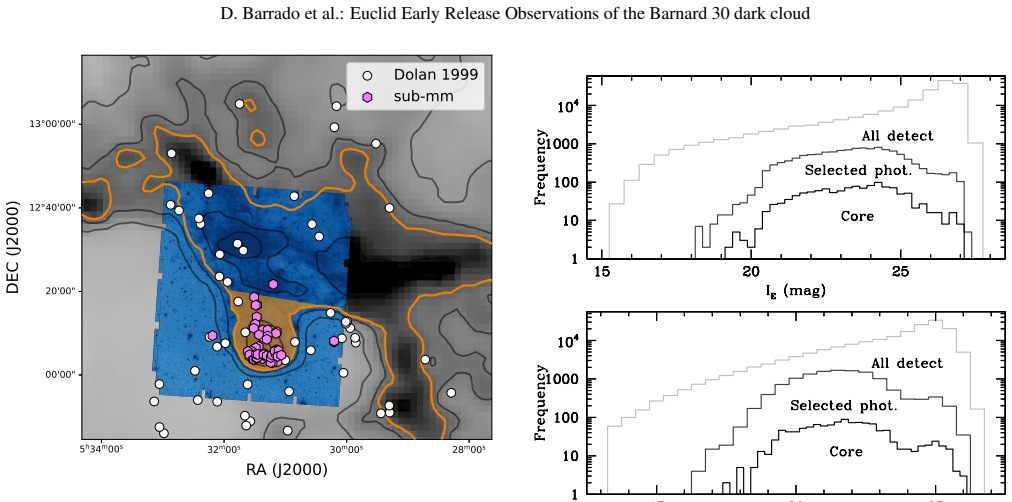
The load-bearing object is DeNeb, a deep-learning tool that models and subtracts the spatially extended nebular emission of the dark cloud so that faint point sources embedded in the nebulosity become detectable. On the DeNeb-processed images, source detection and photometry are run with SExtractor on a $\chi^2$ image built from the three near-infrared Euclid bands, with morphological criteria removing blended or extended sources and Gaia astrometry removing nearby moving objects. Candidate selection then uses 3 Myr isochrones at 400 pc from the CFBD2023 models (complemented by EXO-REM models below 1800 K) in multiple color-magnitude diagrams, followed by VOSA SED fitting with BT-Settl model atmospheres to derive effective temperatures, luminosities, extinctions, and membership grades in the Hertzsprung-Russell diagram.
What would settle it
Take the 23 probable members and measure their parallaxes, proper motions, or medium-resolution spectra: a genuine young member should share the association's space motion and show youth indicators such as low gravity and lithium absorption, while reddened background giants or galaxies would not. Counting how many sources in an equal-area off-cloud control field satisfy the same color-magnitude cuts would quantify the expected contamination.
Extended reading notes
Core claim
The central claim is that Euclid Early Release Observations of Barnard 30, combined with the DeNeb nebula-removal processing and multi-wavelength photometry, select a clean sample of very low-mass candidate members of a 3 Myr-old association at 400 pc. After requiring candidates to fall on the red side of 3 Myr isochrones in six Euclid/Spitzer color-magnitude diagrams and fitting their spectral energy distributions with BT-Settl models, 23 objects are classified as probable members and 44 as possible members. The survey reaches effective temperatures near 1500--1800 K and masses around 45 $M_{\mathrm{Jup}}$, approaching the putative bottom of the initial mass function. The single spectrum obtained, for B30-Euclid-25, shows an L2 low-gravity dwarf with moderate reddening; its estimated mass is 15--20 $M_{\mathrm{Jup}}$ if membership is confirmed, making it a strong substellar benchmark for the region.
Load-bearing premise
The selection assumes every candidate sits at the same distance (400 pc) with the same young surface gravity ($\log g = 3.5$), because the objects are too faint for Gaia astrometry; a different distance or a different true age for the cloud would move the inferred luminosities, masses, and membership grades.
Editorial extensions
If this is right
- If the 23 probable members are real, Barnard 30's substellar population is much richer than the handful of submillimeter candidates known before, and the survey reaches close to the expected low-mass cutoff of the initial mass function.
- B30-Euclid-25, if membership is confirmed, is a benchmark L2 low-gravity object at 15--20 $M_{\mathrm{Jup}}$, one of the lowest-mass spectroscopically studied members of the region.
- The wide binary candidates with separations of roughly 800--2000 au, if physical, would constrain formation pathways that can produce wide substellar pairs.
- The success of the Euclid-plus-DeNeb pipeline in a dense, extincted cloud means the same approach can map brown-dwarf populations in other young associations observed by Euclid.
- Confirmation of even a subset of these candidates would test whether star-formation theories can produce objects down to planetary masses in a roughly 3 Myr environment.
Reading between the lines
- Because the reddening vectors in the color-magnitude diagrams run almost parallel to the isochrones, the mass estimates may be more secure than the membership grades; the next bottleneck is astrometric or spectroscopic confirmation rather than photometric depth.
- The same DeNeb-plus-Euclid methodology could be applied to other Early Release Observation dark clouds, and a multi-cloud survey would test whether the low-mass cutoff of the initial mass function varies with cloud mass or environment.
- If several of the faintest candidates near 45 $M_{\mathrm{Jup}}$ are confirmed, Barnard 30 would provide a young, coeval sample for calibrating atmospheric and evolutionary models at the L/T transition.
Editorial analysis
A structured set of objections, weighed in public.
Referee Report
Summary. This paper presents Euclid ERO observations of the Barnard 30 dark cloud, processed with DeNeb, and identifies 104 low-mass candidate members (71 from strict CMD selection, 23 from flexible selection, 10 from earlier sub-mm studies) of which 23 are classified as 'probable members' near the 3 Myr isochrone. The authors carry out SED fitting with VOSA/BT-Settl and EXO-REM isochrones, reject 16 candidates, and obtain one GTC/EMIR low-resolution NIR spectrum of B30-Euclid-25, classifying it as an L1-L3 low-gravity dwarf. They conclude that the survey reaches approximately 45 M_Jup and potentially approaches the IMF cutoff.
Significance. If the 23-member list is robust, this would be a significant expansion of the substellar census in B30 and would demonstrate the value of Euclid plus DeNeb for very low-mass searches in extincted regions. The paper's strengths include the careful multi-wavelength catalog assembly, the use of both CFBD2023 and EXO-REM isochrones, the comparison with proper-motion-selected Taurus members, and the public candidate tables. However, the central claim is weakened by the lack of an independent contamination control and by the reliance on the same isochrones for selection and classification.
major comments (4)
- [§3.1 and §3.4] The membership selection uses photometric proximity to the 3 Myr isochrone at 400 pc, and the only contamination estimate, reported in Section 3.4 as 'higher than 15% and 33%' for selection #1 and #2, is derived from the same HR-diagram comparison against BT-Settl isochrones. This rate is not propagated into the final 23 'probable members,' and no control field or source-injection test is presented to quantify reddened background contamination. Please add a control-field measurement or an explicit Monte Carlo/synthetic-population contamination estimate, and state how the final membership counts change.
- [§3.4] The SED-fitting classification assumes d=400 pc and log g=3.5 for every object (with the justification that candidates are too faint for Gaia). Because a foreground 250 pc brown dwarf or an older background M dwarf can occupy the same CMD locus after moderate reddening, the rejection step and the 'probable'/'possible' boundary inherit this assumption. The authors acknowledge the distance uncertainty but do not test its impact; I request a sensitivity test varying distance and log g, or a Bayesian treatment with foreground/background priors.
- [§4.2] The conclusion that the survey 'appears to reach down to a few Jupiter masses, approximately 45 M_Jup' is internally inconsistent and unsupported by a completeness calculation. No recovery simulation or limiting-mass analysis is provided for the spatially variable extinction and crowding within B30. Please add a completeness/recovery test and quote the 50% completeness mass, or remove the 'few Jupiter masses' wording.
- [§3.6.2] The paper uses B30-Euclid-25 as validation of the photometric method, but the spectroscopic classification is not secure: the best template match shows discrepancies in the K band, the Hcont index (0.78) is too low for a low-gravity object, and the TLI-g index (0.83) is only marginally consistent with low gravity. Given that membership is explicitly not confirmed, the conclusion that this 'validates our photometric selection methodology' is too strong. Please rephrase this as a single-object case study and list the consistency checks that would be needed for full validation.
minor comments (6)
- [Header/keywords] The 'Key words' line lists 'giant planet formation – κ-mechanism – stability of gas spheres', which are unrelated to this paper; they appear to be left from another manuscript.
- [Abstract and §3.6.2] The phrases 'a initial sample' (Abstract) and 'spetral type' (Section 3.6.2) should be corrected.
- [§3.1 and §3.3] The total number of unique sources is given as 104 in Section 3.1 and 106 in Section 3.3; please reconcile these values.
- [§2.1.3 and elsewhere] The object is called B30-Euclid-025 in Section 2.1.3 and B30-Euclid-25 elsewhere; please standardize the naming.
- [Table 1] The 'Mem?' column lists 'Prob' and 'Poss' but the membership flags are not defined in the table caption; please add a note explaining the criteria.
- [§3.1] The sentence 'Contamination by reddened background stars might be relevant' is immediately followed by an argument that reddening vectors run parallel to the isochrone; since this is central, please quantify the expected contamination rather than relying on the vector direction alone.
Circularity Check
Membership classification is defined by the same 3 Myr isochrone used to select candidates, so the '23 probable members' claim is partly a restatement of the selection criterion rather than an independent confirmation.
-
self definitional
[Section 3.1 (Color-Magnitude Diagrams) and Section 3.4 (VOSA and the HRD)]
"we have redefined our membership classification for the remaining candidates: probable members for those close or above the 3 Myr isochrone (23 objects), and possible members for those between (and close to) the 50 Myr and 10 Gyr isochrones at the dark cloud distance (44 objects)."
Candidates were first defined in Sec. 3.1 by lying 'on the red side of the isochrone in all CMDs'. Membership is then re-defined in Sec. 3.4 as lying 'close or above the 3 Myr isochrone' in the HRD after SED fitting. Both criteria use the same CFBD2023/EXO-REM 3 Myr isochrones and the same assumed distance (400 pc) and gravity (logg = 3.5). The 23 'probable members' are therefore the candidates that remain consistent with the same fiducial isochrone after a model-dependent reddening correction; the label does not come from an independent membership test (no proper motion, no lithium, no radial velocity, and only one object has spectroscopy). The headline count is thus partly a restatement of the selection criterion, not an independent derivation.
full rationale
The central claim of 23 probable members is partially circular: isochrone proximity defines both candidate selection and the 'probable member' classification. The SED fitting step adds Teff/Lbol information but shares the same isochrones, distance, and gravity assumptions, making it a consistency check rather than an independent confirmation. The paper itself acknowledges 'individual distances (we have assumed 400 pc for all of them since they are too faint to be detected by Gaia)' and that 'low-resolution spectroscopy is insufficient to definitively confirm the membership' of B30-Euclid-25. The external Taurus proper-motion comparison in Sec. 3.5 supports the photometric locus of young substellar objects but does not independently establish B30 membership. The admitted pollution rates of 15% and 33% are not folded into the final 23. The completeness claim in Sec. 4.2 is internally contradictory ('a few Jupiter masses, approximately 45 M_Jup') and is not backed by a recovery simulation, but that is a missing-support issue rather than circularity. No load-bearing self-citation chain or imported uniqueness theorem was found; the DeNeb/SExtractor/VOSA tools are standard processing steps. Because the central classification reduces by construction to the same isochrone, the score is 6 rather than lower.
Assumptions & free parameters
free parameters (6)
- A_V reddening per object =
0 to 9 mag in Table 1
- T_eff per object =
1500 to 3700 K in Table 1
- L_bol per object =
3.5e-4 to 0.02 L_sun in Table 1
- log g = 3.5 =
3.5 (fixed)
- Distance = 400 pc =
400 pc (fixed)
- EXO-REM f_sed = 3 =
3 (fixed)
assumptions (4)
- domain assumption Evolutionary and atmospheric models (CFBD2023, EXO-REM, BT-Settl) accurately predict colors, luminosities, and masses for young substellar objects.
- domain assumption Barnard 30 has an age of approximately 3 Myr.
- domain assumption The Cardelli et al. (1989) extinction law applies to the cloud.
- domain assumption The IRAS isocontour boundary effectively shields against background contaminants.
Cite this review
Pith. "Pith review of Euclid Early Release Observations of the Barnard 30 dark cloud I. Brown dwarfs and planetary mass candidate members at the core of the association." pith.science (2026). https://pith.science/paper/KHYO54LO
@misc{pith2026260807048,
  author       = {Pith},
  title        = {Pith review of: Euclid Early Release Observations of the Barnard 30 dark cloud I. Brown dwarfs and planetary mass candidate members at the core of the association},
  year         = {2026},
  howpublished = {\url{https://pith.science/paper/KHYO54LO}},
  note         = {Machine review of arXiv:2608.07048}
}
read the original abstract
This study aims to identify very low-mass members within the Barnard 30 dark cloud, with a particular focus on detecting objects in the substellar domain, including those within the planetary-mass regime. We employed deep photometric observations using data from the Euclid mission, incorporating advanced data processing techniques, in particular the DeNeb tool for optimized source detection. We also analyze multi-wavelength ancillary observations and perform a Spectral Energy Distribution analysis for each candidate member. In addition, low-resolution near-infrared spectroscopy was obtained for one candidate to further assess its nature and properties. Our initial photometric analysis yielded a initial sample of nearly one hundred candidate members in the substellar mass range. A subsample of 23 probable members, located close to the 3 Myr isochrone, has been identified. Thus, we have substantially expanded the known population of faint, cool sources associated with the region. Low resolution near-IR spectroscopic analysis of one candidate reveals an L2 spectral type with low gravity, consistent with a young ultra-cool dwarf. If its membership is confirmed, its estimated mass lies in the range 15-20 Mjup. These findings validate the reliability of our multi-wavelength photometric selection methodology. These results offer valuable insights into the low-mass end of the initial mass function (IMF) and demonstrate the effectiveness of Euclid in identifying brown dwarf and planetary-mass candidates in nearby, densely packed star-forming regions.
Figures


Figures from the paper (7 more)


Reference graph
Works this paper leans on
-
[1]
Youth analysis of near-infrared spectra of young low-mass stars and brown dwarfs. , keywords =. doi:10.1051/0004-6361/202142050 , archivePrefix =. 2110.06368 , primaryClass =
-
[2]
A Near-Infrared Spectroscopic Study of Young Field Ultracool Dwarfs: Additional Analysis
A near-infrared spectroscopic study of young field ultracool dwarfs: additional analysis. , keywords =. doi:10.48550/arXiv.1307.7153 , archivePrefix =. 1307.7153 , primaryClass =
-
[3]
Characterizing Young Brown Dwarfs Using Low-Resolution Near-Infrared Spectra. , keywords =. doi:10.1086/510845 , archivePrefix =. astro-ph/0611408 , primaryClass =
-
[4]
The Relationship between Infrared, Optical, and Ultraviolet Extinction. , keywords =. doi:10.1086/167900 , adsurl =
-
[5]
Astronomical Data Analysis Software and Systems XIV , year = 2005, editor =
TOPCAT & STIL: Starlink Table/VOTable Processing Software. Astronomical Data Analysis Software and Systems XIV , year = 2005, editor =
2005
-
[6]
A new set of atmosphere and evolution models for cool T-Y brown dwarfs and giant exoplanets. , keywords =. doi:10.1051/0004-6361/201937381 , archivePrefix =. 2003.13717 , primaryClass =
arXiv 2003
-
[7]
The Hawaii Infrared Parallax Program. V. New T-dwarf Members and Candidate Members of Nearby Young Moving Groups. , keywords =. doi:10.3847/1538-4357/abe3fa , archivePrefix =. 2102.05045 , primaryClass =
-
[8]
The JWST Early-release Science Program for Direct Observations of Exoplanetary Systems II: A 1 to 20 m Spectrum of the Planetary-mass Companion VHS 1256-1257 b. , keywords =. doi:10.3847/2041-8213/acb04a , archivePrefix =. 2209.00620 , primaryClass =
Show all 290 references
-
[9]
, keywords =
JWST/NIRSpec Observations of the Planetary Mass Companion TWA 27B. , keywords =. doi:10.3847/2041-8213/acd635 , archivePrefix =. 2305.18603 , primaryClass =
-
[10]
, keywords =
Discovery of a Wide Planetary-mass Companion to the Young M3 Star GU Psc. , keywords =. doi:10.1088/0004-637X/787/1/5 , archivePrefix =. 1405.2932 , primaryClass =
-
[11]
, keywords =
WISEA J114724.10-204021.3: A Free-floating Planetary Mass Member of the TW Hya Association. , keywords =. doi:10.3847/2041-8205/822/1/L1 , archivePrefix =. 1603.07985 , primaryClass =
-
[12]
, keywords =
The Extremely Red, Young L Dwarf PSO J318.5338-22.8603: A Free-floating Planetary-mass Analog to Directly Imaged Young Gas-giant Planets. , keywords =. doi:10.1088/2041-8205/777/2/L20 , archivePrefix =. 1310.0457 , primaryClass =
-
[13]
The NISP Instrument
Euclid: III. The NISP Instrument. , keywords =. doi:10.1051/0004-6361/202450786 , archivePrefix =. 2405.13493 , primaryClass =
-
[14]
Euclid preparation. XVIII. The NISP photometric system. , keywords =. doi:10.1051/0004-6361/202142897 , archivePrefix =. 2203.01650 , primaryClass =
-
[15]
The VIS instrument
Euclid: II. The VIS instrument. , keywords =. doi:10.1051/0004-6361/202450996 , archivePrefix =. 2405.13492 , primaryClass =
-
[16]
Overview of the Euclid mission
Euclid: I. Overview of the Euclid mission. , keywords =. doi:10.1051/0004-6361/202450810 , archivePrefix =. 2405.13491 , primaryClass =
-
[17]
, keywords =
Euclid: Early Release Observations A glance at free-floating newborn planets in the Orionis cluster. , keywords =. doi:10.1051/0004-6361/202450793 , archivePrefix =. 2405.13497 , primaryClass =
-
[18]
arXiv e-prints , keywords =
Euclid: Early Release Observations -- A glance at free-floating new-born planets in the sigma Orionis cluster. arXiv e-prints , keywords =. doi:10.48550/arXiv.2405.13497 , archivePrefix =. 2405.13497 , primaryClass =
-
[19]
, keywords =
Euclid: Early Release Observations Overview of the Perseus cluster and analysis of its luminosity and stellar mass functions. , keywords =. doi:10.1051/0004-6361/202450808 , archivePrefix =. 2405.13501 , primaryClass =
-
[20]
, keywords =
Euclid: Early Release Observations Programme overview and pipeline for compact- and diffuse-emission photometry. , keywords =. doi:10.1051/0004-6361/202450803 , archivePrefix =. 2405.13496 , primaryClass =
-
[21]
arXiv e-prints , keywords =
Euclid: Early Release Observations -- Programme overview and pipeline for compact- and diffuse-emission photometry. arXiv e-prints , keywords =. doi:10.48550/arXiv.2405.13496 , archivePrefix =. 2405.13496 , primaryClass =
- [22]
-
[23]
, archivePrefix = "arXiv", eprint =
The Far-Infrared Surveyor (FIS) for AKARI. , archivePrefix = "arXiv", eprint =
-
[24]
, archivePrefix = "arXiv", eprint =
The Wide-field Infrared Survey Explorer (WISE): Mission Description and Initial On-orbit Performance. , archivePrefix = "arXiv", eprint =. doi:10.1088/0004-6256/140/6/1868 , adsurl =
-
[25]
, keywords =
^ 15 NH _ 3 in the atmosphere of a cool brown dwarf. , keywords =. doi:10.1038/s41586-023-06813-y , archivePrefix =. 2311.08054 , primaryClass =
-
[26]
doi:10.1007/978-3-031-29885-1 , adsurl =
Cosmography in the Age of Discovery and the Scientific Revolution. doi:10.1007/978-3-031-29885-1 , adsurl =
-
[27]
Infrared and submillimeter data in the Barnard 30 dark cloud
Early phases in the stellar and substellar formation and evolution. Infrared and submillimeter data in the Barnard 30 dark cloud. , keywords =. doi:10.1051/0004-6361/201527938 , archivePrefix =. 1712.06399 , primaryClass =
-
[28]
XMM-Newton investigations of the Lambda Orionis star-forming region (XILO). I. The young cluster Collinder 69. , archivePrefix = "arXiv", eprint =. doi:10.1051/0004-6361/201014732 , adsurl =
-
[29]
, keywords =
A proto brown dwarf candidate in Taurus. , keywords =. doi:10.1051/0004-6361/200912276 , adsurl =
-
[30]
, archivePrefix = "arXiv", eprint =
Spitzer: Accretion in Low-Mass Stars and Brown Dwarfs in the Orionis Cluster. , archivePrefix = "arXiv", eprint =. doi:10.1086/518816 , adsurl =
-
[31]
, archivePrefix = "arXiv", eprint =
The young, wide and very low mass visual binary Lambda Orionis 167. , archivePrefix = "arXiv", eprint =. doi:10.1051/0004-6361:20077258 , adsurl =
-
[32]
, eprint =
On the age of the TW Hydrae association and 2M1207334-393254. , eprint =. doi:10.1051/0004-6361:20065717 , adsurl =
-
[33]
Astronomische Nachrichten , eprint =
Variability in the Lambda Orionis cluster substellar domain. Astronomische Nachrichten , eprint =. doi:10.1002/asna.200510443 , adsurl =
-
[34]
, eprint =
A New Classical T Tauri Object at the Substellar Boundary in Chamaeleon II. , eprint =. doi:10.1086/424560 , adsurl =
-
[35]
, eprint =
Spectroscopy of Very Low Mass Stars and Brown Dwarfs in IC 2391: Lithium Depletion and H Emission. , eprint =. doi:10.1086/423485 , adsurl =
-
[36]
, eprint =
The Substellar Population of the Young Cluster Orionis. , eprint =. doi:10.1086/421762 , adsurl =
-
[37]
, keywords =
Classical T Tauri Stars and Substellar Analogs. , keywords =. doi:10.1023/B:ASTR.0000045073.12759.1f , adsurl =
-
[38]
Detection of accretion in KPNO-Tau-3
High resolution spectroscopy of brown dwarfs in Taurus. Detection of accretion in KPNO-Tau-3. , eprint =. doi:10.1051/0004-6361:20047122 , adsurl =
-
[39]
, eprint =
Accretion and Outflow in the Substellar Domain: Magellan Spectroscopy of LS-RCrA 1. , eprint =. doi:10.1086/381747 , adsurl =
-
[40]
, eprint =
An Empirical Criterion to Classify T Tauri Stars and Substellar Analogs Using Low-Resolution Optical Spectroscopy. , eprint =. doi:10.1086/379673 , adsurl =
-
[41]
VLT/FORS spectroscopy and 2MASS photometry
The sigma Orionis substellar population. VLT/FORS spectroscopy and 2MASS photometry. , keywords =. doi:10.1051/0004-6361:20030407 , adsurl =
-
[42]
, eprint =
A substellar mass function for Alpha Persei. , eprint =. doi:10.1051/0004-6361:20021262 , adsurl =
-
[43]
, eprint =
Discovery of a very cool object with extraordinarily strong Hmathsf emission. , eprint =. doi:10.1051/0004-6361:20021251 , adsurl =
-
[44]
, eprint =
Optical spectroscopy of isolated planetary mass objects in the Orionis cluster. , eprint =. doi:10.1051/0004-6361:20011152 , adsurl =
-
[45]
, year = 2001, month = jul, volume = 555, pages =
Erratum: From the Top to the Bottom of the Main Sequence: A Complete Mass Function of the Young Open Cluster M35. , year = 2001, month = jul, volume = 555, pages =. doi:10.1086/321435 , adsurl =
2001 doi
-
[46]
, eprint =
Very Low-Mass Stars and Brown Dwarfs of the Young Open Cluster IC 2391. , eprint =. doi:10.1086/320359 , adsurl =
-
[47]
A comparison with the Pleiades, field stars and the Sun
The effect of stellar activity on the Li I 6708, Na I 5896 and K I 7699 lines. A comparison with the Pleiades, field stars and the Sun. , eprint =. doi:10.1051/0004-6361:20010409 , adsurl =
-
[48]
WIYN Open Cluster Study. V. Lithium Depletion and Metallicity in G and K Dwarfs of the Open Cluster M35. , eprint =. doi:10.1086/319045 , adsurl =
-
[49]
, eprint =
From the Top to the Bottom of the Main Sequence: A Complete Mass Function of the Young Open Cluster M35. , eprint =. doi:10.1086/318283 , adsurl =
-
[50]
, keywords =
The Lithium-Depletion Boundary and the Age of the Young Open Cluster IC 2391. , keywords =. doi:10.1086/312212 , adsurl =
- [51]
-
[52]
The age of Fomalhaut and VEGA
The Castor moving group. The age of Fomalhaut and VEGA. , eprint =
-
[53]
, eprint =
Stellar Activity in Coeval Open Clusters: Praesepe and the Hyades. , eprint =. doi:10.1086/306241 , adsurl =
-
[54]
The age-mass relation for chromospherically active binaries. III. Lithium depletion in giant components. , eprint =
-
[55]
, eprint =
The Mass Function at the End of the Main Sequence: The M35 Open Cluster. , eprint =. doi:10.1023/A:1002180229392 , adsurl =
-
[56]
, year = 1998, month = jun, volume = 263, pages =
Brown Dwarfs and Very Low Mass Stars: Towards a New Age Scale for Young Open Clusters. , year = 1998, month = jun, volume = 263, pages =. doi:10.1023/A:1002174614429 , adsurl =
1998 doi
-
[57]
, year = 1998, month = jun, volume = 263, pages =
The Age of Beta PIC Type Stars: Vega, Fomalhaut, PIC and HR4796. , year = 1998, month = jun, volume = 263, pages =. doi:10.1023/A:1002122630358 , adsurl =
1998 doi
-
[58]
The age-mass relation for chromospherically active binaries. II. Lithium depletion in dwarf components. , eprint =
-
[59]
, year = 1997, month = jan, volume = 109, pages =
The Lithium-Age-Mass Connection in Cool Stars: The Effects of Rotation and Chromospheric Activity. , year = 1997, month = jan, volume = 109, pages =. doi:10.1086/133861 , adsurl =
1997 doi
- [60]
-
[61]
, eprint =
Lithium abundance in binaries of the Hyades open cluster. , eprint =
-
[62]
The relation lithium-age-mass en late type stars: The effect of rotation and chromospheric activity
-
[63]
, keywords =
BV(RI)\_KC\_ CCD photometry of the core of the young open cluster, NGC 5460. , keywords =
-
[64]
The age-mass relation for chromospherically active binaries. I. The evolutionary status. , keywords =
-
[65]
, archivePrefix = "arXiv", eprint =
The low-mass population of the Ophiuchi molecular cloud. , archivePrefix = "arXiv", eprint =. doi:10.1051/0004-6361/200913900 , adsurl =
-
[66]
, archivePrefix = "arXiv", eprint =
Deep near-IR variability survey of pre-main-sequence stars in Ophiuchi. , archivePrefix = "arXiv", eprint =. doi:10.1051/0004-6361:20079146 , adsurl =
-
[67]
, archivePrefix = "arXiv", eprint =
Spectroscopic Identifications of Spitzer Sources in the SWIRE/XMM-Newton/ELAIS-S1 Field: A Large Fraction of Active Galactic Nucleus with High F(24 m)/F(R) Ratio. , archivePrefix = "arXiv", eprint =. doi:10.1088/0004-637X/703/2/1778 , adsurl =
-
[68]
, eprint =
X-ray emission from T Tauri stars and the role of accretion: inferences from the XMM-Newton extended survey of the Taurus molecular cloud. , eprint =. doi:10.1051/0004-6361:20066565 , adsurl =
-
[69]
ArXiv Astrophysics e-prints , eprint =
X-ray Emission from T Tauri Stars and the Role of Accretion: Inferences from the XMM-Newton Extended Survey of the Taurus Molecular Cloud. ArXiv Astrophysics e-prints , eprint =
-
[70]
, keywords =
Notes on the convection in the ATLAS9 model atmospheres. , keywords =
-
[71]
I - Univariate distributions
Statistical methods for astronomical data with upper limits. I - Univariate distributions. , keywords =. doi:10.1086/163225 , adsurl =
-
[72]
, eprint =
X-ray emission from the young brown dwarfs of the Taurus molecular cloud. , eprint =. doi:10.1051/0004-6361:20065559 , adsurl =
-
[73]
, eprint =
Optical and Infrared Properties of the 2 Ms Chandra Deep Field North X-Ray Sources. , eprint =. doi:10.1086/376843 , adsurl =
-
[74]
Bright coronal sources and the X-ray emission from intermediate-type stars
XMM-Newton and the Pleiades - I. Bright coronal sources and the X-ray emission from intermediate-type stars. , eprint =. doi:10.1046/j.1365-8711.2003.06991.x , adsurl =
2003
-
[75]
The HELLAS2XMM Survey. I. The X-Ray Data and the logN-logS Relation. , eprint =. doi:10.1086/324261 , adsurl =
-
[76]
, keywords =
Physical parameters of late M-type members of Chamaeleon I and TW Hydrae Association: dust settling, age dispersion and activity. , keywords =. doi:10.1093/mnras/stw2760 , archivePrefix =. 1610.06951 , primaryClass =
-
[77]
Spectroscopy of very low-mass stars and brown dwarfs in the Lambda Orionis star-forming region. II. Rotation, activity and other properties of spectroscopically confirmed members of Collinder 69. , keywords =. doi:10.1051/0004-6361/201219374 , adsurl =
-
[78]
Spectroscopy of very low mass stars and brown dwarfs in the Lambda Orionis star forming region. I. Enlarging the census down to the planetary mass domain in Collinder 69. , archivePrefix = "arXiv", eprint =. doi:10.1051/0004-6361/201116617 , adsurl =
-
[79]
The Lambda Orionis Star Forming Region: a multiwavelength approach
-
[80]
An application to the Collinder 69 open cluster
VOSA: virtual observatory SED analyzer. An application to the Collinder 69 open cluster. , archivePrefix = "arXiv", eprint =. doi:10.1051/0004-6361:200810395 , adsurl =
-
[81]
A deep look into the core of young clusters. II. -Orionis. , archivePrefix = "arXiv", eprint =. doi:10.1051/0004-6361/200912569 , adsurl =
-
[82]
New determination of the hydrogen burning limit
Impact of a new H/He equation of state on the evolution of massive brown dwarfs. New determination of the hydrogen burning limit. , keywords =. doi:10.1051/0004-6361/202243832 , archivePrefix =. 2212.07153 , primaryClass =
-
[83]
, eprint =
Evolutionary Models for Very Low-Mass Stars and Brown Dwarfs with Dusty Atmospheres. , eprint =. doi:10.1086/309513 , adsurl =
-
[84]
2: Interpretations
An IUE survey of interstellar H I LY alpha absorption. 2: Interpretations. , keywords =. doi:10.1086/174139 , adsurl =
-
[85]
, eprint =
The Infrared Array Camera (IRAC) for the Spitzer Space Telescope. , eprint =. doi:10.1086/422843 , adsurl =
-
[86]
, eprint =
The GOODS-MUSIC sample: a multicolour catalog of near-IR selected galaxies in the GOODS-South field. , eprint =. doi:10.1051/0004-6361:20053979 , adsurl =
-
[88]
The Spitzer c2d Survey of Large, Nearby, Interstellar Clouds. VIII. Serpens Observed with MIPS. , archivePrefix = "arXiv", eprint =. doi:10.1086/518647 , adsurl =
-
[89]
The Spitzer c2d Survey of Large, Nearby, Insterstellar Clouds. II. Serpens Observed with IRAC. , eprint =. doi:10.1086/503520 , adsurl =
-
[91]
, eprint =
Spitzer Observations of IC 348: The Disk Population at 2-3 Million Years. , eprint =. doi:10.1086/499808 , adsurl =
-
[92]
, eprint =
Infrared L-Band Observations of the Trapezium Cluster: A Census of Circumstellar Disks and Candidate Protostars. , eprint =. doi:10.1086/316848 , adsurl =
- [93]
-
[94]
, keywords =
The Lambda Orionis association. , keywords =
-
[95]
, keywords =
The Multiband Imaging Photometer for Spitzer (MIPS). , keywords =. doi:10.1086/422717 , adsurl =
-
[96]
, eprint =
An internet server for pre-main sequence tracks of low- and intermediate-mass stars. , eprint =
-
[97]
VizieR Online Data Catalog , keywords =
VizieR Online Data Catalog: SWIRE ELAIS N1 Source Catalogs (Surace+, 2004). VizieR Online Data Catalog , keywords =
2004
-
[98]
, eprint =
An IRAS High Resolution Image Restoration (HIRES) Atlas of All Interacting Galaxies in the IRAS Revised Bright Galaxy Sample. , eprint =. doi:10.1086/420705 , adsurl =
-
[99]
, archivePrefix = "arXiv", eprint =
Brown dwarfs and very low mass stars in the Hyades cluster: a dynamically evolved mass function. , archivePrefix = "arXiv", eprint =. doi:10.1051/0004-6361:20079303 , adsurl =
-
[100]
doi:10.1051/0004-6361:20030938 , Eprint =
, Keywords =. doi:10.1051/0004-6361:20030938 , Eprint =
-
[101]
, keywords =
Brown dwarfs and very low-mass stars in the Pleiades cluster: a deep wide-field imaging survey. , keywords =
-
[102]
, keywords =
The angular momentum evolution of low-mass stars. , keywords =
-
[103]
, year = 1996, month = feb, volume = 236, pages =
Interstellar Extinction from Infrared to X-Rays: an Overview. , year = 1996, month = feb, volume = 236, pages =
1996
-
[104]
, eprint =
The Origin of T Tauri X-Ray Emission: New Insights from the Chandra Orion Ul tradeep Project. , eprint =. doi:10.1086/432891 , adsurl =
-
[105]
Membership and X-ray properties of PMS stars
ACIS-I observations of NGC 2264. Membership and X-ray properties of PMS stars. , eprint =. doi:10.1051/0004-6361:20065084 , adsurl =
-
[106]
, eprint =
Membership of the Orion Nebula Population from the Chandra Orion Ultradeep Project. , eprint =. doi:10.1086/432097 , adsurl =
-
[107]
, year = 2005, month = oct, volume = 160, pages =
Chandra Orion Ultradeep Project: Observations and Source Lists. , year = 2005, month = oct, volume = 160, pages =. doi:10.1086/432092 , adsurl =
2005 doi
-
[108]
, eprint =
The XMM-Newton optical/UV monitor telescope. , eprint =. doi:10.1051/0004-6361:20000044 , adsurl =
-
[109]
, year = 1999, month = nov, volume = 118, pages =
A WIYN Lithium Survey for Young Stars in the Orionis Star-Forming Region. , year = 1999, month = nov, volume = 118, pages =. doi:10.1086/301075 , adsurl =
1999 doi
-
[110]
, year = 2001, month = apr, volume = 121, pages =
The Spatial Distribution of the Orionis Pre-Main-Sequence Population. , year = 2001, month = apr, volume = 121, pages =. doi:10.1086/319946 , adsurl =
2001 doi
- [112]
-
[113]
, eprint =
A statistical analysis of X-ray variability in pre-main sequence objects of th e Taurus molecular cloud. , eprint =. doi:10.1051/0004-6361:20066043 , adsurl =
-
[114]
, eprint =
Stellar Activity on the Young Suns of Orion: COUP Observations of K5-7 Pre-Mai n-Sequence Stars. , eprint =. doi:10.1086/432099 , adsurl =
-
[115]
2MASS All Sky Catalog of point sources
-
[116]
Explanatory Supplement to the AllWISE Data Release Products, by R
Explanatory Supplement to the AllWISE Data Release Products. Explanatory Supplement to the AllWISE Data Release Products, by R. M. Cutri et al. , year = 2013, month = nov, pages =
2013
-
[117]
XMM-Newton observatory. I. The spacecraft and operations. , year = 2001, month = jan, volume = 365, pages =. doi:10.1051/0004-6361:20000036 , adsurl =
2001 doi
-
[118]
, eprint =
The European Photon Imaging Camera on XMM-Newton: The MOS cameras : The MOS cameras. , eprint =. doi:10.1051/0004-6361:20000038 , adsurl =
-
[119]
, year = 2001, month = jan, volume = 365, pages =
The European Photon Imaging Camera on XMM-Newton: The pn-CCD camera. , year = 2001, month = jan, volume = 365, pages =. doi:10.1051/0004-6361:20000066 , adsurl =
2001 doi
-
[120]
doi:10.1086/192235 , Journal =
-
[121]
doi:10.1051/0004-6361:20066993 , Eprint =
, Keywords =. doi:10.1051/0004-6361:20066993 , Eprint =
-
[122]
doi:10.1086/308439 , Journal =
- [123]
-
[124]
doi:10.1086/173608 , Journal =
-
[125]
doi:10.1086/167749 , Journal =
-
[126]
doi:10.1086/186956 , Journal =
-
[127]
doi:10.1086/164924 , Journal =
-
[128]
Star Forming Regions , Date-Added =
-
[129]
, archivePrefix = "arXiv", eprint =
The discovery of a very cool, very nearby brown dwarf in the Galactic plane. , archivePrefix = "arXiv", eprint =. doi:10.1111/j.1745-3933.2010.00927.x , adsurl =
2010
-
[132]
, eprint =
Spectroscopy of planetary mass brown dwarfs in Orion. , eprint =. doi:10.1111/j.1745-3933.2006.00244.x , adsurl =
2006
-
[134]
Origins of Life and Evolution of the Biosphere , keywords =
UV Circular Polarisation in Star Formation Regions: The Origin of Homochirality?. Origins of Life and Evolution of the Biosphere , keywords =. doi:10.1007/s11084-005-7770-6 , adsurl =
-
[135]
, eprint =
High-resolution imaging polarimetry of HL Tau and magnetic field structure. , eprint =. doi:10.1111/j.1365-2966.2004.08026.x , adsurl =
2004
-
[136]
, eprint =
Computations of light scattering in young stellar objects. , eprint =. doi:10.1016/S0022-4073(02)00329-1 , adsurl =
-
[137]
, keywords =
A search for the infrared spectroscopic signature of hot Jupiter planets. , keywords =. doi:10.1046/j.1365-8711.2002.05786.x , adsurl =
2002
-
[138]
, eprint =
Infrared spectroscopy of substellar objects in Orion. , eprint =. doi:10.1046/j.1365-8711.2001.04666.x , adsurl =
2001
-
[140]
, eprint =
A population of very young brown dwarfs and free-floating planets in Orion. , eprint =. doi:10.1046/j.1365-8711.2000.03515.x , adsurl =
2000
-
[142]
, keywords =
Imaging polarimetry of class I young stellar objects. , keywords =. doi:10.1046/j.1365-8711.1998.01797.x , adsurl =
1998
-
[143]
, keywords =
Butterfly star in Taurus: structures of young stellar objects. , keywords =
-
[144]
A High Resolution Study of Circumstellar Matter
-
[145]
, keywords =
Near-infrared observations of L1551-IRS5 with image sharpening. , keywords =
-
[146]
, keywords =
Discovery of a Candidate for the Coolest Known Brown Dwarf. , keywords =. doi:10.1088/2041-8205/730/1/L9 , adsurl =
-
[147]
, year = 2010, month = sep, volume = 720, pages =
ERRATUM: ''Discovery of a Wide Binary Brown Dwarf Born in Isolation'' <A href=''/abs/2009ApJ...691.1265L''>(2009, ApJ, 691, 1265)</A>. , year = 2010, month = sep, volume = 720, pages =. doi:10.1088/0004-637X/720/2/1781 , adsurl =
2009 doi
-
[148]
, year = 2010, month = aug, volume = 189, pages =
Erratum: ''The Disk Population of the Taurus Star-Forming Region'' <A href=''/abs/2010ApJS..186..111L''>(2010, ApJS, 186, 111)</A>. , year = 2010, month = aug, volume = 189, pages =. doi:10.1088/0067-0049/189/2/353 , adsurl =
2010 doi
-
[149]
, archivePrefix = "arXiv", eprint =
Spectroscopy of Putative Brown Dwarfs in Taurus. , archivePrefix = "arXiv", eprint =. doi:10.1088/2041-8205/716/2/L120 , adsurl =
-
[150]
, archivePrefix = "arXiv", eprint =
The Disk Population of the Taurus Star-Forming Region. , archivePrefix = "arXiv", eprint =. doi:10.1088/0067-0049/186/1/111 , adsurl =
-
[151]
, archivePrefix = "arXiv", eprint =
An Infrared/X-Ray Survey for New Members of the Taurus Star-Forming Region. , archivePrefix = "arXiv", eprint =. doi:10.1088/0004-637X/703/1/399 , adsurl =
-
[152]
, archivePrefix = "arXiv", eprint =
Discovery of a Wide Binary Brown Dwarf Born in Isolation. , archivePrefix = "arXiv", eprint =. doi:10.1088/0004-637X/691/2/1265 , adsurl =
-
[153]
, archivePrefix = "arXiv", eprint =
Disks around Brown Dwarfs in the Orionis Cluster. , archivePrefix = "arXiv", eprint =. doi:10.1086/592264 , adsurl =
-
[154]
, archivePrefix = "arXiv", eprint =
New Low-Mass Stars and Brown Dwarfs with Disks in the Chamaeleon I Star-Forming Region. , archivePrefix = "arXiv", eprint =. doi:10.1086/590364 , adsurl =
-
[155]
, archivePrefix = "arXiv", eprint =
The Disk Population of the Chamaeleon I Star-forming Region. , archivePrefix = "arXiv", eprint =. doi:10.1086/527347 , adsurl =
-
[156]
, archivePrefix = "arXiv", eprint =
The Stellar Population of the Chamaeleon I Star-forming Region. , archivePrefix = "arXiv", eprint =. doi:10.1086/520114 , adsurl =
-
[157]
, archivePrefix = "arXiv", eprint =
Hubble and Spitzer Observations of an Edge-on Circumstellar Disk around a Brown Dwarf. , archivePrefix = "arXiv", eprint =. doi:10.1086/520712 , adsurl =
-
[158]
, eprint =
Ophiuchus 1622-2405: Not a Planetary-Mass Binary. , eprint =. doi:10.1086/512539 , adsurl =
-
[159]
, eprint =
Discovery of Two T Dwarf Companions with the Spitzer Space Telescope. , eprint =. doi:10.1086/509073 , adsurl =
-
[160]
Protostars and Planets V , eprint =
The Formation of Brown Dwarfs: Observations. Protostars and Planets V , eprint =
-
[161]
, eprint =
Discovery of a Young Substellar Companion in Chamaeleon. , eprint =. doi:10.1086/506517 , adsurl =
-
[162]
, eprint =
A Survey for New Members of Taurus with the Spitzer Space Telescope. , eprint =. doi:10.1086/505572 , adsurl =
-
[163]
, eprint =
The Spatial Distribution of Brown Dwarfs in Taurus. , eprint =. doi:10.1086/504073 , adsurl =
-
[164]
, eprint =
Testing Theoretical Evolutionary Models with AB Doradus C and the Initial Mass Function. , eprint =. doi:10.1086/499096 , adsurl =
-
[165]
, eprint =
Discovery of a Planetary-Mass Brown Dwarf with a Circumstellar Disk. , eprint =. doi:10.1086/498868 , adsurl =
-
[166]
, eprint =
Discovery of a Wide, Low-Mass Binary System in Upper Scorpius. , eprint =. doi:10.1086/498267 , adsurl =
-
[167]
, eprint =
The Disk Fractions of Brown Dwarfs in IC 348 and Chamaeleon I. , eprint =. doi:10.1086/497031 , adsurl =
- [168]
-
[169]
, eprint =
A Hubble Space Telescope Search for Substellar Companions in the Young Cluster IC 348. , eprint =. doi:10.1086/429154 , adsurl =
-
[170]
, eprint =
Spitzer Identification of the Least Massive Known Brown Dwarf with a Circumstellar Disk. , eprint =. doi:10.1086/428613 , adsurl =
-
[171]
, eprint =
FLAMINGOS Spectroscopy of New Low-Mass Members of the Young Cluster IC 348. , eprint =. doi:10.1086/426052 , adsurl =
-
[172]
, eprint =
New Brown Dwarfs and an Updated Initial Mass Function in Taurus. , eprint =. doi:10.1086/425647 , adsurl =
-
[173]
, eprint =
Spectroscopic Confirmation of the Least Massive Known Brown Dwarf in Chamaeleon. , eprint =. doi:10.1086/425228 , adsurl =
-
[174]
, eprint =
A Survey for Low-Mass Stars and Brown Dwarfs in the Chamaeleontis and Chamaeleontis Young Associations. , eprint =. doi:10.1086/424963 , adsurl =
-
[175]
, eprint =
The First Discovery of a Wide Binary Brown Dwarf. , eprint =. doi:10.1086/423666 , adsurl =
-
[176]
, eprint =
Spectroscopy of Candidate Members of the Chamaeleontis and MBM 12 Young Associations. , eprint =. doi:10.1086/421291 , adsurl =
-
[177]
, eprint =
A Census of the Chamaeleon I Star-forming Region. , eprint =. doi:10.1086/381146 , adsurl =
-
[178]
, eprint =
The [C II] 158 Micron Line Deficit in Ultraluminous Infrared Galaxies Revisited. , eprint =. doi:10.1086/376965 , adsurl =
- [179]
-
[180]
, eprint =
New Low-Mass Members of the Taurus Star-forming Region. , eprint =. doi:10.1086/374983 , adsurl =
-
[181]
, eprint =
An Adaptive Optics Search for Companions to Stars with Planets. , eprint =. doi:10.1086/338338 , adsurl =
- [182]
-
[183]
, keywords =
The Initial Mass Function of Low-Mass Stars and Brown Dwarfs in Taurus. , keywords =. doi:10.1086/317232 , adsurl =
-
[184]
, eprint =
The Initial Mass Function of Low-Mass Stars and Brown Dwarfs in Young Clusters. , eprint =. doi:10.1086/309365 , adsurl =
-
[185]
, eprint =
Young Low-Mass Stars and Brown Dwarfs in IC 348. , eprint =. doi:10.1086/307902 , adsurl =
-
[186]
, eprint =
Low-Mass Star Formation and the Initial Mass Function in the Ophiuchi Cloud Core. , eprint =. doi:10.1086/307891 , adsurl =
-
[187]
, keywords =
Low-Mass Star Formation and the Initial Mass Function in IC 348. , keywords =. doi:10.1086/306393 , adsurl =
-
[188]
, keywords =
Infrared Space Observatory Measurements of a [C II] 158 Micron Line Deficit in Ultraluminous Infrared Galaxies. , keywords =. doi:10.1086/311562 , adsurl =
-
[189]
, eprint =
Near-Infrared Spectroscopy of Photodissociation Regions: The Orion Bar and Orion S. , eprint =. doi:10.1086/305682 , adsurl =
-
[190]
, eprint =
The Low-Mass Initial Mass Function in Young Clusters: L1495E. , eprint =. doi:10.1086/305447 , adsurl =
-
[191]
, keywords =
A Young Star near the Hydrogen-burning Limit. , keywords =. doi:10.1086/305171 , adsurl =
-
[192]
Low-Mass Star Formation and the Initial Mass Function in Young Clusters
-
[193]
, keywords =
Spectroscopy of a Young Brown Dwarf in the rho Ophiuchi Cluster 1. , keywords =. doi:10.1086/316784 , adsurl =
-
[194]
, keywords =
Near-Infrared H 2 and Associated O 0 and C + Emission from Dense Photon-dominated Regions. , keywords =. doi:10.1086/304128 , adsurl =
-
[195]
, keywords =
Near-Infrared Spectra of IC 59/63 and NGC 1535: Comparing Infrared and Ultraviolet Observations of H 2. , keywords =. doi:10.1086/310627 , adsurl =
-
[196]
, keywords =
Ultraviolet-excited H_ 2 : A Comparison with Large-Scale Tracers of Molecular Clouds. , keywords =. doi:10.1086/177234 , adsurl =
-
[197]
, keywords =
High-Resolution Near-Infrared Spectroscopy of Hubble 12. , keywords =. doi:10.1086/177056 , adsurl =
-
[198]
, keywords =
A new Fabry-Perot spectrometer for observations of diffuse near-infrared line emission. , keywords =. doi:10.1086/133535 , adsurl =
-
[199]
Near-Infrared Hydrogen Emission as a Probe of the Global Energetics and Morphology of Molecular Clouds
-
[200]
, keywords =
H2 emission as a tracer of molecular hydrogen: Large-scale observations of Orion. , keywords =. doi:10.1086/187663 , adsurl =
-
[201]
, archivePrefix = "arXiv", eprint =
Deep Near-infrared Imaging of the Oph cloud core: Clues to the Origin of the Lowest-mass Brown Dwarfs. , archivePrefix = "arXiv", eprint =. doi:10.1088/0004-637X/719/1/550 , adsurl =
-
[202]
, archivePrefix = "arXiv", eprint =
A Young Planetary-Mass Object in the Oph Cloud Core. , archivePrefix = "arXiv", eprint =. doi:10.1088/2041-8205/709/2/L158 , adsurl =
-
[203]
doi:10.1086/162628 , Journal =
-
[204]
doi:10.1086/172465 , Journal =
-
[205]
342: The Physics of Star Formation and Early Stellar Evolution , Date-Added =
NATO ASIC Proc. 342: The Physics of Star Formation and Early Stellar Evolution , Date-Added =
-
[206]
doi:10.1146/annurev.aa.25.090187.000323 , Journal =
- [207]
- [208]
-
[209]
arXiv:astro-ph/0211006 , Journal =
- [210]
-
[211]
The Messenger , Keywords =
-
[212]
doi:10.1051/0004-6361:20079049 , Eprint =
, Keywords =. doi:10.1051/0004-6361:20079049 , Eprint =
- [214]
-
[215]
doi:10.1086/305277 , Journal =
-
[216]
doi:10.1111/j.1365-2966.2008.13679.x , Eprint =
, Keywords =. doi:10.1111/j.1365-2966.2008.13679.x , Eprint =
2008
- [217]
-
[218]
doi:10.1086/175703 , Journal =
-
[219]
doi:10.1086/305048 , Journal =
- [220]
- [221]
-
[222]
doi:10.1086/115385 , Journal =
-
[223]
doi:10.1117/12.790276 , Month = aug, Series =
Society of Photo-Optical Instrumentation Engineers (SPIE) Conference Series , Date-Added =. doi:10.1117/12.790276 , Month = aug, Series =
-
[224]
doi:10.1051/0004-6361:200809481 , Eprint =
, Keywords =. doi:10.1051/0004-6361:200809481 , Eprint =
- [225]
-
[226]
doi:10.1051/0004-6361:20011443 , Journal =
-
[227]
arXiv:astro-ph/9706035 , Journal =
- [228]
- [229]
-
[230]
Spitzer Observations of the Orionis Cluster. I. The Frequency of Young Debris Disks at 5 Myr. , archivePrefix = "arXiv", eprint =. doi:10.1088/0004-637X/707/1/705 , adsurl =
-
[231]
doi:10.1051/0004-6361:20066140 , Eprint =
, Keywords =. doi:10.1051/0004-6361:20066140 , Eprint =
- [233]
-
[234]
, Month = jul, Pages =
-
[235]
New Astronomy Review , Month = jan, Pages =
-
[236]
arXiv:astro-ph/0001285 , Journal =
-
[237]
doi:10.1086/300486 , Journal =
-
[238]
arXiv:astro-ph/9506105 , Journal =
-
[239]
doi:10.1086/191733 , Journal =
-
[240]
doi:10.1086/118474 , Journal =
- [241]
-
[242]
doi:10.1086/192052 , Journal =
-
[243]
doi:10.1086/167410 , Journal =
-
[244]
doi:10.1086/171269 , Journal =
- [245]
-
[246]
doi:10.1111/j.1365-2966.2005.08655.x , Eprint =
, Keywords =. doi:10.1111/j.1365-2966.2005.08655.x , Eprint =
2005
-
[247]
doi:10.1051/0004-6361:20000205 , Journal =
- [248]
- [249]
- [250]
- [251]
-
[252]
doi:10.1051/0004-6361:20079207 , Journal =
- [253]
- [254]
- [255]
- [256]
-
[257]
, keywords =
The Coolest Isolated M Dwarf and Other 2MASS Discoveries. , keywords =. doi:10.1086/303613 , adsurl =
-
[258]
doi:10.1086/307414 , Journal =
-
[259]
doi:10.1086/301107 , Journal =
- [260]
-
[261]
arXiv:astro-ph/0208203 , Journal =
-
[262]
doi:10.1086/160858 , Journal =
-
[263]
doi:10.1051/0004-6361:200500020 , Eprint =
, Keywords =. doi:10.1051/0004-6361:200500020 , Eprint =
-
[264]
doi:10.1086/191720 , Journal =
-
[265]
doi:10.1086/115714 , Journal =
- [266]
-
[267]
doi:10.1126/science.1132128 , Journal =
- [268]
- [269]
-
[270]
doi:10.1051/0004-6361:20066814 , Eprint =
, Keywords =. doi:10.1051/0004-6361:20066814 , Eprint =
-
[271]
doi:10.1051/0004-6361:200500167 , Eprint =
, Keywords =. doi:10.1051/0004-6361:200500167 , Eprint =
-
[272]
doi:10.1051/0004-6361:20054252 , Eprint =
, Month = may, Pages =. doi:10.1051/0004-6361:20054252 , Eprint =
- [273]
-
[274]
astro-ph.SR
Atmospheres From Very Low-Mass Stars to Extrasolar Planets. EAS Publications Series , year = 2012, series =. doi:10.1051/eas/1257001 , adsurl =. arXiv:1206.1021 , primaryClass = "astro-ph.SR", editor =
2012
-
[275]
Highlights of Astronomy , keywords =
Brown Dwarf Model Atmospheres Based on Multi-Dimensional Radiation Hydrodynamics. Highlights of Astronomy , keywords =. doi:10.1017/S1743921310011415 , adsurl =
- [276]
- [277]
-
[278]
doi:10.1086/503271 , Journal =
-
[279]
, eprint =
Measuring Accretion in Young Substellar Objects: Approaching the Planetary Mass Regime. , eprint =. doi:10.1086/429483 , adsurl =
- [280]
-
[281]
doi:10.1051/0004-6361:20053493 , Eprint =
, Keywords =. doi:10.1051/0004-6361:20053493 , Eprint =
-
[282]
, keywords =
Free-floating planetary mass objects in LDN 1495 from Euclid Early Release Observations. , keywords =. doi:10.1051/0004-6361/202553979 , archivePrefix =. 2502.16349 , primaryClass =
-
[283]
, keywords =
Infrared spectroscopy of free-floating planet candidates in Upper Scorpius and Ophiuchus. , keywords =. doi:10.1051/0004-6361/202243850 , archivePrefix =. 2206.00916 , primaryClass =
-
[284]
The Seven Sisters DANCe. I. Empirical isochrones, luminosity, and mass functions of the Pleiades cluster. , archivePrefix = "arXiv", eprint =. doi:10.1051/0004-6361/201425019 , adsurl =
-
[285]
Messier 35 (NGC 2168) DANCe. I. Membership, proper motions, and multiwavelength photometry. , archivePrefix = "arXiv", eprint =. doi:10.1051/0004-6361/201425505 , adsurl =
-
[286]
Orion revisited. II. The foreground population to Orion A. , archivePrefix = "arXiv", eprint =. doi:10.1051/0004-6361/201323191 , adsurl =
-
[287]
Automated astrometry from the ground: precision proper motions over a wide field
Dynamical analysis of nearby clusters. Automated astrometry from the ground: precision proper motions over a wide field. , archivePrefix = "arXiv", eprint =. doi:10.1051/0004-6361/201220748 , adsurl =
-
[288]
, archivePrefix = "arXiv", eprint =
Proper motions of cool and ultracool candidate members in the Upper Scorpius OB association. , archivePrefix = "arXiv", eprint =. doi:10.1051/0004-6361/200811088 , adsurl =
-
[289]
A deep look into the cores of young clusters. I. -Orionis. , archivePrefix = "arXiv", eprint =. doi:10.1051/0004-6361:200810267 , adsurl =
-
[290]
, archivePrefix = "arXiv", eprint =
Multi-conjugate adaptive optics images of the Trapezium cluster. , archivePrefix = "arXiv", eprint =. doi:10.1051/0004-6361:20078599 , adsurl =
-
[291]
, archivePrefix = "arXiv", eprint =
Structural and compositional properties of brown dwarf disks: the case of 2MASS J04442713+2512164. , archivePrefix = "arXiv", eprint =. doi:10.1051/0004-6361:20078866 , adsurl =
-
[292]
doi:10.1051/0004-6361:20066096 , Eprint =
, Keywords =. doi:10.1051/0004-6361:20066096 , Eprint =
-
[293]
doi:10.1051/0004-6361:20040356 , Eprint =
, Keywords =. doi:10.1051/0004-6361:20040356 , Eprint =
- [294]
-
[295]
doi:10.1086/430748 , Journal =
- [296]
- [297]
-
[298]
doi:10.1051/0004-6361:20031299 , Journal =
-
[299]
doi:10.1086/160325 , Journal =
-
[300]
arXiv:astro-ph/0412331 , Journal =
Reviewed August 10, 2026 · model on record in the stance chip above.
Discussion (0). Continue with ORCID to comment.