Efficient Circle-Based Camera Pose Tracking Free of PnP
Reviewed by Pith T0 review T1 audit T2 compute T3 formal T4 kernel 2026-05-24 17:18 UTCgrok-4.3pith:KI4YJGNYrecord.jsonopen to challenge →
The pith
Camera pose is computed directly from circle edges via projective invariance without point matching or PnP.
A machine-rendered reading of the paper's core claim, the machinery that carries it, and where it could break.
Core claim
The authors show that 6D camera pose can be represented analytically and unifiedly in concise forms directly from each circular marker via projective invariance on the imaged circle edges, without requiring point matching or PnP.
What carries the argument
Projective invariance formulas that map imaged circle edges to 6D camera pose analytically from each marker.
If this is right
- Pose estimation remains stable when cameras move fast or are distant from markers.
- Tracking accuracy improves without dependence on RANSAC to reject incorrect point matches.
- Real-time performance near 100 FPS is achieved on standard CPU hardware.
- Robustness to noise and blur exceeds that of conventional point-based PnP pipelines.
Where Pith is reading between the lines
- The same invariance approach could be tested on other closed conic sections to broaden marker design options.
- Integration with existing visual odometry pipelines might reduce reliance on feature tracking during rapid motion.
- The polar-n-direction cost function could serve as a drop-in replacement for reprojection error in other geometric solvers.
Load-bearing premise
Imaged circle edges can be extracted reliably enough to apply the projective-invariance formulas accurately even under motion blur or large distances.
What would settle it
A sequence of frames with strong motion blur where the extracted circle edges produce an analytical pose that deviates by more than a few degrees or centimeters from ground truth even after the polar-n-direction optimization.
Figures



read the original abstract
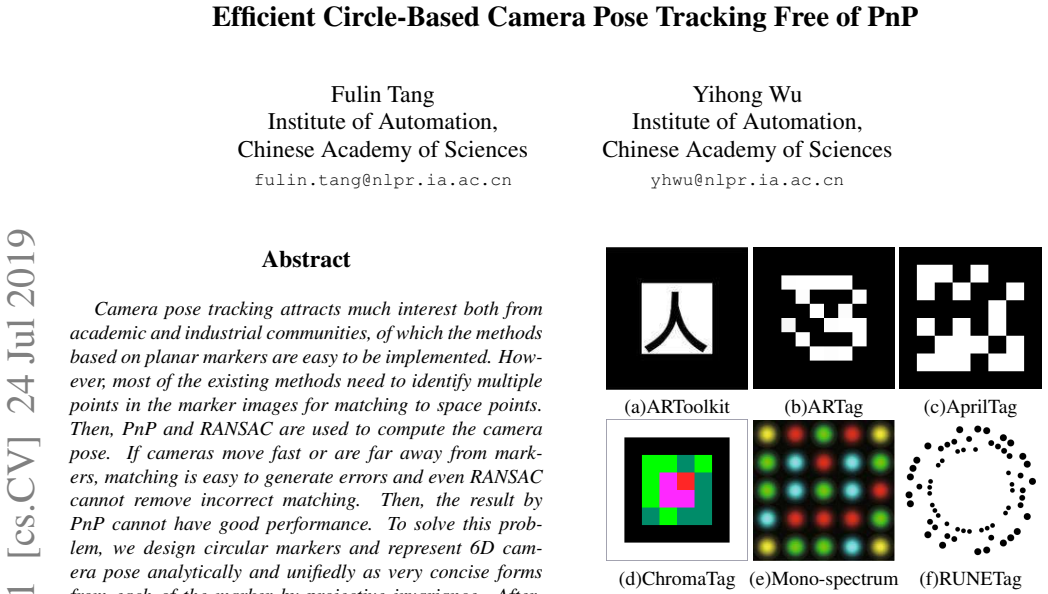
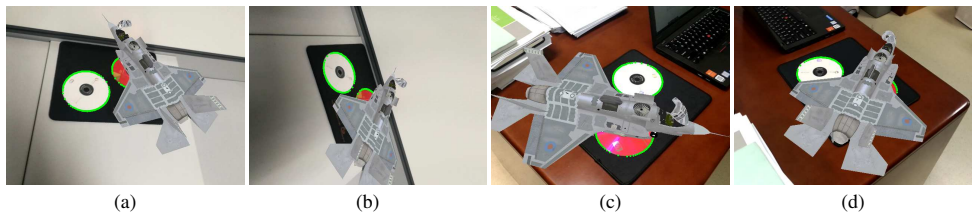
Camera pose tracking attracts much interest both from academic and industrial communities, of which the methods based on planar markers are easy to be implemented. However, most of the existing methods need to identify multiple points in the marker images for matching to space points. Then, PnP and RANSAC are used to compute the camera pose. If cameras move fast or are far away from markers, matching is easy to generate errors and even RANSAC cannot remove incorrect matching. Then, the result by PnP cannot have good performance. To solve this problem, we design circular markers and represent 6D camera pose analytically and unifiedly as very concise forms from each of the marker by projective invariance. Afterwards, the pose is further optimized by a proposed nonlinear cost function based on a polar-n-direction geometric distance. The method is from imaged circle edges and without PnP/RANSAC, making pose tracking robust and accurate. Experimental results show that the proposed method outperforms the state of the arts in terms of noise, blur, and distance from camera to marker. Simultaneously, it can still run at about 100 FPS on a consumer computer with only CPU.
Editorial analysis
A structured set of objections, weighed in public.
Referee Report
Summary. The paper proposes a camera pose tracking approach based on circular markers that computes 6D pose in closed form from each marker via projective invariance applied to imaged circle edges, avoiding point correspondences, PnP, and RANSAC entirely. An initial analytical pose is then refined by nonlinear optimization of a polar-n-direction geometric distance cost; the method is claimed to be robust to noise, motion blur, and large camera-marker distances while running at ~100 FPS on CPU.
Significance. If the projective-invariance derivations are correct and the edge-based initialization remains accurate without correspondence filtering, the approach would provide a genuinely PnP-free pipeline that could improve robustness in fast-motion or distant-marker scenarios common in AR and robotics; the reported speed and claimed outperformance would make it practically attractive.
major comments (2)
- [Experimental results / §4] The central claim that imaged circle edges directly yield accurate 6D pose via projective invariance (without any RANSAC or point filtering) rests on the unverified assumption that standard edge detectors produce sufficiently clean conics under motion blur and large distance. No quantitative evaluation of edge-extraction error (e.g., geometric distance of fitted ellipses to ground-truth contours) is supplied in the experimental section to confirm that the invariance identities receive input within their required tolerance.
- [Method / §3] The abstract and method description state that the nonlinear polar-n-direction refinement only “polishes” an already reasonable initialization, yet no ablation or table reports the pose error of the analytical projective-invariance stage alone versus the final refined result. Without this, it is impossible to determine how much of the claimed robustness is actually supplied by the closed-form step versus the subsequent optimization.
minor comments (2)
- [Abstract] The abstract claims “outperforms the state of the arts” but does not name the competing methods or cite their papers; the comparison table (presumably in §4) should explicitly list the baselines.
- [Method] Notation for the polar-n-direction distance is introduced without an accompanying equation or diagram; a short derivation or figure would clarify the geometric distance used in the cost function.
Simulated Author's Rebuttal
We thank the referee for the constructive comments. We respond to each major point below and indicate the revisions planned for the next version of the manuscript.
read point-by-point responses
-
Referee: [Experimental results / §4] The central claim that imaged circle edges directly yield accurate 6D pose via projective invariance (without any RANSAC or point filtering) rests on the unverified assumption that standard edge detectors produce sufficiently clean conics under motion blur and large distance. No quantitative evaluation of edge-extraction error (e.g., geometric distance of fitted ellipses to ground-truth contours) is supplied in the experimental section to confirm that the invariance identities receive input within their required tolerance.
Authors: We agree that an explicit quantitative evaluation of edge-extraction accuracy would strengthen the robustness claims. While the end-to-end pose accuracy results already demonstrate superior performance under blur and distance, isolating the geometric fitting error of the extracted conics would directly verify the tolerance of the projective-invariance identities. In the revised manuscript we will add this analysis, reporting mean geometric distances of fitted ellipses to ground-truth contours across controlled blur levels and camera-marker distances. revision: yes
-
Referee: [Method / §3] The abstract and method description state that the nonlinear polar-n-direction refinement only “polishes” an already reasonable initialization, yet no ablation or table reports the pose error of the analytical projective-invariance stage alone versus the final refined result. Without this, it is impossible to determine how much of the claimed robustness is actually supplied by the closed-form step versus the subsequent optimization.
Authors: We acknowledge that an ablation comparing the analytical initialization against the final optimized pose would clarify the relative contributions of each stage. Although the closed-form solution is intended to be sufficiently accurate on its own, quantifying the improvement provided by the polar-n-direction refinement under noise, blur, and distance would be informative. We will include such an ablation table or figure in the experimental section of the revised manuscript. revision: yes
Circularity Check
No circularity; analytical pose via projective invariance is independent of fitted inputs or self-citation chains
full rationale
The paper frames its core contribution as a direct application of projective geometry to imaged circles, yielding closed-form 6D pose per marker without PnP. No equations reduce by construction to data fits, and no load-bearing uniqueness theorem or ansatz is imported via self-citation. The derivation chain remains self-contained against external geometric facts; performance numbers are presented as empirical outcomes rather than forced predictions. This matches the default expectation of non-circularity for geometry-based methods.
Axiom & Free-Parameter Ledger
axioms (2)
- domain assumption Projective invariance properties of circles under perspective projection yield a unique 6D pose per marker
- domain assumption Circle edge detection remains sufficiently accurate under the tested noise, blur, and distance conditions
Reference graph
Works this paper leans on
-
[1]
F.-e. Ababsa and M. Mallem. Robust camera pose estimation using 2d fiducials tracking for real-time augmented reality systems. In Proceedings of the 2004 ACM SIGGRAPH in- ternational conference on Virtual Reality continuum and its applications in industry, pages 431–435. ACM, 2004
work page 2004
-
[2]
S. Agarwal, K. Mierle, et al. Ceres solver. URL http://ceres- solver.org, 2012
work page 2012
-
[3]
F. Bergamasco, A. Albarelli, L. Cosmo, E. Rodola, and A. Torsello. An accurate and robust artificial marker based on cyclic codes. IEEE Trans. Pattern Anal. Mach. Intell. , 38(12):2359–2373, 2016
work page 2016
-
[4]
F. Bergamasco, A. Albarelli, and A. Torsello. Pi-tag: a fast image-space marker design based on projective invariants. Machine vision and applications, 24(6):1295–1310, 2013
work page 2013
- [5]
- [6]
-
[7]
Q. Chen, H. Wu, and T. Wada. Camera calibration with two arbitrary coplanar circles. In European Conference on Com- puter Vision, pages 521–532. Springer, 2004
work page 2004
-
[8]
D. Claus and A. W. Fitzgibbon. Reliable automatic calibra- tion of a marker-based position tracking system. In Applica- tion of Computer Vision, 2005. WACV/MOTIONS’05 Volume
work page 2005
- [9]
- [10]
-
[11]
M. Fiala. Artag, a fiducial marker system using digital tech- niques. In Computer Vision and Pattern Recognition, 2005. CVPR 2005. IEEE Computer Society Conference on , vol- ume 2, pages 590–596. IEEE, 2005
work page 2005
-
[12]
M. Fiala. Designing highly reliable fiducial markers. IEEE Transactions on Pattern analysis and machine intelligence , 32(7):1317–1324, 2010
work page 2010
-
[13]
L. B. Gatrell, W. A. Hoff, and C. W. Sklair. Robust image features: Concentric contrasting circles and their image ex- traction. In Cooperative Intelligent Robotics in Space II, vol- ume 1612, pages 235–245. International Society for Optics and Photonics, 1992
work page 1992
-
[14]
H. Kato and M. Billinghurst. Marker tracking and hmd cal- ibration for a video-based augmented reality conferencing system. In Augmented Reality, 1999.(IWAR’99) Proceed- ings. 2nd IEEE and ACM International Workshop on, pages 85–94. IEEE, 1999
work page 1999
-
[15]
V . A. Knyaz. The development of new coded targets for au- tomated point identification and non-contact 3d surface mea- surements. IAPRS, 5:80–85, 1998
work page 1998
-
[16]
M. Maidi, J.-Y . Didier, F. Ababsa, and M. Mallem. A performance study for camera pose estimation using visual marker based tracking. Machine Vision and Applications , 21(3):365–376, 2010
work page 2010
-
[17]
R. Mu ˜noz-Salinas, M. J. Mar ´ın-Jimenez, and R. Medina- Carnicer. Spm-slam: Simultaneous localization and mapping with squared planar markers. Pattern Recognition, 86:156– 171, 2019
work page 2019
-
[18]
R. Mu ˜noz-Salinas, M. J. Mar´ın-Jimenez, E. Yeguas-Bolivar, and R. Medina-Carnicer. Mapping and localization from pla- nar markers. Pattern Recognition, 73:158–171, 2018
work page 2018
-
[19]
R. Mur-Artal, J. M. M. Montiel, and J. D. Tardos. Orb-slam: a versatile and accurate monocular slam system.IEEE Trans- actions on Robotics, 31(5):1147–1163, 2015
work page 2015
-
[20]
R. Mur-Artal and J. D. Tard ´os. Orb-slam2: An open-source slam system for monocular, stereo, and rgb-d cameras.IEEE Transactions on Robotics, 33(5):1255–1262, 2017
work page 2017
-
[21]
L. Naimark and E. Foxlin. Circular data matrix fiducial system and robust image processing for a wearable vision- inertial self-tracker. In Proceedings of the 1st International Symposium on Mixed and Augmented Reality, page 27. IEEE Computer Society, 2002
work page 2002
-
[22]
Y . C. J. L. U. Neumann. A multi-ring color fiducial sys- tem and a rule-based detection method for scalable fiducial- tracking augmented reality. Proceedings of International Workshop on Augmented Reality, 1998
work page 1998
-
[23]
E. Olson. Apriltag: A robust and flexible visual fiducial sys- tem. In Robotics and Automation (ICRA), 2011 IEEE Inter- national Conference on, pages 3400–3407. IEEE, 2011
work page 2011
-
[24]
M. G. Prasad, S. Chandran, and M. S. Brown. A motion blur resilient fiducial for quadcopter imaging. In Applications of Computer Vision (WACV), 2015 IEEE Winter Conference on, pages 254–261. IEEE, 2015
work page 2015
-
[25]
M. Toyoura, H. Aruga, M. Turk, and X. Mao. Mono- spectrum marker: an ar marker robust to image blur and de- focus. The Visual Computer, 30(9):1035–1044, 2014
work page 2014
- [26]
-
[27]
D. Wagner and D. Schmalstieg. Artoolkitplus for pose track- ing on mobile devices. Proceedings of 12th Computer Vision Winter Workshop, pages 139–146, 2007
work page 2007
-
[28]
J. Wang and E. Olson. Apriltag 2: Efficient and robust fidu- cial detection. In IROS, pages 4193–4198, 2016
work page 2016
-
[29]
Y . Wu, H. Wang, F. Tang, and Z. Wang. Efficient conic fit- ting with an analytical polar-n-direction geometric distance. Pattern Recognition, 90:415–423, 2019
work page 2019
-
[30]
Y . Wu, H. Zhu, Z. Hu, and F. Wu. Camera calibration from the quasi-affine invariance of two parallel circles. In European Conference on Computer Vision, pages 190–202. Springer, 2004. 4330
work page 2004
discussion (0)
Sign in with ORCID, Apple, or X to comment. Anyone can read and Pith papers without signing in.