REVIEW 2 major objections 2 minor 50 references
PhaseLift for Coded Diffraction Patterns: Optimal Sampling Rate
T0 review · 2 major / 2 minor · reviewed 2026-08-04 · deepseek-v4-flash
Pith's one-line read This paper proves that PhaseLift exactly recovers any fixed complex signal from O(log n) random coded-diffraction masks, with failure probability at most n^{-ω}, and that this sampling rate is optimal up to constants.
desk verdict The O(log n) mask result is real and important, but the paper as written rests on an omitted proof of tangent-space robust injectivity plus a minor exponent error in the bias bound; both look fixable. read the letter →
The pith
A machine-rendered reading of the paper's core claim, the machinery that carries it, and where it could break.
The reading
What carries the argument
The argument lifts the signal to X0 = x0x0* and works in the Hermitian matrix space, with the linear sampling map A defined by A(Z) = {tr(F_{k,ℓ} Z)}. Two components carry the proof: (1) a robust injectivity estimate, imported from an earlier result, asserting that (1/(ν^2 n L)) ||A(Z)||_2^2 ≥ (1/4) ||Z||_F^2 uniformly on the tangent space T = {x0 z* + z x0*}; and (2) an approximate dual certificate Y in range(A*) + span{I} with ||Y_T − X0||_F ≤ ν/(4 M^2 √n) and ||Y_{T⊥}||_op ≤ 1/2, constructed by an adaptive golfing scheme. The scheme's two refinements are adaptive mask allocation, with batch sizes shrinking as the residual contracts, and a stage-adaptive truncation operator with a dimensio
What would settle it
Compute the smallest singular value of the restricted coded-diffraction sampling map on the tangent space of a fixed signal for small n (e.g., n = 8, 16, 32) and many independent octanary mask sets with L = ⌈C log n⌉. If the minimum of ||A(Z)||_2 / (ν√(nL) ||Z||_F) over the tangent space is consistently below 1/4, or if the failure probability decays slower than n^{-ω}, then the imported robust injectivity estimate—and hence Theorem 1—would be refuted.
Extended reading notes
Core claim
The central claim is Theorem 1: for every fixed signal x0 ∈ C^n with ||x0|| = 1 and every ω ≥ 1, if the number of random masks L is at least C(M,ν) ω log n, then the rank-one matrix X0 = x0 x0* is the unique feasible point of the PhaseLift feasibility program with probability at least 1−n^{-ω}. Consequently x0 is recovered up to a global phase, and the total number of scalar measurements is m = nL = O(ω n log n). The paper also proves a matching lower bound for the erasure mask ensemble: recovering even the flat signal with probability at least 1−n^{-ω} requires L = Ω(ω log n) masks, so the mask complexity is optimal in its joint dependence on dimension and failure probability, up to constan
Load-bearing premise
The argument rests on a robust injectivity estimate on the tangent space—the set of small rank-two perturbations around the true rank-one solution—that is imported from an earlier paper and asserted, without proof, to hold for all masks in the assumed model; if that estimate's constants fail for the complex mask ensembles, the O(log n) guarantee collapses.
Editorial extensions
If this is right
- PhaseLift achieves exact recovery of any fixed signal from m = O(n log n) intensity measurements, the same order as the information-theoretic lower bound for the erasure mask ensemble.
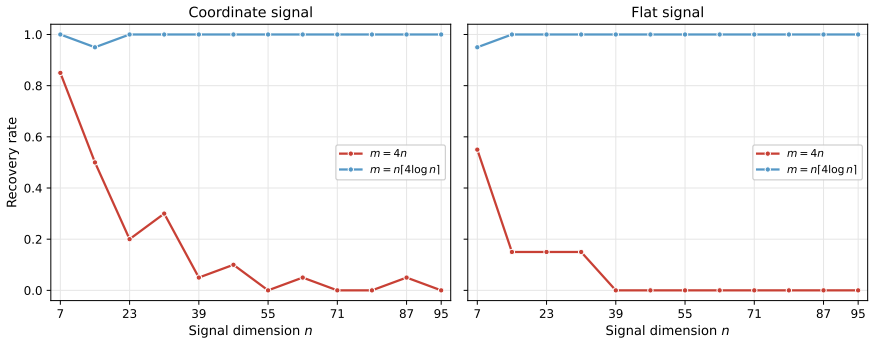
- The previous logarithmic gap between upper and lower bounds on the number of masks is closed: L = O(ω log n) masks suffice and Ω(ω log n) are necessary when the target success probability is 1−n^{-ω}.
- The lower bound holds for the flat signal, not merely for sparse or coordinate signals, so the optimality is not an artifact of localized signals.
- The guarantee is nonuniform: it holds for each fixed signal but not simultaneously for all signals from one mask realization, a limitation the paper explicitly leaves open.
- The adaptive truncation and mask-allocation ideas are presented as having independent use for other structured sampling problems beyond coded diffraction patterns.
Reading between the lines
- Because the certificate construction is modular, a similar adaptive golfing scheme might yield O(log n) mask guarantees for other computationally tractable phase retrieval algorithms, including nonconvex methods, if they can consume an approximate dual certificate; the paper explicitly leaves this as an open direction.
- The numerical experiments on Poisson observations suggest a nonasymptotic stability bound of the form ||X̂ − X0||_F ≲ κ^{-1/2} for photon-limited measurements; proving such a bound with O(n log n) masks would be a natural extension.
- The lower bound uses masks that can erase coordinates entirely; for erasure-free ensembles such as the octanary one, it is unclear whether Ω(log n) masks remain necessary, and testing this would clarify whether the optimal sampling rate is ensemble-specific.
- The dimension-independent truncation threshold suggests the analysis may extend to mask distributions with heavier tails, where dimension-dependent thresholds would fail, but this would require new tail and variance estimates.
Signed reviews
Editorial analysis
A structured set of objections, weighed in public.
Referee Report
Summary. The paper studies the PhaseLift feasibility formulation for coded-diffraction-pattern phase retrieval under i.i.d. random masks. Theorem 1 claims that, for any fixed unit-norm signal x0 in C^n and any ω≥1, L≥C(M,ν)ω log n masks suffice for X0=x0x0* to be the unique feasible point of the program (6) with probability at least 1−n^{−ω}; equivalently, m=O(ω n log n) scalar intensity measurements. The proof combines a near-isotropy identity, a tangent-space robust injectivity estimate, and an approximate dual certificate built by a golfing scheme with adaptively allocated batches and a dimension-independent truncation threshold. An appendix proves an Ω(ω log n) mask lower bound for the flat signal under the erasure mask ensemble, supporting optimality. Numerical experiments compare fixed and logarithmic mask budgets and probe Poisson-noise robustness.
Significance. If the proof can be completed, the paper resolves an open problem of Candès–Li–Soltanolkotabi by closing the gap between O(log^2 n) and Ω(log n) masks for PhaseLift in the random-mask CDP model. The adaptive allocation of masks and the dimension-free truncation are genuine technical novelties, and the lower-bound appendix extends earlier coordinate-signal obstructions to the flat signal. The main proof is detailed and, apart from the gaps identified below, internally coherent. The main caveat is that one of the two probabilistic pillars of Theorem 1 is imported without proof, so the central theorem is at present conditional.
major comments (2)
- [2.1.4, Proposition 2 and Remark 3] Proposition 2 is the second probabilistic pillar of Theorem 1: it supplies the tangent-space lower bound (12) with failure probability 1−2n exp(−cν^4L/M^8), and §2.7 uses it in the union bound. The proof is omitted, and the cited [23, Proposition 8] is described as covering real-valued mask ensembles with n odd. The claimed extension to all complex masks in Assumption 1, including the octanary ensemble, requires verification: the argument in [23] may rely on real-valuedness or on the special erasure structure. Without a proof or an exact statement covering the present setting, the O(log n) guarantee is not established as written.
- [2.3, Proposition 4] The displayed bias bound (15) states O(e^{−τ}), but the proof gives only O(e^{−τ/2}). Specifically, after the Hölder step the factor (E 1_{U^c})^{1/2} is bounded by sqrt(8)e^{−τ/2}, which is then multiplied by the O(M^4) moment factors. Thus the proposition as stated is false. The consequence is local and fixable: enlarging τ0 in (35) by an absolute factor restores the argument, and the O(log n) conclusion survives, but the bias estimates in Propositions 5 and 6 should be re-derived with the correct exponent.
minor comments (2)
- [Section 3, Figures 1–4] The axis labels and legends write 'm = n 4log n'; this should be typeset as n⌈4 log n⌉ to avoid ambiguity.
- [Throughout] There are many small typographical artifacts (missing spaces, malformed equals signs, broken displayed formulas). A careful copyedit is needed before publication.
Circularity Check
No circularity found: the central O(log n) proof is self-contained modulo external robust-injectivity results; the omitted extension in Remark 3 is a proof gap, not a circular reduction.
full rationale
Theorem 1's derivation chain is not circular. The PhaseLift recovery argument rests on three ingredients: near-isotropicity (Proposition 1), robust injectivity on T (Proposition 2), and the deterministic dual-certificate criterion (Proposition 3). All three are quoted from prior external works [7] and [23], not from the present authors' own theorems. The paper's new adaptive golfing construction (Proposition 7) supplies the approximate dual certificate using fresh Bernstein-type estimates (Propositions 5-6) and a geometric tail bound (Lemma 7); it does not assume the target conclusion. The lower bound in Proposition 8 is an independent combinatorial obstruction for erasure masks. The only flagged weakness is Remark 3: 'Combining the near isotropicity identity in Proposition 1 with the argument of [23, Proposition 8] yields Proposition 2 ... Since the proof follows the same lines, we omit the details.' This is an omitted verification of an extension to complex masks satisfying Assumption 1; if the constant/tail estimates fail, the O(log n) guarantee would be endangered. But that is a correctness/completeness risk about a non-self citation, not a circularity: Proposition 2 is not defined in terms of Theorem 1, nor is any fitted parameter relabeled as a prediction. The self-citations [27]-[30] appear only as related-work or alternative-method pointers and are not load-bearing. Accordingly, no circular step is exhibited.
Assumptions & free parameters
free parameters (4)
- η = 1/7 =
1/7
- t2 = 1/2 =
1/2
- τ0 = C1 log(M^2/ν) =
C1 log(M^2/ν)
- C2 in batch sizes m_j =
not specified
assumptions (5)
- domain assumption Random mask model (Assumption 1): i.i.d. entries d with E d=0, E d^2=0 (or n odd), E|d|^4 = 2(E|d|^2)^2, |d|≤M a.s.
- standard math Near-isotropicity identity E F(Z) = Z + tr(Z) I (Proposition 1)
- standard math Robust injectivity on T (Proposition 2): with high probability, 1/(ν^2 n L) ||A(Z)||^2 ≥ 1/4 ||Z||_F^2 for all Z∈T
- standard math Deterministic recovery criterion (Proposition 3): robust injectivity plus an approximate dual certificate implies uniqueness
- standard math Matrix Bernstein and vector Bernstein inequalities (Lemmas 2 and 3)
Cite this review
Pith. "Pith review of PhaseLift for Coded Diffraction Patterns: Optimal Sampling Rate." pith.science (2026). https://pith.science/paper/KISUDGTZ
@misc{pith2026260802450,
  author       = {Pith},
  title        = {Pith review of: PhaseLift for Coded Diffraction Patterns: Optimal Sampling Rate},
  year         = {2026},
  howpublished = {\url{https://pith.science/paper/KISUDGTZ}},
  note         = {Machine review of arXiv:2608.02450}
}
abstract
Recovering a complex-valued signal from coded diffraction patterns, namely the Fourier intensities obtained after modulating the signal with a collection of masks, is a fundamental structured phase retrieval problem arising in diffraction imaging and related applications. Despite its practical importance, the theoretical analysis of this structured framework remains scarce. In the standard random mask model, the optimal sampling rate achievable by computationally tractable recovery methods has remained open. In this paper, we establish the optimal sampling rate for the PhaseLift feasibility program. More precisely, PhaseLift achieves exact recovery of an unknown signal $\pmb{x}_0\in\mathbb{C}^n$, up to a global phase, from $\mathcal{O}(\log n)$ random masks, with polynomially decaying failure probability. Since $\Omega(\log n)$ masks are necessary to identify certain signals under the erasure mask ensemble, our result thereby achieves the optimal mask complexity. Equivalently, PhaseLift attains the optimal total sampling rate of $m=\mathcal{O}( n\log n)$ scalar intensity measurements. The proof is based on an approximate dual certificate construction via a refined golfing scheme that combines adaptive mask allocation with a dimension-independent truncation threshold.
Figures


Figures from the paper (1 more)

Reference graph
Works this paper leans on
-
[23]
Gross, F
D. Gross, F. Krahmer, and R. Kueng. Improved recovery guarantees for phase retrieval from coded diffraction patterns.Applied and Computational Harmonic Analysis, 42(1):37–64, 2017
2017
-
[1]
Bandeira, Yutong Chen, and Dustin G
Afonso S. Bandeira, Yutong Chen, and Dustin G. Mixon. Phase retrieval from power spectra of masked signals.Information and Inference: A Journal of the IMA, 3(2):83–102, 2014
2014
-
[2]
Ambiguities in one-dimensional discrete phase retrieval from Fourier magnitudes.Journal of Fourier Analysis and Applications, 21(6):1169–1198, 2015
Robert Beinert and Gerlind Plonka. Ambiguities in one-dimensional discrete phase retrieval from Fourier magnitudes.Journal of Fourier Analysis and Applications, 21(6):1169–1198, 2015
2015
-
[3]
Tamir Bendory, Robert Beinert, and Yonina C. Eldar. Fourier phase retrieval: uniqueness and algorithms. InCompressed Sensing and Its Applications, pages 55–91. Birkh¨ auser, Cham, 2017
2017
-
[4]
Tony Cai and Anru Zhang
T. Tony Cai and Anru Zhang. ROP: Matrix recovery via rank-one projections. The Annals of Statistics, 43(1):102–138, 2015
2015
-
[5]
Cand` es, Yonina C
Emmanuel J. Cand` es, Yonina C. Eldar, Thomas Strohmer, and Vladislav Voroninski. Phase retrieval via matrix completion.SIAM Journal on Imaging Sciences, 6(1):199– 225, 2013
2013
-
[6]
Cand` es and Xiaodong Li
Emmanuel J. Cand` es and Xiaodong Li. Solving quadratic equations via PhaseLift when there are about as many equations as unknowns.Foundations of Computa- tional Mathematics, 14(5):1017–1026, 2014
2014
-
[7]
Cand` es, Xiaodong Li, and Mahdi Soltanolkotabi
Emmanuel J. Cand` es, Xiaodong Li, and Mahdi Soltanolkotabi. Phase retrieval from coded diffraction patterns.Applied and Computational Harmonic Analysis, 39(2):277–299, 2015
2015
Show all 50 references
-
[8]
Cand` es, Xiaodong Li, and Mahdi Soltanolkotabi
Emmanuel J. Cand` es, Xiaodong Li, and Mahdi Soltanolkotabi. Phase retrieval via Wirtinger Flow: Theory and algorithms.IEEE Transactions on Information Theory, 61(4):1985–2007, 2015
1985
-
[9]
Cand` es, Thomas Strohmer, and Vladislav Voroninski
Emmanuel J. Cand` es, Thomas Strohmer, and Vladislav Voroninski. PhaseLift: exact and stable signal recovery from magnitude measurements via convex pro- gramming.Communications on Pure and Applied Mathematics, 66(8):1241–1274, 2013
2013
-
[10]
Fourier phase retrieval with a single mask by Douglas–Rachford algorithms.Applied and Computational Harmonic Analysis, 44(3):665–699, 2018
Pengwen Chen and Albert Fannjiang. Fourier phase retrieval with a single mask by Douglas–Rachford algorithms.Applied and Computational Harmonic Analysis, 44(3):665–699, 2018
2018
-
[11]
Phase retrieval with one or two diffraction patterns by alternating projections with the null initialization.Journal of Fourier Analysis and Applications, 24(3):719–758, 2018
Pengwen Chen, Albert Fannjiang, and Gi-Ren Liu. Phase retrieval with one or two diffraction patterns by alternating projections with the null initialization.Journal of Fourier Analysis and Applications, 24(3):719–758, 2018. 29
2018
-
[12]
Cand` es
Yuxin Chen and Emmanuel J. Cand` es. Solving random quadratic systems of equations is nearly as easy as solving linear systems.Communications on Pure and Applied Mathematics, 70(5):822–883, 2017
2017
-
[13]
Gradient descent with random initialization: Fast global convergence for nonconvex phase retrieval.Mathematical Programming, 176(1–2):5–37, 2019
Yuxin Chen, Yuejie Chi, Jianqing Fan, and Cong Ma. Gradient descent with random initialization: Fast global convergence for nonconvex phase retrieval.Mathematical Programming, 176(1–2):5–37, 2019
2019
-
[14]
Goldsmith
Yuxin Chen, Yuejie Chi, and Andrea J. Goldsmith. Exact and stable covariance estimation from quadratic sampling via convex programming.IEEE Transactions on Information Theory, 61(7):4034–4059, 2015
2015
-
[15]
Christopher Dainty and James R
J. Christopher Dainty and James R. Fienup. Phase retrieval and image recon- struction for astronomy. In Henry Stark, editor,Image Recovery: Theory and Application, chapter 7, pages 231–275. Academic Press, 1987
1987
-
[16]
Duchi and Feng Ruan
John C. Duchi and Feng Ruan. Solving (most) of a set of quadratic equalities: Composite optimization for robust phase retrieval.Information and Inference: A Journal of the IMA, 8(3):471–529, 2019
2019
-
[17]
Phase retrieval with random phase illumination
Albert Fannjiang and Wenjing Liao. Phase retrieval with random phase illumination. Journal of the Optical Society of America A, 29(9):1847–1859, 2012
2012
-
[18]
The numerics of phase retrieval.Acta Numerica, 29:125–228, 2020
Albert Fannjiang and Thomas Strohmer. The numerics of phase retrieval.Acta Numerica, 29:125–228, 2020
2020
-
[19]
James R. Fienup. Phase retrieval algorithms: a comparison.Applied Optics, 21(15):2758–2769, 1982
1982
-
[20]
Affine phase retrieval via second-order methods.Inverse Problems, 41(5):055011, 2025
Bing Gao. Affine phase retrieval via second-order methods.Inverse Problems, 41(5):055011, 2025
2025
-
[21]
Gerchberg and William O
Ralph W. Gerchberg and William O. Saxton. A practical algorithm for the determination of phase from image and diffraction plane pictures.Optik, 35(2):237– 246, 1972
1972
-
[22]
Provable phase retrieval with mirror descent.SIAM Journal on Imaging Sciences, 16(3):1106–1141, 2023
Jean-Jacques Godeme, Jalal Fadili, Xavier Buet, Myriam Zerrad, Michel Lequime, and Claude Amra. Provable phase retrieval with mirror descent.SIAM Journal on Imaging Sciences, 16(3):1106–1141, 2023
2023
-
[24]
Recovering low-rank matrices from few coefficients in any basis
David Gross. Recovering low-rank matrices from few coefficients in any basis. IEEE Transactions on Information Theory, 57(3):1548–1566, 2011. 30
2011
-
[25]
Phase recovery guarantees from designed coded diffraction patterns in optical imaging.IEEE Transactions on Image Processing, 29:5687–5697, 2020
Andr´ es Guerrero, Samuel Pinilla, and Henry Arguello. Phase recovery guarantees from designed coded diffraction patterns in optical imaging.IEEE Transactions on Image Processing, 29:5687–5697, 2020
2020
-
[26]
R. W. Harrison. Phase problem in crystallography.Journal of the Optical Society of America A, 10(5):1046–1055, 1993
1993
-
[27]
Low-rank Toeplitz matrix restoration: Descent cone analysis and structured random matrix.IEEE Transactions on Information Theory, 71(5):3950–3956, May 2025
Gao Huang and Song Li. Low-rank Toeplitz matrix restoration: Descent cone analysis and structured random matrix.IEEE Transactions on Information Theory, 71(5):3950–3956, May 2025
2025
-
[28]
Low-rank matrix recovery via heavy-tailed quadratic sampling.arXiv preprint arXiv:2607.08671, 2026
Gao Huang and Song Li. Low-rank matrix recovery via heavy-tailed quadratic sampling.arXiv preprint arXiv:2607.08671, 2026
2026 arXiv
-
[29]
Stable Phase retrieval: Optimal rates in Poisson and heavy-tailed models.arXiv preprint arXiv:2510.00551, 2025
Gao Huang, Song Li, and Deanna Needell. Stable Phase retrieval: Optimal rates in Poisson and heavy-tailed models.arXiv preprint arXiv:2510.00551, 2025
2025
-
[30]
Robust outlier bound condition to phase retrieval with adversarial sparse outliers.Applied and Computational Harmonic Analysis, 80:101819, 2026
Gao Huang, Song Li, and Hang Xu. Robust outlier bound condition to phase retrieval with adversarial sparse outliers.Applied and Computational Harmonic Analysis, 80:101819, 2026
2026
-
[31]
Recovery performance of PhaseLift for phase retrieval from coded diffraction patterns.Inverse Problems, 42(4):045021, 2026
Meng Huang, Jinming Wen, and Ran Zhang. Recovery performance of PhaseLift for phase retrieval from coded diffraction patterns.Inverse Problems, 42(4):045021, 2026
2026
-
[32]
Eldar, and Babak Hassibi
Kishore Jaganathan, Yonina C. Eldar, and Babak Hassibi. Phase retrieval with masks using convex optimization. In2015 IEEE International Symposium on Information Theory (ISIT), pages 1655–1659, 2015
2015
-
[33]
Uniqueness of phase retrieval from three measurements.Advances in Computational Mathematics, 49:47, 2023
Philippe Jaming and Martin Rathmair. Uniqueness of phase retrieval from three measurements.Advances in Computational Mathematics, 49:47, 2023
2023
-
[34]
Stable low-rank matrix recovery via null-space properties.Information and Inference: A Journal of the IMA, 5(4):405–441, 2016
Maryia Kabanava, Richard Kueng, Holger Rauhut, and Ulrich Terstiege. Stable low-rank matrix recovery via null-space properties.Information and Inference: A Journal of the IMA, 5(4):405–441, 2016
2016
-
[35]
Complex phase retrieval from subgaussian measurements.Journal of Fourier Analysis and Applications, 26(6):89, 2020
Felix Krahmer and Dominik St¨ oger. Complex phase retrieval from subgaussian measurements.Journal of Fourier Analysis and Applications, 26(6):89, 2020
2020
-
[36]
Low-rank matrix recovery from rank-one measurements.Applied and Computational Harmonic Analysis, 42(1):88–116, 2017
Richard Kueng, Holger Rauhut, and Ulrich Terstiege. Low-rank matrix recovery from rank-one measurements.Applied and Computational Harmonic Analysis, 42(1):88–116, 2017
2017
-
[37]
Truncated amplitude flow with coded diffraction patterns
Huiping Li and Jiayi Li. Truncated amplitude flow with coded diffraction patterns. Inverse Problems, 41(1):015002, 2025. 31
2025
-
[38]
Phase retrieval from Fourier measurements with masks
Huiping Li and Song Li. Phase retrieval from Fourier measurements with masks. Inverse Problems and Imaging, 15(5):1051–1075, 2021
2021
-
[39]
Sampling complexity on phase retrieval from masked Fourier measurements via Wirtinger Flow.Inverse Problems, 38(10):105004, 2022
Huiping Li, Song Li, and Yu Xia. Sampling complexity on phase retrieval from masked Fourier measurements via Wirtinger Flow.Inverse Problems, 38(10):105004, 2022
2022
-
[40]
Loewen and Evgeny Popov.Diffraction Gratings and Applications
Erwin G. Loewen and Evgeny Popov.Diffraction Gratings and Applications. CRC Press, Boca Raton, FL, 2 edition, 2018
2018
-
[41]
R. P. Millane. Phase retrieval in crystallography and optics.Journal of the Optical Society of America A, 7(3):394–411, 1990
1990
-
[42]
Eldar, Oren Cohen, Henry N
Yoav Shechtman, Yonina C. Eldar, Oren Cohen, Henry N. Chapman, Jianwei Miao, and Mordechai Segev. Phase Retrieval with application to Optical Imaging: A contemporary overview.IEEE Signal Processing Magazine, 32(3):87–109, 2015
2015
-
[43]
Mahdi Soltanolkotabi.Algorithms and Theory for Clustering and Nonconvex Quadratic Programming. Ph.D. thesis, Stanford University, 2014
2014
-
[44]
Online stochastic gradient descent with arbitrary initialization solves non-smooth, non-convex phase retrieval.Journal of Machine Learning Research, 24(58):1–47, 2023
Yan Shuo Tan and Roman Vershynin. Online stochastic gradient descent with arbitrary initialization solves non-smooth, non-convex phase retrieval.Journal of Machine Learning Research, 24(58):1–47, 2023
2023
-
[45]
Joel A. Tropp. User-friendly tail bounds for sums of random matrices.Foundations of Computational Mathematics, 12(4):389–434, 2012
2012
-
[46]
Cambridge University Press, Cambridge, 2018
Roman Vershynin.High-Dimensional Probability: An Introduction with Applica- tions in Data Science, volume 47 ofCambridge Series in Statistical and Probabilistic Mathematics. Cambridge University Press, Cambridge, 2018
2018
-
[47]
Giannakis, and Yonina C
Gang Wang, Georgios B. Giannakis, and Yonina C. Eldar. Solving systems of random quadratic equations via truncated amplitude flow.IEEE Transactions on Information Theory, 64(2):773–794, 2018
2018
-
[48]
Richard Zhipeng Wang, Guangyao Li, Silvia Gentilini, Davide Pierangeli, Marcello Calvanese Strinati, Claudio Conti, and Natalia G. Berloff. Phase retrieval via gain-based photonic XY-hamiltonian optimization.Communications Physics, 9:85, 2026
2026
-
[49]
Multiple-level green-noise mask design for practical Fourier phase retrieval.IEEE Transactions on Signal Processing, 72:2607–2621, 2024
Qiuliang Ye, Bingo Wing-Kuen Ling, Li-Wen Wang, and Daniel Pak-Kong Lun. Multiple-level green-noise mask design for practical Fourier phase retrieval.IEEE Transactions on Signal Processing, 72:2607–2621, 2024
2024
-
[50]
A nonconvex approach for phase retrieval: Reshaped Wirtinger flow and incremental algorithms.Journal of Machine Learning Research, 18(141):1–35, 2017
Huishuai Zhang, Yingbin Liang, and Yuejie Chi. A nonconvex approach for phase retrieval: Reshaped Wirtinger flow and incremental algorithms.Journal of Machine Learning Research, 18(141):1–35, 2017. 32
2017
Reviewed August 4, 2026 · model on record in the stance chip above.
Discussion (0). Continue with ORCID to comment.