REVIEW 2 major objections 5 minor 1 cited by
Robust Binding Energy Distribution Sampling on Amorphous Solid Water Models. Method testing and validation with NH3, CO and CH4
T0 review · 2 major / 5 minor · reviewed 2026-08-16 · deepseek-v4-flash
Pith's one-line read The paper infers converged binding-energy distributions for NH3, CO and CH4 on amorphous water ice, finding ammonia binds in two modes — a weak-binding subpopulation covering ~16% of sites — while CO and CH4 are single Gaussians.
desk verdict Careful, honest method paper whose NH3/CO distributions are likely useful, but the CH4 distribution carries a known and unpropagated low-level bias that needs addressing. read the letter →
The pith
A machine-rendered reading of the paper's core claim, the machinery that carries it, and where it could break.
The reading
What carries the argument
The load-bearing machinery is the twofold binding-configuration sampling on a structurally validated amorphous ice model. The substrate is a 2000-molecule water box built by an MD Heat & Quench protocol with the TIP4P/2005 force field, checked against experimental O–O radial distribution functions, from which 100 regularly spaced hemispheric sub-clusters (grid spacing 4 Å, radius 16 Å) are cut. On each site, several starting adsorbate-to-substrate orientations are optimized — 3 for NH3, 3 for CO, 1 for CH4 — so that the local roughness of the potential energy surface contributes to the distribution alongside the variety of binding sites. Binding energies come from the two-layer ONIOM scheme ONIOM(B3LYP-D3(BJ)/6-311+G(d,p):GFN2-xtb), with an 8 Å model zone of about 20–25 water molecules inside a real system of about 235–250 water molecules, corrected for zero-point energy and basis-set superposition error; the real-system size is benchmarked up to $\Delta R_{\mathrm{LL}} = 11$ Å and retro-verified at 25 Å. Redundant configurations are removed with RMSD and binding-energy-difference cutoffs, and the fitted Gaussian (mixture) parameters are tested for statistical convergence by bootstrapping against a 5% tolerance.
What would settle it
Recompute the binding energies of the NH3 configurations with binding energies below about 30 kJ/mol, and of the full CH4 set, with the low-level layer upgraded from GFN2-xtb to a dispersion-aware DFT treatment with diffuse basis functions at a real-system radius of 19 Å ($\Delta R_{\mathrm{LL}} = 11$ Å), then re-fit the distributions: if the 16.3% weak-binding fraction of NH3 or the mean and width of the CH4 Gaussian shift beyond the paper's own 5% convergence tolerance, the reported distributions are artifacts of the low-level method rather than properties of the ice surface.
Extended reading notes
Core claim
On the paper's own terms, the central discovery is that ammonia's binding-energy distribution on amorphous solid water is bimodal and is best fitted by two Gaussian components: a dominant peak from configurations in which NH3 accepts a hydrogen bond from the surface, and a weaker low-energy component (roughly 15–30 kJ/mol) dominated by configurations that form no hydrogen bond with the surface, or at most one with NH3 as donor, covering 16.3% of the distribution. The same sampling yields single-Gaussian distributions for CO and CH4, and the paper shows the distributions' means and standard deviations are converged by bootstrapping once the two-level sampling is complete. It further establishes that one randomly chosen adsorbate orientation per site is not enough to converge the NH3 and CO statistics, that three starting orientations per site are required for both components of the NH3 double Gaussian, that two suffice for CO, and that one is sufficient for the symmetric CH4. Finally, the inferred distributions encompass all previously reported single values and dispersion ranges for these three species on water ice, while no prior individual study covers the full ranges reported here.
Load-bearing premise
Every reported binding energy inherits its accuracy from the semi-empirical GFN2-xtb method used as the low-level layer of the ONIOM scheme, and the paper's own tests (Appendix D) show that for the apolar adsorbate CH4 this method deviates from a DFT low-level treatment by 20–30% at real-system sizes beyond the chosen $\Delta R_{\mathrm{LL}} = 8$ Å shell, so a low-level-method bias in the CH4 distribution — and potentially in the tails of the others — cannot be excluded.
Editorial extensions
If this is right
- Astrochemical kinetic models should carry a distribution rather than a single binding energy per species; for NH3 the paper supplies a two-component Gaussian whose weak subpopulation (16.3% of sites) can be fed directly into desorption and chemical-desorption schemes.
- The weak-binding NH3 component (about 15–30 kJ/mol) provides a concrete desorption channel in cold prestellar cores: a chemical-desorption efficiency below the 1% upper limit inferred for L1544 could explain the observed gas-phase ammonia abundance.
- Method transfer to new adsorbates should follow the paper's convergence rule: the number of starting orientations per site is whatever makes the bootstrapped statistics of the fitted distribution fall within tolerance — 3 for NH3, 2 for CO, 1 for CH4 — and one random orientation per site is insufficient for H-bonding adsorbates.
- Binding energies on amorphous ice require a real system radius of order 16 Å; smaller shells produce artifacts (an NH3 site jumps from about 23 kJ/mol to over 80 kJ/mol at an 11 Å radius), so previously reported small-cluster values that fall outside the new ranges are attributed by the authors to insufficient system size.
Reading between the lines
- If the bimodality is real, warm-up models of ice mantles will release ammonia in two episodes — an early weak-binding release followed by the main sublimation — changing the timing of gas-phase nitrogen chemistry; the paper only sketches the static prestellar-core case.
- The paper's own Appendix D shows GFN2-xtb reproduces DFT low-level binding energies within about 5% for NH3 but deviates by 20–30% for apolar CH4 beyond the chosen shell; a conservative testable extension is to re-run the CH4 sampling, and any future apolar adsorbate, with a dispersion-accurate low-level method before adopting the distribution.
- The 16.3% weak-binding fraction is a sharp prediction: rebuilding the ASW slab with a different quench rate, density, or ice composition (the authors announce a density-variation study) should move this fraction if the surface typology controls it, and leave it stable if it is intrinsic to the NH3–water interaction.
- The bootstrapping-with-tolerance test itself is a transferable standard: any binding-energy distribution published without a convergence check of its fitted statistics — which includes most earlier work in this field — should be treated as provisional.
Signed reviews
Editorial analysis
A structured set of objections, weighed in public.
Referee Report
Summary. This manuscript presents a multiscale ONIOM-based workflow for inferring binding-energy (BE) distributions of NH3, CO, and CH4 on amorphous solid water (ASW). The ice model is built from TIP4P/2005 molecular-dynamics simulations with a Heat & Quench protocol and is validated against experimental radial distribution functions and hydrogen-bond statistics. Binding energies are computed on 100 hemispherical sub-clusters using ONIOM(B3LYP-D3(BJ)/6-311+G(d,p):GFN2-xtb), with a regular grid of starting positions and, for NH3 and CO, multiple starting adsorbate orientations per site. The authors benchmark the DFT high-level method against CCSD(T), investigate convergence with respect to the low-level shell size, retro-check the layer sizes on a 25 Å hemisphere, and use bootstrapping to assess statistical convergence of the final distributions. They report a double-Gaussian NH3 BE distribution with a low-energy component of about 15–30 kJ/mol covering 16.3% of the sample, and single-Gaussian CO and CH4 distributions, and they compare these distributions with previously reported single values and dispersions.
Significance. The paper is a valuable methodological contribution: the structural validation against experimental RDF data, the CCSD(T) benchmark for the high-level method, and the explicit bootstrapping analysis of sampling convergence go beyond most prior BE-distribution studies. The two-level sampling of binding sites and adsorbate orientations directly addresses a recognized source of BE dispersion and provides a concrete recipe for future adsorbates. If the reported distributions are accurate, they are astrochemically significant because desorption rates depend exponentially on BE and because the distribution shape, especially the NH3 weak-binding tail, matters for gas-phase abundance modeling. The main caveat is that the final distributions inherit systematic errors from the GFN2-xtb low-level treatment and from the truncated real-system radius for CH4; these are quantified in the manuscript but are not propagated into the reported means, widths, or literature comparisons, so the strength of the central quantitative claim is currently method-dependent.
major comments (2)
- [Sect. 2.2.2, Table 2, Appendix D (Fig. D.3)] The CH4 distribution is not computed at a converged real-system size, and the chosen low-level method is known to be the weakest for this adsorbate. Table 2 shows BE(CH4) = 9.8 kJ/mol at ΔRLL = 8 Å versus 10.3–10.5 kJ/mol at ΔRLL = 10–11 Å, and the text states that CH4 convergence appears only from ΔRLL ≈ 10 Å; nevertheless all 98 CH4 sites are computed at ΔRLL = 8 Å. Appendix D further reports that ONIOM(DFT:GFN2-xtb) deviates from ONIOM(DFT:DFT) by roughly 20% at ΔRLL = 8 Å and up to about 30% at larger real-system sizes for CH4. Because CH4 binding is dispersion-dominated, this systematic offset shifts both the mean and the width of the distribution in Fig. 4, and it weakens the claim that the reported CH4 distribution encompasses previously published experimental and computational values. The authors should either recompute the CH4 set at a converged ΔRLL (or with a DFT low level), or report the distribution with explicit systematic uncertainty and temper the 'encompassing' conclusion accordingly.
- [Sects. 3 and 4.3] The phrase 'converged statistics' is used for sampling convergence only, and the reported distributions carry no propagated uncertainty from the two largest identified error sources: the ~13.4% MARD of B3LYP-D3(BJ)/6-311+G(d,p) against CCSD(T) (Table 1) and the 20–30% low-level discrepancy for CH4 (Appendix D). The bootstrapping analysis in Sect. 4.3 convincingly shows that the empirical mean, standard deviation, and GMM components stabilize with sample size, but it does not constrain the systematic accuracy of the BE scale. Since desorption rates are exponential in BE, the absence of any systematic error budget makes the quantitative astrochemical statements, including the 16.3% NH3 tail fraction, overly precise. The authors should add a systematic-error discussion and state, at a minimum, how the main conclusions change when the upper end of the benchmark errors is assumed.
minor comments (5)
- [Sects. 2.2.2, Appendix D, Appendix E] The low-level method is repeatedly spelled 'GNF2-xtb'; it should be 'GFN2-xtb' throughout.
- [Appendix C, final paragraph] The final sentence says 'B3LYP-D3(BJ)/6-111+G(d,p)'; this should read '6-311+G(d,p)'.
- [Eq. (3) and Table 2] The notation for the BSSE correction (ΔE_BSSE*_CP versus ΔE_BSSE_CP) is confusing because the two quantities have opposite signs; please define the signs explicitly in the text and use one consistent symbol in Eq. (3), Table 2, and the discussion.
- [Appendix D (Figs. D.1–D.3)] The fonts, axis labels, and legends in these figures are small and difficult to read, and one legend again uses 'GNF2-xtb'; please enlarge and unify the formatting.
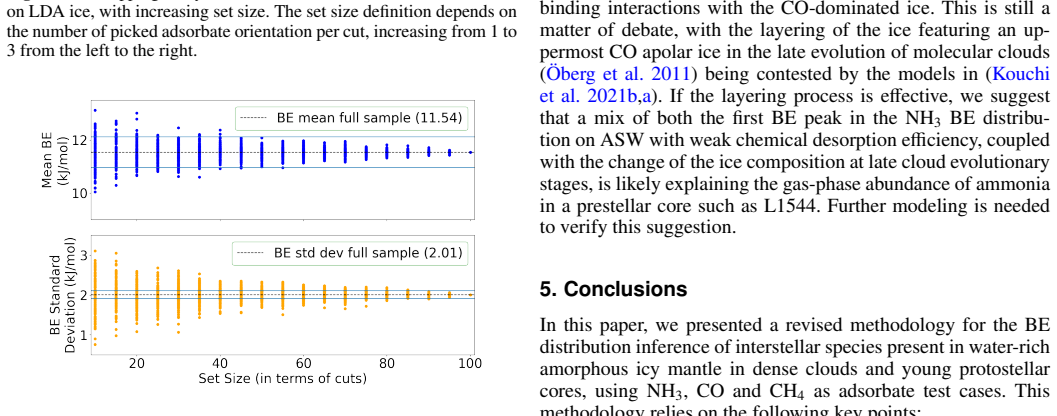
- [Sect. 4.3] There is a typo in 'convergence cu-off tolerance interval' (should be 'cutoff'), and the description of the bootstrapping procedure would be clearer if it stated explicitly that 100 resamples are drawn at each set size and that the three runs differ only in the number of orientations selected per cut.
Circularity Check
No significant circularity; the BE distributions are computed from an externally benchmarked multiscale model, not fitted to prior BE values.
full rationale
The paper's central deliverables (NH3, CO, and CH4 binding energy distributions) are not derived from the literature values they are later compared with. The method chain is self-contained: the ASW model is validated against experimental RDF data (Mariedahl et al. 2018), the high-level DFT functional is selected by benchmarking against CCSD(T) on tetrameric clusters (Table 1, Appendix B), the ONIOM layer sizes are tested by explicit convergence scans and a retro-verification with a 12-A model zone (Section 2.2.3), and the final distributions are assessed with bootstrapping convergence analyses rather than by forcing agreement with prior results. The only self-citation is the Beaujean et al. (2021) external-interface wrapper used to call GFN2-xtb through Gaussian; this is a code/tool citation and does not enter the physics or the derivation. The comparison showing that the new distributions 'encompass' earlier values is a consistency statement made after the computation, not an input to it. Appendix D does report that GFN2-xtb deviates from a DFT low-level treatment for CH4 by up to ~20% at the chosen DeltaRLL=8 A and ~30% at larger sizes; that is a quantified accuracy limitation of the low-level method, not a circular step, because the CH4 values are computed from the model rather than fitted to the compared references. No step in the derivation reduces to its own inputs by construction, and no load-bearing argument depends on an unverified self-citation.
Assumptions & free parameters
free parameters (6)
- ONIOM high-level model zone radius RModel,HL =
8 Å
- Low-level shell size ΔRLL =
8 Å
- Binding site grid spacing =
4 Å
- In-site redundancy cutoffs =
ΔBE < 0.05 × <BE>; RMSD < 1 Å
- Number of starting orientations per site =
3 for NH3/CO, 1 for CH4
- Universal ΔZPE scaling factor =
0.837 (global fit) or 0.841 (average of species)
assumptions (7)
- domain assumption TIP4P/2005 classical force field reproduces the structure of LDA amorphous solid water sufficiently for binding site sampling.
- domain assumption B3LYP-D3(BJ)/6-311+G(d,p) interaction energies for the model zone transfer the observed ~13% MARD vs CCSD(T) on tetramers to the full ONIOM model.
- domain assumption GFN2-xtb reliably describes long-range H-bond cooperativity and dispersion environment of the frozen shell at ΔRLL=8 Å for all three adsorbates.
- standard math Harmonic oscillator approximation for ZPE corrections.
- domain assumption Counterpoise BSSE correction computed on the model zone only is adequate.
- domain assumption 100 grid points on one replicated surface of a single 2000-molecule ASW box are representative of interstellar dust grain ice surfaces.
- domain assumption Two-component Gaussian Mixture Model is the correct parametric description for NH3.
Cite this review
Pith. "Pith review of Robust Binding Energy Distribution Sampling on Amorphous Solid Water Models. Method testing and validation with NH3, CO and CH4." pith.science (2026). https://pith.science/paper/KJ67FLIC
@misc{pith2026250418435,
  author       = {Pith},
  title        = {Pith review of: Robust Binding Energy Distribution Sampling on Amorphous Solid Water Models. Method testing and validation with NH3, CO and CH4},
  year         = {2026},
  howpublished = {\url{https://pith.science/paper/KJ67FLIC}},
  note         = {Machine review of arXiv:2504.18435}
}
read the original abstract
This work aims to develop a method based on a structurally reliable ice model and a statistically and physico-chemically robust approach for BE distribution inference, with the aim to be applicable to various relevant interstellar species. A multiscale computational approach is presented, with a Molecular Dynamics (MD) Heat & Quench protocol for the amorphous water ice model, and an ONIOM(B3LYP-D3(BJ)/6-311+G**:GFN2-xtb) scheme for the BE inference, with a prime emphasis onto the BE/real system size convergence. The sampling of the binding configurations is twofold, exploring both regularly spaced binding sites, as well as various adsorbate-to-substrate orientations on each locally distinct site. This second source of BE diversity accounts for the local roughness of the potential energy landscape of the substrate. Three different adsorbate test cases are considered, i.e. NH3, CO and CH4, owing to their significance in dust icy mantles, and their distinct binding behavior with water ices. The BE distributions for NH3, CO and CH4 have been inferred, with converged statistics. The distribution for NH3 is better represented by a double Gaussian component profile. Three starting adsorbate orientations per site are required to reach convergence for both Gaussian components of NH3, while 2 orientations are sufficient for CO, and one unique for CH4 (symmetric). Further geometrical and molecular surrounding insights have been provided. These results encompass previously reported results.
Figures


Figures from the paper (6 more)


Forward citations
Cited by 1 Pith paper
-
Binding energy distributions of alcohols, thiols, and their precursors on interstellar water ice surfaces
Quantum chemical binding energy distributions are reported for 16 O/S-bearing species on amorphous water ice, and using these distributions alters modeled ice-phase abundances.
Reference graph
Works this paper leans on
-
[1]
Abascal , J. L. F. & Vega , C. 2005, J. Chem. Phys., 123, 234505
work page 2005
-
[2]
Bannwarth , C., Caldeweyher , E., Ehlert , S., et al. 2021, WIRES Comput. Mol. Sci., 11, e1493
work page 2021
-
[3]
Bannwarth , C., Ehlert , S., & Grimme , S. 2019, J. Chem. Theory Comput., 15, 1652
work page 2019
-
[4]
Beaujean , P., Champagne , B., Grimme , S., & de Wergifosse , M. 2021, J. Phys. Chem. Lett., 12, 9684
work page 2021
-
[5]
Boogert , A. C. A., Gerakines , P. A., & Whittet , D. C. 2015, , 53, 541
work page 2015
- [6]
-
[7]
Chung , L. W., Sameera , W. M. C., Ramozzi , R., et al. 2015, Chem. Rev., 115, 5678–5796
work page 2015
-
[8]
Collings , M. P., Anderson , M. A., Chen , R., et al. 2004, , 364, 1133–1140
work page 2004
Show all 68 references
-
[9]
2007, , 470, 221
Crapsi , A., Caselli , P., Walmsley , M., & Tafalla , M. 2007, , 470, 221
2007
-
[10]
S., Morokuma , K., & Frisch , M
Dapprich , S., Komáromi , I., Bryun , K. S., Morokuma , K., & Frisch , M. J. 1999, J. Mol. Struct. THEOCHEM, 461-462, 1
1999
-
[11]
K., & Loison , J.-C
Das , A., Sil , M., Gorai , P., Chakrabarti , S. K., & Loison , J.-C. 2018, , 237, 13pp
2018
-
[12]
2021, Front
Duflot , D., Toubin , C., & Monnerville , M. 2021, Front. astron. space sci., 8, 16pp
2021
-
[13]
2010, , 512, 5 pp
Dulieu , F., Amiaud , L., Congiu , E., et al. 2010, , 512, 5 pp
2010
-
[14]
2020, , 904, 20pp
Ferrero , S., Zamirri , L., Ceccarelli , C., et al. 2020, , 904, 20pp
2020
-
[15]
L., Hallbrucker , A., Kohl , I., Soper , A
Finney , J. L., Hallbrucker , A., Kohl , I., Soper , A. K., & Bowron , D. T. 2002, Phys. Rev. Lett, 88, 225503
2002
-
[16]
J., Trucks , G
Frisch , M. J., Trucks , G. W., Schlegel , H. B., et al. 2016, Gaussian 16, Revision C.01, Gaussian, Inc., Wallingford CT
2016
-
[17]
W., Cuppen , H
Fuchs , G. W., Cuppen , H. M., Ioppolo , S., et al. 2009, , 505, 629
2009
-
[18]
2024, , 974, 115
Furuya , K. 2024, , 974, 115
2024
-
[19]
Ganeshan , S., Ramírez , R., & Fernández-Serra , M. V. 2013, Phys. Rev. B Condens. Matter, 87, 134207
2013
-
[20]
& Ugliengo , P
Germain , A. & Ugliengo , P. 2020, in Gervasi, O., et al. -- ICCSA
2020
-
[21]
Gould , R. J. & Salpeter , E. E. 1963, , 138, 393
1963
-
[22]
2020, , 643, A115
Grassi , T., Bovino , S., Caselli , P., et al. 2020, , 643, A115
2020
-
[23]
Grimme , S., Antony , J., Ehrlich , S., & Krieg , H. 2010, J. Chem. Phys., 132, 154104
2010
-
[24]
Grimme , S., Ehrlich , S., & Goerigk , L. 2011, J. Comput. Chem., 32, 1456
2011
-
[25]
& Watanabe , N
Hama , T. & Watanabe , N. 2013, Chem. Rev., 113, 8783
2013
-
[26]
2016, , 825, 10pp
He , J., Acharyya , K., & Vidali , G. 2016, , 825, 10pp
2016
-
[27]
& Salpeter , E
Hollenbach , D. & Salpeter , E. E. 1971, , 163, 155–164
1971
-
[28]
Humphrey , W., Dalke , A., & Schulten , K. 1996, J. Mol. Graph., 14, 33
1996
-
[29]
M., van Dishoeck , E
Ioppolo , S., van Boheemen , Y., Cuppen , H. M., van Dishoeck , E. F., & Linnartz , H. 2011, , 413, 2281–2287
2011
-
[30]
2017, , 607, 23pp
Kamp , I., Thi , W.-F., Woitke , P., et al. 2017, , 607, 23pp
2017
-
[31]
Karadakov , P. B. & Morokuma , K. 2000, Chem. Phys. Lett., 317, 589
2000
-
[32]
J., Ioppolo , S., van Hemert , M
Karssemeijer , L. J., Ioppolo , S., van Hemert , M. C., et al. 2014, , 781, 16
2014
-
[33]
& Caselli , P
Keto , E. & Caselli , P. 2010, , 402, 1625–1634
2010
-
[34]
2021 a , , 505, 1530
Kouchi , A., Tsuge , M., Hama , T., et al. 2021 a , , 505, 1530
2021
-
[35]
2021 b , , 918, 20pp
Kouchi , A., Tsuge , M., Hama , T., et al. 2021 b , , 918, 20pp
2021
-
[36]
A., & Frank , I
Kraus , P., Obenchain , D. A., & Frank , I. 2018, J. Phys. Chem. A, 122, 1077–1087
2018
-
[37]
Lee , C., Yang , W., & Parr , R. G. 1988, Phys. Rev. B Condens. Matter, 37, 785
1988
-
[38]
Mariedahl , D., Perakis , F., Späh , A., et al. 2018, J. Phys. Chem. B, 122, 7616
2018
-
[39]
G., & Martínez , J
Martinez , L., Andrade , R., Birgin , E. G., & Martínez , J. M. 2009, J. Comput. Chem., 30, 2157
2009
-
[40]
McClure , M., Rocha , W. R. M., Pontoppidan , K. M., et al. 2023, Nat Astron, 7, 431–443
2023
-
[41]
A., Simon , A., Mascetti , J., & Toubin , C
Michoulier , G., Noble , J. A., Simon , A., Mascetti , J., & Toubin , C. 2018, PCCP, 20, 8753
2018
-
[42]
2022, ACS Earth Space Chem., 6, 597–630
Minissale , M., Aikawa , Y., Bergin , E., et al. 2022, ACS Earth Space Chem., 6, 597–630
2022
-
[43]
2015, , 577, A2
Minissale , M., Loison , J.-C., Baouche , S., et al. 2015, , 577, A2
2015
-
[44]
2008, Chem
Miyauchi , N., Hidaka , H., Chigai , T., et al. 2008, Chem. Phys. Lett., 456, 27
2008
-
[45]
& Kästner , J
Molpeceres , G. & Kästner , J. 2020, PCCP, 22, 7552
2020
-
[46]
2018, , 482, 5389
Molpeceres , G., Rimola , A., Ceccarelli , C., et al. 2018, , 482, 5389
2018
-
[47]
2020, , 499, 1373
Molpeceres , G., Zaverkin , V., & Kästner , J. 2020, , 499, 1373
2020
-
[48]
H., Venkatesh , C
Narten , A. H., Venkatesh , C. G., & Rice , S. A. 1976, J. Chem. Phys., 64, 1106–1121
1976
-
[49]
A., Theule , P., Mispelaer , F., et al
Noble , J. A., Theule , P., Mispelaer , F., et al. 2012, , 543, A5
2012
-
[50]
2012, , 749, 67
Oba , Y., Watanabe , N., Hama , T., et al. 2012, , 749, 67
2012
-
[51]
2016, Chemical Review, 116, 9631
Oberg, K. 2016, Chemical Review, 116, 9631
2016
-
[52]
2011, JMLR, 12, 2825
Pedregosa , F., Varoquaux , G., Gramfort , A., et al. 2011, JMLR, 12, 2825
2011
-
[53]
M., Walsh , C., & Cuppen , H
Penteado , E. M., Walsh , C., & Cuppen , H. M. 2017, , 844, 13pp
2017
-
[54]
C., Hardy , D
Phillips , J. C., Hardy , D. J., Maia , J. D. C., et al. 2020, J. Chem. Phys., 153, 044130
2020
-
[55]
& Krim , L
Pirim , C. & Krim , L. 2011, Chem. Phys., 380, 67
2011
-
[56]
2018, , 855, 11pp
Shimonishi , T., Nakatani , N., Furuya , K., & Hama , T. 2018, , 855, 11pp
2018
-
[57]
2019, , 487, 1269–1282
Sipilä , O., Caselli , P., Redaelli , E., Juvela , M., & Bizzocchi , L. 2019, , 487, 1269–1282
2019
-
[58]
G., Sellgren , K., & Tokunaga , A
Smith , R. G., Sellgren , K., & Tokunaga , A. T. 1989, , 344, 413
1989
-
[59]
& Kästner , J
Song , L. & Kästner , J. 2016, PCCP, 18, 29278
2016
-
[60]
& Kästner , J
Song , L. & Kästner , J. 2017, , 850, 9pp
2017
-
[61]
& Grimme , S
Sure , R. & Grimme , S. 2013, J. Comput. Chem., 34, 1672
2013
-
[62]
Svensson , M., Humbel , S., Froese , R. D. J., et al. 1996, J. Phys. Chem., 100, 19357
1996
-
[63]
Tielens , A. G. G. M. & Hagen , W. 1982, , 114, 245
1982
-
[64]
2022, ACS Earth Space Chem., 6, 1514
Tinacci , L., Germain , A., Pantaleone , S., et al. 2022, ACS Earth Space Chem., 6, 1514
2022
-
[65]
S., Komáromi , I., et al
Vreven , T., Bryun , K. S., Komáromi , I., et al. 2006, J. Chem. Theory Comput., 2, 815
2006
-
[66]
2017, Mol
Wakelam , V., Loison , J.-C., Mereau , R., & Ruaud , M. 2017, Mol. Astrophys., 6, 22
2017
-
[67]
Watson , W. D. & Salpeter , E. E. 1972, , 174, 321
1972
-
[68]
I., Boogert , A
Öberg , K. I., Boogert , A. C. A., Pontoppidan , K. M., et al. 2011, , 740, 109
2011
Reviewed August 16, 2026 · model on record in the stance chip above.
Discussion (0). Continue with ORCID to comment.