REVIEW 3 major objections 5 minor 29 references
A Real-world Display Inverse Rendering Dataset
T0 review · 3 major / 5 minor · reviewed 2026-08-05 · deepseek-v4-flash
Pith's one-line read This paper introduces the first real-world dataset for display-based inverse rendering, with 16 objects captured under 144 one-light-at-a-time LCD patterns, stereo polarized views, and scanned ground-truth geometry.
desk verdict First real display-camera inverse rendering dataset, worth engaging; baseline claim and point-light validation need fixing before acceptance. read the letter →
The pith
A machine-rendered reading of the paper's core claim, the machinery that carries it, and where it could break.
The reading
What carries the argument
The load-bearing machinery is the display-camera image formation model: captured intensity is a clipped sum over N display superpixels of BRDF times cosine falloff times superpixel intensity divided by squared distance, plus Gaussian noise (Eq. 2). Calibrated backlight and gamma (Eq. 1) make each OLAT capture a linear basis, so arbitrary patterns are synthesized by Eq. 4. For reconstruction, the key object is the basis-BRDF representation: spatially varying reflectance is a weighted sum of analytic Cook-Torrance BRDFs, which regularizes the sparse light-view angular sampling inherent to displays and is optimized together with per-pixel normals.
What would settle it
Capture a glossy sphere of known BRDF under the same OLAT patterns and compare the actual pixel intensities with those rendered by the point-light model for every superpixel; a residual that grows with superpixel angular size or with surface gloss would falsify the point-light assumption. Independently, synthesize a multiplexed pattern from OLAT images using Eq. 4 and physically capture that pattern: if the residual exceeds the stated noise and clipping model on several objects, the linear-synthesis claim fails.
Extended reading notes
Core claim
The paper's core contribution is the first real-world dataset for display inverse rendering, together with the validation that display-camera capture works for this task. The image formation model treats each 240×240-pixel LCD superpixel as a calibrated near-field point light source, accounts for spatially varying backlight and display nonlinearity, and separates diffuse and specular components using polarization. Because transport is linear, an image under any display pattern is a weighted sum of OLAT images plus noise, so the dataset supports simulation without recapturing. A baseline that optimizes per-pixel normals and a weighted sum of Cook-Torrance basis BRDFs by differentiable renderi
Load-bearing premise
The whole capture and reconstruction pipeline treats each 240×240-pixel display region as a point light source with inverse-square falloff; if the finite size and angular extent of those regions noticeably bias the lighting model, the calibrated lighting and all reconstructed normals and reflectance would be systematically off.
Editorial extensions
If this is right
- Display-camera inverse rendering finally has a public real-world benchmark with ground-truth geometry, so methods can be compared on physical captures rather than synthetic data.
- Because arbitrary display patterns and noise levels can be synthesized offline from OLAT images, researchers can test new pattern designs without re-running the capture hardware.
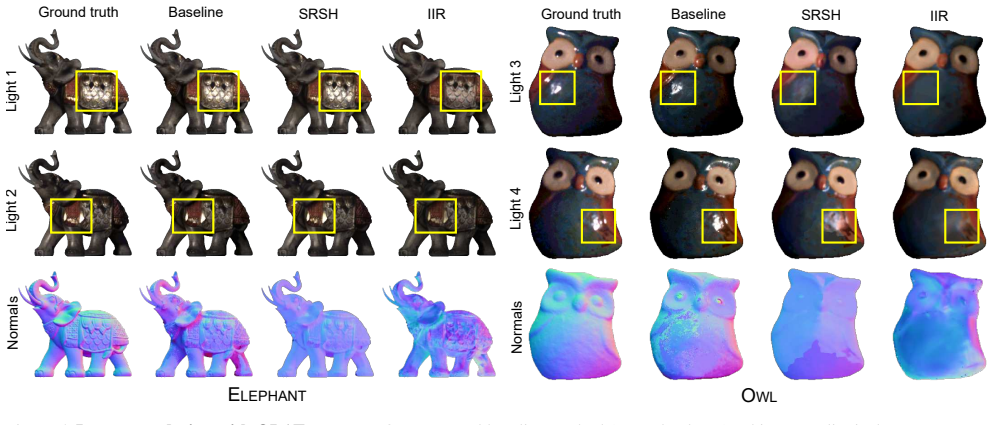
- The evaluation identifies the main bottlenecks of display inverse rendering—limited light-view angular sampling and near-field attenuation—and shows that modeling attenuation improves relighting quality.
- As few as two learned multiplexed patterns support competitive photometric stereo, indicating that faster acquisition with fewer display patterns is achievable.
- Polarization-separated diffuse images improve normal accuracy for some methods, suggesting further gains from exploiting LCD polarization.
Reading between the lines
- The linear-synthesis property also makes the dataset a natural testbed for illumination estimation: an algorithm can be asked to recover the 144-dimensional display pattern from a single image and be scored against the known synthesis weights.
- The point-light superpixel assumption sets a practical ceiling on spatial lighting resolution; extending the image formation model to finite-area emitters or deconvolving the superpixel footprint is a direct next step that the supplement's sphere experiment only partially validates.
- Since the baseline uses depth only for initialization and geometric regularization, the data could support joint normal-depth-reflectance refinement studies, including stability when stereo input is degraded.
- The finding that backlight is invariant to superpixel intensity suggests a simple dark-frame subtraction strategy that might transfer to other LCD displays, lowering the cost of reproducing the capture setup.
Editorial analysis
A structured set of objections, weighed in public.
Referee Report
Summary. The paper presents a real-world dataset for display-camera inverse rendering, built from a calibrated LCD display and stereo polarization cameras. It captures 16 objects with varied geometry and reflectance under one-light-at-a-time (OLAT) superpixel patterns, provides ground-truth geometry from structured-light scanning, and supports synthesis of arbitrary display patterns and noise by linear superposition. The paper also evaluates several photometric stereo and inverse rendering methods and proposes a simple baseline based on photometric stereo initialization, stereo depth, and a basis-BRDF optimization with a point-light near-field image formation model.
Significance. If the claims hold, the dataset is a valuable public benchmark for a practically attractive but under-served imaging configuration: programmable LCD illumination with polarization-based diffuse/specular separation. The paper's strengths include a detailed radiometric and geometric calibration procedure, stereo polarization captures, ground-truth scanned geometry, a linear-synthesis capability with controllable noise, and a broad evaluation across calibrated and uncalibrated methods. The point-light superpixel model and the claimed superiority of the baseline are two areas where the current evidence is not yet sufficient, and both affect how the dataset and baseline should be used.
major comments (3)
- [Abstract; Section 6, Table 3] The claim that the baseline is 'outperforming state-of-the-art inverse rendering methods' is not supported by Table 3 as written. There, SRSH [37] achieves higher relighting PSNR (41.28 vs 39.33) and SSIM (0.9895 vs 0.9821) than the proposed baseline; the baseline wins only in normal MAE (20.94 vs 25.25). The abstract, introduction, and Section 6 discussion should either restrict the superiority claim to normal accuracy or provide a broader metric-by-metric discussion instead of the current unqualified statement.
- [Section 3, Eq. (2); Supplement Section 5, Fig. S7] The image formation model treats each 240x240-pixel superpixel as a point light with 1/d^2 falloff. The supplement's only support for 'minimal impact' is Fig. S7, a qualitative glossy-sphere image set with no error metric, no stated object distance or roughness range, and no test at the actual 50 cm capture distance. Section 6, Table 6 shows the approximation's failure mode at 480x480 superpixels, but no error bound is provided for the 240x240 configuration. Please add a quantitative validation, e.g., comparing the point-light model against an area-light integral for a calibrated sphere over the distances and roughness values in the dataset, and report the resulting bias in normals, roughness, and relighting PSNR.
- [Section 6, Table 3 and text] The comparison protocol for Table 3 is underspecified. The 'Patterns' row shows that the proposed baseline uses both multiplexed and OLAT inputs, while SRSH, DPIR, and IIR use OLAT only; the text says the 144 OLAT images are divided into training and testing sets with a 5:1 ratio but does not state whether SRSH and the other methods receive all 144 images or only the training subset, nor how relighting PSNR is computed on held-out patterns. This ambiguity affects the interpretation of 'outperforming'. Please specify the exact input for each method (number and type of patterns, training/test split, held-out patterns) and, if possible, add a like-for-like comparison with the same M patterns for all methods.
minor comments (5)
- [Section 3 vs. Supplement Section 1] The main text says the LCD emits vertically polarized light, while the supplement says 'each pixel emits horizontally linearly-polarized light.' Reconcile the statement.
- [Figure 2 and Table 2] The object name 'OBJET' appears to be a typo for 'OBJECT'; please correct for consistency.
- [Supplement Section 5] The text 'Robustness without Stereo Imaging' says the uniform-depth baseline 'outperforms previous methods, with relighting PSNR 38.8 and normal MAE 28.29, as shown in Table 3,' but Table 3 does not contain these numbers. Add a dedicated table or remove the citation.
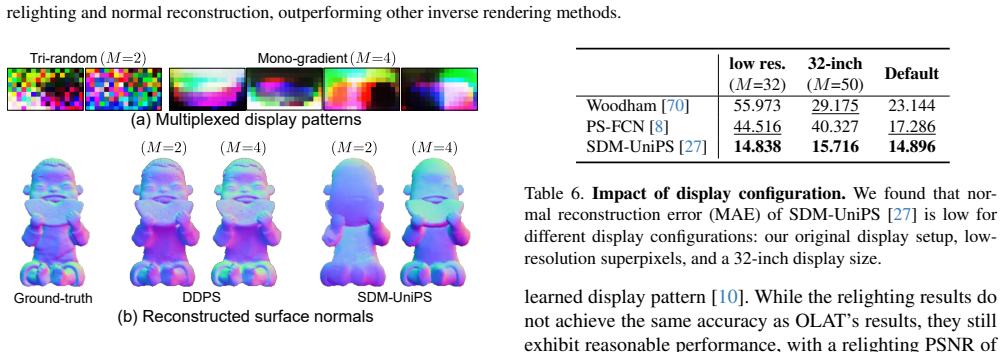
- [Table 6] The column heading 'low res. 32-inch Default(M = 32)' is difficult to parse. Define each configuration explicitly (superpixel size, display size, number of superpixels).
- [Throughout] There are several OCR-style spacing issues such as 'OLA T' instead of 'OLAT' and 'Y ujin' / 'V arious'. Please correct typographical issues.
Circularity Check
No significant circularity: dataset capture and evaluation are grounded in independent hardware calibration and scanned ground truth; self-citations are methodological, not load-bearing.
full rationale
The paper's central artifact is a captured dataset built from physical hardware (LCD + stereo polarization cameras) and independent structured-light ground truth (EinScan SP V2, 0.05 mm tolerance). Calibration of backlight and gamma (Eq. 1) is performed on a separate sphere of known geometry/reflectance, not on the evaluation objects. Geometric calibration uses checkerboard/mirror methods and is independent of the inverse-rendering results. The baseline (Sec. 5) reuses the authors' prior photometric stereo [10] and basis-BRDF representations [11,12,37], but these are published methods with independent content and are not invoked as an external uniqueness theorem; this reuse is standard benchmarking, not circular. Evaluation uses a held-out 5:1 split of the 144 OLAT images (Sec. 6) against independently scanned normal ground truth, so the 'outperforming' claim is not derived from a fit of the tested quantity. Eq. 4's 'synthesis of arbitrary display patterns' is an explicit linear-superposition identity from incoherent light transport, labeled as such; it is not a masked prediction of unseen data. Two validity concerns are worth flagging but do not constitute circularity: (1) the point-superpixel approximation is justified only qualitatively in Fig. S7 with no quantitative error bound on the actual objects, and (2) Table 3 shows SRSH has higher relighting PSNR/SSIM than the baseline, so the abstract's unqualified 'outperforming' overstates the normal-MAE advantage. These are evidence-strength and claims-precision issues, not self-referential derivations. Overall, no step reduces to its own input by construction.
Assumptions & free parameters
free parameters (4)
- s (global display intensity scalar) =
Not explicitly reported
- gamma (display nonlinearity exponent) =
Not explicitly reported
- B_i (spatially-varying backlight per superpixel) =
Per-superpixel values estimated
- a, b, c (light falloff coefficients) =
Fitted from color checker intensity curves
assumptions (5)
- domain assumption LCD display emits linearly polarized light with a known polarization axis
- domain assumption Specular reflection preserves polarization while diffuse reflection becomes unpolarized
- domain assumption Each display superpixel acts as a point light source with 1/d^2 falloff
- domain assumption Captured images are corrupted by additive Gaussian noise with adjustable standard deviation
- domain assumption The mutual-information alignment of scanned mesh to captured images is accurate enough for ground truth
Cite this review
Pith. "Pith review of A Real-world Display Inverse Rendering Dataset." pith.science (2026). https://pith.science/paper/KJEIXXGB
@misc{pith2026250814411,
  author       = {Pith},
  title        = {Pith review of: A Real-world Display Inverse Rendering Dataset},
  year         = {2026},
  howpublished = {\url{https://pith.science/paper/KJEIXXGB}},
  note         = {Machine review of arXiv:2508.14411}
}
read the original abstract
Inverse rendering aims to reconstruct geometry and reflectance from captured images. Display-camera imaging systems offer unique advantages for this task: each pixel can easily function as a programmable point light source, and the polarized light emitted by LCD displays facilitates diffuse-specular separation. Despite these benefits, there is currently no public real-world dataset captured using display-camera systems, unlike other setups such as light stages. This absence hinders the development and evaluation of display-based inverse rendering methods. In this paper, we introduce the first real-world dataset for display-based inverse rendering. To achieve this, we construct and calibrate an imaging system comprising an LCD display and stereo polarization cameras. We then capture a diverse set of objects with diverse geometry and reflectance under one-light-at-a-time (OLAT) display patterns. We also provide high-quality ground-truth geometry. Our dataset enables the synthesis of captured images under arbitrary display patterns and different noise levels. Using this dataset, we evaluate the performance of existing photometric stereo and inverse rendering methods, and provide a simple, yet effective baseline for display inverse rendering, outperforming state-of-the-art inverse rendering methods. Code and dataset are available on our project page at https://michaelcsj.github.io/DIR/
Figures


Figures from the paper (4 more)


Reference graph
Works this paper leans on
-
[1]
Photometric stereo with non-parametric and spatially-varying reflectance
Neil Alldrin, Todd Zickler, and David Kriegman. Photometric stereo with non-parametric and spatially-varying reflectance. In 2008 IEEE Conference on Computer Vision and Pattern Recognition , pages 1–8. IEEE, 2008. 4
work page 2008
-
[2]
Relighting human locomotion with flowed reflectance fields
Charles-F ´elix Chabert, Per Einarsson, Andrew Jones, Bruce Lamond, Wan-Chun Ma, Sebastian Sylwan, Tim Hawkins, and Paul Debevec. Relighting human locomotion with flowed reflectance fields. In ACM SIGGRAPH 2006 Sketches, pages 76–es. 2006. 4
work page 2006
-
[3]
Ps-fcn: A flexible learning framework for photometric stereo
Guanying Chen, Kai Han, and Kwan-Y ee K Wong. Ps-fcn: A flexible learning framework for photometric stereo. In Proceedings of the European conference on computer vision (ECCV) , pages 3–18, 2018. 4
work page 2018
-
[4]
Differentiable display photometric stereo
Seokjun Choi, Seungwoo Y oon, Giljoo Nam, Seungyong Lee, and Seung-Hwan Baek. Differentiable display photometric stereo. In Proceedings of the IEEE/CVF Conference on Computer Vision and Pattern Recognition , pages 11831–11840, 2024. 4
work page 2024
-
[5]
Differentiable point-based inverse rendering
Hoon-Gyu Chung, Seokjun Choi, and Seung-Hwan Baek. Differentiable point-based inverse rendering. In Proceedings of the IEEE/CVF Conference on Computer Vision and Pattern Recognition (CVPR) , 2024. 5
work page 2024
- [6]
-
[7]
Massimiliano Corsini, Matteo Dellepiane, Federico Ponchio, and Roberto Scopigno. Image-to-geometry registration: a mutual infor- mation method exploiting illumination-related geometric properties. In Computer Graphics F orum, pages 1755–1764. Wiley Online Library, 2009. 3
work page 2009
-
[8]
Ground truth dataset and baseline evaluations for intrinsic image algorithms
Roger Grosse, Micah K Johnson, Edward H Adelson, and William T Freeman. Ground truth dataset and baseline evaluations for intrinsic image algorithms. In 2009 IEEE 12th International Conference on Computer Vision , pages 2335–2342. IEEE, 2009. 4
work page 2009
Show all 29 references
-
[9]
Diligenrt: A photometric stereo dataset with quantified roughness and translucency
Heng Guo, Jieji Ren, Feishi Wang, Boxin Shi, Mingjun Ren, and Y asuyuki Matsushita. Diligenrt: A photometric stereo dataset with quantified roughness and translucency. In Proceedings of the IEEE/CVF Conference on Computer Vision and Pattern Recognition , pages 11810–11820, 2024. 4
2024
-
[10]
Neural lightrig: Unlocking accurate object normal and material estimation with multi-light diffusion
Zexin He, Tengfei Wang, Xin Huang, Xingang Pan, and Ziwei Liu. Neural lightrig: Unlocking accurate object normal and material estimation with multi-light diffusion. arXiv preprint arXiv:2412.09593, 2024. 5
2024 arXiv
-
[11]
Cnn-ps: Cnn-based photometric stereo for general non-convex surfaces
Satoshi Ikehata. Cnn-ps: Cnn-based photometric stereo for general non-convex surfaces. In Proceedings of the European conference on computer vision (ECCV) , pages 3–18, 2018. 4
2018
-
[12]
Universal photometric stereo network using global lighting contexts
Satoshi Ikehata. Universal photometric stereo network using global lighting contexts. In Proceedings of the IEEE/CVF Conference on Computer Vision and Pattern Recognition, pages 12591–12600, 2022. 4
2022
-
[13]
Scalable, detailed and mask-free universal photometric stereo
Satoshi Ikehata. Scalable, detailed and mask-free universal photometric stereo. In Proceedings of the IEEE/CVF Conference on Computer Vision and Pattern Recognition, pages 13198–13207, 2023. 5
2023
-
[14]
Large scale multi-view stereopsis evaluation
Rasmus Jensen, Anders Dahl, George V ogiatzis, Engin Tola, and Henrik Aanæs. Large scale multi-view stereopsis evaluation. In Proceedings of the IEEE conference on computer vision and pattern recognition , pages 406–413, 2014. 4
2014
-
[15]
Neroic: Neural rendering of objects from online image collections
Zhengfei Kuang, Kyle Olszewski, Menglei Chai, Zeng Huang, Panos Achlioptas, and Sergey Tulyakov. Neroic: Neural rendering of objects from online image collections. ACM Transactions on Graphics (TOG), 41(4):1–12, 2022. 4
2022
-
[16]
Stanford-orb: a real-world 3d object inverse rendering benchmark
Zhengfei Kuang, Y unzhi Zhang, Hong-Xing Y u, Samir Agarwala, Elliott Wu, Jiajun Wu, et al. Stanford-orb: a real-world 3d object inverse rendering benchmark. 2023. 4
2023
-
[17]
Neural reflectance for shape recovery with shadow handling
Junxuan Li and Hongdong Li. Neural reflectance for shape recovery with shadow handling. In Proceedings of the IEEE/CVF conference on computer vision and pattern recognition , pages 16221–16230, 2022. 5
2022
-
[18]
Multi-view photometric stereo: A robust solution and benchmark dataset for spatially varying isotropic materials
Min Li, Zhenglong Zhou, Zhe Wu, Boxin Shi, Changyu Diao, and Ping Tan. Multi-view photometric stereo: A robust solution and benchmark dataset for spatially varying isotropic materials. In IEEE Transactions on Image Processing, pages 29:4159–4173, 2020. 4
2020
-
[19]
Raft-stereo: Multilevel recurrent field transforms for stereo matching
Lahav Lipson, Zachary Teed, and Jia Deng. Raft-stereo: Multilevel recurrent field transforms for stereo matching. In 2021 Interna- tional Conference on 3D Vision (3DV), pages 218–227. IEEE, 2021. 4
2021
-
[20]
Openillumination: A multi-illumination dataset for inverse rendering evaluation on real objects, 2024
Isabella Liu, Linghao Chen, Ziyang Fu, Liwen Wu, Haian Jin, Zhong Li, Chin Ming Ryan Wong, Yi Xu, Ravi Ramamoorthi, Zexiang Xu, and Hao Su. Openillumination: A multi-illumination dataset for inverse rendering evaluation on real objects, 2024. 4
2024
-
[21]
Luces: A dataset for near-field point light source photometric stereo
Roberto Mecca, Fotios Logothetis, Ignas Budvytis, and Roberto Cipolla. Luces: A dataset for near-field point light source photometric stereo. arXiv preprint arXiv:2104.13135, 2021. 4
2021 arXiv
-
[22]
Practical svbrdf acquisition of 3d objects with unstructured flash photography
Giljoo Nam, Joo Ho Lee, Diego Gutierrez, and Min H Kim. Practical svbrdf acquisition of 3d objects with unstructured flash photography. ACM Transactions on Graphics (TOG), 37(6):1–12, 2018. 5
2018
-
[23]
Diligent102: A photometric stereo benchmark dataset with controlled shape and material variation
Jieji Ren, Feishi Wang, Jiahao Zhang, Qian Zheng, Mingjun Ren, and Boxin Shi. Diligent102: A photometric stereo benchmark dataset with controlled shape and material variation. In Proceedings of the IEEE/CVF Conference on Computer Vision and Pattern Recognition, pages 12581–125...
2022
-
[24]
Nerf for outdoor scene relighting
Viktor Rudnev, Mohamed Elgharib, William Smith, Lingjie Liu, Vladislav Golyanik, and Christian Theobalt. Nerf for outdoor scene relighting. In European Conference on Computer Vision, pages 615–631. Springer, 2022. 4
2022
-
[25]
A benchmark dataset and evaluation for non- lambertian and uncalibrated photometric stereo
Boxin Shi, Zhe Wu, Zhipeng Mo, Dinglong Duan, Sai-Kit Y eung, and Ping Tan. A benchmark dataset and evaluation for non- lambertian and uncalibrated photometric stereo. In Proceedings of the IEEE conference on computer vision and pattern recognition , pages 3707–3716, 2016. 4
2016
-
[26]
Relight my nerf: A dataset for novel view synthesis and relighting of real world objects
Marco Toschi, Riccardo De Matteo, Riccardo Spezialetti, Daniele De Gregorio, Luigi Di Stefano, and Samuele Salti. Relight my nerf: A dataset for novel view synthesis and relighting of real world objects. In Proceedings of the IEEE/CVF conference on computer vision and pattern ...
2023
-
[27]
Diligent-pi: Photometric stereo for planar surfaces with rich details- benchmark dataset and beyond
Feishi Wang, Jieji Ren, Heng Guo, Mingjun Ren, and Boxin Shi. Diligent-pi: Photometric stereo for planar surfaces with rich details- benchmark dataset and beyond. In Proceedings of the IEEE/CVF International Conference on Computer Vision , pages 9477–9487,
-
[28]
From shading to local shape
Ying Xiong, Ayan Chakrabarti, Ronen Basri, Steven J Gortler, David W Jacobs, and Todd Zickler. From shading to local shape. IEEE transactions on pattern analysis and machine intelligence , 37(1):67–79, 2014. 4
2014
-
[29]
Acquisition of spatially-varying reflectance and surface normals via polarized reflectance fields
Jing Y ang, Pratusha Bhuvana Prasad, Qing Zhang, and Y ajie Zhao. Acquisition of spatially-varying reflectance and surface normals via polarized reflectance fields. arXiv preprint arXiv:2412.09772, 2024. 4
2024 arXiv
Reviewed August 5, 2026 · model on record in the stance chip above.
Discussion (0). Continue with ORCID to comment.