REVIEW 3 major objections 4 minor 73 references
Phonons can carry d-wave angular-momentum textures in orbital altermagnets without spin-orbit coupling, enabling heat-driven angular-momentum currents.
Reviewed by Pith at T0; open to challenge. T0 means a machine referee read the full paper against a public rubric. the ladder, T0–T4 →
T0 review · deepseek-v4-flash
2026-08-02 03:18 UTC pith:KJKFMG4L
load-bearing objection A clean symmetry-based demonstration of SOC-free d-wave phonon angular momentum in orbital altermagnets, with a testable transport signature; the qualitative result is solid, but the numerical magnitudes need a second look at the reactive electron-phonon self-energy. the 3 major comments →
Angular momentum splitter effect of d-wave axial phonons in orbital altermagnets
The pith
A machine-rendered reading of the paper's core claim, the machinery that carries it, and where it could break.
Core claim
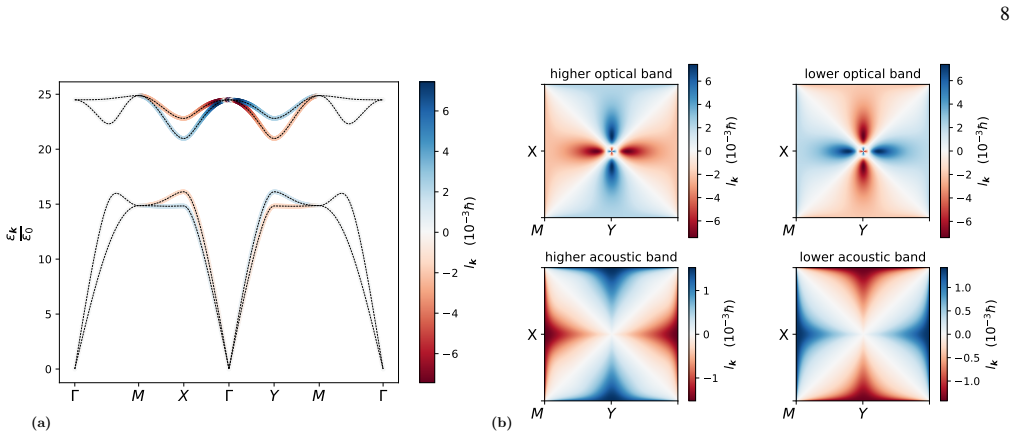
The central claim is a transfer mechanism: in the Born-Oppenheimer approximation, electron-phonon coupling generates a molecular Berry curvature that acts as a real-space gauge field on lattice vibrations. For the minimal two-band model of a d-wave loop-current orbital altermagnet, this curvature inherits the symmetry of the electronic orbital magnetic moments, producing a d-wave phonon angular momentum with four alternating-sign lobes and nodal lines along the diagonals. Both optical and acoustic branches show the texture, with the magnetic point group 4'/mm'm forbidding any optical-mode splitting at the Brillouin-zone center and hence no time-reversal-odd axial moment there. The paper conn
What carries the argument
The molecular Berry curvature (MBC), a gauge-invariant real-space Berry curvature of the Born-Oppenheimer electronic ground state defined from derivatives of the ground state with respect to ionic displacements, is the central object. It enters the phonon Hamiltonian through minimal coupling, with the Berry connection expressed through the MBC, so the curvature acts like a magnetic field for phonons. What carries the argument is the d-wave loop-current tight-binding model on the checkerboard lattice with magnetic point group 4'/mm'm, whose two-band structure lets the MBC be computed analytically and gives the phonon angular momentum its d-wave form.
Load-bearing premise
The whole picture rests on the Born-Oppenheimer molecular-Berry-curvature treatment: adiabatic electrons, with the minimal-coupling term as the only electron-phonon effect on phonon dynamics; if non-adiabatic corrections or additional electron-phonon self-energy terms are not negligible, the d-wave phonon angular momentum and its transport signatures would not survive.
What would settle it
Measure the momentum-resolved phonon angular momentum or circular-phonon dichroism in a loop-current orbital altermagnet near the X and Y points: if no sign-changing four-lobed texture with zero at the zone center and nodal lines along the diagonals is seen, or if the optical phonon modes split at the zone center, the central claim is false. A thermal-transport check: rotate the temperature gradient by 90 degrees and look for the predicted sign reversal of the angular-momentum current; its absence would also falsify the d-wave mechanism.
If this is right
- Orbital altermagnets, including loop-current systems such as certain kagome metals and cuprate-like models, become candidate platforms for intrinsic axial phonons without spin-orbit coupling.
- A temperature gradient along a high-symmetry axis drives a longitudinal angular-momentum current; rotating the gradient by 90 degrees reverses its sign, a hallmark of d-wave symmetry.
- A gradient along a nodal diagonal drives a transverse angular-momentum current with no accompanying heat current, the angular-momentum splitter effect.
- The phonon angular-momentum magnitude grows as the inverse square of the relevant indirect electronic gap, so smaller-gap orbital altermagnets should show strongly enhanced responses; the toy-model estimate gives chi_xx around 10^-4 k_B at tau = 1 ns.
- The symmetry argument is generic: any d-wave altermagnet whose magnetic point group forbids ferromagnetism should exhibit a vanishing zone-center axial moment and a symmetry-protected d-wave phonon texture.
Where Pith is reading between the lines
- Editorial inference: the same d-wave transport tensor could be observed as boundary accumulation of phonon angular momentum, potentially converted into an electrical signal through the inverse spin Hall effect at a metallic contact; the paper mentions this detection route, but the device-level consequence is an extension.
- Editorial inference: because the molecular Berry curvature scales with electron-phonon coupling and inverse squared electronic gaps, materials with small indirect gaps or strong coupling could push the response from the toy-model estimate into the range of magnonic angular-momentum conductivities; a systematic material search is a testable extension.
- Editorial inference: odd-parity p-wave or higher-order g- and i-wave altermagnets would produce different angular-momentum textures and transport anisotropies, suggesting a family of phonon angular-momentum switches controlled by crystal symmetry.
- Editorial inference: measuring the sign flip under a 90-degree rotation of the temperature gradient would simultaneously test both the d-wave symmetry and the molecular-Berry-curvature mechanism; absence of the flip would point to missing non-adiabatic corrections.
Editorial analysis
A structured set of objections, weighed in public.
Referee Report
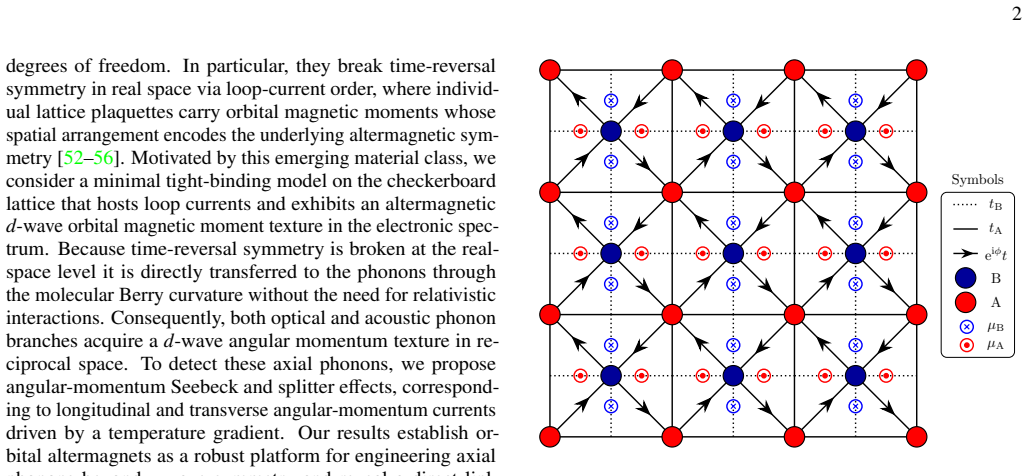
Summary. The paper constructs a minimal two-band tight-binding model of a loop-current orbital altermagnet on the checkerboard lattice, computes the electronic orbital magnetic moment texture and shows that it has d-wave symmetry under the magnetic point group 4'/mm'm. It then computes the molecular Berry curvature (MBC) from a nearest-neighbor electron-phonon coupling and uses the minimal-coupling prescription to modify the phonon Hamiltonian. Solving the coupled phonon eigenproblem yields finite phonon angular momentum l_kσ for all four branches with a d-wave texture. The paper further derives longitudinal (Seebeck) and transverse (splitter) angular-momentum transport responses to a temperature gradient, estimating χ_xx ~ 10^-4 k_B for τ = 1 ns. The central claim is that orbital altermagnets provide a spin-orbit-coupling-free route to d-wave axial phonons and to associated heat-driven angular-momentum currents.
Significance. If correct, this is a meaningful conceptual extension: it connects altermagnetic order, beyond the spin sector, to phonon angular momentum and predicts a directional transport signature. The symmetry analysis is careful: Appendix A gives explicit derivations of the MBC and of the symmetry constraints; the d-wave texture is symmetry-enforced rather than fitted; and the paper makes a concrete, falsifiable prediction — the sign of the angular-momentum Seebeck response reverses under a 90° rotation of the temperature gradient, and a purely transverse symmetric response appears along the nodal lines. These qualitative predictions are robust. However, the quantitative magnitudes of l_kσ and of χ_xx are model-dependent and, as argued below, are not yet established because of an omitted reactive electron-phonon self-energy and the heuristic current definition.
major comments (3)
- [Sec. IV, Eq. (32) and Eq. (38)] The phonon Hamiltonian in Eq. (32) retains the MBC gauge term (p - ħA)^2 but keeps D_k in Eq. (38) as a bare force-constant matrix. The same electron-phonon coupling t' that generates the MBC also generates a reactive (Born-Oppenheimer) correction to the phonon potential, δD ~ t'^2/E_gap. With t' = 1 eV/Å and the smallest direct gap ~0.6 eV near X/Y, δD ~ 27 N/m, which is ~25% of the dominant nearest-neighbor constant n11 = -100 N/m and much larger than the retained G^2 term. Since l_kσ in Eq. (45) depends on phonon eigenvectors and frequencies, the quantitative amplitudes, acoustic/optical ratios, and hence χ_xx in Eq. (49) are not established unless δD is included in D_k or shown to be negligible. The d-wave sign structure is protected by the magnetic point group, so the qualitative claim survives, but the numerical values in Figs. 4 and 5 are model-dependent.
- [Sec. V, Eqs. (47)-(49)] The angular-momentum current is evaluated as j_z = V^{-1} Σ l_kσ v_kσ f_kσ, and χ_xx is computed with a constant relaxation time τ chosen between 1 ps and 1 ns. The authors acknowledge in the Discussion that this definition ignores the non-commutativity of the angular-momentum and velocity operators and the non-conservation of phonon angular momentum. The symmetry argument for the splitter effect (Eqs. (50)-(51)) is robust, but the specific value χ_xx ~ 10^-4 k_B and the temperature dependence shown in Fig. 5(c) are not a controlled prediction. The authors should either derive the current from the microscopic phonon Hamiltonian (including the MBC correction to the phonon velocity) or explicitly present the result as an order-of-magnitude symmetry-based estimate.
- [Sec. III, Eqs. (19)-(20) and App. A 3a] The electron-phonon coupling is restricted to the nearest-neighbor hopping t; the second-neighbor hoppings t_A and t_B and the staggered potential V are treated as frozen. This is acknowledged in the text, but it is load-bearing for the quantitative MBC: Eqs. (30c,d) derive from this approximation and are not symmetry-enforced. In a realistic orbital altermagnet, bond-length modulation of t_A and t_B will contribute to the MBC and will change the detailed k-dependence of G_k and hence of l_kσ, even though the d-wave symmetry remains. The paper should either extend the electron-phonon coupling to the second-neighbor bonds or provide a quantitative estimate of the resulting corrections before presenting specific values for l_kσ and χ_xx.
minor comments (4)
- [Eq. (30c)] The equation 'G_Ay_By(k) = G_Ay_By(k) = 0' is tautological; presumably one of the entries should be G_By_Ay(k).
- [App. A 3b, item (c)] The heading repeats 'G_Ax_Bx(k=0) and G_Ax_Bx(k=0)' twice; the second should be G_Ay_By(k=0).
- [Sec. V, after Eq. (50)] The statement that the product v_x v_y l is 'an odd function in k' is not generally true: under inversion v_x and v_y are both odd, so the product is even. Please specify the symmetry operation (e.g., C4z,+T) that makes the integral vanish.
- [Fig. 5(c)] The color scale and axis labels are hard to read, especially on the log-scale color bar. Please label the axes and color bar explicitly.
Circularity Check
No significant circularity: d-wave phonon angular-momentum texture is computed from the coupled electron-phonon model, not fitted; the single author-overlap citation is not load-bearing.
full rationale
The derivation chain is computational, not definitional: Eq. (1) defines the loop-current tight-binding model; Eq. (8) computes the electronic orbital magnetic moment; Eqs. (21)-(22) compute the molecular Berry curvature (MBC) from the same electronic eigenstates plus the electron-phonon kernels M ~ t'; Eqs. (31)-(35) couple the MBC to phonons via minimal coupling; Eqs. (41)-(45) yield the phonon angular momentum; Eqs. (46)-(49) give the transport response. No parameter is fitted to the target l_kσ or χ_xx: the values in Table I are independent inputs, and χ_xx is a computed output for chosen τ. The d-wave symmetry of the phonon angular momentum is inherited from the magnetic point group 4'/mm'm through the explicit symmetry constraints in Eqs. (25)-(30) and App. A2, not by substituting the electronic m_z into the phonon formula; MBC (Eq. (22)) and orbital moment (Eq. (8)) are distinct quantities. The Gamma-point degeneracy argument in App. A3b is an in-paper symmetry derivation, not an imported uniqueness theorem. The only author-overlap citation is Ref. [42] for the phrase 'angular momentum splitter effect, as pointed out in Ref. [42]' in Sec. V; the effect is re-derived here in Eqs. (46)-(51), so the citation is not load-bearing. The skeptic's omitted reactive electron-phonon self-energy is a quantitative completeness concern acknowledged by the authors in Sec. VI, but it is not a circular reduction of any equation to its input. No Eq. X reduces to Eq. Y by construction.
Axiom & Free-Parameter Ledger
free parameters (6)
- t_A/t_0 = 0.5, t_B/t_0 = -0.5 =
0.5 / -0.5
- phi =
pi/4
- V/t_0 =
0.3
- M_A/M_0, M_B/M_0 =
1, 2
- n_11/n_0, n_12/n_0, gamma_11/n_0, gamma_22/n_0 =
-10^2, -50, -10, -30
- t'/t'_0 =
1
axioms (6)
- domain assumption Born-Oppenheimer approximation: electrons adiabatically follow ionic motion; the molecular Berry phase is the only geometric correction to phonon dynamics.
- domain assumption The magnetic point group of the orbital altermagnet is 4'/mm'm, with symmetries T C_{4z,+}, T M_x, and M_{xy}.
- ad hoc to paper Electron-phonon coupling arises solely from spatial modulation of the nearest-neighbor hopping amplitude t.
- domain assumption The system is an insulator at zero temperature with the lower band fully occupied (half filling); the gap allows the MBC formula in Eq. (21) to be used.
- domain assumption Thermal transport is described by the Boltzmann equation in the constant-relaxation-time approximation (Eq. 48).
- domain assumption Phonon angular momentum is given by Eqs. (44)-(45) from the semiclassical definition J = sum u x u_dot, with a well-defined Bose-Einstein occupation.
read the original abstract
We theoretically demonstrate that axial phonons, lattice vibration quanta carrying finite angular momentum, can host a $d$-wave angular momentum texture in orbital altermagnets in the absence of spin-orbit coupling. We consider a minimal electronic tight-binding model with $d$-wave loop-current order that breaks time-reversal symmetry. Within the Born-Oppenheimer approximation, we incorporate electron-phonon coupling via the molecular Berry curvature and show that the underlying $d$-wave orbital magnetic moment texture of the electronic state is transferred to the phonons without requiring the relativistic spin-orbit coupling. Our results expand the range of platforms available for engineering axial phonons and point to functionality unique to $d$-wave textures, including angular-momentum Seebeck and splitter effects, corresponding to longitudinal and transverse angular-momentum currents driven by a temperature gradient.
Figures



Reference graph
Works this paper leans on
-
[1]
D. M. Juraschek, R. M. Geilhufe, H. Zhu, M. Basini, P. Baum, A. Baydin, S. Chaudhary, M. Fechner, B. Flebus, G. Grisson- nanche, A. I. Kirilyuk, M. Lemeshko, S. F. Maehrlein, M. Migno- let, S. Murakami, Q. Niu, U. Nowak, C. P. Romao, H. Rostami, T. Satoh, N. A. Spaldin, H. Ueda, and L. Zhang, Chiral phonons, Nature Physics21, 1532–1540 (2025)
2025
- [2]
-
[3]
T. Zhang, S. Murakami, and H. Miao, Weyl phonons: the con- nection of topology and chirality, Nature Communications16, 10.1038/s41467-025-58913-0 (2025)
-
[4]
T. Wang, H. Sun, X. Li, and L. Zhang, Chiral phonons: Predic- tion, verification, and application, Nano Letters24, 4311 (2024), pMID: 38587210, https://doi.org/10.1021/acs.nanolett.4c00606
-
[5]
Z. Chen, T. Zhang, X. Wang, J. Li, Z.-K. Lin, F. Gao, L.- W. Wang, Y . Liu, Q. Wang, X. Zhang, G. Ma, X. Chen, M. Lu, Y . Chen, and J.-H. Jiang, Topological phononics (2026), arXiv:2605.20900 [cond-mat.mtrl-sci]
Pith/arXiv arXiv 2026
-
[6]
M. S. Mrudul, M. Weißenhofer, and P. M. Oppeneer, Generation of phonons with angular momentum during ultrafast demagneti- zation, Physical Review B112, 10.1103/nt8w-47hb (2025)
-
[7]
S. R. Tauchert, M. V olkov, D. Ehberger, D. Kazenwadel, M. Evers, H. Lange, A. Donges, A. Book, W. Kreuzpaintner, U. Nowak, and P. Baum, Polarized phonons carry angular mo- mentum in ultrafast demagnetization, Nature602, 73–77 (2022)
2022
-
[8]
C. S. Davies, F. G. N. Fennema, A. Tsukamoto, I. Razdolski, A. V . Kimel, and A. Kirilyuk, Phononic switching of magnetiza- tion by the ultrafast barnett effect, Nature628, 540–544 (2024)
2024
-
[9]
J. Luo, T. Lin, J. Zhang, X. Chen, E. R. Blackert, R. Xu, B. I. Yakobson, and H. Zhu, Large effective magnetic fields from chi- ral phonons in rare-earth halides, Science382, 698–702 (2023)
2023
-
[10]
D. M. Juraschek and N. A. Spaldin, Orbital magnetic moments of phonons, Phys. Rev. Mater.3, 064405 (2019)
2019
-
[11]
Chaudhary, D
S. Chaudhary, D. M. Juraschek, M. Rodriguez-Vega, and G. A. Fiete, Giant effective magnetic moments of chiral phonons from orbit-lattice coupling, Phys. Rev. B110, 094401 (2024)
2024
-
[12]
Yao and S
D. Yao and S. Murakami, Theory of spin magnetization driven by chiral phonons, Phys. Rev. B111, 134414 (2025)
2025
-
[13]
D. Yao, D. Go, Y . Mokrousov, and S. Murakami, Dynami- cal orbital angular momentum induced by circularly polarized phonons (2026), arXiv:2511.09271 [cond-mat.mes-hall]
Pith/arXiv arXiv 2026
-
[14]
Nabei, C
Y . Nabei, C. Yang, H. Sun, H. Jones, T. Mai, T. Wang, R. Bodin, B. Pandey, Z. Wang, Y . Xiong, A. H. Comstock, B. Ewing, J. Bingen, R. Sun, D. Smirnov, W. Zhang, A. Hoffmann, R. Rao, M. Hu, Z. V . Vardeny, B. Yan, X. Li, J. Zhou, J. Liu, and D. Sun, Orbital seebeck effect induced by chiral phonons, Nature Physics 22, 245 (2026)
2026
-
[15]
Y . Chen, W. Qin, S. Zhang, P. Cui, Q. Niu, and Z. Zhang, Emer- gence of chiral phonons in two-dimensional kagome lattices har- boring electronic chirality, Phys. Rev. Lett.135, 126608 (2025)
2025
-
[16]
Grissonnanche, S
G. Grissonnanche, S. Th´eriault, A. Gourgout, M.-E. Boulanger, E. Lefran c ¸ois, A. Ataei, F. Lalibert ´e, M. Dion, J.-S. Zhou, S. Pyon, T. Takayama, H. Takagi, N. Doiron-Leyraud, and L. Taillefer, Chiral phonons in the pseudogap phase of cuprates, Nature Physics16, 1108–1111 (2020)
2020
-
[17]
Boulanger, L
M.-E. Boulanger, L. Chen, V . Oliviero, D. Vignolles, G. Grisson- nanche, K.-J. Xu, Z.-X. Shen, C. Proust, J. Baglo, and L. Taille- fer, Thermal hall conductivity of electron-doped cuprates: Elec- trons and phonons, Phys. Rev. B113, 094511 (2026)
2026
-
[18]
J.-S. W. Lifa Zhang, Jie Ren and B. Li, The phonon hall effect: theory and application, Journal of Physics: Condensed Matter, V olume 23, Number 3023, 10.1088/0953-8984/23/30/305402 (2011)
-
[19]
Zhang and Q
L. Zhang and Q. Niu, Angular momentum of phonons and the einstein–de haas effect, Phys. Rev. Lett.112, 085503 (2014)
2014
-
[20]
Komiyama and S
H. Komiyama and S. Murakami, Universal features of canonical phonon angular momentum without time-reversal symmetry, Phys. Rev. B103, 214302 (2021)
2021
-
[21]
C. P. Romao and D. M. Juraschek, Phonon-induced geometric chirality, ACS Nano18, 29550–29557 (2024)
2024
-
[22]
Coh, Classification of materials with phonon angular momen- tum and microscopic origin of angular momentum, Phys
S. Coh, Classification of materials with phonon angular momen- tum and microscopic origin of angular momentum, Phys. Rev. B108, 134307 (2023)
2023
-
[23]
H. Chen, W. Wu, S. A. Yang, X. Li, and L. Zhang, Chiral phonons in kagome lattices, Phys. Rev. B100, 094303 (2019)
2019
-
[24]
Zhang and Q
L. Zhang and Q. Niu, Chiral phonons at high-symmetry points in monolayer hexagonal lattices, Phys. Rev. Lett.115, 115502 (2015)
2015
-
[25]
H. Zhu, J. Yi, M.-Y . Li, J. Xiao, L. Zhang, C.-W. Yang, R. A. Kaindl, L.-J. Li, Y . Wang, and X. Zhang, Observation of chiral phonons, Science359, 579 (2018)
2018
-
[26]
K. Ohe, H. Shishido, M. Kato, S. Utsumi, H. Matsuura, and Y . Togawa, Chirality-induced selectivity of phonon angular mo- menta in chiral quartz crystals, Phys. Rev. Lett.132, 056302 (2024)
2024
-
[27]
C. A. Mead, The geometric phase in molecular systems, Rev. Mod. Phys.64, 51 (1992)
1992
-
[28]
S. K. Min, A. Abedi, K. S. Kim, and E. K. U. Gross, Is the molecular berry phase an artifact of the born-oppenheimer ap- proximation?, Phys. Rev. Lett.113, 263004 (2014). 12
2014
-
[29]
Bistoni, F
O. Bistoni, F. Mauri, and M. Calandra, Intrinsic vibrational angular momentum from nonadiabatic effects in noncollinear magnetic molecules, Phys. Rev. Lett.126, 225703 (2021)
2021
-
[30]
Oh and N
T. Oh and N. Nagaosa, Phonon thermal hall effect in mott insu- lators via skew scattering by the scalar spin chirality, Phys. Rev. X15, 011036 (2025)
2025
-
[31]
Saparov, B
D. Saparov, B. Xiong, Y . Ren, and Q. Niu, Lattice dynamics with molecular berry curvature: Chiral optical phonons, Phys. Rev. B105, 064303 (2022)
2022
-
[32]
Saito, K
T. Saito, K. Misaki, H. Ishizuka, and N. Nagaosa, Berry phase of phonons and thermal hall effect in nonmagnetic insulators, Phys. Rev. Lett.123, 255901 (2019)
2019
-
[33]
D. Li, G. Yang, T. Qin, J. Zhou, and Y . Yao, Phonon dichro- isms revealing unusual electronic quantum geometry (2025), arXiv:2511.16141 [cond-mat.mes-hall]
arXiv 2025
-
[34]
Liu and J
D. Liu and J. Shi, Circular phonon dichroism in weyl semimetals, Phys. Rev. Lett.119, 075301 (2017)
2017
-
[35]
Y . Ren, D. Saparov, and Q. Niu, Nonreciprocal phonons in PT -symmetric antiferromagnets, Phys. Rev. Lett.134, 206701 (2025)
2025
-
[36]
S. K. Das, R. Yeh, and Y . Ren, Antiferro-chiral phonons inPT - symmetric antiferromagnets (2026), arXiv:2605.08490 [cond- mat.mes-hall]
Pith/arXiv arXiv 2026
-
[37]
F. Wang, X. Liu, H. Sun, H. Wang, S. Murakami, L. Zhang, H. Zhang, and D. Xing, Ab initio theory of phonon magnetic moment induced by electron-phonon coupling in magnetic ma- terials, Phys. Rev. Lett.135, 256701 (2025)
2025
-
[38]
R. Dhakal, D. A. S. Kaib, K. Choi, S. Biswas, R. Valenti, and S. M. Winter, Theory of intrinsic phonon thermal hall effect in α-rucl3 (2025), arXiv:2407.00660 [cond-mat.str-el]
Pith/arXiv arXiv 2025
-
[39]
Bonini, S
J. Bonini, S. Ren, D. Vanderbilt, M. Stengel, C. E. Dreyer, and S. Coh, Frequency splitting of chiral phonons from broken time- reversal symmetry in cri3, Phys. Rev. Lett.130, 086701 (2023)
2023
-
[40]
S. Ren, J. Bonini, M. Stengel, C. E. Dreyer, and D. Vanderbilt, Adiabatic dynamics of coupled spins and phonons in magnetic insulators, Phys. Rev. X14, 011041 (2024)
2024
-
[41]
S. Zhang, M. Wang, and T. Zhang, General ab initio frame- work for chiral phonons induced by electronic order (2025), arXiv:2509.09253 [cond-mat.mtrl-sci]
Pith/arXiv arXiv 2025
-
[42]
H. Bendin, A. Mook, I. Mertig, and R. R. Neumann, D-wave phonon angular momentum texture in altermagnets by magnon- phonon-hybridization (2026), arXiv:2511.08357 [cond-mat.mes- hall]
Pith/arXiv arXiv 2026
-
[43]
F. Wang, J. Xu, X. Liu, H. Wang, L. Zhang, and H. Zhang, Al- teraxial phonons in collinear magnets (2026), arXiv:2512.07518 [cond-mat.mtrl-sci]
arXiv 2026
-
[44]
ˇSmejkal, J
L. ˇSmejkal, J. Sinova, and T. Jungwirth, Emerging research landscape of altermagnetism, Phys. Rev. X12, 040501 (2022)
2022
-
[45]
ˇSmejkal, J
L. ˇSmejkal, J. Sinova, and T. Jungwirth, Beyond conventional ferromagnetism and antiferromagnetism: A phase with nonrel- ativistic spin and crystal rotation symmetry, Phys. Rev. X12, 031042 (2022)
2022
-
[46]
Gonz´alez-Hern´andez, L
R. Gonz´alez-Hern´andez, L. ˇSmejkal, K. V ´yborn´y, Y . Yahagi, J. Sinova, T. c. v. Jungwirth, and J. ˇZelezn´y, Efficient electri- cal spin splitter based on nonrelativistic collinear antiferromag- netism, Phys. Rev. Lett.126, 127701 (2021)
2021
-
[47]
Sufyan, B
A. Sufyan, B. Marfoua, J. A. Larsson, E. v. Loon, and R. Armiento, High-throughput quantification of altermagnetic band splitting, Phys. Rev. Mater. , (2026)
2026
-
[48]
Hoyer, P
R. Hoyer, P. P. Stavropoulos, A. Razpopov, R. Valent ´ı, L. ˇSmejkal, and A. Mook, Altermagnetic splitting of magnons in hematiteα−fe 2o3, Phys. Rev. B112, 064425 (2025)
2025
-
[49]
ˇSmejkal, A
L. ˇSmejkal, A. Marmodoro, K.-H. Ahn, R. Gonz´alez-Hern´andez, I. Turek, S. Mankovsky, H. Ebert, S. W. D’Souza, O. c. v.ˇSipr, J. Sinova, and T. c. v. Jungwirth, Chiral magnons in altermag- netic ruo2, Phys. Rev. Lett.131, 256703 (2023)
2023
-
[50]
Gohlke, A
M. Gohlke, A. Corticelli, R. Moessner, P. A. McClarty, and A. Mook, Spurious symmetry enhancement in linear spin wave theory and interaction-induced topology in magnons, Phys. Rev. Lett.131, 186702 (2023)
2023
-
[51]
Z. Liu, M. Ozeki, S. Asai, S. Itoh, and T. Masuda, Chiral split magnon in altermagnetic mnte, Phys. Rev. Lett.133, 156702 (2024)
2024
-
[52]
L. V . Pupim and M. S. Scheurer, Adatom engineering magnetic order in superconductors: Applications to altermagnetic super- conductivity, Phys. Rev. Lett.134, 146001 (2025)
2025
-
[53]
A. R. Chakraborty, F. Yang, T. Birol, and R. M. Fernandes, Orbital altermagnetism on the kagome lattice and possible appli- cation toav 3sb5 (2025), arXiv:2509.26596 [cond-mat.str-el]
Pith/arXiv arXiv 2025
-
[54]
M. Pan, F. Liu, and H. Huang, Orbital altermagnetism (2026), arXiv:2510.00509 [cond-mat.mtrl-sci]
Pith/arXiv arXiv 2026
-
[55]
Y . Yu, H. G. Suh, M. Roig, and D. F. Agterberg, Altermag- netism from coincident van hove singularities: application to κ-cl, Nature Communications16, 10.1038/s41467-025-57970-9 (2025)
-
[56]
V . Leeb and J. Knolle, Collinearp-wave magnetism and hidden orbital ferrimagnetism (2026), arXiv:2601.07418 [cond-mat.str- el]
arXiv 2026
-
[57]
Y . Li and P. Sukhachov, p-wave orbital magnetism (2026), arXiv:2604.18695 [cond-mat.mes-hall]
Pith/arXiv arXiv 2026
-
[58]
Thonhauser, D
T. Thonhauser, D. Ceresoli, D. Vanderbilt, and R. Resta, Orbital magnetization in periodic insulators, Phys. Rev. Lett.95, 137205 (2005)
2005
-
[59]
D. Xiao, J. Shi, and Q. Niu, Berry phase correction to electron density of states in solids, Phys. Rev. Lett.95, 137204 (2005)
2005
-
[60]
THONHAUSER, Theory of orbital magnetization in solids, In- ternational Journal of Modern Physics B25, 1429–1458 (2011)
T. THONHAUSER, Theory of orbital magnetization in solids, In- ternational Journal of Modern Physics B25, 1429–1458 (2011)
2011
-
[61]
S. Park and B.-J. Yang, Phonon angular momentum hall effect, Nano Letters20, 7694 (2020), pMID: 32955897, https://doi.org/10.1021/acs.nanolett.0c03220
-
[62]
H. Zhao and J. B. Freund, Full-spectrum phonon relaxation times in crystalline si from molecular dynamics simulations, Journal of Applied Physics104, 10.1063/1.2963721 (2008)
-
[63]
C. M. Varma, Non-fermi-liquid states and pairing instability of a general model of copper oxide metals, Phys. Rev. B55, 14554 (1997)
1997
-
[64]
G. Go, D. An, H.-W. Lee, and S. K. Kim, Intrinsic magnon orbital hall effect in honeycomb antiferromagnets (2023), arXiv:2303.11687 [cond-mat.mes-hall]
Pith/arXiv arXiv 2023
-
[65]
Cheng, S
R. Cheng, S. Okamoto, and D. Xiao, Spin nernst effect of magnons in collinear antiferromagnets, Phys. Rev. Lett.117, 217202 (2016)
2016
-
[66]
Q. Cui, B. Zeng, T. Yu, H. Yang, and P. Cui, Efficient spin seebeck and spin nernst effects of magnons in altermagnets (2023), arXiv:2306.08976 [cond-mat.mes-hall]
Pith/arXiv arXiv 2023
-
[67]
Saparov,Effect of Molecular Berry Curvature on the Dynam- ics of Phonons, Ph.D
D. Saparov,Effect of Molecular Berry Curvature on the Dynam- ics of Phonons, Ph.D. thesis, The University of Texas at Austin, Austin, Texas, USA (2022)
2022
-
[68]
J. Yu, C. J. Ciccarino, R. Bianco, I. Errea, P. Narang, and B. A. Bernevig, Non-trivial quantum geometry and the strength of elec- tron–phonon coupling, Nature Physics20, 1262–1268 (2024)
2024
-
[69]
A. A. Maradudin, E. W. Montroll, G. H. Weiss, and I. P. Ipatova, Theory of Lattice Dynamics in the Harmonic Approximation, 2nd ed. (Academic Press, New York, 1971)
1971
-
[70]
Leraand, K
K. Leraand, K. Mæland, and A. Sudbø, Phonon-mediated spin- polarized superconductivity in altermagnets, Phys. Rev. B112, 104510 (2025). 13 Appendix A: Molecular Berry Curvature This section reviews the molecular Berry curvature (MBC). We first follow Ref. [31] to derive an expression for the MBC in terms of single-particle eigenstates and the microscopic ...
2025
-
[71]
Molecular Berry Curvature as a Gauge Field: General Derivation Our starting point is the MBC in Eq. (13) reading Gκα κ′β (k) = i N X n,0 h ⟨Φ0|Mkκα|Φn⟩ D Φn M−kκ′β Φ0 E − D Φ0 M−kκ′β Φn E ⟨Φn|Mkκα|Φ0⟩ i 1 (En−E 0)2 , (A1) where we recall that Mkκα = P l ∂Hel ∂ulκα e−iR0 lκ·k and M−kκ′β = P l′ ∂Hel ∂ul′κ′β eiR0 l′κ′·k are the Fourier transform of the elect...
-
[72]
* ∂Φ0 ∂ulκ′β ∂Φ0 ∂ul′κα + − * ∂Φ0 ∂ul′κα ∂Φ0 ∂ulκ′β +# e−i(R0 lκ−R0 l′κ′)·k = i N X l,l′
Properties and Symmetries of the Molecular Berry Curvature In this section, we discuss how the symmetries of the crystal constrain the MBC and subsequently show that the MBC is anti-Hermitian. Specifically, we consider the following symmetry operations: (a) time-reversal (T), (b) inversion (P), (c) clockwise 90◦ rotation around thez-axis followed by time-...
-
[73]
+” correspond to the eigenstates of the acoustic sector while the ones with “−
Molecular Berry Curvature: Analytical Results for the Checkerboard Lattice Here, we present results regarding the MBC for the checkerboard lattice considered in the main text. More specifically, we (a) derive expressions for the electron-phonon coupling kernels defined in Eq. (A4) and (b) show based on the altermagnetic symmetries of the system that the M...
discussion (0)
Sign in with ORCID, Apple, or X to comment. Anyone can read and Pith papers without signing in.