REVIEW 4 major objections 5 minor 1 cited by
On a structure preserving closure of Langevin dynamics
T0 review · 4 major / 5 minor · reviewed 2026-08-07 · deepseek-v4-flash
Pith's one-line read Any particle system obeying overdamped Langevin dynamics can be reduced to a macroscopic gradient-flow model whose free energy decreases monotonically, so the second law holds automatically for essentially arbitrary trial densities.
desk verdict A genuinely useful extension of STIV to non-Gaussian closures; the 'arbitrary density' claim runs ahead of what is proven, but the quasi-equilibrium and dual results stand on their own. read the letter →
The pith
A machine-rendered reading of the paper's core claim, the machinery that carries it, and where it could break.
The reading
What carries the argument
The mechanism is a variational closure of the Fokker-Planck equation: trial densities $\hat p(x,\alpha)$ and trial test functions $\hat\psi(x,\alpha,\gamma)$ reduce the infinite-dimensional dynamics to equations of motion for the internal variables $\alpha$, and the choice of $\hat\psi$ decides whether the reduced dynamics are dissipative. The load-bearing identity is the choice $\hat\psi = 1 + \gamma_i\chi_i$ with $\chi_i$ obeying the linear adjoint problem $L^\dagger_{\hat u}\chi_i = -\partial_{\alpha_i}\hat u$; this makes the right-hand side of the reduced equation equal the free-energy gradient and renders the kinetic matrix $F_{ij} = \langle\partial_x\chi_i\cdot\partial_x\chi_j\rangle_{\hat p}$, a positive semi-definite object. For quasi-equilibrium densities the same identity works algebraically: the covariance $C_{ij} = \langle(\phi_i-\hat\Phi_i)(\phi_j-\hat\Phi_j)\rangle_{\hat p}$ and the dissipation matrix $M_{ij} = \langle\partial_x\phi_i\cdot\partial_x\phi_j\rangle_{\hat p}$ combine into the gradient flow $C\dot\alpha = -(1/\eta\beta)M\alpha$ with entropy production $T\dot{\hat S}_{\rm tot} = (1/\eta\beta^2)\alpha\cdot M\alpha$. A conjugation by $\sqrt{\hat p}$ transforms $L^\dagger_{\hat u}$ into a self-adjoint operator of the form $\partial_x^2 - v(x,\alpha)$, which connects the needed test functions to spectral methods suited to existing quantum eigensolvers.
What would settle it
Choose a trial density whose log-density is not smooth, such as a uniform distribution on a compact interval, and run the operator-method closure: if the required test functions do not exist, or if the computed entropy-production rate $\eta F_{ij}\dot\alpha_i\dot\alpha_j$ ever turns negative during relaxation, the universality claim fails. The comparison is directly checkable because the paper describes the method but never implements it.
Extended reading notes
Core claim
The central claim is that the gradient-flow structure of the Fokker-Planck equation survives finite-dimensional closure without restricting the trial density to Gaussians. The operator method shows that if the test functions solve $L^\dagger_{\hat u}\chi_i = -\partial_{\alpha_i}\hat u$, the internal-variable dynamics collapse to $F\dot\alpha = -(1/\eta)\partial_\alpha \hat A_{\rm neq}$ with $F_{ij} = \langle\partial_x \chi_i \cdot \partial_x \chi_j\rangle_{\hat p} \geq 0$, a gradient flow whose entropy-production rate $T\dot{\hat S}_{\rm tot} = \eta F_{ij}\dot\alpha_i\dot\alpha_j$ is non-negative by construction. Since solving that elliptic equation is difficult in general, the paper proves the same gradient-flow property directly for quasi-equilibrium densities $\hat p = \exp(-\beta e + \alpha_i\phi_i - f(\alpha,\beta))$, yielding $C\dot\alpha = -(1/\eta\beta)M\alpha$, and shows that the averages of the observables obey the dual gradient flow $d\hat\Phi/dt = -(1/\eta)M\partial_{\hat\Phi}\hat A_{\rm neq}$ even when the system is externally driven in time. For exponential families without the energy, a gradient flow is recovered only after dropping an energy-orthogonal term that the numerics indicate becomes negligible as the number of observables grows.
Load-bearing premise
The claim that any trial density works rests on the unproven premise that the differential equation dictating the test functions always has a well-behaved solution, and the implemented closures only cover exponential-family densities of a restricted form.
Editorial extensions
If this is right
- Macroscopic models built by these closures are thermodynamically consistent automatically: the non-equilibrium free energy decreases along trajectories, so no separate second-law verification is needed.
- The range of usable trial densities is no longer limited to Gaussians, so systems with multimodal or strongly non-Gaussian states — including the protein-on-DNA and driven-particle examples — can be coarse-grained while keeping the gradient-flow structure.
- For quasi-equilibrium trial densities the dynamics of observable averages remain a gradient flow even under time-dependent external driving, a property the natural-parameter equations themselves do not have.
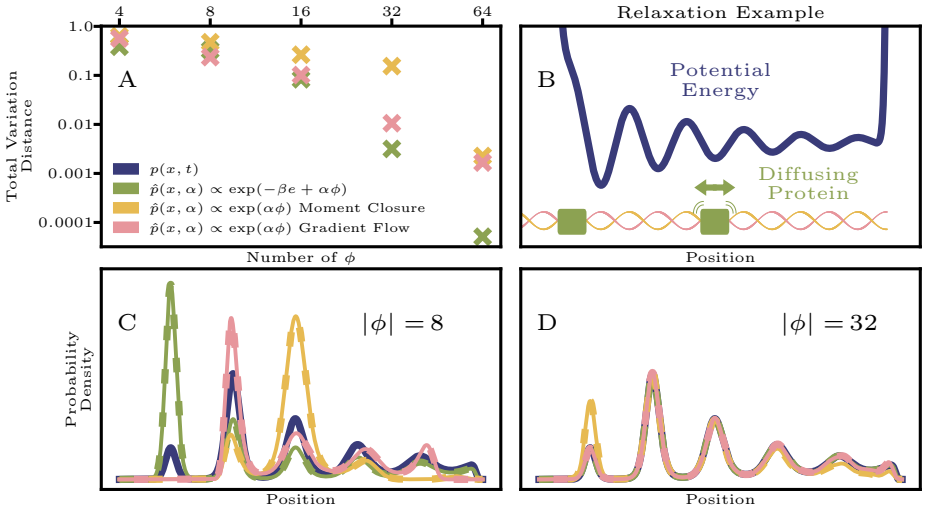
- In the two numerical examples the approximate densities converge to the exact Fokker-Planck density as the number of observables grows, with the energy-including quasi-equilibrium closure roughly an order of magnitude more accurate than the energy-free closures at 32–64 observables.
- The entropy-production rate takes the explicit quadratic form $T\dot{\hat S}_{\rm tot} = (1/\eta\beta^2)\alpha\cdot M\alpha$, identifying $M$ as the dissipation matrix of the fluctuating observables and giving a direct handle on irreversible losses.
Reading between the lines
- A testable next step the paper leaves open is implementing the operator method for observable families where the adjoint equation can be inverted in closed form; success on a non-Gaussian multimodal density would turn the 'arbitrary trial density' guarantee from existential into practical.
- The exponential-family gradient-flow closure works by dropping the energy-orthogonal term $\langle\partial_x e_\perp \cdot \partial_x\phi\rangle_{\hat p}$; monitoring this term's magnitude as observables are added would provide a concrete error diagnostic that the paper does not report.
- Read as a model-reduction statement, the results imply that coarse-grained internal-variable models inherit a Lyapunov function, the non-equilibrium free energy; closures that do not enforce gradient-flow structure should exhibit entropy production that can transiently change sign.
- The dual observable-average formulation suggests that data-driven coarse-graining should learn dynamics in the coordinates of observable averages rather than natural parameters, because that is the coordinate system in which the gradient-flow property is robust, including under driving.
Editorial analysis
A structured set of objections, weighed in public.
Referee Report
Summary. The paper proposes three closure schemes within the Stochastic Thermodynamics with Internal Variables (STIV) framework for overdamped Langevin dynamics. The 'operator method' is intended to yield an exact gradient-flow structure for an arbitrary approximate probability density by choosing test functions that solve an elliptic adjoint-type PDE (Eq. 3). The 'quasi-equilibrium' method restricts the approximate density to an exponential family containing the energy and obtains an exact gradient flow. The 'exponential family' method omits the energy from the approximate density, yielding dynamics that only approximate a gradient flow unless an orthogonal energy term is neglected. The authors also derive a dual formulation in terms of observable averages, show that these obey a gradient flow, and demonstrate numerical convergence to the true density for two one-dimensional examples (protein diffusion on DNA and a driven particle in a periodic potential). An information-theoretic interpretation via KL divergence minimization and an approximation theorem for exponential families are also provided.
Significance. If the central claim is fully established, the paper offers a valuable general strategy for constructing coarse-grained thermodynamic models that automatically satisfy the second law. The quasi-equilibrium and dual derivations are algebraically clean, and the positivity of entropy production follows directly from the positive semidefiniteness of the relevant dissipation matrices. The numerical experiments, with source code made available on GitHub, provide a concrete demonstration that the quasi-equilibrium and exponential-family methods converge to the true density as the number of internal variables grows. The paper also contains a compact approximation result in Appendix C that is of independent interest.
major comments (4)
- [Section 2.1, Eq. (3)] The central claim that a gradient-flow closure exists for an arbitrary approximate density rests on the existence of sufficiently regular solutions χ_i to L†_û χ_i = −∂_{α_i}û. The paper states 'Assuming one can solve this differential equation' but provides no existence, uniqueness, or regularity theorem, and does not discuss the role of boundary conditions or the Fredholm alternative beyond the normalization condition. The solvability condition ⟨∂_{α_i}û⟩_p̂ = 0 is satisfied by construction, so the gap is plausibly fixable, but as written the headline claim 'always possible' is not demonstrated.
- [Section 2.1 and Section 5 (Conclusion)] The operator method is presented but not implemented in any of the examples; the numerical demonstrations use only the quasi-equilibrium and exponential-family approximations, which are restricted families. The abstract's promise of an arbitrary choice of approximate probability density is therefore backed only by a conditional derivation. The authors should either prove existence for a useful class of densities, illustrate the method on a solvable case (e.g., the univariate Gaussian mentioned in the text), or explicitly temper the universality claim.
- [Section 2.3, Eq. (9)] In the exponential-family gradient-flow variant, the term ⟨∂_x e_⊥ ∂_x φ⟩_p̂ is set to zero on the grounds that it is 'reasonable to assume' negligible for flexible approximations. No quantitative error bound is given, and the numerical convergence of this variant is empirical. The text does call the resulting dynamics an approximation, but the separation between the exact quasi-equilibrium result and this approximate variant should be made more prominent, especially in the abstract and conclusion.
- [Section 2.5] The dual dynamics dΦ̂/dt = −(1/η) M ∂_Φ Â_neq and the subsequent entropy-production formula T dŜ_tot/dt = η M^{-1}_{ij} (dΦ̂_i/dt)(dΦ̂_j/dt) require M to be invertible, but M is only shown to be positive semidefinite. The paper assumes the map α→Φ̂ is invertible but does not state or justify invertibility of M. Either invertibility of M should be added as an explicit condition, or the entropy-production expression should be written directly as (1/η) ∂_Φ Â_neq T M ∂_Φ Â_neq, which avoids the inverse.
minor comments (5)
- [Throughout] There are several typos and formatting errors, including 'Univerisity' in the author affiliations, 'accpeted' in the author contributions, 'T ravis' in the CRediT statement, and 'Itˆ o's formula' in Section 2.5; these should be corrected.
- [Abstract] The sentence 'we demonstrate numerical convergence ... for both a multi-modal relaxation problem, a protein diffusing on a strand of DNA, and for an externally driven particle in a periodic landscape' lists three items after 'both' when only two distinct examples are presented; the protein diffusion problem is the multi-modal relaxation example, so the phrase should be reworded.
- [Section 3] The derivation that the STIV dynamics minimize the KL divergence between the true and approximate densities is obtained by replacing p with p̂ in the stationarity condition, which is a heuristic identification rather than a proof. This should be flagged explicitly as an interpretation.
- [Appendix C] The approximation theorem shows that some exponential family (using polynomial observables) can approximate any continuous density, whereas the numerical experiments use Fourier basis functions. The text should clarify that the proof is an existence statement for a suitable choice of observables, not a statement about the specific basis used in the examples.
- [Table 1] The entropy-production entry for the exponential-family gradient-flow row is written as η M^{-1}_{ij} (dΦ̂_i/dt)(dΦ̂_j/dt); this depends on M being invertible, which is not guaranteed by the definitions. A footnote or parenthetical remark should be added to indicate this condition.
Circularity Check
No significant circularity: the gradient-flow closures are explicit constructions or labeled approximations; the main caveat is an unproven solvability condition (Eq. 3), which is a correctness gap, not a circular reduction.
full rationale
I walked the derivation chain in Sections 2.1–2.5 and the appendices. In the operator method, the test functions χ_i are chosen to satisfy L†_û χ_i = -∂_{α_i}û (Eq. 3); substituting this into the variational dynamics then yields the gradient flow F\dot{α} = -(1/η)∂_α Â (Eq. 4). This is a conditional construction: the gradient-flow form is built into the choice of χ, and the paper openly says "Assuming one can solve this differential equation." The broader claim "always possible" depends on existence and positive definiteness, which the paper does not prove and does not implement, stating the operator method is "presented but not pursued due to computational challenges." That is a missing proof or completeness gap, not a circular equivalence, because no fitted quantity is renamed as a prediction and no cited theorem is used to forbid alternatives. The quasi-equilibrium derivation (Eqs. 5–7) computes C\dot{α} = -Mα/(ηβ) by direct moment closure and rewrites it as a gradient flow using ∂_α Â = Cα/β; this is a genuine derivation from the assumed exponential-family density. The exponential-family "Gradient Flow" variant is explicitly obtained by setting the orthogonal energy term in Eq. 9 to zero, with the paper stating the dynamics "only approximate a gradient flow" and the table noting these dynamics "are not given by moment closure, but approximate it for large number of observables"; this is a labeled modeling approximation, not a hidden prediction. The dual formulation (Section 2.5) is an exact change of variables from the same quasi-equilibrium or exponential-family equations. Self-citations to Leadbetter, Purohit, and Reina (2023, 2024) are contextual and are rederived here, so they are not load-bearing external authorities. The information-theoretic section explicitly replaces p by p̂ in the KL stationarity condition as a self-consistent approximation, which is an acknowledged closure step rather than a circular proof. Overall, no step reduces to its inputs by construction in the sense of the circularity patterns; the universal claim is broader than what is proven, but that is a correctness or completeness issue, not circularity.
Assumptions & free parameters
free parameters (4)
- DNA potential coefficients c0, c1, c2, c3 =
-0.87817, 0.04736, 0.60955, 1.25408
- viscosity η (relaxation example) =
0.83
- trap stiffness k and viscosity η (driven example) =
k=1.6287, η=0.8298
- driving velocity v =
0.5
assumptions (7)
- domain assumption Overdamped Langevin dynamics with constant η and β is the microscopic truth model (Eq. 1).
- domain assumption Eyink's variational principle yields valid approximate dynamics for the chosen ansatz.
- domain assumption The approximate density p̂ is normalized, smooth, and decays sufficiently at boundaries so that integration by parts is valid.
- domain assumption Covariance matrix C is invertible and the map α → Φ̂ is invertible.
- ad hoc to paper For the operator method, the PDE L†_û χ_i = -∂_{α_i}û has a solution with sufficient regularity.
- ad hoc to paper For the exp-family gradient-flow variant, the orthogonal energy term ⟨∂_x e_⊥ ∂_x φ⟩ is negligible.
- standard math Quasi-equilibrium/exponential-family densities can approximate any continuous density in TV (Appendix C).
Cite this review
Pith. "Pith review of On a structure preserving closure of Langevin dynamics." pith.science (2026). https://pith.science/paper/KJQFAQ76
@misc{pith2026250608156,
  author       = {Pith},
  title        = {Pith review of: On a structure preserving closure of Langevin dynamics},
  year         = {2026},
  howpublished = {\url{https://pith.science/paper/KJQFAQ76}},
  note         = {Machine review of arXiv:2506.08156}
}
read the original abstract
Given a particle system obeying overdamped Langevin dynamics, we demonstrate that it is always possible to construct a thermodynamically consistent macroscopic model which obeys a gradient flow with respect to its non-equilibrium free energy. To do so, we significantly extend the recent Stochastic Thermodynamics with Internal Variables (STIV) framework, a method for producing macroscopic thermodynamic models far-from-equilibrium from the underlying mesoscopic dynamics and an approximate probability density of states parameterized with so-called internal variables. Though originally explored for Gaussian probability distributions, we here allow for an arbitrary choice of the approximate probability density while retaining a gradient flow dynamics. This greatly extends its range of applicability and automatically ensures consistency with the second law of thermodynamics, without the need for secondary verification. We demonstrate numerical convergence, in the limit of increasing internal variables, to the true probability density of states for both a multi-modal relaxation problem, a protein diffusing on a strand of DNA, and for an externally driven particle in a periodic landscape. Finally, we provide a reformulation of STIV with the quasi-equilibrium approximations in terms of the averages of observables of the mesostate, and show that these, too, obey a gradient flow.
Figures

Forward citations
Cited by 1 Pith paper
-
Using stochastic thermodynamics with internal variables to capture orientational spreading in cell populations undergoing cyclic stretch
A two-variable von Mises reduction of the Fokker-Planck description of cell orientation under cyclic stretch predicts two-stage reorientation: spreading from an energy maximum precedes refocusing at the energy minimum.
Reference graph
Works this paper leans on
-
[1]
Mechanics of distributed cracking
Bazant, Zdenek P (1986). “Mechanics of distributed cracking”. In: Appl. Mech. Rev39.5, pp. 675–705. Bretagnolle, Jean and Catherine Huber (1979). “Estimation des densit´ es: risque minimax”. In: Zeitschrift f¨ ur Wahrscheinlichkeitstheorie und verwandte Gebiete47, pp. 119–137. Bronstein, Leo and Heinz Koeppl (2018). “A variational approach to moment-closu...
arXiv 1986
-
[5]
Wiley-Interscience Hoboken. Pavelka, Michal, V´ aclav Klika, and Miroslav Grmela (2018). Multiscale thermo-dynamics: introduction to GENERIC. Walter de Gruyter GmbH & Co KG. Pinsker, Mark S (1964). “Information and information stability of random variables and processes”. In: Holden-Day. Qiu, Weilun, Shenglin Huang, and Celia Reina (2025). “Bridging stati...
work page Pith review arXiv 2018
-
[18]
Elasticity as the basis of allostery in DNA
Springer Series in Synergetics. Springer-Verlag. Singh, Jaspreet and Prashant K Purohit (2018). “Elasticity as the basis of allostery in DNA”. In:The Journal of Physical Chemistry B123.1, pp. 21–28. 21 Truesdell, Clifford (1984). “Historical Introit The origins of rational thermodynamics”. In: Rational Ther- modynamics. Springer, pp. 1–48. Turkington, Bru...
work page 2018
-
[33]
General projection operator formalism for the dynamics and thermody- namics of complex fluids
¨Ottinger, Hans Christian (1998). “General projection operator formalism for the dynamics and thermody- namics of complex fluids”. In: Physical Review E57.2, p
work page 1998
-
[46]
The thermodynamics of elastic materials with heat conduction and viscosity
Coleman, B.D. and W. Noll (1963). “The thermodynamics of elastic materials with heat conduction and viscosity”. In: Archive for Rational Mechanics and Analysis13.1, pp. 167–178. Eyink, Gregory L (1996). “Action principle in nonequilibrium statistical dynamics”. In: Physical Review E 54.4, p
work page 1963
-
[295]
Deriving a GENERIC system from a Hamiltonian system
Springer. Lehmann, Erich L and George Casella (2006). Theory of point estimation. Springer Science & Business Media. Lemaitre, Jean (1985). “A continuous damage mechanics model for ductile fracture”. In: Journal of Engi- neering Materials and Technology107.1, pp. 83–89. Liu, Burigede et al. (2023). “Learning macroscopic internal variables and history depe...
work page Pith review arXiv 2006
-
[351]
Dynamics and thermodynamics of complex fluids. I. Development of a general formalism
Grmela, Miroslav and Hans Christian ¨Ottinger (1997). “Dynamics and thermodynamics of complex fluids. I. Development of a general formalism”. In: Physical Review E56.6, p
work page 1997
- [1416]
Show all 10 references
-
[3419]
An empirical relation defining the stress dependence to minimum creep rate in metals
Garofalo, F (1963). “An empirical relation defining the stress dependence to minimum creep rate in metals”. In: Trans. Metall. Soc. AIME227, p
1963
-
[6620]
The variational formulation of the Fokker– Planck equation
Jordan, Richard, David Kinderlehrer, and Felix Otto (1998). “The variational formulation of the Fokker– Planck equation”. In: SIAM journal on mathematical analysis29.1, pp. 1–17. Jou, David, Jos´ e Casas-V´ azquez, and Georgy Lebon (1996). “Extended irreversible thermodynamics...
1998 arXiv
Reviewed August 7, 2026 · model on record in the stance chip above.
Discussion (0). Sign in to comment.