REVIEW 2 major objections 6 minor 33 references
An overlapping-free leaf segmentation method for plant point clouds
T0 review · 2 major / 6 minor · reviewed 2026-08-14 · deepseek-v4-flash
Pith's one-line read The paper claims that a two-stage 3D filtering-and-growing pipeline can segment densely overlapping leaves in plant point clouds at near-perfect accuracy, by first eroding shared boundaries and then expanding labeled leaf centers back…
desk verdict A solid engineering pipeline for overlapping-leaf segmentation in 3D point clouds, but the near-perfect accuracy is measured on the same clouds used to tune parameters, so the generality claim is not yet supported. read the letter →
The pith
A machine-rendered reading of the paper's core claim, the machinery that carries it, and where it could break.
The reading
What carries the argument
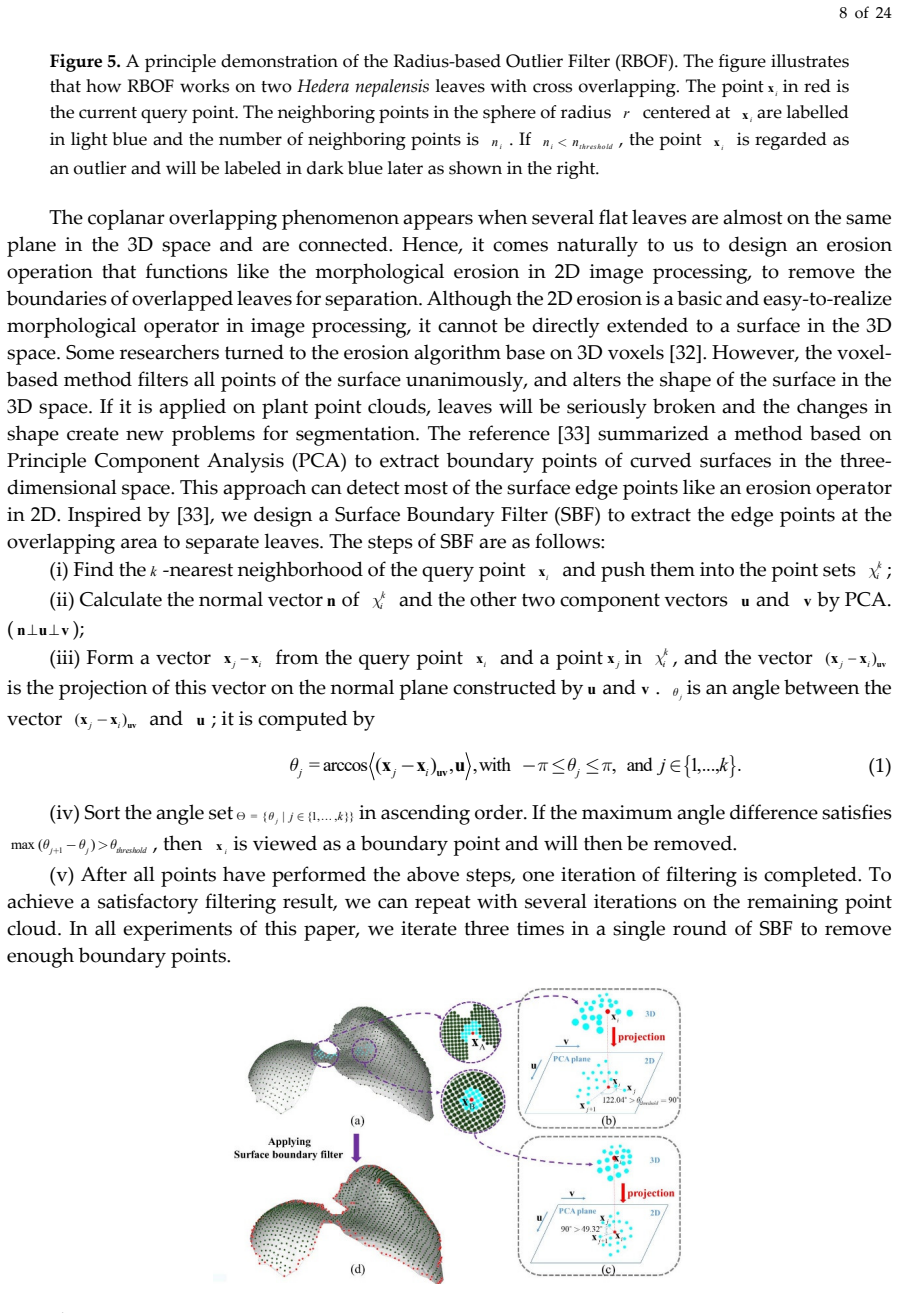
The load-bearing mechanism is the 3D joint filtering operator, composed of a Radius-based Outlier Filter (RBOF) and a Surface Boundary Filter (SBF). RBOF removes sparse points in cross-overlap areas by counting neighbors within a radius, while SBF detects boundary points by computing PCA normals in a k-neighborhood and measuring the maximum angular gap between projected neighbor directions, acting like morphological erosion on a 3D surface. After one or more rounds of joint filtering, the remaining leaf-center points are separated by breadth-first 3D region growing, and the filtered boundary points are over-segmented into facets, which are then grown into full leaves by assigning them to adjacent labeled centers from inside outward.
What would settle it
Scan a new plant of any of the four tested species, apply the parameter values from Tables 6 and 7 without any retuning, and compute the leaf-level F-measure; if the result falls well below the reported 99.66% average, the generalization claim fails.
Extended reading notes
Core claim
The central discovery is that an erosion-like 3D filtering stage can break the connectivity between heavily overlapped leaves in plant point clouds, after which a facet-based region growing stage can restore complete leaves by expanding labels from leaf centers outward. The paper reports point-level cover rates of 97% for Epipremnum aureum, 99% for Monstera deliciosa, 99% for Calathea makoyana, and 87% for Hedera nepalensis, with leaf-level averages of 100.00% Recall, 99.33% Precision, and 99.66% F-measure across those four sample plants. It also claims the method works on point clouds from binocular stereo, a consumer depth camera, and multi-view structure-from-motion, and that the segmented leaves allow automatic trait estimation with average errors of 0.47% for area, 2.89% for length, and 4.64% for width on Calathea makoyana.
Load-bearing premise
The evaluation assumes that one sample plant per species, with parameters tuned separately for each point cloud using statistics from that same cloud, is enough to prove the method generalizes to other plants of the same species and to new species.
Editorial extensions
If this is right
- If the central claim is correct, per-leaf phenotyping of crowded canopies becomes feasible without manual separation, enabling automatic leaf area, length, and width measurement in plant research and agricultural applications.
- The method is claimed to generalize across three types of 3D imaging platforms, so a single segmentation pipeline could be applied to point clouds from binocular stereo, depth sensors, and multi-view reconstruction without changing the core algorithm.
- The reported near-perfect leaf-level scores suggest that the combination of boundary erosion and facet-based regrowth resolves both cross-overlapping and coplanar-overlapping leaf configurations, the two failure modes cited for existing methods.
- Because the pipeline also performs trait estimation from the segmented point clouds, it offers an end-to-end path from raw scans to phenotypic trait values.
Reading between the lines
- The erosion-then-regrow scheme is not inherently leaf-specific; the same RBOF-plus-SBF boundary removal followed by facet growing could plausibly separate other touching or overlapping objects in point clouds, such as fruit clusters, rock fragments, or stacked industrial parts, whenever the objects have locally distinguishable surface orientation.
- If the parameters of the joint filter were set automatically from local point spacing and density statistics, rather than tuned per point cloud, the method could become a turnkey preprocessing step for high-throughput phenotyping pipelines.
- The number of joint-filtering rounds functions like a scale-space erosion parameter; a natural extension would be to stop filtering when the connected-component count stabilizes, making the depth of erosion adaptive to canopy density.
- The reported accuracy values come from the same clouds used for parameter tuning, so a direct test on new plants with fixed parameters would tell whether the method generalizes or needs per-species recalibration.
Signed reviews
Editorial analysis
A structured set of objections, weighed in public.
Referee Report
Summary. The manuscript proposes a three-stage pipeline for individual leaf segmentation in 3D plant point clouds: (i) species-specific concatenations of five preprocessing filters; (ii) a new 3D joint filtering operator that combines a radius-based outlier filter (RBOF) and a surface boundary filter (SBF) to erode overlapping regions and isolate leaf centers; and (iii) pre-segmentation of leaf centers by breadth-first 3D region growing, followed by facet over-segmentation and facet region growing to attach filtered boundary points back to leaves. The method is evaluated on one sample plant each of Epipremnum aureum, Monstera deliciosa, Calathea makoyana, and Hedera nepalensis, acquired with Kinect V2, binocular stereo, and multi-view systems. The authors report point-level cover rates of 97%, 99%, 99%, and 87% for these plants and leaf-level averages of Recall 100.00%, Precision 99.33%, and F-measure 99.66%, plus a leaf-area estimation application with average errors below 5% on nine Calathea leaves.
Significance. The proposed combination of erosion-like joint filtering and facet-based label growing is sensible, and the qualitative results are visually convincing. If the reported accuracies held on unseen plants, the method would be a practically valuable contribution to plant phenotyping, because it addresses the difficult problem of overlapping leaves and is demonstrated on multiple sensor types. The authors provide detailed point-level tables and compare against two relevant baselines ([4] and [19]); the per-plant F-measures in Table 5 are consistent with the stated average. The main value of the paper is the joint filtering plus add-back strategy, which is a reasonable and potentially transferable idea. However, the evidence currently supports only in-sample performance on four single-plant clouds, and the leaf-level metric definitions are too lenient to justify the near-perfect headline. No code or data are released, which further limits reproducibility.
major comments (2)
- [Section 2.1.2, Section 6.4, Tables 6-7, Section 8] The central generalization claim is not supported by the evaluation design. Only one sample plant per species is used, and Table 7 parameters (r, n_threshold, d1, number of joint filtering rounds) are set per point cloud using the average spacing and spherical-neighborhood statistics of that same cloud (Tables 6-7), with preprocessing filter concatenations also chosen per species (Figure 3). The reported point-level cover rates and the 99.66% average F-measure are therefore in-sample estimates. In addition, species and imaging platform are perfectly confounded (Epipremnum aureum with Kinect V2, Monstera deliciosa with binocular stereo, Calathea and Hedera with multi-view), so the claim that the method generalizes across platforms and species is not testable from these data. Section 8 concedes that several parameters require per-case tuning. The authors should add held-out plants, ideally multiple plants per species and repeated acquisitions, report error bars, and demonstrate that the Section 6.4 tuning rules transfer without per-cloud re-tuning; otherwise the broad applicability claim should be substantially weakened.
- [Section 6.2, Table 4, Table 5] The leaf-level metrics are inconsistent with the detailed point-level data. Table 4 lists a Hedera nepalensis leaf 37 with Num_gt=243, Rp=0, Mp=243, and cover_rate=0%, and leaf 11 with cover_rate=51.8%. Under the FN definition in Section 6.2, which states that a real leaf with more than 70% of its points not covered is an FN, leaf 37 should be counted as an FN, yet Table 5 reports FN=0 and Recall=100% for Hedera. The accompanying note to Figure 14 says leaves 24 and 37 were falsely merged into one segment, which should produce both an FP and an FN under the stated definitions. Moreover, the 70% coverage threshold means that a leaf with only 51.8% coverage is neither TP nor FN, so Recall can remain 100% despite substantial under-segmentation. The authors should align the definitions with the per-leaf data, report per-leaf TP/FP/FN, and supplement with stricter point-level or IoU-based metrics before claiming near-perfect leaf-level accuracy.
minor comments (6)
- [Section 3, Figure 3] There are typographical errors such as 'Filer II' in Figure 3 and 'crowed' in Sections 1 and 8; these should be corrected.
- [Equation (1), Section 4.2] Equation (1) and several inline formulas are garbled by formatting; please use clean mathematical notation so the SBF angle computation is unambiguous.
- [Table 4] Table 4 is very hard to read because of the two-column layout and ambiguous row boundaries; please restructure it so each plant's leaves are clearly separated and all column headings are repeated for each block.
- [Section 7.2] The leaf area, length, and width validation is performed on only nine leaves from one Calathea makoyana plant; this limitation should be stated explicitly when the trait-estimation accuracy is reported.
- [Section 8, Abstract] The conclusion acknowledges that parameters need tuning and preprocessing is species-specific, but the abstract overstates generality; the abstract should be tempered to reflect these limitations.
- [Data availability] No data or code availability statement is provided; adding one would materially help reproducibility, especially given the parameter choices in Tables 6 and 7.
Circularity Check
Headline segmentation scores are in-sample: Section 6.4 tunes r, n_threshold, d1, and the preprocessing filter sets per cloud using the same four point clouds on which the 97-99% cover rates and 99.66% F-measure are reported.
-
fitted input called prediction
[Section 6.4 (Parameter tuning), Tables 6-7; Section 2.1.2; Section 8 (Conclusions)]
"Although our method is able to effectively segment leaf point clouds scanned from several kinds of sensors and imaging systems, we need to adjust the parameters separately for each of them. ... Currently, the proposed method still has some restrictions. First, several parameters need to be tuned for an optimal segmentation result."
The paper reports per-species point-level cover rates (97%, 99%, 99%, 87%) and leaf-level F-measure (99.66%) as evidence that the method is suitable for different plant species. But Section 6.4 states parameters were adjusted separately for each cloud, with r, n_threshold, and d1 chosen from the average spacing and spherical-neighborhood counts of that same cloud (Tables 6-7), and Section 2.1.2 uses one sample plant per species. Thus the headline numbers are performance after per-cloud tuning on the very clouds being scored, not held-out predictions. The broad-applicability claim would require the Table 7 settings and preprocessing filter sets to transfer to new plants, which the paper does not test.
full rationale
There is no formal derivation in the paper whose conclusion equals its premise by algebra. The proposed 3D joint filter and facet-region-growing pipeline are genuinely specified modules, and the comparison with [4] and [19] on the same clouds gives some independent evidence of effectiveness. The single load-bearing circularity is empirical: the same four point clouds are used both to tune the method's free parameters (Section 6.4, Tables 6-7) and to compute the claimed near-perfect accuracies (Tables 4-5, Abstract). Because plant species, imaging platform, and tuning instance are confounded, the high F-measure is in-sample and cannot support the paper's generalization claim. The self-citations to [4] for facet over-segmentation are not circular: they import a reusable algorithm module, and the present contribution is judged against [4] as a baseline. I therefore score 5.0: the central capability claim is partially reduced to per-cloud fitting, but the individual segmentation outputs are not constructed from the ground-truth labels, so the paper is not fully circular.
Assumptions & free parameters
free parameters (9)
- r (RBOF search radius) =
0.01 m, 0.01 m, 0.005 m, 0.004 m
- n_threshold (RBOF minimum neighbor count) =
40, 15, 13, 8
- d1 (region growing distance threshold) =
0.004 m, 0.006 m, 0.004 m, 0.006 m
- k (PCA neighborhood size) =
20
- theta_threshold (SBF angular gap threshold) =
90 degrees
- SBF iterations per joint filtering round =
3
- Number of 3D joint filtering rounds =
1 (Epipremnum), 1 (Monstera), 3-4 (Calathea), 3 (Hedera)
- Preprocessing filter concatenation =
I+II+III; I+III; I+IV+II+V; I+II+V
- Facet over-segmentation parameters =
not stated, refer to [4]
assumptions (6)
- domain assumption Overlapping leaf regions are sparser than leaf center regions in the point cloud.
- domain assumption Surface boundaries exhibit a large angular gap in the PCA-projected neighborhood, while interior points do not.
- domain assumption Local surfaces are approximately planar over k=20 neighbors, so PCA yields reliable normals.
- domain assumption The manually labeled ground truth is accurate and consistent.
- domain assumption One scanned plant per species is representative of that species.
- domain assumption Preprocessing filters remove all non-leaf points and leave the leaf geometry intact.
Cite this review
Pith. "Pith review of An overlapping-free leaf segmentation method for plant point clouds." pith.science (2026). https://pith.science/paper/KJYNI657
@misc{pith2026190804018,
  author       = {Pith},
  title        = {Pith review of: An overlapping-free leaf segmentation method for plant point clouds},
  year         = {2026},
  howpublished = {\url{https://pith.science/paper/KJYNI657}},
  note         = {Machine review of arXiv:1908.04018}
}
read the original abstract
Automatic leaf segmentation, as well as identification and classification methods that built upon it, are able to provide immediate monitoring for plant growth status to guarantee the output. Although 3D plant point clouds contain abundant phenotypic features, plant leaves are usually distributed in clusters and are sometimes seriously overlapped in the canopy. Therefore, it is still a big challenge to automatically segment each individual leaf from a highly crowded plant canopy in 3D for plant phenotyping purposes. In this work, we propose an overlapping-free individual leaf segmentation method for plant point clouds using the 3D filtering and facet region growing. In order to separate leaves with different overlapping situations, we develop a new 3D joint filtering operator, which integrates a Radius-based Outlier Filter (RBOF) and a Surface Boundary Filter (SBF) to help to separate occluded leaves. By introducing the facet over-segmentation and facet-based region growing, the noise in segmentation is suppressed and labeled leaf centers can expand to their whole leaves, respectively. Our method can work on point clouds generated from three types of 3D imaging platforms, and also suitable for different kinds of plant species. In experiments, it obtains a point-level cover rate of 97% for Epipremnum aureum, 99% for Monstera deliciosa, 99% for Calathea makoyana, and 87% for Hedera nepalensis sample plants. At the leaf level, our method reaches an average Recall at 100.00%, a Precision at 99.33%, and an average F-measure at 99.66%, respectively. The proposed method can also facilitate the automatic traits estimation of each single leaf (such as the leaf area, length, and width), which has potential to become a highly effective tool for plant research and agricultural engineering.
Figures


Reference graph
Works this paper leans on
-
[4]
Li, D.; Cao, Y.; Tang, X. - S.; Yan, S.; Cai, X. Leaf segmentation on dense plant point clouds with facet region growing. Sensors . 2018 , 18, 3625 -
work page 2018
-
[33]
Rusu, R. B. Semantic 3D object maps for everyday robot manipulation. Springer Berlin Heidelberg . 2013 , 80 -
work page 2013
-
[19]
Automated Segmentation of Leaves from Deciduous Trees in Terrestrial Laser Scanning Point Clouds
Koma, Zs.; Rutzinger, M.; Bremer, M. Automated Segmentation of Leaves from Deciduous Trees in Terrestrial Laser Scanning Point Clouds. IEEE Geoscience and Remote Sensing Letters . 2018 , 1 -
work page 2018
-
[1]
The ge notype conception of heredity
Johannsen , W . The ge notype conception of heredity . Am Nat . 1911 , 45 , 129 – 159
work page 1911
-
[2]
Fahlgren, N.; Gehan, M. A.; Baxter, I. Lights, camera, action: high - throughput plant phenotyping is ready for a close - up. Current Opinion in Plant Biology. 2015 , 24, 93 -
work page 2015
-
[3]
A review of imaging techniques for plant phenotyping
Li, L. A review of imaging techniques for plant phenotyping. Sensors. 2014 , 14, 20078 - 20111
work page 2014
-
[5]
3D Imaging of Greenhouse Plants with an Inexpensive Binocular Stereo Vision System
Li, D. 3D Imaging of Greenhouse Plants with an Inexpensive Binocular Stereo Vision System. Remote Sensing. 2017 , 9, 508 -
work page 2017
-
[6]
Pape, J. - M.; Klukas, C. Utilizing machine learning approaches to improve the prediction of leaf counts and individual leaf segmentation of rosette plant images. CVPPP workshop . 2015 , 3, 1 -
work page 2015
Show all 33 references
-
[7]
Leaf Segmentation and Tracking in Arabidopsis thaliana Combined to an Organ - Scale Plant Model for Genotypic Differentiation
Viaud, G. Leaf Segmentation and Tracking in Arabidopsis thaliana Combined to an Organ - Scale Plant Model for Genotypic Differentiation. Frontiers in Plant Science . 2017 , 7, 2057 -
2017
-
[8]
PlantCV v2: Image analysi s software for high - throughput plant phenotyping
Gehan. PlantCV v2: Image analysi s software for high - throughput plant phenotyping. PeerJ . 2017 , 5, e4088 -
2017
-
[9]
Leaf - GP: An open and automated software application for measuring growth phenotypes for arabidopsis and wheat
Zhou, J. Leaf - GP: An open and automated software application for measuring growth phenotypes for arabidopsis and wheat. Plant Methods . 2017 , 13, 1176 - ,
2017
-
[10]
V.; Tsaftaris, S
Dobrescu, A.; Giuffrida, M. V.; Tsaftaris, S. A. Leveraging multiple datasets for deep leaf counting. ICCV2 017 . 2017 , 2072 -
2017
-
[11]
Joint Multi - Leaf Segmentation, Alignment, and Tracking for Fluorescence Plant Videos
Yin, X. Joint Multi - Leaf Segmentation, Alignment, and Tracking for Fluorescence Plant Videos. IEEE Trans. 2018 , 40, 1411 -
2018
-
[12]
A novel mesh processing based technique for 3D plant analysis
Paproki, A. A novel mesh processing based technique for 3D plant analysis. BMC plant biology. 2012 , 12, 63 -
2012
-
[13]
Facet Segmentation - Based Line Segment Extraction for Large - Scale Point Clouds
Lin, Y. Facet Segmentation - Based Line Segment Extraction for Large - Scale Point Clouds. IEEE Transactions on Geoscience and Remote Sensing . 2017 , 1 -
2017
-
[14]
Dynamic quantification of canopy structure to characterize ea rly plant vigour in wheat genotypes
Duan, T. Dynamic quantification of canopy structure to characterize ea rly plant vigour in wheat genotypes . Journal of Experimental Botany. 2016 , erw227 -
2016
-
[15]
F.; Truong, S
Mccormick, R. F.; Truong, S. K.; Mullet, J. E. 3D sorghum reconstructions from depth images identify QTL regulating shoot architecture. Plant Physiology. 2016 , 00948 -
2016
-
[16]
Segmentation of tree seedling point clouds into elementary units
Wheeler , H . Segmentation of tree seedling point clouds into elementary units. International Journal of Remote Sensing . 2016 , 37, 2881 -
2016
-
[17]
Leaves Segmentation in 3D Point Cloud
Gélard, W . Leaves Segmentation in 3D Point Cloud. International Conference on Advanced Concepts for Intellig ent Vision Systems Springer . 2017
2017
-
[18]
W.; Xu, L
Guo, J. W.; Xu, L. H. Automatic Segmentation for Plant Leaves via Multiview Stereo Reconstruction. Mathematical Problems in Engineering . 2017
2017
-
[20]
- H.; Roderik, L.; Wolfgang, G
Mónica, H. - H.; Roderik, L.; Wolfgang, G. Leaf Movements of Indoor Plants Monitored by Terrestrial LiDAR . Frontiers in Plant Science . 2018 , 9, 189 -
2018
-
[21]
Extraction of Leaf Biophysical Attributes Based on a Computer Graphic - based Algorithm Using Terrestrial Laser Scanning Data
Xu, Q. Extraction of Leaf Biophysical Attributes Based on a Computer Graphic - based Algorithm Using Terrestrial Laser Scanning Data. Remote Sensing . 2019 , 11, 15 - . 24 of 24
2019
-
[22]
Elnashef, B.; Filin, S.; Lati, R. N. Tensor - base d classification and segmentation of three - dimensional point clouds for organ - level plant phenotyping and growth analysis. Computers and Electronics in Agriculture . 2019 , 156, 51 -
2019
-
[23]
A 3D Point Cloud Filtering Method for Leaves Based on Manifold Distance and Normal Estimation
Hu, C.; Pan, Z.; Li, P. A 3D Point Cloud Filtering Method for Leaves Based on Manifold Distance and Normal Estimation. Remote Sensing . 2019 , 11
2019
-
[24]
H.; Kuo, Y
Teng, C. H.; Kuo, Y. T.; Chen, Y. S. Leaf segmentation, classification, and three - dimensional recovery from a few images with close vie wpoints. Optical Engineering . 2011 , 50, 037003 -
2011
-
[25]
In situ 3D segmentation of individual plant leaves using a RGB - D camera for agricultural automation
Xia, C. In situ 3D segmentation of individual plant leaves using a RGB - D camera for agricultural automation. Sensors . 2015 , 15, 20463 - 20479
2015
-
[26]
Editable Parametric Dense Foliage from 3D Capture
Chaurasia, G.; Beardsley, P. Editable Parametric Dense Foliage from 3D Capture. ICCV2017 . 2017 , 5305 -
2017
-
[27]
Automatic Leaf Segmentation for Estimating Leaf Area and Leaf Inclination Angle in 3D Plant Images
Itakura, K.; Hosoi, F. Automatic Leaf Segmentation for Estimating Leaf Area and Leaf Inclination Angle in 3D Plant Images. Sensors . 2018 ,
2018
-
[29]
Evaluating and Improving the Depth Accuracy of Kinect for Windows v2
Yang, L. Evaluating and Improving the Depth Accuracy of Kinect for Windows v2. IEEE Sensors Journal . 2015 , 15, 4275 -
2015
-
[30]
T.; Oliveira, A
Santos, T. T.; Oliveira, A. A. Image - based 3D digitizing for plant architecture analysis and phenotyping. Workshop on Industry Applications . 2012
2012
-
[32]
Point morphology
Stéphane, C.; Boubekeur, T. Point morphology. A CM Transactions on Graphics . 2014 , 33, 1 -
2014
-
[34]
SLIC Superpixels Compared to State - of - the - Art Superpixel Methods
Achanta, R. SLIC Superpixels Compared to State - of - the - Art Superpixel Methods. IEEE Transactions on Pattern Analysis and Machine Intelligence . 2012 , 34, 2274 -
2012
-
[35]
C.; Rusu, R
Marton, Z. C.; Rusu, R. B.; Beetz, M. On fast surface reconstruction methods for large and noisy point clouds. IEEE International Conference on Robotics & Automation . 2009
2009
Reviewed August 14, 2026 · model on record in the stance chip above.
Discussion (0). Continue with ORCID to comment.