A Dual-Burst Geometrical Prescription for Concurrent Signaling
Pith reviewed 2026-06-29 03:28 UTC · model grok-4.3
The pith
Two cosmological transients define a distance-free sky ring for technosignature searches at a chosen time.
A machine-rendered reading of the paper's core claim, the machinery that carries it, and where it could break.
Core claim
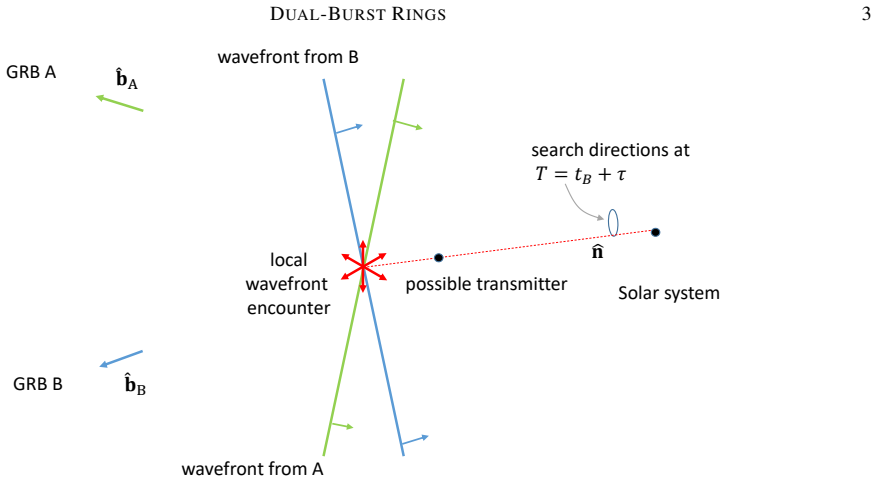
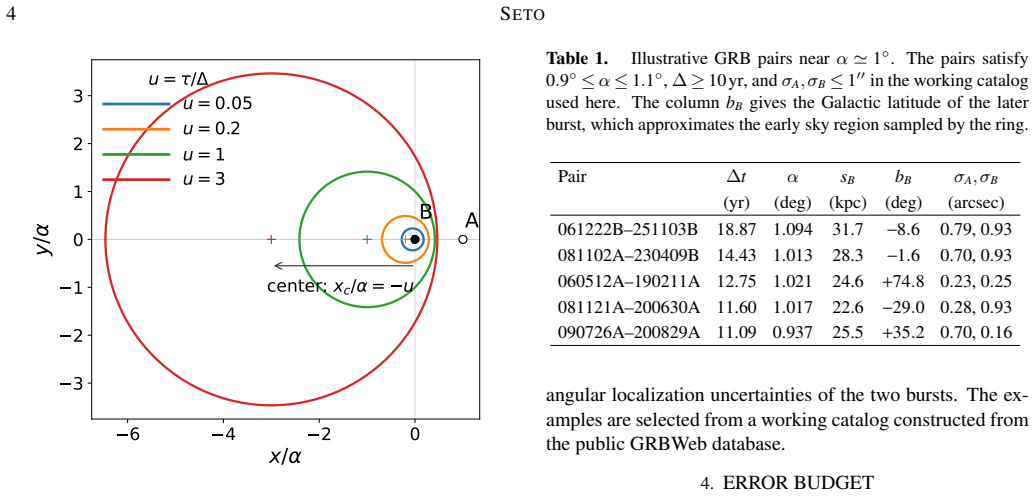
In the dual-burst implementation, two cosmological transients define a sky ring at a chosen observing time after the later burst. The ring is constructed solely from the observed directions of the two bursts and their arrival times at the receiver. No distance information to the bursts, the transmitter, or any Galactic anchor is needed. The width of this ring is set primarily by the accuracy of the burst localizations.
What carries the argument
The dual-burst geometrical prescription that maps the two burst directions and arrival times to a time-dependent sky ring locus.
If this is right
- Transmitters at different line-of-sight distances can be searched collectively through the single time-dependent locus.
- The set of directions to examine shrinks to the finite-width ring whose thickness is governed by burst localization rather than astrophysical distance scales.
- The method supplies an implicit coordination point between transmitter and receiver without any prior communication or shared distance reference.
Where Pith is reading between the lines
- The prescription could be applied directly to pairs of well-localized fast radio bursts to generate concrete search rings for follow-up observations.
- If future instruments reduce burst localization uncertainty, the searchable ring narrows proportionally, lowering the required integration time per direction.
- The same geometry might be combined with other Schelling-point transients to produce multiple intersecting rings and further restrict candidate sky areas.
Load-bearing premise
The two cosmological transients must supply sufficiently precise and independent directional and timing data so the ring width is controlled by localization accuracy rather than distance uncertainties.
What would settle it
For any chosen pair of transients, compute the predicted ring at a later time from their reported directions and arrival times; the prescription fails if the resulting ring width is demonstrably broader than the localization errors alone would allow.
Figures
read the original abstract
We propose a dual-burst implementation of concurrent signaling for technosignature searches. Concurrent signaling is a Schelling-point prescription for implicit coordination between transmitters and receivers without prior communication, using salient astronomical phenomena as coordination anchors. It allows possible transmitters at different line-of-sight distances to be searched collectively through a time-dependent locus on the sky. In the dual-burst implementation, the coordination anchors are two cosmological transients. At a chosen observing time after the later burst, the leading geometrical prescription specifies a precisely defined sky ring from the two burst directions and their observed arrival times at the receiver. No distance to either burst, to a candidate transmitter, or to a Galactic spatial anchor is required to construct this angular search locus. The finite width of the ring is therefore controlled primarily by burst localization rather than by an astrophysical distance scale, thereby reducing the set of sky directions to be searched.
Editorial analysis
A structured set of objections, weighed in public.
Referee Report
Summary. The manuscript proposes a dual-burst geometrical prescription for concurrent signaling in technosignature searches. Two cosmological transients serve as coordination anchors; at a chosen observing time after the later burst, their directions and arrival times at the receiver are used to define a time-dependent sky ring locus for candidate transmitters. The central claim is that this angular locus can be constructed without any distance to the bursts, to a candidate transmitter, or to a Galactic anchor, so that the ring width is set primarily by localization accuracy rather than distance uncertainties.
Significance. If the geometrical construction were valid, the method would allow collective searches over transmitters at arbitrary line-of-sight distances by reducing the search space to a narrow, time-dependent ring whose position is fixed solely by observed burst properties. This would constitute a parameter-free coordination scheme that avoids explicit distance modeling, potentially improving the efficiency of technosignature observations.
major comments (1)
- [Abstract] Abstract: The assertion that the sky ring is constructed from the two burst directions and observed arrival times alone, with no distance to the candidate transmitter required, is geometrically inconsistent. In the plane-wave limit the arrival time T of a signal emitted at the later burst satisfies T = t2 + (d/c)(1 − v · u2) (plus the analogous term from the first burst), where d is the unknown transmitter distance and v is the unit vector toward the transmitter. Solving for the locus of v at fixed T therefore yields a small-circle condition whose angular position explicitly scales with d. The resulting ring cannot be located from burst directions and arrival times without knowledge of d, directly contradicting the manuscript's central claim.
Simulated Author's Rebuttal
We thank the referee for their thorough review and for identifying a potential inconsistency in the geometrical construction. We respond to the single major comment below.
read point-by-point responses
-
Referee: [Abstract] Abstract: The assertion that the sky ring is constructed from the two burst directions and observed arrival times alone, with no distance to the candidate transmitter required, is geometrically inconsistent. In the plane-wave limit the arrival time T of a signal emitted at the later burst satisfies T = t2 + (d/c)(1 − v · u2) (plus the analogous term from the first burst), where d is the unknown transmitter distance and v is the unit vector toward the transmitter. Solving for the locus of v at fixed T therefore yields a small-circle condition whose angular position explicitly scales with d. The resulting ring cannot be located from burst directions and arrival times without knowledge of d, directly contradicting the manuscript's central claim.
Authors: We appreciate the referee highlighting this plane-wave analysis. Upon re-examination of the dual-burst construction, we agree that the provided derivation correctly shows the angular position of the locus depends explicitly on the unknown transmitter distance d in the far-field limit appropriate for cosmological transients. The original claim that the ring can be constructed with no distance information to the candidate transmitter is therefore not supported under this approximation. We will revise the abstract and relevant sections of the manuscript to remove or qualify this assertion, clarify the role of d in the locus position, and discuss whether any alternative coordination timing (e.g., emission triggered by the later of the two burst arrivals) could mitigate the dependence. No other major comments were raised. revision: yes
Circularity Check
No significant circularity; derivation is a direct geometric construction from observables
full rationale
The paper frames its dual-burst prescription as a direct mapping from observed burst directions and arrival times to a time-dependent sky ring at a chosen observing epoch. No equations, fitted parameters, or self-citations are invoked that would reduce the claimed locus to a self-referential definition or force a prediction by construction from the inputs. The central claim of distance independence is presented as an explicit feature of the geometry rather than derived from a prior result or ansatz that already encodes the target. This is a standard case of a self-contained proposal whose validity can be checked against external light-travel geometry; the skeptic's objection addresses physical consistency of the claim, not circularity in the derivation chain itself.
Axiom & Free-Parameter Ledger
axioms (1)
- domain assumption Directions and arrival times of the two bursts can be measured with sufficient precision to define a usable ring.
Reference graph
Works this paper leans on
-
[1]
2023, ApJL, 946, L31, doi: 10.3847/2041-8213/acc39c
Burns, E., Svinkin, D., Fenimore, E., et al. 2023, ApJL, 946, L31, doi: 10.3847/2041-8213/acc39c
-
[2]
Cabrales, B., Davenport, J. R. A., Sheikh, S., & et al. 2024, AJ, 167, 101, doi:
2024
-
[3]
Corbet, R. H. D. 1999, Publ. Astron. Soc. Pac., 111, 881, doi: 10.1086/316395
-
[4]
Davenport, J. R. A., Cabrales, B., Sheikh, S., & et al. 2022, AJ, 164, 117, doi:
2022
-
[5]
Frederiks, D., Svinkin, D., Lysenko, A. L., et al. 2023, ApJL, 949, L7, doi: 10.3847/2041-8213/acd1eb GRA VITY Collaboration, Abuter, R., Amorim, A., et al. 2021, A&A, 647, A59, doi: 10.1051/0004-6361/202040208
-
[6]
1993, The Astrophysical Journal, 415, 218, doi: 10.1086/173164
Horowitz, P., & Sagan, C. 1993, The Astrophysical Journal, 415, 218, doi: 10.1086/173164
-
[7]
Lemarchand, G. A. 1994, Ap&SS, 214, 209, doi: 10.1007/BF00982337
-
[8]
Lesage, S., Veres, P., Briggs, M. S., et al. 2023, ApJL, 952, L42, doi: 10.3847/2041-8213/ace5b4
-
[9]
Makovetskii, P. V . 1980, Icarus, 41, 178, doi: 10.1016/0019-1035(80)90002-0
-
[10]
McLaughlin, W. I. 1977, Icarus, 32, 464, doi: 10.1016/0019-1035(77)90019-7
-
[11]
Nilipour, A., Davenport, J. R. A., Croft, S., & Siemion, A. P. V . 2023, AJ, 166, 79, doi: 10.3847/1538-3881/acde79
-
[12]
Schelling, T. C. 1960, The Strategy of Conflict (Harvard University Press)
1960
-
[13]
2019, The Astrophysical Journal Letters, 876, L10, doi: 10.3847/2041-8213/ab133a —
Seto, N. 2019, The Astrophysical Journal Letters, 876, L10, doi: 10.3847/2041-8213/ab133a —. 2021, The Astrophysical Journal, 917, 96, doi: 10.3847/1538-4357/ac0c7b —. 2024, The Astrophysical Journal, 964, 105, doi: 10.3847/1538-4357/ad2a48 —. 2025, Astrophys. J., 994, 135, doi: 10.3847/1538-4357/ae06a8
-
[14]
2026, ApJ, 1001, 117, doi: 10.3847/1538-4357/ae48ea
Seto, N. 2026, ApJ, 1001, 117, doi: 10.3847/1538-4357/ae48ea
-
[15]
Tarter, J. C. 2001, Annual Review of Astronomy and Astrophysics, 39, 511, doi: 10.1146/annurev.astro.39.1.511
-
[16]
Wright, J. T. 2020, International Journal of Astrobiology, 19, 446, doi: 10.1017/S1473550420000221
discussion (0)
Sign in with ORCID, Apple, or X to comment. Anyone can read and Pith papers without signing in.