REVIEW 4 major objections 5 minor 35 references
Black box behavioural modelling: Predicting human activity schedules with a deep conditional generative approach
T0 review · 4 major / 5 minor · reviewed 2026-08-03 · deepseek-v4-flash
Pith's one-line read ActVAE, a conditional generative model, produces diverse and realistic activity schedules that match the joint distribution of schedules and labels better than either a purely conditional or a purely generative baseline.
desk verdict ActVAE conditions schedule generation on labels and beats its baselines, but the conditional gain is modest and the known ~10% label-effect bias means the controllable-generation claim needs a stronger counterfactual test. read the letter →
The pith
A machine-rendered reading of the paper's core claim, the machinery that carries it, and where it could break.
The reading
What carries the argument
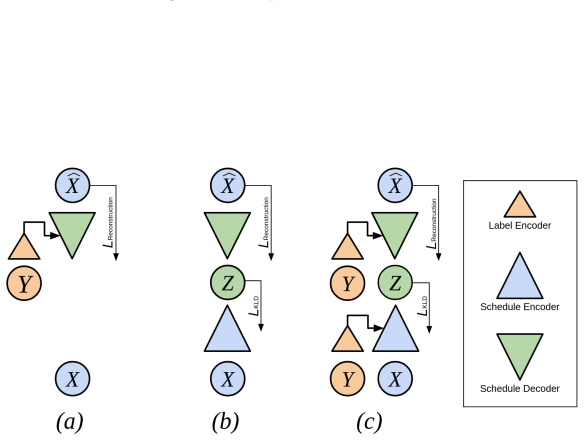
The central object is ActVAE, a conditional variational autoencoder (CVAE) in which a schedule is encoded into a six-dimensional latent vector z with a standard normal prior, and the decoder maps (z, y) to a variable-length sequence of (activity type, duration) tokens; controllable generation relies on the assumption that z and y are independent, so sampling z from the prior and conditioning on y produces samples from p(x|y). The architecture uses stacked LSTM units for the schedule encoder/decoder, a label-encoder block that sums embeddings of categorical attributes, and a combined reconstruction loss (cross-entropy for activity types, MSE for durations) with a β-weighted KL regularisation
What would settle it
A direct falsifier would be a two-sample test between real and ActVAE-generated schedules for a specific label group (e.g., employed males aged 30-39); if the generated conditional distribution differs significantly from the real one on key statistics (work participation, activity start times, sequence length), the paper's central claim fails. More mechanistically, one could compute the mutual information I(z; y) on a held-out set and check whether it is near zero (the paper finds it near 0.17 nats vs. the 0.46 available); a value that does not shrink with increased β would indicate that the a
Extended reading notes
Core claim
On its own terms, the paper establishes that a conditional VAE—termed ActVAE—can learn the joint distribution of 24-hour activity schedules and demographic labels from roughly 59,000 UK travel-diary schedules, and can then generate new schedules conditional on arbitrary label sets. Trained with a continuous encoding of activity types and durations, and an LSTM-based encoder/decoder with a six-dimensional Gaussian latent bottleneck, ActVAE outperforms both a discriminative conditional baseline and a non-conditional generative baseline on a suite of joint-density metrics: participation rates, transition probabilities, and activity timing. The authors find that label-conditioned variation is re
Load-bearing premise
The central assumption is that the latent random variable z that drives schedule diversity is independent of the conditioning labels y; the paper's own mutual-information analysis shows that ActVAE's latents still encode about 37% of the label information, and the model consequently under-estimates label effects by roughly 10%—so if one requires exact conditionality, the load-bearing premise is not fully satisfied.
Editorial extensions
If this is right
- ActVAE can be plugged into existing activity-based demand models as a single joint generator, replacing hand-built compositions of choice sub-models.
- The model can simulate counterfactual scenarios—e.g., population ageing or policy changes—by feeding new label distributions, as demonstrated in the forecasting case study.
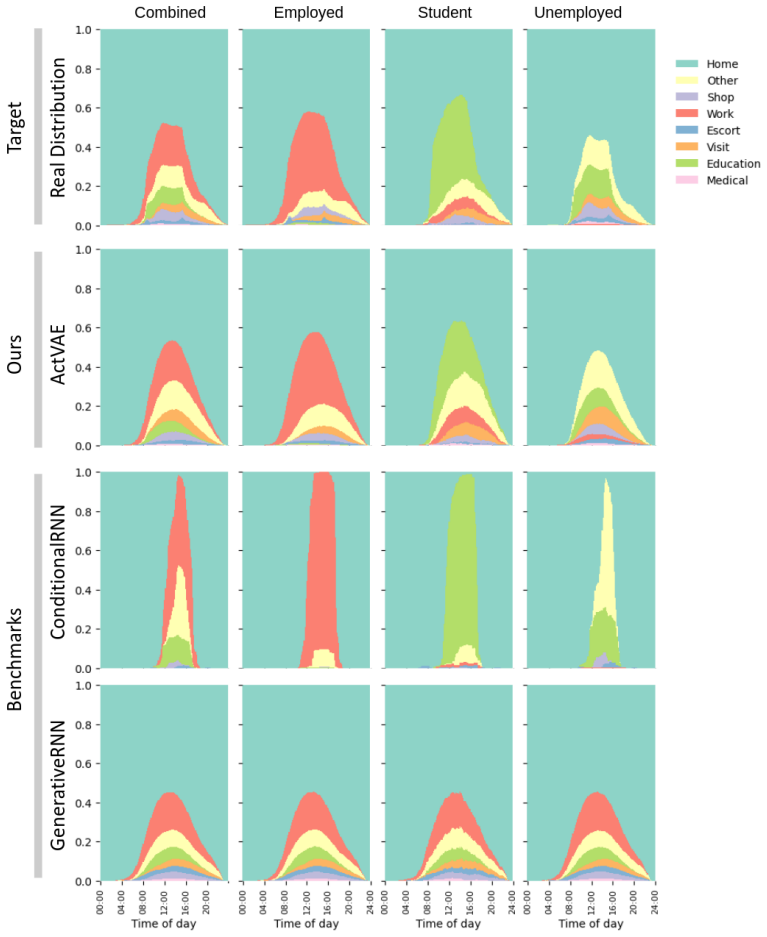
- Explicitly modelling random variation is necessary: a purely conditional model that outputs the most likely schedule fails to match the real diversity of schedules, even with the same conditional architecture.
- The approach is data-efficient, remaining viable with as few as 25,000 schedule samples, and can be trained on multi-year data with year-conditioning to improve performance.
- The residual ~10% under-estimation of label effects means that scenario forecasts are biased toward the population mean, which should be considered when interpreting predictions.
Reading between the lines
- If the disentanglement defect is cured—e.g., by increasing β or using auxiliary objectives—the conditional accuracy could improve substantially while retaining generative diversity, since the paper's own mutual-information numbers suggest a direct trade-off between them.
- The claim that 'labels explain only ~16% of schedule variation' is conditional on the chosen label set; including richer context like weather, day-of-week, or network-level accessibility might raise that share, though the paper's label-availability experiment suggests diminishing returns.
- The joint-density evaluation framework, conditioning on each label marginal, could be extended to higher-order interactions (e.g., age × gender) to catch cases where ActVAE's additive label encoder might miss interactive effects.
- A natural stress test for the model would be to benchmark it on a second country's travel diary with a different label system, to see whether the architecture transfers without tuning.
Editorial analysis
A structured set of objections, weighed in public.
Referee Report
Summary. The paper proposes ActVAE, a conditional variational autoencoder for generating 24-hour human activity schedules conditioned on socio-demographic labels. The architecture combines an LSTM-based continuous schedule encoding with a structured Gaussian latent and learns a joint conditional-generative model. ActVAE is compared against two baselines: ConditionalRNN, a purely conditional model producing the most-likely schedule, and GenerativeRNN, a non-conditional VAE. Evaluation uses reconstruction losses, feasibility and creativity metrics, a joint density estimation framework based on first-order label marginals, mutual information estimates of latent-label entanglement, case studies on forecasting, data/label availability, and a foundational model, plus runtime reporting. The main claims are that ActVAE produces schedules whose joint distribution with labels is closer to the real distribution than both baselines, and that explicit random variation is essential for schedule realism.
Significance. If the claims hold, ActVAE offers a practical, computationally efficient, open-source generative component for activity-based demand models, replacing compositional sub-models with an end-to-end conditional-generative approach. The paper's strengths include a reproducible implementation in Caveat, five-run reporting with variances, honest documentation of limitations (underestimation of label effects, imperfect disentanglement), ablations, and additional case studies. The mutual information analysis is a useful diagnostic for conditional VAEs in this domain. The work also provides evidence that a large fraction of schedule variance is not explained by available labels, which is a substantive empirical finding for activity-scheduling research.
major comments (4)
- [§4.3, §7.6, §7.7] The controlled-generation guarantee depends on the independence assumption z⊥y in Eq. (5)–(7). The paper's own measurements, however, show substantial label leakage: Table 18 reports I(z_φ;y)=0.170 against an upper bound I(x;y)=0.458, i.e. about 37% of available label information remains in the latent, and §7.6 documents a systematic ~10% underestimation of label effects. Since the stated motivation is counterfactual generation under novel label distributions, the present evaluation (aggregate conditional means on observed labels) does not demonstrate robustness of the central claim under the intended operating procedure. The authors should either quantify the impact of leakage on scenario-level outputs (e.g., by comparing p(x|y) from sampling z~p(z) against an estimate using p(z|y)) or substantially weaken the controllability claim.
- [§6.14, §7.4–7.6] The paper repeatedly refers to 'joint density estimation' and matching the 'joint distribution of schedules and labels', but the evaluation in Eq. (17)–(19) conditions only on first-order label marginals. Higher-order interactions among labels (e.g., age × car access × income) are not tested, even though such interactions are likely relevant for activity-based demand models. This is acknowledged in §6.14, but it means the central 'joint' claim is only supported at the marginal level. Please qualify the claims accordingly or add a small number of second-order conditional evaluations.
- [Table 14, §7.5, Table 16] No significance tests are reported. Several ActVAE improvements over GenerativeRNN are small relative to the reported run-to-run variance — for example, label-level participations for age group are 0.050±0.006 for ActVAE versus 0.061±0.005 for GenerativeRNN, and timing distances overlap substantially. Given that the paper's framing is comparative ('ActVAE best matches the joint distribution'), the reader cannot distinguish genuine improvement from noise. Paired tests across the five runs or confidence intervals on the EMD differences should be provided, at least for the summary tables.
- [§7.7] The computation 'label variation is responsible for only 16% of schedule variation in MI terms' via (2.3705−1.9897)/2.3705 assumes that the ActVAE latent captures only random information and the GenerativeRNN latent captures all label information; neither assumption is exactly true, as the paper states. Since this number feeds into a broader conclusion about the relative importance of labels, the authors should report the uncertainty in this derived quantity and perhaps show a sensitivity analysis over the MI estimation model.
minor comments (5)
- [Table 10, Table 11] The hyperparameter notation '4.256.64' is cryptic; please define the tuple (N, S, H) explicitly in the caption or in Section 6.10.
- [Section 5.4] The phrase 'For simplicity, we represent all variables as nominal tokens' is clear, but the later label availability study (Appendix F.3) uses up to 16 labels; a brief note on how continuous variables (e.g., age) are discretized would help reproducibility.
- [Section 7.2, Figure 9] The expected-value conditionality comparison is informative, but the axes or units of the subplots are not always labeled; consider adding a legend and axis titles to make the panels self-contained.
- [Appendix F.2] The 200k/100k/50k/25k/12.5k sample sizes appear in Table F.26 but the sampling procedure is not fully described. State whether these are random samples from the combined 2019–2023 NTS data and how stratification was handled.
- [Throughout] There are several typographical and formatting issues, e.g., 'V ariation Auto-Encoder theory' in the section header, occasional double hyphens in Table E.22, and inconsistent use of 'V AEs' vs 'VAEs'. A final proofread is recommended.
Circularity Check
No significant circularity: ActVAE's central predictions are evaluated against held-out data and external baselines; acknowledged latent-label entanglement is a correctness limitation, not a definitional reduction.
full rationale
The paper's central derivation chain is not circular. ActVAE is trained on an 80% split of real NTS schedules and evaluated on withheld test reconstruction losses, and its generative outputs are compared to real target distributions via density estimation and mutual information estimates. The conditional capability is assessed by generating synthetic schedules from the model using target labels and comparing to real conditional distributions; these are not fitted to the evaluation data. Self-citations to Shone and Hillel (2025) supply an architecture prior, baseline model, encoding choices, and evaluation definitions, but the cited work is an external published result and the present paper's contribution is an independent conditional extension, with its own benchmark comparisons and ablations. The paper explicitly acknowledges that latent-label entanglement violates the independence assumption behind controllable generation (Sec. 4.3, 7.6, 7.7) and reports an approximate 10% under-estimate of label effects and ~37% label leakage; this is an admitted limitation and a correctness risk, not a case where a prediction reduces to a fitted input by construction. The paper also honestly notes in Sec. 8.1 that quantitatively separating conditional capability from generative capability is challenging, which further supports the interpretation that the central claim is asserted with acknowledged uncertainty rather than smuggled in through circular reasoning. No step was found where Eq. X equals Eq. Y by definition or where a fitted parameter is renamed as a prediction.
Assumptions & free parameters
free parameters (5)
- beta (KLD weight) =
0.01
- alpha (duration loss weight) =
200
- latent size =
6
- RNN hidden size and depth (N.S.H = 4.256.64) =
depth 4, hidden 256, label hidden 64
- inverse-label-frequency loss weighting
assumptions (5)
- standard math Latent prior p(z) = N(0, I)
- domain assumption Independence of labels and latent, p(z,y) = p(z)p(y)
- domain assumption NTS 2023 sample is representative of the target population, so (x,y) ~ p(x,y) in Eq. (10)
- domain assumption The continuous schedule encoding (max length 16, 8 activity types, normalised durations) faithfully represents the scheduling problem
- domain assumption First-order label marginals suffice to approximate the joint density for evaluation
Cite this review
Pith. "Pith review of Black box behavioural modelling: Predicting human activity schedules with a deep conditional generative approach." pith.science (2026). https://pith.science/paper/KK6RC7ZZ
@misc{pith2026251204223,
  author       = {Pith},
  title        = {Pith review of: Black box behavioural modelling: Predicting human activity schedules with a deep conditional generative approach},
  year         = {2026},
  howpublished = {\url{https://pith.science/paper/KK6RC7ZZ}},
  note         = {Machine review of arXiv:2512.04223}
}
read the original abstract
Modelling the complexity and diversity of human activity scheduling behaviour is inherently challenging. We demonstrate ActVAE, a deep conditional-generative machine learning approach for the modelling of activity schedules. Suitable for application in activity-based demand modelling frameworks, schedules are modelled as conditional on individual, household and schedule information, such as age, income, and access to public transit. We demonstrate the rapid generation of precise, realistic and diverse schedules dependent on input labels. We extensively evaluate and compare model capabilities against baseline models using a joint-density estimation framework. In addition to providing a novel alternative to existing scheduling approaches, our work highlights the value of explicitly modelling the randomness of complex and diverse human behaviours.
Figures


Figures from the paper (8 more)




Reference graph
Works this paper leans on
-
[5]
(Eds.), Advances in Neural Information Processing Systems, Curran Asso- ciates, Inc
Language models are few-shot learners, in: Larochelle, H., Ranzato, M., Hadsell, R., Balcan, M., Lin, H. (Eds.), Advances in Neural Information Processing Systems, Curran Asso- ciates, Inc.. pp. 1877–1901. URL:https://proceedings.neurips.cc/paper_files/paper/2020/file/ 1457c0d6bfcb4967418bfb8ac142f64a-Paper.pdf. Burgess, C.P., Higgins, I., Pal, A., Matthe...
1901
-
[8]
arXiv preprint arXiv:1810.04805
BERT: Pre-training of deep bidirectional transformers for language understanding. arXiv preprint arXiv:1810.04805 . Diamantis, D.E., Gatoula, P., Iakovidis, D.K.,
-
[9]
Endovae: Generating endoscopic images with a variational autoencoder, in: 2022 IEEE 14th Image, Video, and Multidimensional Signal Processing Workshop (IVMSP), pp. 1–5. doi:10.1109/IVMSP54334.2022.9816329. Goodfellow, I., Pouget-Abadie, J., Mirza, M., Xu, B., Warde-Farley, D., Ozair, S., Courville, A., Bengio, Y.,
arXiv 2022
-
[12]
(Eds.), Advances in Neural Information Processing Systems, Curran Associates, Inc
Denoising diffusion probabilistic models, in: Larochelle, H., Ranzato, M., Hadsell, R., Balcan, M., Lin, H. (Eds.), Advances in Neural Information Processing Systems, Curran Associates, Inc.. pp. 6840–6851. URL:https://proceedings.neurips.cc/paper/2020/hash/ 4c5bcfec8584af0d967f1ab10179ca4b-Abstract.html. Hochreiter, S., Schmidhuber, J.,
2020
-
[14]
Kebaili, A., Lapuyade-Lahorgue, J., Vera, P., Ruan, S.,
Categorical reparameterization with gumbel-softmax doi:10.48550/ arXiv.1611.01144. Kebaili, A., Lapuyade-Lahorgue, J., Vera, P., Ruan, S.,
-
[15]
Discriminative hamiltonian variational autoencoder for accurate tumor segmentation in data-scarce regimes. Neurocomputing 606, 128360. doi:10.1016/j.neucom.2024.128360. Khan, N.A., Habib, M.A.,
arXiv 2024
-
[17]
Transportation Research Part C: Emerging Technologies 137, 103616
Imputing qualitative attributes for trip chains extracted from smart card data using a conditional generative adversarial network. Transportation Research Part C: Emerging Technologies 137, 103616. doi:10.1016/j.trc.2022.103616. Kingma, D.P., Rezende, D.J., Mohamed, S., Welling, M.,
arXiv 2022
-
[18]
(Eds.), Advances in Neural Information Processing Systems, Cur- ran Associates, Inc
Semi-supervised learn- ing with deep generative models, in: Ghahramani, Z., Welling, M., Cortes, C., Lawrence, N., Weinberger, K. (Eds.), Advances in Neural Information Processing Systems, Cur- ran Associates, Inc. URL:https://proceedings.neurips.cc/paper_files/paper/2014/file/ 6d42b1217a6996997ead5a8398c1f944-Paper.pdf. Kingma, D.P., Welling, M.,
2014
Show all 35 references
-
[20]
Transportation Research Record 2677, 1–23
Activity Schedule Modeling Using Machine Learning. Transportation Research Record 2677, 1–23. doi:10.1177/03611981231155426. Larsen, A.B.L., Sønderby, S.K., Larochelle, H., Winther, O.,
-
[21]
Generative active learning with variational autoencoder for radiology data generation in veterinary medicine, pp. 626–631. doi:10. 1109/CAI59869.2024.00123. Liu, K., Jin, X., Cheng, S., Gao, S., Yin, L., Lu, F.,
2024
-
[22]
International Journal of Geographical Information Science 38, 407–431
Act2loc: a synthetic trajectory generation method by combining machine learning and mechanistic models. International Journal of Geographical Information Science 38, 407–431. URL:https://doi.org/10.1080/13658816.2023.2292570, doi:10. 1080/13658816.2023.2292570. Lucas, T., Shme...
2023
-
[25]
Travel Behaviour and Soci- ety 32, 100595
A joint and simultaneous prediction framework of weekday and weekend daily-activity travel pattern using conditional dependency networks. Travel Behaviour and Soci- ety 32, 100595. URL:https://www.sciencedirect.com/science/article/pii/S2214367X23000467, doi:https://doi.org/10....
2023
-
[27]
ArXiv abs/1606.05328
Condi- tional image generation with pixelcnn decoders. ArXiv abs/1606.05328. Pougala, J., Hillel, T., Bierlaire, M.,
-
[28]
Transportation Research Part C: Emerging Technologies 155, 104291
Oasis: Optimisation-based activity scheduling with integrated simultaneous choice dimensions. Transportation Research Part C: Emerging Technologies 155, 104291. doi:https://doi.org/10.1016/j.trc.2023.104291. Rezende, D., Mohamed, S.,
2023
-
[29]
(Eds.), Proceedings of the 31st International Conference on Machine Learning, PMLR, Bejing, China
Stochastic backpropagation and approximate inference 50 in deep generative models, in: Xing, E.P., Jebara, T. (Eds.), Proceedings of the 31st International Conference on Machine Learning, PMLR, Bejing, China. pp. 1278–1286. URL:https://proceedings. mlr.press/v32/rezende14.html...
2023
-
[30]
(Eds.), Advances in Neural Information Processing Systems, Curran Associates, Inc
Assessing genera- tive models via precision and recall, in: Bengio, S., Wallach, H., Larochelle, H., Grauman, K., Cesa-Bianchi, N., Garnett, R. (Eds.), Advances in Neural Information Processing Systems, Curran Associates, Inc. URL:https://proceedings.neurips.cc/paper_files/pap...
2018
-
[33]
Transportation Research Part C: Emerging Technologies 179, 105273
Synthesising activity participations and scheduling with deep generative machine learning. Transportation Research Part C: Emerging Technologies 179, 105273. URL: https://www.sciencedirect.com/science/article/pii/S0968090X25002773, doi:https://doi.org/ 10.1016/j.trc.2025.10527...
2025
-
[34]
(Eds.), Advances in Neural Information Processing Systems, Curran Associates, Inc
Sequence to sequence learning with neural networks, in: Ghahramani, Z., Welling, M., Cortes, C., Lawrence, N., Weinberger, K. (Eds.), Advances in Neural Information Processing Systems, Curran Associates, Inc. URL:https://proceedings.neurips.cc/ paper_files/paper/2014/file/5a18...
2014
-
[35]
ArXiv abs/2205.16007
Improved vector quantised diffusion models. ArXiv abs/2205.16007. URL:https://api.semanticscholar.org/CorpusID:249209888. Vazquez, B., Hevia, N., Perez-Gonzalez, J., Haro, P.,
-
[36]
1316–1324
AttnGAN: Fine-grained text to image generation with attentional generative adversarial networks, in: 2018 IEEE/CVF Conference on Computer Vision and Pattern Recognition, pp. 1316–1324. doi:10.1109/CVPR.2018.00143. 51
2018
- [57]
-
[1997]
Neural Computation 9, 1735–1780
Long Short-Term Memory. Neural Computation 9, 1735–1780. doi:10.1162/neco.1997.9.8.1735. Jang, E., Gu, S., Poole, B.,
1997 doi
-
[2010]
Journal of Choice Modelling 3, 5–31
SACSIM: An applied activity-based model sys- tem with fine-level spatial and temporal resolution. Journal of Choice Modelling 3, 5–31. URL: https://www.sciencedirect.com/science/article/pii/S1755534513700277, doi:https://doi.org/ 10.1016/S1755-5345(13)70027-7. Brown, T., Mann,...
- [2013]
-
[2014]
(Eds.), Advances in Neural Information Processing Systems, Curran Associates, Inc
Generative adversarial nets, in: Ghahramani, Z., Welling, M., Cortes, C., Lawrence, N., Weinberger, K. (Eds.), Advances in Neural Information Processing Systems, Curran Associates, Inc. URL:http://proceedings.neurips.cc/paper_files/paper/2014/file/ f033ed80deb0234979a61f95710d...
2014
-
[2016]
(Eds.), Advances in Neural Information Process- ing Systems, Curran Associates, Inc
Infogan: Inter- pretable representation learning by information maximizing generative adversarial nets, in: Lee, D., Sugiyama, M., Luxburg, U., Guyon, I., Garnett, R. (Eds.), Advances in Neural Information Process- ing Systems, Curran Associates, Inc. URL:https://proceedings.n...
2016
-
[2017]
(Eds.), Advances in Neural Information Processing Systems, Curran Associates, Inc
Neural discrete representation learning, in: Guyon, I., Luxburg, U.V., Bengio, S., Wallach, H., Fergus, R., Vishwanathan, S., Garnett, R. (Eds.), Advances in Neural Information Processing Systems, Curran Associates, Inc. URL:https://proceedings. neurips.cc/paper_files/paper/20...
2017
-
[2018]
Chen, X., Duan, Y., Houthooft, R., Schulman, J., Sutskever, I., Abbeel, P.,
Under- standing disentangling inβ-V AE.arXiv:1804.03599. Chen, X., Duan, Y., Houthooft, R., Schulman, J., Sutskever, I., Abbeel, P.,
-
[2019]
(Eds.), Advances in Neural Information Processing Systems, Curran Associates, Inc
Adaptive density es- timation for generative models, in: Wallach, H., Larochelle, H., Beygelzimer, A., d'Alch´ e- Buc, F., Fox, E., Garnett, R. (Eds.), Advances in Neural Information Processing Systems, Curran Associates, Inc. URL:https://proceedings.neurips.cc/paper_files/pap...
2019
-
[2020]
48 Belghazi, M.I., Baratin, A., Rajeshwar, S., Ozair, S., Bengio, Y., Courville, A., Hjelm, D.,
A differentially private multi-output deep generative networks approach for activity diary synthesis.arXiv:2012.14574. 48 Belghazi, M.I., Baratin, A., Rajeshwar, S., Ozair, S., Bengio, Y., Courville, A., Hjelm, D.,
2012 arXiv
-
[2021]
Transportation Research Part C: Emerging Technolo- gies 123, 102972
Ensemble learning activity scheduler for activity based travel demand models. Transportation Research Part C: Emerging Technolo- gies 123, 102972. URL:https://www.sciencedirect.com/science/article/pii/S0968090X21000097, doi:https://doi.org/10.1016/j.trc.2021.102972. Higgins, I...
2021
-
[2022]
IEEE Transactions on Pattern Analysis and Machine Intelligence 44, 7327–7347
Deep generative modelling: A comparative review of vaes, gans, normalizing flows, energy-based and autoregressive models. IEEE Transactions on Pattern Analysis and Machine Intelligence 44, 7327–7347. doi:10.1109/TPAMI.2021.3116668. Bradley, M., Bowman, J.L., Griesenbeck, B.,
2021
-
[2024]
1886–1890
An improved tabular data generator with vae-gmm integration, in: 2024 32nd European Signal Processing Conference (EUSIPCO), pp. 1886–1890. doi:10.23919/EUSIPCO63174.2024.10715230. Badu-Marfo, G., Farooq, B., Patterson, Z.,
2024
-
[2025]
URL:https:// www.sciencedirect.com/science/article/pii/S0968090X24004182, doi:https://doi.org/10.1016/ j.trc.2024.104897
RUMBoost: Gradient boosted random utility models. URL:https:// www.sciencedirect.com/science/article/pii/S0968090X24004182, doi:https://doi.org/10.1016/ j.trc.2024.104897. Sener, I.N., Bhat, C.R., Copperman, R., Srinivasan, S., Guo, J.Y., Pinjari, A., Eluru, N.,
2024
- [6097]
Reviewed August 3, 2026 · model on record in the stance chip above.
Discussion (0). Sign in to comment.