REVIEW 2 major objections 4 minor 90 references
Raman response of collective modes in multicomponent superconductors
T0 review · 2 major / 4 minor · reviewed 2026-08-03 · deepseek-v4-flash
Pith's one-line read A gauge-invariant Raman formula for any multicomponent superconductor is derived, and it predicts sharp in-gap Raman peaks in UTe2 from intraband relative modes, not a Leggett mode.
desk verdict A careful, useful extension of Raman susceptibility formalism to spin-triplet and TRSB superconductors, with solid derivations and handy group-theory tables; the UTe2 application needs self-consistent checks before its in-gap peaks can be trusted. read the letter →
The pith
A machine-rendered reading of the paper's core claim, the machinery that carries it, and where it could break.
The reading
What carries the argument
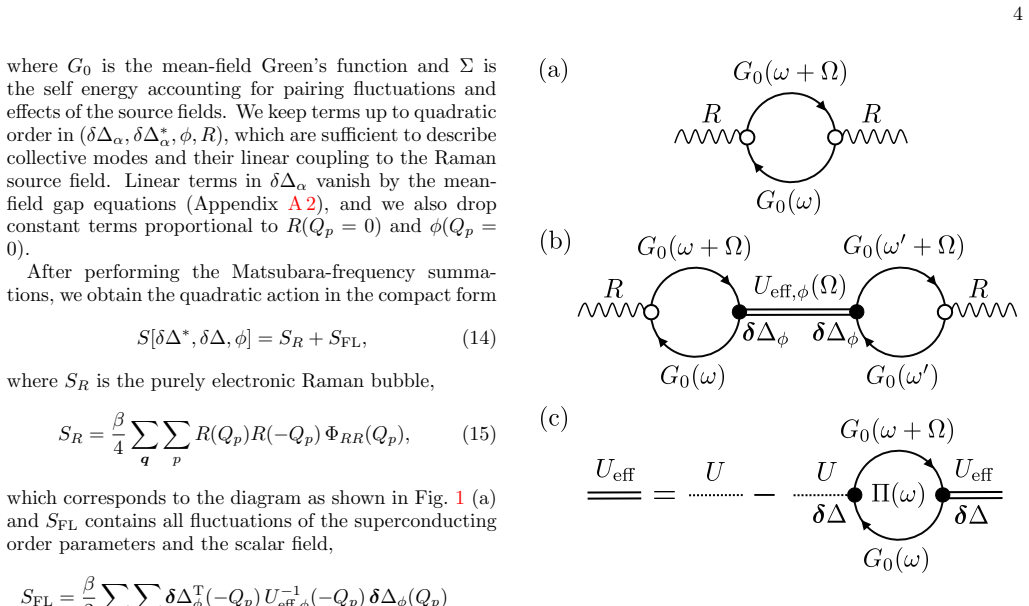
The load-bearing object is the gauge-invariant inverse fluctuation kernel U^{-1}_{eff,ϕ}(q,ω), whose inverse U_{eff,ϕ} is the RPA-resummed propagator for the coupled system of order-parameter fluctuations and the Coulomb scalar field. Poles of U_{eff,ϕ} give the collective-mode spectrum, and its coupling vector Q_{R,ϕ} to the Raman source generates the second term of χ_RR. A Hubbard-Stratonovich scalar field implements the long-range Coulomb interaction and the Anderson-Higgs mechanism; the Ward-Takahashi identity makes the overall phase mode a pure gauge zero mode and cancels Coulomb screening at q→0. The selection rule Γ_{Δ†_α} ⊗ Γ_γ ⊗ Γ_{Δ_β} ∋ A_tot is derived in the Ginzburg-Landau regi
What would settle it
For the UTe2 model, solve the coupled gap equations (A20) with explicit interaction strengths U_i and check whether Δ_x = Δ_y = 0.04, Δ_z = 0.01 is a stationary point. If it is not, recompute Im χ_RR at the self-consistent amplitudes: the in-gap peaks at ω≈0.063 and 0.071 should disappear or shift if they were artifacts of an inconsistent saddle point. Experimentally, polarization-resolved Raman on clean UTe2 below T_c should either show A_g-symmetric in-gap peaks near the predicted frequencies or not.
Extended reading notes
Core claim
Central claim: For any BdG Hamiltonian with separable pairing and Gaussian fluctuations, the Raman susceptibility can be written χ_RR = 1/4 Φ_RR − 1/8 Q^T_{R,ϕ} U_{eff,ϕ} Q_{R,ϕ}, where the first term is the bare quasiparticle bubble and the second term collects collective-mode contributions via an RPA effective interaction that includes Coulomb through a scalar field. This expression is gauge-invariant, computable from BdG eigenvalues/eigenvectors, and applies to singlet/triplet, single/multiband, TRS/TRSB. The authors also derive the selection rule Γ_Δ†_α ⊗ Γ_γ ⊗ Γ_Δ_β ∋ A_tot and tabulate all point groups. For UTe2 with fully gapped Au pairing, they find sharp in-gap Raman peaks at ω≈0.06
Load-bearing premise
The UTe2 calculation assumes the manually chosen gap sizes Δ_x = Δ_y = 0.04 and Δ_z = 0.01 are a genuine stationary point of some specified pairing interaction, but the paper never gives the interaction strengths or solves the gap equation that would confirm this.
Editorial extensions
If this is right
- With a BdG Hamiltonian as input, the full Raman spectrum—quasiparticle background plus collective-mode peaks—follows from explicit kernel expressions without further model-building, enabling computational screening of candidate materials.
- The selection-rule tables imply that a given Raman polarization geometry excites only specific pairs of pairing channels; for example, in D4h the B1g geometry can reach collective modes built from (A1g,B1g) or (A1u,B1u) order-parameter pairs.
- In UTe2, the two sharp in-gap peaks at ω≈0.063 and 0.071 are predicted to be intraband relative modes among the three Au components, distinguishing this state from conventional two-band Leggett scenarios.
- The Raman-active relative Higgs mode at ω≈0.044 is symmetry-allowed but nearly invisible for the standard vertex; increasing the spin-orbit component R_z in the Raman vertex enhances its intensity, so polarization and resonance conditions can tune which mode is observed.
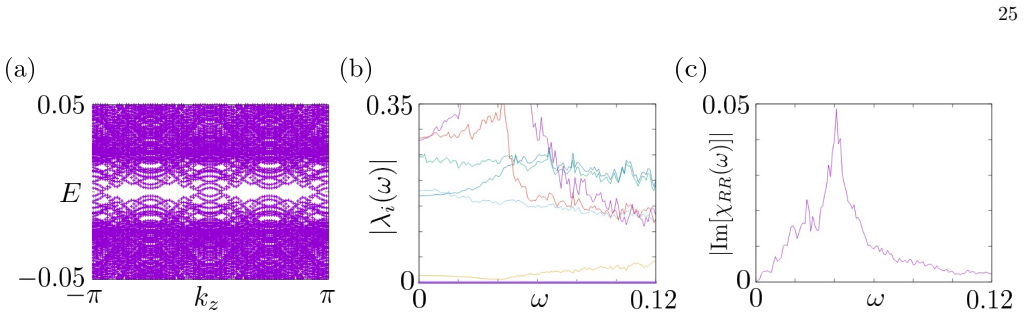
- For nodal B3u pairing the same formalism yields only a broad continuum, confirming that a finite quasiparticle gap is required for sharp collective-mode Raman peaks.
Reading between the lines
- [Editorial inference] The same symmetry tables can be used in reverse: a measured polarization-dependent in-gap Raman peak would pin down the symmetry of the two pairing components involved, offering an order-parameter diagnostic for candidate spin-triplet superconductors beyond UTe2.
- [Editorial inference] Because the formula cleanly separates quasiparticle and collective contributions and is basis-independent, it should transfer to superconductors coupled to phonons or magnons by enlarging the fluctuation sector—a route the paper flags as future work but does not develop.
- [Editorial inference] The prediction of A_g-symmetric in-gap peaks whose intensity tracks spin-orbit coupling provides a concrete experimental target: polarization-resolved Raman on clean UTe2 crystals below T_c. Observing such peaks would also indirectly test whether the assumed Au pairing amplitudes are the correct mean-field state.
Editorial analysis
A structured set of objections, weighed in public.
Referee Report
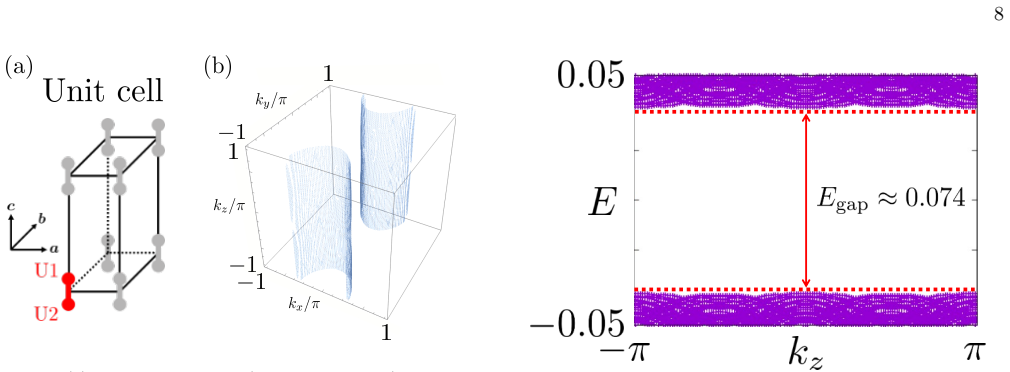
Summary. Yamazaki and Morimoto present a microscopic functional-integral theory of Raman scattering from collective modes in multicomponent superconductors. For a general BdG Hamiltonian with separable pairing interactions and a scalar potential representing the long-range Coulomb interaction, they integrate out fermions, expand to quadratic order in order-parameter fluctuations, and derive a gauge-invariant Raman susceptibility, Eq. (24)/(A43), expressed through explicit BdG kernel functions. They also derive a group-theoretical selection rule (Γ_{Δ†_α}⊗Γ_γ⊗Γ_{Δ_β} ∋ A_tot) and provide classification tables for all point groups. The formalism is applied to a tight-binding model of UTe2 with an Au odd-parity three-component pairing state; the calculation finds two sharp in-gap Raman resonances below the quasiparticle continuum, attributed to intraband relative modes between Au components, and confirms numerically the Ward–Takahashi zero mode and the equality χ_RR(0,ω)=π_RR(0,ω).
Significance. If the central formula is correct, it is a useful and practical advance: it extends earlier singlet-based formulations to arbitrary BdG Hamiltonians with spin-triplet pairing, gives explicit kernel expressions that can be evaluated numerically from BdG eigenvalues and eigenvectors, and provides a symmetry-based framework for identifying Raman-active Leggett, Bardasis–Schrieffer, clapping, and relative modes. The numerical verification of the Ward–Takahashi identity and the equality of screened and unscreened Raman response at q=0 are strengths. The UTe2 application is a falsifiable prediction, but its credibility currently rests on hand-picked mean-field amplitudes; this needs to be fixed before the prediction can be accepted. The group-theoretical tables also need qualification for multidimensional IRs. With these revisions, the paper would be a valuable contribution.
major comments (2)
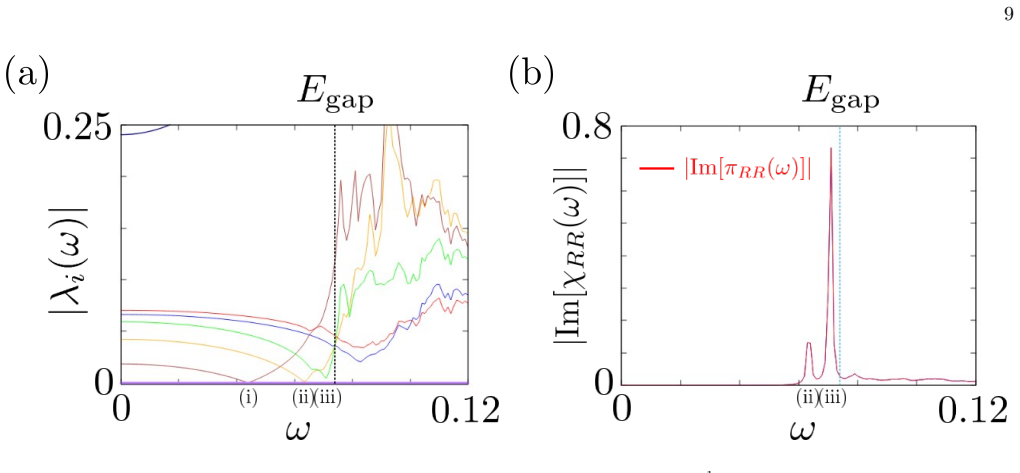
- [Sec. IV.A, Eq. (43), Appendix A 2] The UTe2 calculation is not tied to a specified microscopic interaction. The amplitudes in Eq. (43) are chosen by hand, and no Ui are given; the inverse fluctuation kernel U_eff^{-1} in Eq. (A38) is the correct RPA kernel only if the expansion in Eq. (13) is around a saddle point of the action (A16), i.e., if the mean-field gap equation (A20) is satisfied. The gap equation can be inverted to define Ui for any nonzero Δ, so the issue is not that no interaction exists; the missing checks are (i) Ui>0 as assumed in Eq. (3), (ii) no negative eigenvalues of the Hessian at ω=0, and (iii) the full nonlinear gap equation returns the chosen Δ. Fig. 4(a) plots |λ_i(ω)|, so the sign of the eigenvalues is not visible. Without these checks, the sharp in-gap peaks at ω≈0.063 and 0.071 in Fig. 4(b) cannot be distinguished from artifacts of an unstable or non-stationary expansion point. The same applies
- [Sec. III, Eqs. (27)–(36), Tables I/II] The derivation of the selection rule assumes each gap function transforms as a one-dimensional IR of G (Eq. (27)), but Tables I and II list pairs involving multidimensional IRs (E, T, Eg, Tg). For a component of a multidimensional IR, a generic linear combination does not preserve the full point group, so Eq. (28) does not hold, and the character sum in Eq. (35) is not the correct criterion. The footnote [79] saying higher-dimensional IRs are regarded as 1D IRs of a subgroup does not resolve this, because the tables label full-group IRs and do not specify the subgroup or which component is used. Please either restrict the classification to 1D IRs or derive the correct little-group treatment for multidimensional order parameters. As written, the claim of a classification for 'all point groups' is not fully supported.
minor comments (4)
- [Sec. IV.B, Fig. 4(a)] Fig. 4(a) plots |λ_i(ω)|, so the sign of the inverse-fluctuation eigenvalues is not shown. If the stability checks requested above are added, please plot Re λ_i or otherwise display the sign; otherwise unstable modes are not distinguishable from stable ones.
- [Appendix A, Eq. (A38)] Please specify the convention for the BdG eigenvalues E_m(k) (signed eigenvalues vs. positive quasiparticle energies) and the temperature/filling used in the numerical evaluation of f(E_m). The occupation factors in Eq. (A38) are convention-dependent and the numerics in Fig. 4 are not otherwise reproducible.
- [Sec. III.B] The selection rule is derived in the Ginzburg–Landau regime βΔ≪1, but the UTe2 application is at low temperature. Since the vanishing of symmetry-forbidden vertices is exact, the criterion is presumably general, but the text should state that the linearization in Eq. (33) is only a convenience for the GL analysis and is not required for the symmetry statement.
- [General] There are several typos and minor inconsistencies: 'Euqulid' in Appendix C, 'fequency' in the Fig. 5 caption, 'obatin' in Appendix A, and the statement 'ω≈0.083≈E_gap' (Sec. IV.B) is inconsistent with E_gap≈0.074 quoted earlier. Please correct.
Circularity Check
No significant circularity: Eq. (24) is computed from explicit BdG kernels, and the UTe2 peaks are model outputs, not fitted inputs.
full rationale
The central Raman susceptibility is derived self-containedly. Eq. (A16) is the starting microscopic action, and Eq. (A43)/(24) is obtained by expanding the fermion determinant to quadratic order in fluctuations and external fields (Eqs. A32–A33) and then performing Gaussian integration over the bosonic fields. The kernels Phi_RR, U_eff^{-1}, and Q_R are given explicitly in Eq. (A38) in terms of BdG eigenvalues/eigenvectors and the mean-field amplitudes; no experimental Raman spectrum or target peak is used as an input. The UTe2 resonances in Fig. 4(b) are zeros of det U_eff^{-1} evaluated from the BdG spectrum of the stated tight-binding model, i.e., they are outputs of the computation. The hand-chosen Delta values in Eq. (43) are model parameters, not fit parameters; the related concern that gap equations (A20) are not solved for UTe2 is a consistency/validity assumption, not a circular reduction, because the predicted peaks are not used to define those parameters. The selection rule is derived from the matrix-element symmetry (Eqs. D19–D21) and is equivalent to standard tensor-product decomposition, not imported from a self-citation. The self-citations (Refs. 42, 45, 75) appear only in contextual statements and do not carry the derivation. I therefore find no circular step and assign score 0.
Assumptions & free parameters
free parameters (2)
- Tight-binding parameters t1,t2,t3,t4,μ,Rx,Ry,Rz =
t1=-2.0, t2=1.5, t3=-1.4, t4=0.3, μ=-3.6, Rx=0.6, Ry=0.4, Rz=0.2
- Mean-field order-parameter amplitudes =
ΔMF_x = ΔMF_y = 0.04, ΔMF_z = 0.01
assumptions (6)
- domain assumption Pairing interaction is separable (Eq. 3), with U_i > 0.
- domain assumption Fluctuations are treated only to Gaussian order (RPA) around the mean field (Sec. II B).
- domain assumption Nonresonant Raman vertex γ(k)=Σ e_in e_out ∂²H0 (Eq. 5); no phonons, magnons, excitons, or impurities.
- domain assumption Gap functions transform under 1D IRs; higher-dimensional IRs are treated as 1D IRs of subgroups (footnote [79]).
- domain assumption Selection-rule derivation linearizes in ΔMF (βΔMF ≪ 1, GL regime; Eqs. 33-35).
- domain assumption The tight-binding model of Ref. [81] describes UTe2.
Cite this review
Pith. "Pith review of Raman response of collective modes in multicomponent superconductors." pith.science (2026). https://pith.science/paper/KKUVCVXY
@misc{pith2026260205607,
  author       = {Pith},
  title        = {Pith review of: Raman response of collective modes in multicomponent superconductors},
  year         = {2026},
  howpublished = {\url{https://pith.science/paper/KKUVCVXY}},
  note         = {Machine review of arXiv:2602.05607}
}
abstract
We formulate a microscopic theory of the Raman response of superconducting collective modes in multicomponent superconductors. Starting from a general Bogoliubov--de Gennes (BdG) Hamiltonian with a separable pairing interaction, we derive a gauge-invariant expression for the Raman susceptibility, including a long-range Coulomb interaction. The resulting Raman susceptibility is directly computable for an arbitrary BdG Hamiltonian, which contains single- and multiband systems, spin-singlet and triplet order parameters, and time-reversal-symmetric and time-reversal-symmetry-breaking superconducting states. Based on the microscopic coupling between a Raman source field and collective modes, we derive a symmetry selection rule for Raman-active collective modes and show a group-theoretical classification for all crystalline point groups. This classification provides a unified framework based on the ``higher-order Lifshitz-invariant'' to identify Raman-active collective modes such as Leggett mode, Bardasis-Schrieffer (BS) mode, and clapping mode. As an application, we focus on an effective model of the heavy-fermion superconductor UTe$_2$ with a fully gapped multicomponent odd-parity pairing state. We find sharp in-gap Raman resonances below the quasiparticle continuum, which do not correspond to a conventional Leggett mode but arise from the {\it intraband} relative modes between different pairing components.
Figures
Figures from the paper (1 more)
Reference graph
Works this paper leans on
-
[79]
Ishizuka, S
J. Ishizuka, S. Sumita, A. Daido, and Y. Yanase, Insulator-Metal Transition and Topological Supercon- ductivity in UTe 2 from a First-Principles Calculation, Phys. Rev. Lett.123, 217001 (2019)
2019
-
[1]
Spectrum of collective modes The coupled fluctuations of the superconducting order parameters and the scalar field are described by the ef- fective interaction in Eq. (19). At fixed real frequency ωandq=0, we evaluate the inverse fluctuation kernel U −1 eff,ϕ(0, ω) and diagonalize it as U −1 eff,ϕ(0, ω)vi(ω) =λ i(ω)vi(ω).(44) Hereilabels the eigenmodes bu...
-
[2]
second- order Lifshitz-invariant
Raman susceptibility Using Eq. (24), we compute the full Raman suscepti- bility χRR(0, ω) = 1 4 ΦRR(0, ω)− 1 8 QT R,ϕ(0, ω)Ueff,ϕ(0, ω)QR,ϕ(0,−ω). (46) where the verticesQ R,ϕ encode the coupling of the Ra- man source field to the superconducting fluctuations and to the scalar potential. Fore in x ande out x , Fig. 4 (b) shows the imaginary parts of the f...
-
[3]
General action We start from the Euclidean action related to the partition functionZ= R D[c∗, c, ϕ]e−S[c∗,c,ϕ]: S[c∗, c, ϕ]≡S0[c∗, c] + Z β 0 dτ[H int(τ) +H R(τ) +H ϕ(τ)] +S EM[ϕ] (A1) whereS 0[c∗, c] is the non-interacting part of the action given by S0[c∗, c] = Z β 0 dτ X k c† k(τ)[∂ τ +H 0(k)]ck(τ) (A2) in the basis ofc= [c α, cβ, ...]T, whereα, β, ......
-
[4]
We consider a static and uniform order parameter, ∆i(Q) = ∆iδΩ,0δq,0 withQ≡(q, iΩ), and switch off the external fields,R(Q) =ϕ(Q) =
Gap equation In this section, we derive the mean-field gap equation starting from the general action (A16). We consider a static and uniform order parameter, ∆i(Q) = ∆iδΩ,0δq,0 withQ≡(q, iΩ), and switch off the external fields,R(Q) =ϕ(Q) =
-
[5]
(A13), the quadratic bosonic term in Eq
Using the Fourier convention in Eq. (A13), the quadratic bosonic term in Eq. (A16) reduces to P i(β/Ui)|∆i|2, and the action becomes S[∆∗,∆] = X i β Ui |∆i|2 − 1 2 Tr ln [−βG −1(k1, iωm)], G−1(k, iωm) =− (−iωm +H 0(k)) P i ∆i ˆ∆i(k)P i ∆∗ i ˆ∆† i (k) (−iω m −H T 0 (−k)) .(A17) The mean-field gap equation is obtained as the saddle-point condition of the ef...
-
[6]
0 P α P q δ∆α(q, iωm −iω n) ˆ∆α k1+k2 2 δq,k1−k2P α P q δ∆∗ α(q,−iω m +iω n) ˆ∆† α k1+k2 2 δq,−k1+k2 0 # , ΣR,ϕ ≡ X q
Raman response of collective modes Having set up the formalism, we now consider the Raman response of collective modes in the case where multiple components of the order parameter are simultaneously nonzero. Among the order-parameter components introduced above, we label those that are ordered byα= 1,2, ..., N ∆. We define the fluctuations of the order pa...
-
[7]
P. W. Anderson, Random-Phase Approximation in the Theory of Superconductivity, Phys. Rev.112, 1900 (1958)
1900
Show all 90 references
-
[8]
Schmid, The approach to equilibrium in a pure su- perconductor the relaxation of the Cooper pair density, Phys
A. Schmid, The approach to equilibrium in a pure su- perconductor the relaxation of the Cooper pair density, Phys. Kondens. Mater.8, 129 (1968)
1968
-
[9]
P. B. Littlewood and C. M. Varma, Gauge-Invariant Theory of the Dynamical Interaction of Charge Density Waves and Superconductivity, Phys. Rev. Lett.47, 811 (1981)
1981
-
[10]
P. B. Littlewood and C. M. Varma, Amplitude collective modes in superconductors and their coupling to charge- density waves, Phys. Rev. B26, 4883 (1982)
1982
-
[11]
Pekker and C
D. Pekker and C. Varma, Amplitude/Higgs modes in condensed matter physics, Annu. Rev. Condens. Matter Phys.6, 269 (2015)
2015
-
[12]
Shimano and N
R. Shimano and N. Tsuji, Higgs mode in superconduc- tors, Annu. Rev. Condens. Matter Phys.11, 103 (2020)
2020
-
[13]
I. D. N. Tsuji and S. Tsuchiya, Higgs and Nambu– Goldstone modes in condensed matter physics, inEncy- clopedia of Condensed Matter Physics, 2nd ed. (Academic Press, Oxford, 2024)
2024
-
[14]
Nambu and G
Y. Nambu and G. Jona-Lasinio, Dynamical Model of El- ementary Particles Based on an Analogy with Supercon- ductivity. i, Phys. Rev.122, 345 (1961)
1961
-
[15]
superconductor
J. Goldstone, Field Theories with“superconductor” solutions, Nuovo Cim.19, 154 (1961)
1961
-
[16]
P. W. Anderson, Plasmons, Gauge Invariance, and Mass, Phys. Rev.130, 439 (1963)
1963
-
[17]
P. W. Higgs, Broken Symmetries and the Masses of Gauge Bosons, Phys. Rev. Lett.13, 508 (1964)
1964
-
[18]
A. J. Leggett, Number-Phase Fluctuations in Two-Band Superconductors, Prog. Theor. Phys.36, 901 (1966)
1966
-
[19]
Bardasis and J
A. Bardasis and J. R. Schrieffer, Excitons and Plasmons in Superconductors, Phys. Rev.121, 1050 (1961)
1961
-
[20]
W¨ olfle, Order-Parameter Collective Modes in 3He-A, Phys
P. W¨ olfle, Order-Parameter Collective Modes in 3He-A, Phys. Rev. Lett.37, 1279 (1976)
1976
-
[21]
Tewordt, Collective Order Parameter Modes and Spin Fluctuations for Spin-Triplet Superconducting State in Sr2RuO4, Phys
L. Tewordt, Collective Order Parameter Modes and Spin Fluctuations for Spin-Triplet Superconducting State in Sr2RuO4, Phys. Rev. Lett.83, 1007 (1999)
1999
-
[22]
A. V. Balatsky, P. Kumar, and J. R. Schrieffer, Collec- tive Mode in a Superconductor with Mixed-Symmetry Order Parameter Components, Phys. Rev. Lett.84, 4445 (2000)
2000
-
[23]
N. R. Poniatowski, J. B. Curtis, A. Yacoby, and P. Narang, Spectroscopic signatures of time-reversal sym- metry breaking superconductivity, Commun. Phys.5, 44 (2022)
2022
-
[24]
Blumberg, A
G. Blumberg, A. Mialitsin, B. S. Dennis, M. V. Klein, N. D. Zhigadlo, and J. Karpinski, Observation of Leggett’s Collective Mode in a Multiband MgB 2 Super- conductor, Phys. Rev. Lett.99, 227002 (2007)
2007
-
[25]
Kretzschmar, B
F. Kretzschmar, B. Muschler, T. B¨ ohm, A. Baum, R. Hackl, H.-H. Wen, V. Tsurkan, J. Deisenhofer, and A. Loidl, Raman-Scattering Detection of Nearly Degen- erates-Wave andd-Wave Pairing Channels in Iron- Based Ba0.6K0.4Fe2As2 and Rb0.8Fe1.6Se2 Superconduc- tors, Phys. Rev. Let...
2013
-
[26]
B¨ ohm, A
T. B¨ ohm, A. F. Kemper, B. Moritz, F. Kretzschmar, B. Muschler, H.-M. Eiter, R. Hackl, T. P. Devereaux, D. J. Scalapino, and H.-H. Wen, Balancing Act: Evidence for a Strong Subdominantd-Wave Pairing Channel in Ba0.6K0.4Fe2As2, Phys. Rev. X4, 041046 (2014)
2014
-
[27]
Jost, J.-R
D. Jost, J.-R. Scholz, U. Zweck, W. R. Meier, A. E. 26 B¨ ohmer, P. C. Canfield, N. Lazarevi´ c, and R. Hackl, In- dication of subdominantd-wave interaction in supercon- ducting CaKFe4As4, Phys. Rev. B98, 020504 (2018)
2018
-
[28]
G. He, D. Li, D. Jost, A. Baum, P. P. Shen, X. L. Dong, Z. X. Zhao, and R. Hackl, Raman Study of Cooper Pair- ing Instabilities in Li 1−xFexOHFeSe, Phys. Rev. Lett. 125, 217002 (2020)
2020
-
[29]
Matsumoto, S
H. Matsumoto, S. Neri, T. Kobayashi, A. Maeda, D. Manske, and R. Shimano, A new collective mode in an iron-based superconductor with electronic nematicity, arXiv:2507.14466
-
[30]
C. M. Varma, Higgs Boson in Superconductors, J. Low Temp. Phys.126, 901 (2002)
2002
-
[31]
Tsuji and H
N. Tsuji and H. Aoki, Theory of Anderson pseudospin resonance with Higgs mode in superconductors, Phys. Rev. B92, 064508 (2015)
2015
-
[32]
A. F. Kemper, M. A. Sentef, B. Moritz, J. K. Freericks, and T. P. Devereaux, Direct observation of Higgs mode oscillations in the pump-probe photoemission spectra of electron-phonon mediated superconductors, Phys. Rev. B92, 224517 (2015)
2015
-
[33]
T. Cea, C. Castellani, and L. Benfatto, Nonlinear op- tical effects and third-harmonic generation in supercon- ductors: Cooper pairs versus Higgs mode contribution, Phys. Rev. B93, 180507 (2016)
2016
-
[34]
Tsuji, Y
N. Tsuji, Y. Murakami, and H. Aoki, Nonlinear light– Higgs coupling in superconductors beyond BCS: Effects of the retarded phonon-mediated interaction, Phys. Rev. B94, 224519 (2016)
2016
-
[35]
Jujo, Quasiclassical Theory on Third-Harmonic Gen- eration in Conventional Superconductors with Paramag- netic Impurities, J
T. Jujo, Quasiclassical Theory on Third-Harmonic Gen- eration in Conventional Superconductors with Paramag- netic Impurities, J. Phys. Soc. Jpn.87, 024704 (2018)
2018
-
[36]
Silaev, Nonlinear electromagnetic response and Higgs- mode excitation in BCS superconductors with impurities, Phys
M. Silaev, Nonlinear electromagnetic response and Higgs- mode excitation in BCS superconductors with impurities, Phys. Rev. B99, 224511 (2019)
2019
-
[37]
Schwarz, B
L. Schwarz, B. Fauseweh, N. Tsuji, N. Cheng, N. Bit- tner, H. Krull, M. Berciu, G. S. Uhrig, A. P. Schnyder, S. Kaiser, and D. Manske, Classification and characteri- zation of nonequilibrium Higgs modes in unconventional superconductors, Nat. Commun.11, 287 (2020)
2020
-
[38]
Tsuji and Y
N. Tsuji and Y. Nomura, Higgs-mode resonance in third harmonic generation in NbN superconductors: Multi- band electron-phonon coupling, impurity scattering, and polarization-angle dependence, Phys. Rev. Res.2, 043029 (2020)
2020
-
[39]
Seibold, M
G. Seibold, M. Udina, C. Castellani, and L. Benfatto, Third harmonic generation from collective modes in dis- ordered superconductors, Phys. Rev. B103, 014512 (2021)
2021
-
[40]
Haenel, P
R. Haenel, P. Froese, D. Manske, and L. Schwarz, Time- resolved optical conductivity and Higgs oscillations in two-band dirty superconductors, Phys. Rev. B104, 134504 (2021)
2021
-
[41]
Udina, J
M. Udina, J. Fiore, T. Cea, C. Castellani, G. Seibold, and L. Benfatto, THz non-linear optical response in cuprates: Predominance of the BCS response over the Higgs mode, Faraday Discuss.237, 168 (2022)
2022
-
[42]
C.-g. Oh, H. Watanabe, and N. Tsuji, Role of Quantum Geometry in the Competition between Higgs Mode and Quasiparticles in Third-Harmonic Generation of Super- conductors, arXiv:2512.01200
-
[43]
Matsunaga, Y
R. Matsunaga, Y. I. Hamada, K. Makise, Y. Uzawa, H. Terai, Z. Wang, and R. Shimano, Higgs Amplitude Mode in the BCS Superconductors Nb 1−xTixN Induced by Terahertz Pulse Excitation, Phys. Rev. Lett.111, 057002 (2013)
2013
-
[44]
Matsunaga, N
R. Matsunaga, N. Tsuji, H. Fujita, A. Sugioka, K. Makise, Y. Uzawa, H. Terai, Z. Wang, H. Aoki, and R. Shimano, Light-induced collective pseudospin preces- sion resonating with Higgs mode in a superconductor, Science345, 1145 (2014)
2014
-
[45]
Matsunaga, N
R. Matsunaga, N. Tsuji, K. Makise, H. Terai, H. Aoki, and R. Shimano, Polarization-resolved terahertz third- harmonic generation in a single-crystal superconductor NbN: Dominance of the Higgs mode beyond the BCS approximation, Phys. Rev. B96, 020505 (2017)
2017
-
[46]
Katsumi, N
K. Katsumi, N. Tsuji, Y. I. Hamada, R. Matsunaga, J. Schneeloch, R. D. Zhong, G. D. Gu, H. Aoki, Y. Gal- lais, and R. Shimano, Higgs Mode in thed-wave Super- conductor Bi 2Sr2CaCu2O8+x Driven by an Intense Ter- ahertz Pulse, Phys. Rev. Lett.120, 117001 (2018)
2018
-
[47]
H. Chu, M. Kim, K. Katsumi, et al., Phase-resolved Higgs response in superconducting cuprates, Nat. Commun.11, 1793 (2020)
2020
-
[48]
Kamatani, S
T. Kamatani, S. Kitamura, N. Tsuji, R. Shimano, and T. Morimoto, Optical response of the Leggett mode in multiband superconductors in the linear response regime, Phys. Rev. B105, 094520 (2022)
2022
-
[49]
Nagashima, S
R. Nagashima, S. Tian, R. Haenel, N. Tsuji, and D. Manske, Classification of Lifshitz invariant in multi- band superconductors: An application to Leggett modes in the linear response regime in Kagome lattice models, Phys. Rev. Res.6, 013120 (2024)
2024
-
[50]
Lee and S
C. Lee and S. B. Chung, Linear optical response from the odd-parity Bardasis-Schrieffer mode in locally non- centrosymmetric superconductors, Commun. Phys.6, 307 (2023)
2023
-
[51]
Matsushita, J
T. Matsushita, J. Ieda, Y. Araki, T. Morimoto, I. Vekhter, and Y. Yanase, Microwave Kerr/Faraday Resonance in Two-dimensional Chiral Superconductors, arXiv:2601.10151
-
[52]
L. D. Landau and E. M. Lifshitz, Statistical Physics (Pergamon Press, Oxford, 1969)
1969
-
[53]
M. V. Klein and S. B. Dierker, Theory of Raman scatter- ing in superconductors, Phys. Rev. B29, 4976 (1984)
1984
-
[54]
T. P. Devereaux and R. Hackl, Inelastic light scatter- ing from correlated electrons, Rev. Mod. Phys.79, 175 (2007)
2007
-
[55]
Sooryakumar and M
R. Sooryakumar and M. V. Klein, Raman Scattering by Superconducting-Gap Excitations and Their Coupling to Charge-Density Waves, Phys. Rev. Lett.45, 660 (1980)
1980
-
[56]
M´ easson, Y
M.-A. M´ easson, Y. Gallais, M. Cazayous, B. Clair, P. Rodi` ere, L. Cario, and A. Sacuto, Amplitude Higgs mode in the 2H-NbSe2 superconductor, Phys. Rev. B89, 060503 (2014)
2014
-
[57]
Grasset, T
R. Grasset, T. Cea, Y. Gallais, M. Cazayous, A. Sacuto, L. Cario, L. Benfatto, and M.-A. M´ easson, Higgs-mode radiance and charge-density-wave order in 2H-NbSe 2, Phys. Rev. B97, 094502 (2018)
2018
-
[58]
Grasset, Y
R. Grasset, Y. Gallais, A. Sacuto, M. Cazayous, S. Ma˜ nas Valero, E. Coronado, and M.-A. M´ easson, Pressure- Induced Collapse of the Charge Density Wave and Higgs Mode Visibility in 2H-TaS 2, Phys. Rev. Lett.122, 127001 (2019)
2019
-
[59]
Majumdar, D
A. Majumdar, D. VanGennep, J. Brisbois, D. Chareev, A. V. Sadakov, A. S. Usoltsev, M. Mito, A. V. Silhanek, T. Sarkar, A. Hassan, O. Karis, R. Ahuja, and M. Abdel- Hafiez, Interplay of charge density wave and multiband 27 superconductivity in layered quasi-two-dimensional ma- ...
2020
-
[60]
D. J. Scalapino and T. P. Devereaux, Collectived-wave exciton modes in the calculated Raman spectrum of Fe- based superconductors, Phys. Rev. B80, 140512 (2009)
2009
-
[61]
H. C. Lee and H. Y. Choi, Electronic Raman scatter- ing of two-band superconductors: a time-dependent Lan- dau–Ginzburg theory approach, J. Phys.: Condens. Mat- ter21, 445701 (2009)
2009
-
[62]
M. V. Klein, Theory of Raman scattering from Leggett’s collective mode in a multiband superconductor: Appli- cation to MgB 2, Phys. Rev. B82, 014507 (2010)
2010
-
[63]
Khodas, A
M. Khodas, A. V. Chubukov, and G. Blumberg, Collec- tive modes in multiband superconductors: Raman scat- tering in iron selenides, Phys. Rev. B89, 245134 (2014)
2014
-
[64]
Maiti, T
S. Maiti, T. A. Maier, T. B¨ ohm, R. Hackl, and P. J. Hirschfeld, Probing the Pairing Interaction and Multiple Bardasis-Schrieffer Modes Using Raman Spectroscopy, Phys. Rev. Lett.117, 257001 (2016)
2016
-
[65]
Cea and L
T. Cea and L. Benfatto, Signature of the Leggett mode in theA 1g Raman response: From MgB 2 to iron-based superconductors, Phys. Rev. B94, 064512 (2016)
2016
-
[66]
Maiti, A
S. Maiti, A. V. Chubukov, and P. J. Hirschfeld, Conser- vation laws, vertex corrections, and screening in Raman spectroscopy, Phys. Rev. B96, 014503 (2017)
2017
-
[67]
Benek-Lins and S
I. Benek-Lins and S. Maiti, Many-body physics-induced selection rules: Application to Raman spectroscopy, Phys. Rev. B109, 104505 (2024)
2024
-
[68]
Sarkar and S
S. Sarkar and S. Maiti, Electronic Raman response of a superconductor across a time reversal symmetry breaking phase transition, Phys. Rev. B109, 094515 (2024)
2024
-
[69]
Takasan and N
K. Takasan and N. Tsuji, Superconducting nonlinear Hall effect induced by geometric phases, arXiv:2503.14589
-
[70]
S. Ran, C. Eckberg, Q.-P. Ding, Y. Furukawa, T. Metz, S. R. Saha, I.-L. Liu, M. Zic, H. Kim, J. Paglione, and N. P. Butch, Nearly ferromagnetic spin-triplet supercon- ductivity, Science365, 684 (2019)
2019
-
[71]
Aoki, J.-P
D. Aoki, J.-P. Brison, J. Flouquet, K. Ishida, G. Knebel, Y. Tokunaga, and Y. Yanase, Unconventional supercon- ductivity in UTe2, Journal of Physics: Condensed Matter 34, 243002 (2022)
2022
-
[72]
Matsumura, H
H. Matsumura, H. Fujibayashi, K. Kinjo, S. Kitagawa, K. Ishida, Y. Tokunaga, H. Sakai, S. Kambe, A. Naka- mura, Y. Shimizu, Y. Homma, D. Li, F. Honda, and D. Aoki, Large Reduction in the a-axis Knight Shift on UTe2 with T c = 2.1 K, J. Phys. Soc. Jpn.92, 063701 (2023)
2023
-
[73]
Theuss, A
F. Theuss, A. Shragai, G. Grissonnanche, I. M. Hayes, S. R. Saha, Y. S. Eo, A. Suarez, T. Shishidou, N. P. Butch, J. Paglione, and B. J. Ramshaw, Single- component superconductivity in UTe 2 at ambient pres- sure, Nature Physics20, 1124 (2024)
2024
-
[74]
Suetsugu, M
S. Suetsugu, M. Shimomura, M. Kamimura, T. Asaba, H. Asaeda, Y. Kosuge, Y. Sekino, S. Ikemori, Y. Kasa- hara, Y. Kohsaka, M. Lee, Y. Yanase, H. Sakai, P. Ople- tal, Y. Tokiwa, Y. Haga, and Y. Matsuda, Fully gapped pairing state in spin-triplet superconductor UTe 2, Sci. Adv.10...
2024
-
[75]
Z. Li, C. M. Moir, N. J. McKee, E. Lee-Wong, R. E. Baumbach, M. B. Maple, and Y. Liu, Observation of odd- parity superconductivity in UTe2, Proceedings of the Na- tional Academy of Sciences122, e2419734122 (2025)
2025
-
[76]
I. M. Hayes, T. E. Metz, C. E. Frank, S. R. Saha, N. P. Butch, V. Mishra, P. J. Hirschfeld, and J. Paglione, Ro- bust Nodal Behavior in the Thermal Conductivity of Su- perconducting UTe 2, Phys. Rev. X15, 021029 (2025)
2025
-
[77]
Q. Gu, S. Wang, J. P. Carroll, K. Zhussupbekov, C. Broyles, S. Ran, N. P. Butch, J. A. Horn, S. Saha, J. Paglione, X. Liu, J. C. S. Davis, and D.-H. Lee, Pair wave function symmetry in UTe 2 from zero-energy sur- face state visualization, Science388, 938 (2025)
2025
-
[78]
S. Wang, K. Zhussupbekov, and J. e. a. Carroll, Odd- parity quasiparticle interference in the superconductive surface state of UTe 2, Nat. Phys.21, 1555 (2025)
2025
-
[80]
J. Tei, T. Mizushima, and S. Fujimoto, Possible real- ization of topological crystalline superconductivity with time-reversal symmetry in UTe 2, Phys. Rev. B107, 144517 (2023)
2023
-
[81]
Yamazaki and S
Y. Yamazaki and S. Kobayashi, Higher-order topolog- ical phases for time-reversal-symmetry breaking super- conductivity in UTe2, Phys. Rev. B112, 174507 (2025)
2025
-
[82]
T. P. Devereaux, A. Virosztek, and A. Zawadowski, Multiband electronic Raman scattering in bilayer super- conductors, Phys. Rev. B54, 12523 (1996)
1996
-
[83]
G. R. Boyd, T. P. Devereaux, P. J. Hirschfeld, V. Mishra, and D. J. Scalapino, Probing the pairing symmetry of the iron pnictides with electronic Raman scattering, Phys. Rev. B79, 174521 (2009)
2009
-
[84]
Sauer and G
C. Sauer and G. Blumberg, Screening of the Raman re- sponse in multiband superconductors: Application to iron pnictides, Phys. Rev. B82, 014525 (2010)
2010
-
[85]
Higher-dimensional IRs are regarded as 1D IRs of the subgroup ofG
-
[86]
While our explicit calculations focus on fluctuations of the condensed components included in the mean-field BdG Hamiltonian, the selection rule and the classifica- tion tables are more general. In particular, by taking one of (∆ α,∆ β) to be condensed and the other to represe...
-
[87]
Shishidou, H
T. Shishidou, H. G. Suh, P. M. R. Brydon, M. Weinert, and D. F. Agterberg, Topological band and superconduc- tivity in UTe 2, Phys. Rev. B103, 104504 (2021)
2021
-
[88]
D. Aoki, H. Sakai, P. Opletal, Y. Tokiwa, J. Ishizuka, Y. Yanase, H. Harima, A. Nakamura, D. Li, Y. Homma, Y. Shimizu, G. Knebe, J. Flouquet, and Y. Haga, First Observation of the de Haas–van Alphen Effect and Fermi Surfaces in the Unconventional Superconductor UTe2, J. Phys. ...
2022
-
[89]
T. I. Weinberger, Z. Wu, D. E. Graf, Y. Skourski, A. Ca- bala, J. Posp ´ ıˇ sil, J. Prokleˇ ska, T. Haidamak, G. Bastien, V. Sechovsk´ y, G. G. Lonzarich, M. Valiˇ ska, F. M. Grosche, and A. G. Eaton, Quantum Interference be- tween Quasi-2D Fermi Surface Sheets in UTe 2, Phys....
2024
-
[90]
D. Aoki, I. Sheikin, N. Marquardt, G. Lapertot, J. Flou- quet, and G. Knebel, High Field Superconducting Phases of Ultra Clean Single Crystal UTe 2, J. Phys. Soc. Jpn. 93, 123702 (2024)
2024
Reviewed August 3, 2026 · model on record in the stance chip above.
Discussion (0). Continue with ORCID to comment.