REVIEW 4 major objections 5 minor 66 references
Target Semantics Clustering via Text Representations for Robust Universal Domain Adaptation
T0 review · 4 major / 5 minor · reviewed 2026-08-07 · deepseek-v4-flash
Pith's one-line read Universal domain adaptation can be reduced to searching a discrete English-noun vocabulary for target semantic centers and then refining a vision-language model with one information-maximization loss, a recipe the paper reports beats all…
desk verdict A genuinely useful idea—searching target semantic centers in CLIP's text space—backed by strong but incompletely verified results on common-noun benchmarks. read the letter →
The pith
A machine-rendered reading of the paper's core claim, the machinery that carries it, and where it could break.
The reading
What carries the argument
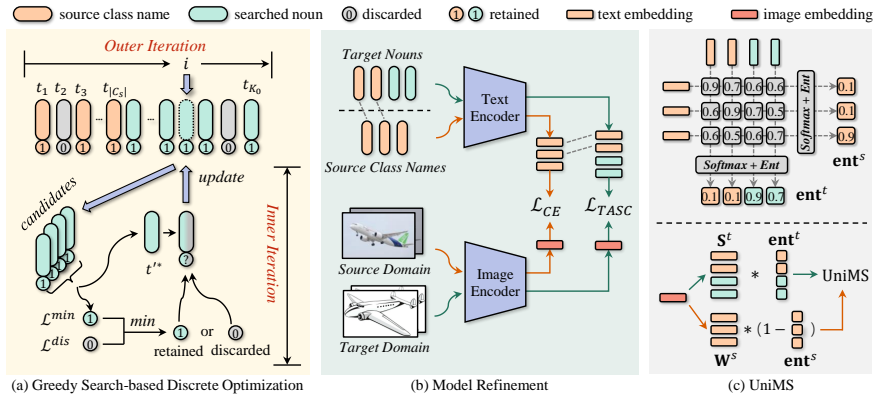
The load-bearing object is the constrained, discrete text representation space: the text embeddings of source class names $T^s$ together with a vocabulary of candidate nouns $T^{nouns}$, from which the algorithm picks a subset $\mathcal{T}$ with a binary hidden state vector $r \in \{0,1\}^{K_0}$ that dynamically determines the number of clusters $K$. TASC is formulated as a Mixed-Integer Nonlinear Programming problem and solved in two stages: a greedy search that, with encoders frozen, proposes $n_c$ candidate nouns per position and keeps or discards each according to an information-maximization loss; then a gradient-descent stage that, with the chosen nouns fixed, fine-tunes the image and text encoders through low-rank adapters on the same loss plus source cross-entropy. The inference-side score UniMS is built from the same centers: it takes the maximum similarity to source centers, discounts it by normalized entropies that encode the estimated category shift, and subtracts a term from target centers; a two-component Gaussian mixture model converts the resulting score into a threshold.
What would settle it
Take a UniDA benchmark whose target-private classes are fine-grained or non-noun categories (e.g., specific bird subspecies, named actions, or synthetic texture classes) and check both whether the vocabulary contains those class names and whether TASC's estimated number of clusters K matches the ground truth; if the estimated K is biased or the unknown-class accuracy drops, the claim that the text space provides unbiased semantic centers fails. A cheaper check is to count, across the paper's own splits, how many true target-private class names actually appear in the search vocabulary.
Extended reading notes
Core claim
The central claim is that constraining the search space of semantic centers to a semantically meaningful and discrete text representation space removes the two failure modes of clustering-based UniDA: domain bias and uncontrolled semantic granularity. In the proposed framework, source semantics are represented by text embeddings of source class names, and target semantics are discovered by a greedy search that selects actual nouns, from a vocabulary of source class names plus ordinary English nouns, to serve as cluster centers; a binary hidden state vector adaptively retains or discards each candidate, so the number of target clusters is estimated rather than fixed. Because the selected text embeddings are almost free of domain bias, the centers of common classes in source and target coincide, and a single information-maximization loss (plus source cross-entropy) performs common-class alignment and private-class clustering at once. For inference, the same centers feed a scoring function that multiplies maximum similarity by category-shift-aware entropy terms, and a two-component Gaussian mixture model supplies the open-set threshold. The paper reports H-scores and accuracies on four benchmarks showing this pipeline outperforms prior clustering-based and optimal-transport-based UniDA methods, with margins of 6.0% on DomainNet and 11.3% on VisDA.
Load-bearing premise
The load-bearing premise is that every meaningful target category, including private ones, can be represented by an English noun from the source class names plus the chosen noun vocabulary at the right level of detail, so the greedy search can always find a text center for it.
Editorial extensions
If this is right
- A single information-maximization loss now performs both common-class alignment and private-class clustering, so UniDA no longer requires cycle-consistent matching, optimal transport, or hand-crafted unknown-detection criteria.
- The estimated number of target classes emerges from the same search: discarded nouns correspond to source-private classes, retained non-source nouns correspond to target-private classes, and the retained source names correspond to common classes.
- Open-set detection gets an adaptive threshold from a Gaussian mixture model whose mixture weights are set by the estimated class counts, replacing manual thresholds that had to be re-tuned per scenario.
- The framework inherits the open-vocabulary coverage of the underlying vision-language model, so new domains only need class names and a noun vocabulary rather than re-estimated image prototypes.
- The reported margins grow on larger, more diverse benchmarks (6.0% on DomainNet, 11.3% on VisDA), which is consistent with the claim that text-space centers scale better than image-space clusters.
Reading between the lines
- If the text representation space is as domain-neutral as the paper claims, the same greedy noun search could serve as a label-discovery subroutine for neighboring problems like generalized category discovery, where the number of clusters is also unknown.
- The method would likely strain on target-private classes that are fine-grained, abstract, or not nameable by English nouns (medical findings, human actions, synthetic textures); the paper's benchmarks are dominated by common object nouns, and its single qualitative example does not establish such coverage.
- The entropy-weighted maximum-similarity idea in UniMS could be ported to any zero-shot open-set classifier, suggesting a testable principle: reweight maximum similarity by normalized cross-entropy between the source and target classifiers to make open-set scores shift-aware.
- A stress test the authors do not report is freezing the text space while swapping the vision encoder, which would separate the benefit of the text space itself from the benefit of the specific pretrained model.
Editorial analysis
A structured set of objections, weighed in public.
Referee Report
Summary. The paper proposes TASC, a Universal Domain Adaptation method that uses CLIP text representations as a discrete, semantically meaningful search space for target semantic centers. In the first stage, with frozen encoders, it greedily searches over source class names and WordNet nouns to find a set of text embeddings that minimizes an information-maximization clustering loss, while learning a binary state vector that discards redundant or source-private centers. In the second stage, the retained centers are fixed and the image and text encoders are fine-tuned with LoRA using the same clustering loss plus source cross-entropy. For inference, the paper introduces UniMS, a maximum-similarity score weighted by per-center entropies, and uses a GMM with estimated class proportions to set an adaptive unknown-detection threshold. Experiments cover OPDA, ODA, PDA, and CDA on Office, Office-Home, DomainNet, and VisDA, reporting state-of-the-art average H-scores and accuracies.
Significance. If the claims hold, the paper makes a useful conceptual contribution: constraining semantic centers to a discrete text space offers a simple way to reduce domain bias and semantic-granularity issues in clustering-based UniDA, and the unified information-maximization objective is elegant. The code release, the detailed algorithm in Appendix C, and the large reported margins on DomainNet (6.0%) and VisDA (11.3%) are concrete strengths. The state-of-the-art claim is, however, conditional on two unresolved issues: the two directly relevant CLIP-based baselines are cited but not compared, and the vocabulary-coverage assumption behind the discrete search space is validated only qualitatively and on benchmark classes that are common nouns.
major comments (4)
- [Compared Methods and Table 1] COCA (Liu et al. 2023) and Deng and Jia (2023) are the two most relevant prior works that combine CLIP with UniDA, and both are discussed in the Related Work and Appendix D, but neither appears in Table 1 or in any ablation. Without these comparisons, the statement that the method "has achieved state-of-the-art performance" is not supported for the CLIP-based regime; the authors should include them or explicitly justify their exclusion on protocol grounds.
- [Estimation of the number of clusters and Figure 3(a)] The adaptive K estimation is demonstrated on a single task, DomainNet SR, and the parameter-sensitivity paragraph admits "partially undiscarded private classes and over-clustering in T r" on Office-Home. Because the estimated K enters UniMS through Eq. (20) as the GMM mixture weights, an inaccurate K directly biases the unknown-detection threshold. The paper needs a systematic evaluation of K accuracy across all four datasets and an analysis of how K error affects H-score.
- [Mathematical Formulation, Eq. (4), and Figure A2] The method assumes that every target-private class can be represented by one noun in T_s ∪ T_nouns with appropriate granularity. The only evidence offered is a single qualitative example on Office (WD), and all benchmark class sets consist of ordinary English nouns. A failure of this assumption would mis-guide the greedy search and the estimated K. Please add a systematic study (e.g., varying the vocabulary, excluding target words, or testing on fine-grained or abstract categories) to validate the coverage assumption rather than relying on qualitative illustration.
- [Model Refinement, Eq. (10)-(11)] After the greedy search is performed with frozen encoders, both the image and text encoders are fine-tuned via LoRA, which changes the text embeddings of the retained nouns. The paper does not show that the searched St remains semantically aligned with the target visual clusters after refinement, even though UniMS relies on these embeddings at inference. Please provide evidence (e.g., measuring embedding drift or comparing UniMS with frozen versus adapted text embeddings) that the discrete semantic centers remain valid after text-encoder updates.
minor comments (5)
- [Implementation Details] The statement that hyper-parameters are fixed "except K0" is imprecise, because λdiv, γent, nc, and Nouter are also manually set; please state how they were chosen (e.g., on a validation split) and whether the results are sensitive to them in a broader range than shown in Figure 3(b-d).
- [Algorithm 1, line 6] The condition "Entropy(h(g(ts_i); µ, τ))" uses a threshold γent, but the entropy is not normalized by log K as in Eq. (12); please clarify the scale consistency or the intended normalization.
- [Table 1 caption] The statement "Some results are referred to previous work (Qu et al. 2023)" is vague; please mark which entries are copied from prior papers and which are re-computed under the CLIP protocol.
- [Figure 2] The meaning of the red and green backgrounds, the 0/1 state values, and the dashed versus solid arrows is not explained in the caption; adding a legend would improve readability.
- [Appendix B, Eq. (22)-(24)] The derivation resets the GMM mixture weights to uniform at inference after fitting with estimated weights; please justify why the means and variances fitted under Eq. (20) remain optimal for the uniform-weight decision rule.
Circularity Check
No significant circularity; the method is a self-contained unsupervised pipeline validated on external benchmarks, with only a non-load-bearing self-citation.
full rationale
The paper does not derive its predictions from the same quantities it evaluates. Target semantic centers are selected by an unsupervised information-maximization objective on unlabeled target features, and the estimated cluster count K is validated against ground-truth class counts in Figure 3(a) rather than used as ground truth. The GMM threshold in UniMS uses the model's own score distribution and the TASC-estimated private-class proportion, which is self-referential only in the benign sense that any learned threshold depends on the model's outputs; it does not incorporate target labels. The only self-citation (Zhang, Wang, and He for information maximization) is not load-bearing, because the same objective is also attributed to external work (Liang, Hu, and Feng). The paper's main limitation, that WordNet nouns must cover target-private semantics at the right granularity, is an external validity assumption rather than a circular reduction: failure of this assumption would degrade performance, but it would not make the reported predictions equal to the method's inputs by construction.
Assumptions & free parameters
free parameters (7)
- lambda_div =
0.6
- gamma_ent =
0.3
- nc =
300
- Nouter =
20
- K0 =
100 for Office/Office-Home/VisDA; 400 for DomainNet
- LoRA rank =
8
- tau =
0.02
assumptions (6)
- domain assumption CLIP text representation space is semantically meaningful, discrete, and has almost no domain bias.
- domain assumption WordNet nouns cover all possible source and target classes at an appropriate semantic granularity.
- domain assumption Information maximization is an appropriate clustering objective for UniDA.
- ad hoc to paper The greedy search finds a near-optimal solution to the MINLP in Eq. (5).
- domain assumption A 2-component Gaussian Mixture Model adequately models UniMS scores for known and unknown samples.
- ad hoc to paper LoRA fine-tuning of the text encoder does not break the semantic alignment of the selected nouns.
Cite this review
Pith. "Pith review of Target Semantics Clustering via Text Representations for Robust Universal Domain Adaptation." pith.science (2026). https://pith.science/paper/KKZP5ILA
@misc{pith2026250603521,
  author       = {Pith},
  title        = {Pith review of: Target Semantics Clustering via Text Representations for Robust Universal Domain Adaptation},
  year         = {2026},
  howpublished = {\url{https://pith.science/paper/KKZP5ILA}},
  note         = {Machine review of arXiv:2506.03521}
}
read the original abstract
Universal Domain Adaptation (UniDA) focuses on transferring source domain knowledge to the target domain under both domain shift and unknown category shift. Its main challenge lies in identifying common class samples and aligning them. Current methods typically obtain target domain semantics centers from an unconstrained continuous image representation space. Due to domain shift and the unknown number of clusters, these centers often result in complex and less robust alignment algorithm. In this paper, based on vision-language models, we search for semantic centers in a semantically meaningful and discrete text representation space. The constrained space ensures almost no domain bias and appropriate semantic granularity for these centers, enabling a simple and robust adaptation algorithm. Specifically, we propose TArget Semantics Clustering (TASC) via Text Representations, which leverages information maximization as a unified objective and involves two stages. First, with the frozen encoders, a greedy search-based framework is used to search for an optimal set of text embeddings to represent target semantics. Second, with the search results fixed, encoders are refined based on gradient descent, simultaneously achieving robust domain alignment and private class clustering. Additionally, we propose Universal Maximum Similarity (UniMS), a scoring function tailored for detecting open-set samples in UniDA. Experimentally, we evaluate the universality of UniDA algorithms under four category shift scenarios. Extensive experiments on four benchmarks demonstrate the effectiveness and robustness of our method, which has achieved state-of-the-art performance.
Figures


Reference graph
Works this paper leans on
-
[1]
, " * write output.state after.block = add.period write newline
ENTRY address archivePrefix author booktitle chapter edition editor eid eprint howpublished institution isbn journal key month note number organization pages publisher school series title type volume year label extra.label sort.label short.list INTEGERS output.state before.all mid.sentence after.sentence after.block FUNCTION init.state.consts #0 'before.a...
-
[2]
write newline
" write newline "" before.all 'output.state := FUNCTION n.dashify 't := "" t empty not t #1 #1 substring "-" = t #1 #2 substring "--" = not "--" * t #2 global.max substring 't := t #1 #1 substring "-" = "-" * t #2 global.max substring 't := while if t #1 #1 substring * t #2 global.max substring 't := if while FUNCTION word.in bbl.in capitalize " " * FUNCT...
-
[3]
Belotti, P.; Kirches, C.; Leyffer, S.; Linderoth, J.; Luedtke, J.; and Mahajan, A. 2013. Mixed-integer nonlinear optimization. Acta Numerica, 22: 1--131
work page 2013
-
[4]
Ben-David, S.; Blitzer, J.; Crammer, K.; Kulesza, A.; Pereira, F.; and Vaughan, J. W. 2010. A theory of learning from different domains. Machine learning, 79: 151--175
work page 2010
-
[5]
Cai, S.; Qiu, L.; Chen, X.; Zhang, Q.; and Chen, L. 2023. Semantic-enhanced image clustering. In AAAI, volume 37, 6869--6878
work page 2023
-
[6]
Cao, Z.; Ma, L.; Long, M.; and Wang, J. 2018. Partial adversarial domain adaptation. In ECCV, 135--150
work page 2018
-
[7]
Carion, N.; Massa, F.; Synnaeve, G.; Usunier, N.; Kirillov, A.; and Zagoruyko, S. 2020. End-to-end object detection with transformers. In ECCV, 213--229. Springer
work page 2020
-
[8]
S.; Doveh, S.; Kim, D.; Panda, R.; Varol, G.; Oliva, A.; Ordonez, V.; Feris, R.; et al
Cascante-Bonilla, P.; Shehada, K.; Smith, J. S.; Doveh, S.; Kim, D.; Panda, R.; Varol, G.; Oliva, A.; Ordonez, V.; Feris, R.; et al. 2023. Going beyond nouns with vision & language models using synthetic data. In ICCV
work page 2023
Show all 66 references
-
[9]
Chang, W.; Shi, Y.; Tuan, H.; and Wang, J. 2022. Unified optimal transport framework for universal domain adaptation. NeurIPS, 35: 29512--29524
2022
-
[10]
Chen, L.; Du, Q.; Lou, Y.; He, J.; Bai, T.; and Deng, M. 2022 a . Mutual nearest neighbor contrast and hybrid prototype self-training for universal domain adaptation. In AAAI, volume 36, 6248--6257
2022
-
[11]
Chen, L.; Lou, Y.; He, J.; Bai, T.; and Deng, M. 2022 b . Evidential neighborhood contrastive learning for universal domain adaptation. In AAAI, volume 36, 6258--6267
2022
-
[12]
Chen, L.; Lou, Y.; He, J.; Bai, T.; and Deng, M. 2022 c . Geometric anchor correspondence mining with uncertainty modeling for universal domain adaptation. In CVPR, 16134--16143
2022
-
[13]
Deng, B.; and Jia, K. 2023. Universal Domain Adaptation from Foundation Models. arXiv preprint arXiv:2305.11092
2023 arXiv
-
[14]
Deng, J.; Dong, W.; Socher, R.; Li, L.-J.; Li, K.; and Fei-Fei, L. 2009. Imagenet: A large-scale hierarchical image database. In CVPR, 248--255. Ieee
2009
-
[15]
Dosovitskiy, A.; Beyer, L.; Kolesnikov, A.; Weissenborn, D.; Zhai, X.; Unterthiner, T.; Dehghani, M.; Minderer, M.; Heigold, G.; Gelly, S.; et al. 2020. An image is worth 16x16 words: Transformers for image recognition at scale. arXiv preprint arXiv:2010.11929
2020 arXiv
-
[16]
Doveh, S.; Arbelle, A.; Harary, S.; Schwartz, E.; Herzig, R.; Giryes, R.; Feris, R.; Panda, R.; Ullman, S.; and Karlinsky, L. 2023. Teaching structured vision & language concepts to vision & language models. In CVPR
2023
-
[17]
Fu, B.; Cao, Z.; Long, M.; and Wang, J. 2020. Learning to detect open classes for universal domain adaptation. In ECCV, 567--583. Springer
2020
-
[18]
Ganin, Y.; and Lempitsky, V. 2015. Unsupervised domain adaptation by backpropagation. In ICML, 1180--1189. PMLR
2015
-
[19]
Gao, Y.; Wang, Z.; Zhuang, J.; Zhang, Y.; and Li, J. 2023. Exploit domain-robust optical flow in domain adaptive video semantic segmentation. In AAAI, volume 37, 641--649
2023
-
[20]
Han, K.; LI, Y.; Vaze, S.; and Jia, X. 2022. Semantic Category Discovery with Vision-language Representations
2022
-
[21]
Han, K.; Vedaldi, A.; and Zisserman, A. 2019. Learning to discover novel visual categories via deep transfer clustering. In Proceedings of the IEEE/CVF International Conference on Computer Vision, 8401--8409
2019
-
[22]
He, K.; Gkioxari, G.; Doll \'a r, P.; and Girshick, R. 2017. Mask r-cnn. In ICCV, 2961--2969
2017
-
[23]
He, K.; Zhang, X.; Ren, S.; and Sun, J. 2016. Deep residual learning for image recognition. In CVPR, 770--778
2016
-
[24]
J.; Shen, Y.; Wallis, P.; Allen-Zhu, Z.; Li, Y.; Wang, S.; Wang, L.; and Chen, W
Hu, E. J.; Shen, Y.; Wallis, P.; Allen-Zhu, Z.; Li, Y.; Wang, S.; Wang, L.; and Chen, W. 2021. Lora: Low-rank adaptation of large language models. arXiv preprint arXiv:2106.09685
2021 arXiv
-
[25]
S.; and Savakis, A
Jahan, C. S.; and Savakis, A. 2024. Unknown sample discovery for source free open set domain adaptation. In CVPR, 1067--1076
2024
-
[26]
H.; Ji, M.; Song, K.; and Moon, I.-C
Jang, J.; Na, B.; Shin, D. H.; Ji, M.; Song, K.; and Moon, I.-C. 2022. Unknown-aware domain adversarial learning for open-set domain adaptation. NeurIPS, 35: 16755--16767
2022
-
[27]
Joseph, K.; Paul, S.; Aggarwal, G.; Biswas, S.; Rai, P.; Han, K.; and Balasubramanian, V. N. 2022. Novel class discovery without forgetting. In ECCV, 570--586. Springer
2022
-
[28]
Li, G.; Kang, G.; Zhu, Y.; Wei, Y.; and Yang, Y. 2021 a . Domain consensus clustering for universal domain adaptation. In CVPR, 9757--9766
2021
-
[29]
Li, J.; Zhang, Y.; Wang, Z.; Hou, S.; Tu, K.; and Zhang, M. 2024. Probabilistic Contrastive Learning for Domain Adaptation. arXiv:2111.06021
2024 arXiv
-
[30]
Li, J.; Zhang, Y.; Wang, Z.; and Tu, K. 2021 b . Semantic-aware representation learning via probability contrastive loss
2021
-
[31]
H.; Zhang, P.; Zhang, H.; Yang, J.; Li, C.; Zhong, Y.; Wang, L.; Yuan, L.; Zhang, L.; Hwang, J.-N.; et al
Li, L. H.; Zhang, P.; Zhang, H.; Yang, J.; Li, C.; Zhong, Y.; Wang, L.; Yuan, L.; Zhang, L.; Hwang, J.-N.; et al. 2022. Grounded language-image pre-training. In CVPR, 10965--10975
2022
-
[32]
Li, Y.; Hu, P.; Peng, D.; Lv, J.; Fan, J.; and Peng, X. 2023. Image clustering with external guidance. arXiv preprint arXiv:2310.11989
2023 arXiv
-
[33]
Liang, J.; Hu, D.; and Feng, J. 2020. Do we really need to access the source data? source hypothesis transfer for unsupervised domain adaptation. In ICML, 6028--6039. PMLR
2020
-
[34]
Lin, Z.; Yu, S.; Kuang, Z.; Pathak, D.; and Ramanan, D. 2023. Multimodality helps unimodality: Cross-modal few-shot learning with multimodal models. In CVPR, 19325--19337
2023
-
[35]
Liu, X.; Zhou, Y.; Zhou, T.; Feng, C.-M.; and Shao, L. 2023. COCA: Classifier-Oriented Calibration for Source-Free Universal Domain Adaptation via Textual Prototype. arXiv preprint arXiv:2308.10450
2023 arXiv
-
[36]
Long, M.; Cao, Y.; Wang, J.; and Jordan, M. 2015. Learning transferable features with deep adaptation networks. In ICML, 97--105. PMLR
2015
-
[37]
Long, M.; Cao, Z.; Wang, J.; and Jordan, M. I. 2018. Conditional adversarial domain adaptation. NeurIPS, 31
2018
-
[38]
J.; Xie, X.; and Lai, J.-H
Lu, Y.; Shen, M.; Ma, A. J.; Xie, X.; and Lai, J.-H. 2024. MLNet: Mutual Learning Network with Neighborhood Invariance for Universal Domain Adaptation. In AAAI, volume 38, 3900--3908
2024
-
[39]
F.; Greene, D.; and Hurley, N
McDaid, A. F.; Greene, D.; and Hurley, N. 2011. Normalized mutual information to evaluate overlapping community finding algorithms. arXiv preprint arXiv:1110.2515
2011 arXiv
-
[40]
Miller, G. A. 1995. WordNet: a lexical database for English. Communications of the ACM, 38(11): 39--41
1995
-
[41]
Min, Y.; Ryoo, K.; Kim, B.; and Kim, T. 2023. UOTA: Unsupervised Open-Set Task Adaptation Using a Vision-Language Foundation Model. In Workshop on Efficient Systems for Foundation Models@ ICML2023
2023
-
[42]
J.; and Yang, Q
Pan, S. J.; and Yang, Q. 2009. A survey on transfer learning. IEEE Transactions on knowledge and data engineering, 22(10): 1345--1359
2009
-
[43]
Peng, X.; Bai, Q.; Xia, X.; Huang, Z.; Saenko, K.; and Wang, B. 2019. Moment matching for multi-source domain adaptation. In ICCV, 1406--1415
2019
-
[44]
Peng, X.; Usman, B.; Kaushik, N.; Wang, D.; Hoffman, J.; and Saenko, K. 2018. Visda: A synthetic-to-real benchmark for visual domain adaptation. In CVPR Workshops, 2021--2026
2018
-
[45]
Qu, S.; Zou, T.; He, L.; R \"o hrbein, F.; Knoll, A.; Chen, G.; and Jiang, C. 2024. Lead: Learning decomposition for source-free universal domain adaptation. arXiv preprint arXiv:2403.03421
2024 arXiv
-
[46]
Qu, S.; Zou, T.; R \"o hrbein, F.; Lu, C.; Chen, G.; Tao, D.; and Jiang, C. 2023. Upcycling models under domain and category shift. In CVPR, 20019--20028
2023
-
[47]
W.; Hallacy, C.; Ramesh, A.; Goh, G.; Agarwal, S.; Sastry, G.; Askell, A.; Mishkin, P.; Clark, J.; et al
Radford, A.; Kim, J. W.; Hallacy, C.; Ramesh, A.; Goh, G.; Agarwal, S.; Sastry, G.; Askell, A.; Mishkin, P.; Clark, J.; et al. 2021. Learning transferable visual models from natural language supervision. In ICML, 8748--8763. PMLR
2021
-
[48]
Saenko, K.; Kulis, B.; Fritz, M.; and Darrell, T. 2010. Adapting visual category models to new domains. In ECCV, 213--226. Springer
2010
-
[49]
Saito, K.; Kim, D.; Sclaroff, S.; and Saenko, K. 2020. Universal domain adaptation through self supervision. NeurIPS, 33: 16282--16292
2020
-
[50]
Saito, K.; and Saenko, K. 2021. Ovanet: One-vs-all network for universal domain adaptation. In ICCV, 9000--9009
2021
-
[51]
Saito, K.; Yamamoto, S.; Ushiku, Y.; and Harada, T. 2018. Open set domain adaptation by backpropagation. In ECCV, 153--168
2018
-
[52]
S.; Cascante-Bonilla, P.; Arbelle, A.; Kim, D.; Panda, R.; Cox, D.; Yang, D.; Kira, Z.; Feris, R.; and Karlinsky, L
Smith, J. S.; Cascante-Bonilla, P.; Arbelle, A.; Kim, D.; Panda, R.; Cox, D.; Yang, D.; Kira, Z.; Feris, R.; and Karlinsky, L. 2023. Construct-vl: Data-free continual structured vl concepts learning. In CVPR
2023
-
[53]
N.; Kaiser, .; and Polosukhin, I
Vaswani, A.; Shazeer, N.; Parmar, N.; Uszkoreit, J.; Jones, L.; Gomez, A. N.; Kaiser, .; and Polosukhin, I. 2017. Attention is all you need. NeurIPS, 30
2017
-
[54]
Vaze, S.; Han, K.; Vedaldi, A.; and Zisserman, A. 2021. Open-set recognition: A good closed-set classifier is all you need? arXiv preprint arXiv:2110.06207
2021 arXiv
-
[55]
Vaze, S.; Han, K.; Vedaldi, A.; and Zisserman, A. 2022. Generalized category discovery. In Proceedings of the IEEE/CVF Conference on Computer Vision and Pattern Recognition, 7492--7501
2022
-
[56]
Venkateswara, H.; Eusebio, J.; Chakraborty, S.; and Panchanathan, S. 2017. Deep hashing network for unsupervised domain adaptation. In CVPR, 5018--5027
2017
-
[57]
Yang, S.; Wang, Y.; Wang, K.; Jui, S.; and van de Weijer, J. 2022. OneRing: A Simple Method for Source-free Open-partial Domain Adaptation. arXiv preprint arXiv:2206.03600
2022 arXiv
-
[58]
Yao, L.; Huang, R.; Hou, L.; Lu, G.; Niu, M.; Xu, H.; Liang, X.; Li, Z.; Jiang, X.; and Xu, C. 2021. Filip: Fine-grained interactive language-image pre-training. arXiv preprint arXiv:2111.07783
2021 arXiv
-
[59]
You, K.; Long, M.; Cao, Z.; Wang, J.; and Jordan, M. I. 2019. Universal domain adaptation. In CVPR, 2720--2729
2019
-
[60]
Yu, Q.; Irie, G.; and Aizawa, K. 2023. Open-set domain adaptation with visual-language foundation models. arXiv preprint arXiv:2307.16204
2023 arXiv
-
[61]
Zara, G.; Roy, S.; Rota, P.; and Ricci, E. 2023. AutoLabel: CLIP-based framework for Open-set Video Domain Adaptation. In CVPR, 11504--11513
2023
-
[62]
Zhang, J.; Huang, J.; Jin, S.; and Lu, S. 2024. Vision-language models for vision tasks: A survey. IEEE Transactions on Pattern Analysis and Machine Intelligence
2024
-
[63]
Zhang, Y.; Li, J.; and Wang, Z. 2022. Low-confidence samples matter for domain adaptation. arXiv preprint arXiv:2202.02802
2022 arXiv
-
[64]
Zhang, Y.; Wang, Z.; and He, W. 2023. Class relationship embedded learning for source-free unsupervised domain adaptation. In CVPR, 7619--7629
2023
-
[65]
Zhang, Y.; Wang, Z.; Li, J.; Zhuang, J.; and Lin, Z. 2023. Towards effective instance discrimination contrastive loss for unsupervised domain adaptation. In ICCV, 11388--11399
2023
-
[66]
Zhu, D.; Li, Y.; Yuan, J.; Li, Z.; Kuang, K.; and Wu, C. 2023. Universal domain adaptation via compressive attention matching. In ICCV, 6974--6985
2023
Reviewed August 7, 2026 · model on record in the stance chip above.
Discussion (0). Sign in to comment.