REVIEW 4 major objections 6 minor 73 references
Absorbing boundary conditions for the time-dependent Schr\"odinger-type equations in $\mathbb R^3$
T0 review · 4 major / 6 minor · reviewed 2026-08-14 · deepseek-v4-flash
Pith's one-line read The paper derives absorbing boundary conditions for 3D Schrödinger-type equations from a discrete Dirichlet-to-Neumann map, proves stability for the zeroth and first orders, and gets second-order accuracy close to exact solutions.
desk verdict A genuinely useful discrete-DtN absorbing boundary condition with real stability theorems, but the first-order proof hides a rank assumption and the arbitrary-geometry claim outruns the experiments. read the letter →
The pith
A machine-rendered reading of the paper's core claim, the machinery that carries it, and where it could break.
The reading
What carries the argument
The central object is the matrix-valued discrete DtN map in Eq. (16), $K(s) = -H_{\Gamma,II}[H_{II,II}-isI]^{-1}H_{II,\Gamma}$, where $H_{\Gamma,II}$ and $H_{II,\Gamma}$ are the boundary-coupling blocks of the finite-difference Hamiltonian and $H_{II,II}$ is the exterior block. The paper replaces this map with rational interpolants $R_{m,m}(s) = (s^mI - s^{m-1}B_0 - \cdots - B_{m-1})^{-1}(s^{m-1}A_0 + \cdots + A_{m-1})$; in the time domain the interpolation coefficients become coefficients of an ODE system, so the convolution becomes cheap to evolve. Evaluating $K(s)$ at interpolation points is done with discrete Green's functions and selected inversion, reducing the problem to small boundary blocks even for arbitrary geometry. The stability arguments use a Lyapunov functional, with the first-order proof choosing $Q = (H_{\Gamma,II}H_{II,\Gamma})^{-1}$ as the weighting matrix.
What would settle it
Form the boundary-coupling product $H_{\Gamma,II}H_{II,\Gamma}$ for a cubic grid with the 7-point Laplacian stencil and test whether it is nonsingular; if it is singular, the Lyapunov matrix for the first-order ABC does not exist, and a numerical run of the 16O+16O TDHF model with nucleons reaching the boundary would show whether energy or nucleon number grows instead of decaying.
Extended reading notes
Core claim
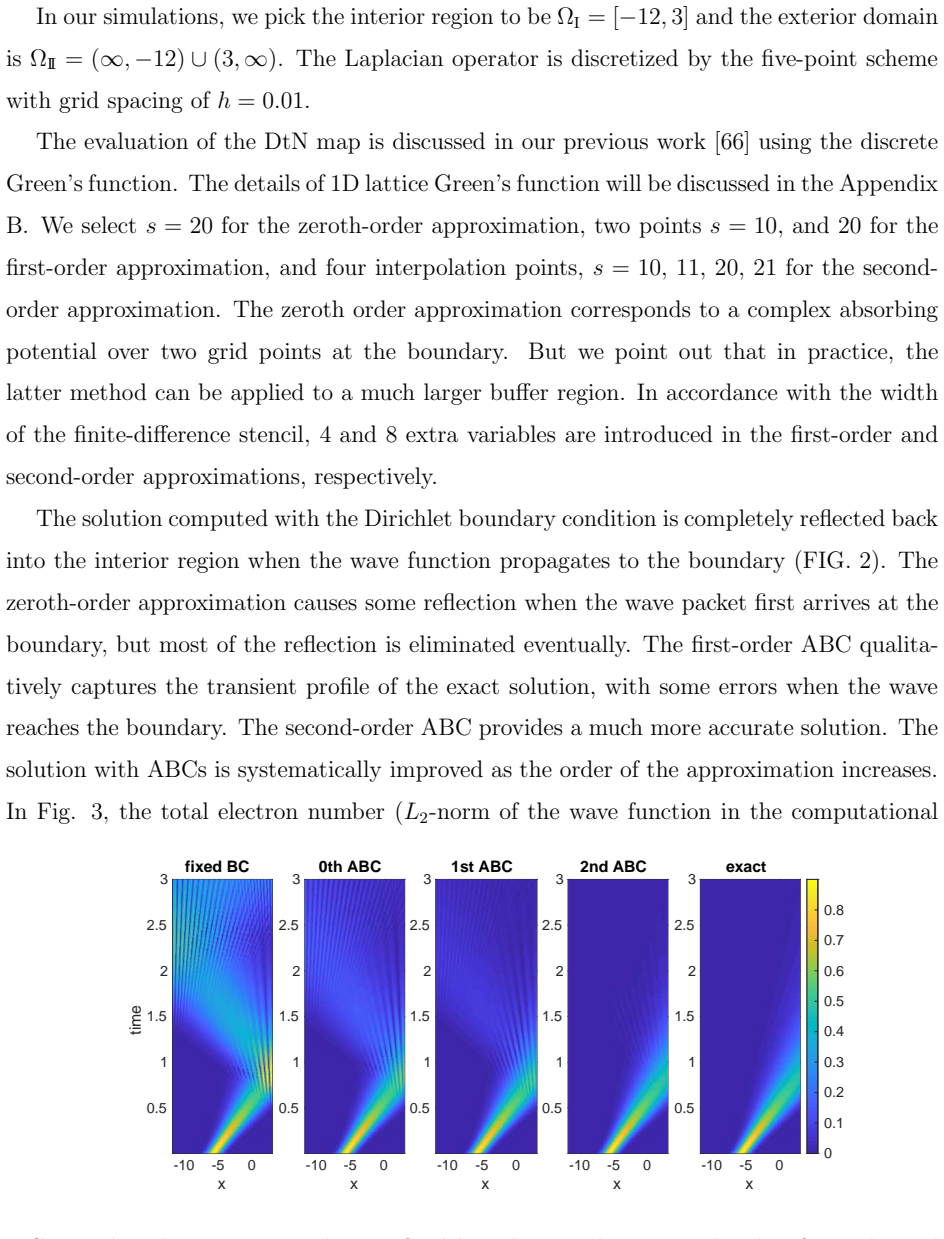
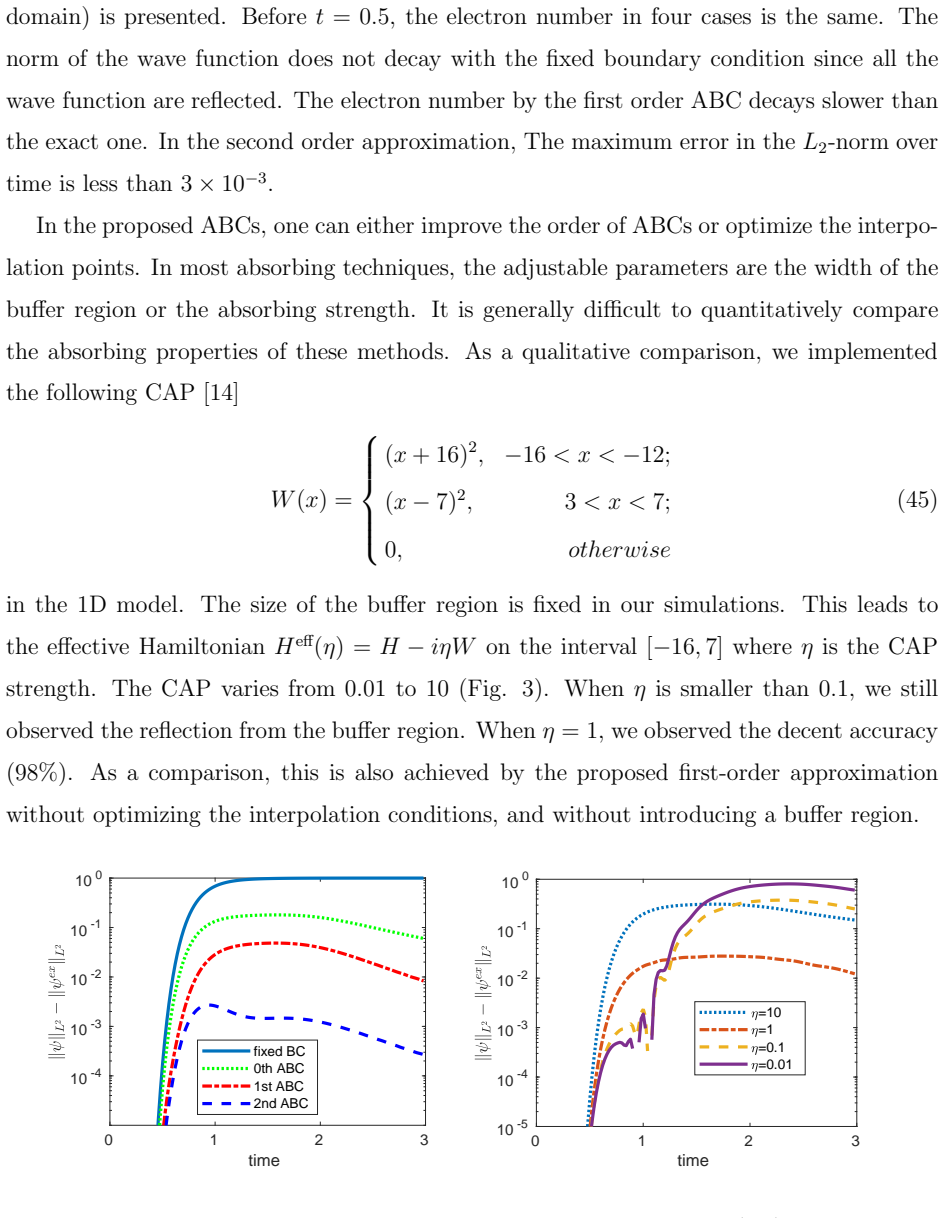
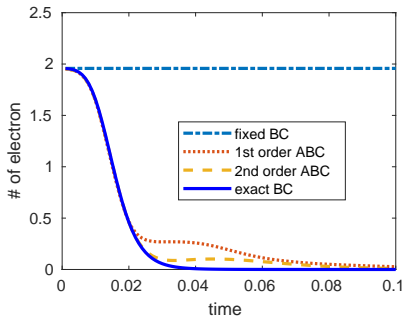
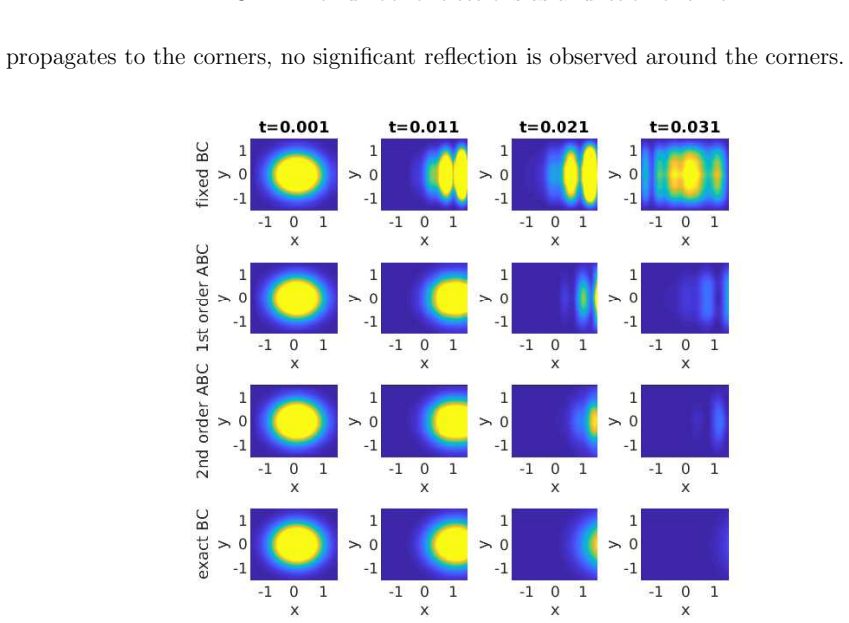
The paper establishes that for the semi-discrete Schrödinger equation, the exact effect of the exterior on the interior is the Laplace-domain operator $K(s) = -H_{\Gamma,II}[H_{II,II}-isI]^{-1}H_{II,\Gamma}$, called the discrete Dirichlet-to-Neumann map. It approximates $K(s)$ by rational matrix functions, whose inverse Laplace transform turns the nonlocal time convolution into linear ODEs for a boundary flux variable. Theorems III.2 and III.4 prove stability of the zeroth- and first-order approximations under stated conditions on the interpolation points, and numerical tests in section IV show that the second-order ABC nearly matches exact solutions in 1D and 3D, including at corners, and that the ABC releases nucleons and energy in the 16O+16O time-dependent Hartree-Fock model in good agreement with the large-domain reference.
Load-bearing premise
The first-order stability proof relies on the product of the boundary-coupling matrices being invertible and positive definite; the paper states this but never verifies the rank condition, so a singular coupling would leave the proof without a Lyapunov function.
Editorial extensions
If this is right
- The zeroth-order ABC is equivalent to a complex absorbing potential derived from the exact DtN map, so it needs no empirical choice of absorbing strength.
- The first-order ABC replaces the nonlocal time convolution with a small system of ordinary differential equations for boundary auxiliary variables.
- Because the DtN map is evaluated through discrete Green's functions, the method works for arbitrary domain geometry, including corners and edges.
- Numerical tests show that increasing the approximation order reduces reflection, with the second-order ABC nearly matching the exact solution in 1D and 3D.
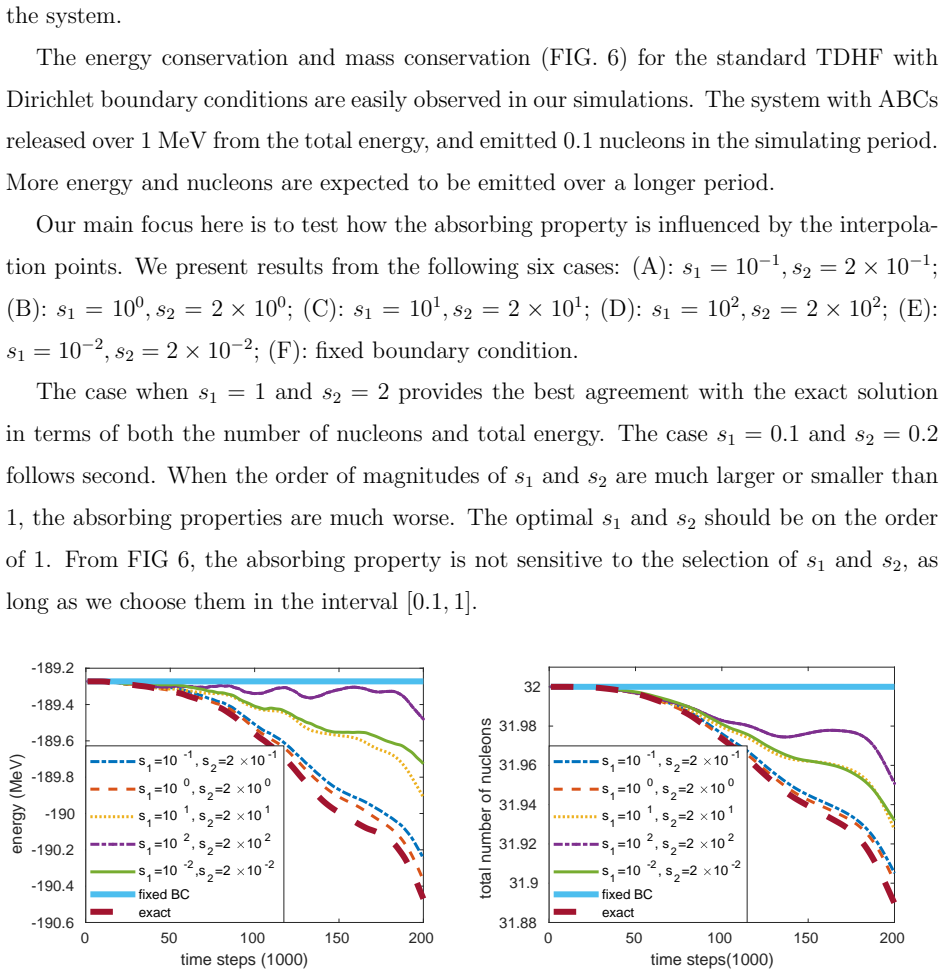
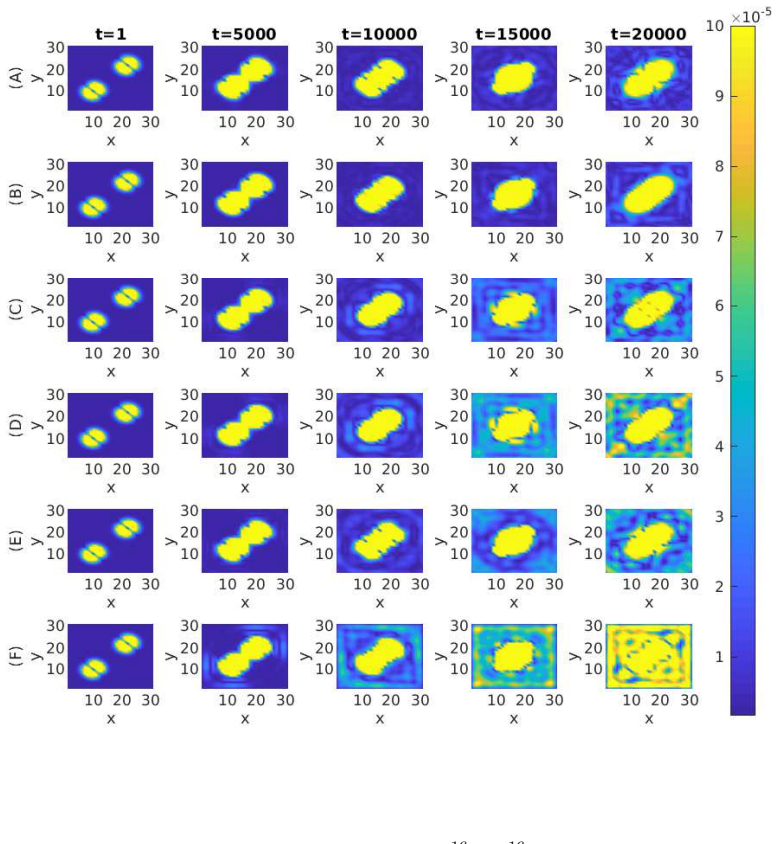
- In the 16O+16O time-dependent Hartree-Fock test, the ABC lets nucleons and energy leave the box, with the best cases closely tracking the exact large-domain energy and density.
Reading between the lines
- A direct extension the paper does not pursue is applying the same rational-interpolation boundary condition to time-dependent density-functional theory, where the exterior Hamiltonian is again the free Laplacian, so the DtN map would be unchanged.
- The TDHF sweep suggests the interpolation scale near $s=1$ is optimal for a 30-fm box; a testable conjecture is that the optimal scale is set by the inverse box size, letting users choose points a priori.
- The missing rank verification in the stability proof is likely to hold for standard 7-point and 9-point stencils on Cartesian grids, but it should be checked for coarse, anisotropic, or unstructured discretizations before applying the first-order ABC there.
Signed reviews
Editorial analysis
A structured set of objections, weighed in public.
Referee Report
Summary. The paper derives absorbing boundary conditions for time-dependent Schrödinger-type equations in three dimensions, starting from a semi-discrete finite-difference model on an unbounded domain. It partitions the unknowns into interior and exterior blocks, defines a boundary layer Γ, and derives the exact discrete Dirichlet-to-Neumann map K(s) = -H_{Γ,II}[H_{II,II}-isI]^{-1}H_{II,Γ} in the Laplace domain (Eq. (16)). This map is then approximated by rational functions R_{m,m}(s), which yield local-in-time ODEs for the auxiliary boundary variables. Stability proofs are given for the zeroth-order (Theorem III.2) and first-order (Theorem III.4) approximations, while higher-order stability is treated numerically. The methods are tested on 1D and 3D linear Schrödinger benchmarks and on a 3D time-dependent Hartree-Fock 16O+16O collision with Skyrme interactions, comparing density, particle number, and energy against large-domain reference solutions.
Significance. If the stability and accuracy claims hold, the paper makes a useful contribution: it constructs boundary conditions directly from the discrete Hamiltonian used in the interior, so no further spatial discretization of the ABC is needed; the DtN map in Eq. (16) is exact model reduction for the semi-discrete problem, not a heuristic; and the rational approximation converts the nonlocal time convolution into a small ODE system. The numerical demonstration on a realistic TDHF model with Skyrme interactions is a strength, as are the explicit comparisons of different interpolation points and the connection of the first-order ABC to a parameter-free complex absorbing potential. However, the rigor of the stability claims is not yet at the level stated in the abstract and Section V: the first-order theorem requires an unstated rank condition, the zeroth-order proof contains an internal inconsistency, and the scheme implemented in the numerical experiments is not exactly the one covered by the first-order stability theorem. These issues are fixable within the scope of the paper, but they must be addressed before the central stability assertions can be accepted as proved.
major comments (4)
- [Section III.B, Theorem III.4, Eqs. (32)-(34)] The proof constructs Q=(H_{Γ,II}H_{II,Γ})^{-1} and asserts that Q is symmetric positive definite. This requires H_{Γ,II}H_{II,Γ} to be invertible, equivalently H_{II,Γ} must have full column rank n_Γ. The theorem neither states nor verifies this condition. If the boundary coupling block is rank-deficient, then A=-iH_{Γ,II}H_{II,Γ} is not invertible, Q is not positive definite, and the projection H_{II,Γ}(H_{Γ,II}H_{II,Γ})^{-1}H_{Γ,II} used in Eq. (34) is not an orthogonal projection, so the Lyapunov argument breaks down. The statement in Section V that the stability results do not depend on the geometry is therefore not justified. Please add the rank condition as an explicit hypothesis, prove it for the 7-point and 9-point stencils and box geometries used in Section IV, or restrict the theorem accordingly.
- [Section III.A, Theorem III.2] The zeroth-order stability proof is internally inconsistent. It begins with 'We restrict M to be a Hermitian matrix,' but then concludes stability from the condition that 'M has a negative definite imaginary part,' and identifies M with K(s0). A Hermitian matrix has zero imaginary part, while K(s0) in Eq. (16) is non-Hermitian. The intended argument can be repaired by showing directly that K(s0) has negative-semidefinite imaginary part from the identity displayed in the proof, but as written the theorem conflates a Hermitian M with the non-Hermitian DtN map K(s0). Please remove the Hermitian restriction and state the sign condition on Im M explicitly.
- [Section III.B compared with Sections IV.A-IV.C] The first-order stability theorem uses interpolation conditions at s=s1 (finite, positive) and at infinity via lim_{λ→0} (d/dλ)K. The numerical first-order ABCs, however, are implemented with two finite interpolation points: s=10 and 20 in Section IV.A, s=1 and 2 in Section IV.B, and pairs (s1,s2) in Section IV.C. The sentence after Theorem III.4 acknowledges only numerically that stability persists for finite s2. Consequently, the theorem does not cover the scheme that is actually tested and recommended. Please either prove stability for two finite interpolation points under explicit conditions, or clearly separate the proved variant from the numerically validated variant.
- [Section IV.C, Eqs. (49)-(53) and final remark] The DtN derivation in Section II assumes that the exterior Hamiltonian is constant (V=0 or a constant) in Ω_II. In the TDHF application, the one-body Hamiltonian (49) contains density-dependent, Yukawa, and Coulomb terms that are nonlocal and long-range. The paper sets ρ=0 in Ω_II at t=0 and expects ρ≈0 in the exterior throughout, but this expectation is not proved or monitored. If particles or density reach the boundary, the ABC omits these potential terms and the error could grow. The manuscript explicitly labels this as an expectation rather than a proof. Please state this as an explicit limitation and provide a diagnostic, such as the maximum exterior density over the simulation time, or quantify the neglected exterior potentials.
minor comments (6)
- [Section II, Eq. (7)] The displayed dimensions of E are inconsistent with the explicit form E=[I_{n_Γ} 0]; the matrix should map from R^{n_I} to R^{n_Γ}, not from R^{n_{II}} to R^{n_Γ}.
- [Section IV.B, first paragraph] The text refers to 'the DtN map K(t) is a 14166×14166 dense matrix'; since K is defined in the Laplace domain, this should read K(s), not K(t).
- [Section II, after Eq. (16)] The notation 'K(s): R → Ω_Γ × Ω_Γ' is not correct: K(s) is a matrix-valued function on C with values in C^{n_Γ×n_Γ}, and Ω_Γ is a set of grid points. Please adjust the notation.
- [Section III.B, Theorem III.4 statement] The phrase 'where s1 is a any positive real number' contains a typo ('a any'); it should be 'any positive real number.'
- [Section IV.C, Eq. (53)] The assumption is written as 'ψ_j = 0 for i=1,...,A and ρ=0 in Ω_II', but the index in the first clause should be j, not i.
- [Appendix D, Eq. (D4)] The symbol c_k is used both for the finite-difference coefficients and for the grid offsets in the exponential; please use a separate symbol for one of them to avoid confusion.
Circularity Check
No significant circularity found; discrete DtN map is an exact reduction and approximations are validated independently.
full rationale
The paper's central object, Eq. (16), is obtained by eliminating phi_II from the linear system (11)-(13) of the paper's own semi-discrete model; it is an exact Schur complement/DtN map, not an ansatz fitted to the effects it later predicts. The zeroth- and first-order ABCs are then defined by rational interpolation conditions that match this K(s) at selected points (Sec. III), so their coefficients are not calibrated against the benchmark solutions used for validation. Stability is argued from Lyapunov functionals with no appeal to a self-citation as the source of the stability claim. The paper does cite the authors' previous work for the discrete Green's function/selected-inversion implementation and for the Lyapunov technique, but the essential manipulations (Eqs. (16), (A2)-(A7), Appendices B-D) are derived in the manuscript, and the accuracy tests compare against independent analytical solutions and a larger-domain TDHF solution. The unstated rank condition on (H_Gamma,II H_II,Gamma)^-1 in Theorem III.4 and the expectation rho approx 0 in the TDHF exterior are genuine assumption/correctness gaps, but they are not cases where a prediction is equivalent to an input by construction. No circular step can be exhibited, so the circularity score is 0.
Assumptions & free parameters
free parameters (2)
- Interpolation points s_i =
1D: s=10,11,20,21; 3D: s=1,2,3,10; TDHF: s1=10^-1,2*10^-1 to 10^2
- TDHF collision momentum k =
not quantified
assumptions (5)
- domain assumption V(x)=0 in the exterior region Ω_II
- domain assumption Zero initial data in the exterior, Φ_II(0)=0
- ad hoc to paper The block H_{Γ,II}H_{II,Γ} is invertible for the first-order stability proof
- domain assumption ρ=0 in the exterior for the TDHF application
- domain assumption Discrete Green's function / boundary element method from [49,66] correctly evaluates the selected inversion in general domains
Cite this review
Pith. "Pith review of Absorbing boundary conditions for the time-dependent Schr\"odinger-type equations in $\mathbb R^3$." pith.science (2026). https://pith.science/paper/KL2Z25PN
@misc{pith2026190802456,
  author       = {Pith},
  title        = {Pith review of: Absorbing boundary conditions for the time-dependent Schr\"odinger-type equations in $\mathbb R^3$},
  year         = {2026},
  howpublished = {\url{https://pith.science/paper/KL2Z25PN}},
  note         = {Machine review of arXiv:1908.02456}
}
read the original abstract
Absorbing boundary conditions are presented for three-dimensional time-dependent Schr\"odinger-type of equations as a means to reduce the cost of the quantum-mechanical calculations. The boundary condition is first derived from a semi-discrete approximation of the Schr\"odinger equation with the advantage that the resulting formulas are automatically compatible with the finite-difference scheme and no further discretization is needed in space. The absorbing boundary condition is expressed as a discrete Dirichlet-to-Neumann (DtN) map, which can be further approximated in time by using rational approximations of the Laplace transform to enable a more efficient implementation. This approach can be applied to domains with arbitrary geometry. The stability of the zeroth order and first order absorbing boundary conditions is proved. We tested the boundary conditions on benchmark problems. The effectiveness is further verified by a time-dependent Hartree-Fock model with Skyrme interactions. The accuracy in terms of energy and nucleon density is examined as well.
Figures

Figures from the paper (6 more)


Reference graph
Works this paper leans on
-
[1]
Richard M. Martin. Electronic Structure: Basic Theory and Practical Methods . Cambridge University Press, 2011. 29
work page 2011
-
[2]
Molecular electronic-structure theory
Trygve Helgaker, Poul Jorgensen, and Jeppe Olsen. Molecular electronic-structure theory . John Wiley & Sons, 2014
work page 2014
-
[3]
−k0x1 + 1 2k2 0t i − 2t ) (46) with k0 = 5. One should notice that the difference between the analytical so lution and the exact solution of the discrete model might not be small due to th e large grid spacing. Therefore, we will only use the analytical solution as a reference fo r qualitative comparisons. For the time integration, the step size is chosen ...
-
[4]
Complex absorbing potential based Lorentzian fitting scheme and time dependen t quantum transport
Hang Xie, Yanho Kwok, Feng Jiang, Xiao Zheng, and GuanHua Chen. Complex absorbing potential based Lorentzian fitting scheme and time dependen t quantum transport. The Journal of chemical physics , 141(16):164122, 2014
work page 2014
- [5]
-
[6]
James R. Hellums and William R. Frensley. Non-Markovian open-system boundary conditions for the time-dependent Schr¨ odinger equation. Physical Review B , 49:2904–2906, Jan 1994
work page 1994
-
[7]
A. Scrinzi, H. P. Stimming, and N. J. Mauser. On the non-eq uivalence of perfectly matched layers and exterior complex scaling. Journal of Computational Physics , 269:98–107, Nov 2014
work page 2014
-
[8]
Gy I. Sz´ asz. On the variational calculation of energies and widths of resonances. Physics Letters A , 62(5):313–314, 1977
work page 1977
Show all 73 references
-
[9]
The definition of molecular resonance curve s by the method of exterior complex scaling
Barry Simon. The definition of molecular resonance curve s by the method of exterior complex scaling. Physics Letters A , 71(2-3):211–214, 1979
1979
-
[10]
Solving the thr ee-body Coulomb breakup problem using exterior complex scaling
C W McCurdy, M Baertschy, and T N Rescigno. Solving the thr ee-body Coulomb breakup problem using exterior complex scaling. Journal of Physics B: Atomic, Molecular and Optical Physics, 37(17):R137–R187, 2004
2004
-
[11]
octopus: a first-principles tool for excited electron–ion dynamics
Miguel AL Marques, Alberto Castro, George F Bertsch, an d Angel Rubio. octopus: a first-principles tool for excited electron–ion dynamics. Computer Physics Communications , 151(1):60–78, 2003
2003
-
[12]
A general and efficien t pseudopotential Fourier fil- tering scheme for real space methods using mask functions
Maxim Tafipolsky and Rochus Schmid. A general and efficien t pseudopotential Fourier fil- tering scheme for real space methods using mask functions. Journal of Chemical Physics , 124(17):174102, 2006
2006
-
[13]
Mask-function real-space implementat ions of nonlocal pseudopotentials
Lin-Wang Wang. Mask-function real-space implementat ions of nonlocal pseudopotentials. Physical Review B - Condensed Matter and Materials Physics , 64(20):201107(R), nov 2001
2001
-
[14]
U. V. Riss and H. D. Meyer. Investigation on the reflectio n and transmission properties of complex absorbing potentials. Journal of Chemical Physics , 105(4):1409–1419, 1996
1996
-
[15]
U. V. Riss and H. D. Meyer. Calculation of resonance ener gies and widths using the complex absorbing potential method. Journal of Physics B: Atomic, Molecular and Optical Physics , 30 26(23):4503–4535, dec 1993
1993
-
[16]
J. G. Muga, J. P. Palao, B. Navarro, and I. L. Egusquiza. C omplex absorbing potentials. Physics Reports, 395(6):357–426, 2004
2004
-
[17]
Suitable coordinates for t he three-body problem in the adiabatic representation
E A Soloviev and S I Vinitsky. Suitable coordinates for t he three-body problem in the adiabatic representation. Journal of Physics B: Atomic and Molecular Physics , 18(16):L557—-L562, aug 1985
1985
-
[18]
E. Y. Sidky and B. D. Esry. Boundary-free propagation wi th the time-dependent schr¨ odinger equation. Phys. Rev. Lett. , 85:5086–5089, Dec 2000
2000
-
[19]
U. V. Riss and H. D. Meyer. The transformative complex ab sorbing potential method: A bridge between complex absorbing potentials and smooth ext erior scaling. Journal of Physics B: Atomic, Molecular and Optical Physics , 31(10):2279–2304, may 1998
1998
-
[20]
F. He, C. Ruiz, and A. Becker. Absorbing boundaries in nu merical solutions of the time- dependent Schr¨ odinger equation on a grid using exterior co mplex scaling. Physical Review A , 75:053407, May 2007
2007
-
[21]
Vanroose, B
Liang Tao, W. Vanroose, B. Reps, T. N. Rescigno, and C. W. McCurdy. Long-time solution of the time-dependent Schr¨ odinger equation for an atom in a n electromagnetic field using complex coordinate contours. Physical Review A , 80:063419, Dec 2009
2009
-
[22]
Infinite-range exterior complex scalin g as a perfect absorber in time-dependent problems
Armin Scrinzi. Infinite-range exterior complex scalin g as a perfect absorber in time-dependent problems. Physical Review A , 81:053845, May 2010
2010
-
[23]
Jiu-Yuan Ge and John Z. H. Zhang. Use of negative complex potential as absorbing potential. The Journal of Chemical Physics , 108(4):1429–1433, 1998
1998
-
[24]
Absorbing boundary conditions for time-de pendent schr¨ odinger equations: A density-matrix formulation
Xiantao Li. Absorbing boundary conditions for time-de pendent schr¨ odinger equations: A density-matrix formulation. The Journal of chemical physics , 150(11):114111, 2019
2019
-
[25]
A Review of artificial boundary conditions for the Schr¨ oding er equation
Xavier Antoine, Anton Arnold, Christophe Besse, Matth ias Ehrhardt, and Achim Sch¨ adle. A Review of artificial boundary conditions for the Schr¨ oding er equation. PAMM, 7(1):1023201– 1023202, 2007
2007
-
[26]
Artificial boundary method
Houde Han and Xiaonan Wu. Artificial boundary method . Springer Science & Business Media, 2013
2013
-
[27]
An analysis of the finite-diffe rence method for one-dimensional Klein-Gordon equation on unbounded domain
Houde Han and Zhiwen Zhang. An analysis of the finite-diffe rence method for one-dimensional Klein-Gordon equation on unbounded domain. Applied Numerical Mathematics , 59(7):1568– 1583, 2009. 31
2009
-
[28]
Antoine and C
X. Antoine and C. Besse. Unconditionally stable discre tization schemes of non-reflecting boundary conditions for the one-dimensional Schr¨ odingerequation. Journal of Computational Physics, 188(1):157–175, 2003
2003
-
[29]
Weak Ill-Posed ness of Spatial Discretizations of Ab- sorbing Boundary Conditions for Schr¨ odinger-Type Equations
Isaias Alonso-Mallo and Nuria Reguera. Weak Ill-Posed ness of Spatial Discretizations of Ab- sorbing Boundary Conditions for Schr¨ odinger-Type Equations. SIAM Journal on Numerical Analysis, 40(1):134–158, 2003
2003
-
[30]
Alonso-Mallo and N
I. Alonso-Mallo and N. Reguera. Adaptive Absorbing Bou ndary Conditions for Schr¨ odinger- type Equations. In Gary C Cohen, Patrick Joly, Erkki Heikkol a, and Pekka Neittaanm¨ aki, editors, Mathematical and Numerical Aspects of Wave Propagation WAV ES 2003, pages 851– 856, Ber...
2003
-
[31]
A. Arnold. On absorbing boundary conditions for quantu m transport equations. ESAIM: Mathematical Modelling and Numerical Analysis , 28(7):853–872, 1994
1994
-
[32]
A. M. Ermolaev, I. V. Puzynin, A. V. Selin, and S. I. Vinit sky. Integral boundary conditions for the time-dependent schr¨ odinger equation: Atom in a laser fi eld. Phys. Rev. A , 60:4831–4845, Dec 1999
1999
-
[33]
A. M. Ermolaev and A. V. Selin. Integral boundary condit ions for the time-dependent schr¨ odinger equation: Superposition of the laser field and a long-range atomic potential. Phys. Rev. A , 62:015401, Jun 2000
2000
-
[34]
Di screte transparent boundary condi- tions for the Schr¨ odinger equation: fast calculation, app roximation, and stability
Anton Arnold, Matthias Ehrhardt, and Ivan Sofronov. Di screte transparent boundary condi- tions for the Schr¨ odinger equation: fast calculation, app roximation, and stability. Communi- cations in Mathematical Sciences , 1(3):501–556, 2013
2013
-
[35]
Fast evaluation of nonre flecting boundary conditions for the Schr¨ odinger equation in one dimension
Shidong Jiang and L Greengard. Fast evaluation of nonre flecting boundary conditions for the Schr¨ odinger equation in one dimension. Computers & Mathematics with Applications , 47(6-7):955–966, Oct 2004
2004
-
[36]
Absorbing Boundary Condi tions for the Schr¨ odinger Equa- tion
Thomas Fevens and Hong Jiang. Absorbing Boundary Condi tions for the Schr¨ odinger Equa- tion. SIAM Journal on Scientific Computing , 21(1):255–282, 2003
2003
-
[37]
Absorbing boundary conditions fo r the finite-difference time-domain calculation of the one-dimensional Schr¨ odinger equation
Tsugumichi Shibata. Absorbing boundary conditions fo r the finite-difference time-domain calculation of the one-dimensional Schr¨ odinger equation. Physical Review B , 43(8):6760–6763, 1991
1991
-
[38]
Design of Absorbing Boundary Condi tions for Schr¨ odinger Equations in Rd
J´ er´ emie Szeftel. Design of Absorbing Boundary Condi tions for Schr¨ odinger Equations in Rd . SIAM Journal on Numerical Analysis , 42(4):1527–1551, 2004. 32
2004
-
[39]
Absorbing boundary conditions for nonlinear Schr¨ odinger equa- tions
Zhenli Xu and Houde Han. Absorbing boundary conditions for nonlinear Schr¨ odinger equa- tions. Physical Review E - Statistical, Nonlinear, and Soft Matter Physics, 74(3):37704, 2006
2006
-
[40]
Efficient represent ation of nonreflecting boundary con- ditions for the time-dependent Schr¨ odinger equation in tw o dimensions
Shidong Jiang and Leslie Greengard. Efficient represent ation of nonreflecting boundary con- ditions for the time-dependent Schr¨ odinger equation in tw o dimensions. Communications on Pure and Applied Mathematics , 61(2):261–268, oct 2008
2008
-
[41]
Numerical schemes for the simu- lation of the two-dimensional Schr¨ odinger equation using non-reflecting boundary conditions
Xavier Antoine, Christophe Besse, and Vincent Mouysse t. Numerical schemes for the simu- lation of the two-dimensional Schr¨ odinger equation using non-reflecting boundary conditions. Mathematics of Computation , 73(248):1779–1800, Apr 2004
2004
-
[42]
Nonreflecting boundary conditions for the time-dependent wave equation
Bradley Alpert, Leslie Greengard, and Thomas Hagstrom . Nonreflecting boundary conditions for the time-dependent wave equation. Journal of Computational Physics , 180(1):270–296, oct 2002
2002
-
[43]
Exact artificial boundary c onditions for the Schr¨ odinger equation in R2
Houde Han and Zhongyi Huang. Exact artificial boundary c onditions for the Schr¨ odinger equation in R2. Communications in Mathematical Sciences , 2(1):79–94, 2013
2013
-
[44]
Adaptive absorbin g boundary conditions for Schr¨ odinger-type equations: Application to nonlinear and multi-dimensional problems
Zhenli Xu, Houde Han, and Xiaonan Wu. Adaptive absorbin g boundary conditions for Schr¨ odinger-type equations: Application to nonlinear and multi-dimensional problems. Jour- nal of Computational Physics , 225(2):1577–1589, Apr 2007
2007
-
[45]
A perfectly matched layer for the absorption of electromagnetic waves
Jean Pierre Berenger. A perfectly matched layer for the absorption of electromagnetic waves. Journal of Computational Physics , 114(2):185–200, Oct 1994
1994
-
[46]
A perfectly matched layer approach to the nonlinear Schr¨ odinger wave equations
Chunxiong Zheng. A perfectly matched layer approach to the nonlinear Schr¨ odinger wave equations. Journal of Computational Physics , 227(1):537–556, 2007
2007
-
[47]
Radiation boundary condi tions for wave-like equations
Alvin Bayliss and Eli Turkel. Radiation boundary condi tions for wave-like equations. Com- munications on Pure and applied Mathematics , 33(6):707–725, 1980
1980
-
[48]
Absorbing boundary conditions for diffe rence approximations to the mul- tidimensional wave equation
Robert L Higdon. Absorbing boundary conditions for diffe rence approximations to the mul- tidimensional wave equation. Mathematics of computation , 47(176):437–459, 1986
1986
-
[49]
Artificial boundary conditions for one-dimensional cubic nonlinear Schr¨ odinger equations
X Antoine, C Besse, and S Descombes. Artificial boundary conditions for one-dimensional cubic nonlinear Schr¨ odinger equations. SIAM Journal on Numerical Analysis , 43(6):2272– 2293, 2006
2006
-
[50]
An atomistic-based boundary element metho d for the reduction of molecular statics models
Xiantao Li. An atomistic-based boundary element metho d for the reduction of molecular statics models. Computer Methods in Applied Mechanics and Engineering , 225-228:1–13, 2012
2012
-
[51]
Ellis, and P
E.J Baerends, D.E. Ellis, and P. Ros. Self-consistent m olecular HartreeFockSlater calculations I. The computational procedure. Chemical Physics , 2(1):41–51, 1973. 33
1973
-
[52]
Time-dependent density functional theory , volume 706
Miguel AL Marques, Carsten A Ullrich, Fernando Nogueir a, Angel Rubio, Kieron Burke, and Eberhard KU Gross. Time-dependent density functional theory , volume 706. Springer Science & Business Media, 2006
2006
-
[53]
Implementation of transparent boundaries for numerical solution of the Schr¨ odinger equation
V A Baskakov and A V Popov. Implementation of transparent boundaries for numerical solution of the Schr¨ odinger equation. Wave motion , 14(2):123–128, 1991
1991
-
[54]
Dan Givoli, Igor Patlashenko, and Joseph B. Keller. Dis crete Dirichlet-to-Neumann maps for unbounded domains. Computer Methods in Applied Mechanics and Engineering , 164(1- 2):173–185, 1998
1998
-
[55]
Xavier Andrade, David Strubbe, Umberto De Giovannini, Ask Hjorth Larsen, Micael J. T. Oliveira, Joseba Alberdi-Rodriguez, Alejandro Varas , Iris Theophilou, Nicole Helbig, Matthieu J. Verstraete, Lorenzo Stella, Fernando Nogueira , Aln Aspuru-Guzik, Alberto Cas- tro, Miguel A....
2015
-
[56]
Higher-order adaptive finite-element methods for Kohn–Sha m density functional theory
Phani Motamarri, Michael R Nowak, Kenneth Leiter, Jaro slaw Knap, and Vikram Gavini. Higher-order adaptive finite-element methods for Kohn–Sha m density functional theory. Jour- nal of Computational Physics , 253:308–343, 2013
2013
-
[57]
Real-space mesh techniques in density-f unctional theory
Thomas L Beck. Real-space mesh techniques in density-f unctional theory. Reviews of Modern Physics, 72(4):1041, 2000
2000
-
[58]
Quarteroni and A
A. Quarteroni and A. Valli. Domain Decomposition Methods for Partial Differential Equa tions. Numerical Mathematics and Scie. Clarendon Press, 1999
1999
-
[59]
Meza, Jianfeng Lu, Lexing Yin g, and Weinan E
Lin Lin, Chao Yang, Juan C. Meza, Jianfeng Lu, Lexing Yin g, and Weinan E. SelInv— An Algorithm for Selected Inversion of a Sparse Symmetric Ma trix. ACM Transactions on Mathematical Software (TOMS) , 37(4):40:1–40:19, February 2011
2011
-
[60]
Krylov subspace techniques for reduced-o rder modeling of large-scale dynamical systems
Zhaojun Bai. Krylov subspace techniques for reduced-o rder modeling of large-scale dynamical systems. Applied Numerical Mathematics , 43(1-2):9–44, Apr 2002
2002
-
[61]
A sur vey of projection-based model reduction methods for parametric dynamical systems
Peter Benner, Serkan Gugercin, and Karen Willcox. A sur vey of projection-based model reduction methods for parametric dynamical systems. SIAM review , 57(4):483–531, 2015
2015
-
[62]
Pad´ e approximants, volume 59
George A Baker, George A Baker Jr, GEORGE A BAKER JR, Pete r Graves-Morris, and Susan S Baker. Pad´ e approximants, volume 59. Cambridge University Press, 1996
1996
-
[63]
On the stability of boundary conditions for molecular dynamics
Xiantao Li. On the stability of boundary conditions for molecular dynamics. Journal of 34 computational and applied mathematics , 231(2):493–505, 2009
2009
-
[64]
Hartree-Fock calcula tions : Application to 16O + 16O collisions
H Flocard, S E Koonin, and S Weiss. Hartree-Fock calcula tions : Application to 16O + 16O collisions. Physical Review C , 17(5):1682, 1978
1978
-
[65]
Pro pagators for the time-dependent Kohn–Sham equations
Alberto Castro, Miguel AL Marques, and Angel Rubio. Pro pagators for the time-dependent Kohn–Sham equations. The Journal of chemical physics , 121(8):3425–3433, 2004
2004
-
[66]
Adri´ an G´ omez Pueyo, Miguel A. L. Marques, Angel Rubio , and Alberto Castro. Propa- gators for the Time-Dependent KohnSham Equations: Multist ep, RungeKutta, Exponential RungeKutta, and Commutator Free Magnus Methods. Journal of Chemical Theory and Com- putation, 14(6):3040...
2018
-
[67]
Stable absorbing boundary co nditions for molecular dynamics in general domains
Xiaojie Wu and Xiantao Li. Stable absorbing boundary co nditions for molecular dynamics in general domains. Computational Mechanics , 62(6):1259–1272, 2018
2018
-
[68]
S. E. Koonin, K. T. R. Davies, V. Maruhn-Rezwani, H. Feld meier, S. J. Krieger, and J. W. Negele. Time-dependent Hartree-Fock calculations for 16O + 16O and 40Ca + 40Ca reactions. Physical Review C , 15:1359–1374, Apr 1977
1977
-
[69]
Time-depe ndent Hartree-Fock calculations for 14N + 12C reactions
V Maruhn-Rezwani, KTR Davies, and SE Koonin. Time-depe ndent Hartree-Fock calculations for 14N + 12C reactions. Physics Letters B , 67(2):134–138, 1977
1977
-
[70]
Variational boundary conditio ns for molecular dynamics simulations of solids at low temperature
Xiantao Li and Weinan E. Variational boundary conditio ns for molecular dynamics simulations of solids at low temperature. Communications in Computational Physics , 1(1):135–175, 2006
2006
-
[71]
An interpolation-based approach to the weighted- H2 model reduction problem
Branimir Anic. An interpolation-based approach to the weighted- H2 model reduction problem. PhD thesis, Virginia Tech, 2008
2008
-
[72]
Gugercin, A
S. Gugercin, A. Antoulas, and C. Beattie. H2 Model Reduction for Large-Scale Linear Dy- namical Systems. SIAM Journal on Matrix Analysis and Applications , 30(2):609–638, 2008
2008
-
[73]
Fast calculati on of energy and mass preserving solutions of Schr¨ odinger–Poisson systems on unbounded do mains
Matthias Ehrhardt and Andrea Zisowsky. Fast calculati on of energy and mass preserving solutions of Schr¨ odinger–Poisson systems on unbounded do mains. Journal of Computational and Applied Mathematics , 187(1):1–28, 2006. 35
2006
Reviewed August 14, 2026 · model on record in the stance chip above.
Discussion (0). Continue with ORCID to comment.