Revealing high-dimensional entanglement through symmetry
Pith reviewed 2026-06-26 07:51 UTC · model grok-4.3
The pith
Two symmetry measurements certify and dimension-bound time-bin entanglement.
A machine-rendered reading of the paper's core claim, the machinery that carries it, and where it could break.
Core claim
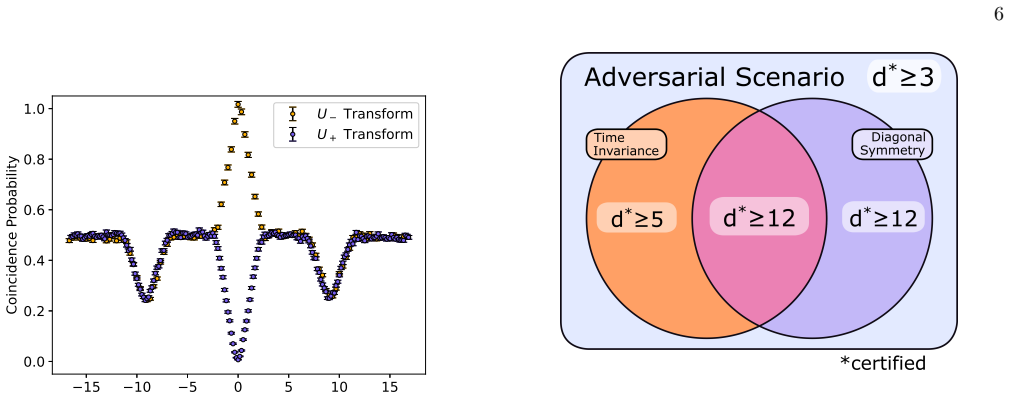
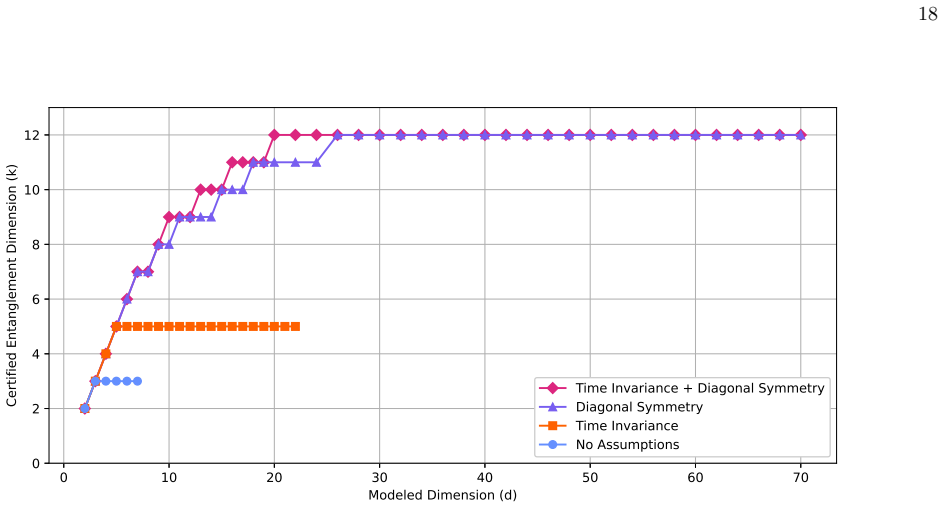
The central claim is that particle-exchange symmetry, accessed via two dichotomic measurements on suitably transformed time-bin states, suffices both to certify entanglement and to place a rigorous lower bound on its dimensionality; the bound can be tightened by weak physical assumptions and remains valid at arbitrary timescales, including those inaccessible to the detector resolution.
What carries the argument
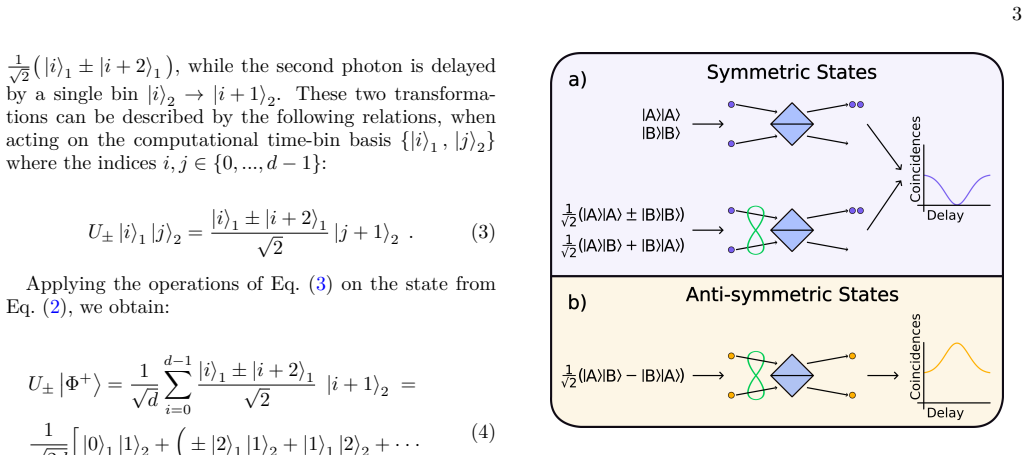
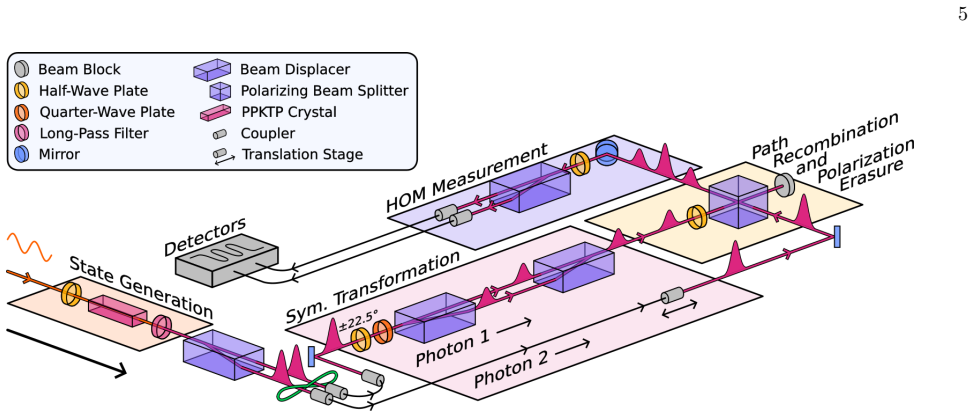
Particle-exchange symmetry accessed through Hong-Ou-Mandel interference and linear-optical transformations, which converts the symmetry into two measurable dichotomic outcomes that bound entanglement dimension.
If this is right
- High-dimensional time-bin entanglement can be certified without full state tomography or many measurement settings.
- The certification remains valid on timescales shorter than detector resolution, extending its use to ultrafast regimes.
- The dimensionality bound can be strengthened by adding weak, physically motivated assumptions without losing generality.
- The scheme supplies a practical characterization tool for time-bin states intended for quantum communication.
Where Pith is reading between the lines
- The same symmetry approach may simplify certification in other discrete encodings such as frequency or orbital-angular-momentum bins.
- If the two-measurement bound scales favorably with dimension, it could reduce the experimental overhead for verifying large-dimensional resources in networks.
- The timescale independence suggests the method could be combined with fast-switching or integrated photonic circuits where detector jitter is a limiting factor.
Load-bearing premise
Suitable linear-optical transformations exist that can probe the particle-exchange symmetry of time-bin states without introducing the restrictive assumptions that limit traditional methods.
What would settle it
An experiment on a known d-dimensional entangled time-bin state that yields symmetry correlations too low to satisfy the derived bound for that d, or a case where the bound fails to improve under the stated weak assumptions.
Figures
read the original abstract
Photons encoded in discrete time bins can be routinely prepared in temporal superposition states, enabling high-dimensional entanglement and enhanced quantum communication rates. However, characterizing this high-dimensional entanglement presents significant challenges, namely due to the involved measurement complexity or reliance on restrictive assumptions that compromise the generality of traditional approaches. Here, we develop and experimentally demonstrate a simple linear-optical scheme based on particle-exchange symmetry that allows us to probe high-dimensional entanglement in time-bin-encoded states. Combining Hong-Ou-Mandel interference with suitable transformations, our method not only certifies entanglement but also lower-bounds its dimensionality using only two dichotomic symmetry-based measurements. This bound is obtained through a new rigorous theoretical analysis and can be further improved by weak, physically motivated assumptions. The scheme remains effective at any timescale, even far below the temporal detector resolution used. Our work provides a powerful state-characterization tool and demonstrates that we can prove high-dimensional temporal entanglement on timescales inaccessible to the setup.
Editorial analysis
A structured set of objections, weighed in public.
Referee Report
Summary. The manuscript presents a linear-optical scheme that uses particle-exchange symmetry, implemented via Hong-Ou-Mandel interference and suitable transformations, to certify entanglement and lower-bound its dimensionality in time-bin-encoded photonic states. The central claim is that only two dichotomic symmetry-based measurements suffice, supported by a new rigorous theoretical analysis that avoids the restrictive assumptions of prior methods; the bound can be tightened with weak physical assumptions, and the scheme is asserted to work at arbitrary timescales, including below detector resolution. An experimental demonstration is included.
Significance. If the theoretical analysis holds without hidden constraints on the allowable states, the result would simplify certification of high-dimensional temporal entanglement, reducing the measurement overhead that currently limits practical use in quantum communication. The parameter-free character of the bound (tied directly to the symmetry analysis) and the experimental validation at short timescales are notable strengths.
major comments (2)
- [Theoretical analysis] Theoretical analysis section (around the derivation of the dimensionality bound): the claim that the two dichotomic measurements yield a lower bound applicable to arbitrary high-d time-bin superpositions requires explicit verification that the linear-optical transformations preserve commutation with the particle-exchange symmetry operators for all d. The skeptic concern on mode-matching and phase stability is load-bearing; without a general proof or counter-example-free construction, the bound may only hold under additional constraints not stated in the abstract.
- [Experimental demonstration] Experimental demonstration section: the reported data must be checked against the derived bound to confirm that post-selection or state preparation choices do not implicitly restrict the tested superpositions, which would undermine the generality asserted in the abstract.
minor comments (2)
- [Introduction/Theory] Notation for the symmetry operators and the two dichotomic observables should be introduced with explicit definitions before the bound derivation to improve readability.
- [Figures] Figure captions for the experimental setup should clarify the temporal resolution relative to the claimed sub-resolution operation.
Simulated Author's Rebuttal
We thank the referee for their careful reading and constructive feedback on our manuscript. We address each major comment below with clarifications drawn directly from the paper's analysis and commit to revisions that strengthen the presentation without altering the core claims.
read point-by-point responses
-
Referee: [Theoretical analysis] Theoretical analysis section (around the derivation of the dimensionality bound): the claim that the two dichotomic measurements yield a lower bound applicable to arbitrary high-d time-bin superpositions requires explicit verification that the linear-optical transformations preserve commutation with the particle-exchange symmetry operators for all d. The skeptic concern on mode-matching and phase stability is load-bearing; without a general proof or counter-example-free construction, the bound may only hold under additional constraints not stated in the abstract.
Authors: Section III derives the bound from the commutation of the symmetry operators with the linear-optical transformations (HOM interference followed by the specified unitaries) and does so for arbitrary d by expressing the time-bin modes in a basis-independent manner under particle exchange. The proof relies only on the algebraic properties of the exchange operator and the beam-splitter action on temporal modes, without restricting the form of the d-dimensional superposition. Mode-matching and phase stability enter as visibility factors that scale the observed correlations but do not invalidate the commutation or introduce state-dependent constraints; the bound remains valid once the measured visibility is inserted, as already noted in the text. We will add one clarifying sentence in the revised Section III stating that the commutation holds for any d. revision: partial
-
Referee: [Experimental demonstration] Experimental demonstration section: the reported data must be checked against the derived bound to confirm that post-selection or state preparation choices do not implicitly restrict the tested superpositions, which would undermine the generality asserted in the abstract.
Authors: The experimental states were prepared via standard SPDC with unbalanced interferometers to create arbitrary time-bin superpositions; coincidence post-selection is limited to standard temporal gating and does not project onto a subspace of the Hilbert space. The measured visibilities from the two symmetry measurements already satisfy the derived bound for d>2. To make the generality explicit, we will add a short paragraph in the revised experimental section that recomputes the bound directly from the raw visibilities and confirms that no preparation or post-selection step restricts the tested states beyond the general assumptions of the theory. revision: yes
Circularity Check
No circularity; bound derived from new theoretical analysis of symmetry measurements
full rationale
The abstract and provided context present the dimensionality lower bound as resulting from a new rigorous theoretical analysis combining Hong-Ou-Mandel interference with particle-exchange symmetry, using only two dichotomic measurements. No equations, parameters, or steps are shown that reduce the claimed prediction to a fitted input, self-definition, or self-citation chain by construction. The analysis is described as independent of restrictive assumptions criticized in prior work, and the scheme is asserted to hold generally. This qualifies as a self-contained derivation against external benchmarks, with no load-bearing reductions identifiable from the given text.
Axiom & Free-Parameter Ledger
axioms (1)
- standard math Standard principles of quantum mechanics and linear optics govern time-bin encoded photon states and Hong-Ou-Mandel interference.
Reference graph
Works this paper leans on
-
[1]
Manipulate the symmetry of the state through suit- able transformations
-
[2]
Perform symmetry projections using HOM interfer- ence
-
[3]
To illustrate this first step, consider an example using the following maximally entangled pure state: Φ+ = 1√ d d−1X i=0 |i⟩1 |i⟩2
Extract the entanglement dimension from these projections through an SDP approach. To illustrate this first step, consider an example using the following maximally entangled pure state: Φ+ = 1√ d d−1X i=0 |i⟩1 |i⟩2 . (2) This state is the one naturally generated by SPDC pumped by a continuous-wave (CW) laser under ideal conditions, truncated to a limited ...
-
[4]
After the transformation, the first photon is horizon- tally polarized, while the second is vertically polarized
In both cases, to com- plete these respective transformations, the second photon is passed through a delay line that imparts the necessary single-bin delay of U±. After the transformation, the first photon is horizon- tally polarized, while the second is vertically polarized. To finally project our transformed state ρ± into the anti- symmetric space, we p...
-
[5]
From this, we conclude that photon distinguishabil- ity alone is not a significant limitation on our certified dimension. Finally, for the analysis, we model the interferomet- ric transformations and the corresponding measurement operators in a discretized time-bin description, intro- ducing a d-dimensional computational space per input photon and the joi...
-
[6]
Horodecki, P
R. Horodecki, P. Horodecki, M. Horodecki, and K. Horodecki, Quantum entanglement, Reviews of mod- ern physics 81, 865 (2009)
2009
-
[7]
Brunner, D
N. Brunner, D. Cavalcanti, S. Pironio, V. Scarani, and S. Wehner, Bell nonlocality, Reviews of modern physics 86, 419 (2014)
2014
-
[8]
H. M. Wiseman and E. G. Cavalcanti, Causarum Investi- gatio and the two Bell’s theorems of John Bell, in Quan- tum [Un] Speakables II (Springer, 2017) pp. 119–142
2017
-
[9]
C. H. Bennett and G. Brassard, Quantum cryptography: Public key distribution and coin tossing, in Proceedings of IEEE International Conference on Computers, Systems, and Signal Processing (IEEE, India, 1984) p. 175
1984
-
[10]
A. K. Ekert, Quantum cryptography based on Bell’s the- orem, Phys. Rev. Lett. 67, 661 (1991)
1991
-
[11]
F. Xu, X. Ma, Q. Zhang, H.-K. Lo, and J.-W. Pan, Secure quantum key distribution with realistic devices, Reviews of modern physics 92, 025002 (2020)
2020
-
[12]
Azuma, S
K. Azuma, S. E. Economou, D. Elkouss, P. Hilaire, L. Jiang, H.-K. Lo, and I. Tzitrin, Quantum repeaters: From quantum networks to the quantum internet, Re- views of Modern Physics 95, 045006 (2023)
2023
-
[13]
F. Kanitschar, A. Bergmayr-Mann, M. Pivoluska, and M. Huber, Harnessing high-dimensional temporal entan- glement using limited interferometric setups, Physical Review Applied 22, 10.1103/physrevapplied.22.054054 (2024)
-
[14]
Kanitschar and M
F. Kanitschar and M. Huber, Practical framework for analyzing high-dimensional quantum key distribution se- tups, Phys. Rev. Lett. 135, 010802 (2025)
2025
-
[15]
Kanitschar and M
F. Kanitschar and M. Huber, Composable finite-size se- curity of high-dimensional quantum-key-distribution pro- tocols, Physical Review Applied 24 (2025)
2025
-
[16]
Polino, M
E. Polino, M. Valeri, N. Spagnolo, and F. Sciarrino, Photonic quantum metrology, A VS Quantum Science 2 (2020)
2020
-
[17]
Barbieri, Optical quantum metrology, PRX Quantum 3, 010202 (2022)
M. Barbieri, Optical quantum metrology, PRX Quantum 3, 010202 (2022)
2022
-
[18]
M. A. Nielsen and I. L. Chuang, Quantum computation and quantum information (Cambridge University Press, 2010)
2010
-
[19]
Preskill, Quantum computing 40 years later, in Feyn- man Lectures on Computation (CRC Press, 2023) pp
J. Preskill, Quantum computing 40 years later, in Feyn- man Lectures on Computation (CRC Press, 2023) pp. 193–244
2023
-
[20]
Erhard, M
M. Erhard, M. Krenn, and A. Zeilinger, Advances in high-dimensional quantum entanglement, Nature Re- views Physics 2, 365 (2020)
2020
-
[21]
Y. Wang, Z. Hu, B. C. Sanders, and S. Kais, Qudits and high-dimensional quantum computing, Frontiers in Physics 8, 589504 (2020)
2020
-
[22]
F. Zhu, M. Tyler, N. H. Valencia, M. Malik, and J. Leach, Is high-dimensional photonic entanglement robust to noise?, A VS Quantum Science 3 (2021)
2021
-
[23]
Zahidy, D
M. Zahidy, D. Ribezzo, C. De Lazzari, I. Vagniluca, N. Biagi, R. Müller, T. Occhipinti, L. K. Oxenløwe, M. Galili, T. Hayashi, et al. , Practical high-dimensional 9 quantum key distribution protocol over deployed multi- core fiber, Nature Communications 15, 1651 (2024)
2024
-
[24]
Rovelli, The order of time (Penguin, 2019)
C. Rovelli, The order of time (Penguin, 2019)
2019
-
[25]
G. Muga, R. S. Mayato, and I. Egusquiza, Time in quan- tum mechanics , Vol. 734 (Springer, 2007)
2007
-
[26]
Brendel, N
J. Brendel, N. Gisin, W. Tittel, and H. Zbinden, Pulsed energy-time entangled twin-photon source for quantum communication, Physical Review Letters 82, 2594 (1999)
1999
-
[27]
Richart, Y
D. Richart, Y. Fischer, and H. Weinfurter, Experimental implementation of higher dimensional time–energy en- tanglement, Applied Physics B 106, 543 (2012)
2012
-
[28]
Zhang, J
Z. Zhang, J. Mower, D. Englund, F. N. Wong, and J. H. Shapiro, Unconditional security of time-energy entangle- ment quantum key distribution using dual-basis interfer- ometry, Physical review letters 112, 120506 (2014)
2014
-
[29]
Reimer, S
C. Reimer, S. Sciara, P. Roztocki, M. Islam, L. Romero Cortés, Y. Zhang, B. Fischer, S. Loranger, R. Kashyap, A. Cino, et al. , High-dimensional one- way quantum processing implemented on d-level cluster states, Nature Physics 15, 148 (2019)
2019
- [30]
-
[31]
G. B. Xavier, J.-Å. Larsson, P. Villoresi, G. Vallone, and A. Cabello, Energy-time and time-bin entanglement: past, present and future, npj Quantum Information 11, 129 (2025)
2025
-
[32]
Tittel, J
W. Tittel, J. Brendel, H. Zbinden, and N. Gisin, Vio- lation of bell inequalities by photons more than 10 km apart, Physical Review Letters 81, 3563 (1998)
1998
-
[33]
Marcikic, H
I. Marcikic, H. De Riedmatten, W. Tittel, H. Zbinden, and N. Gisin, Long-distance teleportation of qubits at telecommunication wavelengths, Nature 421, 509 (2003)
2003
-
[34]
Marcikic, H
I. Marcikic, H. De Riedmatten, W. Tittel, H. Zbinden, M. Legré, and N. Gisin, Distribution of time-bin entan- gled qubits over 50 km of optical fiber, Physical Review Letters 93, 180502 (2004)
2004
-
[35]
Cuevas, G
A. Cuevas, G. Carvacho, G. Saavedra, J. Cariñe, W. Nogueira, M. Figueroa, A. Cabello, P. Mataloni, G. Lima, and G. Xavier, Long-distance distribution of genuine energy-time entanglement, Nature Communica- tions 4, 2871 (2013)
2013
-
[36]
Sun, Y.-L
Q.-C. Sun, Y.-L. Mao, S.-J. Chen, W. Zhang, Y.-F. Jiang, Y.-B. Zhang, W.-J. Zhang, S. Miki, T. Yamashita, H. Terai, et al., Quantum teleportation with independent sources and prior entanglement distribution over a net- work, Nature Photonics 10, 671 (2016)
2016
-
[37]
H. Yu, S. Sciara, M. Chemnitz, N. Montaut, B. Crockett, B. Fischer, R. Helsten, B. Wetzel, T. A. Goebel, R. G. Krämer, et al. , Quantum key distribution implemented with d-level time-bin entangled photons, Nature Com- munications 16, 171 (2025)
2025
-
[38]
Montaut, A
N. Montaut, A. George, M. Monika, F. Nosrati, H. Yu, S. Sciara, B. Crockett, U. Peschel, Z. Wang, R. Lo Franco, et al. , Progress in integrated and fiber op- tics for time-bin based quantum information processing, Advanced Optical Technologies 14, 1560084 (2025)
2025
-
[39]
Tittel, J
W. Tittel, J. Brendel, H. Zbinden, and N. Gisin, Quan- tum cryptography using entangled photons in energy- time bell states, Physical Review Letters 84, 4737 (2000)
2000
-
[40]
Zhong, H
T. Zhong, H. Zhou, R. D. Horansky, C. Lee, V. B. Verma, A. E. Lita, A. Restelli, J. C. Bienfang, R. P. Mirin, T. Gerrits, et al. , Photon-efficient quantum key distribution using time–energy entanglement with high- dimensional encoding, New Journal of Physics 17, 022002 (2015)
2015
-
[41]
N. T. Islam, C. C. W. Lim, C. Cahall, J. Kim, and D. J. Gauthier, Provably secure and high-rate quantum key distribution with time-bin qudits, Science Advances 3, e1701491 (2017)
2017
-
[42]
Cozzolino, B
D. Cozzolino, B. Da Lio, D. Bacco, and L. K. Oxen- løwe, High-dimensional quantum communication: bene- fits, progress, and future challenges, Advanced Quantum Technologies 2, 1900038 (2019)
2019
-
[43]
Fitzke, L
E. Fitzke, L. Bialowons, T. Dolejsky, M. Tippmann, O. Nikiforov, T. Walther, F. Wissel, and M. Gunkel, Scal- able network for simultaneous pairwise quantum key dis- tribution via entanglement-based time-bin coding, PRX Quantum 3, 020341 (2022)
2022
-
[44]
Valivarthi, S
R. Valivarthi, S. I. Davis, C. Peña, S. Xie, N. Lauk, L. Narváez, J. P. Allmaras, A. D. Beyer, Y. Gim, M. Hus- sein, et al. , Teleportation systems toward a quantum in- ternet, PRX Quantum 1, 020317 (2020)
2020
-
[45]
W. Wen, Z. Chen, L. Lu, W. Yan, W. Xue, P. Zhang, Y. Lu, S. Zhu, and X.-s. Ma, Realizing an entanglement- based multiuser quantum network with integrated pho- tonics, Physical Review Applied 18, 024059 (2022)
2022
-
[46]
J. D. Franson, Bell inequality for position and time, Phys- ical Review Letters 62, 2205 (1989)
1989
-
[47]
Takesue and Y
H. Takesue and Y. Noguchi, Implementation of quantum state tomography for time-bin entangled photon pairs, Optics Express 17, 10976 (2009)
2009
-
[48]
Ikuta, S
T. Ikuta, S. Akibue, Y. Yonezu, T. Honjo, H. Takesue, and K. Inoue, Scalable implementation of (d+ 1) mutu- ally unbiased bases for d-dimensional quantum key dis- tribution, Physical Review Research 4, L042007 (2022)
2022
-
[49]
Pe’Er, B
A. Pe’Er, B. Dayan, A. A. Friesem, and Y. Silberberg, Temporal shaping of entangled photons, Physical Review Letters 94, 073601 (2005)
2005
-
[50]
Kuzucu, F
O. Kuzucu, F. N. Wong, S. Kurimura, and S. Tovstonog, Time-resolved single-photon detection by femtosecond upconversion, Optics Letters 33, 2257 (2008)
2008
-
[51]
J. M. Donohue, M. Agnew, J. Lavoie, and K. J. Resch, Coherent ultrafast measurement of time-bin encoded photons, Physical Review Letters 111, 153602 (2013)
2013
-
[52]
J.-P. W. MacLean, J. M. Donohue, and K. J. Resch, Direct characterization of ultrafast energy-time entan- gled photon pairs, Physical Review Letters 120, 053601 (2018)
2018
-
[53]
Bouchard, D
F. Bouchard, D. England, P. J. Bustard, K. Heshami, and B. Sussman, Quantum communication with ultrafast time-bin qubits, PRX Quantum 3, 010332 (2022)
2022
-
[54]
Bouchard, K
F. Bouchard, K. Bonsma-Fisher, K. Heshami, P. J. Bus- tard, D. England, and B. Sussman, Measuring ultrafast time-bin qudits, Physical Review A 107, 022618 (2023)
2023
-
[55]
Friis, G
N. Friis, G. Vitagliano, M. Malik, and M. Huber, Entan- glement certification from theory to experiment, Nature Reviews Physics 1, 72 (2019)
2019
-
[56]
J. J. Sakurai and J. Napolitano, Modern quantum me- chanics (Cambridge University Press, 2020)
2020
-
[57]
Hong, Z.-Y
C.-K. Hong, Z.-Y. Ou, and L. Mandel, Measurement of subpicosecond time intervals between two photons by in- terference, Physical Review Letters 59, 2044 (1987)
2044
-
[58]
Fabre, M
N. Fabre, M. Amanti, F. Baboux, A. Keller, S. Ducci, and P. Milman, The hong–ou–mandel experiment: from photon indistinguishability to continuous-variable quan- tum computing, The European Physical Journal D 76, 10 196 (2022)
2022
-
[59]
Bouchard, A
F. Bouchard, A. Sit, Y. Zhang, R. Fickler, F. M. Miatto, Y. Yao, F. Sciarrino, and E. Karimi, Two-photon inter- ference: the hong–ou–mandel effect, Reports on Progress in Physics 84, 012402 (2020)
2020
-
[60]
Benatti, R
F. Benatti, R. Floreanini, F. Franchini, and U. Mar- zolino, Entanglement in indistinguishable particle sys- tems, Physics Reports 878, 1 (2020)
2020
-
[61]
Fedrizzi, T
A. Fedrizzi, T. Herbst, M. Aspelmeyer, M. Barbieri, T. Jennewein, and A. Zeilinger, Anti-symmetrization re- veals hidden entanglement, New Journal of Physics 11, 103052 (2009)
2009
-
[62]
Francesconi, F
S. Francesconi, F. Baboux, A. Raymond, N. Fabre, G. Boucher, A. Lemaître, P. Milman, M. I. Amanti, and S. Ducci, Engineering two-photon wavefunction and ex- change statistics in a semiconductor chip, Optica 7, 316 (2020)
2020
-
[63]
Barbieri, E
M. Barbieri, E. Roccia, L. Mancino, M. Sbroscia, I. Gi- anani, and F. Sciarrino, What hong-ou-mandel interfer- ence says on two-photon frequency entanglement, Scien- tific reports 7, 7247 (2017)
2017
-
[64]
Graffitti, P
F. Graffitti, P. Barrow, A. Pickston, A. M. Brańczyk, and A. Fedrizzi, Direct generation of tailored pulse-mode en- tanglement, Physical Review Letters 124, 053603 (2020)
2020
-
[65]
Y. Chen, S. Ecker, L. Chen, F. Steinlechner, M. Huber, and R. Ursin, Temporal distinguishability in hong-ou- mandel interference for harnessing high-dimensional fre- quency entanglement, npj Quantum Information 7, 167 (2021)
2021
-
[66]
Eckstein and C
A. Eckstein and C. Silberhorn, Broadband frequency mode entanglement in waveguided parametric downcon- version, Optics letters 33, 1825 (2008)
2008
-
[67]
Kaneda, H
F. Kaneda, H. Suzuki, R. Shimizu, and K. Edamatsu, Direct generation of frequency-bin entangled photons via two-period quasi-phase-matched parametric down- conversion, Optics express 27, 1416 (2019)
2019
-
[68]
Ramelow, L
S. Ramelow, L. Ratschbacher, A. Fedrizzi, N. Langford, and A. Zeilinger, Discrete tunable color entanglement, Physical Review Letters 103, 253601 (2009)
2009
-
[69]
Maltese, M
G. Maltese, M. Amanti, F. Appas, G. Sinnl, A. Lemaître, P. Milman, F. Baboux, and S. Ducci, Generation and symmetry control of quantum frequency combs, npj Quantum Information 6, 13 (2020)
2020
-
[70]
Merkouche, V
S. Merkouche, V. Thiel, A. O. Davis, and B. J. Smith, Heralding multiple photonic pulsed bell pairs via frequency-resolved entanglement swapping, Physical Re- view Letters 128, 063602 (2022)
2022
-
[71]
C. Chen, C. Xu, A. Riazi, E. Y. Zhu, A. C. Greenwood, A. V. Gladyshev, P. G. Kazansky, B. T. Kirby, and L. Qian, Telecom-band hyperentangled photon pairs from a fiber-based source, Physical Review A 105, 043702 (2022)
2022
-
[72]
Y. Chen, S. Ecker, J. Bavaresco, T. Scheidl, L. Chen, F. Steinlechner, M. Huber, and R. Ursin, Verification of high-dimensional entanglement generated in quantum in- terference, Physical Review A 101, 032302 (2020)
2020
-
[73]
W. A. T. Nogueira, S. P. Walborn, S. Pádua, and C. H. Monken, Generation of a two-photon singlet beam, Phys. Rev. Lett. 92, 043602 (2004)
2004
-
[74]
X. Gao, Y. Zhang, A. D’Errico, F. Hufnagel, K. He- shami, and E. Karimi, Manipulating the symmetry of transverse momentum entangled biphoton states, Optics Express 30, 21276 (2022)
2022
-
[75]
Zhang, F
Y. Zhang, F. S. Roux, T. Konrad, M. Agnew, J. Leach, and A. Forbes, Engineering two-photon high-dimensional states through quantum interference, Science Advances 2, e1501165 (2016)
2016
-
[76]
Ibarra-Borja, P
Z. Ibarra-Borja, P. Yepiz-Graciano, N. Claro-Rodríguez, A. B. U’Ren, and R. Ramírez-Alarcón, Imaging sym- metric and antisymmetric behavior of orbital-angular- momentum-entangled two-photon states, Phys. Rev. Appl. 22, 024068 (2024)
2024
-
[77]
Z.-F. Liu, C. Chen, J.-M. Xu, Z.-M. Cheng, Z.-C. Ren, B.-W. Dong, Y.-C. Lou, Y.-X. Yang, S.-T. Xue, Z.-H. Liu, W.-Z. Zhu, X.-L. Wang, and H.-T. Wang, Hong- ou-mandel interference between two hyperentangled pho- tons enables observation of symmetric and antisymmetric particle exchange phases, Phys. Rev. Lett. 129, 263602 (2022)
2022
-
[78]
S. J. White, E. Polino, F. Ghafari, D. J. Joch, L. Villegas- Aguilar, L. K. Shalm, V. B. Verma, M. Huber, and N. Tischler, Robust approach for time-bin-encoded pho- tonic quantum information protocols, Physical Review Letters 134, 180802 (2025)
2025
-
[79]
B. M. Terhal and P. Horodecki, Schmidt number for den- sity matrices, Phys. Rev. A 61, 040301 (2000)
2000
-
[80]
Löfberg, Yalmip : A toolbox for modeling and op- timization in matlab, in In Proceedings of the CACSD Conference (Taipei, Taiwan, 2004)
J. Löfberg, Yalmip : A toolbox for modeling and op- timization in matlab, in In Proceedings of the CACSD Conference (Taipei, Taiwan, 2004)
2004
discussion (0)
Sign in with ORCID, Apple, or X to comment. Anyone can read and Pith papers without signing in.