REVIEW 2 minor 35 references
Entanglement in quantum channel discrimination: sometimes less is more
T0 review · 0 major / 2 minor · reviewed 2026-06-28 · grok-4.3
Pith's one-line read A pair of unitary channels can be perfectly discriminated without entanglement, but maximally entangled inputs make the task nearly indistinguishable from random guessing.
desk verdict Explicit pair of unitaries where separable inputs discriminate perfectly but maximally entangled ones collapse to near-random guessing; MEWC/MEBC definitions classify when this happens. read the letter →
The pith
A machine-rendered reading of the paper's core claim, the machinery that carries it, and where it could break.
The reading
What carries the argument
Maximal Entanglement Worst Case (MEWC) pairs of channels, which are pairs for which the maximally entangled input produces the worst possible discrimination performance among all inputs.
What would settle it
An explicit calculation for the constructed unitary pair showing that the success probability with a maximally entangled input is not within ε of 1/2.
Extended reading notes
Core claim
There exists an explicit pair of unitary channels which are perfectly discriminable without entanglement, but for which any strategy with maximally entangled input states is ε-close to a blind uniform guessing strategy. For MEWC pairs the optimal input states are necessarily separable, and there exist measurement channels for which entanglement necessarily reduces the maximum discrimination probability.
Load-bearing premise
The discrimination task uses each channel only once.
Editorial extensions
If this is right
- Optimal discrimination of MEWC pairs requires separable input states.
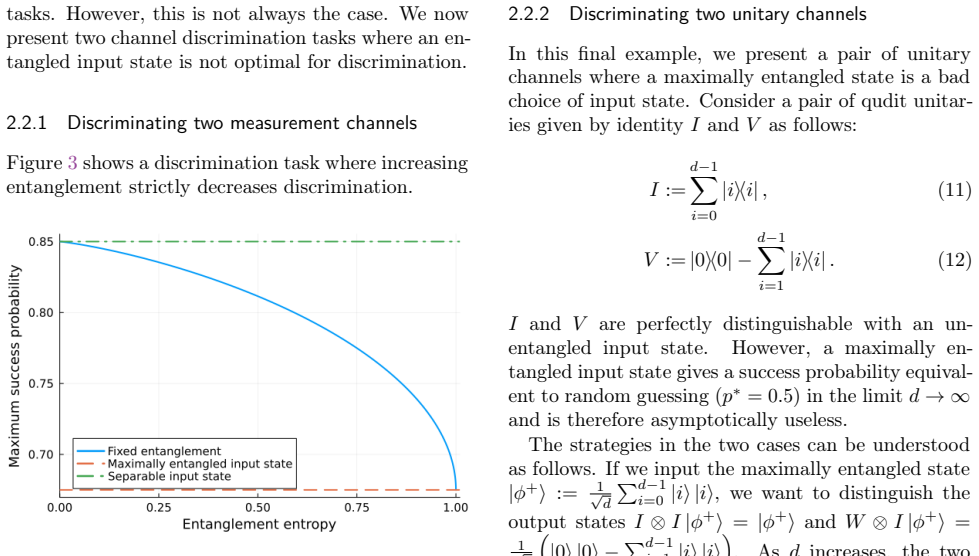
- There exist measurement channels where any entangled input lowers the maximum success probability compared with separable inputs.
- Conditions on channel pairs allow systematic identification of MEWC and MEBC cases without checking every possible input state.
Reading between the lines
- The result indicates that resource accounting in channel discrimination should track entanglement quantity rather than treat it as uniformly advantageous.
- Similar worst-case behavior may appear in discrimination tasks involving non-unitary channels or multiple uses.
- Numerical search over random unitary pairs could locate additional MEWC examples and test how common the phenomenon is.
Signed reviews
Editorial analysis
A structured set of objections, weighed in public.
Referee Report
Summary. The manuscript claims to exhibit an explicit pair of unitary channels that admit perfect single-shot discrimination via a separable input state, yet any discrimination strategy restricted to maximally entangled inputs succeeds with probability at most 1/2 + ε. It introduces the notions of Maximal Entanglement Worst Case (MEWC) and Maximal Entanglement Best Case (MEBC) pairs, supplies algebraic conditions for membership in each class, proves that optimal inputs for MEWC pairs must be separable, and gives examples of measurement channels in which entanglement strictly lowers the maximum discrimination probability.
Significance. If the explicit construction and the derived conditions are correct, the work supplies a concrete counter-example to the intuition that entanglement is invariably helpful for channel discrimination and supplies a classification scheme (MEWC/MEBC) that may be useful for future studies. The provision of an explicit pair together with the algebraic conditions that certify the MEWC property constitutes a verifiable, falsifiable contribution.
minor comments (2)
- [Abstract] Abstract: the numerical value of ε and the explicit form of the two unitaries are not stated; adding these would allow a reader to assess the result without consulting the body of the paper.
- [Introduction] The notation for the input states (separable versus maximally entangled) is introduced without a dedicated preliminary subsection; a short paragraph recalling the definitions of these classes would improve readability for non-specialists.
Simulated Author's Rebuttal
We thank the referee for their careful reading of the manuscript, for the accurate summary of our contributions, and for the recommendation to accept. We are pleased that the explicit construction, the MEWC/MEBC notions, and the algebraic conditions were viewed as a verifiable and falsifiable advance.
Circularity Check
No significant circularity; explicit constructions are self-contained
full rationale
The paper's core claim rests on an explicit pair of unitary channels that achieve perfect discrimination with a separable input while maximally entangled inputs yield near-random guessing. MEWC/MEBC definitions and their algebraic conditions are introduced directly from the task setup and applied to classify the example; the optimality statement that MEWC pairs require separable inputs follows immediately from those definitions without any reduction to fitted parameters, self-citations, or imported uniqueness theorems. No load-bearing step equates a derived quantity to its own input by construction.
Assumptions & free parameters
assumptions (1)
- standard math Standard quantum mechanics and single-shot channel discrimination framework
invented entities (2)
-
MEWC pairs
-
MEBC pairs
Cite this review
Pith. "Pith review of Entanglement in quantum channel discrimination: sometimes less is more." pith.science (2026). https://pith.science/paper/KLOONTPN
@misc{pith2026260531519,
  author       = {Pith},
  title        = {Pith review of: Entanglement in quantum channel discrimination: sometimes less is more},
  year         = {2026},
  howpublished = {\url{https://pith.science/paper/KLOONTPN}},
  note         = {Machine review of arXiv:2605.31519}
}
abstract
Entanglement is known to be a powerful resource that improves performance in various quantum information and computational tasks. A standard example of such a phenomenon is the possibility of perfectly discriminating all four Pauli operations in a single shot via the superdense coding protocol. While entanglement is often a powerful resource for quantum channel discrimination, this is not necessarily the case. In this work, we identify scenarios in which the maximally entangled state is a bad choice of input state and, more generally, show that excessive entanglement can reduce channel discriminability dramatically. To do so, we present an explicit pair of unitary channels which are perfectly discriminable without entanglement, but for which any strategy with maximally entangled input states is $\epsilon$-close to a blind uniform guessing strategy. To develop a systematic approach, we introduce the concepts of Maximal Entanglement Worst Case (MEWC) and Maximal Entanglement Best Case (MEBC) pairs of channels, and present conditions for a pair of channels to be MEWC or MEBC. With these conditions, we show that the optimal input states for discriminating MEWC pairs of channels are necessarily separable, and provide non-trivial examples of measurement channels for which entanglement necessarily reduces the maximum probability of discrimination.
Figures
Figures from the paper (3 more)
Reference graph
Works this paper leans on
-
[1]
Watrous,The Theory of Quantum Informa- tion, 1st ed
J. Watrous,The Theory of Quantum Informa- tion, 1st ed. (Cambridge University Press, 2018)
2018
-
[2]
C. W. Helstrom, Physics Letters A25, 101 (1967)
1967
-
[3]
C. W. Helstrom, Journal of Statistical Physics1, 231 (1969)
1969
-
[4]
Quantum-enhanced measurements: beating the standard quantum limit
V. Giovannetti, S. Lloyd, and L. Maccone, Sci- ence306, 1330 (2004), arXiv:quant-ph/0412078
work page Pith review arXiv 2004
-
[5]
Tóth and I
G. Tóth and I. Apellaniz, Journal of Physics A: Mathematical and Theoretical47, 424006 (2014)
2014
-
[6]
S. Pirandola, R. Laurenza, C. Lupo, and J. L. Pereira, npj Quantum Information5, 50 (2019), arXiv:1803.02834 [quant-ph]
-
[7]
Datta, T
C. Datta, T. Biswas, D. Saha, and R. Augusiak, New Journal of Physics23, 043021 (2021)
2021
-
[8]
Acín, Physical Review Letters87, 177901 (2001)
A. Acín, Physical Review Letters87, 177901 (2001)
2001
Show all 35 references
-
[9]
A.JenčováandM.Plávala,JournalofMathemat- ical Physics57, 122203 (2016), arXiv:1603.01437 [quant-ph]
2016 arXiv
-
[10]
Caiaffa and M
M. Caiaffa and M. Piani, Physical Review A97, 032334 (2018)
2018
-
[11]
Chiribella, G
G. Chiribella, G. M. D’Ariano, and P. Perinotti, Physical Review Letters101, 180501 (2008), arXiv:0803.3237 [quant-ph]
2008 arXiv
-
[12]
T.-A. Ohst, S. Zhang, H. C. Nguyen, M. Plávala, and M. T. Quintino, Characterising memory in quantum channel discrimination via constrained separability problems (2024), arXiv:2411.08110 [quant-ph]
2024
-
[13]
Bavaresco, M
J. Bavaresco, M. Murao, and M. T. Quintino, Physical Review Letters127, 200504 (2021), arXiv:2011.08300 [quant-ph]
2021
-
[14]
Bavaresco, M
J. Bavaresco, M. Murao, and M. T. Quintino, Journal of Mathematical Physics63, 042203 (2022), arXiv:2105.13369 [quant-ph]
2022
-
[15]
Puzzuoli,Entanglement in single-shot quantum channel discrimination, PhD Thesis, University of Waterloo (2018)
D. Puzzuoli,Entanglement in single-shot quantum channel discrimination, PhD Thesis, University of Waterloo (2018)
2018
-
[16]
G. M. D’Ariano, P. Lo Presti, and M. G. A. Paris, Physical Review Letters87, 270404 (2001)
2001
-
[17]
M. F. Sacchi, Physical Review A71, 062340 (2005), arXiv:quant-ph/0505183
2005 arXiv
-
[18]
M. F. Sacchi, Physical Review A72, 014305 (2005), arXiv:quant-ph/0505174
2005 arXiv
-
[19]
M. F. Sacchi, Journal of Optics B: Quantum and Semiclassical Optics7, S333 (2005), arXiv:quant- ph/0506072
2005
-
[20]
G. M. D’Ariano, P. L. Presti, and M. G. A. Paris, Journal of Optics B: Quantum and Semiclassical Optics4, S273 (2002), arXiv:quant-ph/0204050. 15
2002 arXiv
-
[21]
Piani and J
M. Piani and J. Watrous, Physical Review Let- ters102, 250501 (2009)
2009
-
[22]
J. Bae, D. Chruściński, and M. Piani, Phys- ical Review Letters122, 140404 (2019), arXiv:1809.02082 [quant-ph]
2019 arXiv
-
[23]
Manna, A
S. Manna, A. D. Bhowmik, and D. Saha, Max- imally entangled states are not always useful for single shot distinguishability of unitaries (2025), arXiv:2504.14499 [quant-ph] version: 2
2025
-
[24]
M. A. Nielsen and I. L. Chuang, Quantum Com- putation and Quantum Information: 10th An- niversary Edition (2010), iSBN: 9780511976667
2010
-
[25]
C.H.BennettandS.J.Wiesner,PhysicalReview Letters69, 2881 (1992)
1992
-
[26]
R. F. Werner and A. S. Holevo, Journal of Math- ematical Physics43, 4353 (2002), arXiv:quant- ph/0203003
2002
-
[27]
Puzzuoli and J
D. Puzzuoli and J. Watrous, Annales Henri Poin- caré18, 1153 (2017), arXiv:1604.08197 [quant- ph]
2017 arXiv
-
[28]
Taranto, S
P. Taranto, S. Milz, M. Murao, M. T. Quintino, andK.Modi,Higher-OrderQuantumOperations (2025), arXiv:2503.09693 [quant-ph]
2025
-
[29]
Choi, Linear Algebra and its Applications 10, 285 (1975)
M.-D. Choi, Linear Algebra and its Applications 10, 285 (1975)
1975
-
[30]
A. Y. Kitaev, Russian Mathematical Surveys52, 1191 (1997)
1997
-
[31]
Rosenthal, H
G. Rosenthal, H. Aaronson, S. Subramanian, A. Datta, and T. Gur, Quantum Chan- nel Testing in Average-Case Distance (2024), arXiv:2409.12566 [quant-ph]
2024
-
[32]
F. G. S. L. Brandao, M. Piani, and P. Horo- decki, Nature Communications6, 7908 (2015), arXiv:1310.8640 [quant-ph]
2015 arXiv
-
[33]
Yamazaki and S
S. Yamazaki and S. Akibue, Clifford+V syn- thesis for multi-qubit unitary gates (2025), arXiv:2510.08312 [quant-ph]
2025
-
[34]
Michel, M
U. Michel, M. Kliesch, R. Kueng, and D. Gross, IEEE Transactions on Information Theory64, 7443 (2018), arXiv:1612.07931 [cs]. A Details about the plots of success probability as a function of entanglement entropy Since the main focus of this work is to study the way entangleme...
2018 arXiv
-
[35]
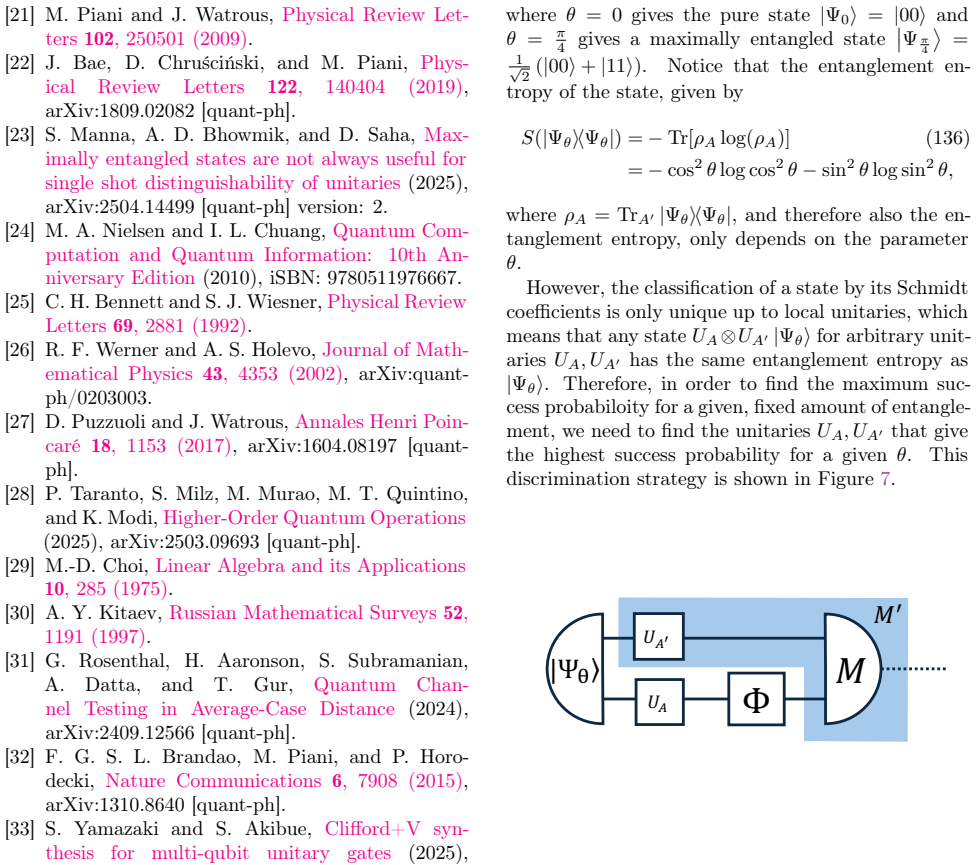
In this section, we will discuss how these plots are made. A two-qubit input state can be parametrised as |Ψθ⟩= cosθ|00⟩+ sinθ|11⟩∈HA⊗HA′,(135) whereθ = 0 gives the pure state|Ψ0⟩=|00⟩and θ= π 4 gives a maximally entangled state ⏐⏐Ψ π 4 ⟩ = 1√ 2 (|00⟩+|11⟩). Notice that the en...
Reviewed June 28, 2026 · model on record in the stance chip above.
Discussion (0). Continue with ORCID to comment.