REVIEW 2 major objections 4 minor 17 references
TurboMap: GPU-Accelerated Local Mapping for Visual SLAM
T0 review · 2 major / 4 minor · reviewed 2026-08-04 · deepseek-v4-flash
Pith's one-line read TurboMap shows that a visual SLAM local mapping backend can be sped up 1.3–1.6× by offloading search and fusion to the GPU with persistent keyframe storage, while preserving trajectory accuracy and avoiding skipped optimization stages under
desk verdict Practical GPU-accelerated local mapping for ORB-SLAM3 with real but modest speedups; the persistent-storage story needs clarification around map-point data for fusion. read the letter →
The pith
A machine-rendered reading of the paper's core claim, the machinery that carries it, and where it could break.
The reading
What carries the argument
The central mechanism is persistent GPU-resident keyframe storage: each keyframe is copied to GPU memory once when it enters local mapping and stays there until it is removed, eliminating repeated transfers for the search and fusion kernels. On this storage, TurboMap runs a parallel Search for Triangulation kernel (descriptor distance plus epipolar verification per thread), a parallel Map Point Fusion kernel, and a CPU-side lightweight per-map-point observation counter array for keyframe culling. It integrates an existing GPU-accelerated Local Bundle Adjustment solver that offloads the Schur complement step. The design rule is: offload work that is computationally intense, highly parallel, a
What would settle it
Measure local mapping time on a sequence where keyframe descriptors are refreshed during map updates (for example, after loop closure or map merge); if the cost of re-synchronizing the persistent GPU keyframe storage approaches the original total local mapping cost, the central speedup claim collapses.
Extended reading notes
Core claim
The paper claims that by splitting local mapping into GPU-side and CPU-side tasks based on data mutability, the entire pipeline can run 1.3–1.6× faster on average (EuRoC and TUM-VI, desktop and embedded) with no change in absolute trajectory error. The key split: keyframe keypoints and descriptors, which are static once created, live permanently on the GPU; map point observations, which change every iteration, stay on the CPU. This lets GPU kernels for triangulation search and fusion run without repeated transfers, while a lightweight observation-count array accelerates keyframe culling. Under high keyframe insertion stress, the baseline skips LBA and culling and its trajectory diverges, whe
Load-bearing premise
The design assumes that keyframe keypoints and descriptors stored on the GPU never change during local mapping, so they need no synchronization; if keyframes were updated frequently, the synchronization overhead would eat the speedup.
Editorial extensions
If this is right
- Local mapping latency drops by 1.3× on EuRoC and 1.6× on TUM-VI on both a desktop GPU (RTX 3090) and an embedded GPU (Jetson Xavier NX), with ATE RMSE essentially unchanged across all sequences.
- Keyframe processing time becomes more consistent: standard deviation shrinks, and the maximum per-keyframe time drops from about 220 ms to 115 ms in the corridor1 sequence, reducing the risk of tracking failure from slow keyframes.
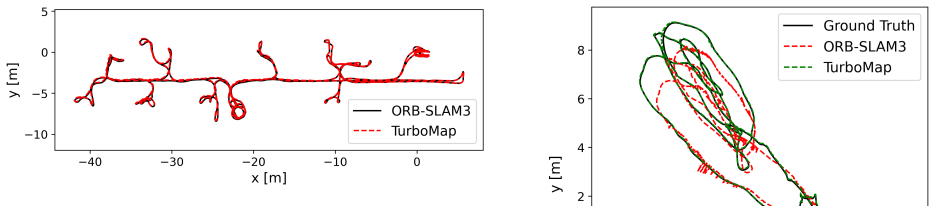
- Under high keyframe insertion stress, TurboMap avoids skipping local bundle adjustment and keyframe culling, whereas the baseline skips many stages; TurboMap's trajectory error stays below 0.05 m ATE RMSE while the baseline reaches 10.1 m on corridor1.
- The speedups scale with map point count: TUM-VI, which has roughly twice as many map points as EuRoC, shows larger gains for the GPU-accelerated components (search and fusion).
- The design is presented as transferable to other visual SLAM systems that maintain a global map and implement analogous local mapping stages.
Reading between the lines
- A testable extension is a dirty-bit mechanism on the persistent keyframe store: if a keyframe's descriptors ever need updating (for example, during map refinement), only the changed keyframe would be re-transferred to the GPU, isolating synchronization cost and making the design applicable to systems that update features.
- The stress-test result suggests TurboMap's practical value is greatest when keyframe insertion is dense — fast motion, low-power robots — so a natural next evaluation is on live onboard flight or handheld data where the real-time limiter is actually active, not disabled as in the simulated stress test.
- The static/dynamic data-split principle could generalize to other iterative mapping modules, such as loop-closing map merging or dense reconstruction, where stable features are stored on the accelerator and frequently changing connectivity remains on the host.
- Because local bundle adjustment still dominates the remaining time in TurboMap (roughly 60–75% of local mapping), a further speedup would require making the LBA itself more parallel; the current paper relies on an existing GPU solver for only the Schur complement step.
Editorial analysis
A structured set of objections, weighed in public.
Referee Report
Summary. TurboMap is a GPU-accelerated local mapping backend for ORB-SLAM3. The paper identifies four local-mapping bottlenecks — map-point creation, map-point fusion, local bundle adjustment (LBA), and keyframe culling — and optimizes them: the search for triangulation correspondences is offloaded to the GPU, map-point fusion is parallelized on the GPU using a persistent GPU-resident keyframe store, an existing GPU LBA solver is integrated, and keyframe culling is optimized on the CPU. Experiments on EuRoC and TUM-VI, on a desktop RTX 3090 platform and a Jetson Xavier NX, report average local-mapping speedups of 1.3x and 1.6x respectively, with comparable ATE RMSE. A stress experiment with denser keyframe insertion shows that ORB-SLAM3 skips LBA/culling and diverges, while TurboMap maintains accuracy. The authors make their code publicly available.
Significance. If the reported results hold, this is a useful and practical contribution to real-time visual SLAM. The paper addresses a genuinely important bottleneck — local mapping latency — and combines targeted GPU kernels with a CPU-side redesign rather than a monolithic port. Strengths include reproducible open-source code, evaluation on two datasets and two very different hardware platforms, per-component speedup breakdowns, and a stress test that goes beyond standard benchmark runs. The LBA component is adopted from the authors' prior work, but the evaluation of the integrated TurboMap system is independent, so this is not circular. The main weaknesses are in the completeness of the design description for GPU fusion and in the comparability of the embedded-platform sequence subset; both are addressable. Overall, the evidence supports the central claim of moderate average speedups with preserved accuracy, though the paper needs revision to fully substantiate the no-transfer-cost claim and to clarify the experimental scope.
major comments (2)
- [IV-D / IV-B] The claim that GPU fusion 'incurs no transfer cost' for neighboring keyframes is not established by the described storage layout. Section IV-B states the persistent GPU keyframe storage contains keypoints and descriptors per keyframe, and Section IV-D says the data required for Fuse are the neighboring keyframes (already on GPU) plus ~100 KB of current-keyframe map-point data. In ORB-SLAM3's fusion logic, however, duplicate detection also needs the 3D positions and representative descriptors of candidate map points observed in the neighboring keyframes. These quantities are dynamically updated during local mapping, and Section IV-F explicitly notes that such dynamic observation data is unsuitable for persistent GPU storage. If neighbor map-point data are transferred or synchronized per keyframe, the overhead is omitted from the stated ~100 KB figure; if they are not required, the paper s
- [Table I / V-A] The embedded and desktop evaluations use different sequence subsets. In Table I(a) the Jetson EuRoC average is computed from MH01, MH02, V101, V102 only, and the Jetson TUM-VI average from room1, room2, corridor1, corridor2 only; in Table I(b) the desktop averages use 8 EuRoC sequences and 9 TUM-VI sequences. The text claims average speedups of 1.3x and 1.6x on EuRoC and TUM-VI 'in both the desktop and embedded settings' without noting this discrepancy. Since the central claim is across both platforms, the paper should either run the full sequence set on both platforms or explicitly state and justify the Jetson subset, and compute averages over the same sequences when making cross-platform comparisons.
minor comments (4)
- [V-A] No statistical significance tests or confidence intervals are reported for the key speedup claims. Given the five-run protocol and consistent per-sequence direction this is not disqualifying, but paired tests or bootstrapped CIs would strengthen the headline result.
- [V-E] The stress test is described as simulating 'high camera velocity' and 'rapidly changing scenes', but the actual modification increases keyframe insertion rate by disabling the real-time limiter and reducing the minimum keyframe interval; the camera motion in the dataset is unchanged. Please rephrase to describe the intervention accurately as a high-keyframe-rate / heavy-local-mapping-load stress test.
- [IV-B] The phrase 'mainly include keypoints and their descriptors' is vague. Please give a precise list of fields stored per keyframe in the persistent GPU storage, especially any fields needed by the GPU Fuse kernel.
- [IV-F] The CPU keyframe-culling optimization is described at a high level. A short pseudocode or a precise description of how the per-map-point scale counters are maintained under keyframe removal and map-point updates would make the correctness and the reported 1.8-3.3x speedup easier to assess.
Circularity Check
No significant circularity: TurboMap's central claims are empirical measurements against external baselines, not derivations from fitted inputs or self-referential definitions.
full rationale
TurboMap's central claims — 1.3x speedup on EuRoC and 1.6x on TUM-VI for local mapping, with comparable ATE — are measured wall-clock timings of TurboMap versus vanilla ORB-SLAM3 on external datasets (Table I). No equation in the paper derives a predicted quantity from a fitted input, and no parameter is calibrated to the reported outcome. The design components in Sections IV-C through IV-F are engineering choices evaluated empirically: Search for Triangulation and Map-point Fusion are measured component-wise, Keyframe Culling is measured on the CPU, and LBA speedups are measured against ORB-SLAM3's g2o baseline in the same table. The paper integrates the same-group GPU LBA solver [12] and cites other same-group work [11], but it does not rely on those citations as evidence for speedup or accuracy; Table I independently reports LBA component timings and ATE on the external datasets. The paper also honestly flags limitations in Section IV-F (synchronization overhead of dynamic map-point storage was nearly the full local-mapping cost) and in the Conclusion (GPU transfer overhead on discrete platforms). These are empirical caveats, not circular premises. The persistent GPU keyframe storage description in Sections IV-B/IV-D may under-specify what map-point data the Fusion kernel requires — a potential correctness/overhead concern — but that is not a circular derivation: no result is true by construction or equivalent to its own input.
Assumptions & free parameters
assumptions (3)
- domain assumption The local mapping workload of ORB-SLAM3 is representative of global-map visual SLAM systems; the component time distribution (95% in Search, Fuse, LBA, Culling) is typical.
- domain assumption The GPU implementations of Search for Triangulation and Map Point Fusion are functionally equivalent to the CPU versions, so accuracy is preserved.
- domain assumption Persistent GPU keyframe storage avoids repeated data transfer because keyframe keypoint/descriptor data is static during local mapping.
Cite this review
Pith. "Pith review of TurboMap: GPU-Accelerated Local Mapping for Visual SLAM." pith.science (2026). https://pith.science/paper/KLZXNDT7
@misc{pith2026251102036,
  author       = {Pith},
  title        = {Pith review of: TurboMap: GPU-Accelerated Local Mapping for Visual SLAM},
  year         = {2026},
  howpublished = {\url{https://pith.science/paper/KLZXNDT7}},
  note         = {Machine review of arXiv:2511.02036}
}
read the original abstract
In real-time Visual SLAM systems, local mapping must operate under strict latency constraints, as delays degrade map quality and increase the risk of tracking failure. GPU parallelization offers a promising way to reduce latency. However, parallelizing local mapping is challenging due to synchronized shared-state updates and the overhead of transferring large map data structures to the GPU. This paper presents TurboMap, a GPU-parallelized and CPU-optimized local mapping backend that holistically addresses these challenges. We restructure Map Point Creation to enable parallel Keypoint Correspondence Search on the GPU, redesign and parallelize Map Point Fusion, optimize Redundant Keyframe Culling on the CPU, and integrate a fast GPU-based Local Bundle Adjustment solver. To minimize data transfer and synchronization costs, we introduce persistent GPU-resident keyframe storage. Experiments on the EuRoC and TUM-VI datasets show average local mapping speedups of 1.3x and 1.6x, respectively, while preserving accuracy.
Figures


Figures from the paper (4 more)



Reference graph
Works this paper leans on
-
[1]
A comprehensive study of systems challenges in visual simultaneous localization and mapping systems,
S. Semenova, S. Ko, Y . D. Liu, L. Ziarek, and K. Dantu, “A comprehensive study of systems challenges in visual simultaneous localization and mapping systems,”ACM Trans. Embed. Comput. Syst., vol. 24, no. 1, Sept. 2024. [Online]. Available: https: //doi.org/10.1145/3677317
-
[2]
Orb-slam: A versatile and accurate monocular slam system,
R. Mur-Artal, J. M. M. Montiel, and J. D. Tardos, “Orb-slam: A versatile and accurate monocular slam system,”IEEE Transactions on Robotics, vol. 31, no. 5, p. 1147–1163, Oct. 2015
2015
-
[3]
Orb-slam2: An open-source slam system for monocular, stereo, and rgb-d cameras,
R. Mur-Artal and J. D. Tardos, “Orb-slam2: An open-source slam system for monocular, stereo, and rgb-d cameras,”IEEE Transactions on Robotics, vol. 33, no. 5, p. 1255–1262, Oct. 2017
2017
-
[4]
Orb-slam3: An accurate open-source library for visual, visual–inertial, and multimap slam,
C. Campos, R. Elvira, J. J. G. Rodriguez, J. M. M. Montiel, and J. D. Tardos, “Orb-slam3: An accurate open-source library for visual, visual–inertial, and multimap slam,”IEEE Transactions on Robotics, vol. 37, no. 6, p. 1874–1890, Dec. 2021
2021
-
[5]
Openvins: A research platform for visual-inertial estimation,
P. Geneva, K. Eckenhoff, W. Lee, Y . Yang, and G. Huang, “Openvins: A research platform for visual-inertial estimation,” in2020 IEEE International Conference on Robotics and Automation (ICRA), 2020, pp. 4666–4672
2020
-
[6]
Kimera: an open- source library for real-time metric-semantic localization and mapping,
A. Rosinol, M. Abate, Y . Chang, and L. Carlone, “Kimera: an open- source library for real-time metric-semantic localization and mapping,” in2020 IEEE International Conference on Robotics and Automation (ICRA), 2020, pp. 1689–1696
2020
-
[7]
The euroc micro aerial vehicle datasets,
M. Burri, J. Nikolic, P. Gohl, T. Schneider, J. Rehder, S. Omari, M. W. Achtelik, and R. Siegwart, “The euroc micro aerial vehicle datasets,”The International Journal of Robotics Research, 2016. [Online]. Available: http://ijr.sagepub.com/content/early/2016/01/21/ 0278364915620033.abstract
2016
-
[8]
The tum vi benchmark for evaluating visual-inertial odometry,
D. Schubert, T. Goll, N. Demmel, V . Usenko, J. St ¨uckler, and D. Cre- mers, “The tum vi benchmark for evaluating visual-inertial odometry,” in2018 IEEE/RSJ International Conference on Intelligent Robots and Systems (IROS), 2018, pp. 1680–1687
2018
Show all 17 references
-
[9]
Data flow orb-slam for real-time performance on embedded gpu boards,
S. Aldegheri, N. Bombieri, D. D. Bloisi, and A. Farinelli, “Data flow orb-slam for real-time performance on embedded gpu boards,” in 2019 IEEE/RSJ International Conference on Intelligent Robots and Systems (IROS). Macau, China: IEEE, Nov. 2019, p. 5370–5375. [Online]. Availabl...
2019
-
[10]
High-speed stereo visual slam for low-powered computing devices,
A. Kumar, J. Park, and L. Behera, “High-speed stereo visual slam for low-powered computing devices,”IEEE Robotics and Automation Letters, vol. 9, no. 1, p. 499–506, Jan. 2024
2024
-
[11]
Fasttrack: Gpu-accelerated tracking for visual slam,
K. Khabiri, P. Hosseininejad, S. Gopinath, K. Dantu, and S. Y . Ko, “Fasttrack: Gpu-accelerated tracking for visual slam,” 2025. [Online]. Available: https://arxiv.org/abs/2509.10757
2025 arXiv
-
[12]
Improving the performance of local bundle adjustment for visual-inertial slam with efficient use of gpu resources,
S. Gopinath, K. Dantu, and S. Y . Ko, “Improving the performance of local bundle adjustment for visual-inertial slam with efficient use of gpu resources,” in2023 IEEE International Conference on Robotics and Automation (ICRA), 2023, pp. 6239–6245
2023
-
[13]
Jacobigpu: Gpu- accelerated numerical differentiation for loop closure in visual slam,
D. Kumar, S. Gopinath, K. Dantu, and S. Y . Ko, “Jacobigpu: Gpu- accelerated numerical differentiation for loop closure in visual slam,” in2024 IEEE International Conference on Robotics and Automation (ICRA), 2024, pp. 1687–1693
2024
-
[14]
Ceres Solver,
S. Agarwal, K. Mierle, and T. C. S. Team, “Ceres Solver,” 10 2023. [Online]. Available: https://github.com/ceres-solver/ceres-solver
2023
-
[15]
Megba: A gpu-based distributed library for large-scale bundle adjustment,
J. Ren, W. Liang, R. Yan, L. Mai, S. Liu, and X. Liu, “Megba: A gpu-based distributed library for large-scale bundle adjustment,”
-
[16]
G2o: A general framework for graph optimization,
R. K ¨ummerle, G. Grisetti, H. Strasdat, K. Konolige, and W. Burgard, “G2o: A general framework for graph optimization,” in2011 IEEE International Conference on Robotics and Automation, 2011, pp. 3607–3613
2011
-
[2022]
Available: https://arxiv.org/abs/2112.01349
[Online]. Available: https://arxiv.org/abs/2112.01349
Reviewed August 4, 2026 · model on record in the stance chip above.
Discussion (0). Sign in to comment.