REVIEW 4 major objections 5 minor 72 references
Prospects for probing light photophobic axion-like particles via displaced vertex signals at the CEPC
T0 review · 4 major / 5 minor · reviewed 2026-08-02 · deepseek-v4-flash
Pith's one-line read At a future Z-pole electron-positron collider, long-lived 'photophobic' axion-like particles could be discovered through displaced vertices produced in Z→aγ decays, covering unexplored regions of mass and coupling.
desk verdict A useful but unvalidated CEPC sensitivity projection for photophobic ALPs via displaced vertices; the zero-background assumption is explicit and the dimuon upper edge looks off by an order of magnitude. read the letter →
The pith
A machine-rendered reading of the paper's core claim, the machinery that carries it, and where it could break.
The reading
What carries the argument
The central object is the photophobic ALP: an axion-like particle whose tree-level couplings to photons and fermions vanish, leaving only couplings to electroweak gauge bosons (W, Z, Zγ). After electroweak symmetry breaking, the scenario reduces to two parameters: the ALP mass m_a and the coupling g_aWW. The effective fermion and photon couplings are generated by one-loop renormalization-group running, which suppresses the total decay width and lengthens the proper decay length. The search exploits the observables |d_0| (transverse impact parameter), v_0 and v_z (vertex displacement), ΔR between the two leptons, and the transverse momentum of the dilepton system to separate the boosted, long
What would settle it
Run a detector-level simulation of the Z-pole environment, including pile-up and track reconstruction, and count background events passing the full cut set (|d0| > 2 mm, 0.1 m < v0 < 1.8 m, vz < 2.35 m, ΔR < 1.0, and dilepton pT > 25 GeV for muons or > 30 GeV for taus); if any background event survives, the projected 95% CL regions are optimistic.
Extended reading notes
Core claim
At the heart of the paper is the observation that photophobic ALPs — axion-like particles with no tree-level coupling to photons or fermions — can be produced at the Z pole via Z→aγ, then decay into charged leptons through loop-induced couplings. Because those couplings are small, the ALP travels a macroscopic distance before decaying, creating a displaced vertex that is essentially background-free after moderate cuts. The authors simulate the μ+μ−γ and τh+τh− E_T^miss γ signals and derive 95% CL sensitivities: g_aWW ∈ [1.27×10⁻³, 0.68] TeV−1 for m_a ∈ [1,4] GeV and g_aWW ∈ [7×10⁻⁴, 9.4×10⁻³] TeV−1 for m_a ∈ [4,9] GeV. These regions are presented as new ground, uncovered by existing collider
Load-bearing premise
The entire sensitivity projection rests on the assumption that after the chosen cuts, pile-up, random-track crossings, and other instrumental backgrounds are negligible; if even one such event survives in 100 ab−1, the 3-event benchmark for the 95% CL limit no longer holds.
Editorial extensions
If this is right
- A Z-pole electron-positron collider with 100 ab−1 can probe photophobic ALP couplings down to about 10−4 TeV−1 for masses 4–9 GeV and about 10−3 TeV−1 for masses 1–4 GeV.
- The dimuon and ditau channels together give continuous mass coverage from 1 to 9 GeV, with no branching-ratio gaps below the b-quark threshold.
- The sensitivity is achieved using only inner-tracker information, so the search does not rely on calorimeter or muon-system capabilities.
- The projected regions extend into parameter space that is complementary to existing hadron-collider and rare-meson-decay searches, so a positive signal would be a new discovery rather than a confirmation.
- The same production and displacement logic applies to any proposed Z-pole lepton collider, so the method provides a blueprint for comparable facilities.
Reading between the lines
- A full detector-level simulation including pile-up and random-track crossings is the natural next step; any surviving background would shrink the quoted regions, especially at the weak-coupling (long-lifetime) boundary where the signal is diluted across larger volumes.
- Because the effective fermion couplings are computed at a fixed cutoff scale f_a = 10 TeV, the sensitivity bands are tied to that choice; scanning over f_a would show how the boundaries move as the lifetime changes.
- Extending the vertex search from the inner tracker to the calorimeters or muon system would add sensitivity to shorter and longer lifetimes, respectively; the paper explicitly leaves those options open.
- The results suggest that a dedicated displaced-vertex search at the Z pole could be mounted with relatively modest detector requirements, which may influence design choices for future electron-positron colliders.
Signed reviews
Editorial analysis
A structured set of objections, weighed in public.
Referee Report
Summary. This paper studies the discovery potential of the CEPC (a 91.2 GeV electron-positron collider with 100 ab^-1) for light, long-lived photophobic axion-like particles (ALPs). The authors adopt the photophobic ALP EFT in which the ALP couples only to electroweak gauge bosons at tree level, with loop-induced couplings to fermions and photons. They compare single-production channels, identify e+e- -> Z -> a gamma as dominant, and simulate the displaced-vertex signals from a -> mu+ mu- and a -> tau+ tau- (with hadronic tau decays), using MadGraph5_aMC@NLO, PYTHIA8, and a simplified fast simulation. Optimized cuts on displacement variables, angular separation, and the reconstructed ALP transverse momentum are applied. With the assumption that SM and instrumental backgrounds are negligible after all cuts, the authors use a 3-event benchmark for 95% C.L. sensitivity and report reachable regions: g_aWW in [1.27e-3, 6.80e-1] TeV^-1 for m_a in [1,4] GeV from the dimuon channel, and g_aWW in [7.00e-4, 9.40e-3] TeV^-1 for m_a in [4,9] GeV from the ditau channel. The paper argues these regions complement existing LEP, LHC, LHCb, and CHARM bounds and the projected HL-LHC sensitivity.
Significance. If the projected reach is correct, this would be a useful and nontrivial result: the CEPC would probe photophobic ALP parameter space not covered by current experiments, and the analysis demonstrates a concrete DV search strategy for a future Z-factory. The study uses state-of-the-art Monte Carlo tools (FeynRules/MadGraph/PYTHIA/MadAnalysis5), presents production cross sections and cut-flow efficiencies, and compares with a broad set of existing constraints. The main weakness is that the central sensitivity claim rests on an unvalidated zero-background assumption: after the displacement cuts, the SM prompt background is eliminated by construction, and the paper explicitly assumes instrumental backgrounds are negligible without a detector-level study. The projected low-edge couplings are therefore conditional on this assumption and cannot be taken as demonstrated without further quantification. This is a correctable issue, but it is load-bearing for the headline numbers.
major comments (4)
- [Sec. III A, Tables II and III] The paper states that after all optimized cuts 'the SM background is expected to be suppressed to a negligible level,' but no background event counts or cross sections after each cut are reported. Only signal cross sections and efficiencies are given in Tables II and III. This matters quantitatively: with L = 100 ab^-1, a background cross section of 10^-11 pb gives O(1) background events, so the 3-event 95% C.L. benchmark requires that the residual background is below roughly 10^-11 pb. The authors must report the expected number of SM background events (for e+e- -> mu+mu- gamma and e+e- -> tau+tau- gamma) at each cut step, or at least give the final background count, to justify the zero-background assumption.
- [Sec. III A, paragraph on instrumental backgrounds] The manuscript explicitly states that instrumental backgrounds such as pile-up interactions, vertices from dense detector regions, and random-track crossings are 'beyond the scope of this study' and are assumed negligible. This is a load-bearing assumption for the quoted sensitivity: the displacement cuts reject prompt SM background by construction, so the only remaining protection against fake displaced vertices is the assumed negligible instrumental rate. With O(10^12) Z decays and 100 ab^-1, even a fractional fake rate of ~10^-9 yields O(1) events. The authors need a quantitative estimate based on CEPC occupancy, vertexing efficiency, and track-fake probabilities, or a conservative background uncertainty, before the 3-event sensitivity can be considered robust.
- [Sec. II, Eq. (5) and Eq. (9); Fig. 9] The sensitivity boundaries in Fig. 9 depend on the ALP lifetime, but the paper never gives the explicit formula for the total ALP width Gamma_a entering Eq. (9). The branching fractions shown in Fig. 1 are insufficient to reproduce the results; the reader needs the sum of the loop-induced partial widths (a -> f fbar, a -> gamma gamma, etc.). In addition, the effective fermion couplings in Eq. (5) depend on the assumed cutoff scale Lambda = 4 pi f_a with f_a fixed to 10 TeV. Since the sensitivity regions are quoted as functions of (m_a, g_aWW) only, the dependence of the lifetime and hence of the projected boundaries on the choice of f_a should be stated explicitly.
- [Sec. III, simplified fast simulation (SFS)] The SFS framework does not include full detector-level reconstruction of displaced vertices: there is no material interaction model, no vertex-fitter efficiency, and no track-fake reconstruction. The signal efficiencies in Tables II and III are obtained by applying geometric cuts on generator-level quantities (|d0|, v0, vz). Since the signal is concentrated near the tracker boundaries (e.g., 0.1 m < v0 < 1.8 m, vz < 2.35 m), detector resolution, material effects, and reconstruction inefficiencies can significantly modify these efficiencies. The authors should validate the key efficiencies with a more realistic detector simulation, or at least provide an efficiency correction/uncertainty estimate.
minor comments (5)
- [Sec. I] 'owning to' should be 'owing to' in the sentence about the clean experimental environment.
- [Eq. (4)] The second relation in Eq. (4) appears typeset incorrectly ('c2W/c2W'); if intended, it should be gaZZ = (c_W^2 / s_W^2) g_aWW. Please correct the rendering.
- [Sec. III A] The phrase 'with the number cuts being taken as the first step filter' is unclear; rephrase.
- [Figs. 1 and 9] The arXiv rendering of Figs. 1 and 9 is badly garbled (e.g., the legend text in Fig. 9 is scrambled). The published-quality figures need to be readable, with all curves and regions clearly labeled.
- [Sec. III B and IV] The statement that for m_a above the b bbar threshold 'no accessible parameter space' remains for long-lived ALPs is asserted without a quantitative lifetime/cut-efficiency demonstration. A short quantitative explanation would strengthen the argument.
Circularity Check
No significant circularity: the CEPC sensitivity is a forward Monte Carlo projection from an EFT, with no data fitting and no load-bearing self-citation.
full rationale
The paper's central derivation is self-contained: it takes the photophobic ALP effective Lagrangian (Eq. (1)), obtains loop-induced couplings via standard RGE and one-loop formulas (Eqs. (5)-(6)), computes production cross sections and decay lengths from those couplings, and then uses MadGraph/PYTHIA/fast simulation to obtain signal efficiencies and cross sections. The projected 95% C.L. regions are obtained by counting signal events after cuts with N_sig = 3, with no parameter fitted to any data subset and no 'prediction' that is equivalent to a fitted input by construction. The only self-citation is Ref. [72], the authors' own HL-LHC projection, which is used solely as a comparison region in Fig. 9 and in the concluding claim of complementarity; it is not an input to the CEPC signal or background calculation, so it is not load-bearing. The paper explicitly states two assumptions that limit the numeric reach but do not make the derivation circular: instrumental backgrounds (pile-up, random-track crossings, dense-detector-region vertices) are assumed negligible and deferred to future detector-level simulation (Sec. III A), and the cutoff is fixed at f_a = 10 TeV (Sec. II). These are stated modeling assumptions, not hidden redefinitions or fitted results. The SM backgrounds e+e- -> mu+mu- gamma and e+e- -> tau+tau- gamma are simulated and removed by the displacement cuts, which is a standard cut-and-count procedure rather than a circular reduction. Overall, no circular step is exhibited.
Assumptions & free parameters
free parameters (2)
- f_a (ALP decay constant) =
10 TeV
- Optimized cut thresholds =
|d0|>2 mm; 0.1 m<v0<1.8 m; vz<2.35 m; ΔR<1; pT>25 GeV (muon), pT>30 GeV (tau)
assumptions (6)
- domain assumption Photophobic boundary conditions: no tree-level couplings of the ALP to photons, fermions, or gluons
- domain assumption The one-loop RGE formula of Eq. (5) correctly gives the low-energy ALP-fermion couplings
- domain assumption The ALP decays only into SM final states; no invisible or exotic decays
- domain assumption CEPC inner tracker geometry and performance as implemented in the SFS fast simulation are adequate
- ad hoc to paper Instrumental backgrounds are negligible after the optimized cuts
- ad hoc to paper The SM backgrounds considered (μ+μ−γ and τ+τ−γ) are the only relevant ones
Cite this review
Pith. "Pith review of Prospects for probing light photophobic axion-like particles via displaced vertex signals at the CEPC." pith.science (2026). https://pith.science/paper/KMAOPP2V
@misc{pith2026260313746,
  author       = {Pith},
  title        = {Pith review of: Prospects for probing light photophobic axion-like particles via displaced vertex signals at the CEPC},
  year         = {2026},
  howpublished = {\url{https://pith.science/paper/KMAOPP2V}},
  note         = {Machine review of arXiv:2603.13746}
}
abstract
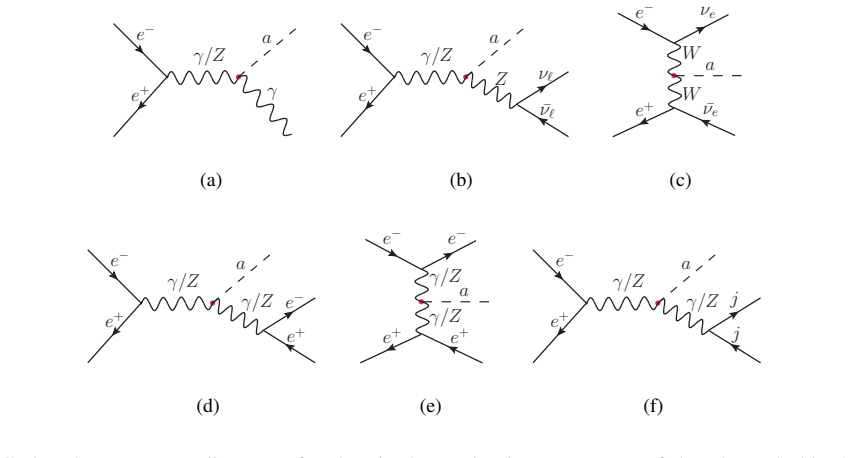
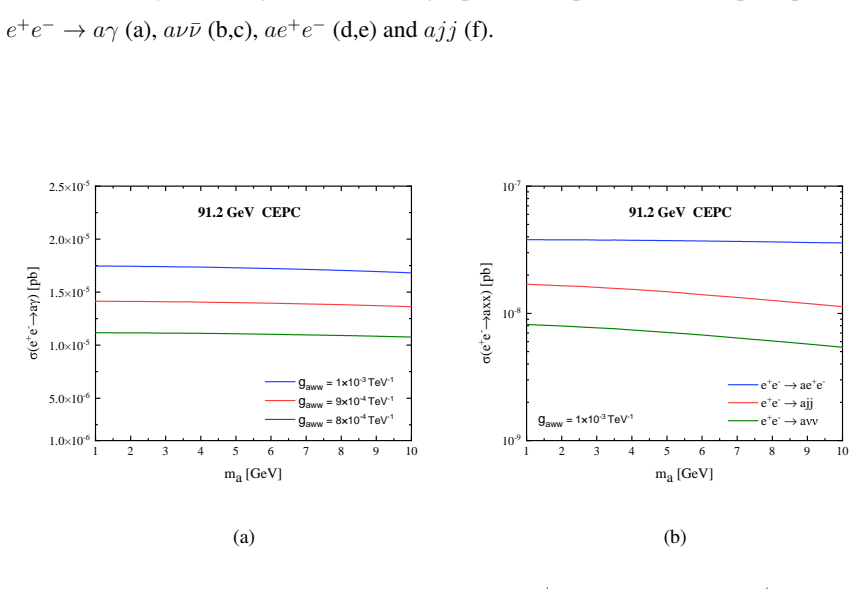
In recent years, long-lived particles (LLPs) have attracted increasing attention in searches for physics beyond the Standard Model (SM). In this paper, we investigate the discovery prospects for light, long-lived ALPs predicted by the photophobic ALP scenario through displaced-vertex signals at the CEPC, with a center-of-mass energy of $\sqrt{s}=91.2 $ GeV and an integrated luminosity of $\mathcal{L}=$ $100$ ab$^{-1}$. After comparing several possible single-production processes for the photophobic ALP, we focus on the dominant process $e^+ e^- \to Z \to a \gamma $, in which the ALP $a$ subsequently decays into a pair of charged leptons at a displaced vertex. Dedicated Monte Carlo simulations are performed for the $\mu^+ \mu^- \gamma$ and $\tau_h^+ \tau_h^- E\mkern-10.5 mu/_T \gamma$ signals. For the $\mu^+\mu^-\gamma$ signal, the CEPC is sensitive to the parameter region $g_{aWW} \in [1.27\times10^{-3},6.80\times10^{-1}]~\mathrm{TeV}^{-1}$ for $m_a \in [1,4]~\mathrm{GeV}$. For the $\tau_h^+\tau_h^- E\mkern-10.5 mu/_T \gamma$ signal, the accessible region is $g_{aWW} \in [7.00\times10^{-4},9.40\times10^{-3}]~\mathrm{TeV}^{-1}$ for $m_a \in [4,9]~\mathrm{GeV}$. These results demonstrate the substantial potential of the CEPC to explore light, long-lived ALPs through displaced-vertex signals, providing complementary coverage to existing searches at LEP and the LHC, as well as to the projected reach of the HL-LHC.
Figures


Figures from the paper (6 more)


Reference graph
Works this paper leans on
-
[55]
S.-Y . Wang, Y .-P. Jiao, H.-H. Zhang, and G. Cacciapaglia (2025), 2509.17718
arXiv 2025
-
[1]
M. C. Gonzalez-Garcia and M. Maltoni, Phys. Rept. 460, 1 (2008), 0704.1800
arXiv 2008
-
[2]
G. Bertone, D. Hooper, and J. Silk, Phys. Rept. 405, 279 (2005), hep-ph/0404175
arXiv 2005
-
[3]
K. R. Dienes and B. Thomas, Phys. Rev. D 85, 083523 (2012), 1106.4546
arXiv 2012
-
[4]
R. D. Peccei and H. R. Quinn, Phys. Rev. Lett. 38, 1440 (1977)
1977
-
[5]
R. D. Peccei and H. R. Quinn, Phys. Rev. D 16, 1791 (1977)
1977
-
[6]
Wilczek, Phys
F. Wilczek, Phys. Rev. Lett. 40, 279 (1978)
1978
-
[7]
J. L. Feng, Ann. Rev. Nucl. Part. Sci. 63, 351 (2013), 1302.6587
arXiv 2013
Show all 72 references
-
[8]
Lanfranchi, M
G. Lanfranchi, M. Pospelov, and P. Schuster, Ann. Rev. Nucl. Part. Sci.71, 279 (2021), 2011.02157
2021 arXiv
- [9]
-
[10]
Jeanty and B
L. Jeanty and B. Shuve (2025), 2511.17934
2025
- [11]
- [12]
- [13]
- [14]
- [15]
- [16]
- [17]
- [18]
- [19]
- [20]
- [21]
- [22]
- [23]
-
[24]
A. M. Sirunyan et al. (CMS), Phys. Rev. D 104, 052011 (2021), 2104.13474
2021 arXiv
-
[25]
A. M. Sirunyan et al. (CMS), Phys. Rev. D 104, 012015 (2021), 2012.01581
2021 arXiv
- [26]
- [27]
- [28]
- [29]
-
[30]
Abdallah et al
W. Abdallah et al. (CEPC Study Group), Radiat. Detect. Technol. Methods 8, 1 (2024), [Erratum: Radiat.Detect.Technol.Methods 9, 184–192 (2025)], 2312.14363
2024
-
[31]
Abada et al
A. Abada et al. (FCC), Eur. Phys. J. ST 228, 261 (2019)
2019
- [32]
-
[33]
Gao (CEPC Accelerator Study Group) (2022), 2203.09451
J. Gao (CEPC Accelerator Study Group) (2022), 2203.09451
2022 arXiv
- [34]
-
[35]
Z. S. Wang and K. Wang, Phys. Rev. D 101, 115018 (2020), 1904.10661
2020 arXiv
-
[36]
Alipour-Fard, N
S. Alipour-Fard, N. Craig, M. Jiang, and S. Koren, Chin. Phys. C 43, 053101 (2019), 1812.05588
2019 arXiv
-
[37]
Q.-H. Cao, J. Guo, J. Liu, Y . Luo, and X.-P. Wang, Phys. Rev. D110, 015029 (2024), 2311.12934
2024 arXiv
-
[38]
R. G. Suarez, Acta Phys. Polon. B 52, 953 (2021), 2102.07597
2021 arXiv
-
[39]
Zhang, C
Y . Zhang, C. Mo, X. Chen, B. Li, H. Chen, J. Hu, and L. Li, Front. Phys. (Beijing) 21, 056202 (2026), 2401.05094
2026
- [40]
-
[41]
K. A. Urqu ´ıa-Calder´on, Phys. Rev. D 109, 055002 (2024), 2310.17406
2024 arXiv
-
[42]
Chrzaszcz, R
M. Chrzaszcz, R. G. Suarez, and S. Monteil, Eur. Phys. J. Plus 136, 1056 (2021), 2106.15459
2021 arXiv
-
[43]
J. E. Kim, Phys. Rev. Lett. 43, 103 (1979)
1979
-
[44]
M. A. Shifman, A. I. Vainshtein, and V . I. Zakharov, Nucl. Phys. B166, 493 (1980)
1980
-
[45]
M. Dine, W. Fischler, and M. Srednicki, Phys. Lett. B 104, 199 (1981)
1981
-
[46]
A. R. Zhitnitsky, Sov. J. Nucl. Phys. 31, 260 (1980)
1980
-
[47]
A. A. Anselm and N. G. Uraltsev, Phys. Lett. B 114, 39 (1982)
1982
-
[48]
Ringwald, in 49th Rencontres de Moriond on Electroweak Interactions and Unified Theories (2014), pp
A. Ringwald, in 49th Rencontres de Moriond on Electroweak Interactions and Unified Theories (2014), pp. 223–230, 1407.0546
2014 arXiv
- [49]
-
[50]
M. Aiko, M. Endo, and K. Fridell, JHEP 06, 194 (2024), 2401.13323
2024 arXiv
- [51]
-
[52]
Y .-n. Mao, K. Wang, and Y . Xiong, Chin. Phys. C49, 083106 (2025), 2411.14041
2025
-
[53]
Feng, Y .-n
J. Feng, Y .-n. Mao, and K. Wang (2025), 2511.21003
2025
-
[54]
Z. Ding, J. Feng, Y .-n. Mao, K. Wang, and Y . Xiong (2025), 2512.23155. 21
2025
-
[56]
Georgi, D
H. Georgi, D. B. Kaplan, and L. Randall, Phys. Lett. B 169, 73 (1986)
1986
- [57]
-
[58]
Bauer, M
M. Bauer, M. Neubert, S. Renner, M. Schnubel, and A. Thamm, JHEP04, 063 (2021), 2012.12272
2021 arXiv
-
[59]
Bonilla, I
J. Bonilla, I. Brivio, M. B. Gavela, and V . Sanz, JHEP 11, 168 (2021), 2107.11392
2021 arXiv
-
[60]
Alloul, N
A. Alloul, N. D. Christensen, C. Degrande, C. Duhr, and B. Fuks, Comput. Phys. Commun. 185, 2250 (2014), 1310.1921
2014 arXiv
-
[61]
Alwall, R
J. Alwall, R. Frederix, S. Frixione, V . Hirschi, F. Maltoni, O. Mattelaer, H. S. Shao, T. Stelzer, P. Torrielli, and M. Zaro, JHEP07, 079 (2014), 1405.0301
2014 arXiv
-
[62]
Sj ¨ostrand, S
T. Sj ¨ostrand, S. Ask, J. R. Christiansen, R. Corke, N. Desai, P. Ilten, S. Mrenna, S. Prestel, C. O. Rasmussen, and P. Z. Skands, Comput. Phys. Commun. 191, 159 (2015), 1410.3012
2015 arXiv
-
[63]
J. Y . Araz, B. Fuks, and G. Polykratis, Eur. Phys. J. C 81, 329 (2021), 2006.09387
2021 arXiv
-
[64]
Conte, B
E. Conte, B. Fuks, and G. Serret, Comput. Phys. Commun. 184, 222 (2013), 1206.1599
2013 arXiv
-
[65]
Conte, B
E. Conte, B. Dumont, B. Fuks, and C. Wymant, Eur. Phys. J. C 74, 3103 (2014), 1405.3982
2014 arXiv
- [66]
- [67]
- [68]
-
[69]
Bergsma et al
F. Bergsma et al. (CHARM), Phys. Lett. B 157, 458 (1985)
1985
-
[70]
P. D. Acton et al. (OPAL), Phys. Lett. B 311, 391 (1993)
1993
-
[71]
Adriani et al
O. Adriani et al. (L3), Phys. Lett. B 292, 472 (1992)
1992
-
[72]
Yue, X.-Y
C.-X. Yue, X.-Y . Li, S. Yang, and M.-S.-Y . Wang, Eur. Phys. J. C85, 1442 (2025), 2510.24097. 22
2025
Reviewed August 2, 2026 · model on record in the stance chip above.
Discussion (0). Continue with ORCID to comment.