REVIEW 3 major objections 6 minor 12 references
What's in the News? Towards Identification of Bias by Commission, Omission, and Source Selection (COSS)
T0 review · 3 major / 6 minor · reviewed 2026-08-15 · deepseek-v4-flash
Pith's one-line read This paper proposes a five-step pipeline that identifies bias by commission, omission, and source selection together by tracing paraphrased paragraphs across news articles.
desk verdict A clear, honest concept paper for joint COSS bias identification; no implementation yet, and the omission step needs a completeness baseline before it can deliver what it promises. read the letter →
The pith
A machine-rendered reading of the paper's core claim, the machinery that carries it, and where it could break.
The reading
What carries the argument
The central object is a directed graph of text reuse whose nodes are articles and paragraphs and whose edges encode the strength of semantic similarity between paraphrased paragraphs, with direction enforced by article timestamps. Paragraph-level paraphrase identification is the load-bearing mechanism: it lets the system treat 'same message, different words' as reuse, which is what distinguishes this approach from earlier copy-paste or TF-IDF-based methods. On top of this graph, the pipeline performs statistical and network analysis of reuse patterns and polarity changes, then visualizes the result on a timeline with per-paragraph polarity labels.
What would settle it
Take a set of event-related news articles with manually annotated paragraph-level paraphrases and known source facts; run the pipeline's text-alignment step and compare its matches to the human annotation. If two paragraphs a human agrees are equivalent are repeatedly left unmatched, or unrelated paragraphs are matched strongly enough to change polarity conclusions, the central claim would be contradicted.
Extended reading notes
Core claim
The central claim is that the three traditionally separate bias types—commission, omission, and source selection—are manifestations of one underlying process: the way information is reused, paraphrased, and re-evaluated as it flows through the news ecosystem. The paper argues that identifying this process requires aligning text at the paragraph level, not just detecting direct copy-paste, and that semantic similarity methods can find paraphrases that use different and possibly loaded wording. By assigning polarity labels to articles and re-labelling individual paragraphs, the pipeline can reveal when a neutral statement becomes left- or right-leaning, when a source is dropped, and when a particular fact is never picked up by another outlet. The paper presents this as a concept pipeline with a visualization example, not a fully evaluated system.
Load-bearing premise
The whole approach assumes that paraphrase identification can reliably recognize paragraphs that say the same thing in different, possibly loaded wording; if that alignment step fails or is inconsistent, the graph and all bias conclusions built on it are unreliable.
Editorial extensions
If this is right
- A seed article can be decomposed into original and reused paragraphs, with each reused paragraph traced to the outlet that first published it.
- An article that draws most of its content from neutral wire services would be classified as less bias-prone than one built from unsourced slanted paragraphs.
- The same paragraph can be tracked over time; if its polarity label changes from center to left when a left-leaning outlet reuses it, that is a concrete instance of bias by commission.
- When a source paragraph never appears in a later article, that absence is visible as a missing edge in the graph and counts as evidence of bias by omission.
- The visualization makes these patterns accessible to non-experts, so news readers could inspect provenance and slant rather than relying on an outlet's reputation.
Reading between the lines
- A natural next step the authors do not spell out is to score an outlet by its reuse profile, such as the ratio of sourced to unsourced paragraphs, as a reproducible bias metric.
- The same paragraph-alignment machinery could be applied outside journalism, for example to political speeches or corporate press releases, wherever the same message is reworded across documents.
- A focused benchmark of human-annotated news paragraphs with intentionally loaded rewordings would test whether the alignment step is accurate enough for the concept to be operationalized at scale.
Signed reviews
Editorial analysis
A structured set of objections, weighed in public.
Referee Report
Summary. This manuscript proposes a concept pipeline for automatically identifying media bias by commission, omission, and source selection (COSS) as a joint three-fold objective. The pipeline consists of five stages: candidate retrieval, source retrieval and text alignment, construction of a graph of text reuse, statistical and network pattern analysis, and visualization. The authors argue that prior work addresses each bias type separately, usually with direct text-reuse matching, whereas the proposed approach uses paragraph-level paraphrase identification via semantic similarity, tracks polarity changes across outlets, and visualizes text-reuse patterns on a timeline. The paper is a position/concept statement: it describes the intended functionality and includes an illustrative figure but presents no implementation, experiments, dataset, or formal derivation. The abstract and conclusion frame the contribution as a methodology proposal for joint COSS identification.
Significance. If realized, the proposed pipeline would address a real gap: existing media-bias tools tend to handle one bias type or work at article level, while COSS identification requires jointly tracking what was added, what was omitted, and which sources are reused as a story propagates. The paper also connects to a credible research lineage (NewsDeps, POLUSA, word-choice bias), and the idea of using paragraph-level paraphrase alignment is well motivated. As a concept, it is useful for the community. However, the manuscript is only a proposal: no component is validated, and the decisive assumptions about alignment reliability and the operational definition of omission are left unsubstantiated. The significance is therefore conditional on future implementation and evaluation.
major comments (3)
- [Section 2, Source retrieval and text alignment] The entire pipeline rests on the assertion that current paraphrase identification and semantic similarity methods can reliably detect paragraphs that convey the same message but use different and possibly loaded wording. No evidence, benchmark, or error analysis is provided to support this assumption. Since the graph of text reuse, the attribution of paragraphs to sources, the detection of polarity changes, and all downstream bias conclusions depend on the accuracy of this alignment step, the central claim of COSS identification cannot be assessed without at least a pilot evaluation or a concrete specification of the paraphrase-detection component and its expected performance.
- [Section 2, Statistical and network analysis] The operationalization of omission bias as 'identifying which parts of the source articles were not picked up' is insufficient. Any condensed article will fail to reuse many paragraphs of its sources, and non-reuse only indicates biased omission if the missing content was expected, relevant, and available under some normative baseline. The manuscript supplies no such baseline, no threshold, and no comparison condition (e.g., against a neutral reference corpus) that would separate bias by omission from routine editorial summarization. Moreover, because candidate retrieval pre-defines the universe of event-related articles, any source missed by retrieval cannot contribute omitted paragraphs, so the omission set is relative to an incomplete and potentially biased retrieval. This under-specification blocks the joint COSS claim as stated.
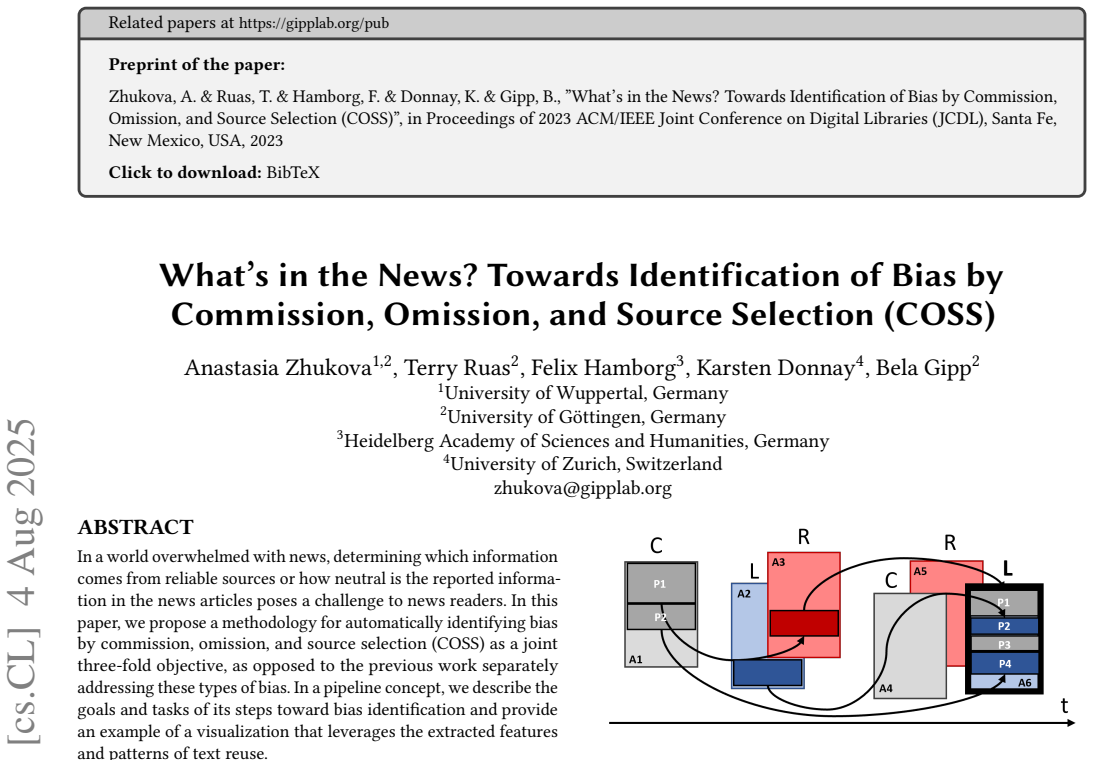
- [Section 2, Polarity classification] The proposed method assigns each article a polarity label induced from its outlet (e.g., Fox News as 'R') and then uses a paragraph-level polarity classifier to detect polarity changes in reused passages. This assumes that outlet-level slant reliably transfers to each paragraph, yet Figure 1 itself illustrates a counterexample: article A6 is left-oriented but contains a center-labeled original paragraph. Without a validated paragraph-level classifier or a discussion of label noise, the measured 'polarity changes' that drive the commission-bias analysis may reflect classifier error or outlet-label artifacts rather than actual bias in text reuse. The manuscript should acknowledge this risk and propose a validation strategy.
minor comments (6)
- [Keywords] The keyword 'new analysis' appears to be a typo; it should likely read 'news analysis'.
- [Section 1, Introduction and Related Work] The word 'adaption' should be 'adaptation' in the sentence 'However, the adaption and application...'.
- [Figure 1] The caption says the figure orders articles 'by date-time,' but the figure itself lacks visible timestamp labels and axis legends; please make the temporal ordering and the polarity labels (L, C, R) self-explanatory.
- [Section 2, Candidate retrieval] The listed data sources (LexisNexis, CommonCrawl, MediaCloud, GDELT) are heterogeneous in structure and coverage; the manuscript should clarify how event relevance is determined for each and whether the retrieval step assumes a particular corpus format.
- [Section 2, Statistical and network analysis] The sentence '...identifying which parts of the source articles were not picked up by which articles were excluded from discussions' is grammatically tangled; please rewrite to distinguish between paragraphs omitted by a specific article and paragraphs excluded from the entire discussion.
- [Section 2, Visualization] The reference to 'the strength of semantic similarities between paragraphs [9]' appears to point to NewsDeps, but the intended citation may instead be the POLUSA or another similarity-related work; please verify all citation numbers.
Circularity Check
No significant circularity: the COSS pipeline is an unvalidated concept architecture whose stages are not defined by the target bias quantities.
full rationale
The manuscript is a short concept paper describing a pipeline for identifying bias by commission, omission, and source selection. It contains no equations, no fitted parameters, and no quantitative predictions. The central claim is architectural: candidate retrieval, semantic paragraph alignment, a timestamped reuse graph, statistical and network pattern analysis, and visualization can jointly support COSS analysis. None of these stages is defined by the target quantity. 'Bias by omission' is operationalized as the set of source paragraphs that are not reused, which is indeed a definition of the targeted pattern; however, the paper explicitly frames these as 'patterns of text reuse that may induce bias' rather than as derived first-principles results. The self-citations (POLUSA, NewsDeps, word-choice bias) are used as component technologies or datasets and are not invoked to exclude alternatives or to prove the joint COSS claim. The paper's own text repeatedly qualifies the outputs as 'may indicate' or 'might indicate,' so no prediction is being asserted as forced by the inputs. Under the stated criteria, I find no circular step.
Assumptions & free parameters
assumptions (3)
- domain assumption Outlet-inferred polarity labels are meaningful proxies for article slant.
- domain assumption Paraphrase detection via semantic similarity can reliably identify conceptually reused paragraphs.
- domain assumption Neutral-source reuse implies reliability, and slanted paragraphs with no sources indicate untrustworthiness.
Cite this review
Pith. "Pith review of What's in the News? Towards Identification of Bias by Commission, Omission, and Source Selection (COSS)." pith.science (2026). https://pith.science/paper/KMHCJNM5
@misc{pith2026250802540,
  author       = {Pith},
  title        = {Pith review of: What's in the News? Towards Identification of Bias by Commission, Omission, and Source Selection (COSS)},
  year         = {2026},
  howpublished = {\url{https://pith.science/paper/KMHCJNM5}},
  note         = {Machine review of arXiv:2508.02540}
}
read the original abstract
In a world overwhelmed with news, determining which information comes from reliable sources or how neutral is the reported information in the news articles poses a challenge to news readers. In this paper, we propose a methodology for automatically identifying bias by commission, omission, and source selection (COSS) as a joint three-fold objective, as opposed to the previous work separately addressing these types of bias. In a pipeline concept, we describe the goals and tasks of its steps toward bias identification and provide an example of a visualization that leverages the extracted features and patterns of text reuse.
Figures
Reference graph
Works this paper leans on
-
[1]
Eytan Bakshy, Solomon Messing, and Lada A Adamic. 2015. Exposure to ide- ologically diverse news and opinion on Facebook. Science 348, 6239 (2015), 1130–1132
2015
-
[2]
Darrell Christian, Paula Froke, Sally Jacobsen, and David Minthorn. 2014. The Associated Press stylebook and briefing on media law . The Associated Press
work page 2014
-
[3]
Jonas Ehrhardt, Timo Spinde, Ali Vardasbi, and Felix Hamborg. 2021. Omis- sion of Information: Identifying Political Slant via an Analysis of Co-occurring Entities. In Information between Data and Knowledge . Schriften zur Information- swissenschaft, Vol. 74. Werner Hülsbusch, Glückstadt, 80–93. https://epub.uni- regensburg.de/44939/
work page 2021
-
[4]
Susanne Fengler and Stephan Ruß-Mohl. 2008. Journalists and the information- attention markets: Towards an economic theory of journalism. Journalism 9, 6 (2008), 667–690
work page 2008
-
[5]
Russell Frank. 2003. These crowded circumstances’ when pack journalists bash pack journalism. Journalism 4, 4 (2003), 441–458
work page 2003
-
[6]
Robert Gaizauskas, Jonathan Foster, Yorick Wilks, John Arundel, Paul Clough, and Scott Piao. 2001. The METER corpus: a corpus for analysing journalistic text reuse. In Proceedings of the corpus linguistics 2001 conference , Vol. 1. Citeseer
work page 2001
-
[7]
Lukas Gebhard and Felix Hamborg. 2020. The POLUSA dataset: 0.9 M politi- cal news articles balanced by time and outlet popularity. In Proceedings of the ACM/IEEE Joint Conference on Digital Libraries in 2020 . 467–468
work page 2020
-
[8]
Felix Hamborg, Karsten Donnay, and Bela Gipp. 2019. Automated identification of media bias in news articles: an interdisciplinary literature review.International Journal on Digital Libraries 20, 4 (2019), 391–415
work page 2019
Show all 12 references
-
[9]
Felix Hamborg, Philipp Meschenmoser, Moritz Schubotz, Philipp Scharpf, and Bela Gipp. 2021. NewsDeps: Visualizing the Origin of Information in News Articles. Wahrheit und Fake im postfaktisch-digitalen Zeitalter: Distinktionen in den Geistes-und IT-Wissenschaften (2021), 151–166
2021
-
[10]
Felix Hamborg, Anastasia Zhukova, and Bela Gipp. 2019. Automated Identifi- cation of Media Bias by Word Choice and Labeling in News Articles. In 2019 ACM/IEEE Joint Conference on Digital Libraries (JCDL) . 196–205
2019
-
[11]
Jonathan Matusitz and Gerald-Mark Breen. 2012. An examination of pack jour- nalism as a form of groupthink: A theoretical and qualitative analysis. Journal of Human Behavior in the Social Environment 22, 7 (2012), 896–915
2012
-
[12]
Zizi Papacharissi and Maria de Fatima Oliveira. 2008. News frames terrorism: A comparative analysis of frames employed in terrorism coverage in US and UK newspapers. The international journal of press/politics 13, 1 (2008), 52–74
2008
Reviewed August 15, 2026 · model on record in the stance chip above.
Discussion (0). Continue with ORCID to comment.