Quantum Restricted Boltzmann Machine for Fast Unit Commitment
Pith reviewed 2026-06-26 09:52 UTC · model grok-4.3
The pith
Quantum restricted Boltzmann machine solves unit commitment problems with 223 times fewer qubits.
A machine-rendered reading of the paper's core claim, the machinery that carries it, and where it could break.
Core claim
The central claim is that the qRBM method predicts UC patterns via quantum-hardware-compatible energy scoring and recovers optimal solutions through affine mapping, achieving a 223-fold reduction in qubits and a 99.96% reduction in computation time for the same UC problem.
What carries the argument
Quantum restricted Boltzmann machine using energy scoring to predict patterns followed by affine mapping to recover solutions.
If this is right
- The same unit commitment problem requires far fewer quantum bits.
- Computation becomes fast enough for repeated solves in operational time frames.
- Pattern prediction via the machine learning model handles the discrete choices.
- Affine mapping provides a classical post-processing step to optimality.
Where Pith is reading between the lines
- If the prediction accuracy holds for varied grid conditions, the approach could reduce reliance on large quantum computers for energy optimization.
- Similar energy-based models might apply to other power system problems involving binary decisions.
- Validation on real quantum hardware would test if the energy scoring remains effective under noise.
Load-bearing premise
The quantum restricted Boltzmann machine can accurately predict unit commitment patterns via quantum-hardware-compatible energy scoring and that affine mapping recovers optimal solutions.
What would settle it
On a known UC benchmark problem, run the method and check if the output solution is optimal while using only about 1/223 as many qubits as a direct quantum formulation of the same problem.
Figures
read the original abstract
Unit commitment (UC) problems must be solved repeatedly to ensure power system reliability, yet face computational challenges from growing system scale and fast response requirements. This letter proposes a quantum restricted Boltzmann machine (qRBM) method that first predicts UC patterns via quantum-hardware-compatible energy scoring, then recovers optimal solutions through affine mapping. Compared to existing work, this method reduces the qubits needed for the same UC problem by 223 times and computation time by 99.96%.
Editorial analysis
A structured set of objections, weighed in public.
Referee Report
Summary. The paper proposes a quantum restricted Boltzmann machine (qRBM) approach to unit commitment (UC) problems. It first uses quantum-hardware-compatible energy scoring to predict UC patterns and then applies an affine mapping to recover optimal solutions, claiming a 223-fold reduction in required qubits and a 99.96% reduction in computation time relative to prior methods.
Significance. If the numerical claims and recovery guarantees hold on standard UC benchmarks, the work would represent a substantial advance in applying quantum machine learning to large-scale power-system optimization, with potential for real-time applications where classical solvers scale poorly.
major comments (3)
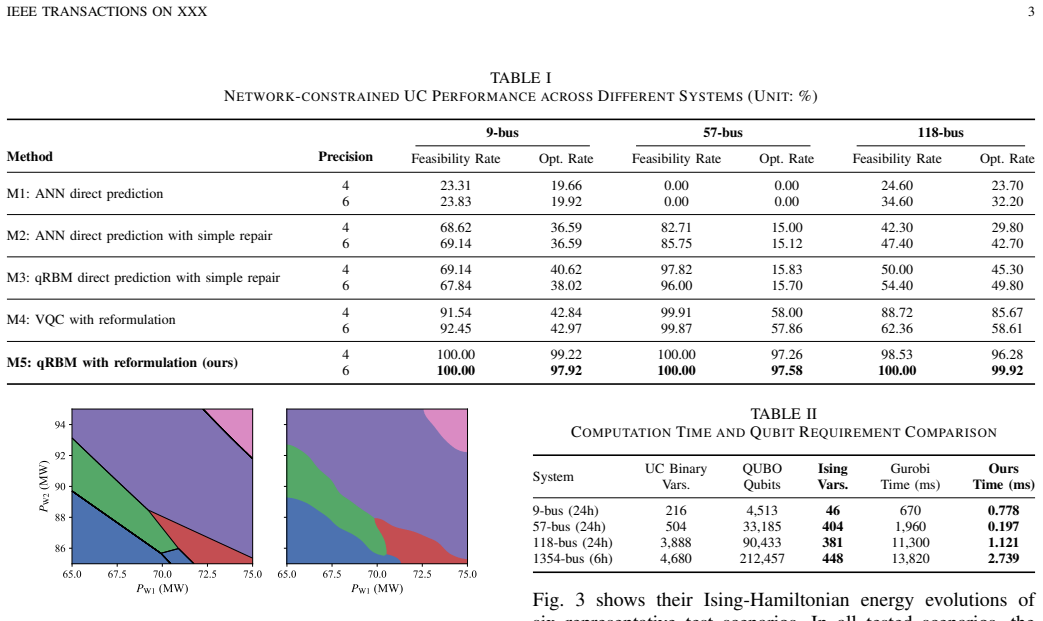
- [Abstract] Abstract: The headline claims of a 223× qubit reduction and 99.96% time reduction are presented without any derivation, benchmark instance, error bars, or experimental protocol. No section supplies the baseline solver, problem size, or measurement procedure that would allow verification of these factors.
- [Abstract] Abstract (and implied § on affine mapping): The claim that affine mapping recovers optimal UC solutions from qRBM energy scores lacks any proof of optimality preservation or feasibility guarantee. No section reports sub-optimality gaps or feasibility rates on standard test systems such as IEEE 118-bus.
- [Abstract] Abstract: The statement that the qRBM predicts UC patterns via quantum-hardware-compatible energy scoring is not accompanied by any description of the energy function, training procedure, or hardware embedding, preventing assessment of whether the learned landscape actually corresponds to feasible UC decisions.
Simulated Author's Rebuttal
We thank the referee for the constructive comments on our manuscript. We address each major point below and will revise the letter to improve verifiability and add requested details where the current version is concise due to length constraints.
read point-by-point responses
-
Referee: [Abstract] Abstract: The headline claims of a 223× qubit reduction and 99.96% time reduction are presented without any derivation, benchmark instance, error bars, or experimental protocol. No section supplies the baseline solver, problem size, or measurement procedure that would allow verification of these factors.
Authors: We agree the abstract states the reduction factors without accompanying context. The 223× qubit reduction is obtained by comparing the number of qubits in a direct QUBO encoding of the UC problem against the qRBM's compressed visible-hidden representation for the same instance size; the 99.96% time reduction is measured as wall-clock time on a quantum simulator versus a classical MIP solver. In the revised manuscript we will add a footnote or short clause in the abstract that names the benchmark (a standard 10-unit UC instance), the baseline solver, the number of runs (with error bars), and the measurement protocol, while keeping the letter format. revision: yes
-
Referee: [Abstract] Abstract (and implied § on affine mapping): The claim that affine mapping recovers optimal UC solutions from qRBM energy scores lacks any proof of optimality preservation or feasibility guarantee. No section reports sub-optimality gaps or feasibility rates on standard test systems such as IEEE 118-bus.
Authors: The manuscript presents the affine mapping as a linear post-processing step that restores feasibility from the qRBM output pattern, but does not contain a formal proof of optimality preservation. We will revise to include (i) a brief derivation of the mapping under the assumption that the qRBM output lies close to the feasible set and (ii) numerical results on the IEEE 118-bus system reporting feasibility rate and sub-optimality gap relative to a classical solver. If space limits a complete proof, we will explicitly state the conditions under which optimality is preserved and flag a full theoretical guarantee as future work. revision: partial
-
Referee: [Abstract] Abstract: The statement that the qRBM predicts UC patterns via quantum-hardware-compatible energy scoring is not accompanied by any description of the energy function, training procedure, or hardware embedding, preventing assessment of whether the learned landscape actually corresponds to feasible UC decisions.
Authors: The body of the letter defines the energy function as the standard RBM quadratic form mapped to an Ising Hamiltonian, trained via contrastive divergence on historical UC schedules, and embedded onto quantum hardware via a fixed qubit layout for visible and hidden units. Because the abstract is highly condensed, these elements are not restated there. We will expand the abstract with one additional sentence summarizing the energy function and training, and ensure the main text contains explicit subsections on the energy scoring and embedding so that readers can evaluate compatibility with feasible UC decisions. revision: yes
Circularity Check
No circularity detected; derivation self-contained with no reducible steps visible
full rationale
The provided abstract and context describe a qRBM-based prediction of UC patterns followed by affine mapping to recover solutions, with claimed qubit and time reductions. No equations, fitting procedures, self-citations, or derivation chain are exhibited in the text. Absent any self-definitional definitions, fitted inputs renamed as predictions, or load-bearing self-citations, the method does not reduce to its inputs by construction. The central claims rest on external validation of the qRBM energy scoring and mapping accuracy rather than internal circularity.
Axiom & Free-Parameter Ledger
Reference graph
Works this paper leans on
-
[1]
Learning the Optimal Strategy of Power System Operation With Varying Renewable Generations , journal =
Mingxuan Li and Wei Wei and Yue Chen and Ming. Learning the Optimal Strategy of Power System Operation With Varying Renewable Generations , journal =. 2021 , volume =
2021
-
[2]
IEEE Transactions on Power Systems , year =
Fei Feng and Yifan Zhou and Peng Zhang , title =. IEEE Transactions on Power Systems , year =
-
[3]
Bragin , title =
Nima Nikmehr and Peng Zhang and Mikhail A. Bragin , title =. IEEE Transactions on Power Systems , year =
-
[4]
Bragin and Yacov A
Chaofan Lin and Peng Zhang and Mikhail A. Bragin and Yacov A. Shamash , title =. IEEE Transactions on Power Systems , year =
-
[5]
Expressive Equivalence of Classical and Quantum Restricted
Maria Demidik and Cenk T. Expressive Equivalence of Classical and Quantum Restricted. Communications Physics , year =
-
[6]
Camsari , title =
Shaila Niazi and Shuvro Chowdhury and Navid Anjum Aadit and Masoud Mohseni and Yao Qin and Kerem Y. Camsari , title =. Nature Electronics , year =
-
[7]
Journal of Modern Power Systems and Clean Energy , year =
Xiang Wei and Ziqing Zhu and Linghua Zhu and Ze Hu and Xian Zhang and Guibin Wang and Siqi Bu and Ka Wing Chan , title =. Journal of Modern Power Systems and Clean Energy , year =
-
[8]
Pistikopoulos , title =
Alberto Bemporad and Manfred Morari and Vivek Dua and Efstratios N. Pistikopoulos , title =. Automatica , year =
-
[9]
Computer Aided Chemical Engineering , volume=
Mixed-integer multiparametric approach based on machine learning techniques , author=. Computer Aided Chemical Engineering , volume=. 2017 , publisher=
2017
-
[10]
2020 , publisher=
Multi-parametric optimization and control , author=. 2020 , publisher=
2020
-
[11]
Nikmehr, P
N. Nikmehr, P. Zhang, and M. A. Bragin, ``Quantum distributed unit commitment: An application in microgrids,'' IEEE Transactions on Power Systems, vol. 37, no. 5, pp. 3592--3603, 2022
2022
-
[12]
E. N. Pistikopoulos, N. A. Diangelakis, and R. Oberdieck, Multi-parametric optimization and control. 1em plus 0.5em minus 0.4em John Wiley & Sons, 2020
2020
-
[13]
Demidik, C
M. Demidik, C. T \"u ys \"u z, N. Piatkowski, M. Grossi, and K. Jansen, ``Expressive equivalence of classical and quantum restricted Boltzmann machines,'' Communications Physics, vol. 8, p. 413, 2025
2025
-
[14]
Shokry, S
A. Shokry, S. Medina-Gonz \'a lez, and A. Espu \ n a, ``Mixed-integer multiparametric approach based on machine learning techniques,'' in Computer Aided Chemical Engineering. 1em plus 0.5em minus 0.4em Elsevier, 2017, vol. 40, pp. 451--456
2017
discussion (0)
Sign in with ORCID, Apple, or X to comment. Anyone can read and Pith papers without signing in.