REVIEW 4 major objections 6 minor 1 cited by
The impact of LHC precision measurements of inclusive jet and dijet production on the CTEQ-TEA global PDF fit
T0 review · 4 major / 6 minor · reviewed 2026-08-12 · deepseek-v4-flash
Pith's one-line read The inclusion of the latest LHC inclusive jet measurements in the CT18 global PDF analysis reduces gluon uncertainties and pushes the large-x gluon harder, and the paper argues inclusive jet data should be preferred over dijet data…
desk verdict A careful, useful impact study of new LHC jet data on CT18, with the right caveat: the headline gluon shift rests on ePump profiling rather than a full refit, so treat CT18+nIncJet as provisional even though the direction is consistent with MSHT and NNPDF. read the letter →
The pith
A machine-rendered reading of the paper's core claim, the machinery that carries it, and where it could break.
The reading
What carries the argument
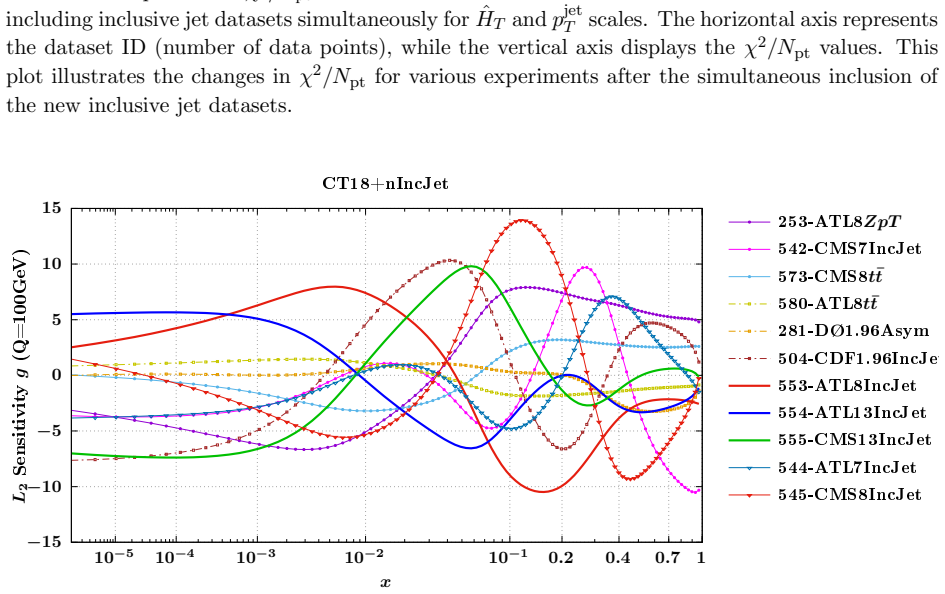
The study is carried by a three-part apparatus. Precomputed NNLO interpolation grids supply the jet cross-section predictions, with renormalization/factorization scales $p_T^{\mathrm{jet}}$ or $\hat H_T$ for inclusive jets and $m_{12}$ or $p_{T,1}e^{0.3y^*}$ for dijets; the ePump Hessian profiling procedure then approximates how each new dataset shifts the best-fit PDFs and their Hessian error bands without a full refit; and the L2 sensitivity quantifies, at each $x$, how strongly each experimental dataset pulls the gluon PDF. The scale-dependence comparison is the argument's decisive test: it is what separates 'safe' inclusive jet data from 'risky' dijet data, particularly the 8 TeV dijet measurement.
What would settle it
Run a full CT18 global fit that includes the same three inclusive jet datasets, using the same smoothing and Monte Carlo integration-error treatment, and compare the large-$x$ gluon PDF with CT18+nIncJet. If the full fit's central gluon at $x\approx 0.3$ falls outside the reduced uncertainty band claimed here, the ePump approximation is not reproducing the global fit and the paper's quantitative claims would not survive.
Extended reading notes
Core claim
The paper's central claim is that the latest inclusive jet data from the LHC, once included in the CT18 analysis through a fast Hessian profiling update, reduce the gluon PDF uncertainty and move the central gluon distribution upward for $x\gtrsim 0.1$, producing a new set called CT18+nIncJet. A second, distinct claim is that inclusive jet data should be preferred over dijet data for constraining the gluon at this stage: the inclusive jet predictions are insensitive to the choice and variation of the central renormalization and factorization scales, whereas dijet predictions, most notably the 8 TeV dijet data, show a strong scale dependence that can change the central gluon by several percent. The paper also shows that inclusive jet datasets pull the gluon PDF more strongly than the dijet datasets from the same collisions, and that the new set raises the gluon-gluon luminosity at large invariant masses, increasing high-mass Higgs-like scalar, top-pair, and $t\bar{t}H$ cross sections at 14 TeV while slightly lowering the inclusive 125 GeV Higgs cross section.
Load-bearing premise
Everything rests on the fast Hessian-profiling update reproducing what a full CT18 global refit with the same datasets would produce, since all of the paper's new PDFs, uncertainties, and sensitivity plots come from that approximate update and no direct full-refit comparison is shown.
Editorial extensions
If this is right
- The gluon PDF uncertainty shrinks, with the largest reduction at large $x$, and the central gluon becomes harder.
- The gluon-gluon luminosity $L_{gg}$ is enhanced at large invariant masses with narrower error bands.
- Higgs-like scalar production at masses above roughly 1 TeV increases, while the inclusive 125 GeV Higgs cross section decreases slightly.
- Top-pair and $t\bar tH$ cross sections at 14 TeV increase mildly, reflecting their positive correlation with the large-$x$ gluon.
- Inclusive jet data are preferred over dijet data for future PDF fits, and dijet data, particularly the 8 TeV dijet set, require further theoretical work on scale dependence before inclusion.
Reading between the lines
- If a future full refit confirms the harder high-$x$ gluon, the same shift should appear in gluon-dominated observables not refit here, such as high-$p_T$ photon-plus-jet production; a consistent shift there would be an independent check.
- The paper's preference for inclusive jets is based on scale dependence, not fit quality, since several dijet datasets fit better. A reader should therefore expect future PDF releases to omit dijets until their scale ambiguity is resolved; a triple-differential dijet measurement with scale behavior similar to inclusive jets would be the natural test.
- Because the numerical size of the uncertainty reduction rests on the ePump approximation, the quoted error bands of CT18+nIncJet should be treated as provisional until a full refit validates them.
Editorial analysis
A structured set of objections, weighed in public.
Referee Report
Summary. The paper assesses the impact of recent LHC inclusive jet and dijet measurements on the CTEQ-TEA (CT18) global PDF analysis. The authors introduce an intermediate baseline, CT18mLHCJet, apply the ePump Hessian-profiling package to add new ATLAS and CMS jet datasets, and systematically examine decorrelation options for ATLAS systematic uncertainties, five treatments of NNLO theory uncertainties and K-factor smoothing, and two central scale choices with factor-of-two variations. They conclude that inclusive jet data have weaker scale dependence than dijet data, impose stronger constraints on the gluon PDF, and prefer a harder large-x gluon; this leads to the proposed CT18+nIncJet PDF set with reduced gluon uncertainties. The phenomenological section computes gluon-gluon luminosities and 14 TeV cross-sections for Higgs, top-quark pair, and ttH production using the updated PDFs.
Significance. If the ePump-based updating is a faithful proxy for a full global refit, the paper is a useful and timely impact study: it is transparent about the many methodological choices, compares with MSHT and NNPDF where data overlap, and provides detailed robustness checks across theory treatments, scales, and decorrelation options. The main findings—that new inclusive jet data pull the large-x gluon harder and reduce its uncertainty—are qualitatively consistent with other groups and are likely to inform the upcoming CTEQ-TEA global fit. However, since the central CT18+nIncJet set is produced by approximate Hessian profiling rather than a full CT18 refit, the quantitative claims of a gluon shift and uncertainty reduction remain provisional until validated against a complete refit.
major comments (4)
- [Sec. III, first paragraph] The central result, CT18+nIncJet, is obtained with the ePump Hessian-profiling package and not with a full CT18 global refit. In Sec. III A the authors write 'we performed PDF fit using ePump', and in Sec. V they describe ePump as a step taken 'before conducting time-intensive global fittings'. ePump reuses the baseline Hessian error sets and applies a profiling chi-square; it is an approximation that can differ from a new global minimization in which PDF parameters, tolerance, and correlations with all other datasets are refit. Because the headline claims are a shift of roughly 1-3% in the large-x gluon and a reduction in its error band, an unvalidated profiling bias of comparable size would change the conclusions. The authors should either provide a direct comparison of CT18+nIncJet with a full CT18 fit containing the same three inclusive jet datasets, or explicitly reframe the paper as an ePump-based impact study whose quantitative PDF set is provisional.
- [Sec. III B, Figs. 6-8] The construction of the baseline CT18mLHCJet set is not fully specified. The text says it 'uses the same framework as the CT18 analysis' but excludes the inclusive jet datasets already in CT18, without stating whether this baseline was produced by a full global refit or by an ePump-based removal of datasets. This distinction matters because every subsequent ePump update is performed relative to CT18mLHCJet; if the baseline is itself an ePump approximation, then the final PDFs inherit that approximation in a way that is not assessed. Please state explicitly how CT18mLHCJet was created and, if it was a full fit, give the relevant fit quality and parameter shifts.
- [Sec. II and Sec. III A] The preference for inclusive jet over dijet datasets is based on a qualitative comparison of PDF ratio plots and chi-square tables. For example, the text notes that for CMS8DiJet the central gluon PDF varies by roughly 4% at x ~ 0.3 under scale variations, while inclusive jet datasets vary by about 1-1.5%, but no quantitative criterion is given for declaring one set 'weakly scale dependent'. Since this preference is a central conclusion and also determines which datasets enter the final fit, the authors should define a quantitative measure of scale dependence (for instance, the maximum shift in g(x, Q = 100 GeV) over the fitted x-range under factor-of-two scale variations) and apply it uniformly to inclusive jet and dijet datasets.
- [Sec. IV B] Several methodological choices are made after inspecting the data and are selected on the basis of the resulting chi-square: the ATLAS decorrelation options (SuggestedR6 and Option18), the theory treatment (Method 5), and the central scale (pT^jet for the final fit). This multiple-comparison selection, performed on the very data used to define CT18+nIncJet, is not reflected in the reported PDF uncertainties. The authors show that the PDF central values and error bands are largely insensitive to these choices, which mitigates the concern, but the conclusion that the new data reduce the gluon uncertainty would be strengthened by a discussion of how much of the improvement is a selection effect rather than a stable constraint from the data.
minor comments (6)
- [Table I vs Table VII] The integrated luminosity for the CMS 13 TeV inclusive jet dataset is listed as 33.5 fb^-1 in Table I but 36.5 fb^-1 in Table VII; these should be reconciled.
- [Fig. 8 caption] The caption of Fig. 8 reads 'Same as Fig. 8, but for CMS8DiJet...'; it should refer to Fig. 7 (or to Fig. 6, depending on intent).
- [Fig. 12 and Sec. IV A] The experiment labels such as 'ATLAS8ZpT' and 'CMS8ttb' are introduced without definition; a short expansion or a pointer to the table of dataset IDs would improve readability.
- [Sec. IV B] The scale choice for ttH production is given as 'MT/2' without defining MT; please define it as the scalar sum of transverse masses of the final-state particles.
- [Appendix A 1] In the sentence 'In contrast, the ATLAS data at 13 TeV and 8 TeV show less significant deviations compared to the baseline', it would be clearer to list all datasets in the same order as the preceding ranking and to specify the x value at which the comparison is made.
- [Sec. IV B] The cross-sections in Fig. 15 and Fig. 16 are applications of the fitted PDFs rather than independent predictions; the text should state this explicitly so that readers do not interpret them as a posteriori validation of CT18+nIncJet.
Circularity Check
No significant circularity: the CT18+nIncJet results are data-driven fit outputs, transparently based on ePump profiling, with independent cross-checks against MSHT and NNPDF.
full rationale
The paper's central derivation is not circular. The CT18 baseline PDFs, the new LHC inclusive jet and dijet measurements, and the NNLO APPLfast theory grids are all external inputs; the updated CT18+nIncJet PDFs are obtained by ePump Hessian profiling of those new data, and the paper explicitly labels this as a fast profiling step 'before conducting time-intensive global fittings' (Sec. V). The reported harder large-x gluon and reduced uncertainty bands are fit results, not predictions that are equivalent to the inputs by construction. The paper also provides independent cross-checks by comparing chi-square values and PDF impacts with the MSHT and NNPDF analyses (Table VII, Sec. IV), which supports the robustness of the conclusions. The phenomenological implications for Higgs, ttbar, and ttH production are explicitly framed as 'implications' of the fitted PDFs rather than as independent tests of them, so they do not constitute a circular validation. The reliance on the self-cited ePump method, Refs. [48,49], is load-bearing in a practical sense, but ePump is a published and externally used updating procedure with stated assumptions; the lack of a full CT18 refit with the same data is an approximation and validation limitation, not a circularity. No equation in the paper reduces a target result to a fitted parameter or to a self-citation chain.
Assumptions & free parameters
free parameters (3)
- Decorrelation option for ATLAS jet systematics =
SuggestedR6 (ATLAS 8 TeV), Option18 (ATLAS 13 TeV)
- Theory treatment =
Method 5: smoothed K-factor + grid MC uncertainty as uncorrelated
- Central scale choice =
H_T, pT^jet, m12, pT,1 e^(0.3y*)
assumptions (5)
- domain assumption NNLO QCD factorization and the APPLfast interpolation grids accurately describe inclusive jet and dijet cross sections.
- domain assumption ePump Hessian profiling is an accurate approximation to a complete global PDF refit.
- domain assumption The CT18 baseline PDFs and their Hessian error sets are reliable.
- ad hoc to paper Smoothing the NNLO K-factor and adding grid MC errors as uncorrelated uncertainties does not bias the fitted PDFs.
- domain assumption Inclusive jet and dijet datasets drawn from the same LHC events have negligible known statistical correlation.
Cite this review
Pith. "Pith review of The impact of LHC precision measurements of inclusive jet and dijet production on the CTEQ-TEA global PDF fit." pith.science (2026). https://pith.science/paper/KMPS44PU
@misc{pith2026241200350,
  author       = {Pith},
  title        = {Pith review of: The impact of LHC precision measurements of inclusive jet and dijet production on the CTEQ-TEA global PDF fit},
  year         = {2026},
  howpublished = {\url{https://pith.science/paper/KMPS44PU}},
  note         = {Machine review of arXiv:2412.00350}
}
abstract
In this study, we investigate the impact of new LHC inclusive jet and dijet measurements on parton distribution functions (PDFs) that describe the proton structure, with a particular focus on the gluon distribution at large momentum fraction, $x$, and the corresponding partonic luminosities. We assess constraints from these datasets using next-to-next-to-leading-order (NNLO) theoretical predictions, accounting for a range of uncertainties from scale dependence and numerical integration. From the scale choices available for the calculations, our analysis shows that the central predictions for inclusive jet production show a smaller scale dependence than dijet production. We examine the relative constraints on the gluon distribution provided by the inclusive jet and dijet distributions and also explore the phenomenological implications for inclusive $H$, $t\bar{t}$, and $t\bar{t}H$ production at the LHC at 14 TeV.
Figures


Figures from the paper (17 more)




Forward citations
Cited by 1 Pith paper
-
Parton distributions confront LHC Run II data: a quantitative appraisal
A systematic NNLO data-theory comparison shows that the main PDF sets generalise to unseen LHC and HERA data about equally well once PDF, alpha_s, and missing higher order uncertainties are included.
Reference graph
Works this paper leans on
-
[1]
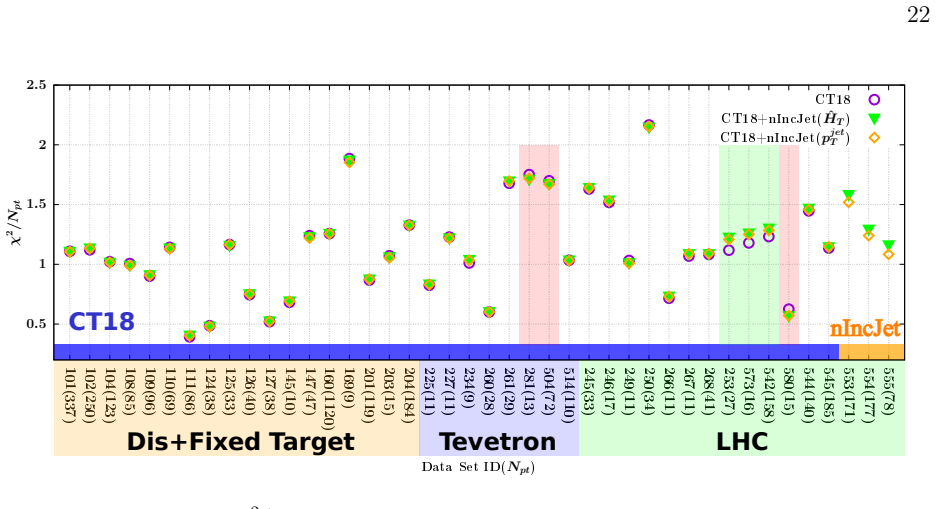
The χ2/Npt fitted individually and simultaneously for inclusive jet datasets are already presented in Tab
Impact from individual jet data sets Here, we present comparisons between the CT18mLHCJet gluon PDF and the newly obtained gluon PDFs, each derived by incorporating one of the inclusive jet datasets (ATL7Incjet, CMS7Incjet, ATL8Incjet, CMS8Incjet, ATL13Incjet, and CMS13Incjet) and dijet datasets (ATL7DiJet, CMS7DiJet, and CMS8DiJet) individually. The χ2/N...
-
[2]
14, here we present the N3LO predictions for the Drell-Yan production cross section dσ/dM 2 ll in Fig
Implication on the Drell-Y an production Similar to the Higgs scenario in Fig. 14, here we present the N3LO predictions for the Drell-Yan production cross section dσ/dM 2 ll in Fig. 19. As before, the theoretical calculations are performed with n3loxs [74], with the lepton-pair invariant mass Mll varying from 5 GeV to 5 TeV. In comparison with Fig. 14, th...
-
[3]
L2 Sensitivity with T 2 = 10 L2 Sensitivity is a way of viewing the pulls of the experiments used in a global PDF fit, for a particular parton flavor as a functionx. For completeness, we provide the L2 sensitivity 30 Error Bands x CT18mLHCJet +ATL7IncJet +CMS7IncJet +CMS8IncJet CT18 CT18+nIncJet 0.80 0.85 0.90 0.95 1.00 1.05 1.10 1.15 1.20 10−5 10−3 10−2 ...
-
[4]
Measurement of the Drell-Yan triple-differential cross section in pp collisions at √s = 8 TeV,
A TLASCollaboration, M. Aaboud et al., “Measurement of the Drell-Yan triple-differential cross section in pp collisions at √s = 8 TeV,” JHEP 12 (2017) 059, arXiv:1710.05167 [hep-ex]
arXiv 2017
-
[5]
New CTEQ global analysis of quantum chromodynamics with high-precision data from the LHC,
T.-J. Hou et al., “New CTEQ global analysis of quantum chromodynamics with high-precision data from the LHC,” Phys. Rev. D103 no. 1, (2021) 014013, arXiv:1912.10053 [hep-ph]
arXiv 2021
-
[6]
Measurements of W and Z boson production in pp collisions at √s = 5.02 TeV with the ATLAS detector,
A TLASCollaboration, M. Aaboud et al., “Measurements of W and Z boson production in pp collisions at √s = 5.02 TeV with the ATLAS detector,” Eur. Phys. J. C79 no. 2, (2019) 128, arXiv:1810.08424 [hep-ex]. [Erratum: Eur.Phys.J.C 79, 374 (2019)]
arXiv 2019
-
[7]
A TLASCollaboration, G. Aad et al., “Measurement of the cross-section and charge asymmetry of W bosons produced in proton–proton collisions at √s = 8 TeV with the ATLAS detector,” Eur. Phys. J. C79 no. 9, (2019) 760, arXiv:1904.05631 [hep-ex]
arXiv 2019
-
[8]
A TLASCollaboration, G. Aad et al., “Measurements of top-quark pair differential and double-differential cross-sections in the ℓ+jets channel with pp collisions at √s = 13 TeV using the ATLAS detector,” Eur. Phys. J. C79 no. 12, (2019) 1028, arXiv:1908.07305 [hep-ex]. [Erratum: Eur.Phys.J.C 80, 1092 (2020)]
arXiv 2019
Show all 86 references
-
[9]
Measurements of differential Z boson production cross sections in proton-proton collisions at √s = 13 TeV,
CMS Collaboration, A. M. Sirunyan et al., “Measurements of differential Z boson production cross sections in proton-proton collisions at √s = 13 TeV,” JHEP 12 (2019) 061, arXiv:1909.04133 [hep-ex]
2019 arXiv
-
[10]
Measurement of forward W → eν production in pp collisions at √s = 8 TeV,
LHCb Collaboration, R. Aaij et al., “Measurement of forward W → eν production in pp collisions at √s = 8 TeV,” JHEP 10 (2016) 030, arXiv:1608.01484 [hep-ex]
2016 arXiv
-
[11]
Precision measurement of forward Z boson production in proton-proton collisions at √s = 13 TeV,
LHCb Collaboration, R. Aaij et al., “Precision measurement of forward Z boson production in proton-proton collisions at √s = 13 TeV,” arXiv:2112.07458 [hep-ex]. 33
-
[12]
Measurement of differential t¯t production cross sections in the full kinematic range using lepton+jets events from proton-proton collisions at√s = 13 TeV,
CMS Collaboration, A. Tumasyan et al., “Measurement of differential t¯t production cross sections in the full kinematic range using lepton+jets events from proton-proton collisions at√s = 13 TeV,” Phys. Rev. D104 no. 9, (2021) 092013, arXiv:2108.02803 [hep-ex]
2021 arXiv
-
[13]
Inclusive and differential cross-sections for dilepton t¯t production measured in √s = 13 TeV pp collisions with the ATLAS detector,
A TLASCollaboration, G. Aad et al., “Inclusive and differential cross-sections for dilepton t¯t production measured in √s = 13 TeV pp collisions with the ATLAS detector,” arXiv:2303.15340 [hep-ex]
-
[14]
Measurements of top-quark pair single- and double-differential cross-sections in the all-hadronic channel in pp collisions at √s = 13 TeV using the ATLAS detector,
A TLASCollaboration, G. Aad et al., “Measurements of top-quark pair single- and double-differential cross-sections in the all-hadronic channel in pp collisions at √s = 13 TeV using the ATLAS detector,” JHEP 01 (2021) 033, arXiv:2006.09274 [hep-ex]
2021 arXiv
-
[15]
Measurements of t t differential cross sections in proton-proton collisions at √s = 13 TeV using events containing two leptons,
CMS Collaboration, A. M. Sirunyan et al., “Measurements of t t differential cross sections in proton-proton collisions at √s = 13 TeV using events containing two leptons,” JHEP 02 (2019) 149, arXiv:1811.06625 [hep-ex]
2019 arXiv
-
[16]
Measurement of the inclusive jet cross-section in p¯p collisions at √s = 1.96 TeV,
D0 Collaboration, V. M. Abazov et al., “Measurement of the inclusive jet cross-section in p¯p collisions at √s = 1.96 TeV,” Phys. Rev. Lett.101 (2008) 062001, arXiv:0802.2400 [hep-ex]
2008 arXiv
-
[17]
Precision studies of the post-CT18 LHC Drell-Yan data in the CTEQ-TEA global analysis,
CTEQ-TEA Collaboration, I. Sitiwaldi, K. Xie, A. Ablat, S. Dulat, T.-J. Hou, and C. . P. Yuan, “Precision studies of the post-CT18 LHC Drell-Yan data in the CTEQ-TEA global analysis,” Phys. Rev. D108 no. 3, (2023) 034030, arXiv:2305.10733 [hep-ph]
2023 arXiv
-
[18]
Exploring the impact of high-precision top-quark pair production data on the structure of the proton at the LHC,
A. Ablat, M. Guzzi, K. Xie, S. Dulat, T.-J. Hou, I. Sitiwaldi, and C. P. Yuan, “Exploring the impact of high-precision top-quark pair production data on the structure of the proton at the LHC,” Phys. Rev. D109 no. 5, (2024) 054027, arXiv:2307.11153 [hep-ph]
2024 arXiv
-
[19]
Measurement of the Inclusive Jet Cross Section at the Fermilab Tevatron p anti-p Collider Using a Cone-Based Jet Algorithm,
CDF Collaboration, T. Aaltonen et al., “Measurement of the Inclusive Jet Cross Section at the Fermilab Tevatron p anti-p Collider Using a Cone-Based Jet Algorithm,” Phys. Rev. D 78 (2008) 052006, arXiv:0807.2204 [hep-ex]. [Erratum: Phys.Rev.D 79, 119902 (2009)]
2008 arXiv
-
[20]
Measurement of the inclusive jet cross section in pp collisions at √s = 2.76 TeV,
CMS Collaboration, V. Khachatryan et al., “Measurement of the inclusive jet cross section in pp collisions at √s = 2.76 TeV,” Eur. Phys. J. C76 no. 5, (2016) 265, arXiv:1512.06212 [hep-ex]
2016 arXiv
-
[21]
Measurement of dijet angular distributions at√s = 1.96 TeV and searches for quark compositeness and extra spatial dimensions,
D0 Collaboration, V. M. Abazov et al., “Measurement of dijet angular distributions at√s = 1.96 TeV and searches for quark compositeness and extra spatial dimensions,” Phys. Rev. Lett.103 (2009) 191803, arXiv:0906.4819 [hep-ex]
2009 arXiv
-
[22]
Measurement of the Dijet Invariant Mass Cross Section in p¯p Collisions at √s = 1.96 TeV,
D0 Collaboration, V. M. Abazov et al., “Measurement of the Dijet Invariant Mass Cross Section in p¯p Collisions at √s = 1.96 TeV,” Phys. Lett. B693 (2010) 531–538, arXiv:1002.4594 [hep-ex]
2010 arXiv
-
[23]
Measurement of the inclusive jet cross section in pp collisions at √s = 2.76 TeV and comparison to the inclusive jet cross section at √s = 7 TeV using the ATLAS detector,
A TLASCollaboration, G. Aad et al., “Measurement of the inclusive jet cross section in pp collisions at √s = 2.76 TeV and comparison to the inclusive jet cross section at √s = 7 TeV using the ATLAS detector,” Eur. Phys. J. C73 no. 8, (2013) 2509, arXiv:1304.4739 [hep-ex]
2013 arXiv
-
[24]
Measurement and QCD analysis of double-differential inclusive jet cross sections in pp collisions at √s = 8 TeV and cross section ratios to 2.76 and 7 TeV,
CMS Collaboration, V. Khachatryan et al., “Measurement and QCD analysis of double-differential inclusive jet cross sections in pp collisions at √s = 8 TeV and cross section ratios to 2.76 and 7 TeV,” JHEP 03 (2017) 156, arXiv:1609.05331 [hep-ex]
2017 arXiv
-
[25]
Measurement of the inclusive jet cross-section in proton-proton collisions at √s = 7 TeV using 4.5 fb −1 of data with the ATLAS detector,
A TLASCollaboration, G. Aad et al., “Measurement of the inclusive jet cross-section in proton-proton collisions at √s = 7 TeV using 4.5 fb −1 of data with the ATLAS detector,” JHEP 02 (2015) 153, arXiv:1410.8857 [hep-ex]. [Erratum: JHEP 09, 141 (2015)]
2015 arXiv
-
[26]
Measurement of the Ratio of Inclusive Jet Cross Sections using the Anti- kT Algorithm with Radius Parameters R=0.5 and 0.7 in pp 34 Collisions at √s = 7 TeV,
CMS Collaboration, S. Chatrchyan et al., “Measurement of the Ratio of Inclusive Jet Cross Sections using the Anti- kT Algorithm with Radius Parameters R=0.5 and 0.7 in pp 34 Collisions at √s = 7 TeV,” Phys. Rev. D90 no. 7, (2014) 072006, arXiv:1406.0324 [hep-ex]
2014 arXiv
-
[27]
Measurement of the inclusive jet cross-sections in proton-proton collisions at √s = 8 TeV with the ATLAS detector,
A TLASCollaboration, M. Aaboud et al., “Measurement of the inclusive jet cross-sections in proton-proton collisions at √s = 8 TeV with the ATLAS detector,” JHEP 09 (2017) 020, arXiv:1706.03192 [hep-ex]
2017 arXiv
-
[28]
Measurement of dijet cross sections in pp collisions at 7 TeV centre-of-mass energy using the ATLAS detector,
A TLASCollaboration, G. Aad et al., “Measurement of dijet cross sections in pp collisions at 7 TeV centre-of-mass energy using the ATLAS detector,” JHEP 05 (2014) 059, arXiv:1312.3524 [hep-ex]
2014 arXiv
-
[29]
Measurement of inclusive jet and dijet cross-sections in proton-proton collisions at √s = 13 TeV with the ATLAS detector,
A TLASCollaboration, M. Aaboud et al., “Measurement of inclusive jet and dijet cross-sections in proton-proton collisions at √s = 13 TeV with the ATLAS detector,” JHEP 05 (2018) 195, arXiv:1711.02692 [hep-ex]
2018 arXiv
-
[30]
Measurement of the double-differential inclusive jet cross section in proton–proton collisions at √s = 13 TeV,
CMS Collaboration, V. Khachatryan et al., “Measurement of the double-differential inclusive jet cross section in proton–proton collisions at √s = 13 TeV,” Eur. Phys. J. C76 no. 8, (2016) 451, arXiv:1605.04436 [hep-ex]
2016 arXiv
-
[31]
Measurement and QCD analysis of double-differential inclusive jet cross sections in proton-proton collisions at √s = 13 TeV,
CMS Collaboration, A. Tumasyan et al., “Measurement and QCD analysis of double-differential inclusive jet cross sections in proton-proton collisions at √s = 13 TeV,” JHEP 02 (2022) 142, arXiv:2111.10431 [hep-ex]. [Addendum: JHEP 12, 035 (2022)]
2022 arXiv
-
[32]
Quantifying the interplay of experimental constraints in analyses of parton distributions,
X. Jing et al., “Quantifying the interplay of experimental constraints in analyses of parton distributions,” Phys. Rev. D108 no. 3, (2023) 034029, arXiv:2306.03918 [hep-ph]
2023 arXiv
-
[33]
Measurements of Differential Jet Cross Sections in Proton-Proton Collisions at √s = 7 TeV with the CMS Detector,
CMS Collaboration, S. Chatrchyan et al., “Measurements of Differential Jet Cross Sections in Proton-Proton Collisions at √s = 7 TeV with the CMS Detector,” Phys. Rev. D87 no. 11, (2013) 112002, arXiv:1212.6660 [hep-ex]. [Erratum: Phys.Rev.D 87, 119902 (2013)]
2013 arXiv
-
[34]
Measurement of the triple-differential dijet cross section in proton-proton collisions at √s = 8 TeV and constraints on parton distribution functions,
CMS Collaboration, A. M. Sirunyan et al., “Measurement of the triple-differential dijet cross section in proton-proton collisions at √s = 8 TeV and constraints on parton distribution functions,” Eur. Phys. J. C77 no. 11, (2017) 746, arXiv:1705.02628 [hep-ex]
2017 arXiv
-
[35]
Measurement of multidifferential cross sections for dijet production in proton-proton collisions at √s = 13 TeV,
CMS Collaboration, A. Hayrapetyan et al., “Measurement of multidifferential cross sections for dijet production in proton-proton collisions at √s = 13 TeV,” arXiv:2312.16669 [hep-ex]
-
[36]
Infrared sensitivity of single jet inclusive production at hadron colliders,
J. Currie, A. Gehrmann-De Ridder, T. Gehrmann, E. W. N. Glover, A. Huss, and J. a. Pires, “Infrared sensitivity of single jet inclusive production at hadron colliders,” JHEP 10 (2018) 155, arXiv:1807.03692 [hep-ph]
2018 arXiv
-
[37]
Precise predictions for dijet production at the LHC,
J. Currie, A. Gehrmann-De Ridder, T. Gehrmann, E. W. N. Glover, A. Huss, and J. Pires, “Precise predictions for dijet production at the LHC,” Phys. Rev. Lett.119 no. 15, (2017) 152001, arXiv:1705.10271 [hep-ph]
2017 arXiv
-
[38]
Next-to-Next-to Leading Order QCD Predictions for Single Jet Inclusive Production at the LHC,
J. Currie, E. W. N. Glover, and J. Pires, “Next-to-Next-to Leading Order QCD Predictions for Single Jet Inclusive Production at the LHC,” Phys. Rev. Lett.118 no. 7, (2017) 072002, arXiv:1611.01460 [hep-ph]
2017 arXiv
-
[39]
Triple Differential Dijet Cross Section at the LHC,
A. Gehrmann-De Ridder, T. Gehrmann, E. W. N. Glover, A. Huss, and J. Pires, “Triple Differential Dijet Cross Section at the LHC,” Phys. Rev. Lett.123 no. 10, (2019) 102001, arXiv:1905.09047 [hep-ph]
2019 arXiv
-
[40]
The anti- kt jet clustering algorithm,
M. Cacciari, G. P. Salam, and G. Soyez, “The anti- kt jet clustering algorithm,” JHEP 04 (2008) 063, arXiv:0802.1189 [hep-ph]
2008 arXiv
-
[41]
Phenomenology of single-inclusive jet production with jet radius and threshold resummation,
X. Liu, S.-O. Moch, and F. Ringer, “Phenomenology of single-inclusive jet production with jet radius and threshold resummation,” Phys. Rev. D97 no. 5, (2018) 056026, arXiv:1801.07284 [hep-ph]. 35
2018 arXiv
-
[42]
Single-jet inclusive rates with exact color at O (α4 s),
M. Czakon, A. van Hameren, A. Mitov, and R. Poncelet, “Single-jet inclusive rates with exact color at O (α4 s),” JHEP 10 (2019) 262, arXiv:1907.12911 [hep-ph]
2019 arXiv
-
[43]
NNLO QCD corrections in full colour for jet production observables at the LHC,
X. Chen, T. Gehrmann, E. W. N. Glover, A. Huss, and J. Mo, “NNLO QCD corrections in full colour for jet production observables at the LHC,” JHEP 09 (2022) 025, arXiv:2204.10173 [hep-ph]
2022 arXiv
-
[44]
New features in version 2 of the fastNLO project,
fastNLO Collaboration, D. Britzger, K. Rabbertz, F. Stober, and M. Wobisch, “New features in version 2 of the fastNLO project,” in 20th International Workshop on Deep-Inelastic Scattering and Related Subjects, pp. 217–221. 2012. arXiv:1208.3641 [hep-ph]
2012 arXiv
-
[45]
NNLO interpolation grids for jet production at the LHC,
D. Britzger et al., “NNLO interpolation grids for jet production at the LHC,” Eur. Phys. J. C 82 no. 10, (2022) 930, arXiv:2207.13735 [hep-ph]
2022 arXiv
-
[46]
A posteriori inclusion of parton density functions in NLO QCD final-state calculations at hadron colliders: The APPLGRID Project,
T. Carli, D. Clements, A. Cooper-Sarkar, C. Gwenlan, G. P. Salam, F. Siegert, P. Starovoitov, and M. Sutton, “A posteriori inclusion of parton density functions in NLO QCD final-state calculations at hadron colliders: The APPLGRID Project,” Eur. Phys. J. C 66 (2010) 503–524, a...
2010 arXiv
-
[47]
FastNLO: Fast pQCD calculations for PDF fits,
T. Kluge, K. Rabbertz, and M. Wobisch, “FastNLO: Fast pQCD calculations for PDF fits,” in 14th International Workshop on Deep Inelastic Scattering, pp. 483–486. 9, 2006. arXiv:hep-ph/0609285
2006 arXiv
-
[48]
Updating and optimizing error parton distribution function sets in the Hessian approach,
C. Schmidt, J. Pumplin, and C.-P. Y. Yuan, “Updating and optimizing error parton distribution function sets in the Hessian approach,” Phys. Rev. D98 no. 9, (2018) 094005, arXiv:1806.07950 [hep-ph]
2018 arXiv
-
[49]
Ploughshare: for all your interpolation grid needs
M. Sutton and B. Patawah, “Ploughshare: for all your interpolation grid needs.” https://ploughshare.web.cern.ch/ploughshare/
-
[50]
Jet cross sections and transverse momentum distributions with NNLOJET,
T. Gehrmann et al., “Jet cross sections and transverse momentum distributions with NNLOJET,” PoS RADCOR2017 (2018) 074, arXiv:1801.06415 [hep-ph]
2018 arXiv
-
[51]
Jet cross sections at the LHC with NNLOJET,
J. Currie, A. Gehrmann-De Ridder, T. Gehrmann, N. Glover, A. Huss, and J. Pires, “Jet cross sections at the LHC with NNLOJET,” PoS LL2018 (2018) 001, arXiv:1807.06057 [hep-ph]
2018 arXiv
-
[52]
HEPData: a repository for high energy physics data,
E. Maguire, L. Heinrich, and G. Watt, “HEPData: a repository for high energy physics data,” J. Phys. Conf. Ser.898 no. 10, (2017) 102006, arXiv:1704.05473 [hep-ex]
2017 arXiv
-
[53]
Updating and optimizing error parton distribution function sets in the Hessian approach. II.,
T.-J. Hou, Z. Yu, S. Dulat, C. Schmidt, and C. P. Yuan, “Updating and optimizing error parton distribution function sets in the Hessian approach. II.,” Phys. Rev. D100 no. 11, (2019) 114024, arXiv:1907.12177 [hep-ph]
2019 arXiv
-
[54]
Successive combination jet algorithm for hadron collisions,
S. D. Ellis and D. E. Soper, “Successive combination jet algorithm for hadron collisions,” Phys. Rev. D48 (1993) 3160–3166, arXiv:hep-ph/9305266
1993 arXiv
-
[55]
Better jet clustering algorithms,
Y. L. Dokshitzer, G. D. Leder, S. Moretti, and B. R. Webber, “Better jet clustering algorithms,” JHEP 08 (1997) 001, arXiv:hep-ph/9707323
1997 arXiv
-
[56]
xFitter: An Open Source QCD Analysis Framework. A resource and reference document for the Snowmass study,
xFitter Collaboration, H. Abdolmaleki et al., “xFitter: An Open Source QCD Analysis Framework. A resource and reference document for the Snowmass study,” 6, 2022. arXiv:2206.12465 [hep-ph]
2022 arXiv
-
[57]
Determination of the parton distribution functions of the proton using diverse ATLAS data from pp collisions at √s = 7, 8 and 13 TeV,
A TLASCollaboration, G. Aad et al., “Determination of the parton distribution functions of the proton using diverse ATLAS data from pp collisions at √s = 7, 8 and 13 TeV,” Eur. Phys. J. C82 no. 5, (2022) 438, arXiv:2112.11266 [hep-ex]
2022 arXiv
-
[58]
The Impact of LHC Jet Data on the MMHT PDF Fit at NNLO,
L. A. Harland-Lang, A. D. Martin, and R. S. Thorne, “The Impact of LHC Jet Data on the MMHT PDF Fit at NNLO,” Eur. Phys. J. C78 no. 3, (2018) 248, arXiv:1711.05757 [hep-ph]. 36
2018 arXiv
-
[59]
PDF reweighting in the Hessian matrix approach,
H. Paukkunen and P. Zurita, “PDF reweighting in the Hessian matrix approach,” JHEP 12 (2014) 100, arXiv:1402.6623 [hep-ph]
2014 arXiv
-
[60]
Mapping the sensitivity of hadronic experiments to nucleon structure,
B.-T. Wang, T. J. Hobbs, S. Doyle, J. Gao, T.-J. Hou, P. M. Nadolsky, and F. I. Olness, “Mapping the sensitivity of hadronic experiments to nucleon structure,” Phys. Rev. D98 no. 9, (2018) 094030, arXiv:1803.02777 [hep-ph]
2018 arXiv
-
[61]
Implications of hadron collider observables on parton distribution function uncertainties,
W. T. Giele and S. Keller, “Implications of hadron collider observables on parton distribution function uncertainties,” Phys. Rev.D58 (1998) 094023, arXiv:hep-ph/9803393 [hep-ph]
1998 arXiv
-
[62]
Reweighting and Unweighting of Parton Distributions and the LHC W lepton asymmetry data,
R. D. Ball, V. Bertone, F. Cerutti, L. Del Debbio, S. Forte, A. Guffanti, N. P. Hartland, J. I. Latorre, J. Rojo, and M. Ubiali, “Reweighting and Unweighting of Parton Distributions and the LHC W lepton asymmetry data,” Nucl. Phys. B855 (2012) 608–638, arXiv:1108.1758 [hep-ph]
2012 arXiv
-
[63]
Reweighting NNPDFs: the W lepton asymmetry,
NNPDF Collaboration, R. D. Ball, V. Bertone, F. Cerutti, L. Del Debbio, S. Forte, A. Guffanti, J. I. Latorre, J. Rojo, and M. Ubiali, “Reweighting NNPDFs: the W lepton asymmetry,” Nucl. Phys. B849 (2011) 112–143, arXiv:1012.0836 [hep-ph]. [Erratum: Nucl.Phys.B 854, 926–927 (20...
2011 arXiv
-
[64]
The Impact of Single Top Data on CT14nnlo PDFs,
A. Ablat, S. Dulat, R. Rashidin, A. Ruzi, and N. Yalkun, “The Impact of Single Top Data on CT14nnlo PDFs,” Int. J. Theor. Phys.59 no. 10, (2020) 3023–3031
2020
-
[65]
New method for reducing parton distribution function uncertainties in the high-mass Drell-Yan spectrum,
C. Willis, R. Brock, D. Hayden, T.-J. Hou, J. Isaacson, C. Schmidt, and C.-P. Yuan, “New method for reducing parton distribution function uncertainties in the high-mass Drell-Yan spectrum,” Phys. Rev.D99 no. 5, (2019) 054004, arXiv:1809.09481 [hep-ex]
2019 arXiv
-
[66]
QCD analysis of CMS W + charm measurements at LHC with√s = 7 TeV and implications for the strange PDF,
N. Yalkun and S. Dulat, “QCD analysis of CMS W + charm measurements at LHC with√s = 7 TeV and implications for the strange PDF,” Chin. Phys. C43 no. 12, (2019) 123101, arXiv:1908.00026 [hep-ph]
2019 arXiv
-
[67]
A study of the impact of double-differential top distributions from CMS on parton distribution functions,
M. Czakon, S. Dulat, T.-J. Hou, J. Huston, A. Mitov, A. S. Papanastasiou, I. Sitiwaldi, Z. Yu, and C. P. Yuan, “A study of the impact of double-differential top distributions from CMS on parton distribution functions,” arXiv:1912.08801 [hep-ph]
1912 arXiv
-
[68]
Parton distributions from high-precision collider data,
NNPDF Collaboration, R. D. Ball et al., “Parton distributions from high-precision collider data,” Eur. Phys. J. C77 no. 10, (2017) 663, arXiv:1706.00428 [hep-ph]
2017 arXiv
-
[69]
The impact of ATLAS and CMS single differential top-quark pair measurements at √s = 8 TeV on CTEQ-TEA PDFs,
M. Kadir, A. Ablat, S. Dulat, T.-J. Hou, and I. Sitiwaldi, “The impact of ATLAS and CMS single differential top-quark pair measurements at √s = 8 TeV on CTEQ-TEA PDFs,” Chin. Phys. C45 no. 2, (2021) 023111, arXiv:2003.13740 [hep-ph]
2021 arXiv
-
[70]
Impact of the LHCb 8 W, Z, and asymmetry data on the CT14HERA2 PDFs,
R. Rashidin, A. Ablimit, H. Fan, and S. Dulat, “Impact of the LHCb 8 W, Z, and asymmetry data on the CT14HERA2 PDFs,” Chin. J. Phys.89 (2024) 1–15
2024
-
[71]
Boost asymmetry of the diboson productions in pp collisions,
S. Yang, M. Xie, Y. Fu, Z. Zhao, M. Liu, L. Han, T.-J. Hou, and C. P. Yuan, “Boost asymmetry of the diboson productions in pp collisions,” Phys. Rev. D106 no. 5, (2022) L051301, arXiv:2207.02072 [hep-ph]
2022 arXiv
-
[72]
The impact of LHC jet and Z pT data at up to approximate N 3LO order in the MSHT global PDF fit,
T. Cridge, L. A. Harland-Lang, and R. S. Thorne, “The impact of LHC jet and Z pT data at up to approximate N 3LO order in the MSHT global PDF fit,” Eur. Phys. J. C84 no. 4, (2024) 446, arXiv:2312.12505 [hep-ph]
2024 arXiv
-
[73]
NNLO QCD corrections for Z boson plus jet production,
A. Gehrmann-De Ridder, T. Gehrmann, N. Glover, A. Huss, and T. A. Morgan, “NNLO QCD corrections for Z boson plus jet production,” PoS RADCOR2015 (2016) 075, arXiv:1601.04569 [hep-ph]
2016 arXiv
-
[74]
Phenomenology of NNLO jet production at the LHC and its impact on parton distributions,
R. Abdul Khalek et al., “Phenomenology of NNLO jet production at the LHC and its impact on parton distributions,” Eur. Phys. J. C80 no. 8, (2020) 797, arXiv:2005.11327 [hep-ph]. 37
2020 arXiv
-
[75]
Modeling NNLO jet corrections with neural networks,
S. Carrazza, “Modeling NNLO jet corrections with neural networks,” Acta Phys. Polon. B 48 (2017) 947, arXiv:1704.00471 [hep-ph]
2017 arXiv
-
[76]
Top++: A Program for the Calculation of the Top-Pair Cross-Section at Hadron Colliders,
M. Czakon and A. Mitov, “Top++: A Program for the Calculation of the Top-Pair Cross-Section at Hadron Colliders,” Comput. Phys. Commun.185 (2014) 2930, arXiv:1112.5675 [hep-ph]
2014 arXiv
-
[77]
Hard Interactions of Quarks and Gluons: A Primer for LHC Physics,
J. M. Campbell, J. W. Huston, and W. J. Stirling, “Hard Interactions of Quarks and Gluons: A Primer for LHC Physics,” Rept. Prog. Phys.70 (2007) 89, arXiv:hep-ph/0611148
2007 arXiv
-
[78]
Inclusive production cross sections at N3LO,
J. Baglio, C. Duhr, B. Mistlberger, and R. Szafron, “Inclusive production cross sections at N3LO,” JHEP 12 (2022) 066, arXiv:2209.06138 [hep-ph]
2022 arXiv
-
[79]
SuggestedR6
between the H, t¯t and t¯tH cross-sections, and the gluon PDF, as shown in Fig. 16. We observe an anti-correlation between the Higgs production cross-section and the gluon PDF at x ∼ 0.3, whereas the t¯t and t¯tH cross-sections positively correlate with the gluon PDF. The redu...
-
[80]
On the Higgs cross section at N3LO+N3LL and its uncertainty,
M. Bonvini, S. Marzani, C. Muselli, and L. Rottoli, “On the Higgs cross section at N3LO+N3LL and its uncertainty,” JHEP 08 (2016) 105, arXiv:1603.08000 [hep-ph]
2016 arXiv
-
[81]
The automated computation of tree-level and next-to-leading order differential cross sections, and their matching to parton shower simulations,
J. Alwall, R. Frederix, S. Frixione, V. Hirschi, F. Maltoni, O. Mattelaer, H. S. Shao, T. Stelzer, P. Torrielli, and M. Zaro, “The automated computation of tree-level and next-to-leading order differential cross sections, and their matching to parton shower simulations,” JHEP ...
2014 arXiv
-
[82]
The automation of next-to-leading order electroweak calculations,
R. Frederix, S. Frixione, V. Hirschi, D. Pagani, H. S. Shao, and M. Zaro, “The automation of next-to-leading order electroweak calculations,” JHEP 07 (2018) 185, arXiv:1804.10017 [hep-ph]. [Erratum: JHEP 11, 085 (2021)]
2018 arXiv
-
[83]
A meta-analysis of parton distribution functions,
J. Gao and P. Nadolsky, “A meta-analysis of parton distribution functions,” JHEP 07 (2014) 035, arXiv:1401.0013 [hep-ph]
2014 arXiv
-
[84]
The upcoming CTEQ-TEA parton distributions in a nutshell,
A. Ablat et al., “The upcoming CTEQ-TEA parton distributions in a nutshell,” arXiv:2408.11131 [hep-ph]
-
[85]
Hadronic structure in high-energy collisions,
K. Kovaˇ r ´ ık, P. M. Nadolsky, and D. E. Soper, “Hadronic structure in high-energy collisions,” Rev. Mod. Phys.92 no. 4, (2020) 045003, arXiv:1905.06957 [hep-ph]
2020 arXiv
-
[86]
New results in the CTEQ-TEA global analysis of parton distributions in the nucleon,
A. Ablat et al., “New results in the CTEQ-TEA global analysis of parton distributions in the nucleon,” arXiv:2408.04020 [hep-ph]
Reviewed August 12, 2026 · model on record in the stance chip above.
Discussion (0). Continue with ORCID to comment.