Generalized Conformal Predictive Systems Under Distributional Shifts
Pith reviewed 2026-06-27 11:24 UTC · model grok-4.3
The pith
Conformal predictive systems remain valid under distributional shifts when the test point is a weighted draw from observed atoms.
A machine-rendered reading of the paper's core claim, the machinery that carries it, and where it could break.
Core claim
By encoding distributional shifts through observation-specific permutation weights, generalized conformal predictive systems produce valid predictive CDF bands whenever the test point is, conditionally on the unordered sample, a weighted draw from the observed atoms. When weights are estimated, weight-uncertainty boxes yield robust CPS envelopes with finite-sample or asymptotic confidence guarantees. Efficient computation is derived for conformity-measure CPS, conformal binning, and conformal isotonic distributional regression.
What carries the argument
Observation-specific permutation weights that represent the distributional shift and treat the test point as a weighted draw from the observed atoms, together with weight-uncertainty boxes that preserve validity guarantees for estimated weights.
If this is right
- The predictive bands remain calibrated under covariate shift and in feedback-driven biomolecular design.
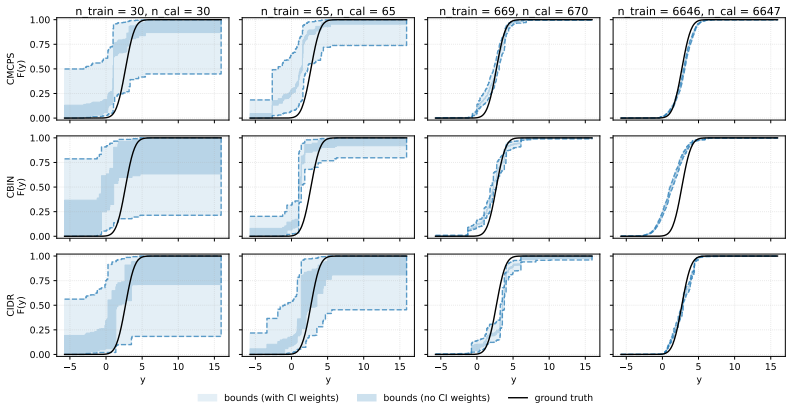
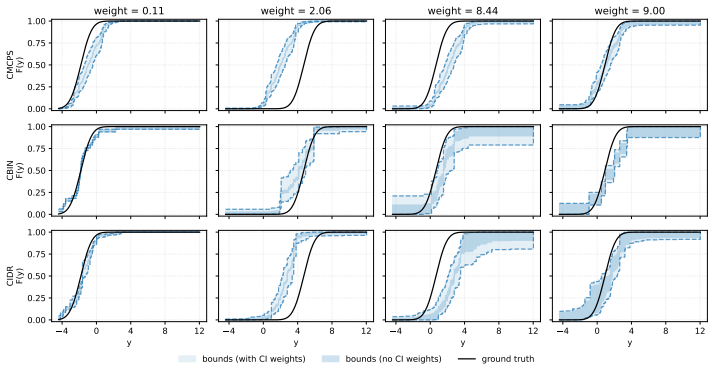
- The bands widen as the strength of the distributional shift increases.
- The bands tighten with increasing sample size.
- Efficient algorithms exist for conformity-measure CPS, conformal binning, and conformal isotonic distributional regression.
Where Pith is reading between the lines
- The same weighting device could be applied to other non-exchangeable regimes such as time-series dependence or selection bias.
- The width of the robust envelopes may serve as an observable diagnostic for shift magnitude in deployed systems.
- Hybrid combinations with other conformal techniques might address shifts that cannot be captured by a single set of permutation weights.
Load-bearing premise
The test point is conditionally a weighted draw from the observed atoms given the unordered sample.
What would settle it
A simulation in which the test point is drawn exactly according to known permutation weights from the observed atoms, with verification that the resulting robust CPS envelopes attain the stated coverage probability for the true CDF.
Figures
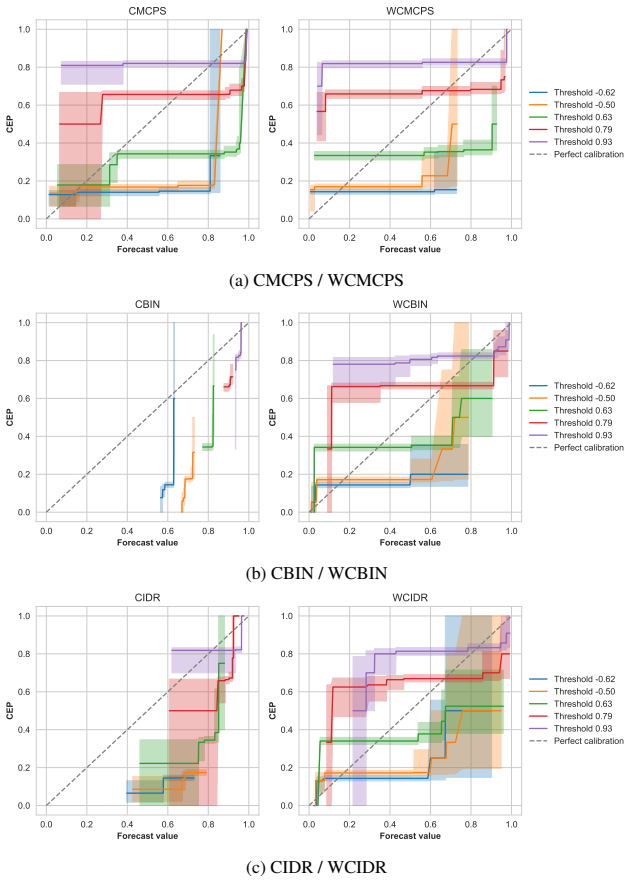
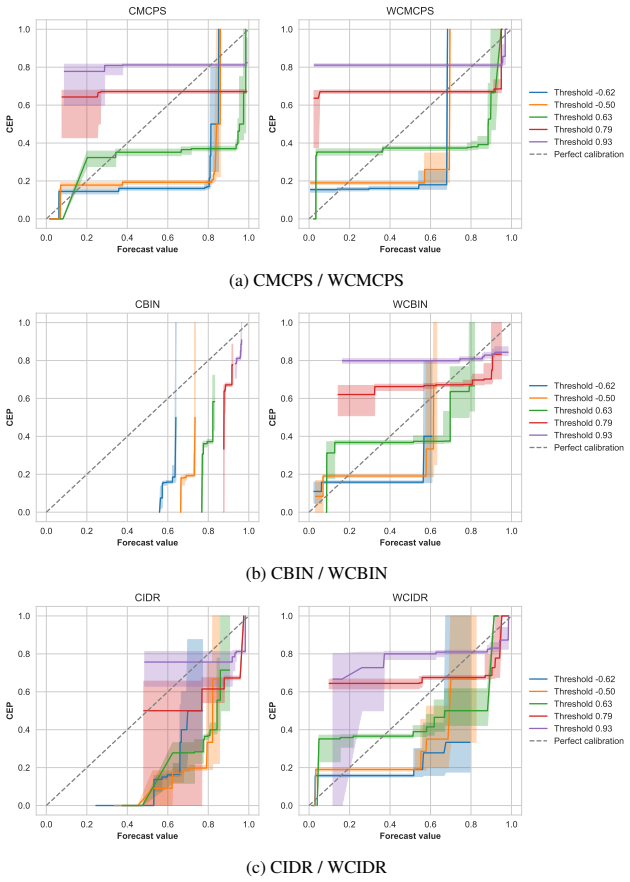
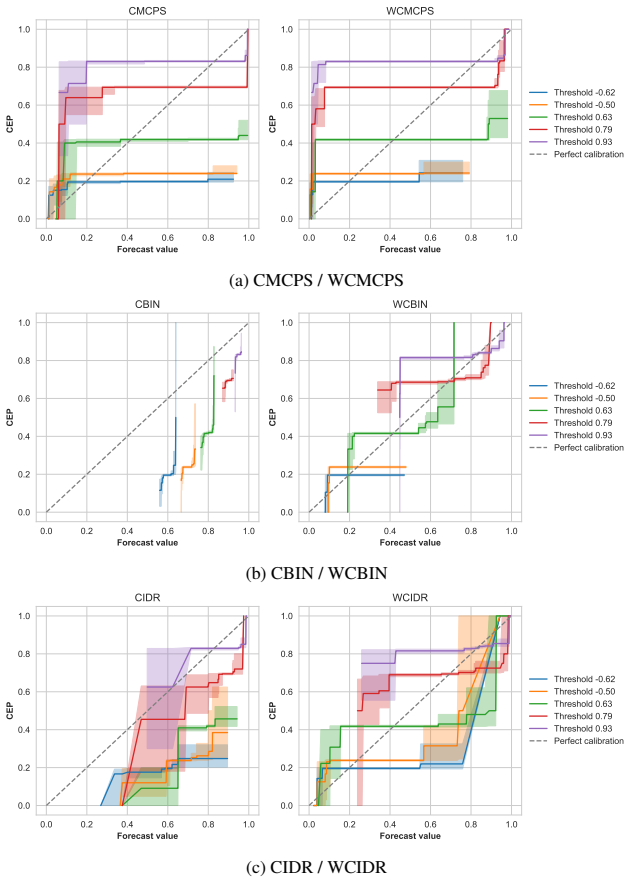
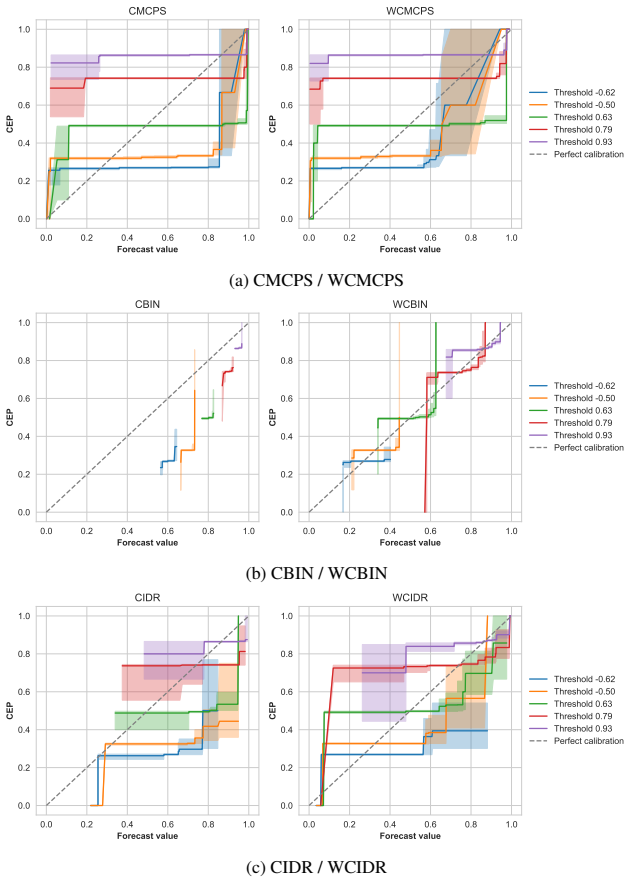
read the original abstract
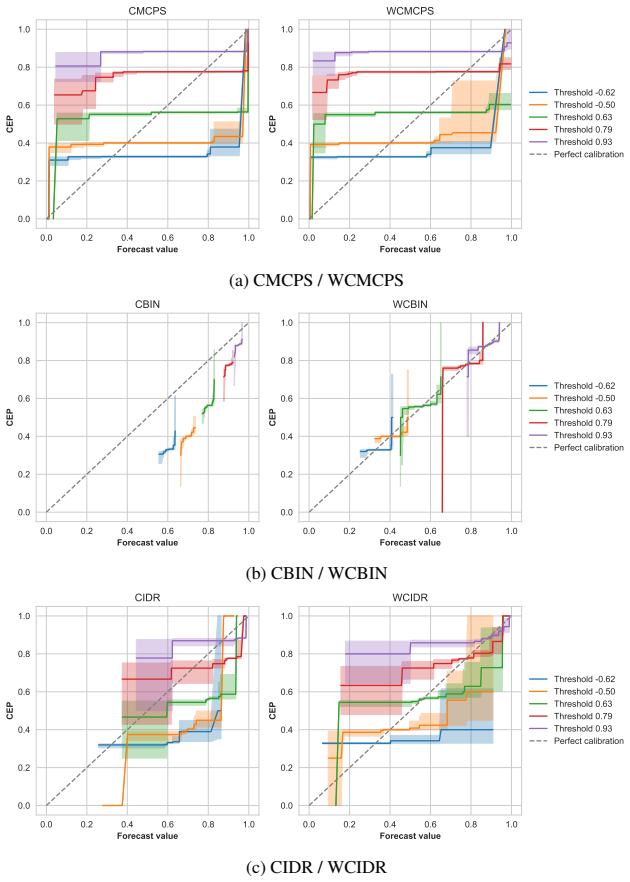
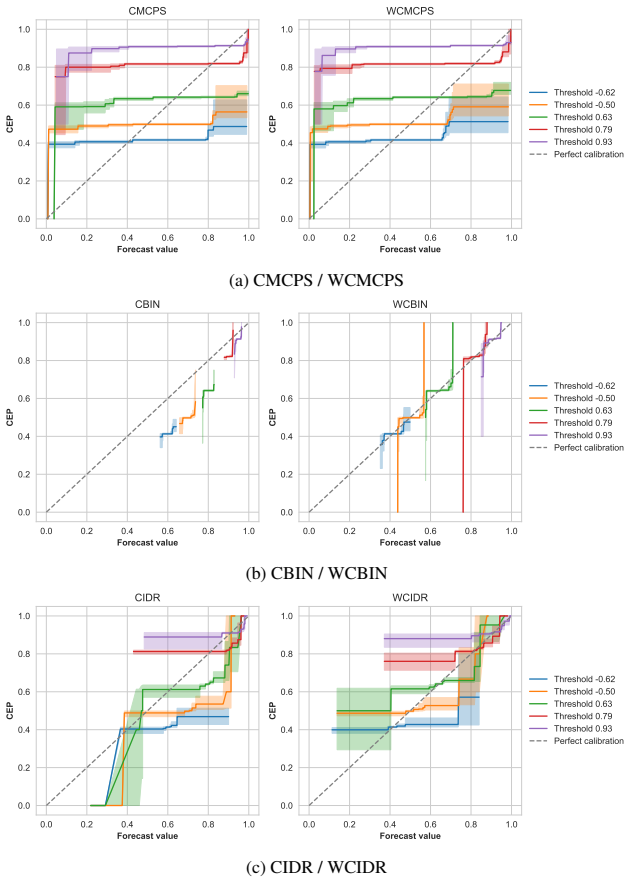
Conformal predictive systems (CPS) output calibrated bands of CDFs under exchangeability. We extend generalized CPS to non-exchangeable settings by encoding distributional shifts through observation-specific permutation weights. This yields shift-aware predictive systems that remain valid whenever the test point is, conditionally on the unordered sample, a weighted draw from the observed atoms. Since such weights are typically estimated, we introduce weight-uncertainty boxes and construct robust CPS envelopes with finite-sample or asymptotic confidence guarantees. We derive efficient computation for conformity-measure CPS, conformal binning, and conformal isotonic distributional regression. Experiments under covariate shift and feedback-driven biomolecular design show calibrated predictive bands that widen under stronger shifts and tighten as sample size increases.
Editorial analysis
A structured set of objections, weighed in public.
Referee Report
Summary. The paper extends generalized conformal predictive systems (CPS) to non-exchangeable settings by encoding distributional shifts via observation-specific permutation weights. This produces shift-aware systems that remain valid when the test point is conditionally a weighted draw from the observed atoms (replacing exchangeability). Weight-uncertainty boxes are introduced to obtain robust CPS envelopes with finite-sample or asymptotic guarantees when weights are estimated. Efficient algorithms are derived for conformity-measure CPS, conformal binning, and conformal isotonic distributional regression. Experiments under covariate shift and feedback-driven biomolecular design demonstrate calibrated predictive bands that widen with stronger shifts and tighten with larger samples.
Significance. If the derivations hold, the work supplies a conditional-validity framework for CPS under a standard reweighting assumption, together with a practical mechanism (weight-uncertainty boxes) for estimated weights. This directly addresses a common limitation of exchangeability-based conformal methods and supplies finite-sample or asymptotic envelopes, which is a concrete advance for applications such as covariate-shifted regression and sequential biomolecular design.
minor comments (3)
- [Abstract] Abstract: the claim of 'finite-sample or asymptotic confidence guarantees' is stated without reference to the specific theorem or proposition that establishes the finite-sample case; adding an explicit pointer would improve clarity.
- [Experiments] The description of the weight-uncertainty boxes would benefit from an explicit statement of how the box radius is chosen or calibrated in the experiments section.
- Notation for the permutation weights is introduced in the abstract but the main text should include a short table comparing the new assumption to classical exchangeability and to standard weighted conformal prediction.
Simulated Author's Rebuttal
We thank the referee for the positive summary, significance assessment, and recommendation of minor revision. No specific major comments were provided in the report.
Circularity Check
No significant circularity; validity conditioned on explicit external modeling assumption
full rationale
The paper conditions its validity guarantees on the modeling assumption that the test point is conditionally a weighted draw from the observed atoms (replacing exchangeability), which is stated as an input rather than derived or fitted inside the derivation. Weight-uncertainty boxes are then constructed around estimated weights to obtain robust envelopes, but this extension follows directly from the stated assumption without reducing any prediction or result to a self-referential fit or self-citation chain. No load-bearing steps equate outputs to inputs by construction, and the derivation remains self-contained against the external weighted-draw premise and standard conformal machinery.
Axiom & Free-Parameter Ledger
free parameters (1)
- observation-specific permutation weights
axioms (1)
- domain assumption The test point is, conditionally on the unordered sample, a weighted draw from the observed atoms.
invented entities (1)
-
weight-uncertainty boxes
no independent evidence
Reference graph
Works this paper leans on
-
[1]
Tilmann Gneiting, Fadoua Balabdaoui, and Adrian E. Raftery. Probabilistic forecasts, calibration and sharpness.Journal of the Royal Statistical Society: Series B (Statistical Methodology), 69 (2):243–268, 2007. ISSN 1467-9868. doi: 10.1111/j.1467-9868.2007.00587.x. URL https: //onlinelibrary.wiley.com/doi/abs/10.1111/j.1467-9868.2007.00587.x
-
[2]
Vladimir V ovk, Jieli Shen, Valery Manokhin, and Min-Ge Xie. Nonparametric predictive distributions based on conformal prediction.Machine Language, 108(3):445–474, March 2019. ISSN 0885-6125. doi: 10.1007/s10994-018-5755-8. URL https://doi.org/10.1007/ s10994-018-5755-8
-
[3]
In-sample calibration yields conformal calibration guarantees, March 2025
Sam Allen, Georgios Gavrilopoulos, Alexander Henzi, Gian-Reto Kleger, and Johanna Ziegel. In-sample calibration yields conformal calibration guarantees, March 2025. URL http:// arxiv.org/abs/2503.03841. arXiv:2503.03841 [stat]
arXiv 2025
-
[4]
Generalized Venn and Venn-Abers Calibration with Applications in Conformal Prediction
Lars van der Laan and Ahmed Alaa. Generalized Venn and Venn-Abers Calibration with Applications in Conformal Prediction. June 2025. URL https://openreview.net/forum? id=kl2SA1N03E
2025
-
[5]
Alexander Henzi, Johanna F. Ziegel, and Tilmann Gneiting. Isotonic Distributional Regression. Journal of the Royal Statistical Society Series B: Statistical Methodology, 83(5):963–993, November 2021. ISSN 1369-7412. doi: 10.1111/rssb.12450. URL https://doi.org/10. 1111/rssb.12450
-
[6]
Conformal Predic- tive Systems Under Covariate Shift
Jef Jonkers, Glenn Van Wallendael, Luc Duchateau, and Sofie Van Hoecke. Conformal Predic- tive Systems Under Covariate Shift. InProceedings of the Thirteenth Symposium on Conformal and Probabilistic Prediction with Applications, pages 406–423. PMLR, September 2024. URL https://proceedings.mlr.press/v230/jonkers24a.html
2024
-
[7]
Jef Jonkers, Jarne Verhaeghe, Glenn Van Wallendael, Luc Duchateau, and Sofie Van Hoecke. Conformal Convolution and Monte Carlo Meta-learners for Predictive Inference of Indi- vidual Treatment Effects, September 2025. URL http://arxiv.org/abs/2402.04906. arXiv:2402.04906 [cs]
arXiv 2025
-
[8]
Conformal Prediction Under Covariate Shift
Ryan J Tibshirani, Rina Foygel Barber, Emmanuel Candes, and Aaditya Ramdas. Conformal Prediction Under Covariate Shift. InAdvances in Neural Information Processing Systems, vol- ume 32. Curran Associates, Inc., 2019. URL https://proceedings.neurips.cc/paper/ 2019/hash/8fb21ee7a2207526da55a679f0332de2-Abstract.html
2019
-
[9]
Conformal Validity Guarantees Exist for Any Data Distribution (and How to Find Them)
Drew Prinster, Samuel Don Stanton, Anqi Liu, and Suchi Saria. Conformal Validity Guarantees Exist for Any Data Distribution (and How to Find Them). June 2024. URL https:// openreview.net/forum?id=F3936hVwQa
2024
-
[10]
Angelopoulos, Jennifer Listgarten, and Michael I
Clara Fannjiang, Stephen Bates, Anastasios N. Angelopoulos, Jennifer Listgarten, and Michael I. Jordan. Conformal prediction under feedback covariate shift for biomolecular design.Proceed- ings of the National Academy of Sciences, 119(43):e2204569119, October 2022. doi: 10.1073/ pnas.2204569119. URLhttps://www.pnas.org/doi/abs/10.1073/pnas.2204569119. 10
-
[11]
Isotonic conditional laws.Bernoulli, 31 (2):1140–1159, May 2025
Sebastian Arnold and Johanna Ziegel. Isotonic conditional laws.Bernoulli, 31 (2):1140–1159, May 2025. ISSN 1350-7265. doi: 10.3150/24-BEJ1764. URL https://projecteuclid.org/journals/bernoulli/volume-31/issue-2/ Isotonic-conditional-laws/10.3150/24-BEJ1764.full
-
[12]
Venn-Abers predictors, June 2014
Vladimir V ovk and Ivan Petej. Venn-Abers predictors, June 2014. URLhttp://arxiv.org/ abs/1211.0025. arXiv:1211.0025 [cs, stat]
Pith/arXiv arXiv 2014
-
[13]
Selective Classification for Deep Neural Networks, June
Yonatan Geifman and Ran El-Yaniv. Selective Classification for Deep Neural Networks, June
- [14]
-
[15]
Danqing Zhu, David H. Brookes, Akosua Busia, Ana Carneiro, Clara Fannjiang, Galina Popova, David Shin, Kevin C. Donohue, Li F. Lin, Zachary M. Miller, Evan R. Williams, Edward F. Chang, Tomasz J. Nowakowski, Jennifer Listgarten, and David V . Schaffer. Optimal trade-off control in machine learning–based library design, with application to adeno-associated...
-
[16]
Candès, Aaditya Ramdas, and Ryan J
Rina Foygel Barber, Emmanuel J. Candès, Aaditya Ramdas, and Ryan J. Tibshirani. Conformal prediction beyond exchangeability.The Annals of Statistics, 51(2):816–845, April 2023. ISSN 0090-5364, 2168-8966. doi: 10.1214/23-AOS2276. URL https: //projecteuclid.org/journals/annals-of-statistics/volume-51/issue-2/ Conformal-prediction-beyond-exchangeability/10.1...
-
[17]
Leying Guan. Localized conformal prediction: a generalized inference framework for conformal prediction.Biometrika, 110(1):33–50, March 2023. ISSN 1464-3510. doi: 10.1093/biomet/ asac040. URLhttps://doi.org/10.1093/biomet/asac040
-
[18]
Conformal prediction with local weights: randomiza- tion enables local guarantees, October 2024
Rohan Hore and Rina Foygel Barber. Conformal prediction with local weights: randomiza- tion enables local guarantees, October 2024. URL http://arxiv.org/abs/2310.07850. arXiv:2310.07850 [stat]
arXiv 2024
-
[19]
Rina Foygel Barber and Ryan J. Tibshirani. Unifying Different Theories of Conformal Predic- tion, April 2025. URLhttp://arxiv.org/abs/2504.02292. arXiv:2504.02292 [math]
arXiv 2025
-
[20]
Timo Dimitriadis, Tilmann Gneiting, and Alexander I. Jordan. Stable reliability diagrams for probabilistic classifiers.Proceedings of the National Academy of Sciences, 118(8):e2016191118, February 2021. doi: 10.1073/pnas.2016191118. URL https://www.pnas.org/doi/abs/ 10.1073/pnas.2016191118. 11 Appendix overview This appendix is organized as follows. Appen...
discussion (0)
Sign in with ORCID, Apple, or X to comment. Anyone can read and Pith papers without signing in.