SNAS: A Multi-Layer Defense-in-Depth Architecture for Secure Egress in Sandboxed Workloads
Pith reviewed 2026-06-27 00:38 UTC · model grok-4.3
The pith
SNAS layers eBPF filtering, GENEVE overlays and egress proxies to control outbound traffic from sandboxed workloads with low overhead.
A machine-rendered reading of the paper's core claim, the machinery that carries it, and where it could break.
Core claim
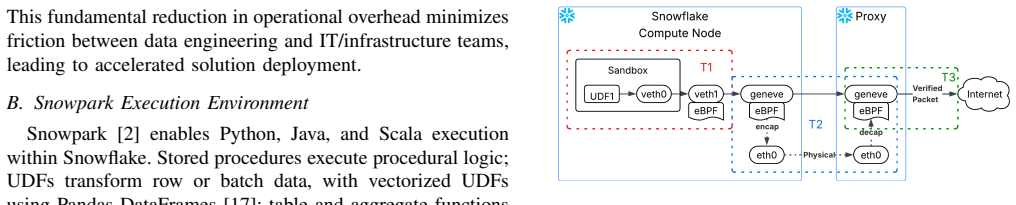
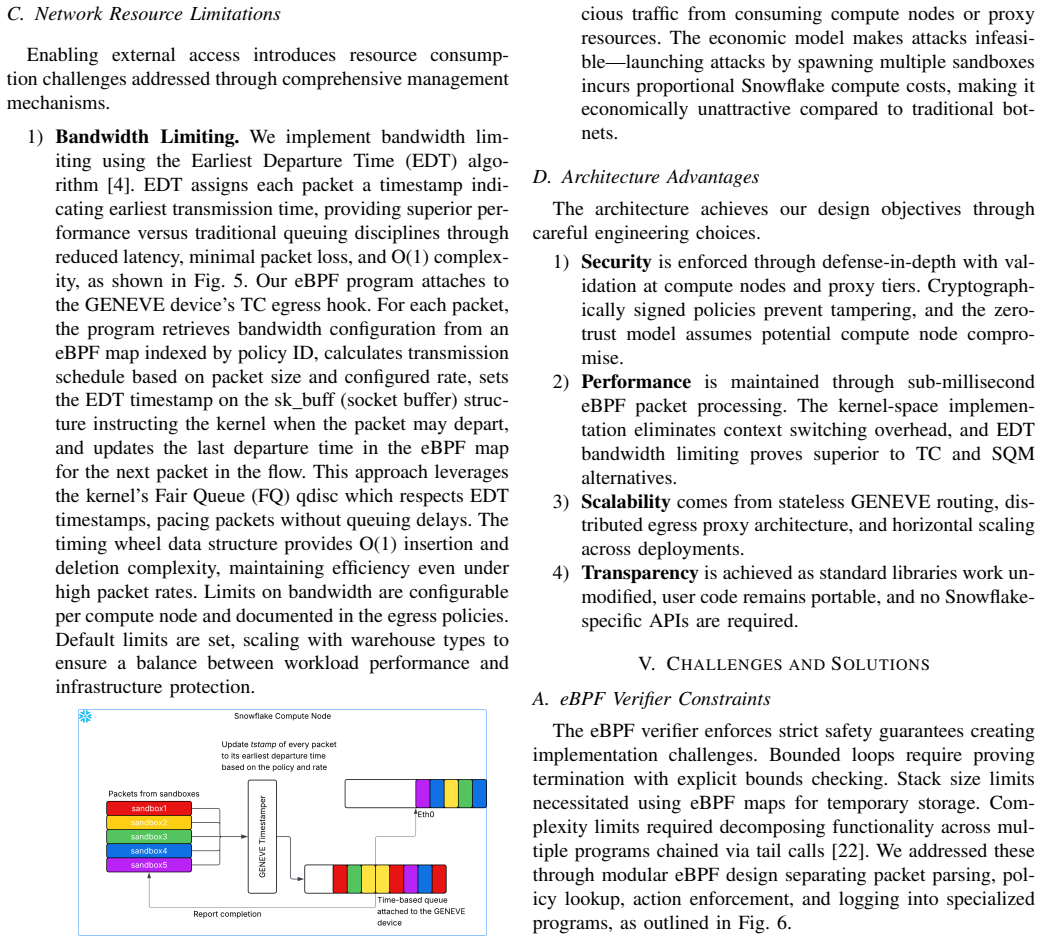
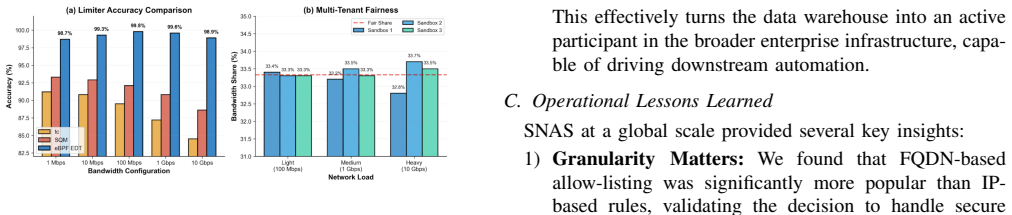
SNAS integrates eBPF packet filtering, GENEVE overlay networks, and distributed egress proxies to achieve policy-driven egress control from sandboxed workloads, including an eBPF-based bandwidth limiter that uses the Earliest Departure Time algorithm together with dual-tier policy enforcement and safeguards against connection limiting and port exhaustion.
What carries the argument
The three-layer stack of eBPF filtering with bandwidth limiting, GENEVE encapsulation, and distributed egress proxies for policy enforcement.
If this is right
- Sandboxed workloads gain transparent access to external services while policies remain enforced at multiple points.
- Bandwidth limiting and connection safeguards prevent any single workload from exhausting shared resources.
- The same architecture supports production workloads across every region with petabyte-scale data movement.
- Dual-tier enforcement separates coarse kernel rules from finer proxy-level decisions.
Where Pith is reading between the lines
- The same layering pattern could be examined for use in other multi-tenant sandbox platforms that face similar egress requirements.
- The choice of the Earliest Departure Time algorithm for bandwidth control invites direct comparison with alternative fairness schedulers under real cloud traffic.
- Additional public measurements of isolation strength under adversarial conditions would clarify how far the current safeguards extend.
Load-bearing premise
The layered combination of eBPF, GENEVE, and proxies preserves strict multi-tenant isolation and resource fairness while adding only low overhead.
What would settle it
A documented case of one tenant affecting another's traffic or a measured overhead that visibly slows petabyte-scale transfers would show the claims do not hold.
Figures
read the original abstract
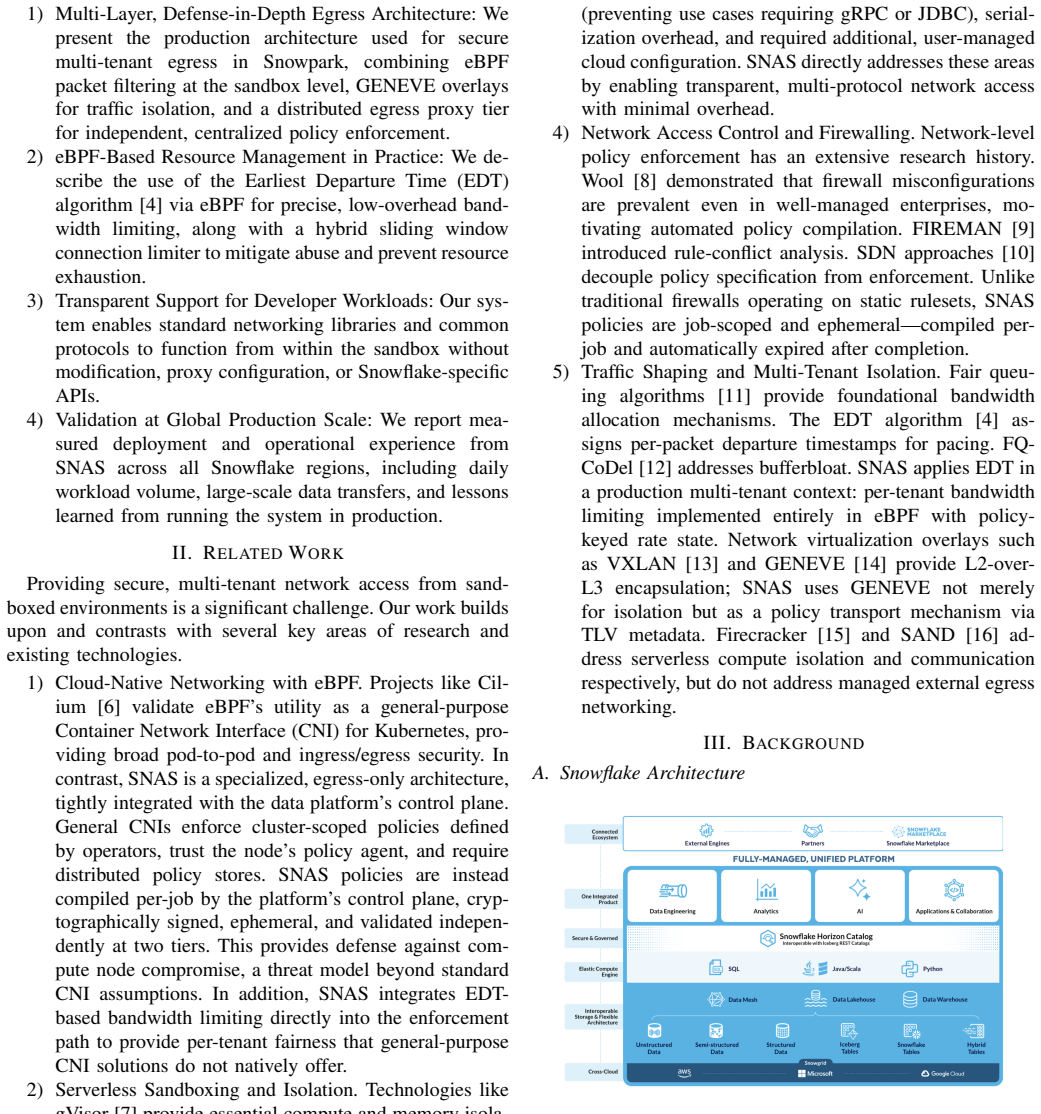
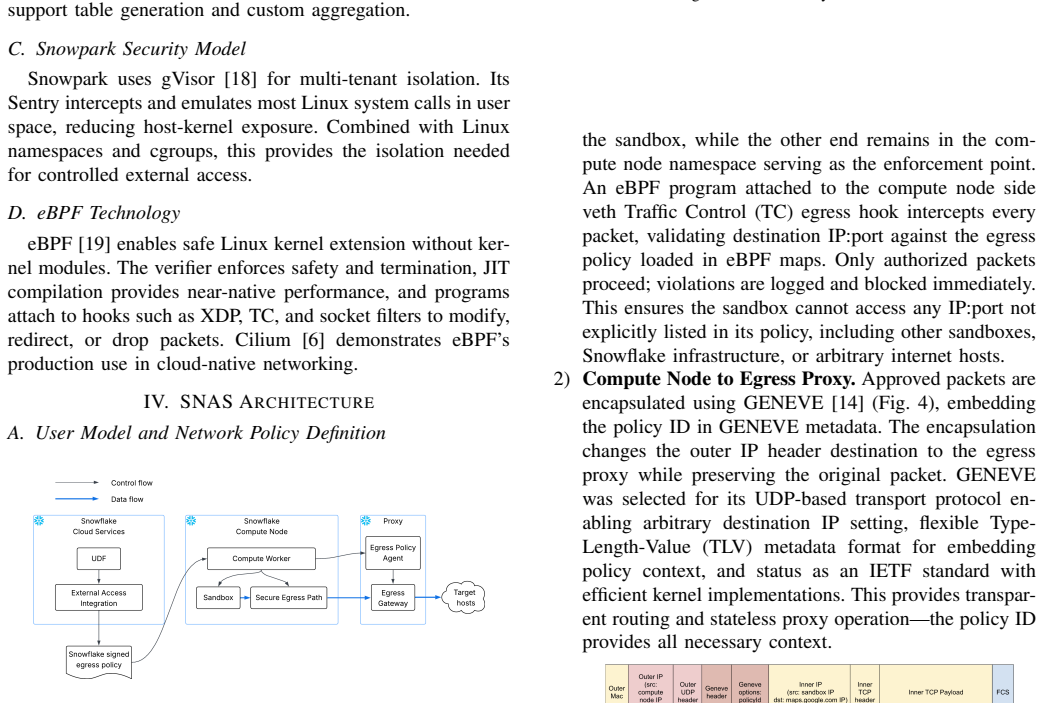
Snowpark enables data engineering and AI/ML workloads in Snowflake by executing user-defined functions in secure sandboxes. Many of these workloads require external connectivity to access cloud APIs, external databases, or feature stores, creating a dependability challenge: how to provide transparent network access while preserving strict multi-tenant isolation and resource fairness. This paper presents Secure Network Access in Snowpark (SNAS), a production architecture for secure external communication from sandboxed workloads. SNAS combines Extended Berkeley Packet Filter (eBPF) packet filtering, Generic Network Virtualization Encapsulation (GENEVE) overlay networks, and distributed egress proxies for policy-driven egress control with low overhead. We describe the design, deployment, and measured production behavior of SNAS, including an eBPF-based bandwidth limiter using the Earliest Departure Time (EDT) algorithm, dual-tier policy enforcement, and safeguards for connection limiting and port exhaustion. SNAS is deployed across all Snowflake regions and supports large-scale production workloads including petabyte-scale data transfer and latency-sensitive external integrations.
Editorial analysis
A structured set of objections, weighed in public.
Referee Report
Summary. The paper presents SNAS, a multi-layer defense-in-depth architecture for secure egress from sandboxed Snowpark workloads in Snowflake. It integrates eBPF-based packet filtering and EDT bandwidth limiting, GENEVE overlay networks, and distributed egress proxies with dual-tier policy enforcement and connection safeguards. The system is deployed across all Snowflake regions and supports production workloads including petabyte-scale data transfers while aiming to preserve multi-tenant isolation and resource fairness with low overhead.
Significance. If the production measurements and isolation properties hold, the work provides a concrete, deployed example of combining kernel-level mechanisms (eBPF) with overlay networking for policy-driven egress control in large-scale multi-tenant sandboxes. The explicit use of the EDT algorithm for bandwidth limiting and the dual-tier enforcement are practical contributions that could inform similar systems in cloud environments.
minor comments (2)
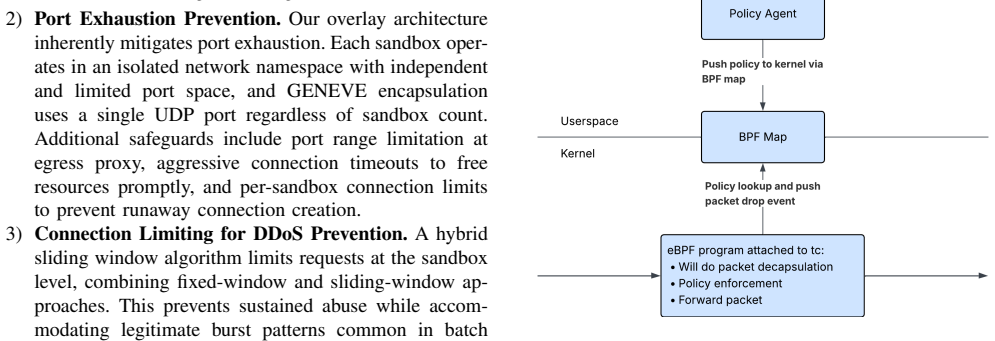
- [§3.2] §3.2: The interaction between the eBPF EDT limiter and the GENEVE encapsulation layer is described at a high level; a diagram or timing diagram would clarify whether encapsulation occurs before or after the departure-time scheduling.
- [Table 2] Table 2: The reported overhead percentages lack error bars or the number of trials; adding these would strengthen the low-overhead claim.
Simulated Author's Rebuttal
We thank the referee for their positive review and recommendation of minor revision. The assessment correctly identifies the practical contributions of combining eBPF mechanisms with overlay networking for egress control in multi-tenant sandboxes. No major comments were provided in the report.
Circularity Check
No significant circularity
full rationale
The manuscript is a high-level system architecture and deployment paper. It describes the combination of eBPF, GENEVE, and proxies, reports production measurements, and states deployment facts. No equations, derivations, fitted parameters presented as predictions, or load-bearing self-citations appear in the text. All claims rest on direct operational evidence rather than any reduction to prior inputs by construction.
Axiom & Free-Parameter Ledger
Reference graph
Works this paper leans on
-
[1]
The snowflake elastic data warehouse,
B. Dageville, T. Cruanes, M. Zukowski, V . Antonov, A. Avanes, J. Bock, J. Claybaugh, D. Engovatov, M. Hentschel, J. Huang, A. W. Lee, A. Mo- tivala, A. Q. Munir, S. Pelley, P. Povinec, G. Rahn, S. Triantafyllis, and P. Unterbrunner, “The snowflake elastic data warehouse,” inProceedings of the ACM SIGMOD International Conference on Management of Data, 201...
2016
-
[2]
Snowpark: Performant, secure, user- friendly data engineering and ai/ml next to your data,
B. Baker, E. Brossard, C. Xie, Z. Ye, D. Liu, Y . Xie, A. Zwiegincew, N. K. Sharma, G. Jain, E. Retunsky, M. Halcrow, D. Denny-Brown, I. Cseri, T. Akidau, and Y . He, “Snowpark: Performant, secure, user- friendly data engineering and ai/ml next to your data,” inProceedings of the IEEE International Conference on Distributed Computing Systems (ICDCS), 2025
2025
-
[3]
Snowflake external functions,
Snowflake Inc., “Snowflake external functions,” https://docs.snowflake. com/en/sql-reference/external-functions-introduction, 2024
2024
-
[4]
Tcp small queues and earliest departure time,
E. Dumazet, V . Jacobson, and Y . Cheng, “Tcp small queues and earliest departure time,” inLinux Plumbers Conference, 2018
2018
-
[5]
A survey on dos/ddos mitigation techniques in sdns,
B. Alhijawi, S. Almajali, H. Elgala, H. A. Bany Salameh, and M. Ayyash, “A survey on dos/ddos mitigation techniques in sdns,” Computers & Electrical Engineering, vol. 99, p. 107706, 2022
2022
-
[6]
Cilium: ebpf-based networking, observability, security,
Isovalent, “Cilium: ebpf-based networking, observability, security,” https://cilium.io/, 2024
2024
-
[7]
The true cost of containing: A gvisor case study,
E. G. Young, P. Zhu, T. Caraza-Harter, A. C. Arpaci-Dusseau, and R. H. Arpaci-Dusseau, “The true cost of containing: A gvisor case study,” in USENIX HotCloud, 2019
2019
-
[8]
A quantitative study of firewall configuration errors,
A. Wool, “A quantitative study of firewall configuration errors,”IEEE Computer, vol. 37, no. 6, pp. 62–67, 2004
2004
-
[9]
Fireman: A toolkit for firewall modeling and analysis,
L. Yuan, J. Mai, Z. Su, H. Chen, C.-N. Chuah, and P. Mohapatra, “Fireman: A toolkit for firewall modeling and analysis,” inIEEE Symposium on Security and Privacy, 2006
2006
-
[10]
B4: Experience with a globally-deployed software defined wan,
S. Jainet al., “B4: Experience with a globally-deployed software defined wan,” inACM SIGCOMM, 2013
2013
-
[11]
Analysis and simulation of a fair queueing algorithm,
A. Demers, S. Keshav, and S. Shenker, “Analysis and simulation of a fair queueing algorithm,” inProceedings of the ACM SIGCOMM Conference, 1989
1989
-
[12]
Controlling queue delay,
K. Nichols and V . Jacobson, “Controlling queue delay,”ACM Queue, vol. 10, no. 5, 2012
2012
-
[13]
Vxlan: A framework for overlaying virtualized layer 2 networks over layer 3 networks,
M. Mahalingam, D. Dutt, K. Duda, P. Agarwal, L. Kreeger, T. Srid- har, M. Bursell, and C. Wright, “Vxlan: A framework for overlaying virtualized layer 2 networks over layer 3 networks,” RFC 7348, 2014
2014
-
[14]
Geneve: Generic network virtual- ization encapsulation,
J. Gross, I. Ganga, and T. Sridhar, “Geneve: Generic network virtual- ization encapsulation,” IETF, RFC 8926, 2020
2020
-
[15]
Firecracker: Lightweight virtual- ization for serverless applications,
A. Agache, M. Brooker, A. Florescu, A. Iordache, A. Liguori, R. Neuge- bauer, P. Piwonka, and D.-M. Popa, “Firecracker: Lightweight virtual- ization for serverless applications,” inUSENIX NSDI, 2020
2020
-
[16]
Sand: Towards high-performance serverless computing,
I. E. Akkus, R. Chen, I. R. Wang, S. D. Gribble, and D. Kostic, “Sand: Towards high-performance serverless computing,” inProceedings of the USENIX Annual Technical Conference (ATC), 2018
2018
-
[17]
Python and java support for serverless tasks,
Snowflake Inc., “Python and java support for serverless tasks,” https: //docs.snowflake.com/en/user-guide/tasks-python-jvm, 2024
2024
-
[18]
See++: Evolving snowpark execution environment for modern workloads,
G. Jain, B. Baker, J. Yin, C. Xie, Z. Ye, S. Kulkarni, S. Abdelrahman, N. Qi, U. Shrestha, M. Halcrow, D. Bailey, and Y . He, “See++: Evolving snowpark execution environment for modern workloads,” in IEEE BigData, 2025
2025
-
[19]
The linux kernel documentation – bpf,
Linux Kernel Community, “The linux kernel documentation – bpf,” https://www.kernel.org/doc/html/latest/bpf/, 2024
2024
-
[20]
Snowflake external network access overview,
Snowflake Inc., “Snowflake external network access overview,” https: //docs.snowflake.com/en/developer-guide/external-network-access/ external-network-access-overview, 2024
2024
-
[21]
Snowflake architecture and key concepts,
——, “Snowflake architecture and key concepts,” https://docs.snowflake. com/en/user-guide/intro-key-concepts, 2024
2024
-
[22]
Creating complex network services with ebpf,
S. Mianoet al., “Creating complex network services with ebpf,” inIEEE HPSR, 2018
2018
-
[23]
The express data path: Fast programmable packet processing in the os kernel,
T. Høiland-Jørgensenet al., “The express data path: Fast programmable packet processing in the os kernel,” inACM CoNEXT, 2018
2018
-
[24]
Katran: A high-performance layer 4 load balancer,
Facebook/Meta, “Katran: A high-performance layer 4 load balancer,” https://github.com/facebookincubator/katran, 2018
2018
-
[25]
High- speed high-security signatures,
D. J. Bernstein, N. Duif, T. Lange, P. Schwabe, and B.-Y . Yang, “High- speed high-security signatures,”Journal of Cryptographic Engineering, vol. 2, no. 2, pp. 77–89, 2012
2012
-
[26]
Gregg,BPF Performance Tools: Linux System and Application Observability
B. Gregg,BPF Performance Tools: Linux System and Application Observability. Addison-Wesley Professional, 2019
2019
-
[27]
Serverless computing: One step forward, two steps back,
J. M. Hellerstein, J. M. Faleiro, J. Gonzalez, J. Schleier-Smith, V . Sreekanti, A. Tumanov, and C. Wu, “Serverless computing: One step forward, two steps back,” inProceedings of the 9th Biennial Conference on Innovative Data Systems Research (CIDR), 2019
2019
-
[28]
Retrieval-augmented generation for knowledge-intensive NLP tasks,
P. Lewis, E. Perez, A. Piktus, F. Petroni, V . Karpukhin, N. Goyal, H. K¨uttler, M. Lewis, W.-t. Yih, T. Rockt¨aschel, S. Riedel, and D. Kiela, “Retrieval-augmented generation for knowledge-intensive NLP tasks,” in Advances in Neural Information Processing Systems (NeurIPS), 2020
2020
-
[29]
Triggerflow: Trigger-based orchestration of serverless workflows,
A. Arjona, P. Garc ´ıa-L´opez, J. Samp ´e, A. Slominski, and L. Villard, “Triggerflow: Trigger-based orchestration of serverless workflows,”Fu- ture Generation Computer Systems, vol. 124, pp. 215–229, 2021
2021
discussion (0)
Sign in with ORCID, Apple, or X to comment. Anyone can read and Pith papers without signing in.