A Synthetic Reliability-Aware PINN Benchmark for Offshore Wind Turbine Support-Structure Monitoring with Bayesian Inverse Identification
Pith reviewed 2026-06-26 00:35 UTC · model grok-4.3
The pith
A PINN benchmark embeds the Euler-Bernoulli beam equation with Winkler foundation and Bayesian inverse identification for offshore wind turbine monopile monitoring.
A machine-rendered reading of the paper's core claim, the machinery that carries it, and where it could break.
Core claim
The paper presents Digi Turbine, a synthetic reliability-aware PINN benchmark workflow that embeds the simplified Euler-Bernoulli beam equation with Winkler soil foundation in the training objective, couples it with Bayesian-prior-informed inverse identification, and adds First Order Reliability Method screening, with all validation performed on synthetic configurations that supply analytical or finite-difference ground truth motivated by the NREL 5MW reference turbine context.
What carries the argument
The Digi Turbine PINN workflow that embeds the Euler-Bernoulli beam equation with Winkler soil foundation into the loss function and pairs it with Bayesian priors for inverse identification plus FORM reliability screening.
If this is right
- Fast state estimation from sparse measurements becomes possible without requiring large purely data-driven training sets.
- Bayesian priors enable inverse identification of unknown structural parameters within the same training loop.
- First Order Reliability Method screening can be integrated directly into the monitoring workflow.
- The synthetic benchmark supplies controlled ground truth for testing reliability-aware PINN variants before real-world deployment.
Where Pith is reading between the lines
- The same embedding strategy could be tested on other beam or foundation models to check sensitivity to soil parameter uncertainty.
- Replacing synthetic inputs with scaled physical model test data would provide an intermediate validation step before full-scale field trials.
- The workflow's reliance on a single simplified beam equation suggests examining how additional physics terms affect training stability and accuracy.
Load-bearing premise
Synthetic configurations with analytical or finite-difference ground truth motivated by the NREL 5MW reference turbine are representative enough to validate the method for practical offshore wind turbine monitoring applications.
What would settle it
Direct application of the trained PINN to real sensor measurements from an operating offshore wind turbine monopile followed by comparison of estimated states against independent full-scale finite-element results or additional field sensors would test whether the synthetic benchmark translates.
Figures
read the original abstract
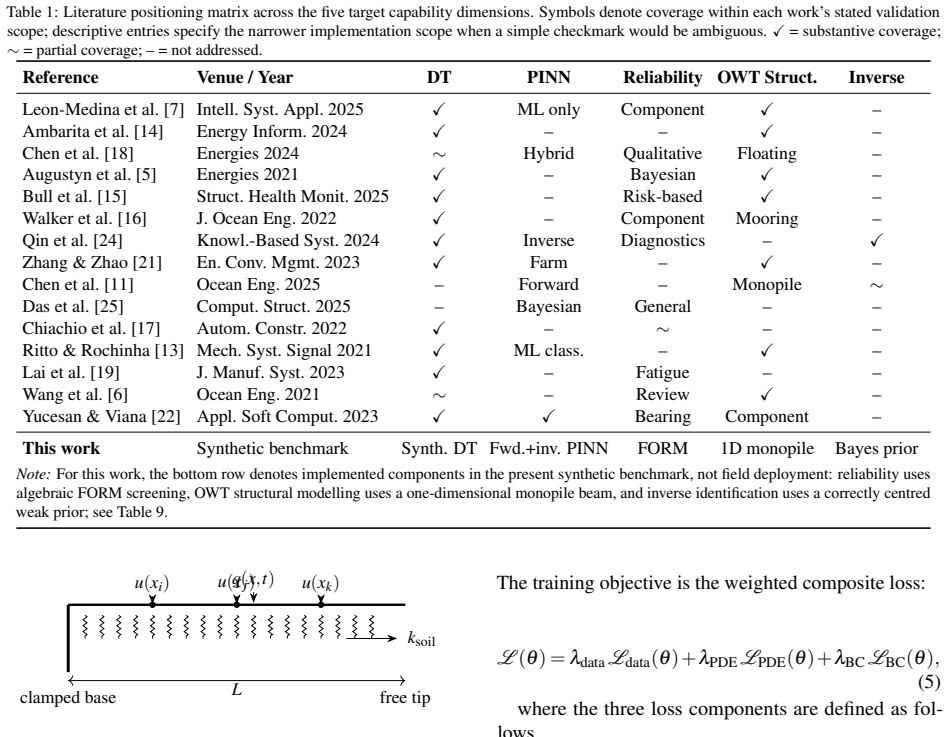
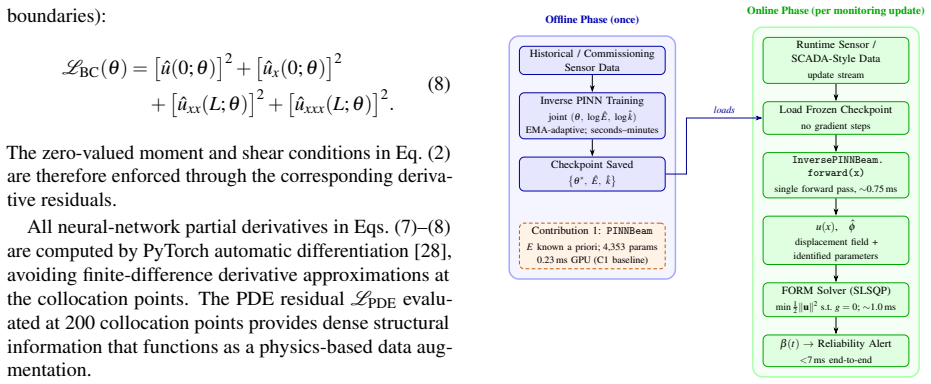
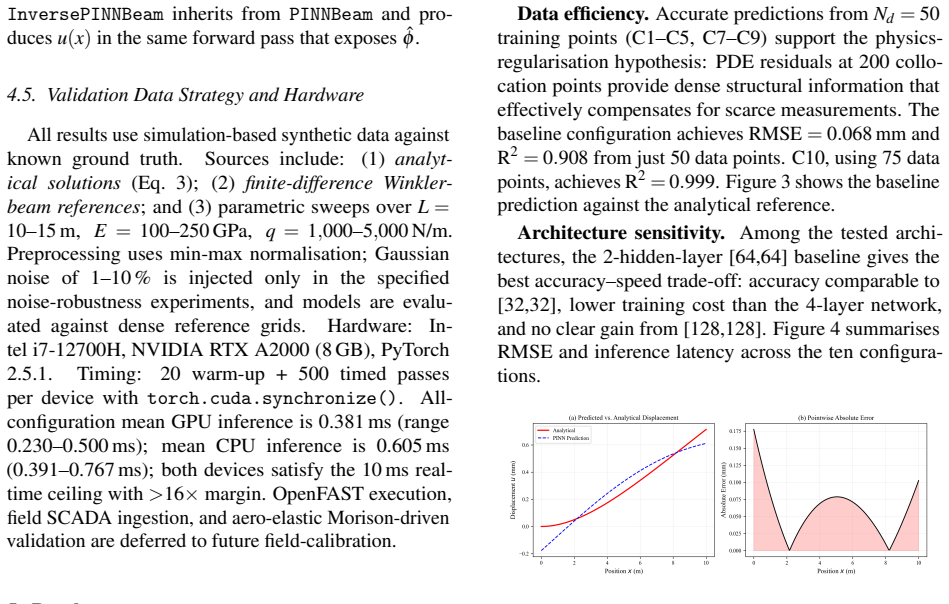
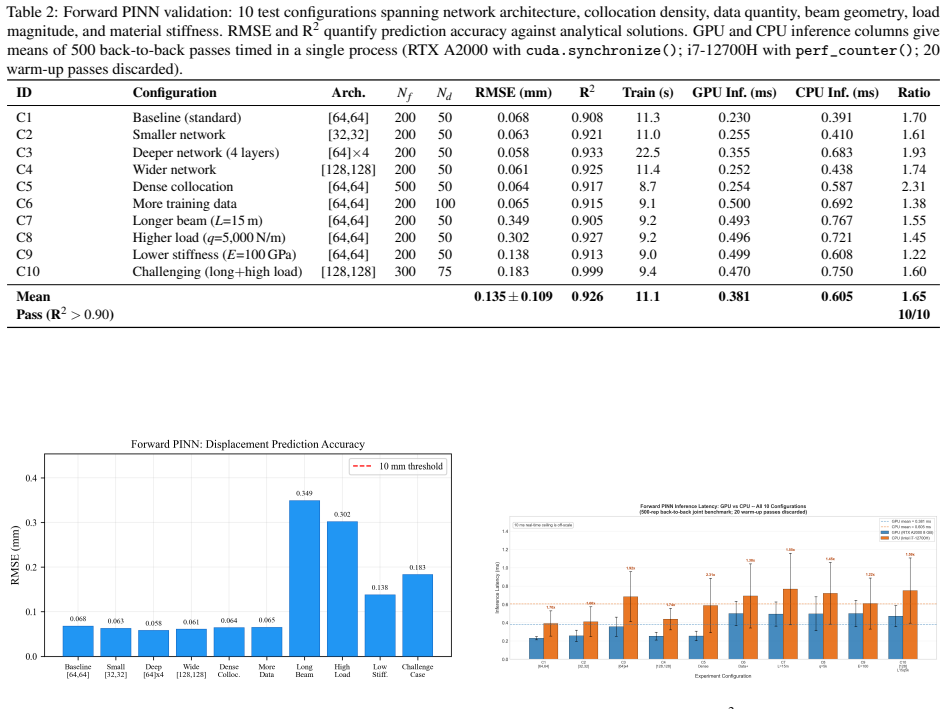
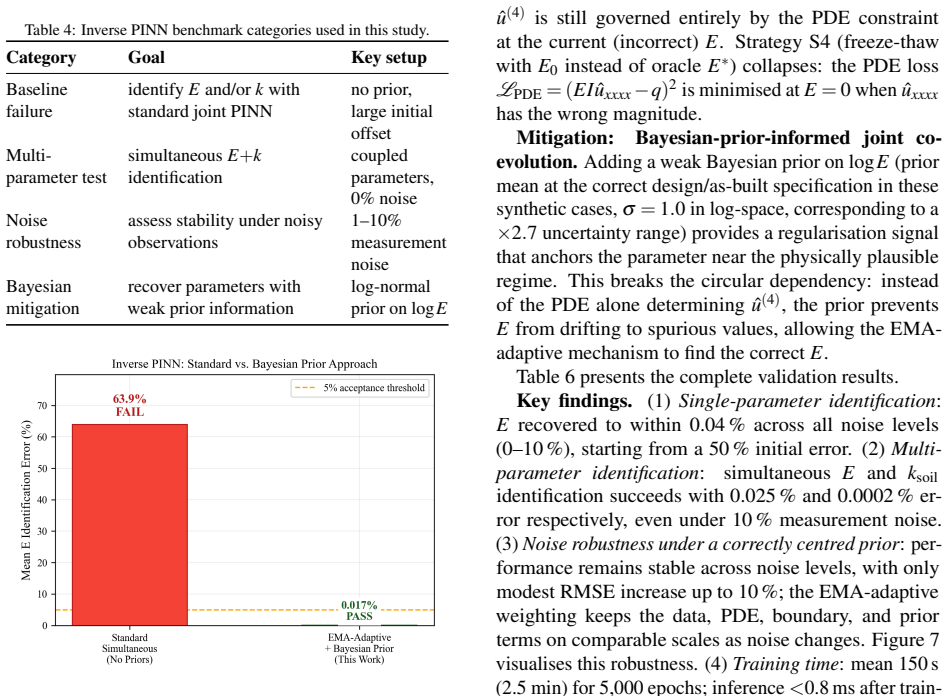
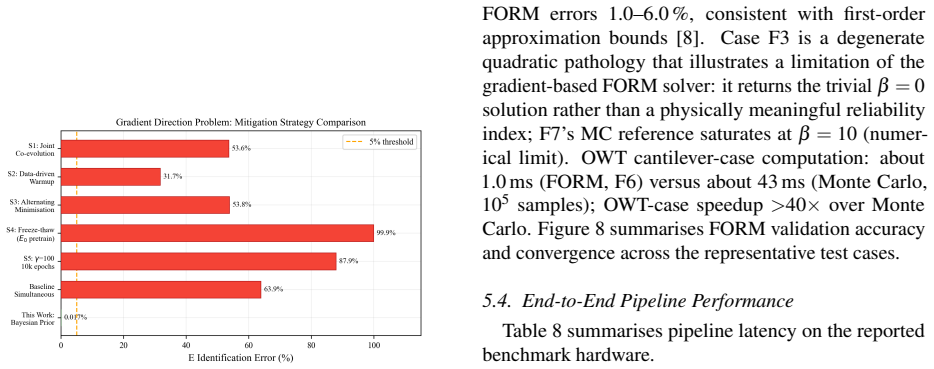
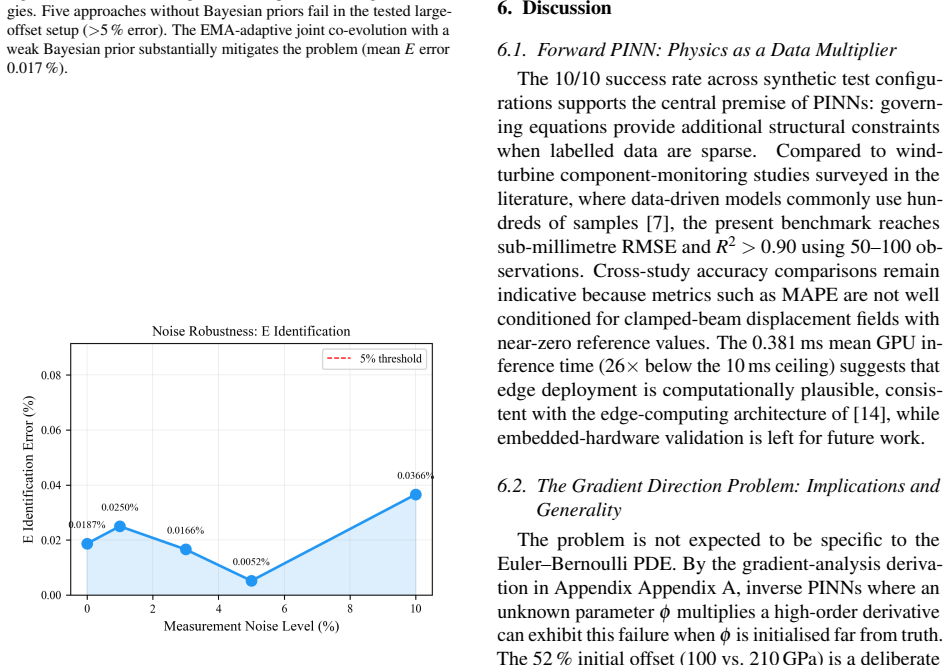
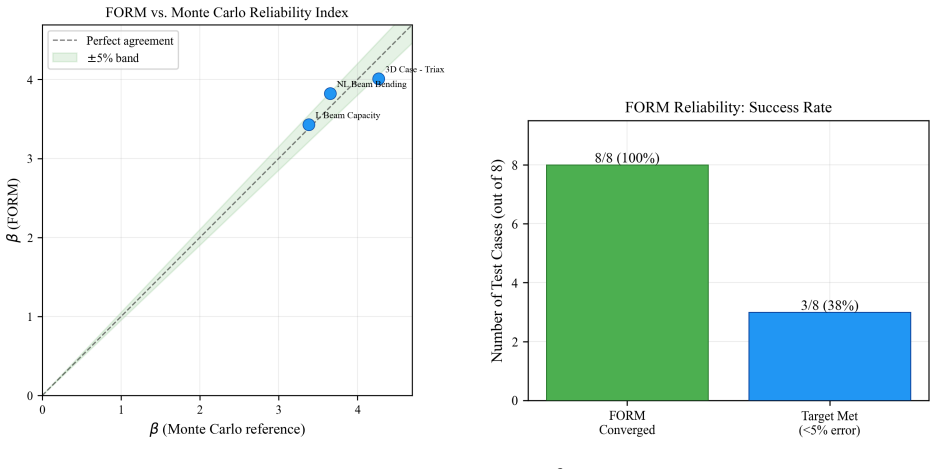
Reliable structural health monitoring (SHM) of offshore wind turbine (OWT) support structures requires fast state estimation from sparse measurements. Repeated high fidelity finite element or aeroelastic analyses are difficult to use directly in online monitoring loops, while purely data-driven surrogates can require large training sets. This paper presents Digi Turbine, a synthetic reliability-aware Physics Informed Neural Network (PINN) benchmark for OWT monopile support structure monitoring. The workflow embeds a simplified Euler Bernoulli beam equation with Winkler soil foundation in the training objective, couples it with Bayesian-prior-informed inverse identification, and adds First Order Reliability Method (FORM) screening. All validation uses synthetic configurations with analytical or finite-difference ground truth motivated by the NREL 5MW reference turbine context.
Editorial analysis
A structured set of objections, weighed in public.
Referee Report
Summary. The manuscript introduces Digi Turbine, a synthetic reliability-aware Physics-Informed Neural Network (PINN) benchmark for offshore wind turbine (OWT) monopile support-structure monitoring. The workflow embeds a simplified Euler-Bernoulli beam equation with Winkler soil foundation into the training objective, couples it with Bayesian-prior-informed inverse identification, and incorporates First Order Reliability Method (FORM) screening. All validation is performed on synthetic configurations with analytical or finite-difference ground truth motivated by the NREL 5MW reference turbine.
Significance. If the quantitative results demonstrate that the embedded PINN recovers parameters and states accurately while the FORM step produces reliable screening on the synthetic suite, the work would supply a reproducible, physics-constrained benchmark that future SHM methods could be compared against. The combination of PINN embedding, Bayesian priors, and reliability analysis is a coherent technical contribution for this domain.
major comments (2)
- [Validation/results] Validation/results section: because every reported metric is generated from synthetic data produced by the identical Euler-Bernoulli + Winkler model that is embedded in the PINN loss, any reported error reduction or reliability improvement is at risk of being an artifact of model reduction rather than a property of the PINN+Bayesian+FORM pipeline. Real monopile behavior includes 3D soil-structure interaction, cyclic degradation, distributed wave loading, and geometric nonlinearities absent from the embedded PDE; the manuscript must either (a) quantify the mismatch between the 1D model and higher-fidelity 3D reference solutions or (b) explicitly limit its claims to the synthetic benchmark setting.
- [Inverse identification] § on inverse identification: the claim that Bayesian priors improve identifiability is load-bearing for the reliability-aware aspect, yet no ablation is described that isolates the contribution of the prior versus the physics loss alone; without this comparison the added value of the Bayesian component remains unquantified.
minor comments (2)
- The abstract states that the method is intended for “fast state estimation from sparse measurements,” but the manuscript supplies no timing or complexity figures for the trained PINN inference step.
- Notation for the Winkler foundation modulus and the Bayesian hyper-parameters should be introduced once in a dedicated nomenclature table or early in §2 to avoid repeated re-definition.
Simulated Author's Rebuttal
We thank the referee for the thoughtful and constructive comments. We address each major point below and will make the indicated revisions to clarify the scope of our synthetic benchmark.
read point-by-point responses
-
Referee: [Validation/results] Validation/results section: because every reported metric is generated from synthetic data produced by the identical Euler-Bernoulli + Winkler model that is embedded in the PINN loss, any reported error reduction or reliability improvement is at risk of being an artifact of model reduction rather than a property of the PINN+Bayesian+FORM pipeline. Real monopile behavior includes 3D soil-structure interaction, cyclic degradation, distributed wave loading, and geometric nonlinearities absent from the embedded PDE; the manuscript must either (a) quantify the mismatch between the 1D model and higher-fidelity 3D reference solutions or (b) explicitly limit its claims to the synthetic benchmark setting.
Authors: We agree that all reported metrics are generated under the same modeling assumptions used to construct the PINN loss. Digi Turbine is presented as a controlled synthetic benchmark with analytical ground truth, not as a claim about real monopile behavior. We will revise the manuscript to explicitly adopt option (b): we will add clear statements in the abstract, introduction, and conclusions that all accuracy and reliability results are limited to the synthetic Euler-Bernoulli + Winkler setting and do not extend to 3D soil-structure interaction, cyclic effects, or geometric nonlinearities. Because the work is intentionally synthetic, we do not perform a 3D mismatch quantification. revision: yes
-
Referee: [Inverse identification] § on inverse identification: the claim that Bayesian priors improve identifiability is load-bearing for the reliability-aware aspect, yet no ablation is described that isolates the contribution of the prior versus the physics loss alone; without this comparison the added value of the Bayesian component remains unquantified.
Authors: We acknowledge that an explicit ablation isolating the Bayesian prior is missing. In the revised manuscript we will add a new ablation study that compares inverse identification performance (parameter recovery error and posterior uncertainty) using (i) the physics loss alone versus (ii) the physics loss plus the Bayesian prior. The results will be reported in a new table or figure in the inverse-identification section to quantify the prior's contribution. revision: yes
Circularity Check
No circularity detected; workflow uses standard PINN embedding of known PDE plus established Bayesian/FORM methods on synthetic data
full rationale
The paper defines Digi Turbine by embedding the Euler-Bernoulli beam equation with Winkler foundation directly into the PINN training objective, coupling it with Bayesian-prior-informed inverse identification and FORM screening, then validating on synthetic analytical/FD ground truth generated from the same NREL-motivated model. None of the load-bearing steps reduce a claimed prediction to a fitted quantity by construction, invoke self-citations for uniqueness theorems, smuggle ansatzes, or rename known results. The derivation chain is self-contained: the physical model, priors, and screening are externally specified inputs, and performance metrics are computed against independently generated synthetic truth, satisfying the criteria for a non-circular benchmark presentation.
Axiom & Free-Parameter Ledger
axioms (1)
- domain assumption Simplified Euler-Bernoulli beam equation with Winkler soil foundation sufficiently captures the monopile dynamics for the monitoring task
Reference graph
Works this paper leans on
-
[1]
rep., Global Wind Energy Council, Lisbon, Portugal (2026)
GWEC, Global wind report 2026, Tech. rep., Global Wind Energy Council, Lisbon, Portugal (2026). URL https://www.gwec.net/reports/globa lwindreport
2026
-
[2]
rep., Global Wind Energy Council, Lisbon, Portu- gal (2026)
GWEC, Global offshore wind report 2026, Tech. rep., Global Wind Energy Council, Lisbon, Portu- gal (2026). URL https://www.gwec.net/reports/globa loffshorewindreport
2026
-
[3]
rep., International Energy Agency, Paris (2025)
IEA, Renewables 2025: Analysis and forecasts to 2030, Tech. rep., International Energy Agency, Paris (2025). URL https://www.iea.org/reports/renewa bles-2025
2025
-
[4]
URL https://www.dnv.com/energy/standar ds-guidelines/dnv-st-0126-support-str uctures-for-wind-turbines/
DNV, DNV-ST-0126: Support Structures for Wind Turbines, Høvik, Norway, edition 2021-12 (2021). URL https://www.dnv.com/energy/standar ds-guidelines/dnv-st-0126-support-str uctures-for-wind-turbines/
2021
-
[5]
D. Augustyn, M. D. Ulriksen, J. D. Sørensen, Reli- ability updating of offshore wind substructures by use of digital twin information, Energies 14 (18) (2021) 5859.doi:10.3390/en14185859
-
[6]
M. Wang, C. Wang, A. Hnydiuk-Stefan, S. Feng, I. Atilla, Z. Li, Recent progress on reliability anal- ysis of offshore wind turbine support structures considering digital twin solutions, Ocean Engineer- ing 232 (2021) 109168. doi:10.1016/j.oceane ng.2021.109168
-
[8]
L. Wang, A. Kolios, X. Liu, D. Venetsanos, R. Cai, Reliability of offshore wind turbine support struc- tures: A state-of-the-art review, Renewable and Sustainable Energy Reviews 161 (2022) 112250. doi:10.1016/j.rser.2022.112250
-
[9]
M. Raissi, P. Perdikaris, G. E. Karniadakis, Physics- informed neural networks: A deep learning frame- work for solving forward and inverse problems involving nonlinear partial differential equations, Journal of Computational Physics 378 (2019) 686– 707.doi:10.1016/j.jcp.2018.10.045. 16
-
[10]
E. Haghighat, M. Raissi, A. Moure, H. Gomez, R. Juanes, A physics-informed deep learning frame- work for inversion and surrogate modeling in solid mechanics, Computer Methods in Applied Mechan- ics and Engineering 379 (2021) 113741. doi: 10.1016/j.cma.2021.113741
-
[11]
X. Chen, Y . Yu, L. Liu, Physics-informed neural network for prediction of scour depth using natural frequency of monopiles, Ocean Engineering 339 (2025) 122054. doi:10.1016/j.oceaneng.202 5.122054
-
[12]
A. Rasheed, O. San, T. Kvamsdal, Digital twin: Values, challenges and enablers from a modeling perspective, IEEE Access 8 (2020) 21980–22012. doi:10.1109/ACCESS.2020.2970143
-
[13]
T. G. Ritto, F. A. Rochinha, Digital twin, physics- based model, and machine learning applied to damage detection in structures, Mechanical Sys- tems and Signal Processing 155 (2021) 107614. doi:10.1016/j.ymssp.2021.107614
-
[14]
E. E. Ambarita, A. Karlsen, F. Scibilia, A. Hasan, Industrial digital twins in offshore wind farms, En- ergy Informatics 7 (1) (2024) 5. doi:10.1186/s4 2162-024-00306-6
work page doi:10.1186/s4 2024
-
[15]
T. Bull, D. V . Muff, P.-R. Wagner, W.-H. Zhang, M. Schubert, H. J. Riber, M. H. Faber, Probabilistic digital-twin-informed risk-based inspection plan- ning for offshore wind turbine structures, Structural Health Monitoring (2025). doi:10.1177/1475 9217251316199. URL https://doi.org/10.1177/1475921725 1316199
-
[16]
J. Walker, A. Coraddu, M. Collu, L. Oneto, Dig- ital twins of the mooring line tension for float- ing offshore wind turbines to improve monitor- ing, lifespan, and safety, Journal of Ocean Engi- neering and Marine Energy 8 (2022) 1–16. doi: 10.1007/s40722-021-00213-y
-
[17]
M. Chiachío, M. Megía, J. Chiachío, J. Fernán- dez, M. L. Jalón, Structural digital twin frame- work: Formulation and technology integration, Automation in Construction 140 (2022) 104333. doi:10.1016/j.autcon.2022.104333
-
[18]
B.-Q. Chen, K. Liu, T. Yu, R. Li, Enhancing reli- ability in floating offshore wind turbines through digital twin technology: A comprehensive review, Energies 17 (8) (2024) 1964. doi:10.3390/en17 081964
-
[19]
X. Lai, L. Yang, X. He, Y . Pang, X. Song, W. Sun, Digital twin-based structural health monitoring by combining measurement and computational data: An aircraft wing example, Journal of Manufactur- ing Systems 69 (2023) 76–90. doi:10.1016/j. jmsy.2023.06.006
work page doi:10.1016/j 2023
-
[20]
G. E. Karniadakis, I. G. Kevrekidis, L. Lu, P. Perdikaris, S. Wang, L. Yang, Physics-informed machine learning, Nature Reviews Physics 3 (6) (2021) 422–440. doi:10.1038/s42254-021-0 0314-5
-
[21]
J. Zhang, X. Zhao, Digital twin of wind farms via physics-informed deep learning, Energy Conver- sion and Management 293 (2023) 117507. doi: 10.1016/j.enconman.2023.117507
-
[22]
Y . A. Yucesan, F. A. C. Viana, Physics-informed digital twin for wind turbine main bearing fa- tigue: Quantifying uncertainty in grease degrada- tion, Applied Soft Computing 149 (2023) 110921. doi:10.1016/j.asoc.2023.110921
-
[23]
A Complete Set of 4-Point Amplitudes in the Con- structive Standard Model
A. Gijón, A. Pujana-Goitia, E. Perea, M. Molina- Solana, J. Gómez-Romero, Prediction of wind turbines power with physics-informed neural net- works and evidential uncertainty quantification, arXiv:2307.14675 (2023). doi:10.48550/arXiv .2307.14675. URLhttps://arxiv.org/abs/2307.14675
work page internal anchor Pith review doi:10.48550/arxiv 2023
-
[24]
Y . Qin, H. Liu, Y . Wang, Y . Mao, Inverse physics- informed neural networks for digital twin-based bearing fault diagnosis under imbalanced samples, Knowledge-Based Systems 292 (2024) 111641. do i:10.1016/j.knosys.2024.111641
-
[25]
S. Das, S. Das, A. Chakraborty, Bayesian neu- ral network based probability density evolution approach for efficient structural reliability analy- sis, Computers & Structures 315 (2025) 107807. doi:10.1016/j.compstruc.2025.107807
-
[26]
J. Jonkman, S. Butterfield, W. Musial, G. Scott, Definition of a 5-mw reference wind turbine for off- shore system development, Tech. Rep. NREL/TP- 500-38060, National Renewable Energy Labora- tory, Golden, CO (2009). doi:10.2172/947422. URL https://www.osti.gov/biblio/947422 17
-
[27]
J. R. Morison, M. P. O’Brien, J. W. Johnson, S. A. Schaaf, The force exerted by surface waves on piles, Journal of Petroleum Technology 2 (5) (1950) 149– 154.doi:10.2118/950149-G
-
[28]
Paszke, S
A. Paszke, S. Gross, F. Massa, A. Lerer, J. Brad- bury, G. Chanan, T. Killeen, Z. Lin, N. Gimelshein, L. Antiga, A. Desmaison, A. Kopf, E. Yang, Z. DeVito, M. Raison, A. Tejani, S. Chilamkurthy, B. Steiner, L. Fang, J. Bai, S. Chintala, PyTorch: An imperative style, high-performance deep learn- ing library, in: Advances in Neural Information Processing Sy...
2019
-
[29]
D. P. Kingma, J. Ba, Adam: A method for stochastic optimization, International Conference on Learning Representations; arXiv:1412.6980 (2015). URLhttps://arxiv.org/abs/1412.6980
Pith/arXiv arXiv 2015
-
[30]
URL https://www.nrel.gov/wind/nwtc/ope nfast.html 18
NREL, OpenFAST, official software page (2024). URL https://www.nrel.gov/wind/nwtc/ope nfast.html 18
2024
discussion (0)
Sign in with ORCID, Apple, or X to comment. Anyone can read and Pith papers without signing in.