REVIEW 3 major objections 4 minor 50 references
Generation of quasi-rectangle-states of the vibrational motion of an ion
T0 review · 3 major / 4 minor · reviewed 2026-08-14 · deepseek-v4-flash
Pith's one-line read Repeated conditional measurements of a trapped ion's electronic state can sculpt its vibrational motion into a quasi-rectangle state with nearly flat position probability.
desk verdict A short, honest construction paper for flat-position motional states of a trapped ion; the central idea works and the typos are fixable, but the stress-test's off-by-one charge is itself wrong. read the letter →
The pith
A machine-rendered reading of the paper's core claim, the machinery that carries it, and where it could break.
The reading
What carries the argument
The load-bearing object is the conditional-measurement operator $\cos[igt(a-a^\dagger)]$: each detection of the excited electronic state multiplies the vibrational wavefunction by this cosine of the quadrature and discards the ground-state branch through renormalization. The identity that carries the argument is that with $gt_j=2^j\tau$, the repeated product of these cosines collapses into a sum of $2^k$ displacement operators, so the squeezed vacuum becomes an equidistant, equal-weight superposition of squeezed states. The squeezing parameter $r$ then controls the width and spacing of the component Gaussians, which is what allows the flat-topped position profile to appear.
What would settle it
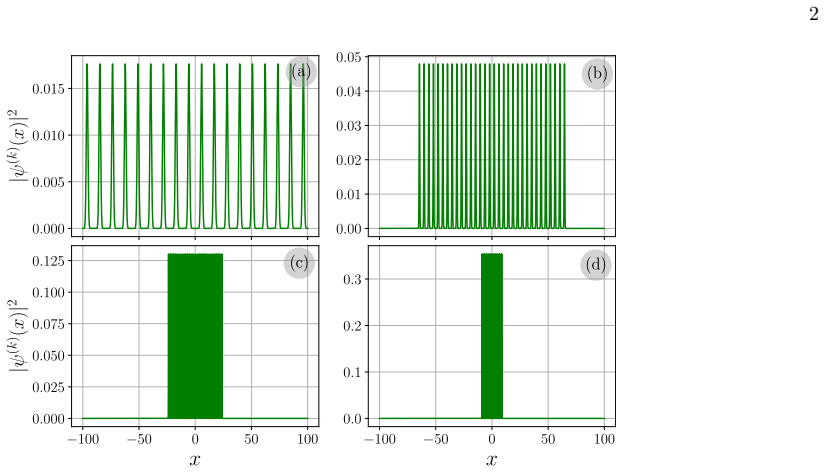
Prepare a squeezed vacuum with $r=2$, run the sequence with four interactions and $\tau=e^{-2}/2$, then measure the position distribution of the ion's motion after the fourth excited-state detection; if the profile shows appreciable curvature or residual interference fringes inside the predicted central plateau, the recursive product in Eq. (10) does not describe the actual state.
Extended reading notes
Core claim
The central discovery is that the product of measurement operators $\prod_{j=0}^{k}\cos[igt_j(a-a^\dagger)]$, with interaction times chosen as $gt_j=2^j\tau$, acts on a squeezed vacuum to produce a finite sum of displaced squeezed states: $|\psi^{(k)}\rangle_v = \frac{1}{\tilde N_k}\sum_{j=0}^{2^k-1} \left[|(2j+1)\tau,r\rangle + |-(2j+1)\tau,r\rangle\right]$. Because the components sit at equidistant real amplitudes with equal weights, their position-space Gaussians interfere constructively over a central window; for $k=4$ and $\tau=e^{-r}/2$ the interference fringes wash out and the probability profile becomes a quasi-rectangle. The paper presents this as a way to generate equal-probability position states by tuning only the initial squeezing and the interaction time.
Load-bearing premise
The recipe assumes each measurement of the excited electronic state is a perfect, lossless projection that multiplies the vibrational wavefunction by $\cos[igt(a-a^\dagger)]$ and leaves the ground-state branch completely out of the subsequent dynamics.
Editorial extensions
If this is right
- With four consecutive excited-state detections and $\tau=e^{-r}/2$, the motional position probability becomes nearly flat across a central window, making the scheme a concrete preparation recipe rather than an abstract construction.
- The width of the flat region is adjustable through the squeezing parameter $r$, and the oscillatory fringes seen for larger $\tau$ can be suppressed by choosing smaller scaled times.
- The same state displays a localized Husimi $Q$-function, so the flat position profile is accompanied by a clear signature in phase space that could be used to verify the preparation.
- Because the protocol relies only on the standard ion-laser interaction in the Lamb-Dicke regime and projective electronic-state measurements, it is directly compatible with existing trapped-ion experimental setups.
Reading between the lines
- An immediate extension would be to detect the ground state instead of the excited state; the cosine factors would become sine factors, and the same telescoping identity should yield a related superposition with different phases and possibly a complementary shape.
- The cosine-product identity is essentially a discrete summation over roots of unity, so the same flat-top synthesis could be applied to motion in two dimensions or to momentum-space shaping by choosing different quadrature operators.
- Imperfect detection efficiency is the natural failure mode: the recursion assumes the unobserved ground-state branch never re-enters, so the plateau should survive only when detection is both efficient and projective; measuring how the flatness degrades with detection efficiency would test the preparation's robustness.
- One could try to replace the squeezed vacuum by another initial state, such as a coherent state or number state, and ask which initial states make the same cosine-product summation converge to a flat position profile.
Signed reviews
Editorial analysis
A structured set of objections, weighed in public.
Referee Report
Summary. The paper proposes a scheme to generate quasi-rectangle states—motional states of a trapped ion with approximately equal position probability over a finite interval—by starting from a squeezed vacuum state and applying repeated ion-laser interactions followed by conditional measurements of the excited electronic state. The authors derive that after a sequence of such measurements the vibrational state becomes a superposition of equidistant squeezed states, and they plot the resulting position probability and Husimi Q-function for several squeezing parameters. The central claim is that tuning the squeezing parameter r and the scaled interaction time τ yields a highly localized, flat-topped position distribution.
Significance. If correct, the protocol offers a simple, constructive route to motional quantum state engineering with tailored position distributions, using only conditional measurements and standard trapped-ion tools. Notably, the two main control parameters, r and τ, are openly stated design choices rather than values fitted to a target outcome, and the derivation from Eq. (7) to Eq. (12) is analytic with an explicit normalization constant. The paper also provides Husimi Q-function plots as additional visualization. However, the significance is tempered by an indexing error in the number of measurement cycles, an operator inconsistency in the early derivation, and the absence of any quantitative measure of flatness for the claimed quasi-rectangle states.
major comments (3)
- [Section II, Eqs. (9)-(12) and Figs. 1-2] There is an off-by-one error in the labeling of the number of measurements. Equation (9) defines the state 'after k interactions' as a product over j=0..k of cos[igt_j(a-a†)], which contains k+1 factors. With gt_j=2^j τ, the product identity expands into 2^k terms, matching the upper limit 2^k-1 in Eq. (10). Hence the index k in Eq. (12) actually denotes k+1 measurement cycles. The captions of Figs. 1 and 2 state that the plotted states are obtained 'after k=4 consecutive measurements', but Eq. (12) with k=4 contains 16 squeezed-state components, which requires five laser-measurement cycles. A four-measurement protocol would produce only 8 components (Eq. (12) with k=3). Consequently, the plotted quasi-rectangle is twice as wide as the state that the stated four-measurement protocol would yield, and the central demonstration does not substantiate the claim. The authors should either change Eq. (9) to a product over j=0..k-1 or change Eq. (10) to an upper limit 2^{k-1}-1, and regenerate the figures for the correct number of measurements.
- [Section II, Eq. (5)] Equation (5) is inconsistent with Eq. (2). After setting φ=π/2, the evolution operator in Eq. (2) contains (a-a†). However, Eq. (5) writes the evolved state with (a+a†), which corresponds to φ=0. Since Eq. (7) and all subsequent conditional-measurement equations use (a-a†), the reader cannot tell whether the derivation is built on the correct operator. Please correct Eq. (5) or explain the transformation that changes the sign.
- [Section III and Figs. 1-2] The central claim that the generated state is a 'quasi-rectangle' is supported only by visual inspection of the plotted probability distributions. No quantitative criterion (e.g., a maximum relative deviation over a specified position interval) is given, so the reader cannot judge the quality of the rectangle approximation or compare the four values of r. Please provide a quantitative measure of flatness, or at least a table of the relevant deviations for the correct number of measurements.
minor comments (4)
- [Captions and Section III] There are several typos and grammatical issues: 'ploted' should be 'plotted' in the figure captions, 'squezing' should be 'squeezing' in Section III, and the sentence 'It may be seen that Although a reduction...' is grammatically broken and should be rewritten.
- [References] References [3] and [28] are the same citation (Wineland et al. 1992 Phys. Rev. A 46 R6797); one should be replaced or removed.
- [References] Reference [7] is missing page numbers; the full citation is Monroe et al., Science 272 (1996) 1131.
- [Section II, Eq. (14)] The normalization constant in Eq. (14) would be clearer if the double sum were explicitly written with limits, and the notation for the exponentials could be made less cramped to avoid ambiguity between (j+m+1)^2 τ^2 and (j-m)^2 τ^2.
Circularity Check
No circularity: the quasi-rectangle states are obtained from an explicit conditional-measurement construction with openly chosen parameters.
full rationale
The paper's derivation is constructive and does not disguise any input as a prediction. It starts from a standard ion-laser interaction Hamiltonian, Eq. (1), citing prior work [8,33] for the model; this is a physical input, not the paper's claimed output, and [33] is external to the present authors, so the Hamiltonian is not purely a self-citation. The protocol state after repeated conditional measurements is built by direct multiplication of cos[igt_j(a-a^†)] factors (Eqs. 7-10); the expansion into equidistant squeezed-state components is a mathematical identity, not an ansatz fitted to the target probability. The parameters r and tau are explicitly chosen design parameters ('we will fix later', 'by tuning the squeezing parameter') whose values (tau = e^{-r}/2, etc.) are selected to shape the position probability, not inferred from the plotted output. No term in the derivation is defined in terms of the quasi-rectangle shape it is claimed to generate, and no quantity that is called a prediction is obtained by renaming a fit. There is a possible indexing/counting concern in Eqs. 9-12 regarding whether 'k' denotes k measurements or k+1 factors, but that is an internal consistency issue, not circularity. Therefore no circular step is exhibited.
Assumptions & free parameters
free parameters (3)
- Squeezing parameter r =
0, 1, 2, 3 (figures)
- Scaled interaction time τ =
4e^{-r} (Fig. 1), e^{-r}/2 (Fig. 2)
- Number of measurements k =
4 in the figures
assumptions (5)
- domain assumption The ion-laser Hamiltonian (1), with two lasers detuned to the first lower and upper sidebands and equal intensities, is valid in the resolved-sideband and Lamb-Dicke regimes (RWA, η<<1).
- domain assumption Each conditional measurement of the excited electronic state leaves the motional state multiplied by cos[igt(a−a†)] and projects away the ground state without further motional disturbance.
- standard math Product-to-sum identity: ∏_{j} cosh(2^j x) expands into a superposition of displacements with odd-integer weights, giving Eq. (10) from Eq. (9).
- standard math Squeezed-state position wavefunction and overlap formulas (Eqs. 14 and 16) are taken as standard results from the literature.
- domain assumption Initial motional state is a squeezed vacuum |0,r> = S(r)|0>.
Cite this review
Pith. "Pith review of Generation of quasi-rectangle-states of the vibrational motion of an ion." pith.science (2026). https://pith.science/paper/KNYE3OA3
@misc{pith2026190805638,
  author       = {Pith},
  title        = {Pith review of: Generation of quasi-rectangle-states of the vibrational motion of an ion},
  year         = {2026},
  howpublished = {\url{https://pith.science/paper/KNYE3OA3}},
  note         = {Machine review of arXiv:1908.05638}
}
read the original abstract
We show how to generate quasi-rectangle-states of the vibrational motion of an ion, this is, states that have the same probability in a given position interval. We produce those states by repeated ion-laser interactions followed by conditional measurements that generate a superposition of squeezed states. The squeeze parameter of the initial state may be tuned in order to obtain such highly localized rectangle states.
Figures


Figures from the paper (1 more)

Reference graph
Works this paper leans on
-
[1]
Glauber R J 1963 Phys. Rev. 130 2529-39
work page 1963
-
[2]
Glauber R J 1963 Phys. Rev. 131 2766-88
work page 1963
-
[4]
Cirac J I and Zoller P 1995 Phys. Rev. Lett. 74, 4091
work page 1995
-
[5]
Jonathan D, Plenio M B and Knight P L 2000 Phys. Rev. A 62 042307
work page 2000
-
[6]
Meekhof D M, Monroe C, King B E, Itano W M and Wineland D J 1996 Phys. Rev. Lett. 76 1796
work page 1996
-
[7]
Monroe C, Meekhof D M, King B E and Wineland D J Science 1996 272
work page 1996
-
[8]
Moya-Cessa H, Wallentowitz S and Vogel W 1999 Physical Review A 59 2920-2925
work page 1999
-
[9]
Kis Z, Vogel W and Davidovich L 2001 Phys. Rev. A 64 033401
work page 2001
Show all 50 references
-
[10]
de Matos Filho R L and Vogel W 1996 Phys. Rev. Lett. 76 608
1996
-
[11]
de Matos Filho R L and Vogel W 1996 Phys. Rev. A 54 4560
1996
-
[12]
Moya-Cessa H and Tombesi P 2000 Phys. Rev. A 61 025401
2000
-
[13]
Wineland D J, Monroe C, Itano W M, Leibfried D, King B E and Meekhof D M 1998 J. Res. Nat. Inst. Stan. 103 259
1998
-
[14]
Blockley C A, Walls D F and Risken H 1992 Europhys. Lett. 17 509
1992
-
[15]
and the generation of nonclassical states, peculiar of such a model, or its multiphotonic generalizations [16–18]. It should be noted also that, via a similarity transformation that does not need of any approximations, the ion-laser interaction may be taken to a two-level atom...
1908 arXiv
-
[16]
Cirac J I, Blatt R, Parkins A S and Zoller P 1994 Phys. Rev. A 49 1202
1994
-
[17]
Cirac J I, Parkins A S, Blatt R and Zoller P 1996 Adv. Atom. Mol. Opt. Phys. 37 237
1996
-
[18]
Cirac J I, Blatt R, Parkins A S and Zoller P 1993 Phys. Rev. Lett. 70 762
1993
-
[19]
Blatt R, Cirac J I, Parkins A S and Zoller P 1995 Physica Scripta T59 294
1995
-
[20]
Moya-Cessa H, Jonathan D and Knight P L 2003 J. Mod. Opt. 50 265
2003
-
[21]
Moya-Cessa H, Soto-Eguibar F, Vargas-Martinez J M, Juarez-Amaro R and Z´ u˜ niga-Segundo A 2012 Phys. Rep. 513 229-261
2012
-
[22]
Moya-Cessa H M 2016 Sc. Rep. 6 38961
2016
-
[23]
Casanova J, Puebla R, Moya-Cessa H and Plenio M B 2018 npj Quant. Inf. 5 47
2018
-
[24]
Poyatos J F, Cirac J I, Blatt R and Zoller P 1996 Phys. Rev. A 54 1532
1996
-
[25]
IEEE 51 89
Jaynes E T and Cummings F W 1963 Proc. IEEE 51 89
1963
-
[26]
Shore B W and Knight P L 1993 J. of Mod. Opt. 40 1195
1993
-
[27]
Rodriguez-Lara B M, Moya-Cessa H and Klimov A B 2005 Phys. Rev. A 71 023811
2005
-
[28]
Rempe G, Walther H and Klein N 1987 Phys. Rev. Lett. 58, 353
1987
-
[29]
Wineland D J, Bollinger J J, Itano W M, Moore F L and Heinzen D J 1992 Phys. Rev. A 46 R6797
1992
-
[30]
Semiclass
Ar´ evalo-Aguilar L M and Moya-Cessa H 1998Quant. Semiclass. Opt 10 671-674
-
[31]
Hanoura S A, Ahmed M M A, Khalil E M and Obada A S F 2019 Fortschr. Phys. 67 1800101
2019
-
[32]
Sherman B and Kurizki G 1992 Phys. Rev. A 45 R7674
1992
-
[33]
Vogel K, Akulin V M and Schleich W P 1993 Phys. Rev. Lett. 71 1816
1993
-
[34]
Wallentowitz S and Vogel W 1995 Phys. Rev. Lett. 75 2932
1995
-
[35]
Wallentowitz S and Vogel W 1996 Phys. Rev. A 54 3322
1996
-
[36]
Loudon R and Knight P L 1987 J. Mod. Opt. 34 709-759
1987
-
[37]
Yuen H P 1976 Phys. Rev. A 13 2226-2243
1976
-
[38]
Caves C M 1981 Phys. Rev. D 23 1693-1708
1981
-
[39]
Fisher R A, Nieto M M and Snadberg V D 1984 Phys. Rev. D 29 1107-10
1984
-
[40]
Barnett, S.M. et al. 2017 Progr. Quant. Elec. 54 19–45
2017
-
[41]
Moya-Cessa H M and Vidiella-Barranco A 1992 J. of Mod. Opt. 39 2481
1992
-
[42]
Janszky J, Domokos P and Adam P 1993 Phys. Rev. A 48 2213
1993
-
[43]
Adam P, Fo¨ oldesi I and Janszky J 1994Phys. Rev. A 49 1281
-
[44]
Zheng S-B 1998 Phys. Rev. A 58 761
1998
-
[45]
Perez-Leija A, Keil R, Moya-Cessa H, Szameit A and Christodoulides D N 2013 Phys. Rev. A 87 022303
2013
-
[46]
Perez-Leija A, Hernandez-Herrejon J C, Moya-Cessa H, Szameit A and Christodoulides D N 2013 Phys. Rev. A 87 013842
2013
-
[47]
Wigner E P 1932 Phys. Rev. 40 749
1932
-
[48]
Husimi K 1940 Proc. Phys. Math. Soc. Jpn. 22 264-314
1940
-
[49]
Sudarshan E C G 1963 Phys. Rev. Lett. 10 277-279
1963
-
[50]
Leibfried D, Meekhof D M, King B E, Monroe C, Itano W M and Wineland D J 1996 Phys. Rev. Lett. 77 4281
1996
-
[51]
Bertet P, Auffeves A, Maioli P, Osnaghi S, Meunier T, Brune M, Raimond J M and Haroche S 2002 Phys. Rev. Lett. 89 200402
2002
Reviewed August 14, 2026 · model on record in the stance chip above.
Discussion (0). Continue with ORCID to comment.