REVIEW 2 major objections 5 minor 35 references
Implicit Differentiation for Measurement-Efficient Bilevel Quantum-Classical Optimization
T0 review · 2 major / 5 minor · reviewed 2026-08-11 · deepseek-v4-flash
Pith's one-line read Outer gradients for parametric quantum optimization can be read off measurements already taken during the inner solve, at essentially zero extra circuit cost.
desk verdict Clean theory, but the matched-budget experiments undercount SPSA's true cost, so the headline efficiency gains aren't yet established. read the letter →
The pith
A machine-rendered reading of the paper's core claim, the machinery that carries it, and where it could break.
The reading
What carries the argument
The load-bearing object is the envelope identity (Eq. 27), $dF(\lambda)/d\lambda = \partial J(\phi^*(\lambda),\lambda)/\partial\lambda$, which removes the need to differentiate the inner optimizer map. In this setting it is instantiated as correlator-reuse: the estimator $\hat{g}_{CR}(\lambda)=\sum_e w'_e(\lambda)\hat{p}_e$ (Eq. 30) reweights edge-cut probabilities $\hat{p}_e$ that are computed by classical post-processing from the same bitstrings as the energy estimate. This works because Max-Cut's commuting projectors mean one $Z$-basis measurement batch yields all correlators simultaneously. The remaining machinery is the distinction between VQE, where $\rho$ is $\lambda$-independent, and QAOA, where the cost unitary $e^{-i\gamma_\ell H_C(\lambda)}$ makes the state $\lambda$-dependent, so the full derivative includes $\sum_e w_e(\lambda)\partial_\lambda p_e$ (Eq. 33).
What would settle it
Take one parametric instance, solve the inner problem classically to obtain the true value function $F(\lambda)$, then run CR-ID and central finite differences with the inner solver deliberately stopped after 1, 5, 20, and 100 SPSA iterations; if the CR-ID gradient is not a descent direction or its advantage disappears at low iteration counts, the zero-cost claim fails in that non-stationary regime.
Extended reading notes
Core claim
The central claim is that for diagonal cost Hamiltonians of the form $H_C(\lambda)=\sum_e w_e(\lambda)\Pi_e$, the derivative of the value function $F(\lambda)=\max_\phi J(\phi,\lambda)$ at an inner optimum reduces, by the envelope theorem, to the partial derivative $\partial_\lambda J = \sum_e w'_e(\lambda) p_e(\phi^*)$. Since every $p_e$ is an edge-cut probability already estimated from the same $Z$-basis shots used to estimate the inner energy, the outer signal is available at essentially zero additional measurement cost. The paper then states the architecture-dependence result: for VQE, $\partial_\lambda \rho(\theta)=0$, so the reuse estimator is exactly unbiased; for QAOA, the cost unitary injects $\lambda$ into the state preparation, producing a state-dependence term that is zero-cost to ignore but biased, or extra-cost to estimate.
Load-bearing premise
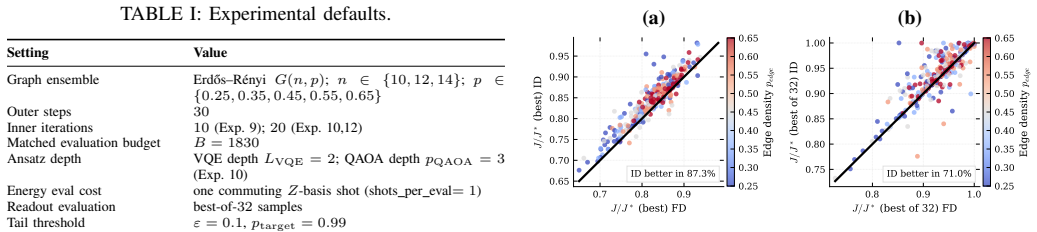
The load-bearing premise, acknowledged in the paper's limitations section, is that the inner variational solver has reached a stationary point so the envelope identity applies; the experiments allow only 20 single-shot SPSA iterations, so this is an approximation whose error is not characterized.
Editorial extensions
If this is right
- For any diagonal Hamiltonian with $\lambda$-dependent coefficients, an outer-loop gradient update costs only the inner solve at the current $\lambda$, removing the factor-of-$M$ probe overhead (e.g., $M=3$ for central finite differences) per outer step.
- Under matched evaluation budgets, the method reports consistent area-under-curve gains, about 4% in one-dimensional outer control and over 14% when the control is edge-wise and multi-dimensional, with trajectory curves reaching the plateau earlier.
- The reuse gradient is exact for VQE if the inner solver has reached stationarity; for QAOA, using only the explicit term is biased, and estimating the missing state-dependence term reintroduces measurement overhead—a cost–bias trade-off practitioners must choose between.
- Operationally, when solutions are read out by best-of-32 sampling, QAOA's tail quality narrows the expectation-level gap, but VQE retains a higher per-shot probability of drawing a solution within 10% of the optimum, which matters under limited readout budget.
Reading between the lines
- Editorial extension: for non-diagonal Hamiltonians whose Pauli terms fall into a few commuting groups, the same reuse argument should apply per group, so the zero-additional-cost property should survive with overhead equal to the number of measurement groups rather than the number of Hamiltonian terms.
- Editorial extension: a practical estimator for the QAOA state-dependence term could be built from parameter-shift-style shifts in $\lambda$ at the final variational angles, costing only a small constant number of additional inner-solve-equivalent circuits; the paper does not test such an estimator.
- Editorial extension: because the reuse signal only needs weight derivatives, a black-box user who can query $w_e(\lambda)$ classically can obtain a fully classical gradient of the weights and keep the quantum cost at zero, even when the response functions are not analytic.
- Editorial extension: the envelope identity suggests a quantitative diagnostic for when reuse-only gradients can be trusted: measure the residual inner-gradient norm $\|\nabla_\phi J(\phi,\lambda)\|$; if it is below a threshold, the bias from non-stationarity is expected to be small. The paper does not derive that threshold.
Editorial analysis
A structured set of objections, weighed in public.
Referee Report
Summary. The paper proposes a bilevel optimization framework for parametric diagonal cost Hamiltonians, where an outer loop tunes a continuous parameter λ and an inner VQA solve optimizes circuit parameters. The main methodological contribution is correlator-reuse implicit differentiation (CR-ID), which uses the envelope theorem to estimate outer gradients from edge-cut probabilities already measured during inner energy evaluation, avoiding extra circuit executions. The authors derive unbiased reuse gradients for VQE and identify a state-dependence bias term for QAOA. They report experimental comparisons against finite-difference value probing under a claimed matched evaluation budget, showing approximately 4% and over 14% improvements in 1D and multi-dimensional settings.
Significance. The theoretical core of the paper is a clean application of the envelope theorem to parametric VQAs, and the architecture-dependence result (VQE vs. QAOA) is a useful insight for practitioners. The presentation is generally clear, and the empirical study uses paired per-instance comparisons across multiple coefficient families and operational metrics. The method is falsifiable and the derivations in Eqs. (26)-(32) are transparent. However, the empirical claims rest on a budget accounting that appears internally inconsistent.
major comments (2)
- [VI-C] The matched evaluation budget in Section VI-C is defined as B=T(3I+1)=30·(3·20+1)=1830, which charges exactly one inner solve per outer step. This contradicts the FD baseline description in the same section, which requires M=3 inner solves per outer step (center and two perturbation evaluations). If an inner solve costs 3I+1=61 energy evaluations, the correct FD cost is T·3·(3I+1)=5490; if an inner solve costs I+1 evaluations, the correct FD cost is T·3·(I+1)=1890. With the reported B=1830, the FD baseline is credited with only about one-third of its true cost, so the AUC_B improvements in Tables II-IV and Figures 2-3 do not establish a matched-budget advantage. This is a load-bearing error because the headline efficiency claim depends directly on this accounting. Please rerun the experiments with a correctly matched budget (e.g., B=5490 for both methods, or with FD allowed only T/3 outer steps) and report the resulting metrics.
- [V-C, VIII-A] The envelope identity (Eq. 27) and the unbiasedness of the CR-ID estimator (Eq. 32) require the inner solver to reach a stationary point, ∇_φ J(φ*(λ), λ)=0. With I=20 SPSA iterations and a single shot per energy evaluation, the inner solution is almost certainly far from stationarity, so the CR-ID gradient is biased for VQE as well. The paper acknowledges this in the Limitations but does not characterize the magnitude of the bias or demonstrate robustness with respect to the inner budget. I ask for either a theoretical bound on the bias in terms of the inner optimality gap or a sensitivity study with increased inner iterations (e.g., I=50, 100, 200). Without this, the 'exact reuse gradient' claim in Section V-E is only an asymptotic statement and cannot be assessed against the finite-budget experiments.
minor comments (5)
- [VI-C] The parenthetical 'three objective evaluations per SPSA iteration plus one final evaluation per outer step' is confusing; please clarify the cost of an inner solve and reconcile it with Eq. (24).
- [V-A] Equation (24) defines C_outer ≈ M·N_inner, but the budget formula in Section VI-C appears to set M=1; please ensure the notation and cost model are consistent throughout.
- [Table II] Use consistent subscript notation 'AUC_B' rather than 'AU C_B' across tables and text.
- [References] Reference [32] is an abstract in the Bulletin of the American Physical Society; consider citing a full journal or arXiv version if one exists.
- [Acknowledgment] The disclosure that generative AI was used to create text, tables, graphs, code, and citations is unusual; please verify that it complies with the journal's policy on AI use and disclosure.
Circularity Check
No significant circularity: the CR-ID gradient estimator is a direct application of the envelope theorem and reuses measured correlators without fitting or self-referential input.
full rationale
The derivation is self-contained. Eq. (21) defines the inner objective as a weighted sum of edge-cut probabilities, Eq. (27) is the envelope identity obtained from the chain rule and the stationarity condition, and Eq. (28) is the corresponding partial derivative with respect to the outer parameter. Eq. (30) replaces the exact probabilities by their sample estimates, so Eq. (32) states unbiasedness by linearity of expectation. No parameter is fitted to make the identity hold, and no claimed prediction is constructed from the data it is tested against. The cited foundation [32] is work by Ahmed, Killoran, and Carrasquilla, not by the present authors, and the envelope theorem is attributed to Milgrom and Segal [14]. The only reference to work from the present group is a background example [7] on vehicle routing, which is not load-bearing. The acknowledged stationarity limitation and the possible budget-accounting inconsistency in Section VI-C are genuine correctness or fairness concerns, but they do not make the theoretical derivation circular: the validity of the CR-ID estimator does not depend on how the FD baseline's evaluation budget is computed.
Assumptions & free parameters
free parameters (4)
- Number of inner SPSA iterations I =
20 (10 for Experiment 9)
- SPSA perturbation/step-size hyperparameters =
not specified
- Finite-difference perturbation c_t =
not specified
- Tail threshold epsilon and target probability =
epsilon=0.1, p_target=0.99
assumptions (5)
- standard math Envelope theorem (Milgrom-Segal) applies to the value function F(lambda)=max_phi J(phi,lambda), requiring differentiability and inner stationarity.
- domain assumption The parametric Max-Cut Hamiltonian is diagonal in the computational basis, so all edge projectors commute and a single Z-basis measurement estimates all edge correlators p_e simultaneously.
- domain assumption For VQE with fixed circuit parameters, the quantum state does not depend on the outer parameter lambda.
- domain assumption Edge weight functions w_e(lambda) are differentiable and positive on the domain, and their derivatives dw_e/dlambda are available analytically or via classical finite differences.
- ad hoc to paper The inner VQA solver reaches (approximately) a stationary point of J(phi,lambda) within the allocated budget.
Cite this review
Pith. "Pith review of Implicit Differentiation for Measurement-Efficient Bilevel Quantum-Classical Optimization." pith.science (2026). https://pith.science/paper/KO6DA55Z
@misc{pith2026260807717,
  author       = {Pith},
  title        = {Pith review of: Implicit Differentiation for Measurement-Efficient Bilevel Quantum-Classical Optimization},
  year         = {2026},
  howpublished = {\url{https://pith.science/paper/KO6DA55Z}},
  note         = {Machine review of arXiv:2608.07717}
}
read the original abstract
Quantum optimization has shown promising results for quadratic unconstrained binary optimization (QUBO) problems. Real-world applications, however, often involve polynomial coefficients that depend on tunable external factors - such as demand forecasts or risk preferences - giving rise to bilevel optimization structures. We show how variational quantum algorithms (VQAs) can efficiently handle such parametric problems, making three contributions. First, we propose a bilevel optimization model for diagonal cost Hamiltonians where coefficients depend on a tunable outer parameter: an outer loop adjusts this parameter - reshaping the cost landscape - while an inner VQA optimizes circuit variables. Second, since derivative-free probing methods incur a multiplicative overhead when each outer evaluation requires a complete inner solve, we develop correlator-reuse implicit differentiation (CR-ID), which obtains outer gradients by reusing quantum measurements already collected during inner energy estimation, requiring essentially no additional circuit executions. Experiments across three coefficient families show that CR-ID consistently improves budget-normalized efficiency by ~4\% in 1D and over 14\% in multi-dimensional settings, showing a significant performance advantage compared to finite-difference methods. Third, we show that this property is architecture-dependent: VQE admits exact reuse gradients, whereas QAOA introduces a state-dependent term that creates a cost-bias trade-off.
Figures


Figures from the paper (1 more)

Reference graph
Works this paper leans on
-
[1]
A quantum approximate optimization algorithm,
E. Farhi, J. Goldstone, and S. Gutmann, “A quantum approximate optimization algorithm,”arXiv preprint arXiv:1411.4028, 2014
arXiv 2014
-
[2]
A variational eigenvalue solver on a photonic quantum processor,
A. Peruzzo, J. McClean, P. Shadbolt, M.-H. Yung, X.-Q. Zhou, P. J. Love, A. Aspuru-Guzik, and J. L. O’brien, “A variational eigenvalue solver on a photonic quantum processor,”Nature communications, vol. 5, no. 1, p. 4213, 2014
2014
-
[3]
Variational quantum algorithms,
M. Cerezo, A. Arrasmith, R. Babbush, S. C. Benjamin, S. Endo, K. Fujii, J. R. McClean, K. Mitarai, X. Yuan, L. Cincio, and P. J. Coles, “Variational quantum algorithms,”Nature Reviews Physics, vol. 3, no. 9, pp. 625–644, 2021
2021
-
[4]
Filtering variational quantum algorithms for combinatorial optimization,
D. Amaro, C. Modica, M. Rosenkranz, M. Fiorentini, M. Benedetti, and M. Lubasch, “Filtering variational quantum algorithms for combinatorial optimization,”Quantum Science and Technology, vol. 7, no. 1, p. 015021, 2022
work page 2022
-
[5]
A review on Quantum Approximate Optimization Algorithm and its variants,
K. Blekos, D. Brand, A. Ceschini, C.-H. Chou, R.-H. Li, K. Pandya, and A. Summer, “A review on Quantum Approximate Optimization Algorithm and its variants,”Physics Reports, vol. 1068, pp. 1–66, 2024
work page 2024
-
[6]
G. Buonaiuto, F. Gargiulo, G. De Pietro, M. Esposito, and M. Pota, “Best practices for portfolio optimization by quantum computing, ex- perimented on real quantum devices,”Scientific Reports, vol. 13, no. 1, p. 19434, 2023
work page 2023
-
[7]
A hybrid solution method for the capacitated vehicle routing problem using a quantum annealer,
S. Feld, C. Roch, T. Gabor, C. Seidel, F. Neukart, I. Galter, W. Mauerer, and C. Linnhoff-Popien, “A hybrid solution method for the capacitated vehicle routing problem using a quantum annealer,”Frontiers in ICT, vol. 6, p. 13, 2019
work page 2019
-
[8]
J.-C. Picard and M. Queyranne, “The time-dependent traveling salesman problem and its application to the tardiness problem in one-machine scheduling,”Operations research, vol. 26, no. 1, pp. 86–110, 1978
work page 1978
Show all 35 references
-
[9]
A review on bilevel optimization: From classical to evolutionary approaches and applications,
A. Sinha, P. Malo, and K. Deb, “A review on bilevel optimization: From classical to evolutionary approaches and applications,”IEEE transactions on evolutionary computation, vol. 22, no. 2, pp. 276–295, 2017
2017
-
[10]
Real-coded quantum optimization-based bi-level dispatching strategy of integrated power and heat systems,
B. Deng, Y . Teng, Q. Hui, T. Zhang, and X. Qian, “Real-coded quantum optimization-based bi-level dispatching strategy of integrated power and heat systems,”IEEE Access, vol. 8, pp. 47 888–47 899, 2020
2020
-
[11]
Bi-level multi-objective optimization scheduling for regional integrated energy systems based on quantum evolutionary algorithm,
W. Fan, Q. Liu, and M. Wang, “Bi-level multi-objective optimization scheduling for regional integrated energy systems based on quantum evolutionary algorithm,”Energies, vol. 14, no. 16, p. 4740, 2021
2021
-
[12]
A quantum-inspired bilevel optimization algorithm for the first responder network design problem,
A. Karahalios, S. Tayur, A. Tenneti, A. Pashapour, F. S. Salman, and B. Yıldız, “A quantum-inspired bilevel optimization algorithm for the first responder network design problem,”INFORMS Journal on Computing, vol. 37, no. 1, pp. 172–188, 2025
2025
-
[13]
Eval- uating analytic gradients on quantum hardware,
M. Schuld, V . Bergholm, C. Gogolin, J. Izaac, and N. Killoran, “Eval- uating analytic gradients on quantum hardware,”Physical Review A, vol. 99, no. 3, p. 032331, 2019
2019
-
[14]
Envelope theorems for arbitrary choice sets,
P. Milgrom and I. Segal, “Envelope theorems for arbitrary choice sets,” Econometrica, vol. 70, no. 2, pp. 583–601, 2002
2002
-
[15]
Reducibility among combinatorial problems,
R. M. Karp, “Reducibility among combinatorial problems,” inComplex- ity of Computer Computations, ser. The IBM Research Symposia Series, R. E. Miller, J. W. Thatcher, and J. D. Bohlinger, Eds. Boston, MA: Springer US, 1972, pp. 85–103
1972
-
[16]
Optimization, approximation, and complexity classes,
C. H. Papadimitriou and M. Yannakakis, “Optimization, approximation, and complexity classes,”Journal of Computer and System Sciences, vol. 43, pp. 425–440, 1991
1991
-
[17]
Some optimal inapproximability results,
J. H ˚astad, “Some optimal inapproximability results,”Journal of the ACM (JACM), vol. 48, no. 4, pp. 798–859, 2001
2001
-
[18]
Improved approximation algo- rithms for maximum cut and satisfiability problems using semidefinite programming,
M. X. Goemans and D. P. Williamson, “Improved approximation algo- rithms for maximum cut and satisfiability problems using semidefinite programming,”Journal of the ACM (JACM), vol. 42, no. 6, pp. 1115– 1145, 1995
1995
-
[19]
On the power of unique 2-prover 1-round games,
S. Khot, “On the power of unique 2-prover 1-round games,” inProceed- ings of the thiry-fourth annual ACM symposium on Theory of computing, 2002, pp. 767–775
2002
-
[20]
Ising formulations of many np problems,
A. Lucas, “Ising formulations of many np problems,”Frontiers in physics, vol. 2, p. 5, 2014
2014
-
[21]
In finding the correction for the open end of an organ- pipe,
J. Rayleigh, “In finding the correction for the open end of an organ- pipe,”Phil. Trans, vol. 161, no. 77, p. 1870, 1870
-
[22]
¨Uber eine neue Methode zur L ¨osung gewisser Variationsprob- leme der mathematischen Physik,
W. Ritz, “ ¨Uber eine neue Methode zur L ¨osung gewisser Variationsprob- leme der mathematischen Physik,”Journal f ¨ur die reine und angewandte Mathematik, vol. 135, pp. 1–61, 1908
1908
-
[23]
Multivariate stochastic approximation using a simultaneous perturbation gradient approximation,
J. C. Spall, “Multivariate stochastic approximation using a simultaneous perturbation gradient approximation,”IEEE transactions on automatic control, vol. 37, no. 3, pp. 332–341, 2002
2002
-
[24]
Barren plateaus in quantum neural network training landscapes,
J. R. McClean, S. Boixo, V . N. Smelyanskiy, R. Babbush, and H. Neven, “Barren plateaus in quantum neural network training landscapes,”Nature communications, vol. 9, no. 1, p. 4812, 2018
2018
-
[25]
Evolving objective function for improved variational quantum optimization,
I. Kolotouros and P. Wallden, “Evolving objective function for improved variational quantum optimization,”Physical Review Research, vol. 4, no. 2, p. 023225, 2022
2022
-
[26]
Optimizing millions of hyper- parameters by implicit differentiation,
J. Lorraine, P. Vicol, and D. Duvenaud, “Optimizing millions of hyper- parameters by implicit differentiation,” inInternational conference on artificial intelligence and statistics. PMLR, 2020, pp. 1540–1552
2020
-
[27]
Meta-learning with implicit gradients,
A. Rajeswaran, C. Finn, S. M. Kakade, and S. Levine, “Meta-learning with implicit gradients,”Advances in neural information processing systems, vol. 32, 2019
2019
-
[28]
Bilevel programming for hyperparameter optimization and meta-learning,
L. Franceschi, P. Frasconi, S. Salzo, R. Grazzi, and M. Pontil, “Bilevel programming for hyperparameter optimization and meta-learning,” in International conference on machine learning. PMLR, 2018, pp. 1568– 1577
2018
-
[29]
Quantum circuit learning,
K. Mitarai, M. Negoro, M. Kitagawa, and K. Fujii, “Quantum circuit learning,”Physical Review A, vol. 98, no. 3, p. 032309, 2018
2018
-
[30]
General parameter- shift rules for quantum gradients,
D. Wierichs, J. Izaac, C. Wang, and C. Y .-Y . Lin, “General parameter- shift rules for quantum gradients,”Quantum, vol. 6, p. 677, 2022
2022
-
[31]
Measuring analytic gradients of general quantum evolution with the stochastic parameter shift rule,
L. Banchi and G. E. Crooks, “Measuring analytic gradients of general quantum evolution with the stochastic parameter shift rule,”Quantum, vol. 5, p. 386, 2021
2021
-
[32]
Implicit differentiation of variational quantum algorithms,
S. Ahmed, N. Killoran, and J. Carrasquilla, “Implicit differentiation of variational quantum algorithms,”Bulletin of the American Physical Society, vol. 68, 2023
2023
-
[33]
On the evolution of random graphs,
P. Erd ˝os and A. R ´enyi, “On the evolution of random graphs,”Pub- lications of the Mathematical Institute of the Hungarian Academy of Sciences, vol. 5, no. 1, pp. 17–60, 1960
1960
-
[34]
Quantum approximate optimization algorithm: Performance, mechanism, and im- plementation on near-term devices,
L. Zhou, S.-T. Wang, S. Choi, H. Pichler, and M. D. Lukin, “Quantum approximate optimization algorithm: Performance, mechanism, and im- plementation on near-term devices,”Physical Review X, vol. 10, no. 2, p. 021067, 2020
2020
-
[35]
Multiobjective optimization and network routing with near-term quantum computers,
S.-H. Chiew, K. Poirier, R. Mishra, U. Bornheimer, E. Munro, S. H. Foon, C. W. Chen, W. S. Lim, and C. W. Nga, “Multiobjective optimization and network routing with near-term quantum computers,” IEEE Transactions on Quantum Engineering, vol. 5, pp. 1–19, 2024
2024
Reviewed August 11, 2026 · model on record in the stance chip above.
Discussion (0). Continue with ORCID to comment.