Evo-PI: Aligning Medical Reasoning via Evolving Principle-Guided Supervision
Pith reviewed 2026-07-01 05:33 UTC · model grok-4.3
The pith
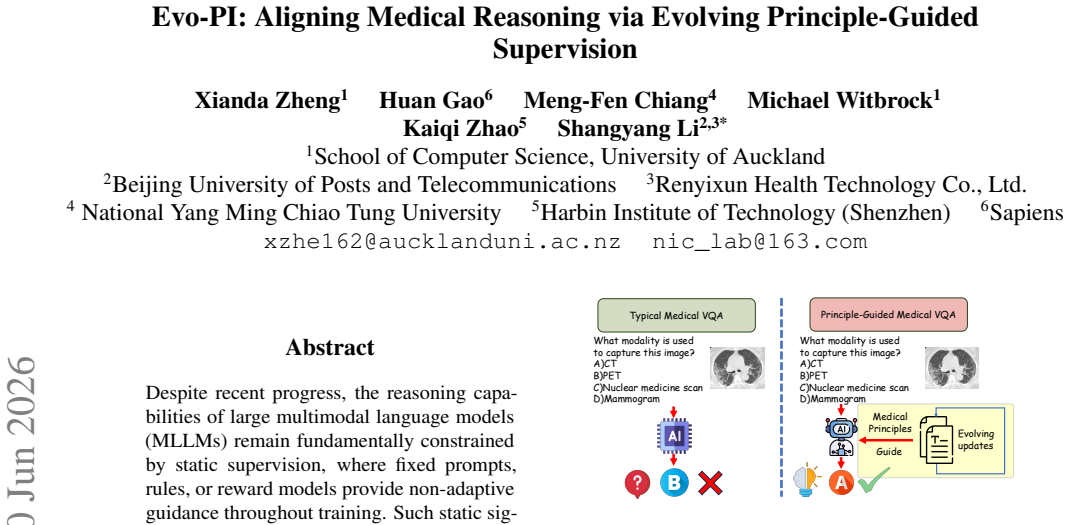
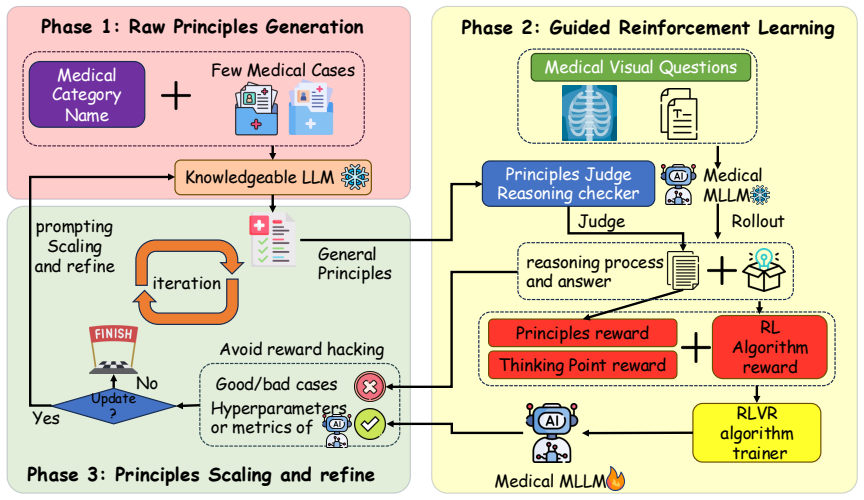
Evo-PI creates a loop where language principles supervise model reasoning and model outputs refine those principles to fix deficiencies dynamically.
A machine-rendered reading of the paper's core claim, the machinery that carries it, and where it could break.
Core claim
Evo-PI treats reasoning principles as explicit, language-based supervision that can be generated, evaluated, and iteratively evolved. Principles guide the model's reasoning process; the model's behavior in turn supplies the signal used to refine the principles. This co-evolutionary dynamic replaces static supervision with supervision that progressively targets observed reasoning deficiencies, producing accuracy gains of up to 24.6 percent on medical visual question answering tasks across multiple backbones.
What carries the argument
The co-evolutionary loop in which language principles direct reasoning while model outputs are used to rewrite and improve those same principles.
If this is right
- Supervision becomes adaptive to the specific deficiencies exhibited by the current model rather than remaining fixed throughout training.
- Accuracy on structured visual-textual medical reasoning tasks rises consistently across eight benchmarks and multiple model backbones.
- The same framework supplies a scalable route to expert-aligned reasoning without requiring hand-crafted reward models for every new task.
- Reasoning improvements transfer across different multimodal backbones when the principle evolution loop is applied.
Where Pith is reading between the lines
- The same loop structure could be applied to non-medical domains where reasoning deficiencies are hard to anticipate in advance.
- Because principles remain human-readable, the method may make it easier to audit and steer the alignment process than black-box reward models.
- Combining the evolutionary loop with other forms of feedback, such as human preference data, could further stabilize the refinement process.
- The approach may reduce the amount of task-specific human engineering needed when moving to new multimodal reasoning domains.
Load-bearing premise
Language principles can be generated and evolved automatically so that each iteration reliably corrects the model's reasoning errors without introducing new instability or bias.
What would settle it
If repeated runs of the evolutionary process on the same medical VQA benchmarks yield no accuracy improvement or produce lower scores than a fixed-principle baseline, the claim that the loop adapts supervision usefully would be falsified.
Figures
read the original abstract
Despite recent progress, the reasoning capabilities of large multimodal language models (MLLMs) remain fundamentally constrained by static supervision, where fixed prompts, rules, or reward models provide non-adaptive guidance throughout training. Such static signals are often sufficient to enforce output formats, but fail to shape the underlying reasoning process, leading to brittle generalization and performance saturation in complex decision-making tasks. We propose Evo-PI, a principle-centric learning framework that treats reasoning principles as explicit, language-based supervision signals that can be generated, evaluated, and iteratively evolved. Instead of relying on fixed rewards, Evo-PI enables a co-evolutionary loop in which principles guide model reasoning, while model behaviors in turn refine the principles that supervise them. This dynamic alignment mechanism allows supervision to progressively adapt to the model's reasoning deficiencies. We instantiate Evo-PI in medical visual question answering as a high-stakes testbed requiring structured visual-textual reasoning. Across eight benchmarks and multiple model backbones, Evo-PI consistently improves reasoning accuracy, achieving gains of up to 24.6%. Our results suggest that evolving principle-guided supervision offers a scalable and general paradigm for training expert-aligned reasoning in MLLMs. Code is available at https://github.com/zhengxianda/Evo_PI.
Editorial analysis
A structured set of objections, weighed in public.
Referee Report
Summary. The paper proposes Evo-PI, a principle-centric framework for MLLMs that treats reasoning principles as evolving, language-based supervision signals. It describes a co-evolutionary loop in which principles guide model reasoning while model outputs refine the principles, instantiated on medical VQA tasks, and reports accuracy gains of up to 24.6% across eight benchmarks and multiple backbones.
Significance. If the empirical results are shown to be robust, the work could provide a general mechanism for adaptive, non-static supervision that addresses limitations of fixed prompts or rewards in complex reasoning domains. The public code release supports reproducibility and is a clear strength.
major comments (2)
- [Abstract] Abstract: the central claim of consistent gains up to 24.6% is presented without any description of the baselines, control conditions, statistical tests, or potential confounds (e.g., compute budget, prompt length, or data leakage), rendering the support for the co-evolutionary mechanism unassessable.
- [Abstract / §3] Abstract / §3 (method description): the co-evolutionary loop is defined only at the level of high-level iteration between principles and model behaviors; no explicit evaluation criteria, update rules for principle evolution, convergence conditions, or bias/instability safeguards are provided, which are load-bearing for the claim that the loop reliably corrects reasoning deficiencies.
Simulated Author's Rebuttal
We thank the referee for the constructive feedback on the abstract and method description. The comments highlight areas where additional clarity will strengthen the presentation of our claims and the co-evolutionary mechanism. We address each point below and have revised the manuscript to incorporate more explicit details.
read point-by-point responses
-
Referee: [Abstract] Abstract: the central claim of consistent gains up to 24.6% is presented without any description of the baselines, control conditions, statistical tests, or potential confounds (e.g., compute budget, prompt length, or data leakage), rendering the support for the co-evolutionary mechanism unassessable.
Authors: We agree that the abstract would benefit from brief context on the experimental setup to make the reported gains more readily assessable. In the revised version, we have expanded the abstract to note that improvements are measured against standard prompting and fixed-principle supervision baselines, with consistent results across eight benchmarks and multiple MLLM backbones. Full details on baselines, statistical tests (paired t-tests, p < 0.05), compute-matched training, prompt-length controls, and held-out evaluation to address data leakage are provided in Sections 4 and 5; we have added a cross-reference sentence in the abstract. revision: yes
-
Referee: [Abstract / §3] Abstract / §3 (method description): the co-evolutionary loop is defined only at the level of high-level iteration between principles and model behaviors; no explicit evaluation criteria, update rules for principle evolution, convergence conditions, or bias/instability safeguards are provided, which are load-bearing for the claim that the loop reliably corrects reasoning deficiencies.
Authors: We acknowledge that the high-level description requires more explicit operational details. In the revised §3, we now specify: evaluation criteria (validation accuracy delta plus coherence score), update rules (LLM-based mutation, selection, and crossover of principles), convergence (improvement <1% over three iterations), and safeguards (diversity enforcement via embedding clustering and periodic stability checks). Algorithm 1 and accompanying pseudocode have been added to make the loop fully reproducible. revision: yes
Circularity Check
No circularity in Evo-PI co-evolutionary framework
full rationale
The provided abstract and description present Evo-PI as a methodological framework involving generation, evaluation, and iterative evolution of language-based principles in a co-evolutionary loop with model reasoning. No equations, derivations, fitted parameters renamed as predictions, self-citations, uniqueness theorems, or ansatzes are present that would reduce any claimed result to its inputs by construction. The reported accuracy gains on external medical VQA benchmarks are externally verifiable and do not rely on internal self-definition or load-bearing self-citation chains. The derivation chain is self-contained as an empirical method description.
Axiom & Free-Parameter Ledger
Reference graph
Works this paper leans on
-
[1]
Reinforcement learning with verifiable re- wards implicitly incentivizes correct reasoning in base llms.CoRR, abs/2506.14245. Jianyu Wu, Hao Yang, Xinhua Zeng, Guibing He, Zhiyu Chen, Zihui Li, Xiaochuan Zhang, Yangyang Ma, Run Fang, and Yang Liu. 2025. Pathvlm- r1: A reinforcement learning-driven reasoning model for pathology visual-language tasks.CoRR, ...
work page internal anchor Pith review Pith/arXiv arXiv 2025
-
[2]
DAPO: An Open-Source LLM Reinforcement Learning System at Scale
DAPO: an open-source LLM reinforcement learning system at scale.CoRR, abs/2503.14476. Chujie Zheng, Shixuan Liu, Mingze Li, Xiong-Hui Chen, Bowen Yu, Chang Gao, Kai Dang, Yuqiong Liu, Rui Men, An Yang, Jingren Zhou, and Jun- yang Lin. 2025. Group sequence policy optimization. CoRR, abs/2507.18071. Lianmin Zheng, Wei-Lin Chiang, Ying Sheng, Siyuan Zhuang, ...
work page internal anchor Pith review Pith/arXiv arXiv 2025
-
[3]
X-rays typically show high-contrast grayscale images
Recognize common imaging signatures. X-rays typically show high-contrast grayscale images. Bone appears white, air (such as in the lungs) appears dark, and soft tissue is various shades of gray. Look for clear bony landmarks like ribs, spine, and clavicles. 2.Identify typical anatomical projections. Chest X-rays are often captured in pos- teroanterior (PA...
-
[4]
**Recognize Imaging Signatures:** Understand the high-contrast nature of X-rays, where bones appear white, air is dark, and soft tissues are gray
-
[5]
**Understand Anatomical Projections:** Be familiar with common X-ray views like posteroanterior (PA) and anteroposterior (AP) to properly interpret anatomical structures
-
[6]
**Differentiate Imaging Modalities:** Identify X-rays by their grayscale images and lack of high-resolution soft tissue contrast
-
[7]
**Integrate Clinical Context:** Use X-rays in the context of clinical presenta- tion to assess conditions like pneumonia, pneumothorax, and heart failure
-
[8]
**Acknowledge Limitations:** Be aware that X-rays do not provide detailed cross-sectional or 3D images
-
[9]
**Employ Pattern Recognition:** Develop proficiency through practice and focus on identifying typical X-ray patterns
-
[10]
Principles for X-ray in iteration 3
**Enhance Diagnostic Accuracy:** Combine X-ray findings with clinical in- formation for a comprehensive evaluation. Principles for X-ray in iteration 3
-
[11]
**Recognize Imaging Patterns:** Identify distinctive grayscale patterns for bones, air spaces, and soft tissues in X-rays
-
[12]
**Understand Projections:** Be aware of common anatomical projections like PA and AP views for accurate image assessment
-
[13]
**Differentiate Modalities:** Distin- guish features of X-rays from those of MRI, CT, and ultrasound
-
[14]
**Contextualize Clinically:** Integrate clinical data to enhance X-ray interpreta- tion, aiding in diagnosis of conditions like pneumonia
-
[15]
**Acknowledge Limitations:** Rec- ognize the limitations of X-rays, such as limited soft tissue detail and no 3D rendering
-
[16]
**Apply Pattern Recognition:** De- velop the skill to efficiently recognize and interpret common X-ray findings
-
[17]
**Ensure Systematic Approach:** Adopt a systematic approach to evaluating X-rays to ensure comprehensive analysis
-
[18]
**Correlate with Findings:** Relate X- ray observations with clinical examination and laboratory results for a holistic view
-
[19]
**Prioritize Safety:** Maintain aware- ness of radiation exposure and ensure justified use of X-ray imaging
-
[20]
Question First output the thinking process in <think>B</think> and final choice (A, B, C, D ...) in <answer></answer> tags
**Stay Informed:** Keep updated with evolving X-ray technology and guidelines for best practices. A.8 Prompt for Generating Responses from Medical MLLMs For this section, we directly adopted the prompt provided on med-r1, thereby eliminating any sensi- tivity associated with the prompt. rollout prompt QUESTION_TEMPLATE = "Question First output the thinkin...
-
[21]
The scan shows a cross-sectional view of the neck, including the thyroid gland, which is a critical structure in the neck
-
[22]
The thyroid gland appears to be in its normal position, with no visible signs of enlargement or abnormal shape
-
[23]
There are no visible masses, calcifications, or other abnormalities that would suggest a pathological condition
-
[24]
The surrounding structures, such as the trachea and carotid arteries, appear to be in their normal anatomical positions
-
[25]
Based on the above observations, there does not appear to be any perceptible anomaly present in the image
The image does not show any signs of inflammation, infection, or other conditions that would typically be indicated by abnormal findings on a CT scan. Based on the above observations, there does not appear to be any perceptible anomaly present in the image. </think> <answer>A</answer> Sample of MI case Problem:What is the name of the tissue shown in the p...
-
[26]
Analyze the Image Content: - The image shows a clear, well-defined brain structure with no apparent distortions or irregularities. - The white matter and gray matter are distinguishable, and there are no signs of abnormal hyperintensities (bright areas) or hypointensities (dark areas) that would suggest pathology. - The ventricles and sulci (grooves) are ...
-
[27]
- The absence of any abnormal signals or changes in the brain’s structure in this image suggests that there are no immediate signs of pathology
Consider the Context and Medical Knowledge: - MRI scans are highly sensitive and specific for detecting abnormalities in the brain, including tumors, lesions, and structural anomalies. - The absence of any abnormal signals or changes in the brain’s structure in this image suggests that there are no immediate signs of pathology. - The clarity and detail of...
-
[28]
It’s difficult to determine if there is an abnormality based on this image
Evaluate the Options: - Option A: "It’s difficult to determine if there is an abnormality based on this image." This option suggests uncertainty, which is not supported by the clear and detailed nature of the image. - Option B: "There is a possibility of abnormality, but further tests are needed for confirmation." This option implies a need for additional...
-
[29]
- The high quality and clarity of the image further support the conclusion that there are no abnormalities present
Conclusion: - The MRI scan of the brain shows no signs of abnormality, as evidenced by the clear and detailed structure of the brain, the absence of any hyperintensities or hypointensities, and the normal appearance of the ventricles and sulci. - The high quality and clarity of the image further support the conclusion that there are no abnormalities present
-
[30]
- The options provided do not align with the clear and detailed nature of the image, which supports the conclusion that the scan is normal
Final Analysis: - The image does not show any signs of abnormality, and the clear and detailed structure of the brain suggests that the scan is normal. - The options provided do not align with the clear and detailed nature of the image, which supports the conclusion that the scan is normal
-
[31]
Therefore, the final decision is that the image is normal, and no further tests are needed for confirmation
Final Decision: - Based on the detailed analysis and the clear nature of the image, the correct answer is that there is no abnormality present, and the scan is normal. Therefore, the final decision is that the image is normal, and no further tests are needed for confirmation. </think> <answer>D</answer>
discussion (0)
Sign in with ORCID, Apple, or X to comment. Anyone can read and Pith papers without signing in.