REVIEW 2 major objections 4 minor 63 references
Discriminative Topic Mining via Category-Name Guided Text Embedding
T0 review · 2 major / 4 minor · reviewed 2026-08-14 · deepseek-v4-flash
Pith's one-line read CatE mines discriminative topics from category names alone: retrieved terms belong to and only belong to the provided category, and the same embeddings improve weakly supervised classification and lexical entailment direction.
desk verdict A genuinely new task framing with strong empirical topic-mining results, but the generative derivation is loose and the BLESS experiment leaves its supervision setup unstated. read the letter →
The pith
A machine-rendered reading of the paper's core claim, the machinery that carries it, and where it could break.
The reading
What carries the argument
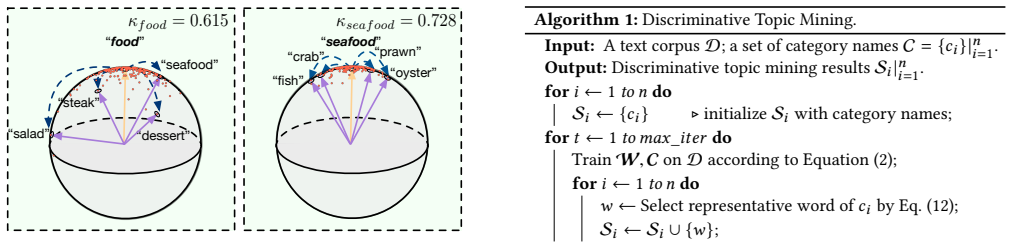
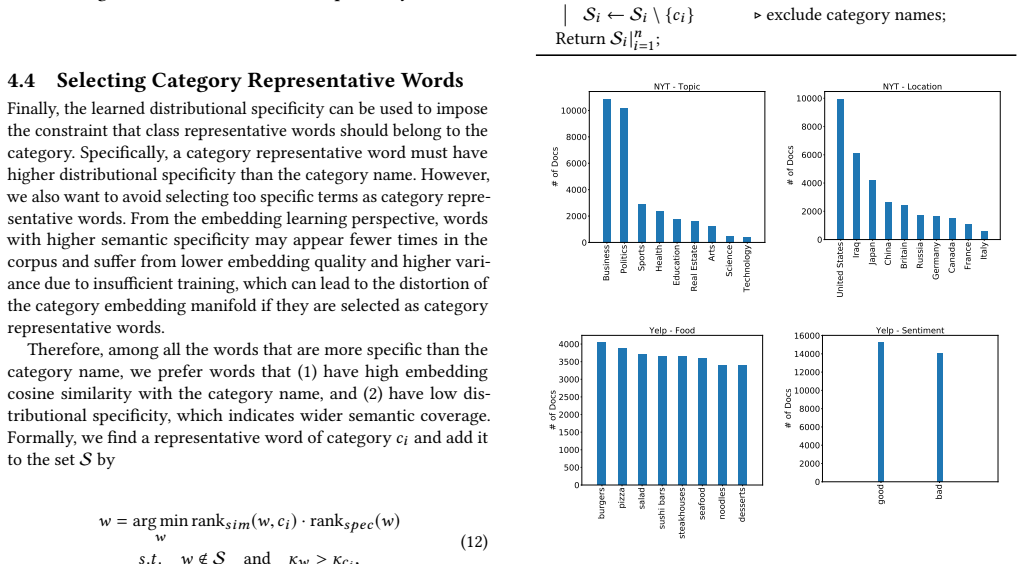
The central mechanism is a joint embedding space in which every word is represented by an input vector, a context vector, and a scalar specificity $\kappa_w$; all vectors are constrained to the unit sphere, and the distribution of contexts around a word is modeled as a von Mises-Fisher distribution with concentration $\kappa_w$. A high $\kappa_w$ means the word is semantically specific because it appears in few contexts. Category names are embedded as anchor vectors, and the training objective includes a KL-divergence term that pushes each selected representative word's category distribution toward a one-hot vector for its own category, alongside the usual local- and global-context objectives. Representative words are then chosen by ranking candidates by the product of cosine similarity to the category anchor and low specificity, while requiring $\kappa_w$ to exceed the category name's $\kappa$. The iterative loop, train then select then augment then retrain, is what turns a few category names into a separated embedding space.
What would settle it
On a held-out set of documents with known categories, compute the rewritten topic loss $-\sum_{c\in C}\sum_{w\in S_c} p(c\mid w) + \mathrm{const}$ and compare it with the original negative log-likelihood $-\log p(d\mid c_d)$ from Eq. (2); if the two differ by more than a constant across documents, the generative-model interpretation of CatE is not the implemented objective, and the empirical success rests on the heuristic self-training loop instead.
Extended reading notes
Core claim
The paper's central claim is that a short list of category names, with no labeled documents and no seed words beyond the names, is sufficient supervision for mining discriminative topics. CatE models text generation as conditioned on user categories, rewrites the topic term in the corpus likelihood as a sum over per-word category assignments, and implements it as an embedding model in which category embeddings act as anchors while each word carries a learned concentration parameter measuring how specific the word is. Representative words are selected by a rank product of similarity to the category anchor and specificity, subject to being more specific than the category name, then fed back into training to separate the categories further. The paper argues that the learned specificity encodes the distributional inclusion hypothesis: a specific term appears in a narrower set of contexts than its hypernym. The reported payoffs are mean accuracy (MACC) of 0.972 and 0.967 on NYT-Location and NYT-Topic, 0.913 and 1.000 on Yelp-Food and Yelp-Sentiment, improved weakly supervised classification over the compared unsupervised embeddings, and 0.895 accuracy on BLESS direction identification.
Load-bearing premise
The method relies on the assumption that a document's fit to a category can be computed purely from the product of its words' per-word category probabilities, and that the iterative self-selection of representative words keeps improving rather than amplifying its own errors.
Editorial extensions
If this is right
- Users can extract distinctive vocabularies from a corpus by typing category names, with no labeled documents and no need to choose the number of topics.
- Swapping the input embeddings of the WeSTClass weakly supervised classifier from unsupervised embeddings to CatE improves micro-F1 on the tested datasets, e.g., NYT-Location from 0.533 to 0.655.
- The learned specificity value acts as an unsupervised lexical-entailment direction signal, identifying the more specific word in BLESS hypernym-hyponym pairs at 0.895 accuracy.
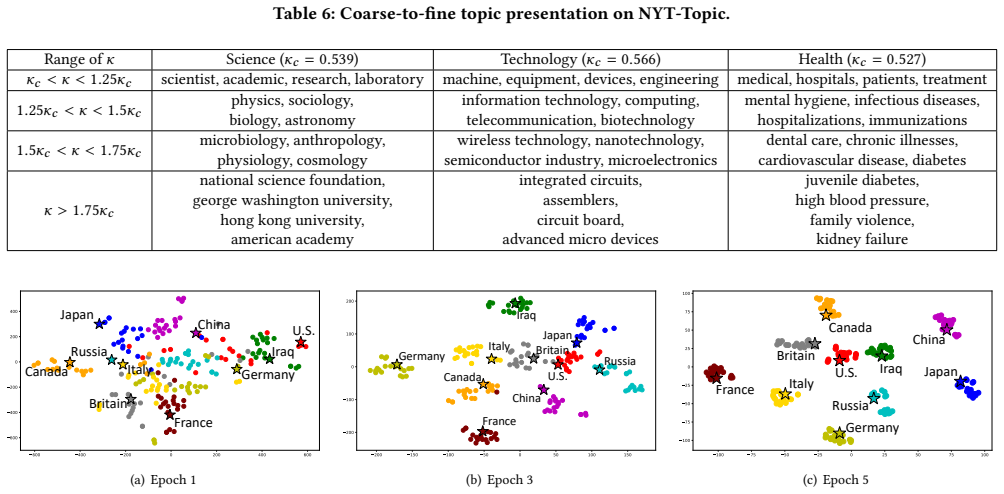
- Because retrieved terms must be more specific than the category name, topic results can be ordered coarse-to-fine by $\kappa$ rather than by an opaque topic-word probability.
- The method requires no document labels, making it applicable to new corpora where annotation is expensive and the user's only input is a list of categories of interest.
Reading between the lines
- A natural stress test is to run CatE with deliberately nested or overlapping category names, such as food and dessert or Europe and France; performance on the more specific category would show whether the anchor-plus-specificity selection truly enforces exclusive membership or merely separates well-chosen anchors.
- One could apply CatE recursively: once a category's representative terms are retrieved, feed the more specific terms as new category names to mine subcategories and build a taxonomy from corpus statistics alone.
- The specificity parameter $\kappa_w$ is a free by-product of training and could be used in other lexical-semantics tasks, such as definition ranking or technical-term extraction, where hypernym-like generality is useful and labeled data are scarce.
Signed reviews
Editorial analysis
A structured set of objections, weighed in public.
Referee Report
Summary. The paper proposes a new task, discriminative topic mining, in which the user supplies only a set of category names and the system retrieves terms that belong to and only belong to each category. The proposed method, CatE, jointly learns word, document, and category embeddings by combining a topic-level term, a global document-context term, and a local context term, while also learning a per-word distributional specificity scalar kappa. Category representative words are selected by ranking candidates by embedding similarity to the category name and by low-to-high kappa, and the procedure iteratively expands the representative sets. The paper evaluates CatE on NYT and Yelp benchmarks for topic mining, as an embedding input to WeSTClass for weakly supervised classification, and on BLESS for unsupervised lexical entailment direction identification. The reported results show large gains over baselines in topic mining (MACC up to 1.000), classification (e.g., Micro-F1 0.838 vs. 0.738 for fastText on Yelp-Sentiment), and LE direction (0.895 vs. 0.861 for SLQS). Source code is provided.
Significance. If the reported results hold, CatE is a practically useful method for weakly supervised text analysis: it turns minimal user guidance (category names only) into discriminative embeddings and topic lists, and it is shown to improve a downstream weakly supervised classifier across several domains. The paper's distributional specificity mechanism is a novel component with an independent validation in the BLESS direction-identification task, and the availability of source code is a concrete strength. The main significance is therefore empirical: CatE appears to be an effective recipe for category-name-guided topic mining. The theoretical framing, however, is considerably weaker than the empirical contribution, and the BLESS experiment lacks important reporting on what supervision was used; these issues need to be resolved before the central claims can be taken at face value.
major comments (2)
- [Section 3.2, Eq. (2) through Eq. (6)] placeholder
- [Section 5.4 and Algorithm 1] placeholder
minor comments (4)
- [Table 3] placeholder
- [Eq. (12)] placeholder
- [Section 5.3] placeholder
- [Section 3.2] placeholder
Circularity Check
No significant circularity: CatE's category names are external supervision, its objectives are not defined in terms of the evaluation labels, and the BLESS and MACC benchmarks are external to the training procedure.
full rationale
CatE's inputs are a text corpus and a set of category names, and its outputs are retrieved category-representative terms and learned embeddings. The retrieval criterion in Eq. (12) is based on embedding cosine similarity to category embeddings and on the learned distributional-specificity parameter kappa, while the category embeddings and kappa are optimized through the objectives in Eqs. (2), (6), (7), and (8). None of these objectives is defined in terms of the human MACC labels, the document classification labels, or the BLESS hypernymy labels used for evaluation. MACC is an external human judgment of whether retrieved terms semantically belong to the user-provided categories, which is the evaluation of the task definition rather than a training signal. BLESS is an external benchmark not used in training. The iterative expansion in Algorithm 1 is a self-training or bootstrapping procedure initialized from the externally provided category names, but it does not inject any test or evaluation labels into the loss, so the predictions are not statistically forced by the fit. The paper's Section 3.2 algebraic rewrite of L_topic is mathematically imprecise: the equality to -sum over categories and words of p(c|w) plus a constant does not follow as written from the preceding product decomposition, and the implemented L_topic in Eq. (6) is a KL-divergence regularization rather than a direct transcription of that derivation. Also, Section 5.4 reports the BLESS result without stating what category names, if any, were supplied to CatE, so the 0.895 accuracy may not clearly demonstrate the category-name-guided claim. These are correctness and reporting concerns, not circularity. The self-citations in the paper, such as [30], [31], [32], and [44], are used for design choices, downstream evaluation infrastructure, or preprocessing tools, and they are not the load-bearing justification for the central derivation or the empirical claims. Therefore, no significant circularity is present, and the score is 0.
Assumptions & free parameters
free parameters (3)
- kappa_w per-word specificity scalar =
learned, initialized to 1; category-name values around 0.527-0.566 in Table 6
- Embedding vectors for words, documents, and categories =
learned, dimension p=100
- Hyperparameters p=100, h=5, k=5, max_iter=10, negative samples =
p=100, h=5, k=5, max_iter=10
assumptions (5)
- ad hoc to paper p(d|cd) is proportional to the product over words in d of p(cd|w)
- domain assumption Each document belongs to exactly one user category
- domain assumption Distributional inclusion hypothesis: hyponyms occur in a subset of the contexts of their hypernyms
- standard math Continuous softmax over the unit sphere converges to the von Mises Fisher distribution
- domain assumption AutoPhrase phrase extraction is accurate and phrases can be treated as atomic words
invented entities (1)
-
kappa_w, distributional specificity scalar for each word
independent evidence
Cite this review
Pith. "Pith review of Discriminative Topic Mining via Category-Name Guided Text Embedding." pith.science (2026). https://pith.science/paper/KOY7NGBD
@misc{pith2026190807162,
  author       = {Pith},
  title        = {Pith review of: Discriminative Topic Mining via Category-Name Guided Text Embedding},
  year         = {2026},
  howpublished = {\url{https://pith.science/paper/KOY7NGBD}},
  note         = {Machine review of arXiv:1908.07162}
}
read the original abstract
Mining a set of meaningful and distinctive topics automatically from massive text corpora has broad applications. Existing topic models, however, typically work in a purely unsupervised way, which often generate topics that do not fit users' particular needs and yield suboptimal performance on downstream tasks. We propose a new task, discriminative topic mining, which leverages a set of user-provided category names to mine discriminative topics from text corpora. This new task not only helps a user understand clearly and distinctively the topics he/she is most interested in, but also benefits directly keyword-driven classification tasks. We develop CatE, a novel category-name guided text embedding method for discriminative topic mining, which effectively leverages minimal user guidance to learn a discriminative embedding space and discover category representative terms in an iterative manner. We conduct a comprehensive set of experiments to show that CatE mines high-quality set of topics guided by category names only, and benefits a variety of downstream applications including weakly-supervised classification and lexical entailment direction identification.
Figures
Reference graph
Works this paper leans on
-
[1]
David Andrzejewski and Xiaojin Zhu. 2009. Latent Dirichlet Allocation with Topic-in-Set Knowledge. In HLT-NAACL
work page 2009
-
[2]
Marco Baroni and Alessandro Lenci. 2011. How we BLESSed distributional semantic evaluation. In EMNLP
work page 2011
-
[3]
Kayhan Batmanghelich, Ardavan Saeedi, Karthik Narasimhan, and Sam Gersh- man. 2016. Nonparametric spherical topic modeling with word embeddings. In ACL. 537
work page 2016
-
[4]
David Blei and John Lafferty. 2006. Correlated topic models. In NIPS. 147
work page 2006
-
[5]
David M Blei and Jon D Mcauliffe. 2008. Supervised topic models. In NIPS. 121–128
work page 2008
-
[6]
David M. Blei, Andrew Y. Ng, and Michael I. Jordan. 2003. Latent Dirichlet Allocation. In NIPS
work page 2003
-
[7]
Piotr Bojanowski, Edouard Grave, Armand Joulin, and Tomas Mikolov. 2017. En- riching Word Vectors with Subword Information. Transactions of the Association for Computational Linguistics 5 (2017), 135–146
2017
-
[8]
Ming-Wei Chang, Lev-Arie Ratinov, Dan Roth, and Vivek Srikumar. 2008. Impor- tance of Semantic Representation: Dataless Classification. In AAAI
work page 2008
Show all 63 references
-
[9]
Chaitanya Chemudugunta, Padhraic Smyth, and Mark Steyvers. 2008. Combining concept hierarchies and statistical topic models. In CIKM. 1469–1470
2008
-
[10]
Rajarshi Das, Manzil Zaheer, and Chris Dyer. 2015. Gaussian lda for topic models with word embeddings. In ACL. 795–804
2015
-
[11]
Jacob Devlin, Ming-Wei Chang, Kenton Lee, and Kristina Toutanova. 2019. BERT: Pre-training of Deep Bidirectional Transformers for Language Understanding. In NAACL-HLT
2019
-
[12]
Shallue, Mohammad Norouzi, Andrew M
Bhuwan Dhingra, Christopher J. Shallue, Mohammad Norouzi, Andrew M. Dai, and George E. Dahl. 2018. Embedding Text in Hyperbolic Spaces. In TextGraphs@NAACL-HLT
2018
-
[13]
Dieng, Francisco J
Adji B. Dieng, Francisco J. R. Ruiz, and David M. Blei. 2019. Topic Modeling in Embedding Spaces. ArXiv abs/1907.04907 (2019)
2019 arXiv
-
[14]
Zhicheng Dou, Ruihua Song, and Ji-Rong Wen. 2007. A large-scale evaluation and analysis of personalized search strategies. In WWW
2007
-
[15]
Foster and Roland Kuhn
George F. Foster and Roland Kuhn. 2007. Mixture-Model Adaptation for SMT. In WMT@ACL
2007
-
[16]
Gallagher, Kyle Reing, David C
Ryan J. Gallagher, Kyle Reing, David C. Kale, and Greg Ver Steeg. 2017. Anchored Correlation Explanation: Topic Modeling with Minimal Domain Knowledge. TACL (2017)
2017
-
[17]
Octavian-Eugen Ganea, Gary Bécigneul, and Thomas Hofmann. 2018. Hyperbolic Entailment Cones for Learning Hierarchical Embeddings. In ICML
2018
-
[18]
Thomas L Griffiths, Michael I Jordan, Joshua B Tenenbaum, and David M Blei
-
[19]
Thomas Hofmann. 1999. Probabilistic Latent Semantic Indexing. In SIGIR
1999
-
[20]
Jiaxin Huang, Yiqing Xie, Yu Meng, Jiaming Shen, Yunyi Zhang, and Jiawei Han
-
[21]
Jagadeesh Jagarlamudi, Hal Daumé, and Raghavendra Udupa. 2012. Incorporating Lexical Priors into Topic Models. In EACL
2012
-
[22]
Yoon Kim. 2014. Convolutional Neural Networks for Sentence Classification. In EMNLP
2014
-
[23]
Simon Lacoste-Julien, Fei Sha, and Michael I Jordan. 2009. DiscLDA: Discrimina- tive learning for dimensionality reduction and classification. In NIPS. 897–904
2009
-
[24]
Jey Han Lau, David Newman, and Timothy Baldwin. 2014. Machine Reading Tea Leaves: Automatically Evaluating Topic Coherence and Topic Model Quality. In EACL
2014
-
[25]
Wei Li and Andrew McCallum. 2006. Pachinko allocation: DAG-structured mixture models of topic correlations. In ICML. 577–584
2006
-
[26]
Yang Liu, Zhiyuan Liu, Tat-Seng Chua, and Maosong Sun. 2015. Topical Word Embeddings. In AAAI
2015
-
[27]
Laurens van der Maaten and Geoffrey Hinton. 2008. Visualizing data using t-SNE. Journal of machine learning research 9, Nov (2008), 2579–2605
2008
-
[28]
Xian-Ling Mao, Zhao-Yan Ming, Tat-Seng Chua, Si Li, Hongfei Yan, and Xiaoming Li. 2012. SSHLDA: a semi-supervised hierarchical topic model. In EMNLP. 800– 809
2012
-
[29]
Qiaozhu Mei, Xuehua Shen, and ChengXiang Zhai. 2007. Automatic labeling of multinomial topic models. In KDD
2007
-
[30]
Yu Meng, Jiaxin Huang, Guangyuan Wang, Chao Zhang, Honglei Zhuang, Lance Kaplan, and Jiawei Han. 2019. Spherical Text Embedding. In NeurIPS
2019
-
[31]
Yu Meng, Jiaming Shen, Chao Zhang, and Jiawei Han. 2018. Weakly-Supervised Neural Text Classification. In CIKM
2018
-
[32]
Yu Meng, Jiaming Shen, Chao Zhang, and Jiawei Han. 2019. Weakly-Supervised Hierarchical Text Classification. In AAAI
2019
-
[33]
Corrado, and Jeffrey Dean
Tomas Mikolov, Ilya Sutskever, Kai Chen, Gregory S. Corrado, and Jeffrey Dean
-
[34]
Dat Quoc Nguyen, Richard Billingsley, Lan Du, and Mark Johnson. 2015. Im- proving topic models with latent feature word representations. TACL 3 (2015), 299–313
2015
-
[35]
Kim Anh Nguyen, Maximilian Köper, Sabine Schulte im Walde, and Ngoc Thang Vu. 2017. Hierarchical Embeddings for Hypernymy Detection and Directionality. In EMNLP
2017
-
[36]
Maximilian Nickel and Douwe Kiela. 2017. Poincaré Embeddings for Learning Hierarchical Representations. In NIPS
2017
-
[37]
Maximilian Nickel and Douwe Kiela. 2018. Learning Continuous Hierarchies in the Lorentz Model of Hyperbolic Geometry. In ICML
2018
-
[38]
Jeffrey Pennington, Richard Socher, and Christopher D. Manning. 2014. Glove: Global Vectors for Word Representation. InEMNLP
2014
-
[39]
Daniel Ramage, David Hall, Ramesh Nallapati, and Christopher D Manning. 2009. Labeled LDA: A supervised topic model for credit attribution in multi-labeled corpora. In EMNLP. 248–256
2009
-
[40]
Michal Rosen-Zvi, Thomas Griffiths, Mark Steyvers, and Padhraic Smyth. 2004. The author-topic model for authors and documents. In UAI. 487–494
2004
-
[41]
Timothy N Rubin, America Chambers, Padhraic Smyth, and Mark Steyvers. 2012. Statistical topic models for multi-label document classification. Machine learning 88, 1-2 (2012), 157–208
2012
-
[42]
Evan Sandhaus. 2008. The New York Times Annotated Corpus
2008
-
[43]
Enrico Santus, Alessandro Lenci, Qin Lu, and Sabine Schulte im Walde. 2014. Chasing Hypernyms in Vector Spaces with Entropy. In EACL
2014
-
[44]
Voss, and Jiawei Han
Jingbo Shang, Jialu Liu, Meng Jiang, Xiang Ren, Clare R. Voss, and Jiawei Han
-
[45]
Yangqiu Song and Dan Roth. 2014. On Dataless Hierarchical Text Classification. In AAAI
2014
-
[46]
Jian Tang, Meng Qu, and Qiaozhu Mei. 2015. PTE: Predictive Text Embedding through Large-scale Heterogeneous Text Networks. In KDD
2015
-
[47]
Alexandru Tifrea, Gary Bécigneul, and Octavian-Eugen Ganea. 2019. Poincaré Glove: Hyperbolic Word Embeddings. In ICLR
2019
-
[48]
Gomez, Lukasz Kaiser, and Illia Polosukhin
Ashish Vaswani, Noam Shazeer, Niki Parmar, Jakob Uszkoreit, Llion Jones, Aidan N. Gomez, Lukasz Kaiser, and Illia Polosukhin. 2017. Attention Is All You Need. In NIPS
2017
-
[49]
Ivan Vulic, Daniela Gerz, Douwe Kiela, Felix Hill, and Anna Korhonen. 2017. HyperLex: A Large-Scale Evaluation of Graded Lexical Entailment.Computational Linguistics (2017)
2017
-
[50]
Guoyin Wang, Chunyuan Li, Wenlin Wang, Yizhe Zhang, Dinghan Shen, Xinyuan Zhang, Ricardo Henao, and Lawrence Carin. 2018. Joint Embedding of Words and Labels for Text Classification. In ACL
2018
-
[51]
Weir, and Diana McCarthy
Julie Weeds, David J. Weir, and Diana McCarthy. 2004. Characterising Measures of Lexical Distributional Similarity. In COLING
2004
-
[52]
Bruce Croft
Xing Wei and W. Bruce Croft. 2006. LDA-based document models for ad-hoc retrieval. In SIGIR
2006
-
[53]
Hongteng Xu, Wenlin Wang, Wei Liu, and Lawrence Carin. 2018. Distilled wasserstein learning for word embedding and topic modeling. In NIPS. 1716– 1725
2018
-
[54]
Guangxu Xun, Vishrawas Gopalakrishnan, Fenglong Ma, Yaliang Li, Jing Gao, and Aidong Zhang. 2016. Topic discovery for short texts using word embeddings. In ICDM. 1299–1304
2016
-
[55]
Guangxu Xun, Yaliang Li, Jing Gao, and Aidong Zhang. 2017. Collaboratively Improving Topic Discovery and Word Embeddings by Coordinating Global and Local Contexts. In KDD
2017
-
[56]
Smola, and Ed- uard H
Zichao Yang, Diyi Yang, Chris Dyer, Xiaodong He, Alexander J. Smola, and Ed- uard H. Hovy. 2016. Hierarchical Attention Networks for Document Classification. In HLT-NAACL
2016
-
[57]
Sadler, Michelle T
Chao Zhang, Fangbo Tao, Xiusi Chen, Jiaming Shen, Meng Jiang, Brian M. Sadler, Michelle T. Vanni, and Jiawei Han. 2018. TaxoGen: Constructing Topical Concept Taxonomy by Adaptive Term Embedding and Clustering. In KDD
2018
-
[58]
Yu Zhang, Frank F Xu, Sha Li, Yu Meng, Xuan Wang, Qi Li, and Jiawei Han. 2019. HiGitClass: Keyword-Driven Hierarchical Classification of GitHub Repositories. In ICDM
2019
-
[59]
Maayan Zhitomirsky-Geffet and Ido Dagan. 2005. The Distributional Inclusion Hypotheses and Lexical Entailment. In ACL
2005
-
[2004]
Hierarchical topic models and the nested Chinese restaurant process. In NIPS. 17–24
-
[2013]
Distributed Representations of Words and Phrases and their Composition- ality. In NIPS
-
[2018]
IEEE Transactions on Knowledge and Data Engineering 30 (2018), 1825–1837
Automated Phrase Mining from Massive Text Corpora. IEEE Transactions on Knowledge and Data Engineering 30 (2018), 1825–1837
2018
-
[2020]
Guiding Corpus-based Set Expansion by Auxiliary Sets Generation and Co-Expansion. In WWW
Reviewed August 14, 2026 · model on record in the stance chip above.
Discussion (0). Continue with ORCID to comment.